engine VOLVO S60 2008 Repair Manual
[x] Cancel search | Manufacturer: VOLVO, Model Year: 2008, Model line: S60, Model: VOLVO S60 2008Pages: 230, PDF Size: 5.33 MB
Page 174 of 230
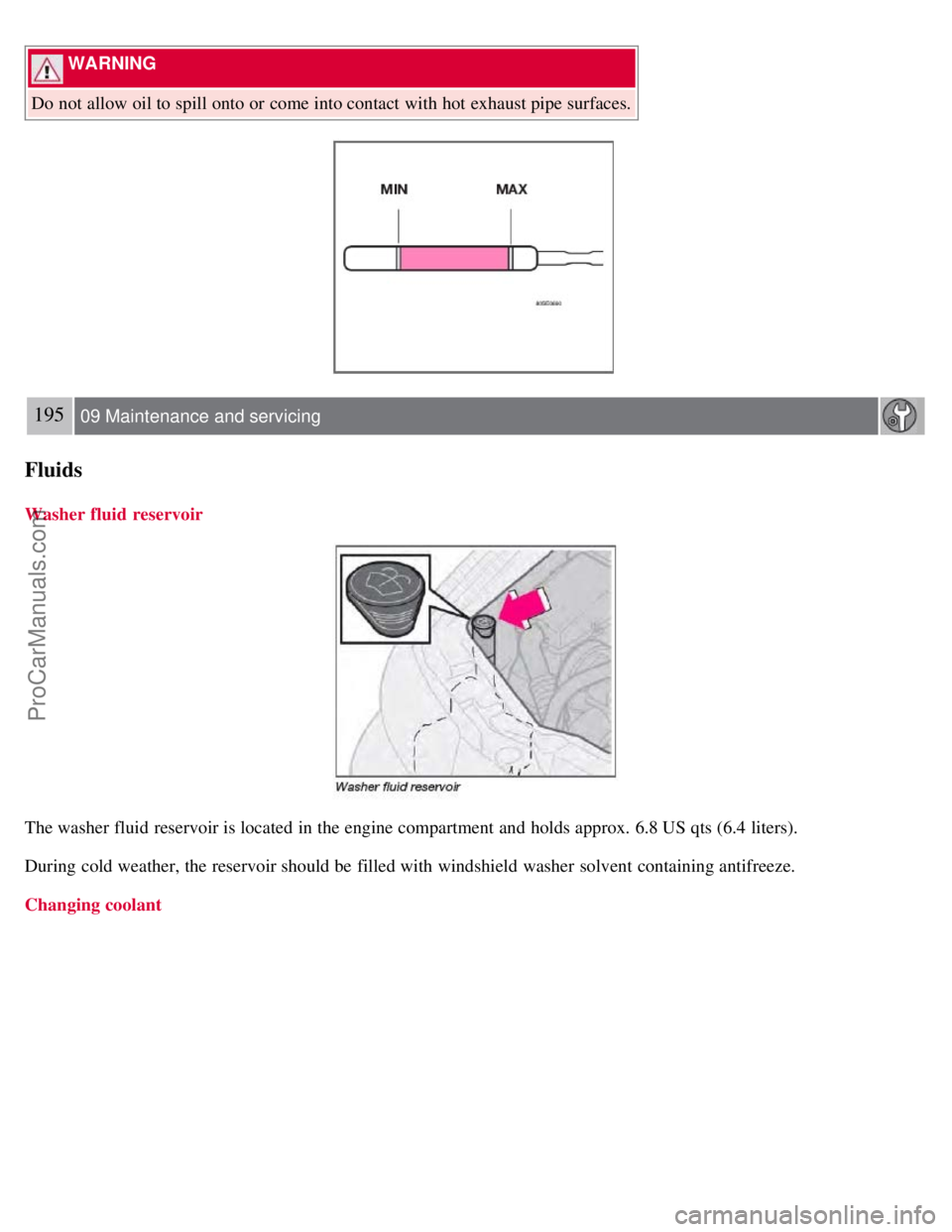
WARNING
Do not allow oil to spill onto or come into contact with hot exhaust pipe surfaces.
195 09 Maintenance and servicing
Fluids
Washer fluid reservoir
The washer fluid reservoir is located in the engine compartment and holds approx. 6.8 US qts (6.4 liters).
During cold weather, the reservoir should be filled with windshield washer solvent containing antifreeze.
Changing coolant
ProCarManuals.com
Page 175 of 230
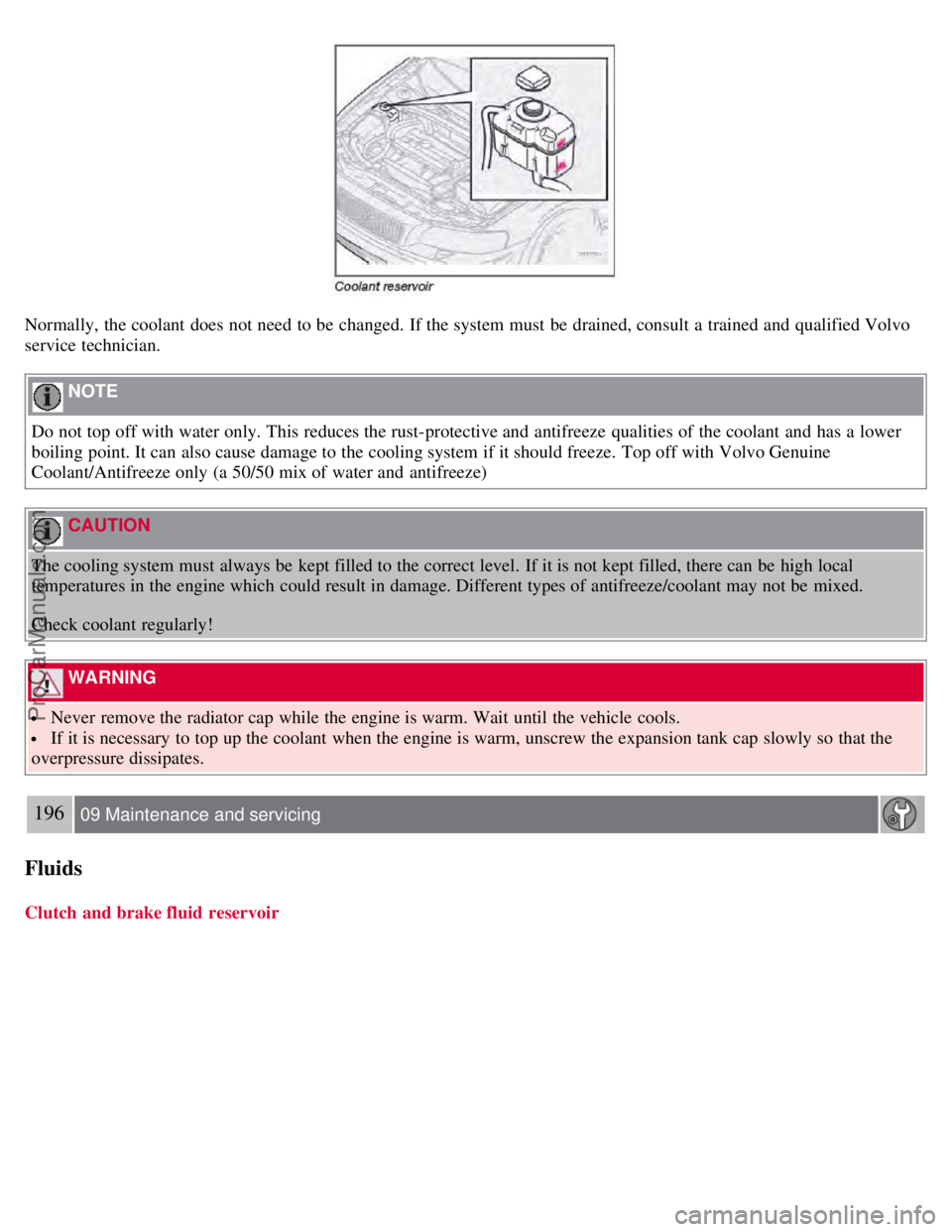
Normally, the coolant does not need to be changed. If the system must be drained, consult a trained and qualified Volvo
service technician.
NOTE
Do not top off with water only. This reduces the rust-protective and antifreeze qualities of the coolant and has a lower
boiling point. It can also cause damage to the cooling system if it should freeze. Top off with Volvo Genuine
Coolant/Antifreeze only (a 50/50 mix of water and antifreeze)
CAUTION
The cooling system must always be kept filled to the correct level. If it is not kept filled, there can be high local
temperatures in the engine which could result in damage. Different types of antifreeze/coolant may not be mixed.
Check coolant regularly!
WARNING
Never remove the radiator cap while the engine is warm. Wait until the vehicle cools.
If it is necessary to top up the coolant when the engine is warm, unscrew the expansion tank cap slowly so that the
overpressure dissipates.
196 09 Maintenance and servicing
Fluids
Clutch and brake fluid reservoir
ProCarManuals.com
Page 178 of 230
The battery in your vehicle is located under the floor of the trunk.
Driving habits and conditions, climate, the number of starts, etc. all affect the service life and function of the battery. In
order for your battery to perform satisfactorily, keep the following in mind:
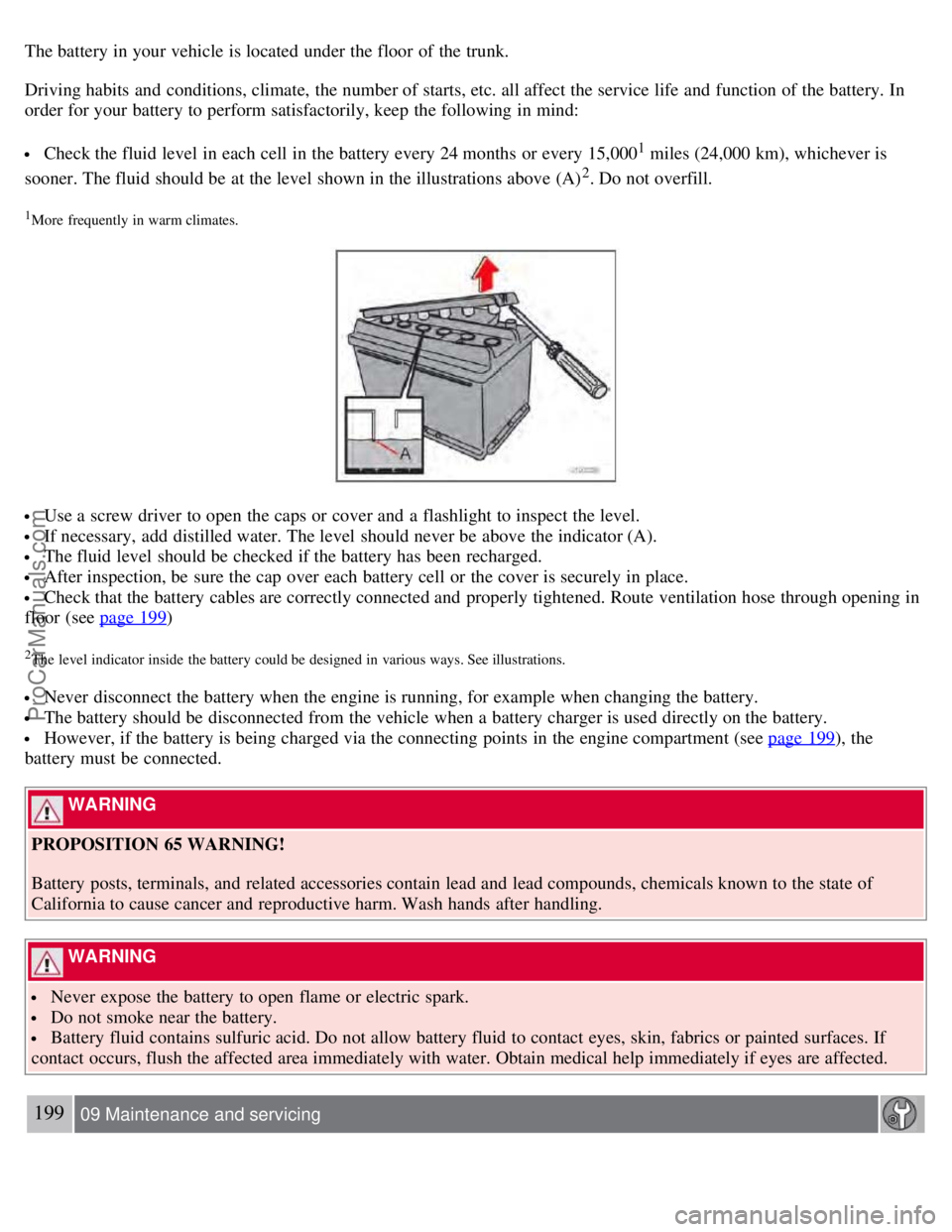
Check the fluid level in each cell in the battery every 24 months or every 15,0001 miles (24,000 km), whichever is
sooner. The fluid should be at the level shown in the illustrations above (A)
2. Do not overfill.
1More frequently in warm climates.
Use a screw driver to open the caps or cover and a flashlight to inspect the level.
If necessary, add distilled water. The level should never be above the indicator (A).
The fluid level should be checked if the battery has been recharged.
After inspection, be sure the cap over each battery cell or the cover is securely in place.
Check that the battery cables are correctly connected and properly tightened. Route ventilation hose through opening in
floor (see page 199
)
2The level indicator inside the battery could be designed in various ways. See illustrations.
Never disconnect the battery when the engine is running, for example when changing the battery.
The battery should be disconnected from the vehicle when a battery charger is used directly on the battery.
However, if the battery is being charged via the connecting points in the engine compartment (see page 199), the
battery must be connected.
WARNING
PROPOSITION 65 WARNING!
Battery posts, terminals, and related accessories contain lead and lead compounds, chemicals known to the state of
California to cause cancer and reproductive harm. Wash hands after handling.
WARNING
Never expose the battery to open flame or electric spark.
Do not smoke near the battery.
Battery fluid contains sulfuric acid. Do not allow battery fluid to contact eyes, skin, fabrics or painted surfaces. If
contact occurs, flush the affected area immediately with water. Obtain medical help immediately if eyes are affected.
199 09 Maintenance and servicing
ProCarManuals.com
Page 181 of 230
Never touch the glass of bulbs with your fingers. Grease and oils from your fingers vaporize in the heat and will leave
a deposit on the reflector, which will damage it.
The optional Active Bi -Xenon® headlight bulbs contain trace amounts of mercury. These bulbs should always be
disposed of by an authorized Volvo retailer.
The following bulbs should only be replaced by an authorized Volvo service technician:
- Active Bi -Xenon® headlights,
- Courtesy (dome) lighting,
- Reading lights,
- Glove compartment lights
- Turn signals and courtesy lights in the side door mirrors
- High-mounted brake lights
- Diodes in the rear tail lights
Replacing bulbs at the front of the vehicle
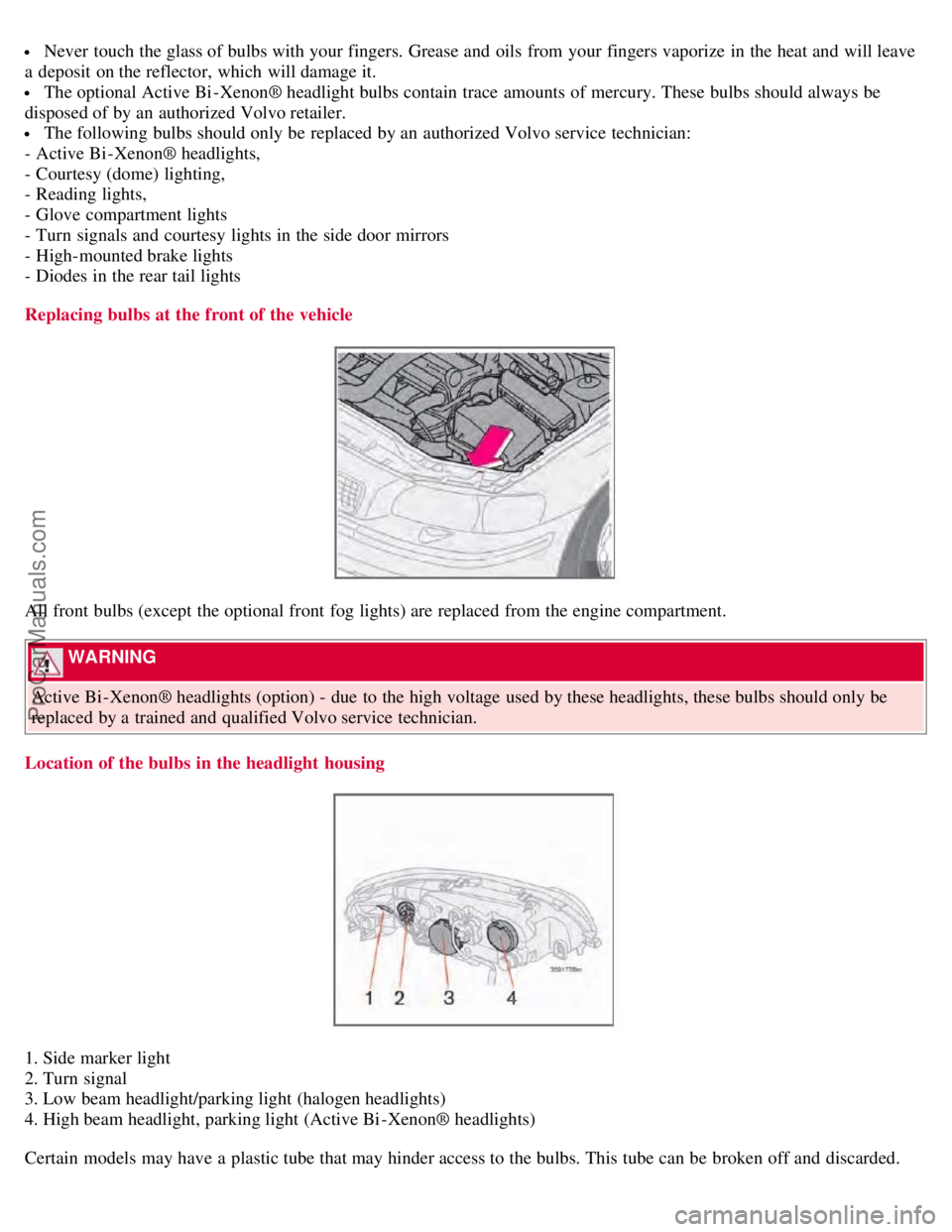
All front bulbs (except the optional front fog lights) are replaced from the engine compartment.
WARNING
Active Bi -Xenon® headlights (option) - due to the high voltage used by these headlights, these bulbs should only be
replaced by a trained and qualified Volvo service technician.
Location of the bulbs in the headlight housing
1. Side marker light
2. Turn signal
3. Low beam headlight/parking light (halogen headlights)
4. High beam headlight, parking light (Active Bi -Xenon® headlights)
Certain models may have a plastic tube that may hinder access to the bulbs. This tube can be broken off and discarded.
ProCarManuals.com
Page 190 of 230
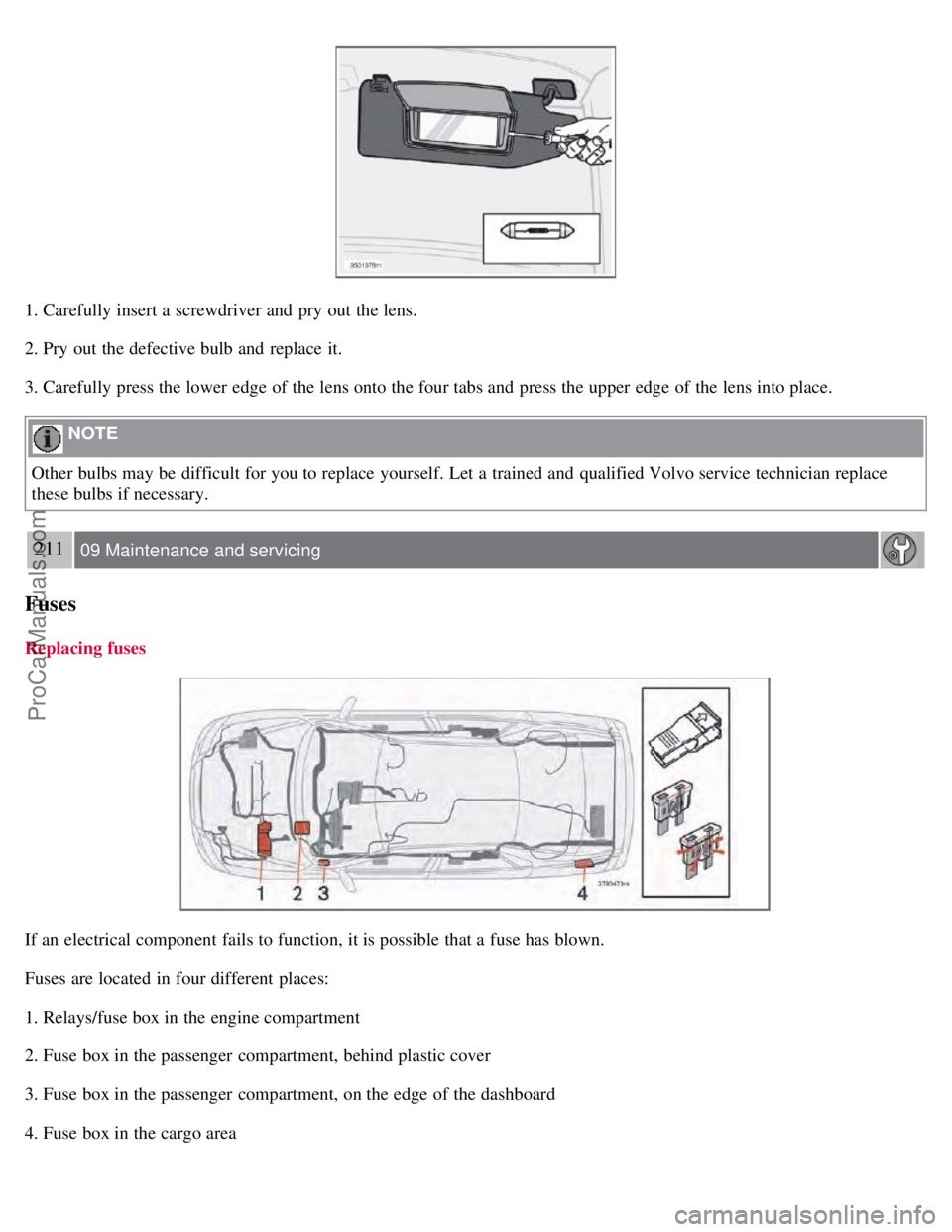
1. Carefully insert a screwdriver and pry out the lens.
2. Pry out the defective bulb and replace it.
3. Carefully press the lower edge of the lens onto the four tabs and press the upper edge of the lens into place.
NOTE
Other bulbs may be difficult for you to replace yourself. Let a trained and qualified Volvo service technician replace
these bulbs if necessary.
211 09 Maintenance and servicing
Fuses
Replacing fuses
If an electrical component fails to function, it is possible that a fuse has blown.
Fuses are located in four different places:
1. Relays/fuse box in the engine compartment
2. Fuse box in the passenger compartment, behind plastic cover
3. Fuse box in the passenger compartment, on the edge of the dashboard
4. Fuse box in the cargo area
ProCarManuals.com
Page 191 of 230
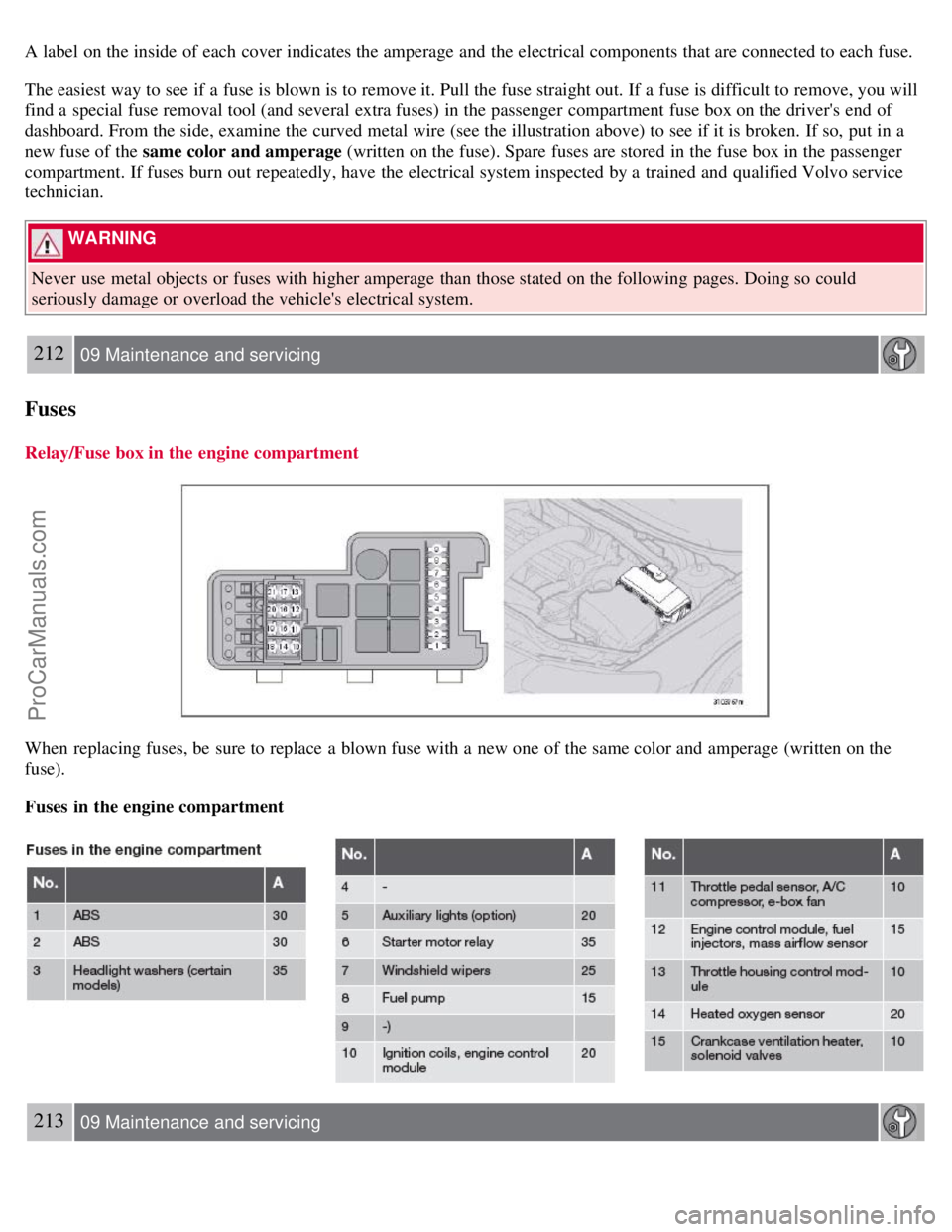
A label on the inside of each cover indicates the amperage and the electrical components that are connected to each fuse.
The easiest way to see if a fuse is blown is to remove it. Pull the fuse straight out. If a fuse is difficult to remove, you will
find a special fuse removal tool (and several extra fuses) in the passenger compartment fuse box on the driver's end of
dashboard. From the side, examine the curved metal wire (see the illustration above) to see if it is broken. If so, put in a
new fuse of the same color and amperage (written on the fuse). Spare fuses are stored in the fuse box in the passenger
compartment. If fuses burn out repeatedly, have the electrical system inspected by a trained and qualified Volvo service
technician.
WARNING
Never use metal objects or fuses with higher amperage than those stated on the following pages. Doing so could
seriously damage or overload the vehicle's electrical system.
212 09 Maintenance and servicing
Fuses
Relay/Fuse box in the engine compartment
When replacing fuses, be sure to replace a blown fuse with a new one of the same color and amperage (written on the
fuse).
Fuses in the engine compartment
213 09 Maintenance and servicing
ProCarManuals.com
Page 213 of 230
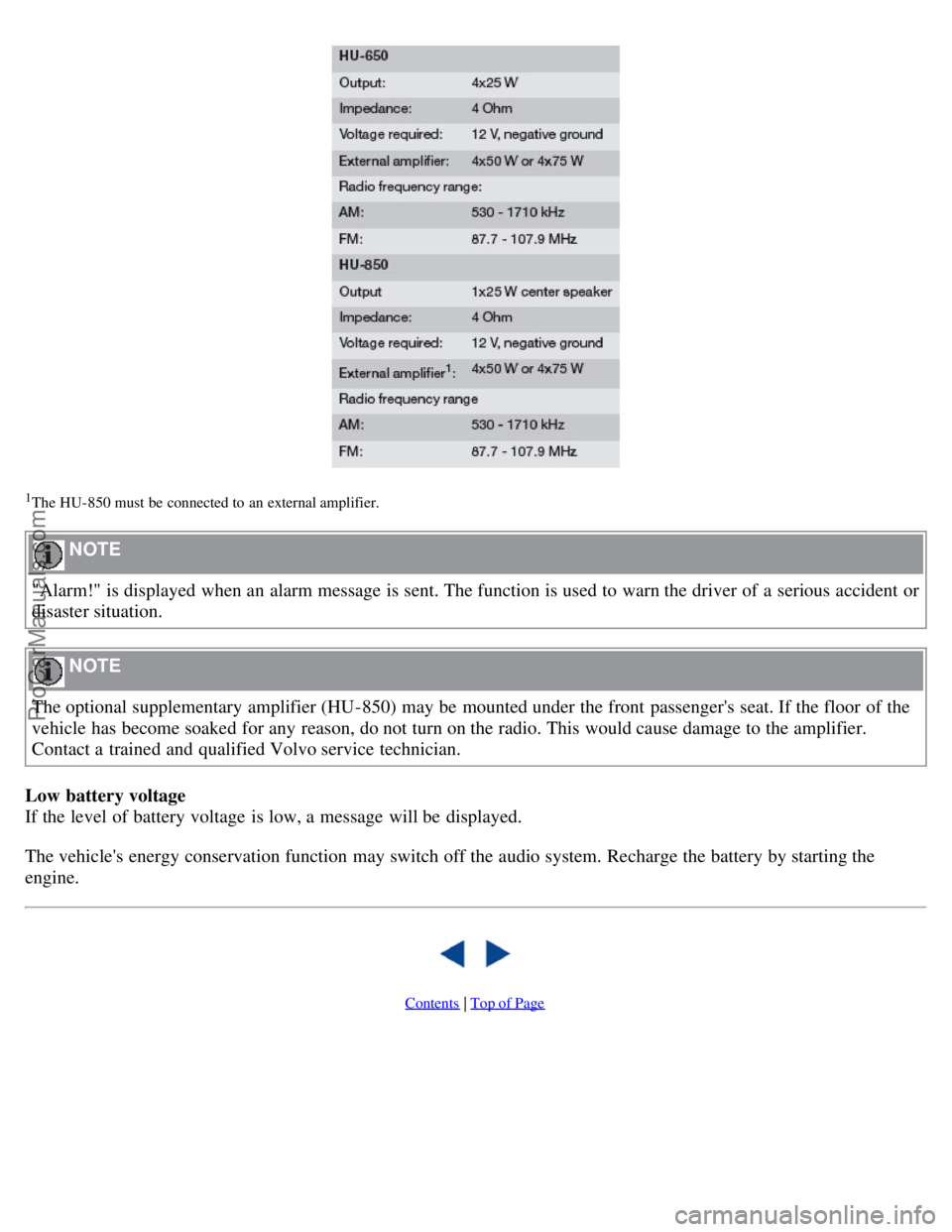
1The HU- 850 must be connected to an external amplifier.
NOTE
"Alarm!" is displayed when an alarm message is sent. The function is used to warn the driver of a serious accident or
disaster situation.
NOTE
The optional supplementary amplifier (HU-850) may be mounted under the front passenger's seat. If the floor of the
vehicle has become soaked for any reason, do not turn on the radio. This would cause damage to the amplifier.
Contact a trained and qualified Volvo service technician.
Low battery voltage
If the level of battery voltage is low, a message will be displayed.
The vehicle's energy conservation function may switch off the audio system. Recharge the battery by starting the
engine.
Contents | Top of Page
ProCarManuals.com
Page 214 of 230
2 0 0 8
VOLVO S60
240 11 Specifications
Label information 242
Dimensions and weights244
Capacities246
Engine specifications247
Bulbs248
Electrical system249
Three-way catalytic converter250
Suspension251
Volvo programs252
241 11 Specifications
242 11 Specifications
Label information
ProCarManuals.com
Page 218 of 230
NOTE
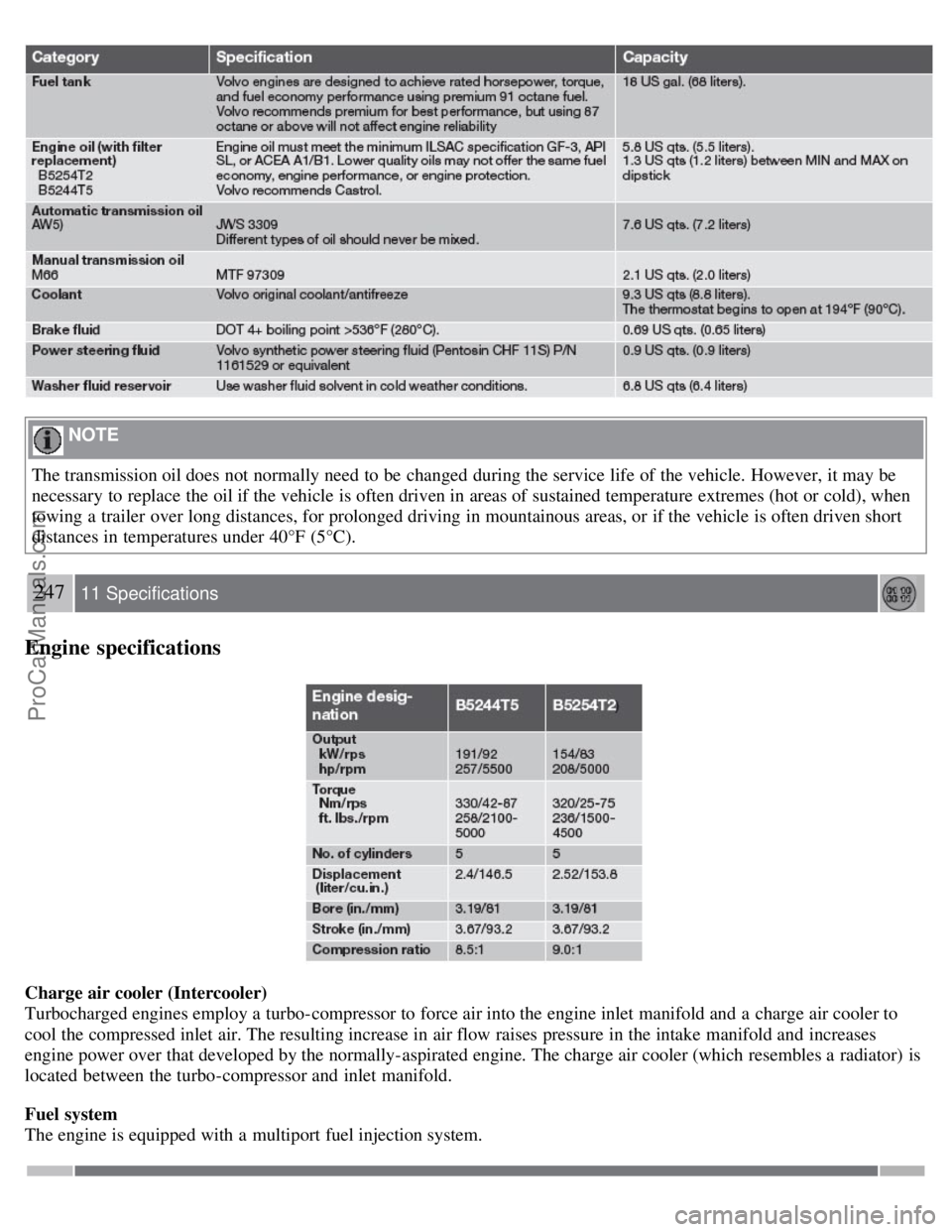
The transmission oil does not normally need to be changed during the service life of the vehicle. However, it may be
necessary to replace the oil if the vehicle is often driven in areas of sustained temperature extremes (hot or cold), when
towing a trailer over long distances, for prolonged driving in mountainous areas, or if the vehicle is often driven short
distances in temperatures under 40°F (5°C).
247 11 Specifications
Engine specifications
Charge air cooler (Intercooler)
Turbocharged engines employ a turbo-compressor to force air into the engine inlet manifold and a charge air cooler to
cool the compressed inlet air. The resulting increase in air flow raises pressure in the intake manifold and increases
engine power over that developed by the normally-aspirated engine. The charge air cooler (which resembles a radiator) is
located between the turbo-compressor and inlet manifold.
Fuel system
The engine is equipped with a multiport fuel injection system.
ProCarManuals.com
Page 219 of 230
248 11 Specifications
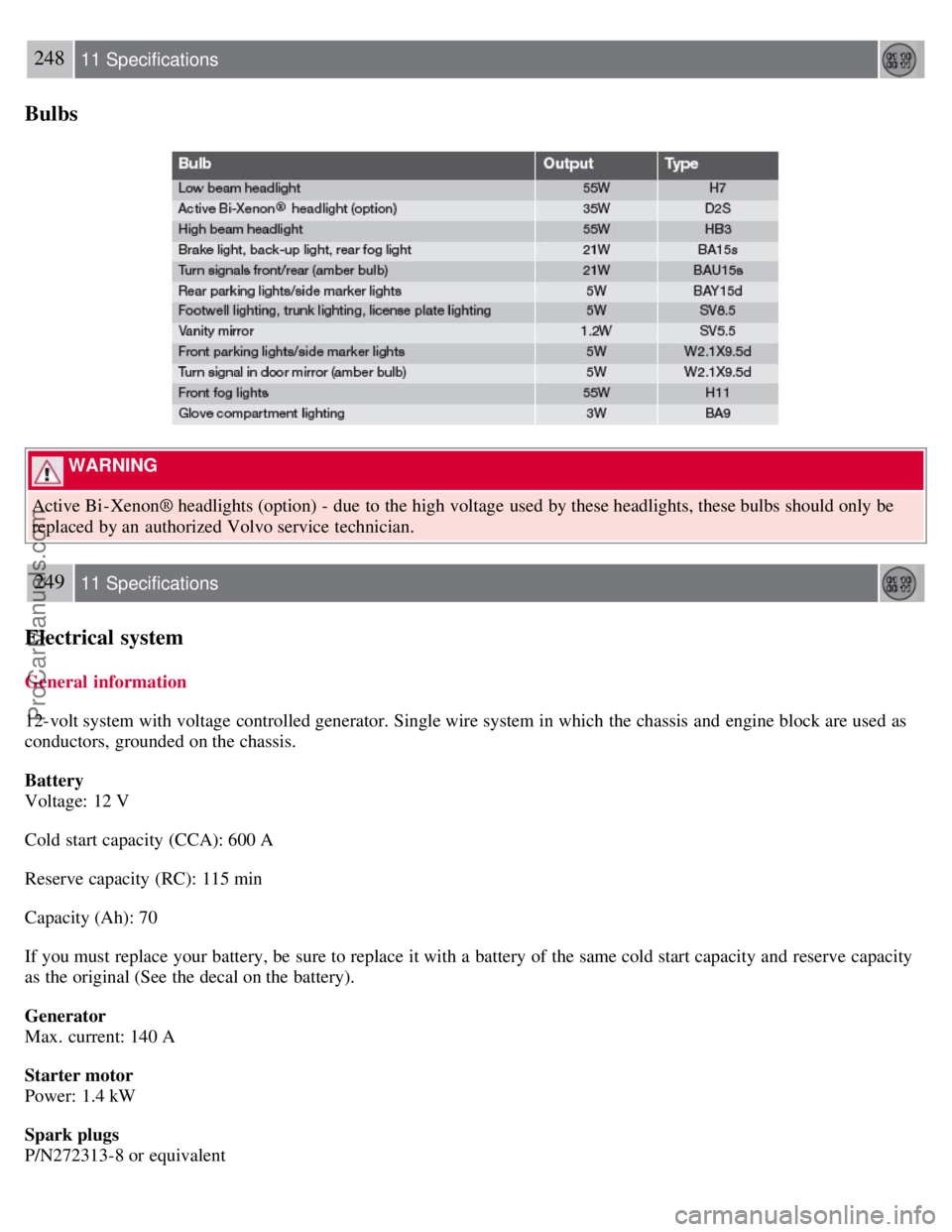
Bulbs
WARNING
Active Bi -Xenon® headlights (option) - due to the high voltage used by these headlights, these bulbs should only be
replaced by an authorized Volvo service technician.
249 11 Specifications
Electrical system
General information
12-volt system with voltage controlled generator. Single wire system in which the chassis and engine block are used as
conductors, grounded on the chassis.
Battery
Voltage: 12 V
Cold start capacity (CCA): 600 A
Reserve capacity (RC): 115 min
Capacity (Ah): 70
If you must replace your battery, be sure to replace it with a battery of the same cold start capacity and reserve capacity
as the original (See the decal on the battery).
Generator
Max. current: 140 A
Starter motor
Power: 1.4 kW
Spark plugs
P/N272313-8 or equivalent
ProCarManuals.com