airbag off VOLVO S60 2008 Owners Manual
[x] Cancel search | Manufacturer: VOLVO, Model Year: 2008, Model line: S60, Model: VOLVO S60 2008Pages: 230, PDF Size: 5.33 MB
Page 15 of 230
2 0 0 8
VOLVO S60
10 01 Safety
Occupant safety 12
Seat belts14
Supplemental Restraint System16
Front airbags17
Occupant Weight Sensor (OWS)21
Side impact (SIP) airbag25
Volvo Inflatable Curtain (VIC)26
Whiplash Protection System (WHIPS)28
Child safety30
Child restraint systems32
Infant seats34
Convertible seats36
Booster cushions39
ISOFIX lower anchors40
Top tether anchors42
Child restraint registration and recalls43
11 01 Safety
12 01 Safety
Occupant safety
Volvo's concern for safety
Safety is the Volvo cornerstone. Our concern dates back to 1927 when the first Volvo rolled off the production line.
Three-point seat belts (a Volvo invention), safety cages, and energy-absorbing impact zones were designed into Volvo
vehicles long before it was fashionable or required by government regulation. We will not compromise our commitment
ProCarManuals.com
Page 20 of 230
selector to the neutral position:
Switch off the ignition for at least 10 minutes and disconnect the battery
Wait at least one minute.
Insert the key in the ignition and turn it to position II.
Press firmly on the brake pedal.
Move the gear selector from (P)ark to the (N)eutral position. See page 132 for information on manually overriding
the shiftlock system.
17 01 Safety
Front airbags
The front airbag system
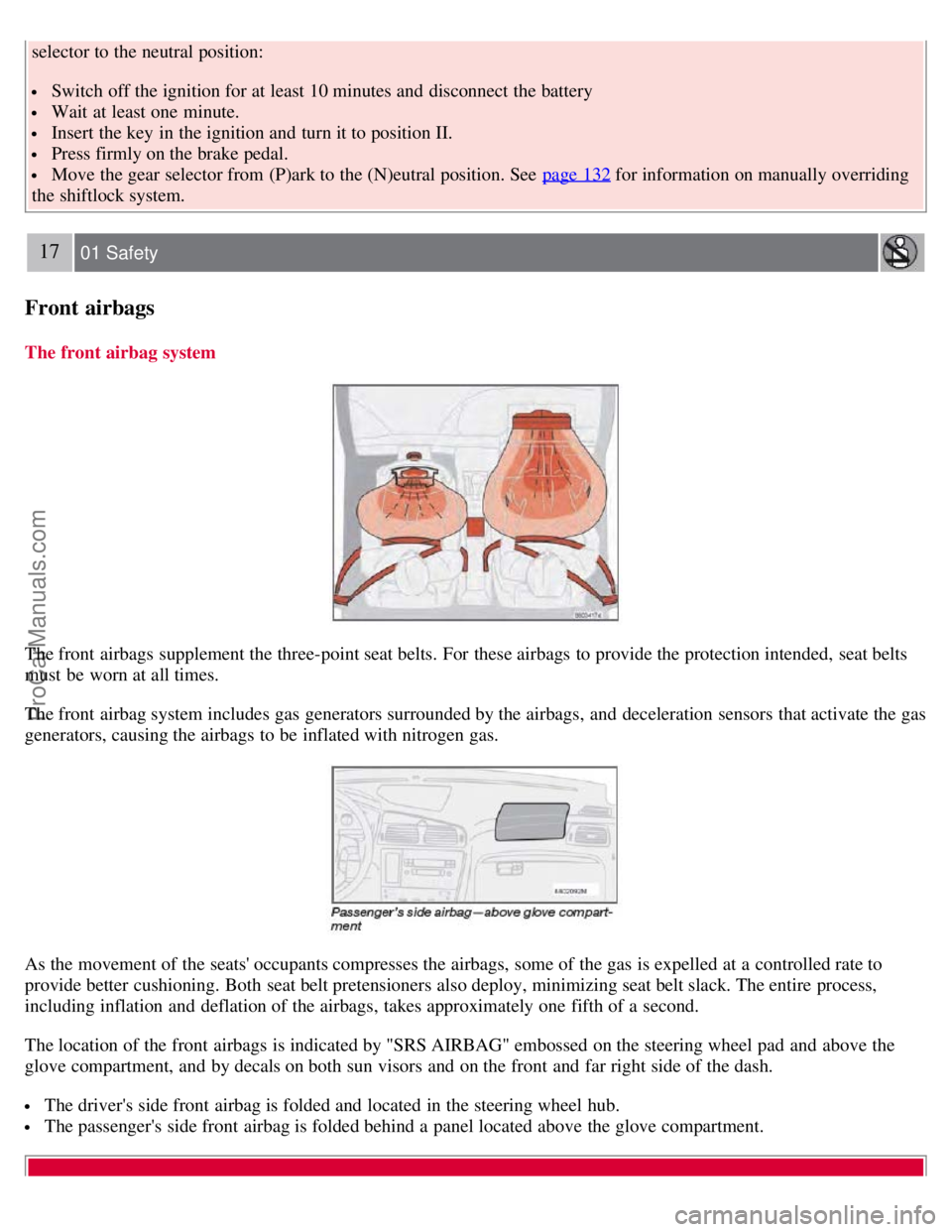
The front airbags supplement the three-point seat belts. For these airbags to provide the protection intended, seat belts
must be worn at all times.
The front airbag system includes gas generators surrounded by the airbags, and deceleration sensors that activate the gas
generators, causing the airbags to be inflated with nitrogen gas.
As the movement of the seats' occupants compresses the airbags, some of the gas is expelled at a controlled rate to
provide better cushioning. Both seat belt pretensioners also deploy, minimizing seat belt slack. The entire process,
including inflation and deflation of the airbags, takes approximately one fifth of a second.
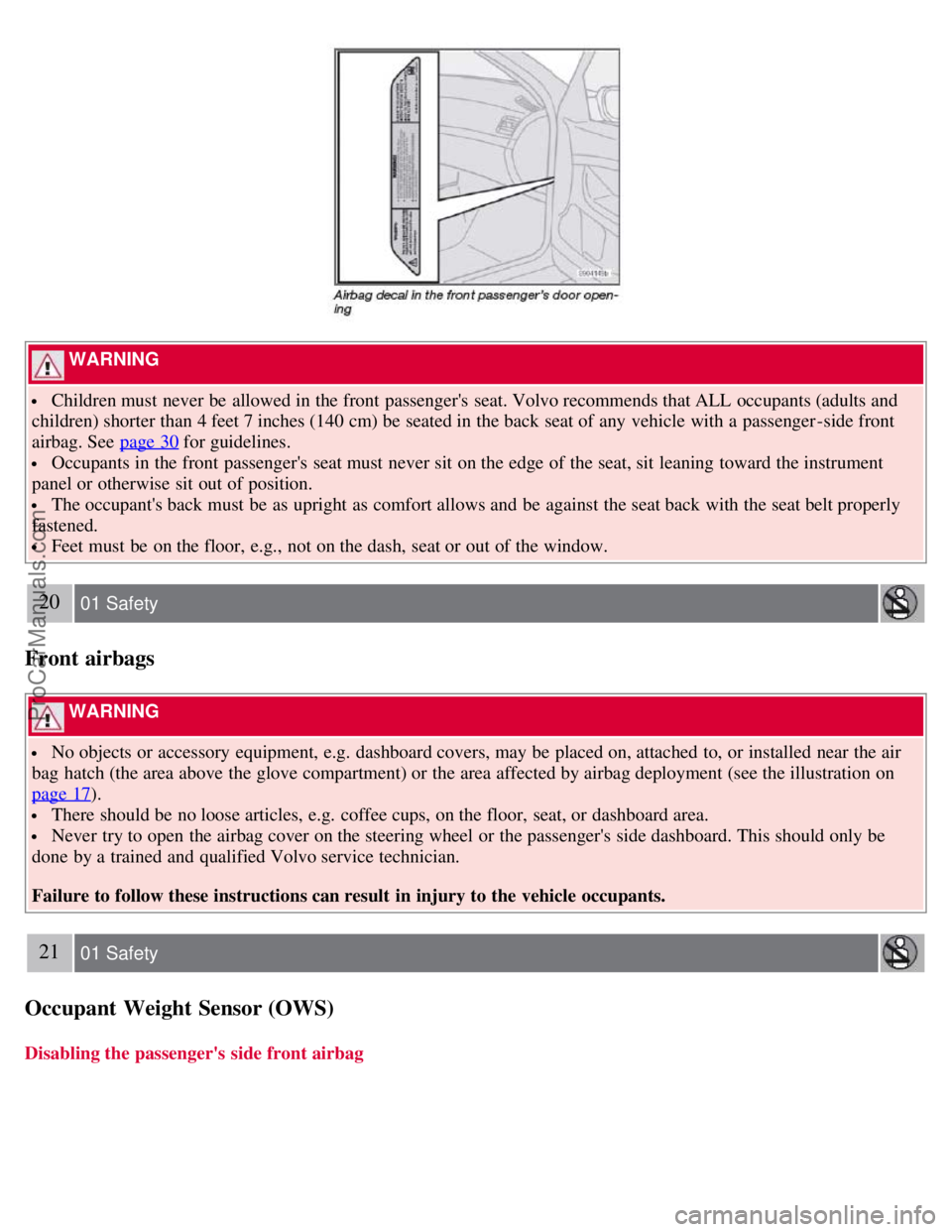
The location of the front airbags is indicated by "SRS AIRBAG" embossed on the steering wheel pad and above the
glove compartment, and by decals on both sun visors and on the front and far right side of the dash.
The driver's side front airbag is folded and located in the steering wheel hub.
The passenger's side front airbag is folded behind a panel located above the glove compartment.
ProCarManuals.com
Page 23 of 230
WARNING
Children must never be allowed in the front passenger's seat. Volvo recommends that ALL occupants (adults and
children) shorter than 4 feet 7 inches (140 cm) be seated in the back seat of any vehicle with a passenger -side front
airbag. See page 30
for guidelines.
Occupants in the front passenger's seat must never sit on the edge of the seat, sit leaning toward the instrument
panel or otherwise sit out of position.
The occupant's back must be as upright as comfort allows and be against the seat back with the seat belt properly
fastened.
Feet must be on the floor, e.g., not on the dash, seat or out of the window.
20 01 Safety
Front airbags
WARNING
No objects or accessory equipment, e.g. dashboard covers, may be placed on, attached to, or installed near the air
bag hatch (the area above the glove compartment) or the area affected by airbag deployment (see the illustration on
page 17
).
There should be no loose articles, e.g. coffee cups, on the floor, seat, or dashboard area.
Never try to open the airbag cover on the steering wheel or the passenger's side dashboard. This should only be
done by a trained and qualified Volvo service technician.
Failure to follow these instructions can result in injury to the vehicle occupants.
21 01 Safety
Occupant Weight Sensor (OWS)
Disabling the passenger's side front airbag
ProCarManuals.com
Page 24 of 230
Volvo recommends that ALL occupants (adults and children) shorter than 4 feet 7 inches (140 cm) be seated in the rear
seat of any vehicle with a passenger's side front airbag, and be properly restrained. Children should always be seated in
child restraints appropriate for their size and weight. See also the child safety recommendations beginning on page 30
.
The Occupant Weight Sensor (OWS) is designed to meet the regulatory requirements of Federal Motor Vehicle Safety
Standard (FMVSS) 208 and is designed to disable (will not inflate) the passenger's side front airbag under certain
conditions.
The OWS works with sensors that are part of the front passenger's seat and seat belt. The sensors are designed to detect
the presence of a properly seated occupant and determine if the passenger's side front airbag should be enabled (may
inflate) or disabled (will not inflate).
The OWS will disable (will not inflate) the passenger's side front airbag when:
the front passenger's seat is unoccupied, or has small/medium objects in the front seat,
the system determines that an infant is present in a rear-facing infant seat that is installed according to the
manufacturer's instructions,
the system determines that a small child is present in a forward-facing child restraint that is installed according to the
manufacturer's instructions,
the system determines that a small child is present in a booster seat,
a front passenger takes his/her weight off of the seat for a period of time,
a child or a small person occupies the front passenger's seat.
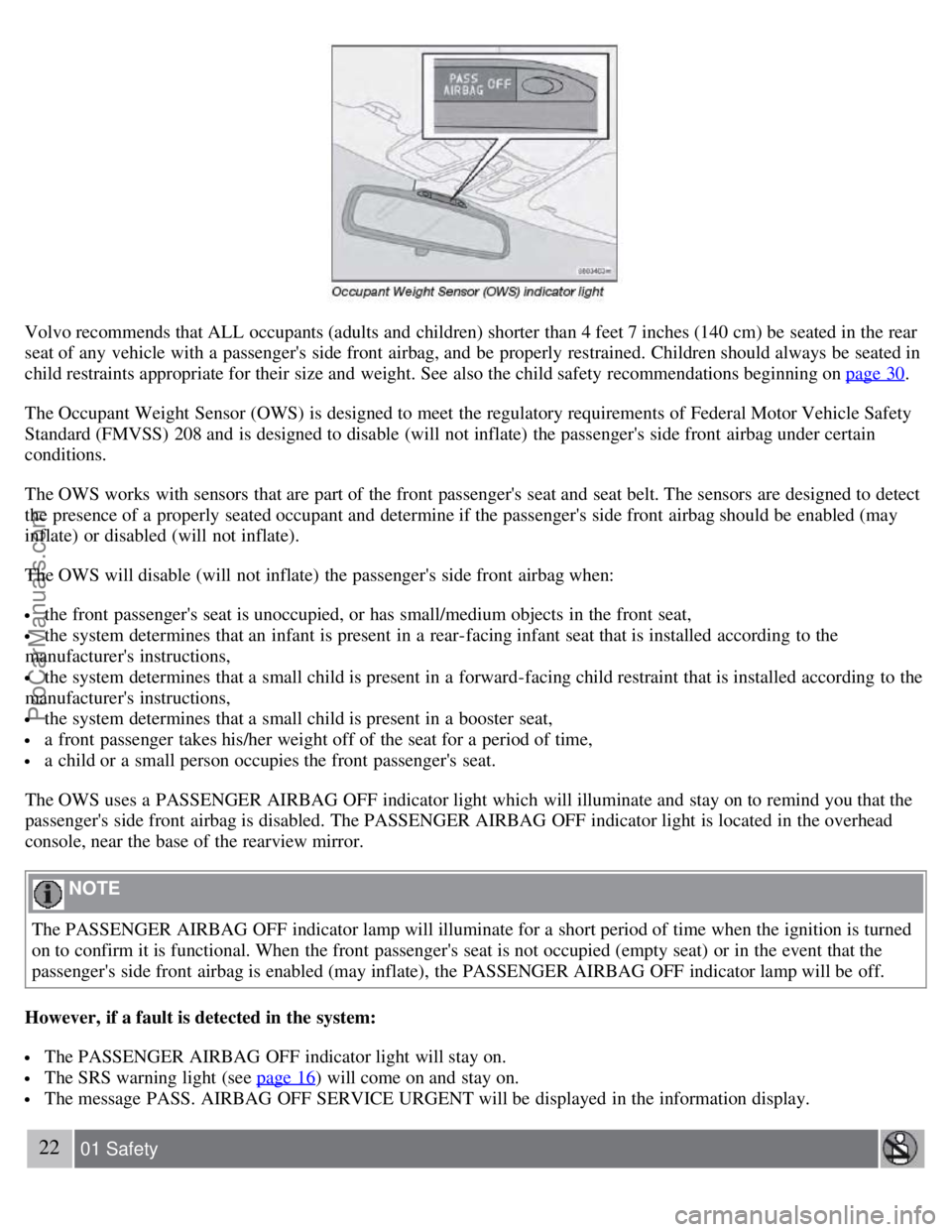
The OWS uses a PASSENGER AIRBAG OFF indicator light which will illuminate and stay on to remind you that the
passenger's side front airbag is disabled. The PASSENGER AIRBAG OFF indicator light is located in the overhead
console, near the base of the rearview mirror.
NOTE
The PASSENGER AIRBAG OFF indicator lamp will illuminate for a short period of time when the ignition is turned
on to confirm it is functional. When the front passenger's seat is not occupied (empty seat) or in the event that the
passenger's side front airbag is enabled (may inflate), the PASSENGER AIRBAG OFF indicator lamp will be off.
However, if a fault is detected in the system:
The PASSENGER AIRBAG OFF indicator light will stay on.
The SRS warning light (see page 16) will come on and stay on.
The message PASS. AIRBAG OFF SERVICE URGENT will be displayed in the information display.
22 01 Safety
ProCarManuals.com
Page 25 of 230
Occupant Weight Sensor (OWS)
WARNING
If a fault in the system is detected and indicated as explained on the previous page, be aware that the passenger's
side front airbag will not deploy in the event of a collision.
In this case, the safety systems and Occupant Weight Sensor should be inspected by a trained and qualified Volvo
service technician as soon as possible.
WARNING
Never try to open, remove, or repair any components in the OWS system. This could result in system malfunction.
Maintenance or repairs should only be carried out by an authorized Volvo service technician.
The front passenger's seat should not be modified in any way. This could reduce pressure on the seat cushion,
which might interfere with the OWS system's function.
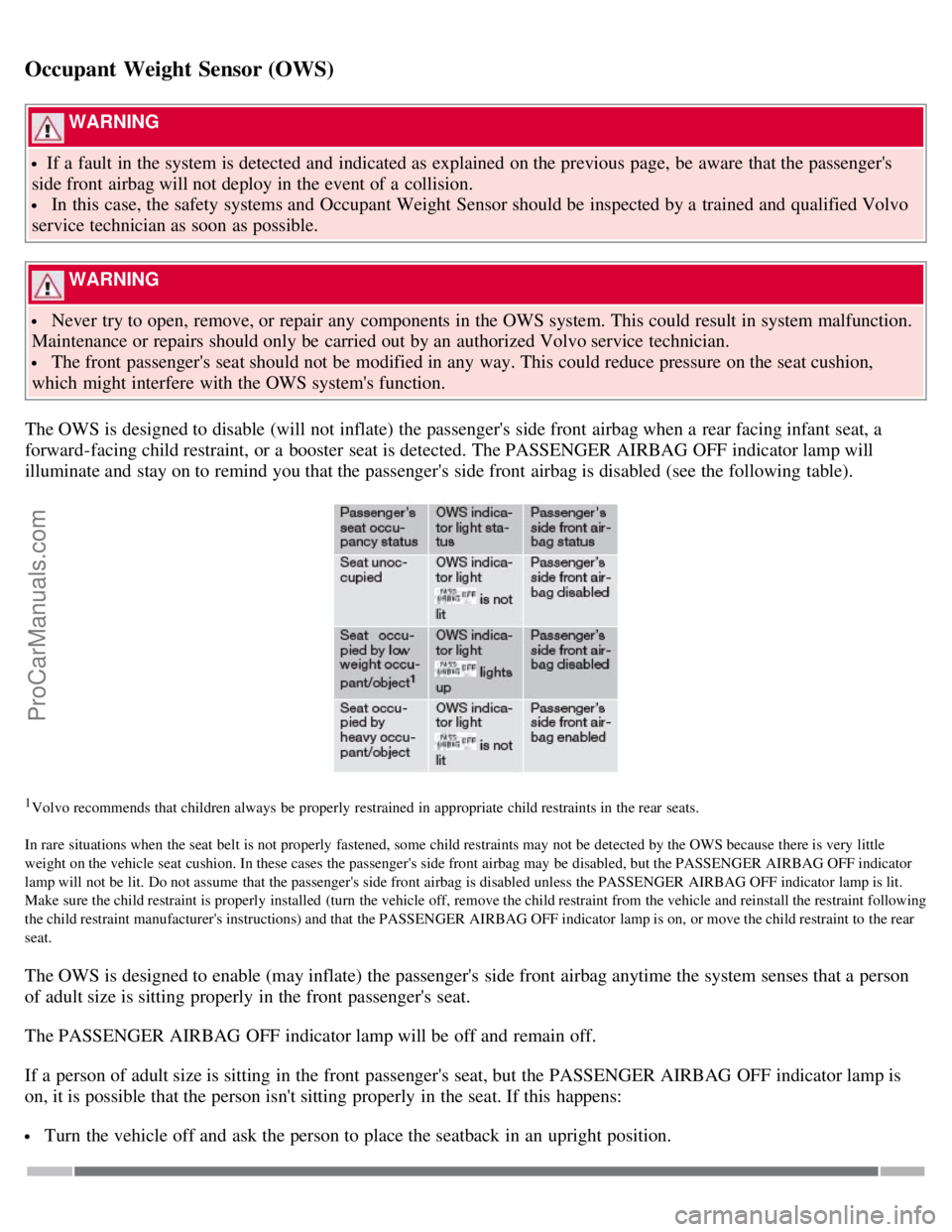
The OWS is designed to disable (will not inflate) the passenger's side front airbag when a rear facing infant seat, a
forward-facing child restraint, or a booster seat is detected. The PASSENGER AIRBAG OFF indicator lamp will
illuminate and stay on to remind you that the passenger's side front airbag is disabled (see the following table).
1Volvo recommends that children always be properly restrained in appropriate child restraints in the rear seats.
In rare situations when the seat belt is not properly fastened, some child restraints may not be detected by the OWS because there is very little
weight on the vehicle seat cushion. In these cases the passenger's side front airbag may be disabled, but the PASSENGER AIRBAG OFF indicator
lamp will not be lit. Do not assume that the passenger's side front airbag is disabled unless the PASSENGER AIRBAG OFF indicator lamp is lit.
Make sure the child restraint is properly installed (turn the vehicle off, remove the child restraint from the vehicle and reinstall the restraint following
the child restraint manufacturer's instructions) and that the PASSENGER AIRBAG OFF indicator lamp is on, or move the child restraint to the rear
seat.
The OWS is designed to enable (may inflate) the passenger's side front airbag anytime the system senses that a person
of adult size is sitting properly in the front passenger's seat.
The PASSENGER AIRBAG OFF indicator lamp will be off and remain off.
If a person of adult size is sitting in the front passenger's seat, but the PASSENGER AIRBAG OFF indicator lamp is
on, it is possible that the person isn't sitting properly in the seat. If this happens:
Turn the vehicle off and ask the person to place the seatback in an upright position.
ProCarManuals.com
Page 26 of 230
23 01 Safety
Occupant Weight Sensor (OWS)
Have the person sit upright in the seat, centered on the seat cushion, with the person's legs comfortably extended.
Restart the vehicle and have the person remain in this position for about two minutes. This will allow the system to
detect that person and enable the passenger's frontal airbag.
If the PASSENGER AIRBAG OFF indicator lamp remains on even after this, the person should be advised to ride in
the rear seat.
This condition reflects limitations of the OWS classification capability. It does not indicate OWS malfunction.
Modifications
If you are considering modifying your vehicle in any way to accommodate a disability, for example by altering or
adapting the driver's or front passenger's seat(s) and/or airbag systems, please contact Volvo at:
In the USA
Volvo Cars of North America, LLC
Customer Care Center
P.O. Box 914 Rockleigh, New Jersey 07647-0914
1-800-458-1552
In Canada
Volvo Cars of Canada Corp.
National Customer Service
175 Gordon Baker Road
North York, Ontario M2H 2N7
1-800-663-8255
WARNING
No objects that add to the total weight on the seat should be placed on the front passenger's seat. If a child is seated
in the front passenger's seat with any additional weight, this extra weight could cause the OWS system to enable the
airbag, which might cause it to deploy in the event of a collision, thereby injuring the child.
The seat belt should never be wrapped around an object on the front passenger's seat. This could interfere with the
OWS system's function.
The front passenger's seat belt should never be used in a way that exerts more pressure on the passenger than
normal. This could increase the pressure exerted on the weight sensor by a child, and could result in the airbag being
enabled, which might cause it to deploy in the event of a collision, thereby injuring the child.
24 01 Safety
Occupant Weight Sensor (OWS)
WARNING
Keep the following points in mind with respect to the OWS system. Failure to follow these instructions could
adversely affect the system's function and result in serious injury to the occupant of the front passenger's seat:
The full weight of the front seat passenger should always be on the seat cushion. The passenger should never lift
him/herself off the seat cushion using the armrest in the door or the center console, by pressing the feet on the floor,
by sitting on the edge of the seat cushion, or by pressing against the backrest in a way that reduces pressure on the
ProCarManuals.com
Page 33 of 230
WARNING
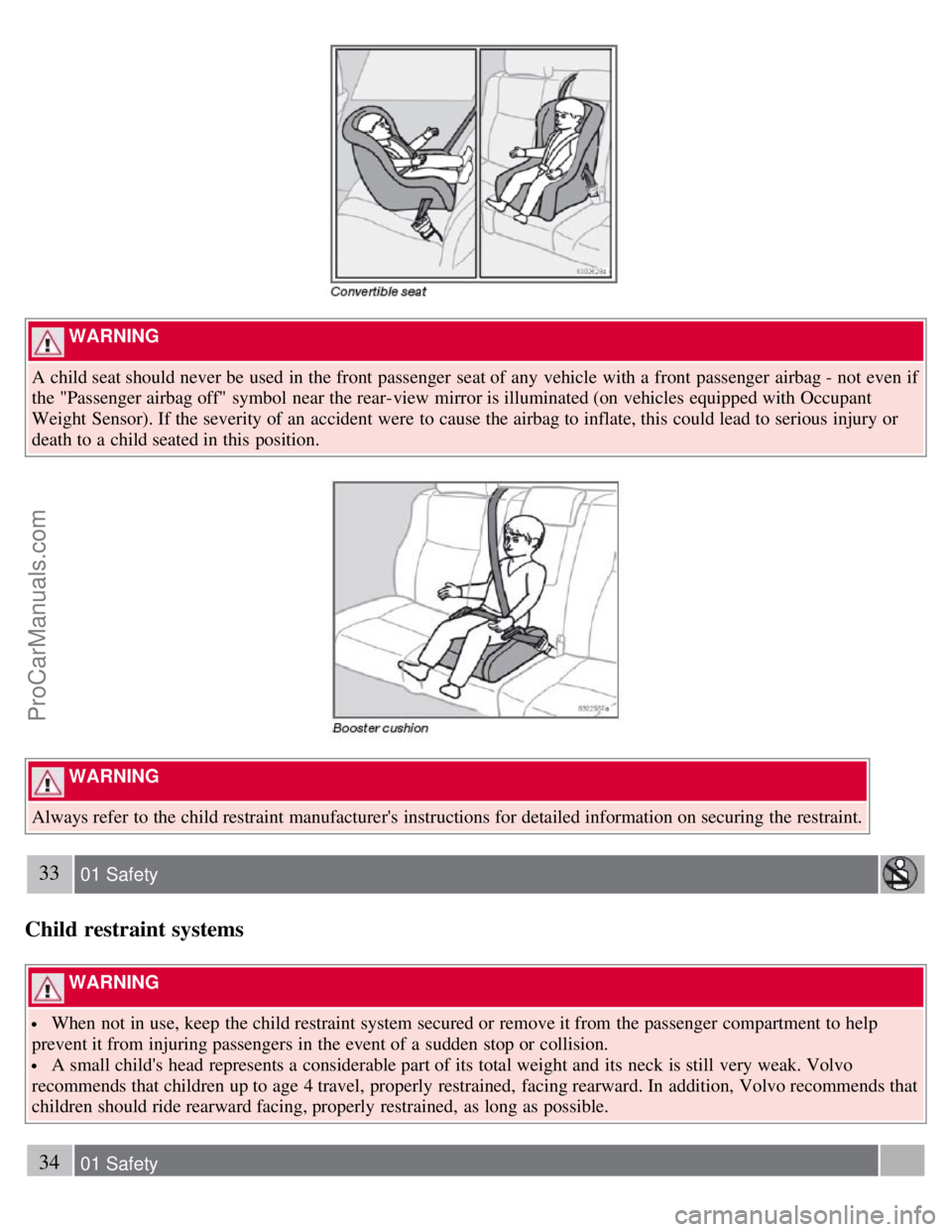
A child seat should never be used in the front passenger seat of any vehicle with a front passenger airbag - not even if
the "Passenger airbag off" symbol near the rear-view mirror is illuminated (on vehicles equipped with Occupant
Weight Sensor). If the severity of an accident were to cause the airbag to inflate, this could lead to serious injury or
death to a child seated in this position.
WARNING
Always refer to the child restraint manufacturer's instructions for detailed information on securing the restraint.
33 01 Safety
Child restraint systems
WARNING
When not in use, keep the child restraint system secured or remove it from the passenger compartment to help
prevent it from injuring passengers in the event of a sudden stop or collision.
A small child's head represents a considerable part of its total weight and its neck is still very weak. Volvo
recommends that children up to age 4 travel, properly restrained, facing rearward. In addition, Volvo recommends that
children should ride rearward facing, properly restrained, as long as possible.
34 01 Safety
ProCarManuals.com
Page 35 of 230
WARNING
A child seat should never be used in the front passenger seat of any vehicle with a front passenger airbag - not even if
the "Passenger airbag off" symbol near the rear-view mirror is illuminated (on vehicles equipped with Occupant
Weight Sensor). If the severity of an accident were to cause the airbag to inflate, this could lead to serious injury or
death to a child seated in this position.
35 01 Safety
Infant seats
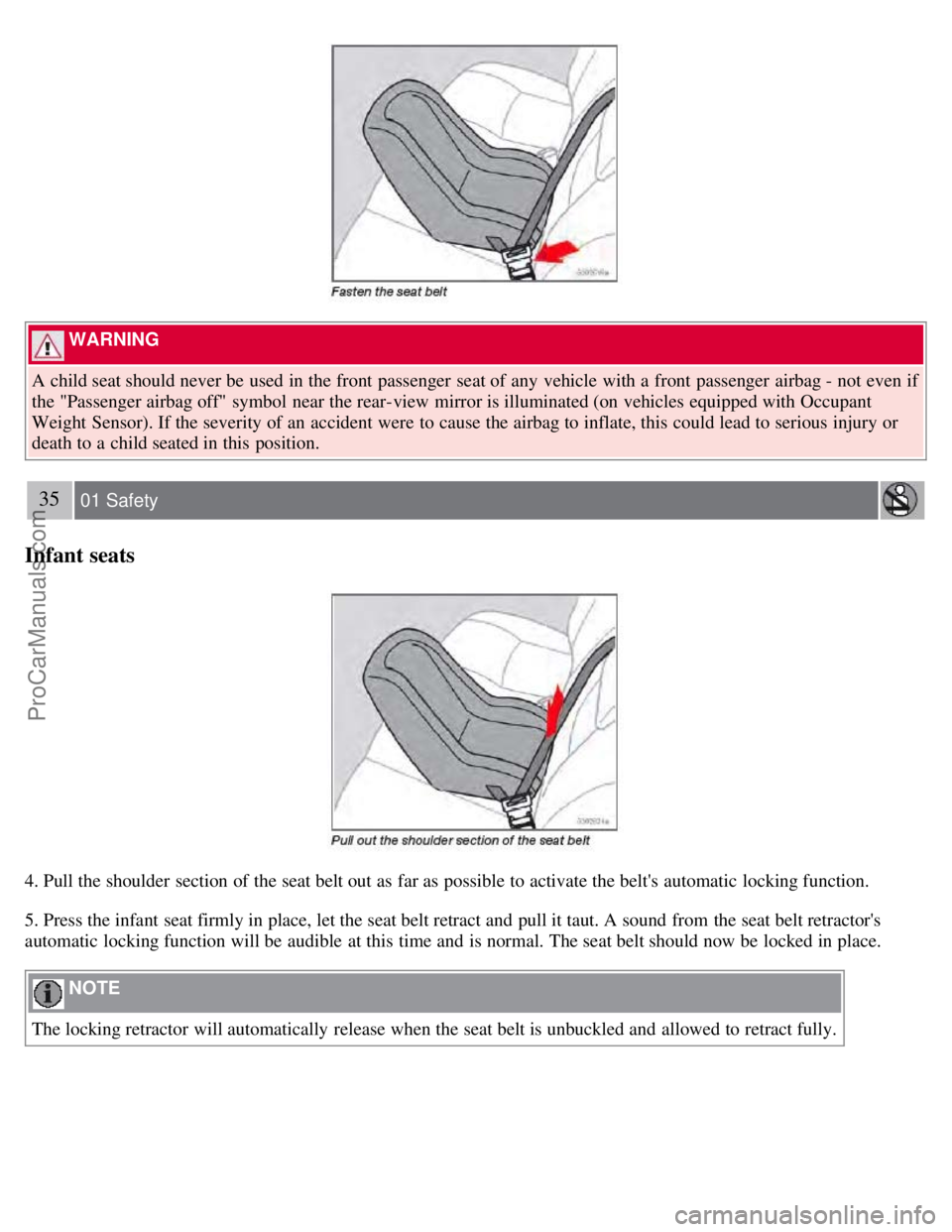
4. Pull the shoulder section of the seat belt out as far as possible to activate the belt's automatic locking function.
5. Press the infant seat firmly in place, let the seat belt retract and pull it taut. A sound from the seat belt retractor's
automatic locking function will be audible at this time and is normal. The seat belt should now be locked in place.
NOTE
The locking retractor will automatically release when the seat belt is unbuckled and allowed to retract fully.
ProCarManuals.com
Page 38 of 230
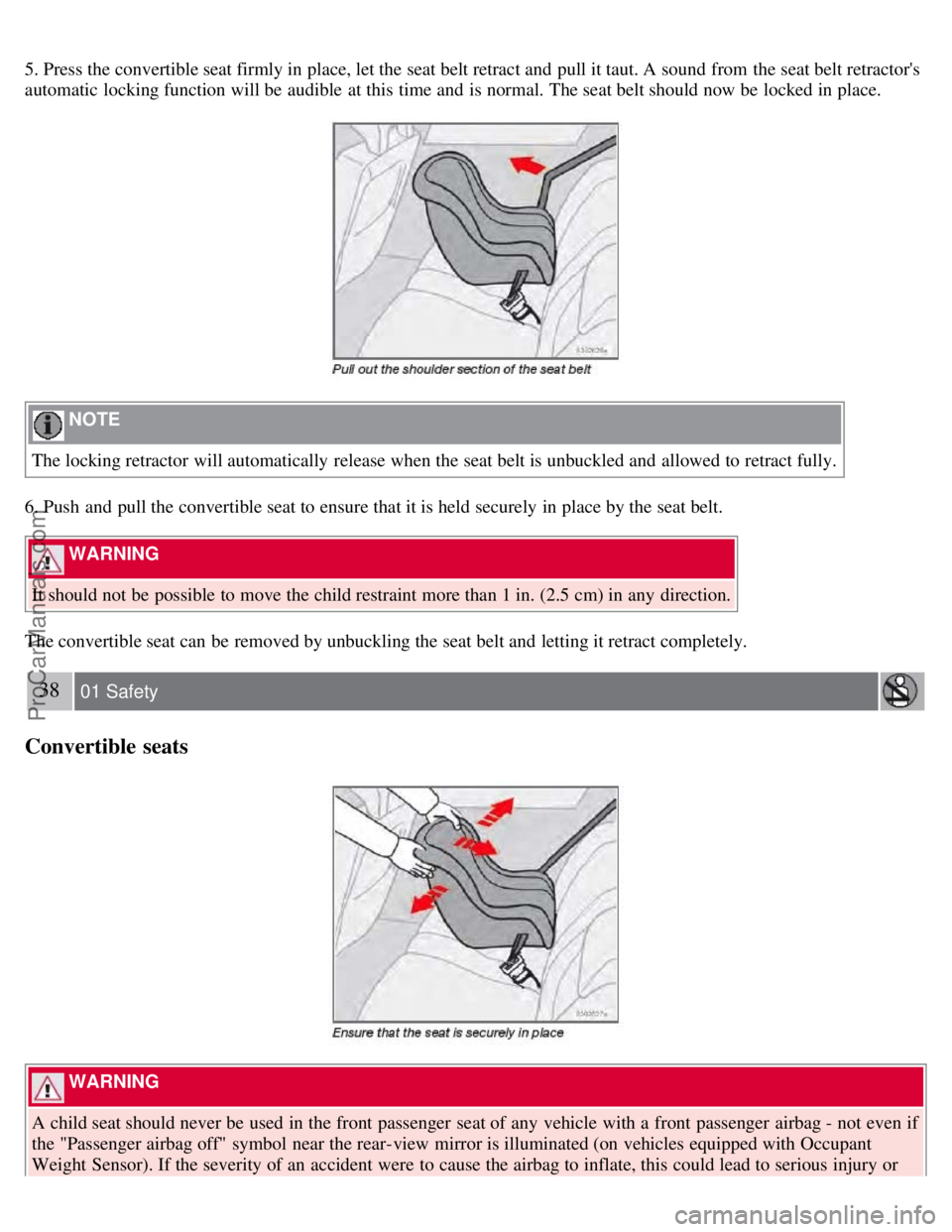
5. Press the convertible seat firmly in place, let the seat belt retract and pull it taut. A sound from the seat belt retractor's
automatic locking function will be audible at this time and is normal. The seat belt should now be locked in place.
NOTE
The locking retractor will automatically release when the seat belt is unbuckled and allowed to retract fully.
6. Push and pull the convertible seat to ensure that it is held securely in place by the seat belt.
WARNING
It should not be possible to move the child restraint more than 1 in. (2.5 cm) in any direction.
The convertible seat can be removed by unbuckling the seat belt and letting it retract completely.
38 01 Safety
Convertible seats
WARNING
A child seat should never be used in the front passenger seat of any vehicle with a front passenger airbag - not even if
the "Passenger airbag off" symbol near the rear-view mirror is illuminated (on vehicles equipped with Occupant
Weight Sensor). If the severity of an accident were to cause the airbag to inflate, this could lead to serious injury or
ProCarManuals.com
Page 48 of 230
1On certain engines, the symbol for low oil pressure is not used. Instead, a text warning is provided in the information display, see also page 52.
Warning symbol in the center of the instrument panel
This symbol shines as a red or yellow light depending on the severity of the discovered fault.
Red symbol - Stop the vehicle as soon as possible in a suitable location and read the message shown in the text window.
The symbol and accompanying text will remain on until the fault has been corrected.
Yellow symbol - Follow the instructions shown in the text window. The text can be erased by pressing the READ button
(see page 52
), or will disappear automatically after two minutes.
When the message "TIME FOR REGULAR SERVICE" is displayed, the text can be erased and the yellow symbol light
can be turned off by pressing the READ button. The text will disappear and the symbol light will go out automatically
after two minutes.
Symbols in the instrument panel
Seat belt reminder
This symbol lights up to indicate that the driver has not fastened his/her seat belt.
Supplemental Restraint System SRS
If this light comes on while the vehicle is being driven, or remains on for longer than approximately 10 seconds after the
vehicle has been started, the SRS system's diagnostic functions have detected a fault in a seat belt lock or pretensioner, a
front airbag, side impact airbag, and/or an inflatable curtain. Have the system(s) inspected by a trained and qualified
Volvo service technician as soon as possible.
BRAKE - Brake failure warning light
If the light comes on while driving or braking, stop immediately, open the hood and check the brake fluid level in the
reservoir. See page 196
.
Canadian models are equipped with this warning light.
50 02 Instruments and controls
Instrument and warning symbols
If the BRAKE and ABS warning lights come on at the same time, this could indicate a fault in the brake system.
1. Stop the vehicle in a suitable place and switch off the engine.
2. Restart the engine.
3. If both warning lights go off, no further action is required.
4. If both lights are still on after the engine has been restarted, switch off the engine again and check the brake fluid level
(see page 196
for the location of the brake fluid reservoir).
5. If the brake fluid level is above the MIN mark, drive carefully to a trained and qualified Volvo service technician and
have the brake system inspected.
ProCarManuals.com