trunk VOLVO S60 TWIN ENGINE 2019 Owner's Manual
[x] Cancel search | Manufacturer: VOLVO, Model Year: 2019, Model line: S60 TWIN ENGINE, Model: VOLVO S60 TWIN ENGINE 2019Pages: 645, PDF Size: 13.96 MB
Page 251 of 645
KEY, LOCKS AND ALARM
}}
* Option/accessory.249
Locking and unlocking from insidethe vehicle
The doors and trunk lid can be locked andunlocked from inside the vehicle using the cen-tral lock buttons in the front doors.
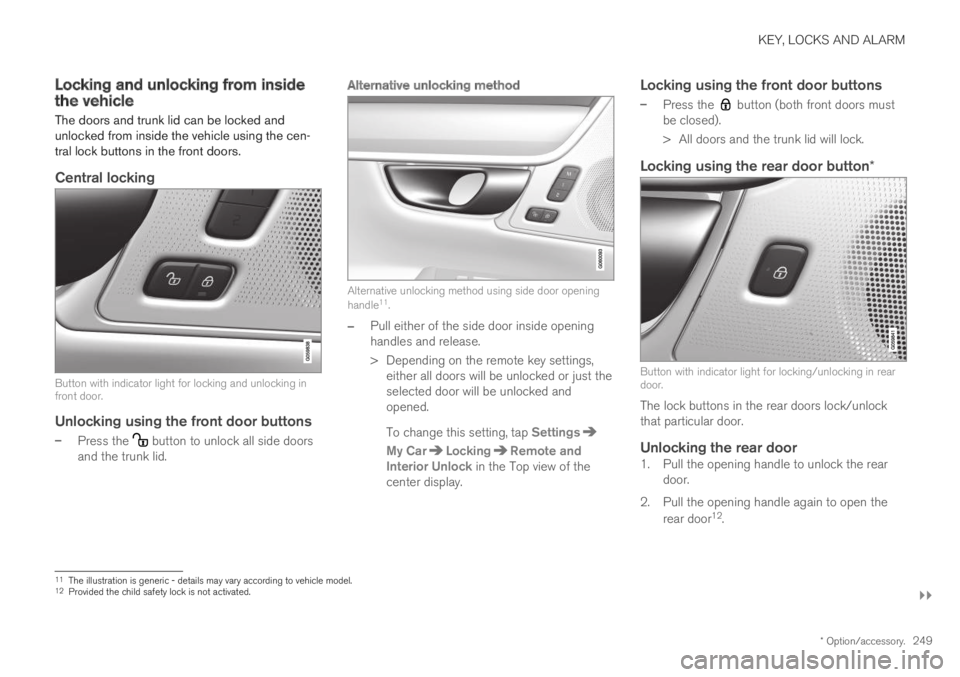
Central locking
Button with indicator light for locking and unlocking infront door.
Unlocking using the front door buttons
–Press the button to unlock all side doorsand the trunk lid.
Alternative unlocking method
Alternative unlocking method using side door openinghandle11.
–Pull either of the side door inside openinghandles and release.
>Depending on the remote key settings,either all doors will be unlocked or just theselected door will be unlocked andopened.
To change this setting, tap Settings
My CarLockingRemote andInterior Unlock in the Top view of thecenter display.
Locking using the front door buttons
–Press the button (both front doors mustbe closed).
>All doors and the trunk lid will lock.
Locking using the rear door button *
Button with indicator light for locking/unlocking in reardoor.
The lock buttons in the rear doors lock/unlockthat particular door.
Unlocking the rear door
1. Pull the opening handle to unlock the reardoor.
2. Pull the opening handle again to open the
rear door12.
11The illustration is generic - details may vary according to vehicle model.12Provided the child safety lock is not activated.
Page 252 of 645

||
KEY, LOCKS AND ALARM
250
Related information
Settings for remote and inside door unlock(p. 233)
Unlocking the trunk lid from inside the vehi-cle (p. 250)
Activating and deactivating child safety locks(p. 251)
Opening the trunk lid from inside the trunk(p. 250)
Unlocking the trunk lid from insidethe vehicle
The trunk lid can be unlocked from the insideusing the button on the dashboard.
–Press the button on the dashboard.
>The trunk lid will unlock and can beopened from the outside by pressing therubberized pressure plate on the handle.
Related information
Locking and unlocking from inside the vehi-cle (p. 249)
Opening the trunk lid from inside
the trunk13
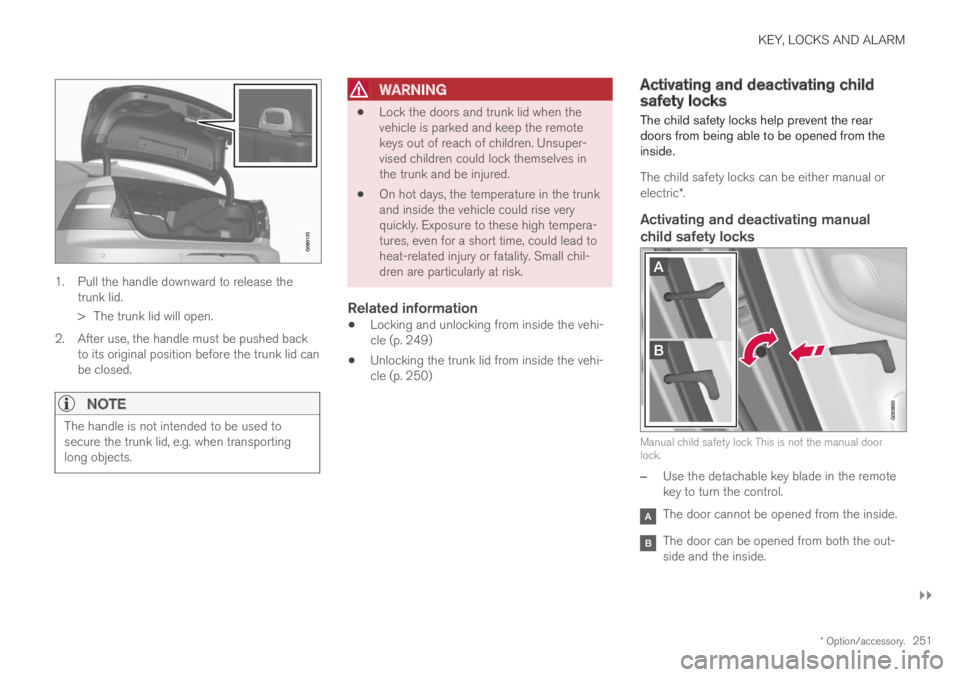
The vehicle is equipped with a fluorescent han-dle on the inside of the trunk lid that can beused in an emergency to open the trunk lid fromthe inside.
13US market only.
Page 253 of 645
KEY, LOCKS AND ALARM
}}
* Option/accessory.251
1. Pull the handle downward to release thetrunk lid.
>The trunk lid will open.
2. After use, the handle must be pushed backto its original position before the trunk lid canbe closed.
NOTE
The handle is not intended to be used tosecure the trunk lid, e.g. when transportinglong objects.
WARNING
Lock the doors and trunk lid when thevehicle is parked and keep the remotekeys out of reach of children. Unsuper-vised children could lock themselves inthe trunk and be injured.
On hot days, the temperature in the trunkand inside the vehicle could rise veryquickly. Exposure to these high tempera-tures, even for a short time, could lead toheat-related injury or fatality. Small chil-dren are particularly at risk.
Related information
Locking and unlocking from inside the vehi-cle (p. 249)
Unlocking the trunk lid from inside the vehi-cle (p. 250)
Activating and deactivating childsafety locks
The child safety locks help prevent the reardoors from being able to be opened from theinside.
The child safety locks can be either manual orelectric*.
Activating and deactivating manual
child safety locks
Manual child safety lock This is not the manual doorlock.
–Use the detachable key blade in the remotekey to turn the control.
The door cannot be opened from the inside.
The door can be opened from both the out-side and the inside.
Page 255 of 645
KEY, LOCKS AND ALARM
}}
253
Automatic locking when driving
The doors and trunk lid will automatically lockwhen the vehicle begins to move.
Related information
Locking and unlocking from inside the vehi-cle (p. 249)
Private Locking
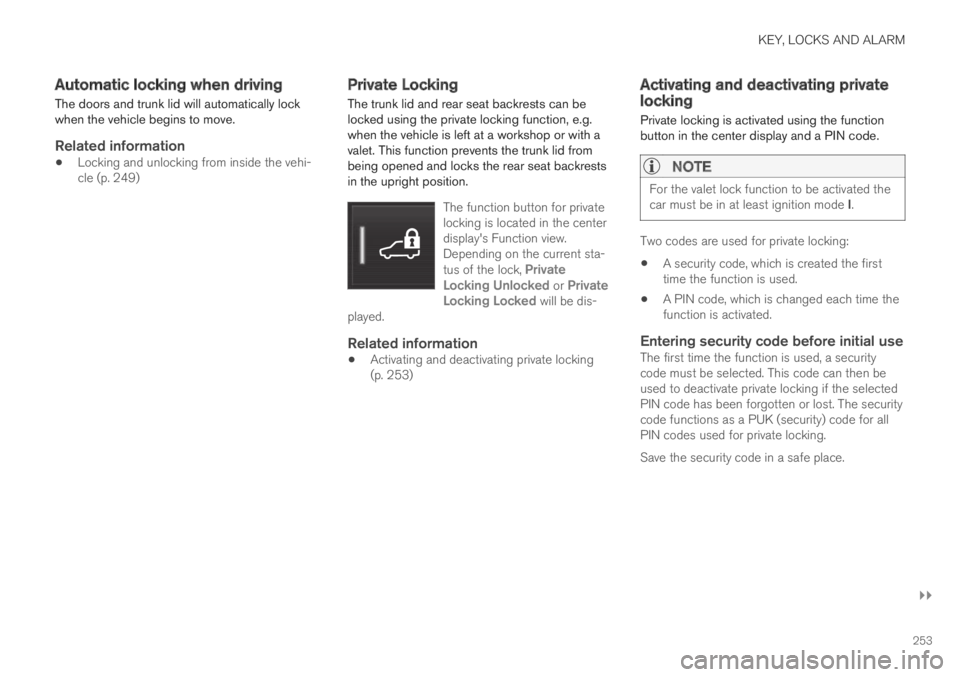
The trunk lid and rear seat backrests can belocked using the private locking function, e.g.when the vehicle is left at a workshop or with avalet. This function prevents the trunk lid frombeing opened and locks the rear seat backrestsin the upright position.
The function button for privatelocking is located in the centerdisplay's Function view.Depending on the current sta-tus of the lock, PrivateLocking Unlocked or PrivateLocking Locked will be dis-played.
Related information
Activating and deactivating private locking(p. 253)
Activating and deactivating privatelocking
Private locking is activated using the functionbutton in the center display and a PIN code.
NOTE
For the valet lock function to be activated thecar must be in at least ignition mode I.
Two codes are used for private locking:
A security code, which is created the firsttime the function is used.
A PIN code, which is changed each time thefunction is activated.
Entering security code before initial use
The first time the function is used, a securitycode must be selected. This code can then beused to deactivate private locking if the selectedPIN code has been forgotten or lost. The securitycode functions as a PUK (security) code for allPIN codes used for private locking.
Save the security code in a safe place.
Page 256 of 645
||
KEY, LOCKS AND ALARM
254
To create a security code:
1. Tap the button for private locking in Functionview.
> A pop-up window will appear.
2.Enter the desired security code and pressConfirm.
>The security code is saved. The privatelocking function is now ready for activa-tion.
Activating private locking
NOTE
The rear seat must be in the upright positionwhen private locking is activated in order forthe seats to lock.
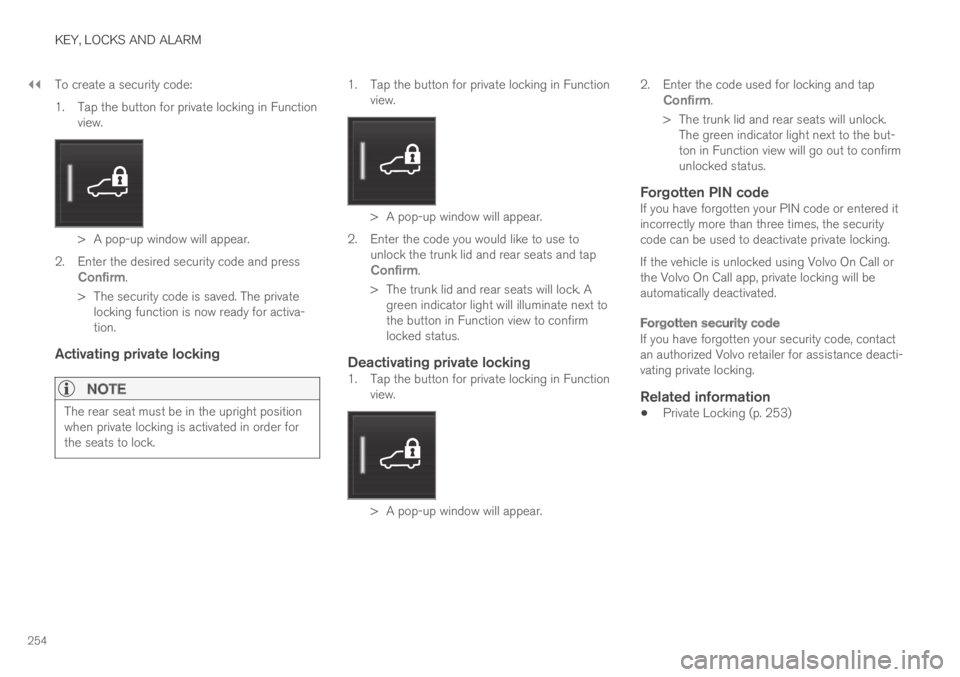
1. Tap the button for private locking in Functionview.
> A pop-up window will appear.
2.Enter the code you would like to use tounlock the trunk lid and rear seats and tapConfirm.
>The trunk lid and rear seats will lock. Agreen indicator light will illuminate next tothe button in Function view to confirmlocked status.
Deactivating private locking
1. Tap the button for private locking in Functionview.
> A pop-up window will appear.
2.Enter the code used for locking and tapConfirm.
>The trunk lid and rear seats will unlock.The green indicator light next to the but-ton in Function view will go out to confirmunlocked status.
Forgotten PIN code
If you have forgotten your PIN code or entered itincorrectly more than three times, the securitycode can be used to deactivate private locking.
If the vehicle is unlocked using Volvo On Call orthe Volvo On Call app, private locking will beautomatically deactivated.
Forgotten security code
If you have forgotten your security code, contactan authorized Volvo retailer for assistance deacti-vating private locking.
Related information
Private Locking (p. 253)
Page 257 of 645

KEY, LOCKS AND ALARM
255
Alarm
The alarm emits sound and light signals if any-one without a valid remote key attempts to breakinto the vehicle or interferes with the start batteryor alarm siren.
When armed, the alarm will be triggered if:
the hood, trunk lid or any door is opened.
a battery cable is disconnected.
the alarm siren is disconnected.
Alarm signals
The following occurs if the alarm is triggered:
A siren will sound for 30 seconds or until thealarm is turned off.
The hazard warning flashers will flash for5 minutes or until the alarm is turned off.
If the reason the alarm was triggered is not recti-
fied, the alarm cycle will repeat up to 10 times14.
Alarm indicator
A red indicator light on the dashboard shows thestatus of the alarm:
Indicator off - the alarm is disarmed.
Indicator flashes once every two seconds -the alarm is armed.
The indicator flashes quickly after the alarmhas been disabled for up to 30 seconds oruntil the ignition is put in I mode – the alarmhas been triggered.
In the event of alarm system failure
If a problem is detected in the alarmsystem, a symbol and the messageAlarm system failure Servicerequired will appear in the instrumentpanel. Contact a workshop - an authorized Volvoworkshop is recommended.
NOTE
Do not attempt to repair or alter any of thecomponents in the alarm system yourself. Anysuch attempt could affect the terms and con-ditions of your insurance policy.
Related information
Arming and disarming the alarm (p. 256)
14Certain markets only.
Page 258 of 645

KEY, LOCKS AND ALARM
* Option/accessory.256
Arming and disarming the alarm
The alarm is armed when the vehicle is locked.
Arming the alarm
Lock and arm the vehicle by
pressing the lock button on the remote key
.
touch the marked surface on the outside ofthe door handle or the rubberized pressure
plate on the trunk lid15.
A red LED light on the dashboard will flash every othersecond when the vehicle is locked and the alarm isarmed.
Disarming the alarm
Unlock and disarm the vehicle alarm by
pressing the unlock button on the remote
key .
grip a door handle or lightly press the trunk
lid's rubberized button15.
Disarming the alarm without a functioning
remote key
The vehicle can be unlocked and disarmed evenif the remote key is not functioning, e.g. if thebattery is discharged.
1. Open the driver's door using the detachablekey blade.
> This will trigger the alarm.
Location of the backup key reader in the cup holder.
2. Place the remote key on the key symbol inthe backup reader in the tunnel console'scup holder.
3.Turn the start knob clockwise and release.
> The alarm will be disarmed.
Turning off a triggered alarm
–Press the unlock button on the remote keyor put the ignition into mode I by turning thestart knob clockwise and then releasing it.
Automatically arming and disarming the
alarm
Automatically arming the alarm helps preventinadvertently leaving the vehicle without alarmprotection.
If the vehicle is unlocked using the remote key(and the alarm is disarmed) but none of thedoors or trunk lid is opened within two minutes,the alarm will be automatically rearmed. The vehi-cle will also re-lock.
On some markets, the alarm will be automaticallyarmed following a slight delay after the driver'sdoor has been opened and closed without beinglocked.
To change this setting:
1.Tap Settings in the center display's Topview.
2.Tap My CarLocking.
3.Select Passive Arming Deactivation totemporarily deactivate the function.
15Vehicles with keyless locking and unlocking*.
Page 305 of 645

DRIVER SUPPORT
* Option/accessory.303
Park Assist Camera *
Blind sectors
There are "blind" sectors between the cameras' fields ofvision.
With Park Assist Camera's 360° view* selected,objects/obstacles may not be detected if theyare located in the "joints" where the edges of theindividual camera views meet.
WARNING
Even if it seems as though only a fairly smallsection of the screen image is obstructed, thismay mean that a relatively large sector is hid-den and obstacles there may not be detecteduntil they are very near the vehicle.
Defective camera
If a camera sector is dark andcontains this symbol, this indi-cates that the camera is notfunctioning properly.
See the following illustration foran example.
The vehicle's left-side camera is malfunctioning.
A dark camera sector may also be displayed inthe following situations, but without the defectivecamera symbol:
a door is open
the trunk lid is open
a rearview mirror is folded in
Lighting conditions
The camera image is automatically adjustedaccording to the current lighting conditions. Thismeans that the brightness and quality of the
image may vary slightly. Poor lighting conditionsmay result in reduced image quality.
Rear Park Assist Camera
WARNING
Be extra cautious whenreversing if this symbol isshown when a trailer, bikecarrier or similar is attachedand electrically connectedto the vehicle.
The symbol indicates thatthe rear parking assist sensors are deacti-vated and will not warn of any obstacles.
NOTE
A bike carrier and other accessories mountedon the rear of the vehicle can obscure thecamera's view.
Related information
Camera (p. 299)
Radar sensor (p. 297)
Recommended camera and radar sensormaintenance (p. 304)
Park Assist Camera* (p. 355)
Page 377 of 645

HYBRID INFORMATION
}}
375
Gear selector positions for automatic trans-missions (p. 406)
Towing using a towline (p. 438)
Charging the hybrid battery
In addition to the conventional fuel tank, yourvehicle is also equipped with a rechargeablelithium-ion hybrid battery.
WARNING
California Proposition 65
Operating, servicing and maintaining a pas-senger vehicle can expose you to chemicalsincluding engine exhaust, carbon monoxide,phthalates, and lead, which are known to theState of California to cause cancer and birthdefects or other reproductive harm. To mini-mize exposure, avoid breathing exhaust, donot idle the engine except as necessary, serv-ice your vehicle in a well ventilated area andwear gloves or wash your hands frequentlywhen servicing your vehicle. For more infor-mation go to www.P65Warnings.ca.gov/passenger-vehicle.
The hybrid battery can be recharged using thecharging cable stored in a storage space in thetrunk.
WARNING
The hybrid electrical system in your vehicleuses high voltage electrical current. Any dam-age to this system or to the hybrid batterymay result in the danger of overheating, fire,or serious injury. If the vehicle is involved in acollision or subjected to flooding, fire, etc.,have it inspected by a trained and qualifiedVolvo service technician. Prior to this inspec-tion, the vehicle should be parked outdoors ata safe distance from any building or poten-tially flammable materials.
The hybrid battery's charging time depends onthe charging current used.
NOTE
The capacity of the hybrid battery diminishessomewhat with age and use, which couldresult in increased use of the gasoline engineand consequently, slightly higher fuel con-sumption.
WARNING
If the hybrid battery needs to be replaced, thismay only be done by a Volvo retailer orauthorized Volvo workshop.
Page 383 of 645
HYBRID INFORMATION
}}
381
WARNING
The charging cable must be groundedwhen in use. It is equipped with a cordwith a grounding conductor and agrounding plug. The plug must beinserted into an appropriate outlet that isproperly installed and grounded inaccordance with all local codes and ordi-nances and is not damaged in any way.
Children should be supervised when inthe vicinity of the charging cable when itis plugged in.
High voltage is present in your electricmeter housing and power distributionservice panel. Contact with high voltagecan cause death or serious personalinjury.
Do not use the charging cable if it isdamaged in any way. A damaged or mal-functioning charging cable may only berepaired by a workshop – an authorizedVolvo workshop is recommended.
Always position the charging cable sothat it will not be driven over, stepped on,tripped over or otherwise damaged, orcause personal injury.
Disconnect the charger from the wall out-let before cleaning it.
Never connect the charging cable to anextension cord or a multiple plug socket.
Also, refer to the manufacturer's instructionsfor using the charging cable and its compo-nents.
CAUTION
Make sure that the 120/240 V outlet (AC,alternating current) has a power capacity suf-ficient for charging electric vehicles. If you areuncertain of the capacity, have the outletchecked by a licensed electrician.
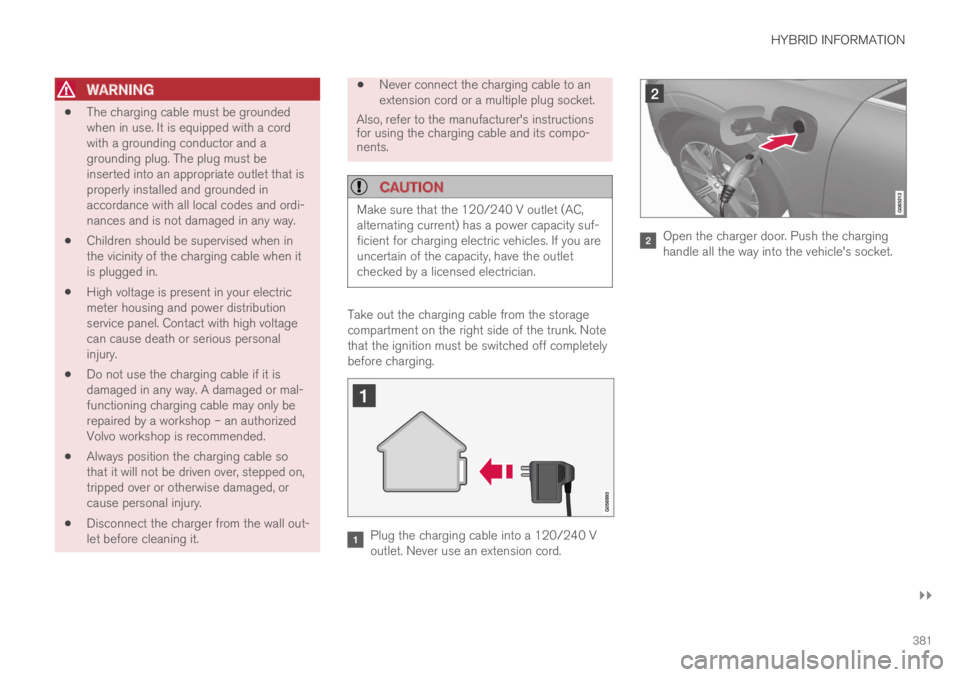
Take out the charging cable from the storagecompartment on the right side of the trunk. Notethat the ignition must be switched off completelybefore charging.
Plug the charging cable into a 120/240 Voutlet. Never use an extension cord.
Open the charger door. Push the charginghandle all the way into the vehicle's socket.