tire pressure VOLVO S80 1999 Owners Manual
[x] Cancel search | Manufacturer: VOLVO, Model Year: 1999, Model line: S80, Model: VOLVO S80 1999Pages: 96, PDF Size: 2.27 MB
Page 4 of 96
remaining emissions continues. Volvo is the only automobile manufacturer to offer CFC-free retrofit kits for the air
conditioning system for all models as far back as the M/Y 1975 240. Advanced electronic engine controls, refined
purification systems and cleaner fuels are bringing us closer to our goal.
After Volvo cars and parts have fulfilled their use, recycling is the next critical step in completing the life cycle. The
metal content is about 75% of the total weight of a car, which makes the car among the most recycled industrial
products. In order to have efficient and well controlled recycling, many Volvo variants have printed dismantling
manuals, indicating the weight and material of individual components. For Volvo, all homogeneous plastic parts
weighing more than 1.7 oz. (50 grams) are marked with international symbols that indicate how the component is to be
sorted for recycling.
In addition to continuous environmental refinement of conventional gasoline-powered internal combustion engines,
Volvo is actively looking at advanced technology alternative-fuel vehicles.
When you drive a Volvo, you become our partner in the work to lessen the car's impact on the environment.
To reduce your vehicle's environmental impact, you can:
· Maintain proper air pressure in your tires. Tests have shown decreased fuel economy with improperly inflated tires
· Follow the recommended maintenance schedule
· Drive at a constant speed
· See an authorized Volvo retailer as soon as possible for inspection if the check engine (malfunction indicator) lamp
illuminates, or stays on after the vehicle has started
· Properly dispose of any vehicle related waste such as used motor oil, used batteries, brake pads, etc.
· When cleaning your car, use Volvo's own car care products, all of which have systematically been adapted to the
environment.
For additional information regarding the environmental activities inwhich Volvo Cars of North America, Inc. and
Volvo Car Corporation are involved, visit our Internet Home Page at:
http://www.volvocars.com
Top of Page
ProCarManuals.com
Page 52 of 96
gear).
· When starting in the (M)anual position, 3rd gear is the highest gear that may be selected.
NOTE: Kickdown (see previous page) does not function when the transmission is in the manual shift (geartronic)
mode.
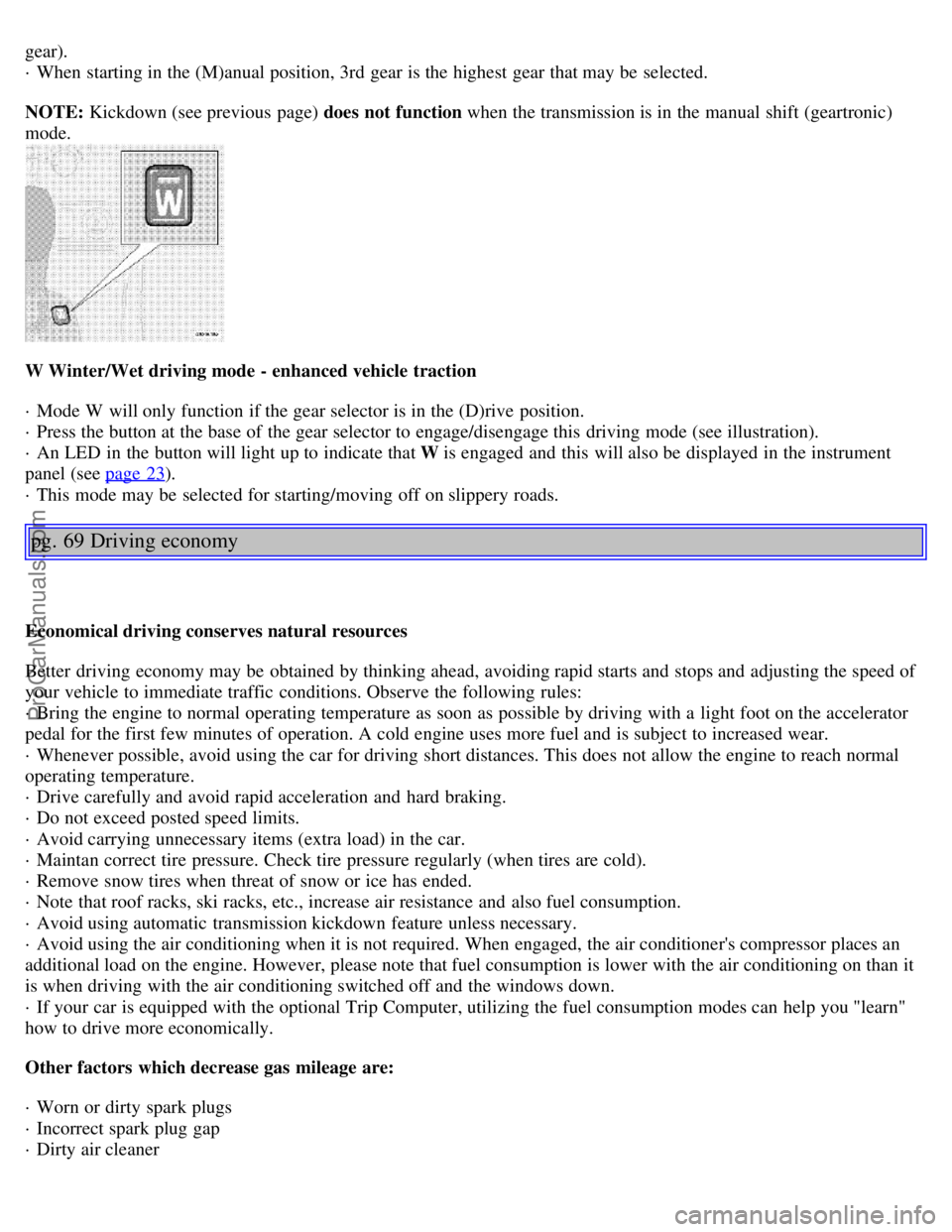
W Winter/Wet driving mode - enhanced vehicle traction
· Mode W will only function if the gear selector is in the (D)rive position.
· Press the button at the base of the gear selector to engage/disengage this driving mode (see illustration).
· An LED in the button will light up to indicate that W is engaged and this will also be displayed in the instrument
panel (see page 23
).
· This mode may be selected for starting/moving off on slippery roads.
pg. 69 Driving economy
Economical driving conserves natural resources
Better driving economy may be obtained by thinking ahead, avoiding rapid starts and stops and adjusting the speed of
your vehicle to immediate traffic conditions. Observe the following rules:
· Bring the engine to normal operating temperature as soon as possible by driving with a light foot on the accelerator
pedal for the first few minutes of operation. A cold engine uses more fuel and is subject to increased wear.
· Whenever possible, avoid using the car for driving short distances. This does not allow the engine to reach normal
operating temperature.
· Drive carefully and avoid rapid acceleration and hard braking.
· Do not exceed posted speed limits.
· Avoid carrying unnecessary items (extra load) in the car.
· Maintan correct tire pressure. Check tire pressure regularly (when tires are cold).
· Remove snow tires when threat of snow or ice has ended.
· Note that roof racks, ski racks, etc., increase air resistance and also fuel consumption.
· Avoid using automatic transmission kickdown feature unless necessary.
· Avoid using the air conditioning when it is not required. When engaged, the air conditioner's compressor places an
additional load on the engine. However, please note that fuel consumption is lower with the air conditioning on than it
is when driving with the air conditioning switched off and the windows down.
· If your car is equipped with the optional Trip Computer, utilizing the fuel consumption modes can help you "learn"
how to drive more economically.
Other factors which decrease gas mileage are:
· Worn or dirty spark plugs
· Incorrect spark plug gap
· Dirty air cleaner
ProCarManuals.com
Page 54 of 96
1 9 9 9
VOLVO S80
Chapter 7 - Wheels and tires
pg. 79 Wheels and tires
General information, Wear indicator, Tire economy, Flat spots80
Snow chains, Winter tires81
Inflation pressure, Spare tire82
Uniform tire quality grading83
Changing wheels84
pg. 80 Wheels and tires
General information
Your vehicle is equipped with tires according to the tire information label on the inside of the fuel tank cover.
The following is an example of a tire designation code: 225/55 R16
225 = tire width in mm.
55 = tire profile. This is the relationship (in percent) between the section height and width of the tire.
R = radial tires.
16 = diameter in inches.
The tires have good road holding characteristics and offer good handling on dry and wet surfaces. It should be noted
however that the tires have been developed to give these features on snow/icefree surfaces. Certain models are
equipped with "all-season" tires, which provide a somewhat higher degree of road holding on slippery surfaces
than tires without the "all-season" rating. However, for optimum road holding on icy or snow covered roads we
recommend suitable winter tires on all four wheels. When replacing tires, be sure that the new tires are the same
size designation, type (radial) and preferably from the same manufacturer, on all four wheels. Otherwise there is a risk
of altering the car's roadholding and handling characteristics.
NOTE: When storing wheel/tire assemblies (e.g. winter tires and wheels), either stand the assemblies upright, or
suspend them off the ground. Laying wheel/tire assemblies on their sides for prolonged periods can cause wheel and/or
ProCarManuals.com
Page 55 of 96
tire damage.
Wear indicator
The tires have a socalled "wear indicator" in the form of a number of narrow strips running across or parallel to the
tread. When approx. 1/16" (1.6 mm) is left on the tread, these strips become visible and indicate that the tire should be
replaced.
Tires with less than 1/16" (1.6 mm) tread have a very poor grip in rain
or snow.
When replacing worn tires, it is recommended that the tire be identical in type (radial) and size as the one being
replaced. Using a tire of the same make (manufacturer) will prevent alteration of the driving characteristics of the
vehicle.
To improve tire economy:
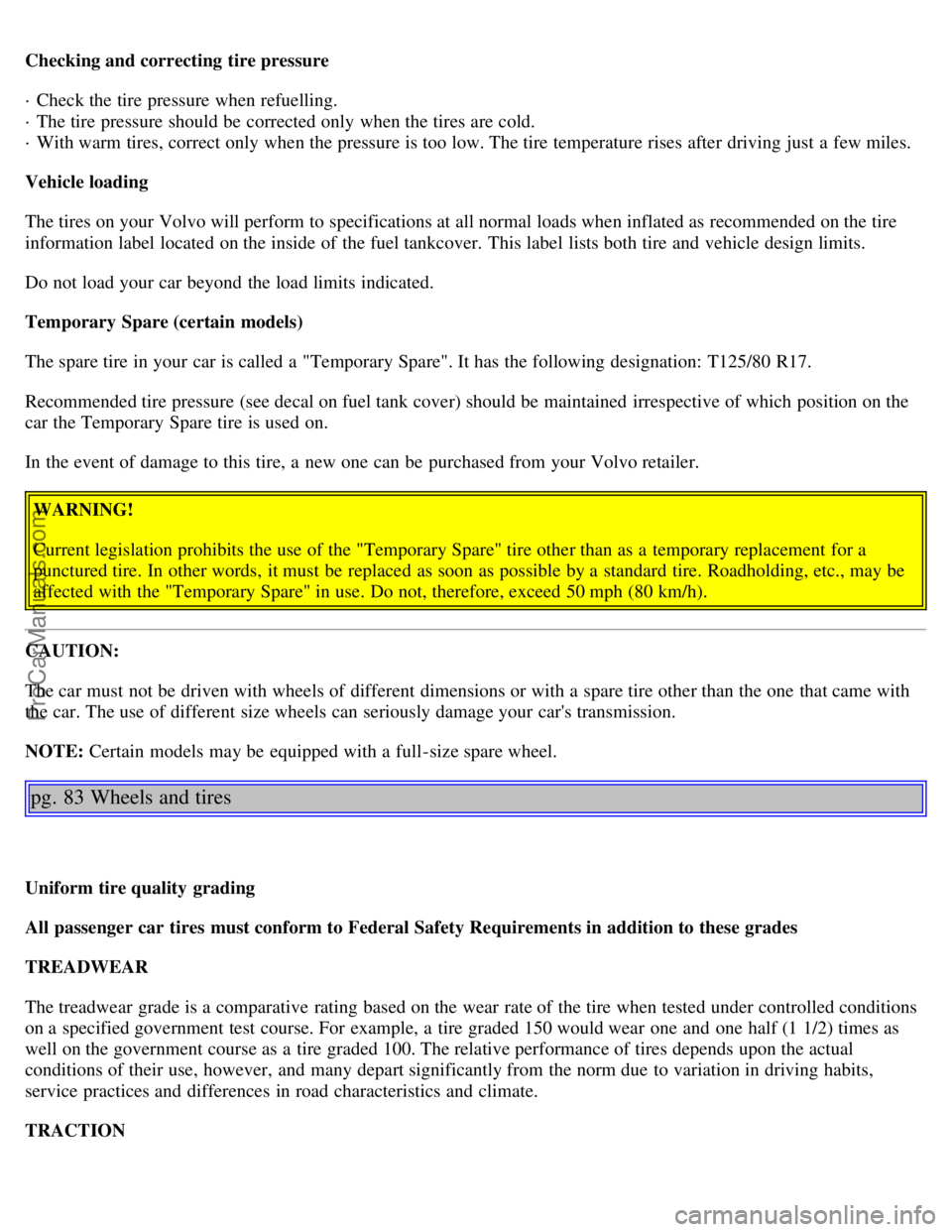
· Maintain correct tire pressure. See the tire pressure label on the inside of the fuel tank cover.
· Drive smoothly: avoid fast starts, hard braking and tire screeching.
· Tire wear increases with speed.
· Correct front wheel alignment is very important.
· Unbalanced wheels impair tire economy and driving comfort.
· If the wheels are rotated, they should be kept on the same side of the car so that they revolve in the same direction as
prior to rotation.
· Hitting curbs or potholes can damage the tires and/or wheels permanently.
Flat spots
All tires become warm during use. After cooling, when the vehicle is parked, the tires have a tendency to distort
slightly, forming flat spots. These flat spots can cause vibrations similar to the vibrations caused by unbalanced wheels.
They do, however, disappear when the tire warms up. The degree to which flat spots form depends on the type of cord
used in the tire. Remember that, in cold weather, it takes longer for the tire to warm up and consequently longer for the
flat spot to disappear.
CAUTION:
The car must not be driven with wheels of different dimensions or with a spare tire other than the one that came with
the car. The use of different size wheels can seriously damage your car's transmission.
pg. 81 Wheels and tires
Snow chains
Snow chains can be used on your Volvo with the following restrictions:
· Snow chains should be installed on front wheels only. Use only Volvo approved snow chains.
· Special snow chains must be mounted on 215/55 R16, 225/55 R16 and 225/50 R17 tires. Consult your Volvo retailer.
· If accessory, aftermarket or "custom" tires and wheels are installed and are of a size different than the original tires
and wheels, chains in some cases CANNOT be used. Sufficient clearances between chains and brakes, suspension and
body components must be maintained.
· Some strapon type chains will interfere with brake components and therefore CANNOT be used.
ProCarManuals.com
Page 56 of 96
Consult your Volvo retailer for additional snow chain information.
CAUTION:
· Check local regulations regarding the use of snow chains before installing.
· Always follow the chain manufacturer's installation instructions carefully. Install chains as tightly as possible and
retighten periodically.
· Never exceed the chain manufacturer's specified maximum speed limit. (Under no circumstances should that limit be
higher than
31 mph (50 km/h).
· Avoid bumps, holes or sharp turns when driving with snow chains.
· The handling of the vehicle can be adversely affected when driving with chains. Avoid fast or sharp turns as well as
locked wheel braking.
Snow tires, studded tires *
Tires for winter use:
Owners who live in or regularly commute through areas with sustained periods of snow or icy driving
conditions are strongly advised to fit suitable winter tires to help retain the highest degree of traction.
It is important to install winter tires on all four wheels to help retain traction during cornering, braking, and
accelerating. Failure to do so could reduce traction to an unsafe level or adversely affect handling. Do not mix tires of
different design as this could also negatively affect overall tire road grip.
Volvo recommends 215/55 R16 winter tires on all four wheels .
Winter tires wear more quickly on dry roads in warm weather. They should be removed when the winter driving
season has ended.
Studded tires should be runin 300600 miles (5001000 km) during which the car should be driven as smoothly as
possible to give the studs the opportunity to seat properly in the tires. The tires should have the same rotational
direction throughout their entire lifetime. In other words, if you wish to rotate the wheels, make sure that the same
wheels are always on the same side of the car.
NOTE: Please consult state or provincial regulations restricting the use of studded winter tires before installing such
tires.
* Where permitted.
pg. 82 Wheels and tires
Tire pressure label
ProCarManuals.com
Page 57 of 96
Checking and correcting tire pressure
· Check the tire pressure when refuelling.
· The tire pressure should be corrected only when the tires are cold.
· With warm tires, correct only when the pressure is too low. The tire temperature rises after driving just a few miles.
Vehicle loading
The tires on your Volvo will perform to specifications at all normal loads when inflated as recommended on the tire
information label located on the inside of the fuel tankcover. This label lists both tire and vehicle design limits.
Do not load your car beyond the load limits indicated.
Temporary Spare (certain models)
The spare tire in your car is called a "Temporary Spare". It has the following designation: T125/80 R17.
Recommended tire pressure (see decal on fuel tank cover) should be maintained irrespective of which position on the
car the Temporary Spare tire is used on.
In the event of damage to this tire, a new one can be purchased from your Volvo retailer.WARNING!
Current legislation prohibits the use of the "Temporary Spare" tire other than as a temporary replacement for a
punctured tire. In other words, it must be replaced as soon as possible by a standard tire. Roadholding, etc., may be
affected with the "Temporary Spare" in use. Do not, therefore, exceed 50 mph (80 km/h).
CAUTION:
The car must not be driven with wheels of different dimensions or with a spare tire other than the one that came with
the car. The use of different size wheels can seriously damage your car's transmission.
NOTE: Certain models may be equipped with a full-size spare wheel.
pg. 83 Wheels and tires
Uniform tire quality grading
All passenger car tires must conform to Federal Safety Requirements in addition to these grades
TREADWEAR
The treadwear grade is a comparative rating based on the wear rate of the tire when tested under controlled conditions
on a specified government test course. For example, a tire graded 150 would wear one and one half (1 1/2) times as
well on the government course as a tire graded 100. The relative performance of tires depends upon the actual
conditions of their use, however, and many depart significantly from the norm due to variation in driving habits,
service practices and differences in road characteristics and climate.
TRACTION
ProCarManuals.com
Page 73 of 96
1 9 9 9
VOLVO S80
Chapter 9 - Specifications
pg.117 Specifications
Label information118
Dimensions and weights119
Engine/transmission specifications120
Oil/fluid specifications and volumes121
Fuel system, Distributor ignition system, Suspension122
Electrical system123
Volvo On Call, Service manuals124
pg.118 Label information
1 Vehicle Emission Control Information
Your Volvo is designed to meet all applicable emission standards, as evidenced by the certification label on the
underside of the hood. For further information regarding these regulations, please consult your Volvo retailer.
2 Vacuum hose routing
(underside of hood)
3 Loads and Tire Pressures
(on inside of fuel tank cover)
4 Model plate
Vehicle Identification Number (VIN). Codes for color and upholstery, etc. The plate is located in the engine
compartment, on the inside of the left front fender.
5 Vehicle Identification Number (VIN) *
The VIN plate is located on the top left surface of the dashboard. The VIN is also stamped on the right hand door
pillar.
6 Federal Motor Vehicle Safety Standards (FMVSS) specifications (USA) and Ministry of Transport (CMVSS)
ProCarManuals.com
Page 95 of 96

SRS diagnostic system24
Stability Traction Control (STC)18, 27
Start inhibitor (immobilizer)54, 64
Starting the engine64
Steering wheel adjustment32
Steering wheel lock32
Storage compartment in center console50
Storage compartments49
Studded tires81
Sun roof37
Supplemental Restraint System4, 24
Suspension122
Switches in center console27
T
Tachometer23
Tail light bulbs - replacing94
Temperature gauge23
Temporary spare tire82
Text window26
Three-way catalytic converters78
Tire pressure82
Tires70, 80-83
Tires - changing84-85
Tool bag51
Towing a trailer74
Towing eyelet72
Towing the car72,73
Trailer towing74
Trailer weight - maximum119
Transmission - automatic65-68
Transmission - specifications120
Transmission fluid (automatic)113, 121
Trip computer28
Trip odometer23
Trunk - unlocking with master key55
Trunk lights - replacing97
Trunk lock switch27, 55
Turn signals31
U
Uniform tire quality grading83
Unlocking the trunk with key55
Upholstery - cleaning101
V
Vanity mirror lights - replacing95
ProCarManuals.com