tow VOLVO S80 1999 Owners Manual
[x] Cancel search | Manufacturer: VOLVO, Model Year: 1999, Model line: S80, Model: VOLVO S80 1999Pages: 96, PDF Size: 2.27 MB
Page 11 of 96
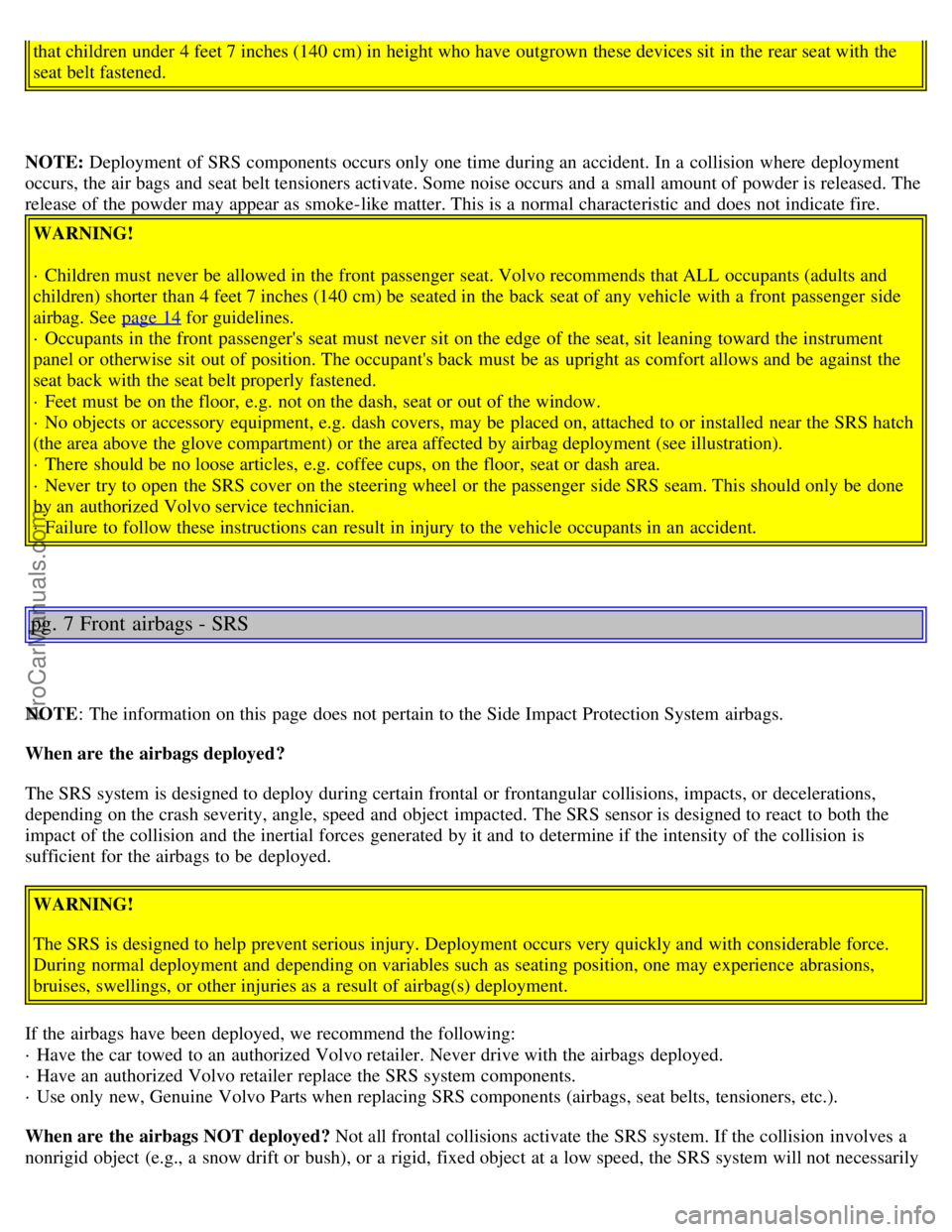
that children under 4 feet 7 inches (140 cm) in height who have outgrown these devices sit in the rear seat with the
seat belt fastened.
NOTE: Deployment of SRS components occurs only one time during an accident. In a collision where deployment
occurs, the air bags and seat belt tensioners activate. Some noise occurs and a small amount of powder is released. The
release of the powder may appear as smoke-like matter. This is a normal characteristic and does not indicate fire.
WARNING!
· Children must never be allowed in the front passenger seat. Volvo recommends that ALL occupants (adults and
children) shorter than 4 feet 7 inches (140 cm) be seated in the back seat of any vehicle with a front passenger side
airbag. See page 14
for guidelines.
· Occupants in the front passenger's seat must never sit on the edge of the seat, sit leaning toward the instrument
panel or otherwise sit out of position. The occupant's back must be as upright as comfort allows and be against the
seat back with the seat belt properly fastened.
· Feet must be on the floor, e.g. not on the dash, seat or out of the window.
· No objects or accessory equipment, e.g. dash covers, may be placed on, attached to or installed near the SRS hatch
(the area above the glove compartment) or the area affected by airbag deployment (see illustration).
· There should be no loose articles, e.g. coffee cups, on the floor, seat or dash area.
· Never try to open the SRS cover on the steering wheel or the passenger side SRS seam. This should only be done
by an authorized Volvo service technician.
· Failure to follow these instructions can result in injury to the vehicle occupants in an accident.
pg. 7 Front airbags - SRS
NOTE : The information on this page does not pertain to the Side Impact Protection System airbags.
When are the airbags deployed?
The SRS system is designed to deploy during certain frontal or frontangular collisions, impacts, or decelerations,
depending on the crash severity, angle, speed and object impacted. The SRS sensor is designed to react to both the
impact of the collision and the inertial forces generated by it and to determine if the intensity of the collision is
sufficient for the airbags to be deployed.
WARNING!
The SRS is designed to help prevent serious injury. Deployment occurs very quickly and with considerable force.
During normal deployment and depending on variables such as seating position, one may experience abrasions,
bruises, swellings, or other injuries as a result of airbag(s) deployment.
If the airbags have been deployed, we recommend the following:
· Have the car towed to an authorized Volvo retailer. Never drive with the airbags deployed.
· Have an authorized Volvo retailer replace the SRS system components.
· Use only new, Genuine Volvo Parts when replacing SRS components (airbags, seat belts, tensioners, etc.).
When are the airbags NOT deployed? Not all frontal collisions activate the SRS system. If the collision involves a
nonrigid object (e.g., a snow drift or bush), or a rigid, fixed object at a low speed, the SRS system will not necessarily
ProCarManuals.com
Page 12 of 96

deploy. Front airbags do not normally deploy in a side impact collision, in a collision from the rear or in a rollover
situation. The amount of damage to the bodywork does not reliably indicate if the airbags should have deployed or not.
Seat belts the heart of the Volvo safety system The heart of the Volvo safety system is the threepoint seat belt (a
Volvo invention)! In order for the SRS system to provide the protection intended, seat belts must be worn at all times
by everyone in the car. The SRS system is a supplement to the seat belts.
WARNING!
If your car has been subjected to flood conditions (e.g. soaked carpeting/standing water on the floor of the vehicle)
or if your car has become flooddamaged in any way, do not attempt to start the vehicle or put the key in the ignition
before disconnecting the battery (see below). This may cause airbag deployment which could result in personal
injury. Have the car towed to an authorized Volvo retailer for repairs.
Automatic transmission:
Before attempting to tow the car, use the following procedure to override the shiftlock system to move the gear
selector to the neutral position.
· Switch off the ignition for at least 10 minutes and disconnect the battery
· Wait at least one minute
· Insert the key in the ignition and turn it to position II
· Press firmly on the brake pedal.
· Move the gear selector from (P)ark to the (N)eutral position.
WARNING!
Never drive with the airbags deployed. The fact that they hang out can impair the steering of your car. Other safety
systems can also be damaged. The smoke and dust formed when the airbags are deployed can cause skin and eye
irritation in the event of prolonged exposure.
pg. 8 Side impact airbags (SIPS)
SIPS airbag decal*
SIPS airbag (front seats only)
As an enhancement to the structural Side Impact Protection System built into your car, the car is also equipped with
Side Impact Protection System (SIPS) airbags. The SIPS airbag system consists of airbag modules built into the sides
of both front seat backrests (1), wires (2) and gas generators/sensor units (3).
ProCarManuals.com
Page 13 of 96

The SIPS airbag system is designed to help increase occupant protection in the event of certain side impact collisions.
The SIPS airbags are designed to deploy only during certain sideimpact collisions, depending on the crash severity,
angle, speed and point of impact. The airbags are not designed to deploy in all side impact situations.
NOTE: SIPS airbag deployment (one airbag) occurs only on the side of the vehicle affected by the impact.
WARNING!
· The SIPS airbag system is a supplement to the Side Impact Protection System and the threepoint seat belt system.
It is not designed to deploy during collisions from the front or rear of the car or in rollover situations.
· The use of seat covers on the front seats may impede SIPS airbag deployment.
· No objects, accessory equipment or stickers may be placed on, attached to or installed near, the SIPS airbag system
or in the area affected by SIPS airbag deployment (see illustration to the right above).
· Never try to open or repair any components of the SIPS airbag system. This should only be done by an authorized
Volvo service technician.
· For best protection from the SIPS airbag system, both front seat occupants should sit in an upright position with
the seat belt properly fastened.
1 - Airbag, 2 - wire, 3 - gas generator/sensor unit
WARNING!
· Never drive with the airbags deployed. The fact that they hang out can impair the steering of your car. Other safety
systems can also be damaged. The smoke and dust formed when the airbags are deployed can cause skin and eye
irritation in the event of prolonged exposure.
· If your car has been subjected to flood conditions (e.g. soaked carpeting/standing water on the floor of the vehicle)
or if your car has become flooddamaged in any way, do not attempt to start the vehicle or put the key in the ignition
before disconnecting the battery. This may cause airbag deployment which could result in personal injury. Have the
car towed to an authorized Volvo retailer for repairs.
*A SIPS airbag warning decal is also located at the end of the instrument panel on the driver's side of the car.
pg. 9 Volvo Inflatable curtain (VIC)
Volvo Inflatable curtain (VIC) This system consists of inflatable curtains located along the sides of the roof liners,
stretching from the center of both front side windows to the rear edge of the rear side windows. It is designed to help
protect the heads of the occupant of the front seat and the occupant of the outboard rear seat position in certain side
ProCarManuals.com
Page 21 of 96
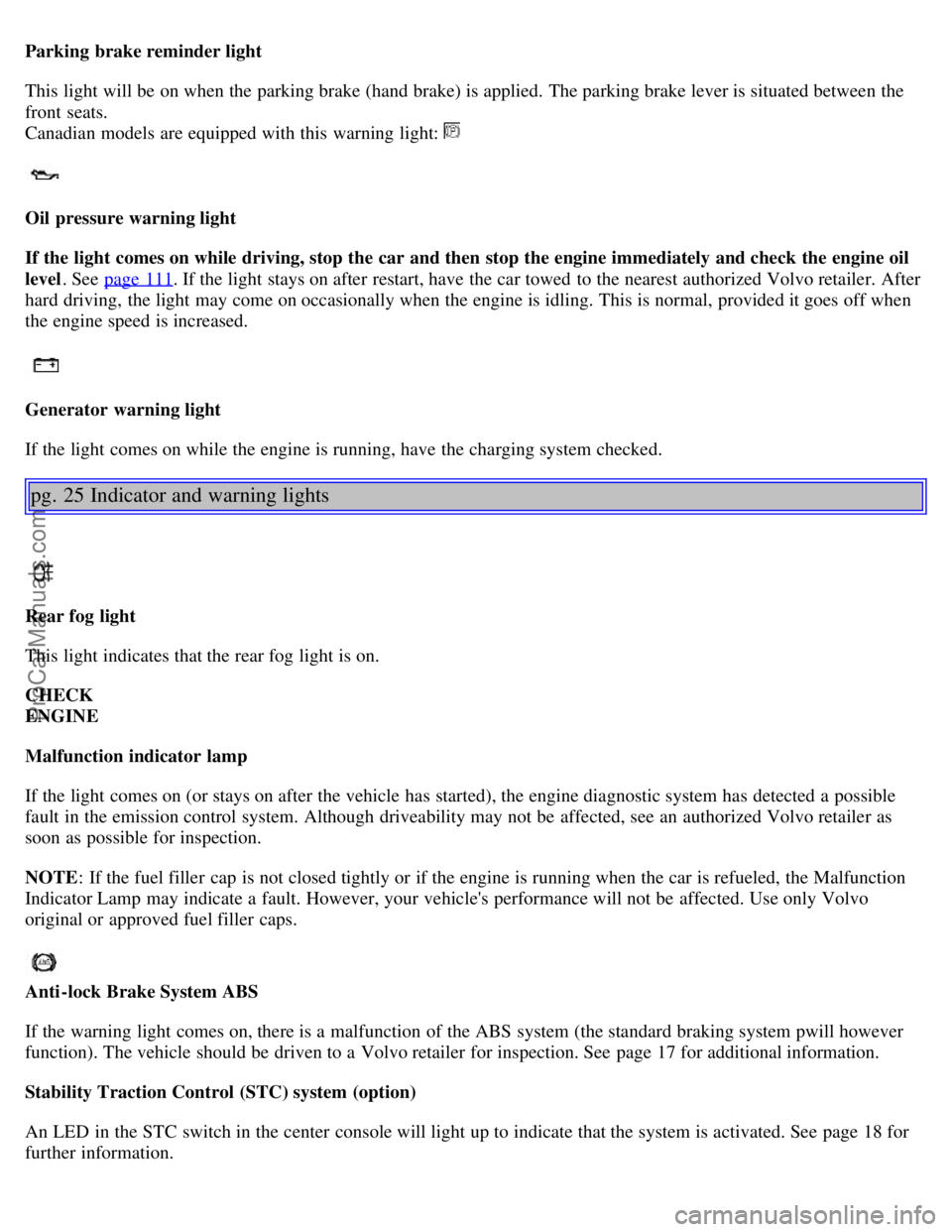
Parking brake reminder light
This light will be on when the parking brake (hand brake) is applied. The parking brake lever is situated between the
front seats.
Canadian models are equipped with this warning light:
Oil pressure warning light
If the light comes on while driving, stop the car and then stop the engine immediately and check the engine oil
level . See page 111
. If the light stays on after restart, have the car towed to the nearest authorized Volvo retailer. After
hard driving, the light may come on occasionally when the engine is idling. This is normal, provided it goes off when
the engine speed is increased.
Generator warning light
If the light comes on while the engine is running, have the charging system checked.
pg. 25 Indicator and warning lights
Rear fog light
This light indicates that the rear fog light is on.
CHECK
ENGINE
Malfunction indicator lamp
If the light comes on (or stays on after the vehicle has started), the engine diagnostic system has detected a possible
fault in the emission control system. Although driveability may not be affected, see an authorized Volvo retailer as
soon as possible for inspection.
NOTE : If the fuel filler cap is not closed tightly or if the engine is running when the car is refueled, the Malfunction
Indicator Lamp may indicate a fault. However, your vehicle's performance will not be affected. Use only Volvo
original or approved fuel filler caps.
Anti-lock Brake System ABS
If the warning light comes on, there is a malfunction of the ABS system (the standard braking system pwill however
function). The vehicle should be driven to a Volvo retailer for inspection. See page 17 for additional information.
Stability Traction Control (STC) system (option)
An LED in the STC switch in the center console will light up to indicate that the system is activated. See page 18 for
further information.
ProCarManuals.com
Page 22 of 96

Service reminder indicator
This light will come on at 7,500 mile (12,000 km) intervals, after 750 hours of driving or after 12 months, whichever
occurs first, to remind the driver that the service interval has been exceeded. The light will stay on for 2 minutes after
start until reset by the servicing retailer.
Turn signal indicator - trailer (certain models)
If you are towing a trailer, this light will flash simultaneously with the turn signals on the trailer. If the light does not
flash when signaling, neither the trailer's turn signals nor the car's turn signals are functioning.
Contents | Top of Page
ProCarManuals.com
Page 23 of 96
1 9 9 9
VOLVO S80
Chapter 3 - Climate control system
pg. 39 Climate control system
Ventilation40
Electronic Climate Control (ECC)41
Climate control system - general information44
pg. 40 Ventilation
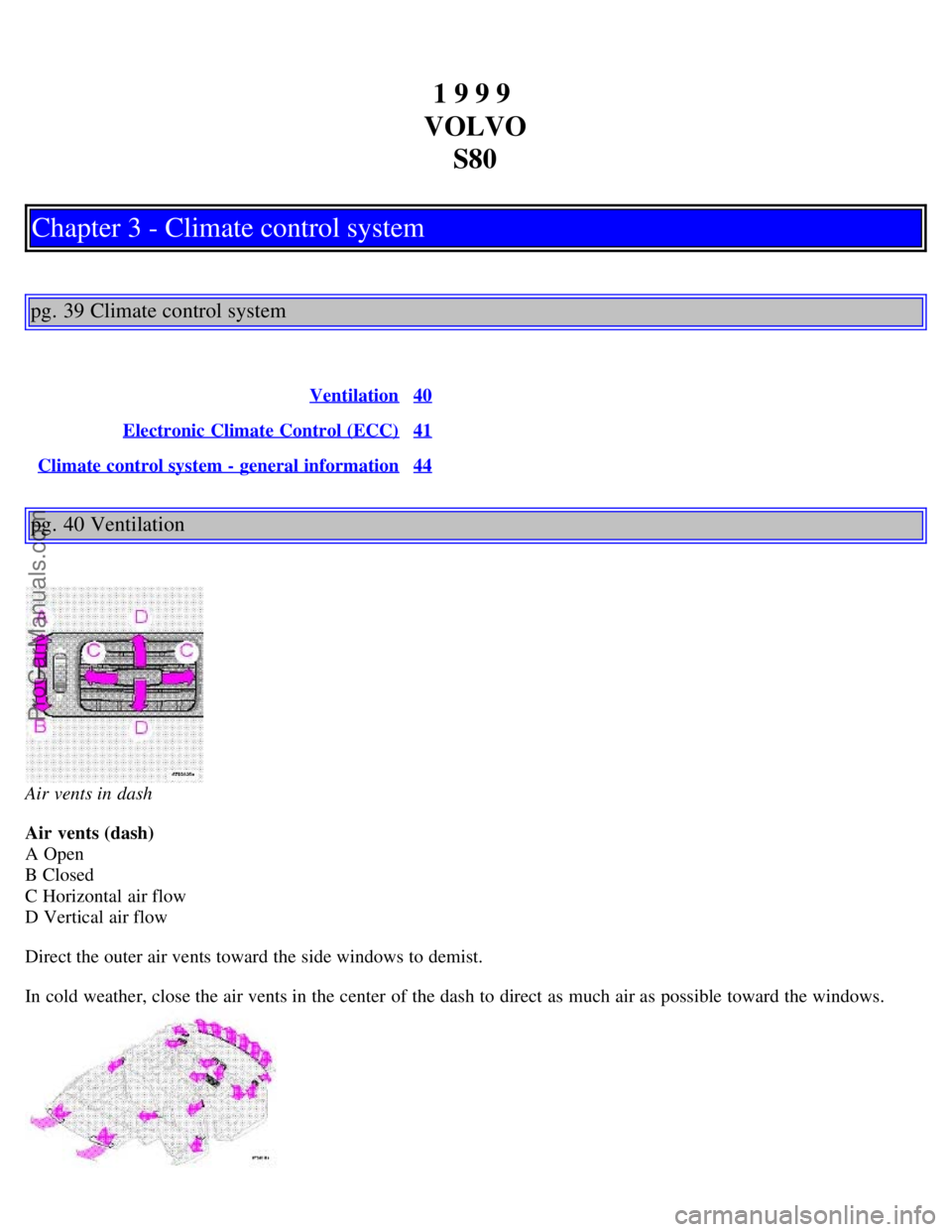
Air vents in dash
Air vents (dash)
A Open
B Closed
C Horizontal air flow
D Vertical air flow
Direct the outer air vents toward the side windows to demist.
In cold weather, close the air vents in the center of the dash to direct as much air as possible toward the windows.
ProCarManuals.com
Page 24 of 96
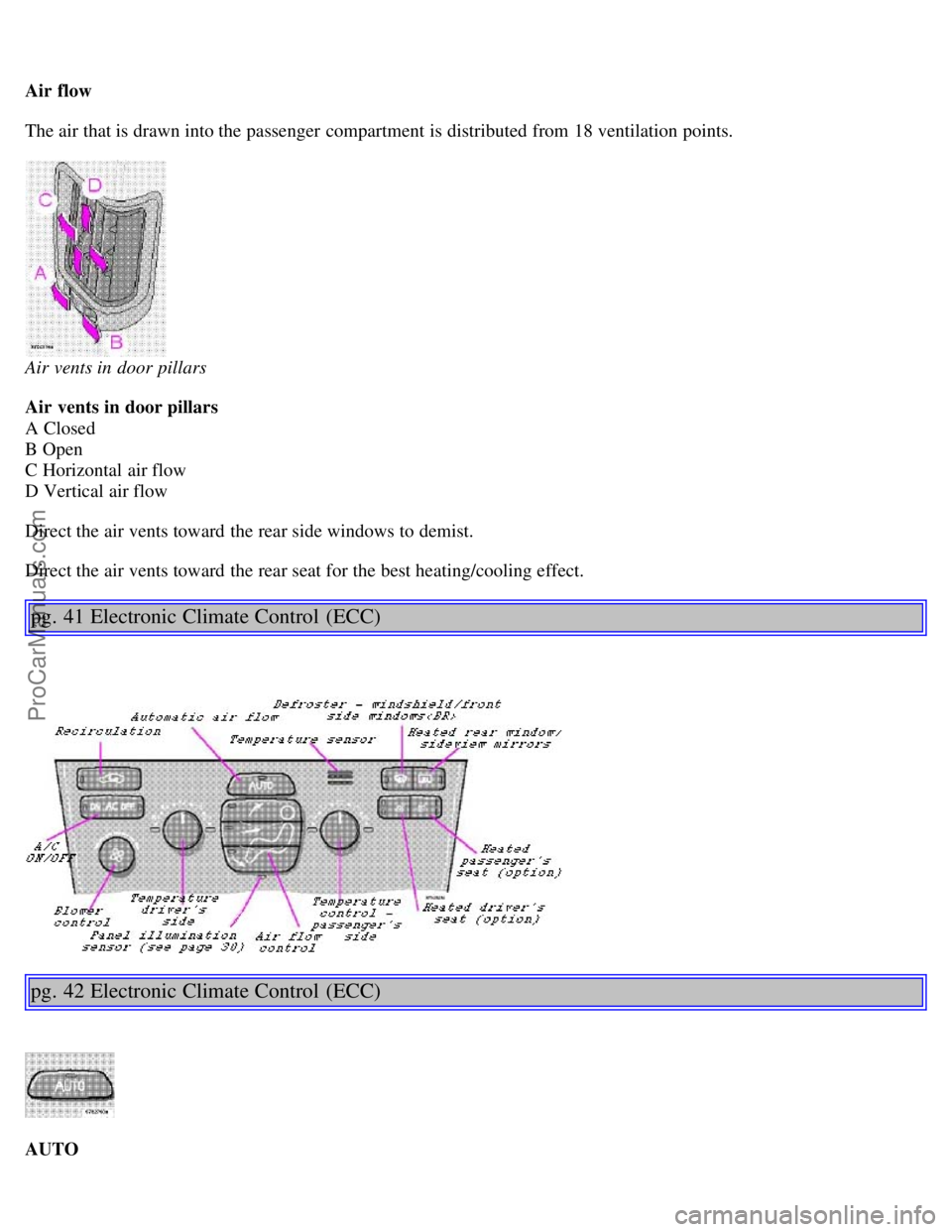
Air flow
The air that is drawn into the passenger compartment is distributed from 18 ventilation points.
Air vents in door pillars
Air vents in door pillars
A Closed
B Open
C Horizontal air flow
D Vertical air flow
Direct the air vents toward the rear side windows to demist.
Direct the air vents toward the rear seat for the best heating/cooling effect.
pg. 41 Electronic Climate Control (ECC)
pg. 42 Electronic Climate Control (ECC)
AUTO
ProCarManuals.com
Page 33 of 96
Spare tire
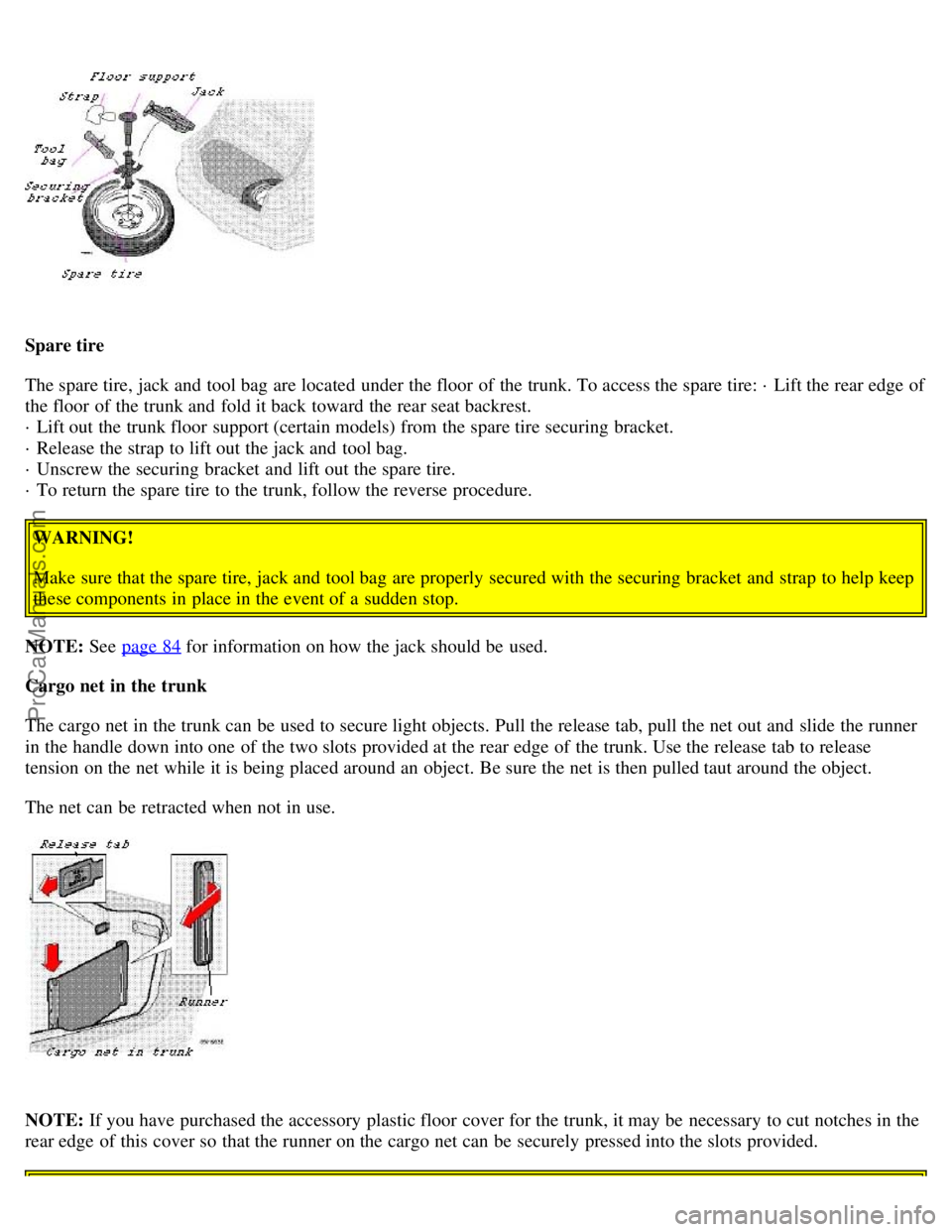
The spare tire, jack and tool bag are located under the floor of the trunk. To access the spare tire: · Lift the rear edge of
the floor of the trunk and fold it back toward the rear seat backrest.
· Lift out the trunk floor support (certain models) from the spare tire securing bracket.
· Release the strap to lift out the jack and tool bag.
· Unscrew the securing bracket and lift out the spare tire.
· To return the spare tire to the trunk, follow the reverse procedure.WARNING!
Make sure that the spare tire, jack and tool bag are properly secured with the securing bracket and strap to help keep
these components in place in the event of a sudden stop.
NOTE: See page 84
for information on how the jack should be used.
Cargo net in the trunk
The cargo net in the trunk can be used to secure light objects. Pull the release tab, pull the net out and slide the runner
in the handle down into one of the two slots provided at the rear edge of the trunk. Use the release tab to release
tension on the net while it is being placed around an object. Be sure the net is then pulled taut around the object.
The net can be retracted when not in use.
NOTE: If you have purchased the accessory plastic floor cover for the trunk, it may be necessary to cut notches in the
rear edge of this cover so that the runner on the cargo net can be securely pressed into the slots provided.
ProCarManuals.com
Page 37 of 96
Turn the key again (within 10 seconds) to unlock all doors and the trunk.
One turn with the key towards lock in the drivers door locks all doors, trunk.
Use the switch on the front door armrests to lock/unlock the car from the inside.
WARNING!
If the doors are locked while driving, this may hinder rapid access to the occupants of the car in the event of an
accident. (Also see information on "Child safety locks").
Note: To help prevent accidentally locking the keys in the car, the central locking system is designed to unlock the
doors immediately if the key is left in the ignition switch, the car is locked using the lock button on the door and the
door is then closed. A sound from the lock will be audible at this time.
Please note that this function will not unlock the doors if the engine is running.
Immobilizer (start inhibitor)
Each of the keys supplied with your car contains a coded transmitter and receiver (transponder). The code in the key is
transmitted to an antenna in the ignition switch where it is compared to the code stored in the start inhibitor module.
The car can only be started if a properly coded key is used.
If you misplace a key, take the other keys to an authorized Volvo retailer for reprogramming as an antitheft measure.
This device complies with part 15 of the FCC rules. Operation is subject to the following condition: (1) This device
may not cause harmful interference, and (2) this device must accept any interference received, including interference
that may cause undesired operation.
Courtesy lights
Home Safe System
When you leave your car at night, you can make use of the courtesy lighting function:
· Remove the key from the ignition switch.
· Pull the direction indicator lever towards the steering wheel (as when using the headlight flasher function).
· Exit the car and lock the doors.
The headlights, parking lights, license plate lights and the lights in the sideview mirrors will now come on and remain
on for 30, 60 or 90 seconds (the time interval is at your discretion and can be changed by an authorized Volvo retailer).
Approach lighting
When approaching the car at night, press the yellow button in the central locking remote control (see illustration on
page 56
). This lights up the interior courtesy light, parking lights, license plate lights and the lights in the sideview
mirrors.
pg. 55 Locking and unlocking the car
ProCarManuals.com
Page 41 of 96

Remote keyless entry system - replacing batteries
Each remote transmitter is powered by a three-volt, CR 2032 battery.
If the range of the transmitter is noticeably reduced, this indicates that the battery is weak and should be replaced.
Replacement: Remove the screw on the back of the transmitter cover. Replace the battery. Reinstall the cover and
tighten the screw to help protect the transmitter.
NOTE: The old battery should be disposed of properly at a recycling center or at your Volvo retailer.
pg. 58 Alarm
Alarm
The alarm is automatically set (armed) whenever you lock your car.
When armed (set), the alarm continuously monitors a number of points on the car. The following conditions will set off
the alarm:
· The hood is opened.
· The trunk is opened.
· A door is opened.
· The ignition switch is tampered with.
· If there is movement in the passenger compartment (if the car is equipped with the optional movement sensor).
· The car is lifted or towed (if the car is equipped with the optional inclination sensor).
· The battery is disconnected (while the alarm is set).
Arming (setting) the alarm
Press the LOCK button on the remote control, lock the car using the key in the driver's door or press the central lock
button on one of the front doors with the door open. One long flash of the turn signals will confirm that the alarm is
set.
Disarming the alarm
Press the UNLOCK button on the remote control or unlock the doors with the key.
Turning off (stopping) the alarm
If the alarm is sounding, it can be stopped by pressing the UNLOCK button on the remote control or by unlocking the
driver's door with the key.
ProCarManuals.com