oil VOLVO S80 2009 Owner´s Manual
[x] Cancel search | Manufacturer: VOLVO, Model Year: 2009, Model line: S80, Model: VOLVO S80 2009Pages: 288, PDF Size: 6.3 MB
Page 236 of 288
06 Maintenance and specificationsFuses
06236
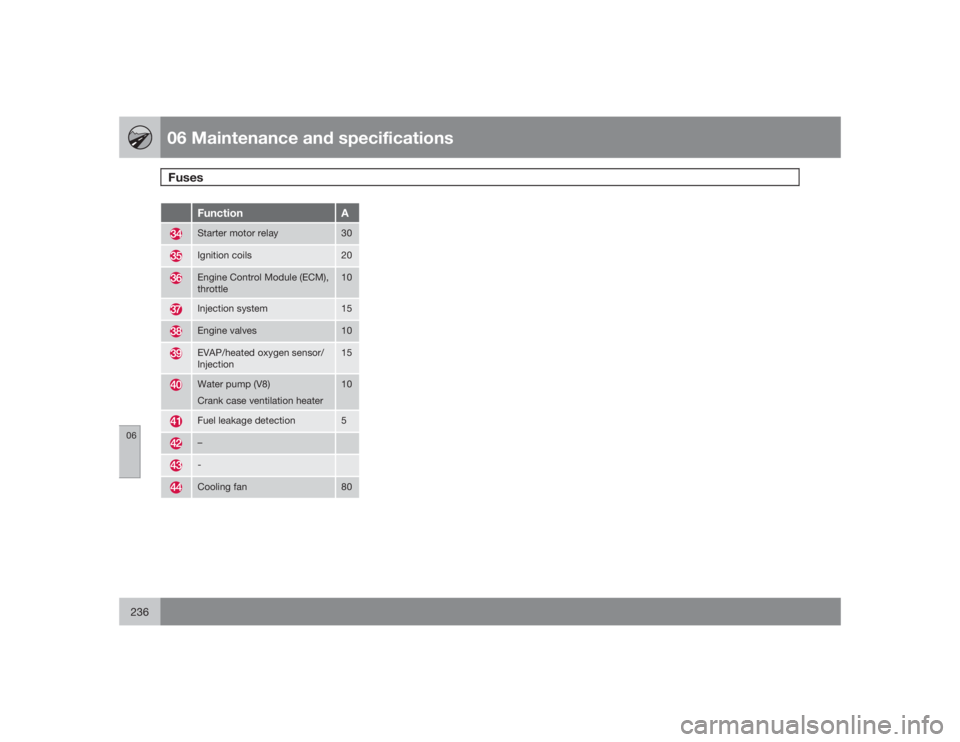
Function
A
Starter motor relay
30
Ignition coils
20
Engine Control Module (ECM),
throttle
10
Injection system
15
Engine valves
10
EVAP/heated oxygen sensor/
Injection
15
Water pump (V8)
Crank case ventilation heater
10
Fuel leakage detection
5
–-Cooling fan
80
Page 242 of 288
06 Maintenance and specificationsWheels and tires
06242
IntroductionYour vehicle is equipped with tires according
to the vehicle's tire information placard on the
B-pillar (the structural member at the side of
the vehicle, at the rear of the driver's door
opening).
The tires have good road holding characteris-
tics and offer good handling on dry and wet
surfaces. It should be noted however that the
tires have been developed to give these fea-
tures on snow/ice-free surfaces.
Certain models are equipped with "all-season"
tires, which provide a somewhat higher degree
of road holding on slippery surfaces than tires
without the "all-season" rating. However, for
optimum road holding on icy or snow-covered
roads, we recommend suitable winter tires on
all four wheels.
CAUTION
Some Volvo models are equipped with an
Ultra High Performance tire and wheel com-
bination designed to provide maximum dry
pavement performance with consideration
for hydroplaning resistance. As such, they
may be more susceptible to road hazard
damage and, depending on driving condi-
tions, may achieve a tread life of less than
20,000 miles (30,000 km). Even if this vehi-
cle is equipped with Volvo’s advanced AWD
or DSTC system, these tires are not
designed for winter driving, and should be
replaced with winter tires when weather
conditions dictate.When replacing tires, be sure that the new tires
are the same size designation, type (radial) and
preferably from the same manufacturer, on all
four wheels. Otherwise there is a risk of altering
the car's roadholding and handling characte-
ristics.Storing wheels and tiresWhen storing complete wheels (tires mounted
on rims), they should be suspended off the
floor or placed on their sides on the floor.
Tires not mounted on rims should be stored on
their sides or standing upright, but should not
be suspended.
CAUTION
Tires should preferably be stored in a cool,
dry, dark place, and should never be stored
in close proximity to solvents, gasoline, oils,
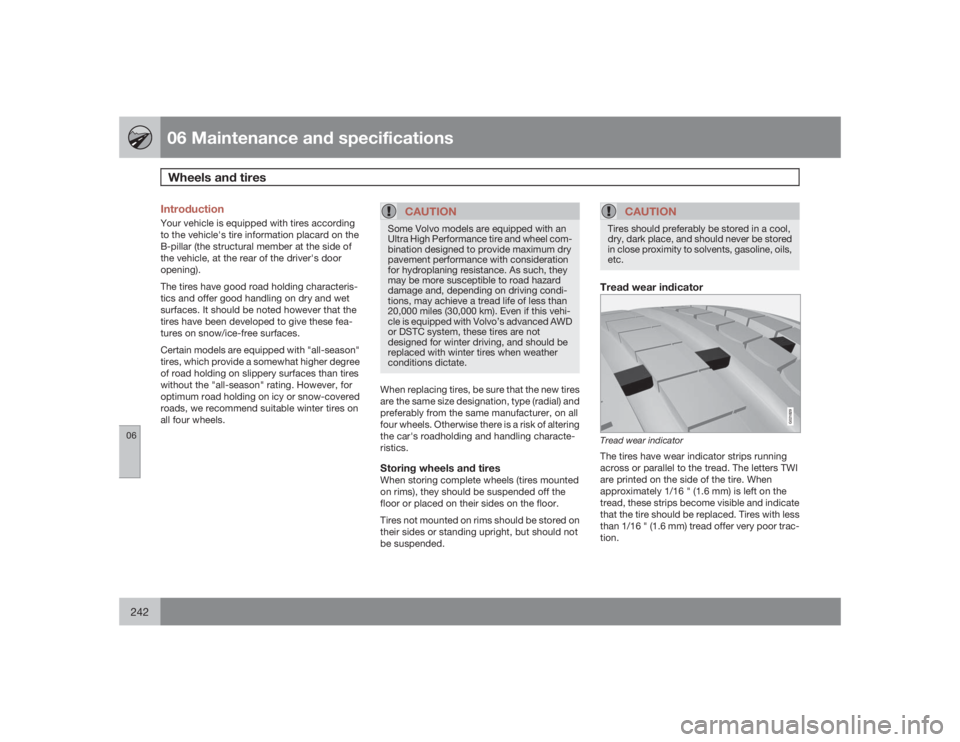
etc.Tread wear indicator
G021829
Tread wear indicatorThe tires have wear indicator strips running
across or parallel to the tread. The letters TWI
are printed on the side of the tire. When
approximately 1/16 " (1.6 mm) is left on the
tread, these strips become visible and indicate
that the tire should be replaced. Tires with less
than 1/16 " (1.6 mm) tread offer very poor trac-
tion.
Page 264 of 288
06 Maintenance and specificationsVehicle care
06264
Washing the car
WARNING
Be sure that the compressor is not con-
nected to a 12-volt socket while replacing
the container.The following points should be kept in mind
when washing and cleaning the car:•
The car should be washed at regular inter-
vals since dirt, dust, insects and tar spots
adhere to the paint and may cause dam-
age. To help prevent corrosion, it is partic-
ularly important to wash the car frequently
in the wintertime.
•
Avoid washing your car in direct sunlight.
Doing so may cause detergents and wax
to dry out and become abrasive. To avoid
scratching, use lukewarm water to soften
the dirt before you wash with a soft
sponge, and plenty of sudsy water.
•
Bird droppings: Remove from paintwork
as soon as possible. Otherwise the finish
may be permanently damaged.
•
A detergent can be used to facilitate the
softening of dirt and oil.
•
A water-soluble grease solvent may be
used in cases of sticky dirt. However, use
a wash place equipped with a drainage
separator.
•
Dry the car with a clean chamois and
remember to clean the drain holes in the
doors and rocker panels.
•
Tar spots can be removed with kerosene
or tar remover after the car has been
washed.
•
A stiff-bristle brush and lukewarm soapy
water can be used to clean the wiper
blades. Frequent cleaning of the wind-
shield and wiper blades improves visibility
considerably and also helps prolong the
service life of the wiper blades.
•
Wash off the dirt from the underside (wheel
housings, fenders, etc).
•
In areas of high industrial fallout, more fre-
quent washing is recommended.
•
After cleaning the engine, the spark plug
wells should be inspected for water and
blown dry if necessary.NOTE
When washing the car, remember to remove
dirt from the drain holes in the doors and
sills.
CAUTION
•
During high pressure washing, the
spray mouthpiece must never be closer
to the vehicle than 13" (30 cm). Do not
spray into the locks.
•
Dirt, snow, etc., on the headlights can
reduce lighting capacity considerably.
Clean the headlights regularly, for
example when refueling.
•
When washing or steam cleaning the
engine, avoid spraying water or steam
directly on the electrical components or
toward the rear side of the engine. Spe-
cial moonroof cautions:
•
Always close the moonroof and sun
shade before washing your vehicle.
•
Never use abrasive cleaning agents on
the moonroof.
•
Never use wax on the rubber seals
around the moonroof.
Exterior componentsVolvo recommends the use of special cleaning
products, available at your Volvo retailer, for
cleaning colored plastic, rubber, or ornamental
components such as chromed strips on the
exterior of your vehicle. The instructions for
using these products should be followed care-
Page 266 of 288
06 Maintenance and specificationsVehicle care
06266
CAUTION
Volvo does not recommend the use of long-
life or durable paint protection coatings,
some of which may claim to prevent pitting,
fading, oxidation, etc. These coatings have
not been tested by Volvo for compatibility
with your vehicle's clear coat. Some of them
may cause the clear coat to soften, crack,
or cloud. Damage caused by application of
paint protection coatings may not be cov-
ered under your vehicle's paint warranty.Cleaning the interiorOnly use cleaning agents and car care prod-
ucts recommended by Volvo. Clean regularly
and follow the instructions included with the
car care product.Upholstery care
FabricClean with soapy water or a detergent. For
more difficult spots caused by oil, ice cream,
shoe polish, grease, etc., use a clothing/fabric
stain remover. Consult your Volvo retailer.Alcantera
TM suede-like material
Suede-like upholstery can be cleaned with a
soft cloth and mild soap solution.Leather careVolvo's leather upholstery is manufactured
with a protectant to repel soiling. Over time,sunlight, grease and dirt can break down the
protection. Staining, cracking, scuffing, and
fading can result.
Volvo offers an easy-to-use, non-greasy
leather care kit formulated to clean and beau-
tify your vehicle's leather, and to renew the
protective qualities of its finish. The cleaner
removes dirt and oil buildup. The light cream
protectant restores a barrier against soil and
sunlight.
Volvo also offers a special leather softener that
should be applied after the cleaner and pro-
tectant. It leaves leather soft and smooth, and
reduces friction between leather and other fin-
ishes in the vehicle.
Volvo recommends cleaning, protecting and
conditioning your vehicle's leather two to four
times a year. Ask your Volvo retailer about
Leather Care Kit 951 0251 and Leather Soft-
ener 943 7429.
Cleaning leather upholstery1. Pour leather cleaner on a damp sponge
and squeeze it until the cleaner foams.
2. Apply the foam to the stain by moving the
sponge with circular movements.
3. Dampen the stain thoroughly with the
sponge. Let the sponge absorb the stain,
do not rub.4. Dry the stain with soft paper towels or a
towel, and allow the leather to dry com-
pletely.
Protecting leather upholstery1. Put a small amount of protectant cream on
a cloth and apply a thin coating of cream
to the upholstery with light circular move-
ments.
2. Allow the leather to dry for 20 minutes.
This will help the leather resist staining and
protect against sunlight's harmful UV rays.
Page 274 of 288
06 Maintenance and specificationsSpecifications
06274
Specification/Model
3.2 6-cyl.
3.0T
V8
Torque (Nm/rps)
320/53
400/25 – 80
440/66
Torque (ft. lbs./rpm)
236/3200
295/1500 – 4800
325/3950
No. of cylinders
6
6
8
Bore (in/mm)
3.3/84
3.23/82
3.7/94
Stroke (in/mm)
3.78/96
3.67/93.2
3.13/79.5
Displacement
3.19 liters (194.8 cu. in.)
2.95 liters (175 cu. in.)
4.4 liters (269.4 cu. in.)
Compression ratio
10.8:1
9.3:1
10.4:1
Engine oilEngine oil must meet the minimum ILSAC
specification GF-4, API SL, or ACEA A1/B1.
Lower quality oils may not offer the same fuel
economy, engine performance, or engine pro-
tection.
Volvo recommends Castrol.
Depending on your driving habits, premium or
synthetic oils may provide superior fuel econ-
omy and engine protection. Consult your Volvo
retailer for recommendations on premium or
synthetic oils.
Oil additives must not be used.Synthetic oil is not used when the oil is
changed at the normal maintenance services.
This oil is only used at customer request, at
additional charge. Please consult your Volvo
retailer.
Oil viscosity (stable ambient
temperatures)
Operation in hot climatesWhen temperatures exceed 104 °F (40 °C) in
your area, Volvo recommends, for the protec-
tion of your engine, that you use a heavier
weight oil, such as such as SAE 5W-40 or
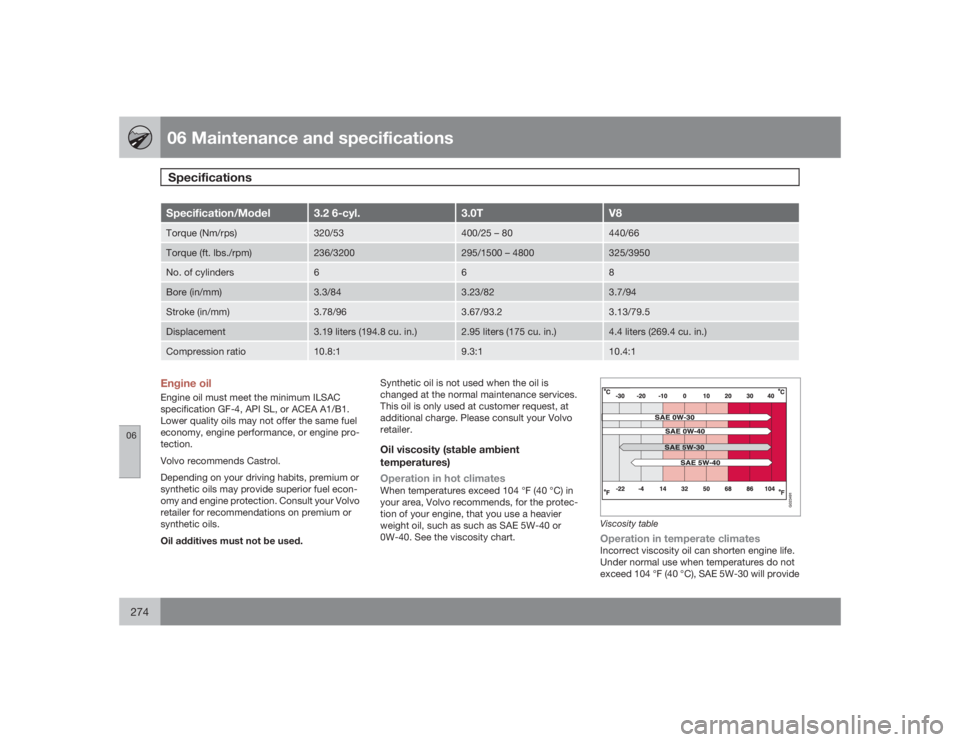
0W-40. See the viscosity chart.
G023491
Viscosity tableOperation in temperate climatesIncorrect viscosity oil can shorten engine life.
Under normal use when temperatures do not
exceed 104 °F (40 °C), SAE 5W-30 will provide
Page 275 of 288
06 Maintenance and specifications
Specifications
06``275
good fuel economy and engine protection. See
the viscosity chart.Extreme engine operationSynthetic oils meeting SAE 0W-30 or 0W-40
and complying with oil quality requirements are
recommended for driving in areas of sustained
temperature extremes (hot or cold), when tow-
ing a trailer over long distances, and for pro-
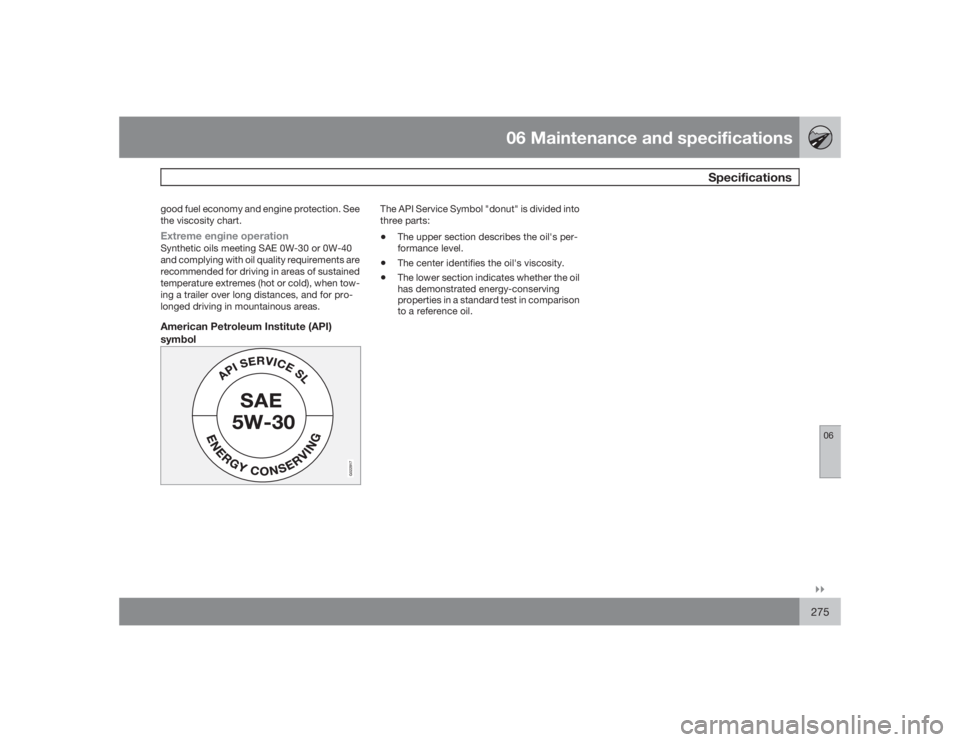
longed driving in mountainous areas.American Petroleum Institute (API)
symbol
G022917
The API Service Symbol "donut" is divided into
three parts:•
The upper section describes the oil's per-
formance level.
•
The center identifies the oil's viscosity.
•
The lower section indicates whether the oil
has demonstrated energy-conserving
properties in a standard test in comparison
to a reference oil.
Page 276 of 288
06 Maintenance and specificationsSpecifications
06276
Oil volumeEngine model
Oil volume between MIN and
MAX
Volume (incl. filter)
3.2 (6-cyl.)
B6324S
0.85 US qts (0.8 liters)
7.7 US qts (7.3 liters)
3.0T (6 cyl.)
B6304T2
1.1 US qts (1.2 liters)
7.8 US qts (7.4 liters)
V8
B8444S
1.0 US qts (1.1 liters)
7.4 US qts (7.0 liters)
Other fluids and lubricantsFluid
System
Volume
Specification
Transmission oil
A
Automatic (TF-80SC)
7.4 US qts (7.0 liters)
Transmission fluid JWS 3309
Coolant
3.2 (6-cyl.)
9.4 US qts. (8.9 liters)
Coolant with corrosion inhibitor
mixed with water (50/50 mix), see
packaging.
3.0T
9.4 US qts. (8.9 liters)
V8
10.7 US qts. (10.2 liters)
Air conditioning
3.2 6-cyl.
1.4 lbs (620 g)
Refrigerant: R134a (HFC134a),
PAG oil
V8
1.5 lbs (700 g)
Brake fluid
0.63 US qts (0.6 liters)
DOT 4+
Power steering
1.26 US qts (1.2 liters)
Power steering fluid WSS
M2C204-A2 or equivalent product.
Page 277 of 288
06 Maintenance and specifications
Specifications
06
277
Fluid
System
Volume
Specification
Washer fluid
6.8 US qts (6.5 liters)
4.7 US qts (4.5 liters
B)
Use a washer antifreeze recom-
mended by Volvo, mixed with
water.
Fuel tank volume
18.5 US gallons (70 liters)
AUnder normal driving conditions the transmission oil does not need changing during its service life. However, it may be necessary under adverse driving conditions.BModels without headlight washersElectrical systemGeneral information12 volt system with a voltage-regulated alter-
nator. Single pole system in which the chassis
and engine block are used as conductors. The
negative terminal is connected to the chassis.Performance, batteryEngine
3.2
6-cyl./3.0T
V8
Voltage (V)
12
12
Cold start
capacity (A)
520
800
A
Reserve capacity
(min)
100
120
ACertain models may be equipped with 600 or 700 A batteries,
depending on the options chosen.
WARNING
PROPOSITION 65 WARNING!
Battery posts, terminals, and related acces-
sories contain lead and lead compounds,
chemicals known to the state of California
to cause cancer and reproductive harm.
Wash hands after handling.
CAUTION
If the battery is replaced, replace it with a
battery of the same cold start capacity and
reserve capacity as the original (see the
decal on the battery).
Page 279 of 288
07 Index
07
279
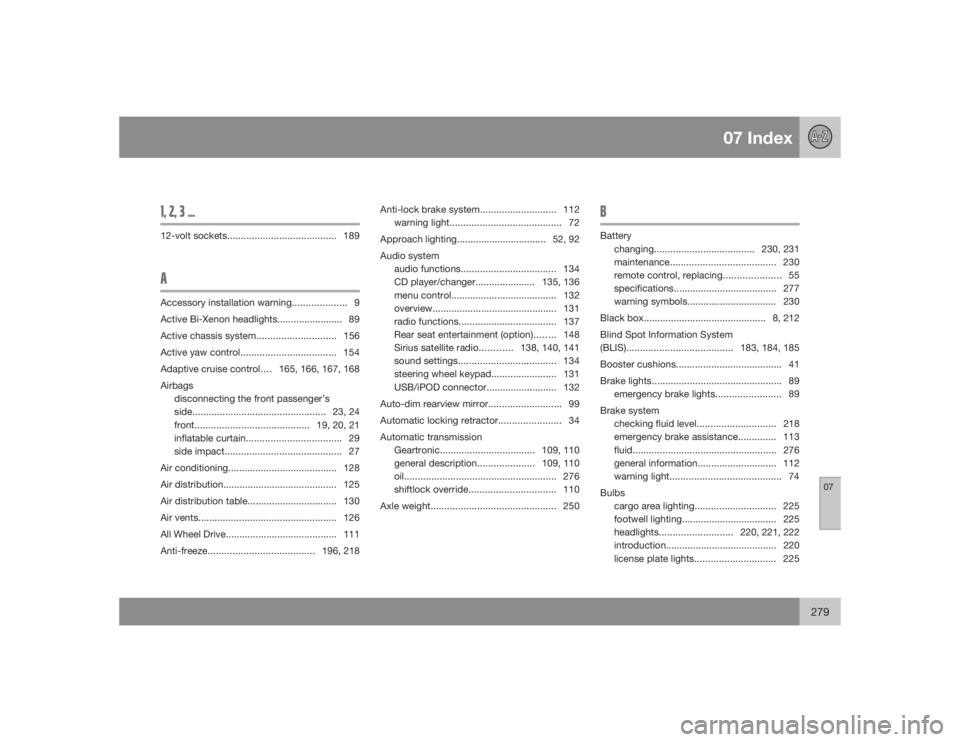
1, 2, 3 ...12-volt sockets........................................ 189AAccessory installation warning.................... 9
Active Bi-Xenon headlights........................ 89
Active chassis system.............................156
Active yaw control................................... 154
Adaptive cruise control....165, 166, 167, 168
Airbags
disconnecting the front passenger’s
side.................................................23, 24
front..........................................19, 20, 21
inflatable curtain................................... 29
side impact........................................... 27
Air conditioning........................................ 128
Air distribution.......................................... 125
Air distribution table................................. 130
Air vents................................................... 126
All Wheel Drive......................................... 111
Anti-freeze.......................................196, 218Anti-lock brake system............................ 112
warning light......................................... 72
Approach lighting................................. 52, 92
Audio system
audio functions................................... 134
CD player/changer...................... 135, 136
menu control....................................... 132
overview.............................................. 131
radio functions.................................... 137
Rear seat entertainment (option)........ 148
Sirius satellite radio............138, 140, 141
sound settings.................................... 134
steering wheel keypad........................ 131
USB/iPOD connector.......................... 132
Auto-dim rearview mirror........................... 99
Automatic locking retractor....................... 34
Automatic transmission
Geartronic................................... 109, 110
general description..................... 109, 110
oil........................................................ 276
shiftlock override................................ 110
Axle weight.............................................. 250
BBattery
changing..................................... 230, 231
maintenance....................................... 230
remote control, replacing..................... 55
specifications...................................... 277
warning symbols................................. 230
Black box.............................................8, 212
Blind Spot Information System
(BLIS).......................................183, 184, 185
Booster cushions....................................... 41
Brake lights................................................ 89
emergency brake lights........................ 89
Brake system
checking fluid level.............................218
emergency brake assistance.............. 113
fluid.....................................................276
general information............................. 112
warning light......................................... 74
Bulbs
cargo area lighting.............................. 225
footwell lighting................................... 225
headlights...........................220, 221, 222
introduction......................................... 220
license plate lights.............................. 225
Page 281 of 288
07 Index
07
281
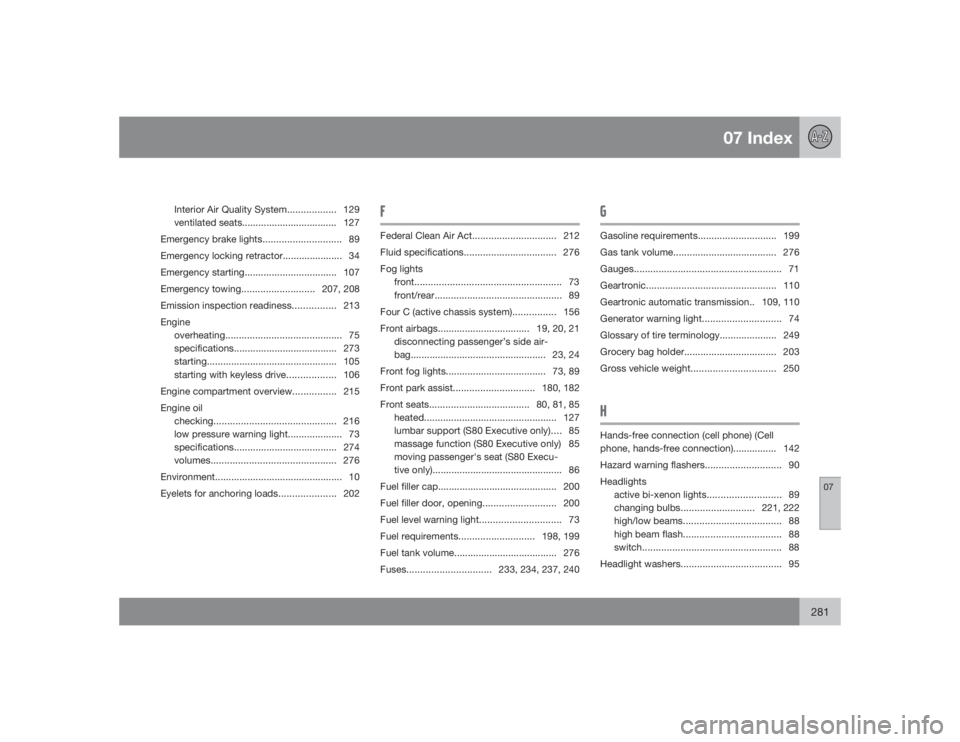
Interior Air Quality System.................. 129
ventilated seats................................... 127
Emergency brake lights............................. 89
Emergency locking retractor...................... 34
Emergency starting.................................. 107
Emergency towing...........................207, 208
Emission inspection readiness................ 213
Engine
overheating........................................... 75
specifications...................................... 273
starting................................................ 105
starting with keyless drive.................. 106
Engine compartment overview................ 215
Engine oil
checking............................................. 216
low pressure warning light.................... 73
specifications...................................... 274
volumes.............................................. 276
Environment............................................... 10
Eyelets for anchoring loads..................... 202
FFederal Clean Air Act............................... 212
Fluid specifications.................................. 276
Fog lights
front...................................................... 73
front/rear...............................................89
Four C (active chassis system)................156
Front airbags.................................. 19, 20, 21
disconnecting passenger’s side air-
bag.................................................. 23, 24
Front fog lights..................................... 73, 89
Front park assist..............................180, 182
Front seats..................................... 80, 81, 85
heated................................................. 127
lumbar support (S80 Executive only).... 85
massage function (S80 Executive only) 85
moving passenger's seat (S80 Execu-
tive only)................................................ 86
Fuel filler cap............................................ 200
Fuel filler door, opening........................... 200
Fuel level warning light.............................. 73
Fuel requirements............................198, 199
Fuel tank volume...................................... 276
Fuses...............................233, 234, 237, 240
GGasoline requirements............................. 199
Gas tank volume...................................... 276
Gauges...................................................... 71
Geartronic................................................ 110
Geartronic automatic transmission.. 109, 110
Generator warning light............................. 74
Glossary of tire terminology..................... 249
Grocery bag holder.................................. 203
Gross vehicle weight............................... 250HHands-free connection (cell phone) (Cell
phone, hands-free connection)................ 142
Hazard warning flashers............................ 90
Headlights
active bi-xenon lights........................... 89
changing bulbs...........................221, 222
high/low beams.................................... 88
high beam flash.................................... 88
switch................................................... 88
Headlight washers..................................... 95