key battery VOLVO S90 2018 Owner´s Manual
[x] Cancel search | Manufacturer: VOLVO, Model Year: 2018, Model line: S90, Model: VOLVO S90 2018Pages: 640, PDF Size: 11.37 MB
Page 259 of 640
KEY, LOCKS AND ALARM
257
Alarm
The alarm emits sound and light signals if any- one without a valid remote key attempts to breakinto the vehicle or interferes with the start batteryor alarm siren.
When armed, the alarm will be triggered if:
• the hood, trunk lid or any door is opened.
• a battery cable is disconnected
• the alarm siren is disconnected.
Alarm signalsThe following occurs if the alarm is triggered:
• A siren will sound for 30 seconds or until the alarm is turned off.
• All turn signals will flash for 5 minutes oruntil the alarm is turned off.
If the reason the alarm was triggered is not recti- fied, the alarm cycle will repeat up to 10 times 20
.
Alarm indicator
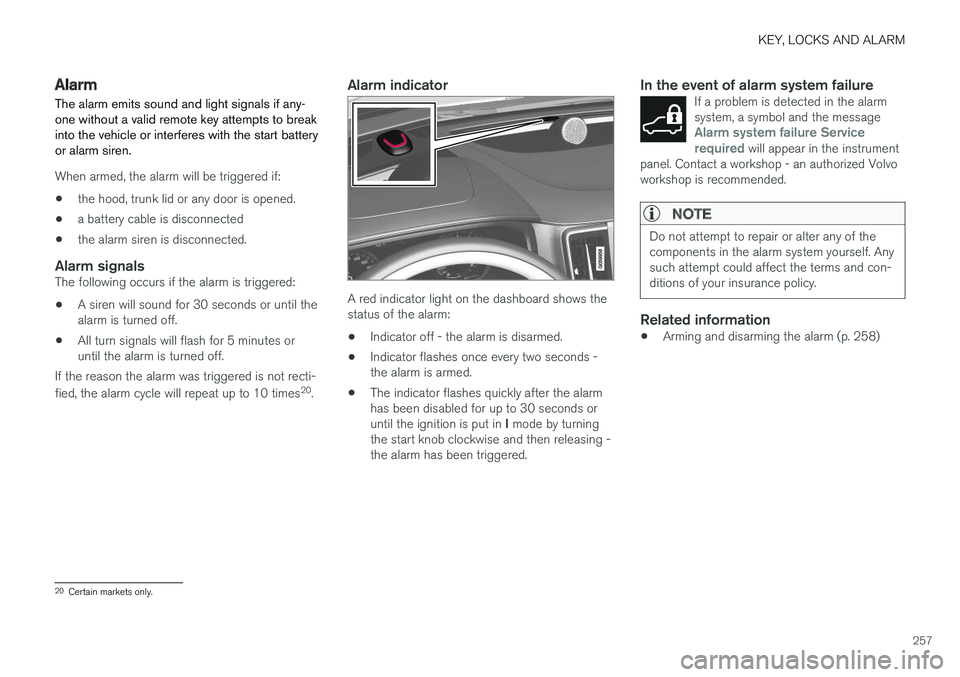
A red indicator light on the dashboard shows the status of the alarm:
• Indicator off - the alarm is disarmed.
• Indicator flashes once every two seconds -the alarm is armed.
• The indicator flashes quickly after the alarmhas been disabled for up to 30 seconds or until the ignition is put in
I mode by turning
the start knob clockwise and then releasing - the alarm has been triggered.
In the event of alarm system failureIf a problem is detected in the alarmsystem, a symbol and the message
Alarm system failure Service
required will appear in the instrument
panel. Contact a workshop - an authorized Volvo workshop is recommended.
NOTE
Do not attempt to repair or alter any of the components in the alarm system yourself. Anysuch attempt could affect the terms and con-ditions of your insurance policy.
Related information
• Arming and disarming the alarm (p. 258)
20
Certain markets only.
Page 260 of 640

KEY, LOCKS AND ALARM
* Option/accessory.
258
Arming and disarming the alarm
The alarm is armed when the vehicle is locked.
Arming the alarmLock and arm the vehicle by:
• pressing the lock button on the remote key
• touch the marked surface on the outside of the door handle or the rubberized pressure plate on the trunk lid 21
.
If the vehicle is equipped with both keyless lock- ing/unlocking * and power trunk lid, the button
on the lower edge of the trunk lid can also
be used to lock and arm the vehicle.
A red LED light on the dashboard will flash every other second when the vehicle is locked and the alarm isarmed.
Disarming the alarmUnlock and disarm the vehicle alarm by:
• pressing the unlock button on the remote key
•
grip a door handle or press the trunk lid's rubberized pressure plate 21
.
Disarming the alarm without a functioning
remote key
The vehicle can be unlocked and disarmed even if the remote key is not functioning, e.g. if thebattery is discharged.
1. Open the driver's door using the detachable
key blade.
> This will trigger the alarm.
Location of the backup key reader in the cup holder.
2. Place the remote key on the key symbol inthe backup reader in the tunnel console's cup holder. 3. Turn the start knob clockwise and release.
> The alarm will be disarmed.
Turning off a triggered alarm
–Press the unlock button on the remote key or put the ignition into mode I by turning the
start knob clockwise and then releasing it.
NOTE
• Remember that the alarm is armed when the vehicle is locked.
• The alarm will be triggered if any of thedoors is opened from the inside.
Automatically arming and disarming the alarm
Automatically arming the alarm helps prevent inadvertently leaving the vehicle without alarmprotection. If the vehicle is unlocked using the remote key (and the alarm is disarmed) but none of thedoors or trunk lid is opened within two minutes,the alarm will be automatically rearmed. The vehi-cle will also re-lock. On some markets, the alarm will be automatically armed following a slight delay after the driver'sdoor has been opened and closed without beinglocked.
21
Only vehicles with keyless locking and unlocking * (Passive Entry).
Page 397 of 640
STARTING AND DRIVING
}}
395
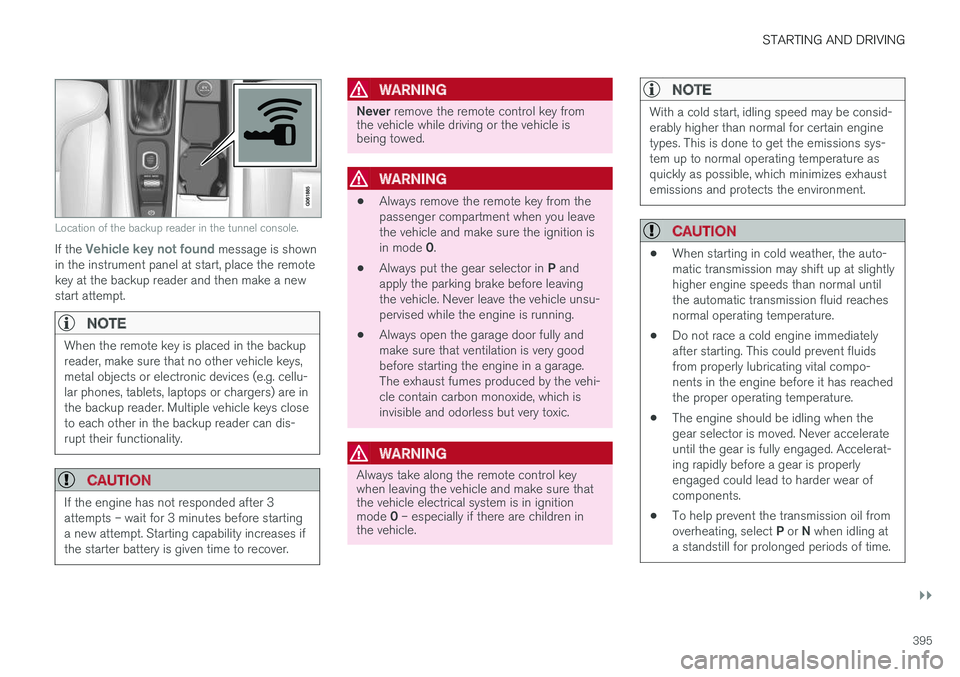
Location of the backup reader in the tunnel console.
If the Vehicle key not found message is shown
in the instrument panel at start, place the remote key at the backup reader and then make a newstart attempt.
NOTE
When the remote key is placed in the backup reader, make sure that no other vehicle keys,metal objects or electronic devices (e.g. cellu-lar phones, tablets, laptops or chargers) are inthe backup reader. Multiple vehicle keys closeto each other in the backup reader can dis-rupt their functionality.
CAUTION
If the engine has not responded after 3 attempts – wait for 3 minutes before startinga new attempt. Starting capability increases ifthe starter battery is given time to recover.
WARNING
Never remove the remote control key from
the vehicle while driving or the vehicle is being towed.
WARNING
• Always remove the remote key from the passenger compartment when you leavethe vehicle and make sure the ignition is in mode
0.
• Always put the gear selector in
P and
apply the parking brake before leaving the vehicle. Never leave the vehicle unsu-pervised while the engine is running.
• Always open the garage door fully andmake sure that ventilation is very goodbefore starting the engine in a garage.The exhaust fumes produced by the vehi-cle contain carbon monoxide, which isinvisible and odorless but very toxic.
WARNING
Always take along the remote control key when leaving the vehicle and make sure thatthe vehicle electrical system is in ignition mode
0 – especially if there are children in
the vehicle.
NOTE
With a cold start, idling speed may be consid- erably higher than normal for certain enginetypes. This is done to get the emissions sys-tem up to normal operating temperature asquickly as possible, which minimizes exhaustemissions and protects the environment.
CAUTION
• When starting in cold weather, the auto- matic transmission may shift up at slightlyhigher engine speeds than normal untilthe automatic transmission fluid reachesnormal operating temperature.
• Do not race a cold engine immediatelyafter starting. This could prevent fluidsfrom properly lubricating vital compo-nents in the engine before it has reachedthe proper operating temperature.
• The engine should be idling when thegear selector is moved. Never accelerateuntil the gear is fully engaged. Accelerat-ing rapidly before a gear is properlyengaged could lead to harder wear ofcomponents.
• To help prevent the transmission oil from overheating, select
P or N when idling at
a standstill for prolonged periods of time.
Page 400 of 640
STARTING AND DRIVING
398
Selecting ignition modeThe vehicle's ignition can be put in various modes (levels) to make different functions availa-ble.
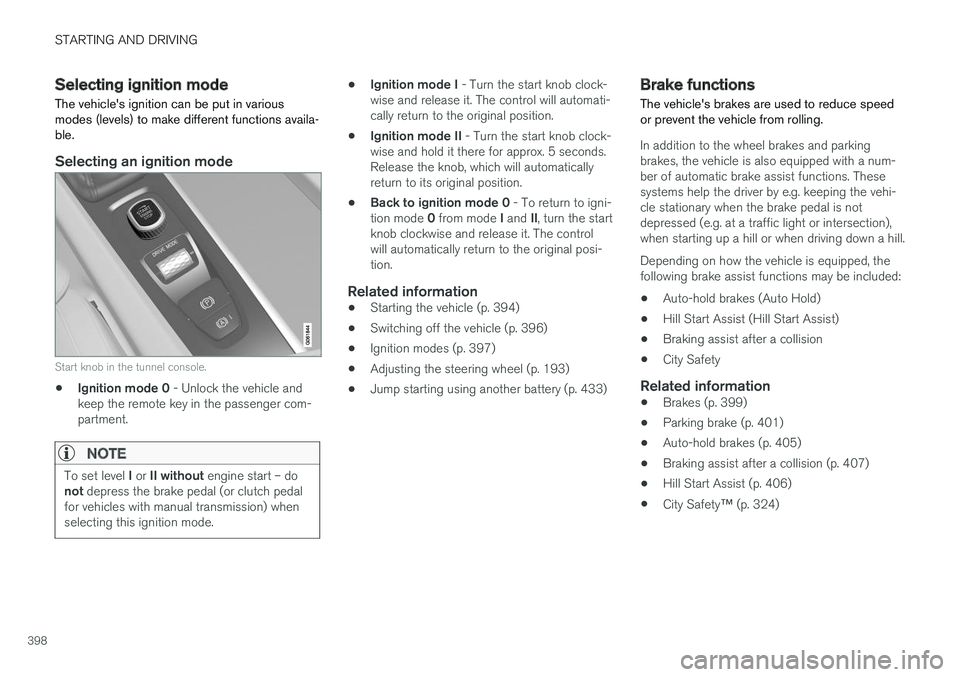
Selecting an ignition mode
Start knob in the tunnel console.
• Ignition mode 0
- Unlock the vehicle and
keep the remote key in the passenger com- partment.
NOTE
To set level I or II without engine start – do
not depress the brake pedal (or clutch pedal
for vehicles with manual transmission) when selecting this ignition mode.
• Ignition mode I
- Turn the start knob clock-
wise and release it. The control will automati- cally return to the original position.
• Ignition mode II
- Turn the start knob clock-
wise and hold it there for approx. 5 seconds.Release the knob, which will automaticallyreturn to its original position.
• Back to ignition mode 0
- To return to igni-
tion mode 0 from mode I and II, turn the start
knob clockwise and release it. The controlwill automatically return to the original posi-tion.
Related information
• Starting the vehicle (p. 394)
• Switching off the vehicle (p. 396)
• Ignition modes (p. 397)
• Adjusting the steering wheel (p. 193)
• Jump starting using another battery (p. 433)
Brake functions
The vehicle's brakes are used to reduce speed or prevent the vehicle from rolling.
In addition to the wheel brakes and parking brakes, the vehicle is also equipped with a num-ber of automatic brake assist functions. Thesesystems help the driver by e.g. keeping the vehi-cle stationary when the brake pedal is notdepressed (e.g. at a traffic light or intersection),when starting up a hill or when driving down a hill. Depending on how the vehicle is equipped, the following brake assist functions may be included:
• Auto-hold brakes (Auto Hold)
• Hill Start Assist (Hill Start Assist)
• Braking assist after a collision
• City Safety
Related information
•Brakes (p. 399)
• Parking brake (p. 401)
• Auto-hold brakes (p. 405)
• Braking assist after a collision (p. 407)
• Hill Start Assist (p. 406)
• City Safety
™ (p. 324)
Page 436 of 640
||
STARTING AND DRIVING
434
WARNING
•Batteries generate hydrogen gas, which is flammable and explosive.
• Do not connect the jumper cable to anypart of the fuel system or to any movingparts. Avoid touching hot manifolds.
• Battery fluid contains sulfuric acid. Do notallow battery fluid to contact eyes, skin,fabrics or painted surfaces.
• If contact occurs, flush the affected areaimmediately with water. Obtain medicalhelp immediately if eyes are affected.
• Never expose the battery to open flameor electric spark. Do not smoke near thebattery. Failure to follow the instructionsfor jump starting can lead to injury.
Related information
• Starting the vehicle (p. 394)
• Ignition modes (p. 397)
• Adjusting the steering wheel (p. 193)
• Selecting ignition mode (p. 398)
Towing using a towline
This section refers to one vehicle being towed behind another using a towline.
Before towing another vehicle, check applicable speed limit regulations.
Preparations and towing
CAUTION
Note that the vehicle must always be towed with the wheels rolling forward.
• Do not tow a vehicle with automatictransmission at a speed greater than80 km/h (50 mph) or for a distancegreater than 80 km (50 miles).
WARNING
•
Ignition mode
II must be active – all air-
bags are deactivated in ignition mode I.
• Always have the remote key in the vehicle when it is towed.
WARNING
The brake and steering servos do not work when the engine is off – it takesabout 5 times more pressure on the brakepedal and steering requires much more effortthan normal. 1. Turn on the hazard warning flashers.
2. Attach the towline to the towing eyelet.3.
Put the vehicle in ignition mode II – without
pressing the brake pedal, turn the start knob clockwise and hold it there for about4 seconds. Release the knob, which willautomatically return to its original position.
4. Move the gear selector to neutral ( N) and
release the parking brake. If the battery charge level is too low, it may not be possible to release the parking brake.Connect an auxiliary battery to the vehicle ifthe battery is discharged.
> The towing vehicle can now start driving.
5. Keep the towline taut when the towing vehi- cle slows down by applying light pressure to the brake pedal. This will help avoid jarringmovements.
6. Be prepared to apply the brakes to stop the vehicle.
Jump startingDo not tow the vehicle to start the engine. Use anauxiliary battery if the start battery's charge levelis so low that the engine cannot be started.
Page 626 of 640
INDEX
624
B
Backrestfront seat, adjusting 184, 185, 188, 189 , 190
rear seat, adjusting 192
Battery jump-start 433
Maintenance 573
start 573
support 576
symbols on the battery 577
warning symbols 577
BLIS 337, 338, 339, 340 Blower adjusting 220, 221
air distribution 202
air vents 203
Bluetooth connect 471
connecting vehicle to Internet 489
phone 478
settings 487
Book service and repair 552
Booster cushions 71Brake assist after collision 407
Brake fluidgrade 619
Brake functions 398
Brake light 159
Brakes 399 anti-lock brakes, ABS 399
automatic when stationary 405
Brake Assist System, BAS 400
brake lights 159
brake system 398
emergency brake lights 159
handbrake 401
Maintenance 401
on salted roads 401
on wet roads 400
brake system fluid 619
C
Camera sensor 333
Camera unit 320
Capacity weight 536, 615
Cargo compartment 543
attachment points 545
Car wash 595, 596, 598, 599, 600, 601
Catalytic converter 431 recovery 434
CD player 469
Cell phone, see Phone 479
Center console 539Center display change appearance 129
cleaning 590
climate controls 208
Function view 120
keyboard 124
messages 138, 139, 140
operation 110, 113, 117, 122
overview 107
settings 130, 131, 132
switch off and change volume 129
symbols in status bar 122
views 113
Central locking 247
Change of owner 132
Changing a wheel 522
Checking engine oil level 561
Child restraints 63, 65 booster cushions 71
convertible seats 69
infant seats 67
ISOFIX/LATCH anchors 74
lower attachment points 73
Page 634 of 640
INDEX
632Red Key 238
settings 239
Refrigerant 558 climate system 620
Refueling filling 427
fuel filler door, fuel flap 427
Remote immobilizer 242
Remote key 229 battery replacement 234
connecting to driver profile 137
detachable key blade 240
loss 238
Range 233
Remote updates 551
Reporting safety defects 44
Resetting door mirrors 173
Resetting settings 133 change of owner 132
Driver profile 137
Resetting trip odometer 88
Road Sign Information 346, 347, 348 limitations 350
operation 347, 348, 349, 350
Road trip 425
Roll Stability Control 263
Roof load, max. weight 615
RSC (Roll Stability Control) 263
Run-off Mitigation 362, 363
S
Safety 42 pregnancy 43
Safety belt, see Seat belt 47
Safety defects, reporting 44
Safety mode 61 starting/moving 62
Sealing compound 530
Seat, see Seats 184
Seat belt reminder 51
Seat belts 47 Automatic locking retractor/Emergency
locking retractor 65
buckling/unbuckling 48
pregnancy 43
seat belt reminder 51
seat belt tensioner 50
securing child restraint systems 67, 69, 71
Seat belt tensioner 50 resetting 51
Seats heating 210, 211
manual front seat 184
memory function front seat 186, 187
power front seats 185
ventilation 212, 213
whiplash protection 46
Sensors air quality 201
climate 197
Sensus connection and entertainment 30
Sensus Navigation 348
Service position 605
Service program 548
Set time interval 282
settings 133 Categories 134
contextual 131
resetting 133
settings menu 133
Shiftlock 411 deactivate 411
Side airbag 59
Side Impact Protection System 59, 60
SIM card 491
SIPS (Side Impact Protection System) 59, 60Sirius Satellite radio Travel link 460
Page 635 of 640
INDEX
633
SiriusXM
® Satellite radio
traffic information 456, 457, 458
Ski hatch 545
Slippery conditions 425, 426
Slippery road conditions 426
Software updates 33
Sound settings 444, 485 phone 486
playing media 466, 467
text message 485
Spare tire 527, 528
Speed camera 350
Speed Limiter 267, 270, 271, 274 getting started 268
shut down 270
temporary deactivation 269
Speed symbols, tires 512
Spin control 264
Stability and traction control system 264, 266 operation 265
Stability system 264
Stains 590, 592, 593, 594, 595
Start/Stop 418 deactivate 419
Driving 418
limitations 420
Start and lock systemtype designations 242
Start battery 433, 573 overload 432
Start engine 394 Starting the engine after a collision 62
Start the vehicle 394Steering assistance at risk of colli-
sion 361, 362, 363, 364, 365, 366, 367, 369 Steering assistance at risk of rear-end col-
lision 366, 367 Steering power level, see Steering wheel
resistance 262 Steering resistance at risk of head-on colli-
sion 364, 365
Steering wheel 192, 193 heating 214, 215
keypad 192
paddle 192
steering wheel adjustment 193
Steering wheel keypad 192
Steering wheel paddles 409 Steering wheel resistance, speed-depend- ent 262
Stone chips and scratches 602, 603
Stop/start function 418Storage compartments 538 center console 539
glove compartment 541
sun visor 542
Sunroof pinch protection 166
Sun shade panoramic roof 174, 179
pinch protection 166
rear door 170
rear window 170
Sun visor 542 mirror lighting 161
Support battery 576 Symbols indicator symbols 91
Symbols and messages Adaptive Cruise Control 298
center display's status bar 122
Collision warner with auto-brake 335
Symbols and messages for Assistance at
risk of collision 369
system updates 551
Page 637 of 640
INDEX
635
U
Uniform Tire Quality Grading 514
Units 130
Unknown vehicle component 259Unlockingsettings 232
with key blade 241
USB socket for connecting media 472
V
Vehicle care 595, 596, 598, 599, 600, 601leather upholstery 593
Vehicle Event Data 33 Vehicle functions in the center display 120
Vehicle key bat. low 234Vehicle modem connecting vehicle to Internet 490
settings 491
Vehicle recovery 437
Vehicle status 552 inflation pressure 520
Vehicle upholstery 590, 592, 593, 594, 595
Vehicle weight 615
Ventilation 201, 202, 203 Seats 212, 213
Video 470, 472 settings 471
Voice control 143 climate 198
phone 145
radio and media 146
settings 146
VOL mark 508
Volvo ID 26 create and register 27
W
Warning light
Adaptive Cruise Control 287
stability and traction control system 264
Warning lights airbags SRS 93
alternator does not charge 93
brake system error 93
low oil pressure 93
parking brake applied 93
seat belt reminder 93
starter battery not charging 93
WARNING 93
Warning soundparking brake 404
warning symbols 93 Warning symbols safety 42
Warranties 548Washer Headlights 182
washer fluid, filling 606
Windshield 182
Washer fluid 606
Washer nozzles, heated 180
Waxing 596 Weights Curb weight 615
Wheel bolts 523 locking 523
Wheels cleaning 601
mounting 526
removal 524
Snow chains 529
Wheels and tires Load index and speed symbol 512
Whiplash protection 46
Whiplash Protection System 46
WHIPS (Whiplash Protection System) 46