warning light VOLVO S90 TWIN ENGINE 2019 Owner's Manual
[x] Cancel search | Manufacturer: VOLVO, Model Year: 2019, Model line: S90 TWIN ENGINE, Model: VOLVO S90 TWIN ENGINE 2019Pages: 669, PDF Size: 14.33 MB
Page 240 of 669
||
KEY, LOCKS AND ALARM
* Option/accessory.238
The keyless system for locking/unlocking thedoors and trunk lid (Passive Entry*) is available asan option. This system has a range in a semicirclewith a radius of approximately 1.5 meter (5 feet)out from the driver's door and approx. 1 meter(3 feet) out from the trunk lid.
With keyless start in combination with keylesslocking and unlocking, the remote key can belocated anywhere in the passenger compartmentor trunk in order to start the engine.
Each remote key supplied with the vehicle can belinked to a driver profile with unique settings forthe vehicle. When a key with a specific profile isused, the vehicle settings are adjusted accordingto that profile.
Buttonless key, Key Tag
For vehicles equipped with keyless locking andunlocking*, a smaller, lighter and button-less key
(Key Tag4) is also provided. It works the sameway as the regular remote key as regard keylessstart and keyless locking and unlocking. The keyis waterproof up to a depth of approx. 10 meters(30 feet) for up to 60 minutes. It does not have adetachable key blade and its battery cannot bereplaced.
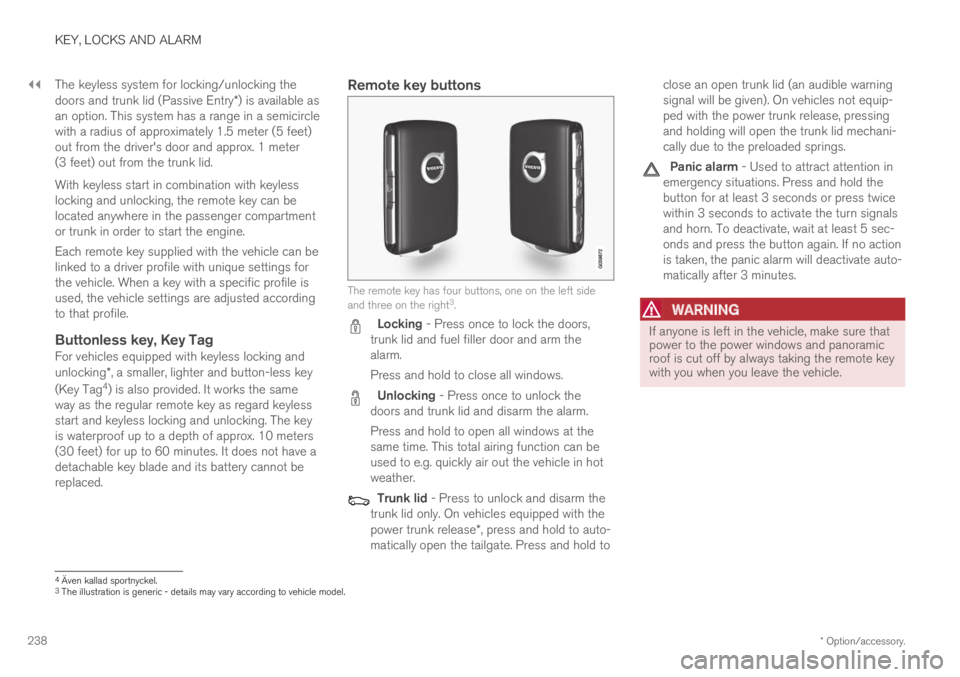
Remote key buttons
The remote key has four buttons, one on the left sideand three on the right3.
Locking - Press once to lock the doors,trunk lid and fuel filler door and arm thealarm.
Press and hold to close all windows.
Unlocking - Press once to unlock thedoors and trunk lid and disarm the alarm.
Press and hold to open all windows at thesame time. This total airing function can beused to e.g. quickly air out the vehicle in hotweather.
Trunk lid - Press to unlock and disarm thetrunk lid only. On vehicles equipped with thepower trunk release*, press and hold to auto-matically open the tailgate. Press and hold to
close an open trunk lid (an audible warningsignal will be given). On vehicles not equip-ped with the power trunk release, pressingand holding will open the trunk lid mechani-cally due to the preloaded springs.
Panic alarm - Used to attract attention inemergency situations. Press and hold thebutton for at least 3 seconds or press twicewithin 3 seconds to activate the turn signalsand horn. To deactivate, wait at least 5 sec-onds and press the button again. If no actionis taken, the panic alarm will deactivate auto-matically after 3 minutes.
WARNING
If anyone is left in the vehicle, make sure thatpower to the power windows and panoramicroof is cut off by always taking the remote keywith you when you leave the vehicle.
4Även kallad sportnyckel.3The illustration is generic - details may vary according to vehicle model.
Page 257 of 669

KEY, LOCKS AND ALARM
}}
* Option/accessory.255
Keyless trunk lid unlock*
The trunk lid can be opened using the remotekey. The key only needs to be within range, e.g.in a pocket or bag.
The trunk lid is held closed by an electronic lock-ing mechanism.
To open the tailgate:
1. Lightly press the rubberized pressure plateon the underside of the trunk lid handle.
>The lock will disengage.
NOTE
One of the vehicle's remote keys must bewithin range behind the vehicle for unlockingto be possible.
2. Lift the outer handle to fully open the trunklid.
CAUTION
Only light pressure on the rubberized pres-sure plate is necessary to release thetrunk lid's locking mechanism.
Use the handle to lift the trunk lid and donot apply force to the rubberized pressureplate. Too much force can damage thepressure plate's electrical connections.
Hands-free opening of the trunk lid is also possi-ble using a foot movement under the rearbumper; see the separate section.
WARNING
Do not drive with the trunk lid open. Toxicexhaust fumes can be sucked into the vehiclethrough the trunk.
Related information
Opening and closing the trunk lid with footmovement* (p. 263)
Keyless and touch-sensitive surfaces*(p. 252)
Remote key range (p. 242)
Antenna locations for the start andlock system
The vehicle is equipped with a keyless start and
lock system13 that uses a number of integratedantennas positioned throughout the vehicle.
Location of the antennas.
Under the cup holder in the front section ofthe tunnel console
In the upper front section of the left-side rear
door14
In the upper front section of the right-side
rear door14
In the trunk14
Page 258 of 669
||
KEY, LOCKS AND ALARM
* Option/accessory.256
WARNING
Individuals with an implanted pacemakershould not allow the pacemaker to comecloser than 22 cm (9 in.) to the Keyless sys-tem antennas. The aim of this is to preventdisturbances between the pacemaker and theKeyless system.
Related information
Keyless and touch-sensitive surfaces*(p. 252)
Remote key range (p. 242)
Locking and unlocking from insidethe vehicle
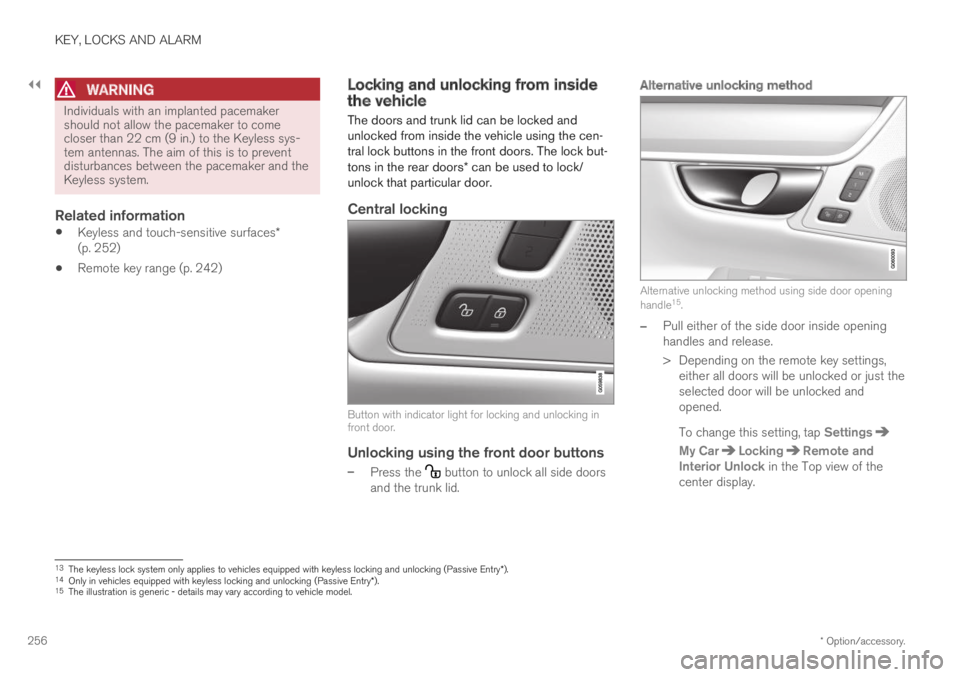
The doors and trunk lid can be locked andunlocked from inside the vehicle using the cen-tral lock buttons in the front doors. The lock but-tons in the rear doors* can be used to lock/unlock that particular door.
Central locking
Button with indicator light for locking and unlocking infront door.
Unlocking using the front door buttons
–Press the button to unlock all side doorsand the trunk lid.
Alternative unlocking method
Alternative unlocking method using side door openinghandle15.
–Pull either of the side door inside openinghandles and release.
> Depending on the remote key settings,either all doors will be unlocked or just theselected door will be unlocked andopened.
To change this setting, tap Settings
My CarLockingRemote andInterior Unlock in the Top view of thecenter display.
13The keyless lock system only applies to vehicles equipped with keyless locking and unlocking (Passive Entry*).14Only in vehicles equipped with keyless locking and unlocking (Passive Entry*).15The illustration is generic - details may vary according to vehicle model.
Page 283 of 669
DRIVER SUPPORT
281
Activating/deactivating AutomaticSpeed Limiter
The Automatic Speed Limiter (ASL) is a supple-ment to the Speed Limiter (SL) and can be acti-vated/deactivated.
Activating ASL
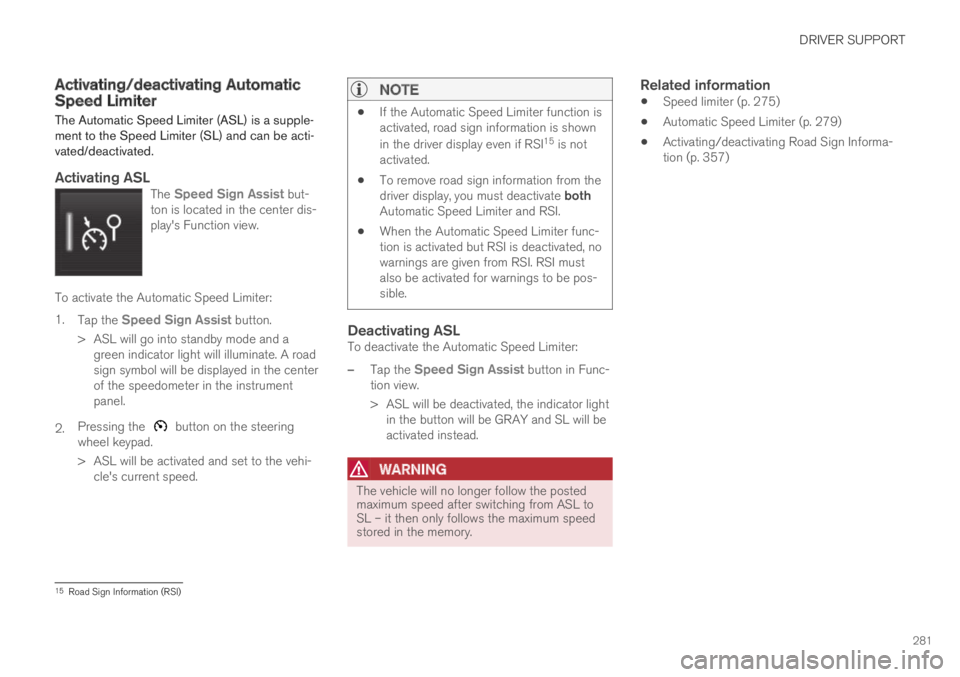
The Speed Sign Assist but-ton is located in the center dis-play's Function view.
To activate the Automatic Speed Limiter:
1.Tap the Speed Sign Assist button.
> ASL will go into standby mode and agreen indicator light will illuminate. A roadsign symbol will be displayed in the centerof the speedometer in the instrumentpanel.
2.Pressing the button on the steeringwheel keypad.
> ASL will be activated and set to the vehi-cle's current speed.
NOTE
If the Automatic Speed Limiter function isactivated, road sign information is shown
in the driver display even if RSI15 is notactivated.
To remove road sign information from thedriver display, you must deactivate bothAutomatic Speed Limiter and RSI.
When the Automatic Speed Limiter func-tion is activated but RSI is deactivated, nowarnings are given from RSI. RSI mustalso be activated for warnings to be pos-sible.
Deactivating ASL
To deactivate the Automatic Speed Limiter:
–Tap the Speed Sign Assist button in Func-tion view.
> ASL will be deactivated, the indicator lightin the button will be GRAY and SL will beactivated instead.
WARNING
The vehicle will no longer follow the postedmaximum speed after switching from ASL toSL – it then only follows the maximum speedstored in the memory.
Related information
Speed limiter (p. 275)
Automatic Speed Limiter (p. 279)
Activating/deactivating Road Sign Informa-tion (p. 357)
15Road Sign Information (RSI)
Page 291 of 669
DRIVER SUPPORT
* Option/accessory.289
WARNING
Distance Alert only reacts of the time intervalto the vehicle ahead is shorter than the presetvalue – vehicle speed is not affected.
Related information
Head-up display for Distance Alert (p. 289)
Activating/deactivating Distance Alert(p. 290)
Setting a time interval for Distance Alert(p. 290)
Distance Alert limitations (p. 291)
Head-up display for Distance Alert28
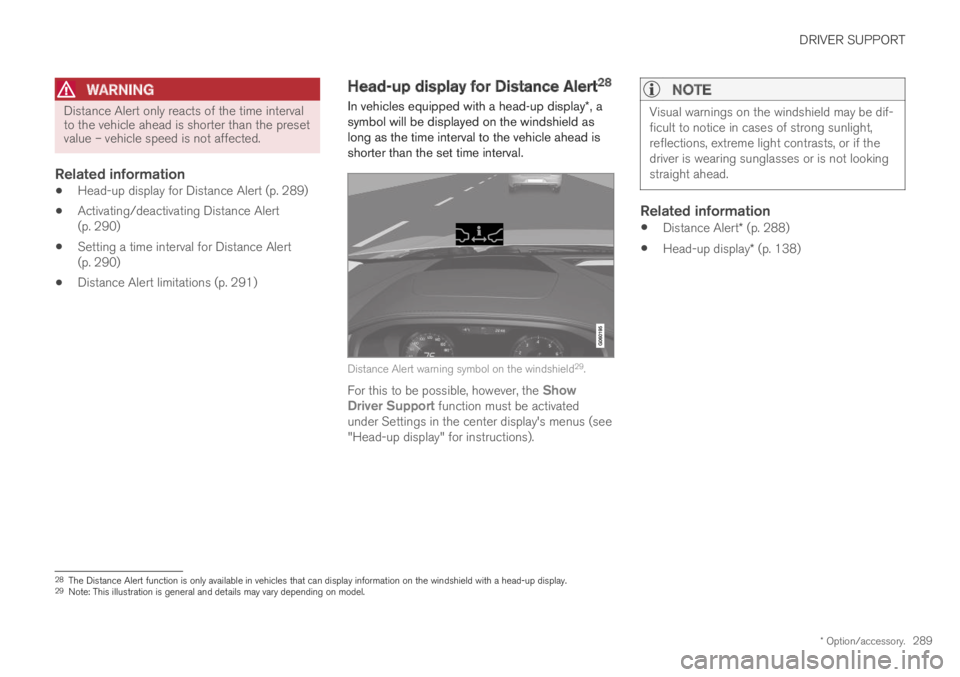
In vehicles equipped with a head-up display*, asymbol will be displayed on the windshield aslong as the time interval to the vehicle ahead isshorter than the set time interval.
Distance Alert warning symbol on the windshield29.
For this to be possible, however, the ShowDriver Support function must be activatedunder Settings in the center display's menus (see"Head-up display" for instructions).
NOTE
Visual warnings on the windshield may be dif-ficult to notice in cases of strong sunlight,reflections, extreme light contrasts, or if thedriver is wearing sunglasses or is not lookingstraight ahead.
Related information
Distance Alert* (p. 288)
Head-up display* (p. 138)
28The Distance Alert function is only available in vehicles that can display information on the windshield with a head-up display.29Note: This illustration is general and details may vary depending on model.
Page 293 of 669

DRIVER SUPPORT
}}}}
* Option/accessory.291
NOTE
The greater the vehicles' speed, thegreater the distance between them for aset time interval.
Only use the time intervals permitted bylocal traffic regulations.
The set time interval is also used by theAdaptive Cruise Control and Pilot Assistfunctions.
WARNING
Only use a time interval suitable for thecurrent traffic conditions.
The driver should be aware that shorttime intervals give them limited time toreact and act to any unforeseen trafficsituation.
Related information
Distance Alert* (p. 288)
Distance Alert limitations32
Distance Alert functionality may be reduced incertain situations.
WARNING
The radar sensor has a limited field ofvision. In some situations, it may detect avehicle later than expected or not detectother vehicles at all.
The radar sensor cannot cover all drivingsituations and traffic, weather and roadconditions.
The driver is responsible for maintaining asafe distance and speed and must inter-vene if the various driver support systemsdo not maintain a suitable speed or suita-ble distance to the vehicle ahead.
Maintenance of radar sensor componentsmay only be performed by a trained andqualified Volvo technician.
Strong sunlight, reflections from the roadsurface, strong lighting contrasts or usingsunglasses may make the warning light inthe windshield difficult to see. Poorweather or winding roads can affect theradar sensor's capacity to detect vehiclesahead.
A vehicle's size (e.g., a motorcycle) canalso affect the radar sensor's capacity todetect another vehicle. This may result inthe warning light illuminating at a shorter
32The Distance Alert function is only available in vehicles that can display information on the windshield with a head-up display.
Page 294 of 669

||
DRIVER SUPPORT
* Option/accessory.292
distance than the one that has been setor not illuminating at all.
High speeds may also result in the warn-ing light illuminating at a shorter distancethan the one that has been set due tolimitations in the radar sensor's range.
NOTE
The function uses the vehicle's radar unit,which has some general limitations – see thesection "Radar unit limitations".
Related information
Distance Alert* (p. 288)
Radar sensor limitations (p. 325)
Adaptive Cruise Control*
Adaptive Cruise Control (ACC33) helps thedriver maintain a constant speed with a set timeinterval to the vehicle ahead.
Adaptive Cruise Control helps provide a morerelaxed driving experience on long trips on high-ways or long, straight roads with even trafficflows.
The camera/radar sensor measures the distance to thevehicle ahead34.
The driver sets a speed and a time interval to thevehicle ahead. If the camera/radar sensor detectsa slower-moving vehicle ahead, your vehicle'sspeed will be automatically adapted according tothe set time interval to that vehicle. When there
are no longer slower-moving vehicles ahead, thevehicle will return to the set speed.
WARNING
The Adaptive Cruise Control function issupplementary driver support intended tofacilitate driving and help make it safer –it cannot handle all situations in all traffic,weather and road conditions.
The driver is advised to read all sectionsin the Owner's Manual about this functionto learn of its limitations, which the drivermust be aware of before using the func-tion (see the link list at the end of thisarticle).
Adaptive Cruise Control is not a substi-tute for the driver's attention and judg-ment. The driver is always responsible forensuring the vehicle is driven in a safemanner, at the appropriate speed, with anappropriate distance to other vehicles,and in accordance with current trafficrules and regulations.
NOTE
Depending on market, this function may beeither Standard or Optional.
33Adaptive Cruise Control34Note: This illustration is general and details may vary depending on model.
Page 295 of 669

DRIVER SUPPORT
}}
293
Adaptive Cruise Control regulates speed byaccelerating and braking. It is normal for thebrakes to emit a slight sound when they arebeing used to adjust speed.
Adaptive Cruise Control always attempts to regu-late speed smoothly. The driver must apply thebrakes in situations requiring immediate braking.For example, when there are great differences inspeed between vehicles or if the vehicle aheadbrakes suddenly. Due to limitations in the radarsensor, braking may occur unexpectedly or not atall.
Adaptive Cruise Control is designed to follow avehicle ahead in the same lane and maintain atime interval to that vehicle set by the driver. If theradar sensor does not detect a vehicle ahead, itwill instead maintain the speed set by the driver.This will also happen if the speed of the vehicleahead exceeds the set speed for your vehicle.
Adaptive Cruise Control can follow anothervehicle at speeds from a standstill up to200 km/h (125 mph).
WARNING
Adaptive Cruise Control is not a collisionavoidance system. The driver is alwaysresponsible and must intervene if the sys-tem fails to detect a vehicle ahead.
Adaptive Cruise Control does not brakefor people or animals and does not brakefor small vehicles, such as bikes andmotorcycles. Similarly, it does not brakefor low trailers, oncoming, slow-moving orstationary vehicles and objects.
Do not use Adaptive Cruise Control indemanding situations, such as in city traf-fic, at intersections, on slippery surfaces,with a lot of water or slush on the road, inheavy rain/snow, in poor visibility, onwinding roads, or on on/off ramps.
CAUTION
Maintenance of Adaptive Cruise Control com-ponents may only be performed by a work-shop – an authorized Volvo workshop is rec-ommended.
Overview
Controls
Function buttons and symbols34.
: Activates Adaptive Cruise Control fromstandby mode and resumes the set speed
: Increases the set speed
: From standby mode - activates theAdaptive Cruise Control and stores the cur-rent speed
: From active mode - deactivates/switches the Adaptive Cruise Control tostandby mode
: Reduces the set speed
Increases the time interval to the vehicleahead
34Note: This illustration is general and details may vary depending on model.
Page 297 of 669

DRIVER SUPPORT
}}
* Option/accessory.295
Adaptive Cruise Control andcollision warning
Adaptive Cruise Control can alert the driver if thedistance to the vehicle ahead suddenly decrea-ses to an unsafe distance.
Collision warning audible signal and symbol35.
Acoustic collision warning signal
Collision warning symbol
Camera/radar sensor distance monitoring
Adaptive Cruise Control utilizes approx. 40% ofthe vehicle's braking capacity. If a situationrequires more braking force than the AdaptiveCruise Control can provide, and if the driver doesnot apply the brakes, a warning light and audible
warning signal will be activated to alert the driverthat immediate action is required.
WARNING
Adaptive Cruise Control only issues a warningfor vehicles detected by its radar unit – thus, awarning may come after a delay or not at all.
Never wait for a warning. Apply thebrakes when necessary.
Related information
Adaptive Cruise Control* (p. 292)
Head-up display for Adaptive CruiseControl with collision warning
In vehicles equipped with a head-up display*, aflashing warning symbol will be displayed on thewindshield.
Collision warning symbol on the windshield36.
NOTE
Visual warnings on the windshield may be dif-ficult to notice in cases of strong sunlight,reflections, extreme light contrasts, or if thedriver is wearing sunglasses or is not lookingstraight ahead.
35Note: This illustration is general and details may vary depending on model.36Note: This illustration is general and details may vary depending on model.
Page 305 of 669

DRIVER SUPPORT
}}
* Option/accessory.303
WARNING
When Adaptive Cruise Control follows anothervehicle at speeds over approx. 30 km/h(20 mph) and changes target vehicle – from amoving vehicle to a stationary one – AdaptiveCruise Control will ignore the stationary vehi-cle and instead accelerate to the storedspeed.
The driver must then intervene and applythe brakes.
Automatic standby mode when switching
targets
Adaptive Cruise Control will be disabled and gointo standby mode:
if your vehicle's speed goes below 5 km/h(3 mph) and Adaptive Cruise Control cannotdetermine if the target object is a stationaryvehicle or another object, e.g. a speed bump.
if your vehicle's speed goes under 5 km/h(3 mph) and the vehicle ahead turns so thatAdaptive Cruise Control no longer has a vehi-cle to follow.
Related information
Adaptive Cruise Control* (p. 292)
Automatic braking with AdaptiveCruise Control
The Adaptive cruise control (ACC47) has a spe-cial brake function in slow traffic and while sta-tionary.
Braking function in slow traffic and at a
standstill
In slow-moving, stop-and-go traffic or when stop-ped at a traffic light, driving will resume automati-cally if the vehicle is stopped for less thanapprox. 3 seconds. If it takes more than 3 sec-onds for the vehicle ahead to begin moving again,Adaptive Cruise Control will go into standbymode and the Auto-hold brake function will acti-vate.
–Adaptive Cruise Control can be reactivated inone of the following ways:
Pressing the button on the steeringwheel keypad.
Pressing the accelerator pedal.
> Adaptive Cruise Control will resume fol-lowing the vehicle ahead if it begins tomove within approx. 6 seconds.
NOTE
ACC can keep the vehicle stationary for nomore than 5 minutes – after that time theparking brake is applied and Adaptive CruiseControl is deactivated.
The parking brake must be released beforeAdaptive Cruise Control can be reactivated.
Deactivation of the Auto-hold brake function
In certain situations, Auto-hold will be deactivatedwhen the vehicle is at a standstill and AdaptiveCruise Control will go into standby mode. Thismeans that the brakes will be released and thevehicle could begin to roll. The driver mustactively apply the brakes to keep the vehicle sta-tionary.
This can occur if:
the driver depresses the brake pedal
the parking brake is applied
the gear selector is moved to the P, N or Rpositions
the driver puts Adaptive Cruise Control instandby mode.
Auto Activate Parking Brake
In certain situations, the parking brake will beapplied to keep the vehicle at a standstill.
46Adaptive Cruise Control47Adaptive Cruise Control