fuel VOLVO S90 TWIN ENGINE 2019 Workshop Manual
[x] Cancel search | Manufacturer: VOLVO, Model Year: 2019, Model line: S90 TWIN ENGINE, Model: VOLVO S90 TWIN ENGINE 2019Pages: 669, PDF Size: 14.33 MB
Page 598 of 669

MAINTENANCE AND SERVICE
596
Engine compartment overview
This overview shows some service-related com-ponents.
Some of the components included in the vehi-cle's electric drive system are located in theengine compartment. Exercise caution whenaccessing the engine compartment and onlytouch what is required for normal maintenance.
WARNING
Orange wiring may only be handled by quali-fied personnel.
WARNING
Several components in the vehicle work withhigh voltage that can be hazardous in case ofan incorrect procedure.
Do not touch anything that is not clearlydescribed in this Owner's Manual.
Be careful when checking/filling fluids inthe engine compartment.
The layout of the engine compartment may vary depend-ing on model and engine variant.
Coolant expansion tank
Brake fluid reservoir (located on the driver'sside)
Washer fluid filler pipe12
Fusebox
Air filter
Engine oil filler pipe
WARNING
Bear in mind that the cooling fan (located atthe front of the engine compartment behindthe radiator) may start or continue runningautomatically up to about 6 minutes after theengine is turned off.
Always entrust engine washing to a workshop– an authorized Volvo workshop is recom-mended. If the engine is hot, there is a risk offire.
WARNING
The ignition system works with extremely highand dangerous voltages. The vehicle electricalsystem should always be in ignition mode 0when work in being performed in the enginecompartment.
Do not touch any spark plugs or ignition coilswhen the vehicle electrical system is in igni-tion mode II or when the engine is warm.
Related information
Opening and closing the hood (p. 594)
Filling washer fluid (p. 635)
Refilling coolant (p. 599)
Fuses in the engine compartment (p. 608)
Checking and filling engine oil (p. 598)
Ignition modes (p. 429)
12Fill the washer fluid at regular intervals, e.g. when refueling.
Page 599 of 669

MAINTENANCE AND SERVICE
597
Engine oil
For the recommended service intervals and war-ranties to be applied, an approved engine oilmust be used.
Volvo recommends:
If the engine oil is not checked regularly and thelevel becomes low, this could cause seriousengine damage.
CAUTION
To satisfy the requirements for the engine'sservice intervals, all engines are factory-filledwith a specially adapted synthetic engine oil.Great care has been put into the choice of oil,with consideration given to service life, starta-bility, fuel consumption and environmentalimpact.
For the recommended service intervals toapply, an approved engine oil must be used.Only use the prescribed oil grade to top off orchange the oil. Otherwise, there is a risk ofthe vehicle's service life, startability, fuel con-sumption and environmental impact beingaffected.
Failure to use engine oil of the prescribedgrade and viscosity could cause damage toengine-related components. Volvo Car Corpo-ration disclaims warranty liability for such typeof damage.
Volvo recommends entrusting oil changes toan authorized Volvo workshop.
Volvo uses different systems to warn if the oillevel is too low/high or the oil pressure is low. Onengine variants with an oil pressure sensor, a
warning symbol is displayed in the instrument
panel when oil pressure is low . On engine
variants with an oil level sensor, the warn-ing symbol in the instrument panel and displaymessages are used to alert the driver. Someengine variants have both systems. Contact aVolvo retailer for more information.
Change the engine oil and oil filter according tothe schedule specified in the Warranty and Main-tenance Records Information booklet. Oils of ahigher grade than that specified may be used. Ifthe vehicle is driven in adverse conditions, Volvorecommends using an oil with a higher gradethan that specified.
Related information
Checking and filling engine oil (p. 598)
Engine oil specifications (p. 646)
Page 603 of 669

MAINTENANCE AND SERVICE
}}
601
Start battery
The vehicle has a single-pole electrical systemthat uses the chassis and engine mount as con-ductors.
The start battery is used to start the electricalsystem and power electrical equipment in thevehicle. The hybrid battery is used to start thecombustion engine.
The start battery should only be replaced by a
workshop15.
The start battery is a 12 V AGM (Absorbed GlassMat) battery, dimensioned for regenerative charg-ing and to support the function of the vehicle'svarious systems.
The service life and performance of the start bat-tery are affected by factors such as driving style,driving conditions, climate, battery discharges,number of starts, etc.
Never disconnect the start battery while theengine is running.
Make sure the cables to the start battery arecorrectly connected and the clamps aresecurely tightened.
WARNING
Batteries generate hydrogen gas, whichis flammable and explosive.
Do not connect the jumper cable to anypart of the fuel system or to any movingparts. Avoid touching hot manifolds.
Battery fluid contains sulfuric acid. Do notallow battery fluid to contact eyes, skin,fabrics or painted surfaces.
If contact occurs, flush the affected areaimmediately with water. Obtain medicalhelp immediately if eyes are affected.
Never expose the battery to open flameor electric spark. Do not smoke near thebattery. Failure to follow the instructionsfor jump starting can lead to injury.
Connection points
WARNING
PROPOSITION 65 WARNING
Battery posts, terminals, and related accesso-ries contain lead and lead compounds, chemi-cals known to the state of California to causecancer and reproductive harm. Wash handsafter handling.
Use the vehicle's connection points in the enginecompartment to connect an external start batteryor battery charger.
The battery terminals on the car's start battery inthe luggage/cargo area must not be used.
Positive connection point
Negative connection point
14LED (Light Emitting Diode)15An authorized Volvo workshop is recommended.
Page 607 of 669

MAINTENANCE AND SERVICE
605
Hybrid battery
The vehicle's electric motor is powered by arechargeable, maintenance-free, lithium-ionhybrid battery.
NOTE
The vehicle cannot be started if the hybridbattery is discharged.
NOTE
If both the starter battery and the hybrid bat-tery are discharged, both batteries must becharged. In such cases, it is not possible tocharge only the hybrid battery first.
The starter battery must have a certain levelof charge for it to be possible to charge thehybrid battery.
WARNING
Hybrid battery replacement may only be per-formed by a workshop – an authorized Volvoworkshop is recommended.
Coolant
The hybrid battery's cooling system has its ownexpansion tank.
CAUTION
Filling the hybrid battery coolant should onlybe performed by a workshop – an authorizedVolvo workshop is recommended.
Specifications for hybrid battery
Type: Lithium-ion
Power reserve: 10.4 kWh.
NOTE
The capacity of the hybrid battery decreaseswith age and use, which could result inincreased use of the combustion engine,leading to higher fuel consumption andreduced electric motor range.
Related information
Battery symbols (p. 606)
Start battery (p. 601)
Charging the hybrid battery (p. 409)
Page 616 of 669

||
MAINTENANCE AND SERVICE
* Option/accessory.614
FunctionAmpere
Door module in right-side reardoor
Power right rear seatA
20
Fuses in the trunk/cargo com-partment10
Control module for Internet-connected vehicle; Controlmodule for Volvo On Call
5
Door module in left-side reardoor
Power left rear seatB
20
Audio control module (ampli-fier) (certain models only)40
––
Multi-band antenna module 5
Front seat massage function*5
––
Rear door sun curtain modules 15
Fuel pump control module 15
FunctionAmpere
Relay windings for distributionbox in engine compartment;Relay windings for transmis-sion oil pump
5
––
Driver's seat heating15
Front passenger's seat heat-ing15
Coolant pump10
––
Power driver's seat*20
Active chassis control module*20
––
Sensus control module10
––
Climate system blower module(rear)10
Power front passenger seat*20
FunctionAmpere
Display for rear seat conven-
ience functionsA; On-boarddiagnostics (OBD II) in tunnel
console between rear seatsA;
Extra movement sensorA
5A
TV* (certain markets only)5
Primary fuse for fuses 9, 53and 5815
AExcellenceBExcellence
Related information
Fuses and fuseboxes (p. 606)
Replacing fuses (p. 607)
Page 628 of 669

||
MAINTENANCE AND SERVICE
626
Wash using a sponge, car washing detergentand plenty of lukewarm water.
Clean the wiper blades with lukewarm soapsolution or car washing detergent.
Dry the vehicle using a clean, soft chamois ora squeegee. Try not to let drops of water dryin strong sunlight. This could cause waterdrying stains that may need to be polishedout.
In areas with heavy industrial emissions,more frequent washing of the vehicle's exte-rior is recommended.
Tar spots from asphalt may remain even afterwashing. Use a tar remover to remove thesespots after washing the vehicle.
WARNING
Always entrust engine washing to a workshop.If the engine is hot, there is a risk of fire.
CAUTION
Dirty headlights do not work as well. Cleanthem regularly, e.g. when refueling.
Do not use corrosive cleaners. Use water anda non-abrasive sponge.
NOTE
Exterior lighting such as headlights and tail-lights may develop temporary condensationon the inside of the lens. This is normal. Allexterior lighting is designed to resist this.Condensation is normally vented out of thelamp housing once the light has been lit forsome period of time.
CAUTION
Make sure that the panoramic roof andsun shade are closed before washing thevehicle.
Never use abrasive polishing agents onthe panoramic roof.
Never use wax on the rubber sealsaround the panoramic roof.
CAUTION
Remember to remove dirt from the drainholes in the doors and sills after washing thevehicle.
Related information
Cleaning the exterior (p. 624)
Polishing and waxing (p. 625)
Automatic car washes (p. 627)
High-pressure washing (p. 628)
Cleaning the wiper blades (p. 628)
Cleaning exterior plastic, rubber and trimcomponents (p. 629)
Cleaning rims (p. 630)
Corrosion protection (p. 630)
Settings for automatically activating the park-ing brake (p. 436)
Page 648 of 669

SPECIFICATIONS
646
Engine oil specifications
Fully synthetic engine oil of at leastACEA A5/B5 must be used. Lower oil gradesmay not offer the same fuel economy, engineperformance or engine protection.
Volvo recommends:
General
See the Service and warranty booklet for infor-mation about oil change intervals.
NOTE
This vehicle is delivered from the factory withsynthetic oil.
Do not use oil additives.
Oil viscosity
The wrong oil viscosity can shorten engine serv-ice life during normal use. SAE 5W-30 providesgood fuel economy and engine protection. Seethe viscosity chart.
Viscosity chart
Extreme driving conditions
Volvo's VCC RBS0-2AE/SAE 0W20 oil is recom-mended for extreme conditions.
Oil volume
The oil volume for the engine is:
Liter (approx)5.6
US qts (approx)5.9
Related information
Type designations (p. 638)
Checking and filling engine oil (p. 598)
Engine oil (p. 597)
Page 650 of 669
SPECIFICATIONS
648
Fuel tank volume
The fuel tank's refillable volume is shown in thetable below.
All models
Liter (approx)60
US gallons (approx)15.9
Related information
Refueling (p. 460)
Octane rating (p. 462)
Air conditioning specifications
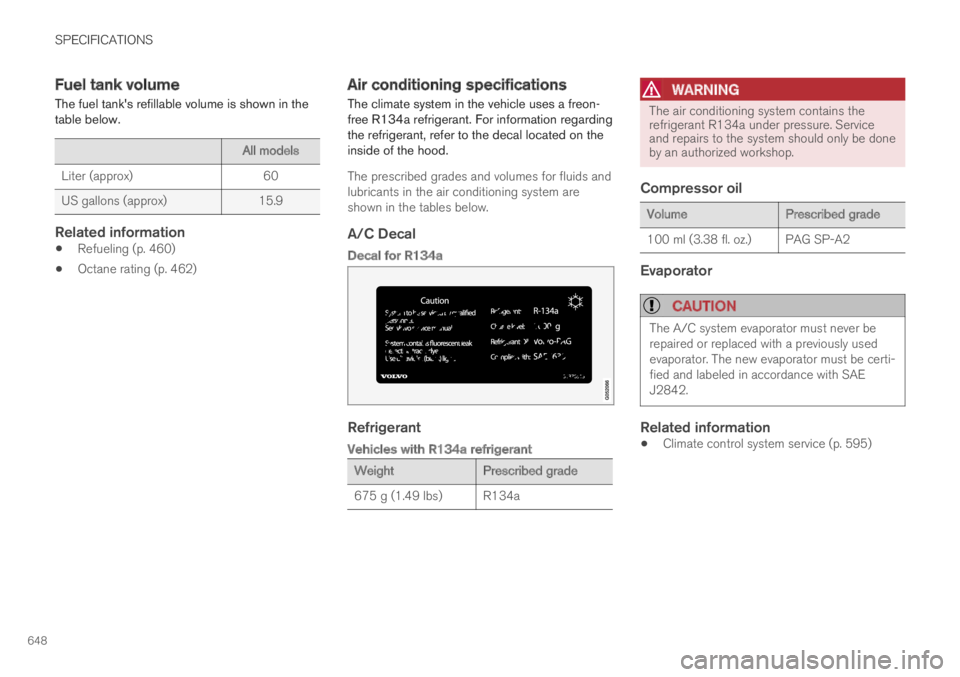
The climate system in the vehicle uses a freon-free R134a refrigerant. For information regardingthe refrigerant, refer to the decal located on theinside of the hood.
The prescribed grades and volumes for fluids andlubricants in the air conditioning system areshown in the tables below.
A/C Decal
Decal for R134a
Refrigerant
Vehicles with R134a refrigerant
WeightPrescribed grade
675 g (1.49 lbs) R134a
WARNING
The air conditioning system contains therefrigerant R134a under pressure. Serviceand repairs to the system should only be doneby an authorized workshop.
Compressor oil
VolumePrescribed grade
100 ml (3.38 fl. oz.) PAG SP-A2
Evaporator
CAUTION
The A/C system evaporator must never berepaired or replaced with a previously usedevaporator. The new evaporator must be certi-fied and labeled in accordance with SAEJ2842.
Related information
Climate control system service (p. 595)
Page 657 of 669

INDEX
655
Engine
automatic start and stop of combustion
engine 445
overheating 465
start 426
turn off 428
Engine braking 431, 440
Engine compartment
coolant 599
engine oil 597
overview 596
Engine drag control 271
Engine oil 597
filling 598
filter 597
grade and volume 646
Engine shutdown 428
Engine specifications 645
Engine temperature
high 465
Environment 27
Error messages
Adaptive Cruise Control 306
see Messages and symbols 306, 322
Error messages in BLIS 351
Ethanol content
max. 10% by volume 461
Exterior dimensions641
Extra heater (Auxiliary heater)232
F
Federal Clean Air Act584
Ferry transport451
Flat tire564
Flooded road 458
Fluids, volumes 635, 648
Fluids and oils 647, 648
Fog lights
rear 155
Four-C 451
Front seat
blower 219
climate 207
heating 209, 210
temperature 221
ventilation 211
Front seat manual 180
Front seats, power 181
adjusting passenger seat from driver's
seat 188
adjusting seat 181
Lumbar support 187
massage184, 185
multifunction control 184, 185, 186, 187
Side bolsters186
store position 182, 183
Fuel 461
Travel Link service 498
Fuel filling 460
Fuel gauge 83
Fuel requirements 461, 462
Fuel tank
volume 648
Fuse box 607
Fuses
below the glove compartment 612
general 606
in engine compartment 608
in trunk 615
replacing 607
G
Gasoline grade461
Gauge
fuel gauge83
Gear selector positions
automatic transmission440
Page 662 of 669

INDEX
660
R
Radar sensor295, 324
limitations325
Radar unit324
Radio483
changing radio waveband and radio sta-
tion484
HD radio487
RBDS487
search radio station485
settings486
SiriusXM® Satellite radio 490, 491, 493
start483
voice control144
Radio favorites485
Rain sensor176, 177
Rain sensor's memory function177
Rear camera 388, 389, 391, 393, 394,
395, 396, 397
Rear door
sun shade166
Rear seat579
adjusting backrest tilt192
Adjusting passenger seat from rear
seat192
blower220
climate207
folding backrest189
head restraint191
heating210
temperature 221
ventilation 212
Rear sensors 382, 383, 384, 385, 386, 387
Rearview/door mirrors
dimming 168
heating 218
interior 167
Rearview mirror 167
dimming 168
Rear window
heating 218
sun shade 166
Recalls 45
Recommendations when driving 457
Recommendations when loading 580
Recovery 470
Red Key 246
settings 247
Refrigerant 595
climate system 648
Refueling
filling 460
fuel filler door, fuel flap 459
Remote immobilizer 250
Remote key237
battery replacement243
connecting to driver profile134
detachable key blade248
loss246
Range242
Remote updates587
Reporting safety defects44
Resetting door mirrors169
Resetting settings130
change of owner130
Driver profile135
Resetting trip odometer88
Road Sign Information356, 357, 358
limitations361
operation358, 359, 360
Road trip457
Roof load, max. weight643
Run-off Mitigation373, 374, 375
S
Safety42
pregnancy43
Safety belt, see Seat belt47
Safety defects, reporting44