oil temperature VOLVO V60 2012 Owners Manual
[x] Cancel search | Manufacturer: VOLVO, Model Year: 2012, Model line: V60, Model: VOLVO V60 2012Pages: 400, PDF Size: 9.28 MB
Page 14 of 400
Introduction
Volvo and the environment
12* Option/accessory, for more information, see Introduction.
the level of certain unhealthy gases such as
carbon monoxide then the air intake is closed.
Such a situation may arise in heavy traffic,
queues and tunnels for example.
The entry of nitrous oxides, ground-level ozone
and hydrocarbons is prevented by the carbon
filter.
InteriorThe interior of a Volvo is designed to be plea-
sant and comfortable, even for people with
contact allergies and for asthma sufferers.
Extreme attention has been given to choosing
environmentally-compatible materials.
Volvo workshops and the environmentRegular maintenance creates the conditions
for a long service life and low fuel consumption
for your car. In this way you contribute to a
cleaner environment. When Volvo's workshops
are entrusted with the service and mainte-
nance of your car it becomes part of our sys-
tem. Volvo makes clear demands regarding the
way in which our workshops are designed in
order to prevent spills and discharges into the
environment. Our workshop staff have the
knowledge and the tools required to guarantee
good environmental care.
Reducing environmental impactYou can easily help reduce environmental
impact - here are a few tips:
•Avoid letting the engine idle - switch off the
engine when stationary for longer periods.
Pay attention to local regulations.
•Drive economically - think ahead.
•Perform service and maintenance in
accordance with the owner's manual's
instructions - follow the Service and War-
ranty Booklet's recommended intervals.
•If the car is equipped with an engine block
heater*, use it before starting from cold - it
improves starting capacity and reduces
wear in cold weather and the engine rea-
ches normal operating temperature more
quickly, which lowers consumption and
reduces emissions.
•High speed increases consumption con-
siderably due to increased wind resistance
- a doubling of speed increases wind resis-
tance 4 times.
•Always dispose of environmentally hazar-
dous waste, such as batteries and oils, in
an environmentally safe manner. Consult a
workshop in the event of uncertainty about
how this type of waste should be discarded
- an authorised Volvo workshop is recom-
mended.
Following this advice can save money, the
planet's resources are saved, and the car's
durability is extended. For more information
and further advice, see the pages 270 and
363.
RecyclingAs a part of Volvo's environmental work, it is
important that the car is recycled in an envi-
ronmentally sound manner. Almost all of the
car can be recycled. The last owner of the car
is therefore requested to contact a dealer for
referral to a certified/approved recycling
facility.
The owner's manual and the
environment
The Forest Stewardship CouncilŸ symbol
shows that the paper pulp in this publication
comes from FSC
Ÿ certified forests or other
controlled sources.
ProCarManuals.com
Page 272 of 400
06 During your journey
Recommendations during driving
06
270
General
Economical drivingDriving economically means driving smoothly
while thinking ahead and adjusting your driving
style and speed to the prevailing conditions.
•Drive in the highest gear possible, adapted
to the current traffic situation and road -
lower engine speeds result in lower fuel
consumption.
•Avoid driving with open windows.
•Avoid sudden unnecessary acceleration
and heavy braking.
•Remove unnecessary items from the car -
the greater the load the higher the fuel con-
sumption.
•Use engine braking to slow down, when it
can take place without risk to other road
users.
•A roof load and ski box increase air resis-
tance, leading to higher fuel consumption
- remove the load carriers when not in use.
•Do not run the engine to operating tem-
perature at idling speed, but rather drive
with a light load as soon as possible - a
cold engine consumes more fuel than a
warm one.
•Cars with the D5 engine and 6-speed man-
ual transmission or DRIVe engine and 6-
speed manual transmission are started in2nd gear under normal conditions on level
ground.
For more information and further advice, see
the pages 12 and 363.
WARNING
Never switch off the engine while moving,
such as downhill, this deactivates important
systems such as the power steering and
brake servo.
Driving in waterThe car can be driven through water at a maxi-
mum depth of 25 cm at a maximum speed of
10 km/h. Extra caution should be exercised
when passing through flowing water.
During driving in water, maintain a low speed
and do not stop the car. When the water has
been passed, depress the brake pedal lightly
and check that full brake function is achieved.
Water and mud for example can make the
brake linings wet resulting in delayed brake
function.
•Clean the electric contacts of the electric
engine block heater and trailer coupling
after driving in water and mud.
•Do not let the car stand with water over the
sills for any long period of time - this could
cause electrical malfunctions.
IMPORTANT
Engine damage can occur if water enters
the air filter.
In depths greater than 25 cm, water could
enter the transmission. This reduces the
lubricating ability of the oils and shortens
the service life of these systems.
In the event of the engine stalling in water,
do not try restart - tow the car from the water
to a workshop - an authorised Volvo work-
shop is recommended. Risk of engine
breakdown.
Engine, gearbox and cooling systemUnder special conditions, for example hard
driving in hilly terrain and hot climate, there is
a risk that the engine and drive system may
overheat - in particular with a heavy load.
For information about overheating when driv-
ing with a trailer, see page 283.
•Remove any auxiliary lamps from in front
of the grille when driving in hot climates.
•If the temperature in the engine's cooling
system is too high the instrument panel's
warning symbol is illuminated and there is
a text message displayed there
High
engine temp Stop safely - stop the car in
a safe way and allow the engine to run at
idling speed for several minutes to cool
down.
ProCarManuals.com
Page 277 of 400
06 During your journey
Fuel
06
275
IMPORTANT
•Always refuel with unleaded petrol so as
not to damage the catalytic converter.
•Do not use additives not recommended
by Volvo.
Bioethanol E85
Do not modify the fuel system or its compo-
nents, and do not replace components with
parts that are not specifically designed for use
with bioethanol.
WARNING
Methanol must not be used. A decal on the
inside of the fuel filler flap shows the correct
alternative fuel.
The use of components not designed for
bioethanol engines could cause fire, injury
or engine damage.
Reserve fuel canThe reserve fuel can should be filled with petrol,
see the NOTE box, page 114.
IMPORTANT
Make sure the reserve fuel can is securely
fastened and that its cap is sealed.
WARNING
Ethanol is sensitive to sparks, and explosive
gases could form in the reserve fuel can if it
is refuelled with ethanol.
Diesel
Only use diesel fuel from well-known produc-
ers. Never use diesel of dubious quality. Diesel
should fulfil the EN 590 or JIS K2204 stand-
ards. Diesel engines are sensitive to contami-
nants in the fuel, such as excessively high vol-
umes of sulphur particles for example.
At low temperatures (-6 °C to -40 °C), a paraffin
precipitate may form in the diesel fuel, which
may lead to ignition problems. Special diesel
fuel designed for low temperatures around
freezing point is available from the major oil
companies. This fuel is less viscous at low tem-
peratures and reduces the risk of paraffin pre-
cipitate.
The risk of condensation in the fuel tank is
reduced if the tank is kept well filled. Whenrefuelling, check that the area around the fuel
filler pipe is clean. Avoid spilling fuel onto the
paintwork. Wash off any spillage with deter-
gent and water.
IMPORTANT
Only ever use fuel that fulfils the European
diesel standard.
The sulphur content must be a maximum of
50 ppm.
IMPORTANT
Diesel type fuels that must not be used:
•Special additives
•Marine diesel fuel
•Heating oil
•FAME1 (Fatty Acid Methyl Ester) and
vegetable oil.
These fuels do not fulfil the requirements in
accordance with Volvo recommendations
and generate increased wear and engine
damage that is not covered by the Volvo
warranty.
Empty tankThe design of the fuel system in a diesel engine
means that if the vehicle runs out of fuel, the
1Diesel fuel may contain a certain amount of FAME, but further amounts must not be added.
ProCarManuals.com
Page 285 of 400
06 During your journey
Driving with a trailer
06
* Option/accessory, for more information, see Introduction.283 General
Payload depends on the car's kerb weight. The
total of the weight of the passengers and all
accessories, e.g. towbar, reduces the car's
payload by a corresponding weight. For more
detailed information on weights, see
page 355.
If the towing bracket is mounted by Volvo, then
the car is delivered with the necessary equip-
ment for driving with a trailer.
•The car's towing bracket must be of an
approved type.
•If the towbar is retrofitted, check with your
Volvo dealer that the car is fully equipped
for driving with a trailer.
•Distribute the load on the trailer so that the
weight on the towing bracket complies
with the specified maximum towball load.
•Increase the tyre pressure to the recom-
mended pressure for a full load. For tyre
pressure label location, see page 301.
•The engine is loaded more heavily than
usual when driving with a trailer.
•Do not tow a heavy trailer when the car is
brand new. Wait until it has been driven at
least 1000 km.
•The brakes are loaded much more than
usual on long and steep downhill slopes.
Downshift to a lower gear and adjust your
speed.
•For safety reasons, the maximum permit-
ted speed for the car when coupled with a
trailer should not be exceeded. Follow the
regulations in force for the permitted
speeds and weights.
•Maintain a low speed when driving with a
trailer up long, steep ascents.
•Avoid driving with a trailer on inclines of
more than 12%.
Trailer cableAn adapter is required if the car's towing
bracket has 13 pin electrics and the trailer has
7 pin electrics. Use an adapter cable approved
by Volvo. Make sure the cable does not drag
on the ground.
Direction indicators and brake lights on
the trailer
If any of the trailer's lamps for direction indica-
tors are broken, then the combined instrument
panel's symbol for direction indicators flashes
faster than normal and the display shows the
text
Bulb fail - Ind. signal trailer.
If any of the trailer's lamps for the brake light
are broken then the
Bulb fail - Stop lamp
trailer text is shown.
Level control*The rear shock absorbers maintain a constant
height irrespective of the car's load (up to the
maximum permissible weight). When the car isstationary the rear of the car lowers slightly,
which is normal.
Trailer weightsFor information on Volvo's permitted trailer
weights, see page 356.
NOTE
The stated maximum permitted trailer
weights are those permitted by Volvo.
National vehicle regulations can further limit
trailer weights and speeds. Towbars can be
certified for higher towing weights than the
car can actually tow.
WARNING
Follow the stated recommendations for
trailer weights. Otherwise, the car and trailer
may be difficult to control in the event of
sudden movement and braking.
Manual gearbox
OverheatingWhen driving with a trailer in hilly terrain in a hot
climate there may be a risk of overheating.
•Do not run the engine at higher revolutions
than 4500 rpm (diesel engines: 3500 rpm)
- otherwise the oil temperature may
become too high.
ProCarManuals.com
Page 318 of 400
08 Maintenance and service
Engine compartment
08
316
IMPORTANT
In the event of the message Oil level low
Refill 0,5 Ltr, only fill with 0.5 litres.
NOTE
The oil level is only detected by the system
during driving. The system cannot directly
detect changes when the oil is filled or
drained. The car must be driven
about 30 km before the oil level display is
correct.
WARNING
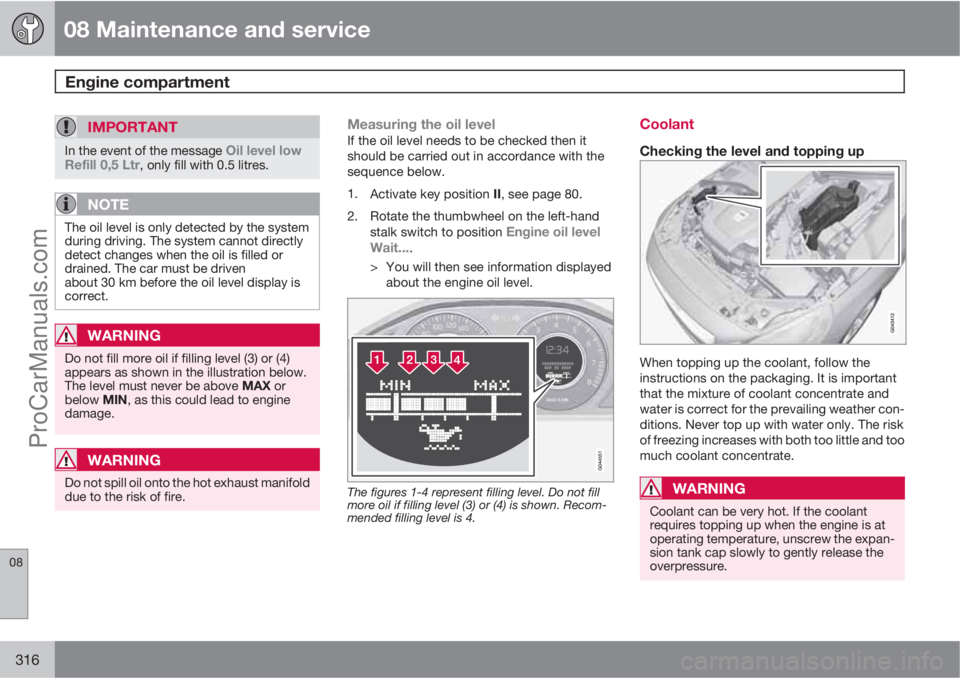
Do not fill more oil if filling level (3) or (4)
appears as shown in the illustration below.
The level must never be above MAX or
below MIN, as this could lead to engine
damage.
WARNING
Do not spill oil onto the hot exhaust manifold
due to the risk of fire.
Measuring the oil levelIf the oil level needs to be checked then it
should be carried out in accordance with the
sequence below.
1.
Activate key position II, see page 80.
2. Rotate the thumbwheel on the left-hand
stalk switch to position
Engine oil level
Wait....
> You will then see information displayed
about the engine oil level.
The figures 1-4 represent filling level. Do not fill
more oil if filling level (3) or (4) is shown. Recom-
mended filling level is 4.
Coolant
Checking the level and topping up
When topping up the coolant, follow the
instructions on the packaging. It is important
that the mixture of coolant concentrate and
water is correct for the prevailing weather con-
ditions. Never top up with water only. The risk
of freezing increases with both too little and too
much coolant concentrate.
WARNING
Coolant can be very hot. If the coolant
requires topping up when the engine is at
operating temperature, unscrew the expan-
sion tank cap slowly to gently release the
overpressure.
ProCarManuals.com
Page 361 of 400
09 Specifications
Engine oil09
359 Adverse driving conditions
Adverse driving conditions can lead to abnor-
mally high oil temperature or oil consumption.
Below are some examples of adverse driving
conditions.
Check the oil level more frequently for long
journeys:
•towing a caravan or trailer
•in mountainous regions
•at high speeds
•in temperatures colder than -30 °C or hot-
ter than +40 °C
The above also apply to shorter driving dis-
tances at low temperatures.Choose a fully synthetic engine oil for adverse
driving conditions. It provides extra protection
for the engine.
Volvo recommends Castrol oil products.
IMPORTANT
In order to fulfil the requirements for the
engine's service intervals all engines are
filled with a specially adapted synthetic
engine oil at the factory. The choice of oil
has been made very carefully with regard to
service life, starting characteristics, fuel
consumption and environmental impact.
An approved engine oil must be used in
order that the recommended service inter-
vals can be applied. Only use a prescribed
grade of oil for both filling and oil change,
otherwise you will risk affecting service life,
starting characteristics, fuel consumption
and environmental impact.
Volvo Car Corporation disclaims all war-
ranty liability if engine oil of the prescribed
grade and viscosity is not used.
Volvo recommends that oil changes are car-
ried out at an authorised Volvo workshop.
ProCarManuals.com
Page 391 of 400
10 Alphabetical Index
10
389
Electrical socket......................................217
cargo area........................................... 279
front seat............................................. 217
Electric parking brake.............................. 133
low battery voltage.............................133
releasing automatically....................... 134
releasing manually.............................. 134
Emergency equipment
warning triangle.................................. 302
Emergency puncture repair..................... 305
Emissions of carbon dioxide................... 277
Engine
overheating......................................... 283
starting................................................ 112
Engine block heater................................. 114
fuel-driven........................................... 162
Engine compartment
coolant................................................ 316
oil........................................................ 313
overview.............................................. 313
power steering fluid............................ 318
Engine drag control ................................168
Engine oil.........................................313, 359
adverse driving conditions.................. 359
capacities........................................... 359filter..................................................... 313
oil grade.............................................. 359
Engine specifications............................... 358
Environmental labelling, FSC, owner's
manual.......................................................12
Error messages
Driver Alert Control............................. 201
Lane Departure Warning..................... 203
see Messages and symbols.......135, 183
Error messages in BLIS........................... 213
Error messages in Distance Alert............ 186
Error messages in the Adaptive cruise con-
trol............................................................ 183
ETC, electronic temperature control ....... 156
Expectant mothers, seatbelt...................... 17
External dimensions................................354
F
Fan........................................................... 157
Fault tracing for the camera sensor. 190, 196
First aid equipment.................................. 302
First aid kit .............................................. 302Flexifuel.................................................... 114
adaptation........................................... 115
Fluids, capacities..................................... 361
Fluids and oils.......................................... 361
Fog lamps
rear........................................................ 90
Foot brake............................................... 131
FOUR-C – Active chassis........................170
FSC, environmental labelling..................... 12
Fuel.......................................................... 274
fuel consumption................................ 363
fuel economy...................................... 301
fuel filter.............................................. 276
Fuse box.................................................. 333
glovebox............................................. 338
Fuses.......................................................333
box in cargo area................................ 341
changing............................................. 333
cold zone............................................ 342
general................................................ 333
relay/fuse box in engine compart-
ment.................................................... 334
Start/Stop........................................... 342
Fuse table
fuses in engine compartment............. 335
ProCarManuals.com