wheel VOLVO V60 2013 Owners Manual
[x] Cancel search | Manufacturer: VOLVO, Model Year: 2013, Model line: V60, Model: VOLVO V60 2013Pages: 422, PDF Size: 9.59 MB
Page 314 of 422
08 Wheels and tyres
General
08
312* Option/accessory, for more information, see Introduction.
Jack*The original jack should only be used for
changing to the spare wheel. The jack's thread
must always be well greased.
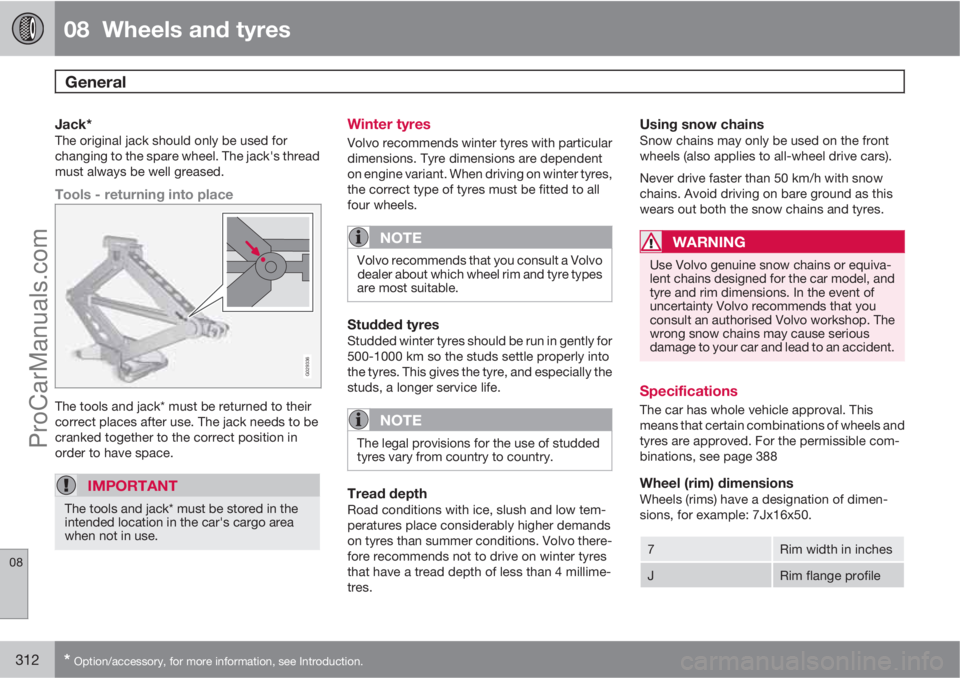
Tools - returning into place
G029336
The tools and jack* must be returned to their
correct places after use. The jack needs to be
cranked together to the correct position in
order to have space.
IMPORTANT
The tools and jack* must be stored in the
intended location in the car's cargo area
when not in use.
Winter tyres
Volvo recommends winter tyres with particular
dimensions. Tyre dimensions are dependent
on engine variant. When driving on winter tyres,
the correct type of tyres must be fitted to all
four wheels.
NOTE
Volvo recommends that you consult a Volvo
dealer about which wheel rim and tyre types
are most suitable.
Studded tyresStudded winter tyres should be run in gently for
500-1000 km so the studs settle properly into
the tyres. This gives the tyre, and especially the
studs, a longer service life.
NOTE
The legal provisions for the use of studded
tyres vary from country to country.
Tread depthRoad conditions with ice, slush and low tem-
peratures place considerably higher demands
on tyres than summer conditions. Volvo there-
fore recommends not to drive on winter tyres
that have a tread depth of less than 4 millime-
tres.
Using snow chainsSnow chains may only be used on the front
wheels (also applies to all-wheel drive cars).
Never drive faster than 50 km/h with snow
chains. Avoid driving on bare ground as this
wears out both the snow chains and tyres.
WARNING
Use Volvo genuine snow chains or equiva-
lent chains designed for the car model, and
tyre and rim dimensions. In the event of
uncertainty Volvo recommends that you
consult an authorised Volvo workshop. The
wrong snow chains may cause serious
damage to your car and lead to an accident.
Specifications
The car has whole vehicle approval. This
means that certain combinations of wheels and
tyres are approved. For the permissible com-
binations, see page 388
Wheel (rim) dimensionsWheels (rims) have a designation of dimen-
sions, for example: 7Jx16x50.
7Rim width in inches
JRim flange profile
ProCarManuals.com
Page 315 of 422
08 Wheels and tyres
General
08
313
16Rim diameter in
inches
50Off-set in mm (dis-
tance from wheel
centre to wheel con-
tact surface against
the hub)
Tyre dimensionsThe dimensions are stated on all car tyres.
Example of designation: 215/55R16 97W.
215Tyre width (mm)
55Ratio between tyre wall height and
tyre width (%)
RRadial ply
16Rim diameter in inches (")
97Codes for the maximum permitted
tyre load, tyre load index (LI)
WSpeed rating for maximum permitted
speed, speed rating (SS). (In this case
270 km/h).
Load indexEach tyre has a certain capacity to carry a load,
a load index (LI). The car's weight determines
the load capacity required of the tyres. Mini-mum permitted index is specified in the table,
see page 388.
Speed ratingsEach tyre can withstand a certain maximum
speed, a speed rating (Speed Symbol; SS).
Tyre speed class must at least correspond with
the car's top speed. Minimum permitted speed
rating is specified in the table, see page 388.
The only exception to these conditions is win-
ter tyres (both those with metal studs and those
without), where a lower speed rating may be
used. If such a tyre is chosen, the car must not
be driven faster than the speed rating of the
tyre (for example, class Q can be driven at a
maximum of 160 km/h).
Traffic regulations determine how fast a car
can be driven, not the speed rating of the tyres.
NOTE
It is the maximum permitted speed that is
stated in the table.
Q160 km/h (used only on winter tyres)
T190 km/h
H210 km/h
V240 km/h
W270 km/h
Y300 km/h
WARNING
The car must be fitted with tyres which have
the same or a higher load index (LI) and
speed rating (SS) than specified. If a tyre
with too low a load index or speed rating is
used, it may overheat.
ProCarManuals.com
Page 316 of 422
08 Wheels and tyres
Changing wheels
08
314* Option/accessory, for more information, see Introduction.
Spare wheel*
The following instructions are applicable
only if a spare wheel has been purchased as
an optional extra with the car. If the car does
not have a spare wheel, see page 321 for infor-
mation on temporary tyre sealing (TMK).
The spare wheel (Temporary spare) is only
intended for use temporarily and must be
replaced by an ordinary wheel as soon as pos-
sible. The car's handling may be altered by the
use of the spare wheel. The spare wheel is
smaller than the normal wheel. The car's
ground clearance is affected accordingly. Pay
attention to high kerbs and do not machine
wash the car. If the spare wheel is fitted on the
front axle, you cannot use snow chains at the
same time. On all-wheel drive cars the drive on
the rear axle can be disconnected. The spare
wheel must not be repaired. The correct tyre
pressure for the spare wheel is stated in the
tyre pressure table, see page 388.
IMPORTANT
Never drive faster than 80 km/h with a spare
wheel on the car.
IMPORTANT
The car must never be driven fitted with
more than one temporary spare wheel.
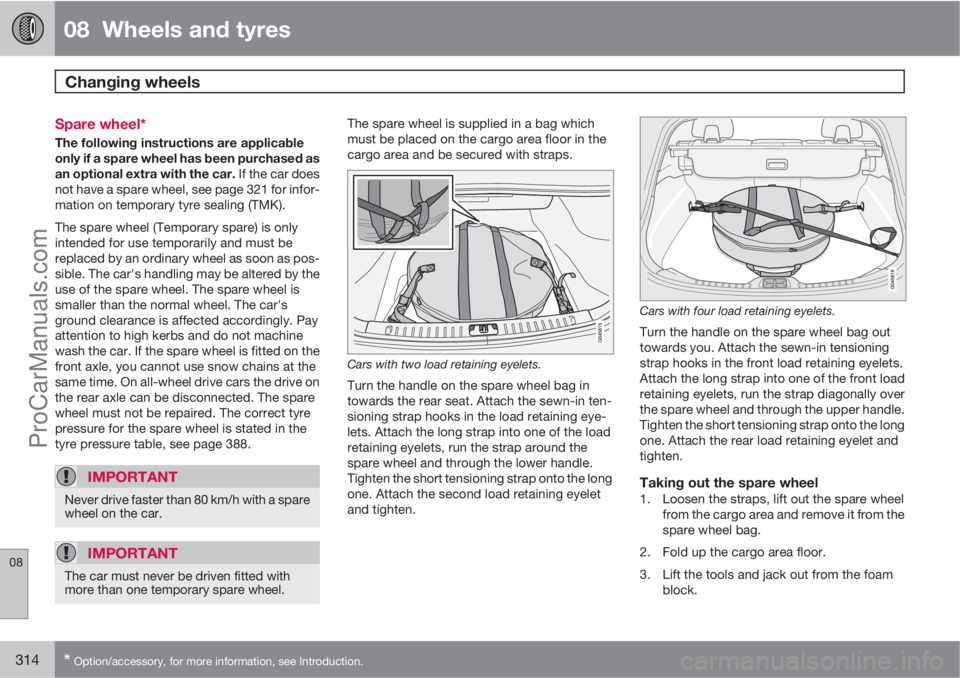
The spare wheel is supplied in a bag which
must be placed on the cargo area floor in the
cargo area and be secured with straps.
Cars with two load retaining eyelets.
Turn the handle on the spare wheel bag in
towards the rear seat. Attach the sewn-in ten-
sioning strap hooks in the load retaining eye-
lets. Attach the long strap into one of the load
retaining eyelets, run the strap around the
spare wheel and through the lower handle.
Tighten the short tensioning strap onto the long
one. Attach the second load retaining eyelet
and tighten.
Cars with four load retaining eyelets.
Turn the handle on the spare wheel bag out
towards you. Attach the sewn-in tensioning
strap hooks in the front load retaining eyelets.
Attach the long strap into one of the front load
retaining eyelets, run the strap diagonally over
the spare wheel and through the upper handle.
Tighten the short tensioning strap onto the long
one. Attach the rear load retaining eyelet and
tighten.
Taking out the spare wheel1. Loosen the straps, lift out the spare wheel
from the cargo area and remove it from the
spare wheel bag.
2. Fold up the cargo area floor.
3. Lift the tools and jack out from the foam
block.
ProCarManuals.com
Page 317 of 422
08 Wheels and tyres
Changing wheels
08
* Option/accessory, for more information, see Introduction.315 Removing
Set up the warning triangle, see page 318 if a
wheel must be replaced at a busy location. The
car and jack* must be on a firm horizontal sur-
face.
1. Apply the parking brake and engage
reverse gear, or position P if the car has an
automatic gearbox.
WARNING
Check that the jack is not damaged, that the
threads are thoroughly lubricated and that it
is free from dirt.
NOTE
Volvo recommends only using the jack* that
belongs to the car model in question, which
is indicated on the jack's label.
The label also indicates the jack's maximum
lift capacity at a specified minimum lifting
height.
2. Take out the jack*, wheel wrench* and
removal tool for wheel covers* located
under the cargo floor in the cargo area. If
another jack is selected, see page 328.
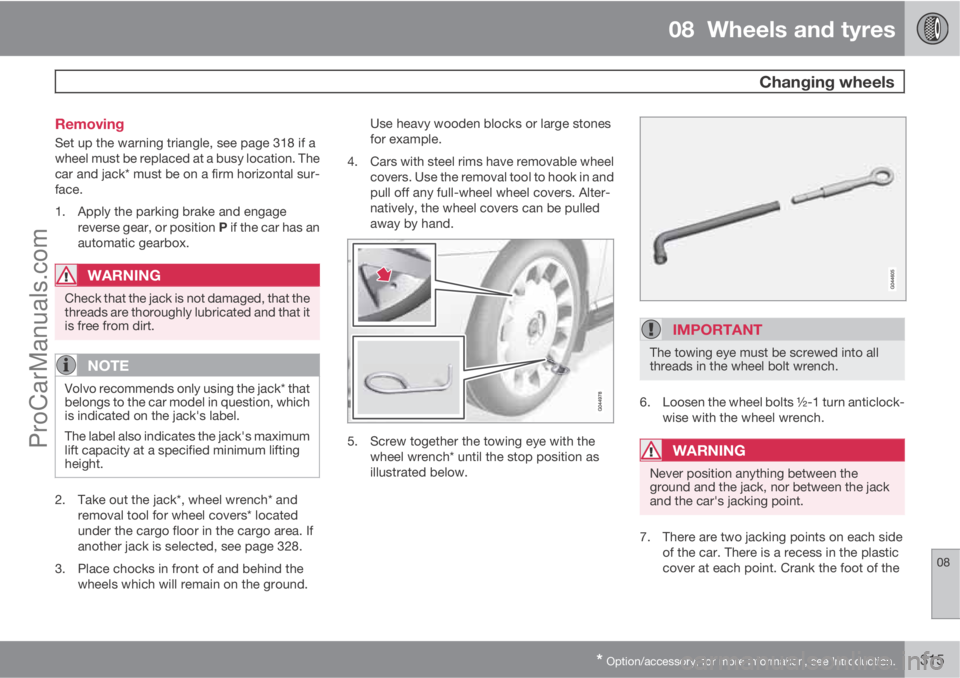
3. Place chocks in front of and behind the
wheels which will remain on the ground.Use heavy wooden blocks or large stones
for example.
4. Cars with steel rims have removable wheel
covers. Use the removal tool to hook in and
pull off any full-wheel wheel covers. Alter-
natively, the wheel covers can be pulled
away by hand.
5. Screw together the towing eye with the
wheel wrench* until the stop position as
illustrated below.
IMPORTANT
The towing eye must be screwed into all
threads in the wheel bolt wrench.
6. Loosen the wheel bolts ½-1 turn anticlock-
wise with the wheel wrench.
WARNING
Never position anything between the
ground and the jack, nor between the jack
and the car's jacking point.
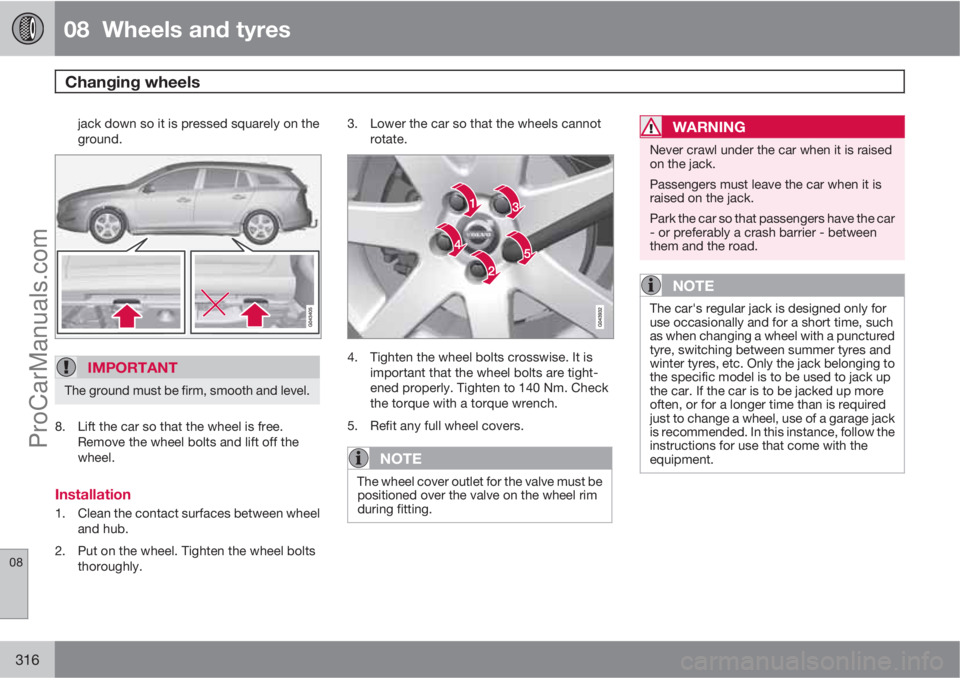
7. There are two jacking points on each side
of the car. There is a recess in the plastic
cover at each point. Crank the foot of the
ProCarManuals.com
Page 318 of 422
08 Wheels and tyres
Changing wheels
08
316
jack down so it is pressed squarely on the
ground.
IMPORTANT
The ground must be firm, smooth and level.
8. Lift the car so that the wheel is free.
Remove the wheel bolts and lift off the
wheel.
Installation
1. Clean the contact surfaces between wheel
and hub.
2. Put on the wheel. Tighten the wheel bolts
thoroughly.3. Lower the car so that the wheels cannot
rotate.
4. Tighten the wheel bolts crosswise. It is
important that the wheel bolts are tight-
ened properly. Tighten to 140 Nm. Check
the torque with a torque wrench.
5. Refit any full wheel covers.
NOTE
The wheel cover outlet for the valve must be
positioned over the valve on the wheel rim
during fitting.
WARNING
Never crawl under the car when it is raised
on the jack.
Passengers must leave the car when it is
raised on the jack.
Park the car so that passengers have the car
- or preferably a crash barrier - between
them and the road.
NOTE
The car's regular jack is designed only for
use occasionally and for a short time, such
as when changing a wheel with a punctured
tyre, switching between summer tyres and
winter tyres, etc. Only the jack belonging to
the specific model is to be used to jack up
the car. If the car is to be jacked up more
often, or for a longer time than is required
just to change a wheel, use of a garage jack
is recommended. In this instance, follow the
instructions for use that come with the
equipment.
ProCarManuals.com
Page 319 of 422
08 Wheels and tyres
Tyre pressure
08
317
Tyre pressure
G021830
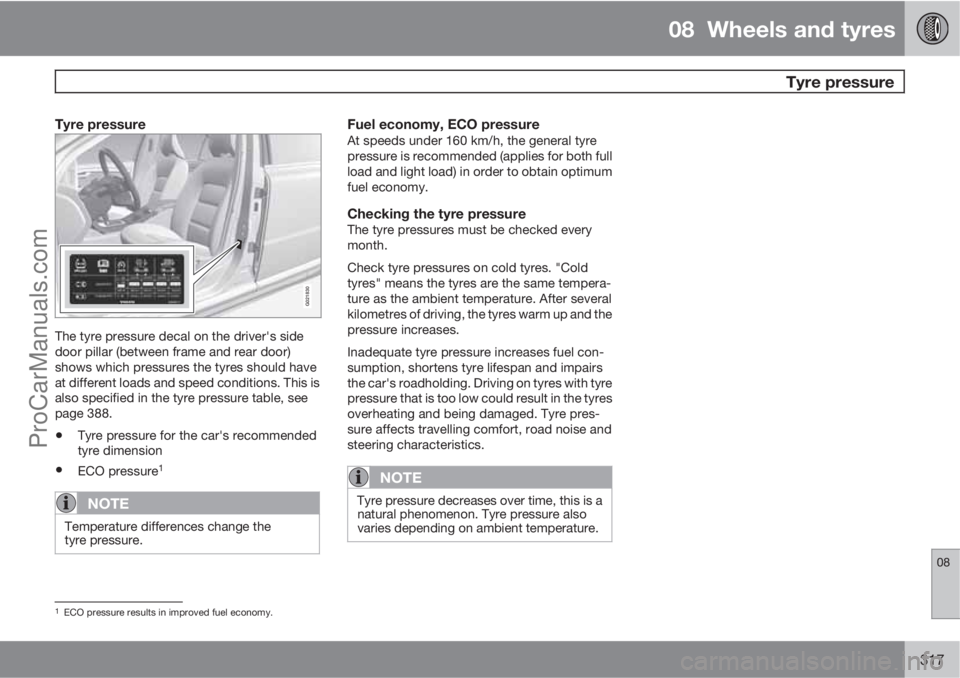
The tyre pressure decal on the driver's side
door pillar (between frame and rear door)
shows which pressures the tyres should have
at different loads and speed conditions. This is
also specified in the tyre pressure table, see
page 388.
•Tyre pressure for the car's recommended
tyre dimension
•ECO pressure1
NOTE
Temperature differences change the
tyre pressure.
Fuel economy, ECO pressureAt speeds under 160 km/h, the general tyre
pressure is recommended (applies for both full
load and light load) in order to obtain optimum
fuel economy.
Checking the tyre pressureThe tyre pressures must be checked every
month.
Check tyre pressures on cold tyres. "Cold
tyres" means the tyres are the same tempera-
ture as the ambient temperature. After several
kilometres of driving, the tyres warm up and the
pressure increases.
Inadequate tyre pressure increases fuel con-
sumption, shortens tyre lifespan and impairs
the car's roadholding. Driving on tyres with tyre
pressure that is too low could result in the tyres
overheating and being damaged. Tyre pres-
sure affects travelling comfort, road noise and
steering characteristics.
NOTE
Tyre pressure decreases over time, this is a
natural phenomenon. Tyre pressure also
varies depending on ambient temperature.
1ECO pressure results in improved fuel economy.
ProCarManuals.com
Page 320 of 422
08 Wheels and tyres
Warning triangle and first-aid kit*
08
318* Option/accessory, for more information, see Introduction.
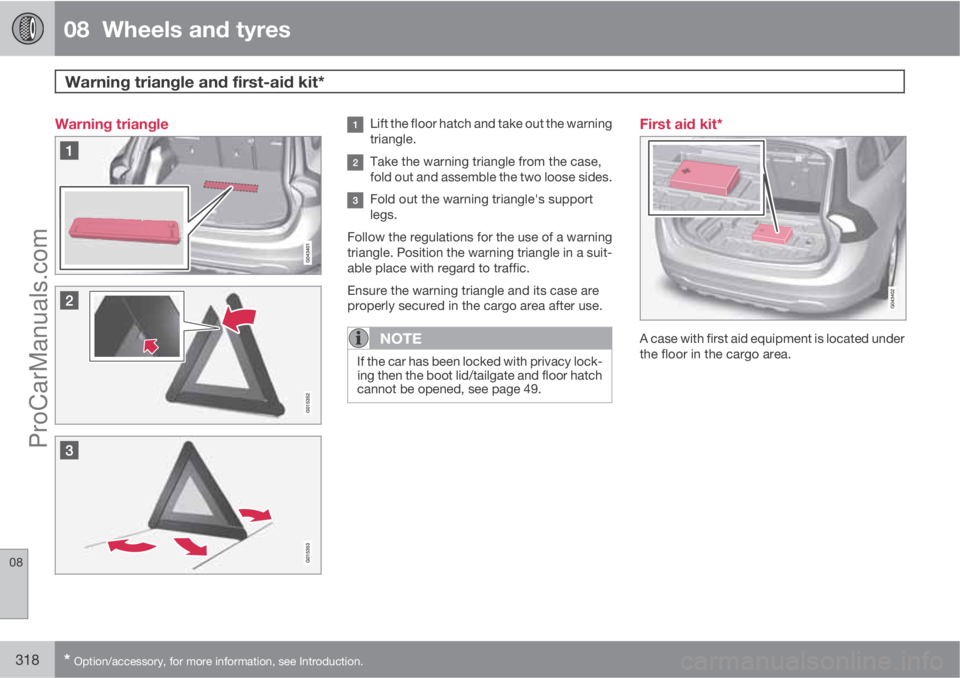
Warning triangleLift the floor hatch and take out the warning
triangle.
Take the warning triangle from the case,
fold out and assemble the two loose sides.
Fold out the warning triangle's support
legs.
Follow the regulations for the use of a warning
triangle. Position the warning triangle in a suit-
able place with regard to traffic.
Ensure the warning triangle and its case are
properly secured in the cargo area after use.
NOTE
If the car has been locked with privacy lock-
ing then the boot lid/tailgate and floor hatch
cannot be opened, see page 49.
First aid kit*
A case with first aid equipment is located under
the floor in the cargo area.
ProCarManuals.com
Page 321 of 422
08 Wheels and tyres
Tyre pressure monitoring (TPMS)*
08
* Option/accessory, for more information, see Introduction.319 General
TPMS (Tyre Pressure Monitoring System)*
warns the driver when the pressure is too low
in one or more of the car's tyres. It uses sensors
located inside the air valve in each wheel.
When the car is driven at about 40 km/h the
system detects the tyre pressure. If the pres-
sure is too low then a warning lamp
on the
instrument panel illuminates and a message is
shown on the display.
Only factory fitted wheels are equipped with
TPMS sensors in the valves.
If wheels without TPMS sensors are used then
Tyre press. syst Service required will be
shown every time the car is driven faster than
40 km/h for more than 10 minutes.
Always check the system after changing a
wheel in order to ensure that replacement
wheels work with the system.
For information on correct tyre pressures, see
page 388.
The system does not replace normal tyre main-
tenance.
IMPORTANT
If a fault should arise in the tyre pressure
system a warning lamp on the instru-
ment panel will illuminate and a message
will be shown. This can be for various rea-
sons, e.g. fitting a wheel not equipped with
a sensor adapted for Volvo's tyre pressure
monitoring system.
Adjusting tyre pressure monitoringTyre pressure monitoring can be adjusted in
order to follow Volvo's tyre pressure recom-
mendations, when driving with a heavy load for
example.
NOTE
The engine must not be running when the
tyres are calibrated.
The settings are made with the control in the
centre console, see page 203.
1. Inflate the tyres to the required pressure
and select key position I or II.
2.
Select the menu system MY CAR to open
the menus to Settings
Tyre pressure
3.
Select
Calibrate tyre pressure.
4.
Press OK.5. Start the car and drive at least at 40 km/h
for a total of at least 1 minute and check
that the message disappears.
> Calibration is complete.
Rectifying low tyre pressureIf a message for low tyre pressure is shown in
the display:
1. Check the tyre pressure in all four tyres.
2. Inflate the tyre(s) to the correct pressure.
3. Drive at least at 40 km/h for a total of at
least 1 minute and check that the message
disappears.
Deactivating/activating tyre pressure
monitoring
NOTE
The engine must not be running when tyre
pressure monitoring is activated/deacti-
vated.
The settings are made with the control in the
centre console, see page 203.
1.
Select key position I or II.
2.
Select the system MY CAR to open the
menus to Car settings
Tyre pressure
3.
Select
Tyre pressure system and press
OK.
ProCarManuals.com
Page 322 of 422
08 Wheels and tyres
Tyre pressure monitoring (TPMS)*
08
320* Option/accessory, for more information, see Introduction.
>
A X is shown in the display if the system
is activated, the option disappears if the
system is deactivated.
Recommendations
•Volvo recommends that TPMS sensors are
fitted to all wheels on the car.
•Volvo recommends that sensors are not
moved between different wheels.
WARNING
When inflating a tyre equipped with TPMS,
hold the nozzle of the pump directly against
the valve to avoid damaging the valve.
Driveable punctured tyres*
If Self Supporting run flat Tyres (SST)* have
been selected then the car is also equipped
with TPMS.
This type of tyre has a specially reinforced side
wall that makes continued driving possible to
a limited extent despite the tyre losing all or
some of its pressure. These tyres are fitted on
a special rim. (Normal tyres can also be fitted
to this rim).
If an SST tyre loses tyre pressure then the yel-
low TPMS lamp on the instrument panel illumi-
nates and a message is shown in the text
panel. If this occurs, reduce speed tomax. 80 km/h. The tyre must be replaced as
soon as possible.
Drive carefully, in some cases it can be difficult
to see which tyre is faulty. In order to establish
which tyre needs attention, check all four tyres.
WARNING
SST tyres should only be fitted by individu-
als with expertise on SST tyres.
SST tyres must only be fitted together with
TPMS.
After a fault message on low tyre pressure
has been shown, do not drive faster than
80 km/h.
Maximum driving distance to tyre change is
80 km.
Avoid hard driving such as sudden braking
or turning.
SST tyres must be replaced if they are dam-
aged or punctured.
ProCarManuals.com
Page 323 of 422
08 Wheels and tyres
Emergency puncture repair (TMK)
08
321 General
Emergency puncture repair (TMK; Temporary
Mobility Kit) is used to seal a puncture and
check and adjust tyre pressure. It consists of a
compressor and a bottle with sealing fluid. The
kit works as a temporary repair. The sealing
fluid bottle must be replaced before its expira-
tion date and after use.
The sealing fluid effectively seals tyres punc-
tured in the tread.
NOTE
The emergency puncture repair kit is only
intended for sealing tyres with a puncture in
the tread.
The emergency puncture repair kit has limited
capacity to seal tyres which have punctures inthe wall. Do not seal tyres with the emergency
puncture repair kit if they have larger slits,
cracks or similar damage.
Connect the compressor to one of the car's 12
V sockets, see pages 229 and 293. Choose the
electrical socket that is nearest the punctured
tyre.
IMPORTANT
If the compressor for emergency puncture
repair is connected to one of the two sock-
ets in the tunnel console, see page 229, no
other current consumer must be connected
to the other one.
NOTE
The compressor for temporary emergency
puncture repair has been tested and
approved by Volvo.
Location of the emergency puncture
repair kit
Set up the warning triangle if a tyre is being
sealed in a trafficked location. The emergency
puncture repair kit is located under the floor in
the cargo area, see page 318.
WARNING
You should not drive faster than 80 km/h
after the emergency tyre repair kit has been
used. Volvo recommends that you visit an
authorised Volvo workshop for inspection of
the sealed tyre (maximum driving distance
is 200 km). The staff there can determine
whether or not the tyre can be repaired or if
it needs to be replaced.
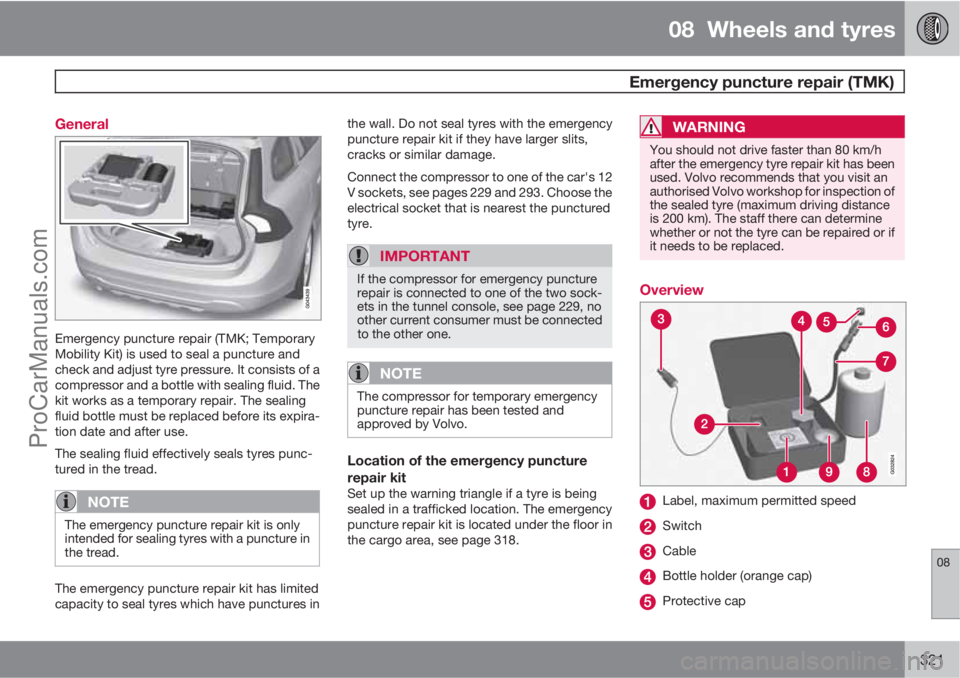
Overview
Label, maximum permitted speed
Switch
Cable
Bottle holder (orange cap)
Protective cap
ProCarManuals.com