wheel VOLVO V60 2013 Manual Online
[x] Cancel search | Manufacturer: VOLVO, Model Year: 2013, Model line: V60, Model: VOLVO V60 2013Pages: 422, PDF Size: 9.59 MB
Page 301 of 422
07 During your journey
Driving with a trailer
07
299
Diesel engine 5-cyl
•In the event of a risk of overheating the
optimal speed for the engine is 2300-3000
rpm for optimal circulation of the coolant.
Automatic gearbox
OverheatingWhen driving with a trailer in hilly terrain in a hot
climate there may be a risk of overheating.
•An automatic gearbox selects the optimum
gear related to load and engine speed.
•In the event of overheating a warning sym-
bol illuminates on the instrument panel
combined with a text message - follow the
recommendation given.
Steep inclines
•Do not lock the automatic transmission in
a higher gear than the engine "can cope
with" - it is not always a good idea to drive
at a high gear with low engine revolutions.
IMPORTANT
See also the specific information on slow
driving with trailer for cars with the
Powershift automatic transmission on page
125.
Parking on a hill1. Depress the foot brake.2. Activate the parking brake.
3.
Move the gear selector to position P.
4. Release the foot brake.
•Move the gear selector to park position P
when parking an automatic car with a
hitched trailer. Always use the parking
brake.
•Block the wheels with chocks when park-
ing a car with hitched trailer on a hill.
Starting on a hill1. Depress the foot brake.
2. Move the gear selector to driving posi-
tion D.
3. Release the parking brake.
4. Release the foot brake and start driving off.
Towing bracket
If the car is equipped with a detachable towbar,
the installation instructions for the loose sec-
tion must be followed carefully, see page 301.
WARNING
If the car is fitted with a Volvo detachable
towbar:
•Follow the installation instructions care-
fully.
•The detachable section must be locked
with the key before setting off.
•Check that the indicator window shows
green.
Important checks
•The towbar's towball must be cleaned and
greased regularly.
NOTE
If a towball hitch with vibration damper is
used, it is not necessary to grease the tow-
ball.
ProCarManuals.com
Page 304 of 422
07 During your journey
Driving with a trailer
07
302
G021494
Check that the towbar is secure by pulling
it up, down and back.
WARNING
If the towbar is not fitted correctly then it
must be detached and reattached in
accordance with the previous instructions.
IMPORTANT
Only grease in the ball for the towing hitch,
the remainder of the towbar should be clean
and dry.
G021495
Safety cable.
WARNING
Be sure to attach the trailer's safety cable to
the correct place.
Removing the towbar
Insert the key and turn it clockwise to the
unlocked position.
Push in the locking wheel and turn it
anticlockwise
until you hear a click.
Turn the locking wheel down fully, until it
comes to a stop. Hold it in this position
while pulling the towbar rearward and
upward.
WARNING
Secure the towbar safely if it is stored in the
car, see page 300.
ProCarManuals.com
Page 305 of 422
07 During your journey
Driving with a trailer
07
* Option/accessory, for more information, see Introduction.303
G018929
Push the protective cover until it snaps
tight.
Trailer Stability Assist - TSA*
The TSA system (Trailer Stability Assist) serves
to stabilise the car and trailer combination if it
begins to snake.
The TSA function is part of the DSTC system
(Dynamic Stability and Traction Control), see
page 146.
FunctionThe snaking phenomenon can occur with any
car/trailer combination. Normally, snaking
occurs at extremely high speeds. But, there is
a risk of it occurring at lower speeds
(70-90 km/h) if the trailer is overloaded or the
load is improperly distributed, e.g. too far back.
In order for snaking to occur, there must be a
triggering factor, e.g.:
•Car with trailer subjected to a sudden and
powerful side wind.
•Car with trailer drives on an uneven road
surface or in a pothole.
•Sweeping steering wheel movements.
OperationIf snaking has started, it could be difficult or
even impossible to suppress. This makes the
car/trailer combination difficult to control and
there is a risk that you could, for example, end
up in the wrong lane or leave the carriageway.
TSA system continually monitors car move-
ments, particularly lateral movements. If snak-
ing is detected, the front wheels are individually
braked. This serves to stabilise the car/trailer
combination. This is often enough to help the
driver regain control of the car.
If snaking is not eliminated the first time the
TSA system comes into action, the car/trailer
combination is braked with all wheels and
engine power is reduced. Once snaking has
been gradually suppressed and the car/trailer
combination is once again stable, the TSA sys-
tem stops regulating and the driver once again
has full control of the car.
MiscellaneousThe TSA system can engage within the speed
interval 60 to 160 km/h.
NOTE
TSA function is switched off if the driver
selects Sport mode, see page 146.
TSA may fail to engage if the driver uses severe
steering wheel movements to try to rectify the
snaking because in such a situation the TSA
system cannot determine whether it is the
trailer or the driver that is causing the snaking.
The DSTC symbol in the combined
instrument panel flashes when the
TSA is working.
ProCarManuals.com
Page 306 of 422
07 During your journey
Towing and recovery
07
304
Towing
Find out the statutory maximum speed limit for
towing before towing begins.
1. Unlock the steering lock by inserting the
remote control key in the ignition switch
and giving a long press on the START/
STOP ENGINE button - key position II is
activated, see page 78 for more informa-
tion on key positions.
2. The remote control key must remain in the
ignition switch while the car is being towed.
3. Keep the towline taut when the towing
vehicle reduces speed by holding your foot
gently pressed on the brake pedal -
thereby avoiding unnecessary jerking.
4. Be prepared to brake to stop.
WARNING
•Check that the steering lock is unlocked
before towing.
•The remote control key must be in key
position II - in position I all airbags are
deactivated.
•Never remove the remote control key
from the ignition switch when the car is
being towed.
WARNING
The brake servo and power steering do not
work when the engine is switched off - the
brake pedal needs to be depressed
about 5 times more heavily and the steering
is considerably heavier than normal.
Manual gearboxPrior to towing:
–Move gear lever into neutral and release
the parking brake.
Automatic gearbox Geartronic
IMPORTANT
Note that the car must always be towed with
the wheels rolling forward.
•Cars with automatic gearbox must not
be towed at speeds above 80 km/h or
further than 80 km.
Prior to towing:
–
Move the gear selector to position N and
release the parking brake.
Automatic gearbox PowershiftThe model with Powershift transmission
should not be towed as it is dependent on the
engine running in order to receive sufficientlubrication. If towing still has to take place, the
route must be as short as possible and then
with very low speed.
In the event of uncertainty as to whether or not
the car is equipped with Powershift transmis-
sion, this can be verified by checking the des-
ignation on the transmission's label under the
bonnet - see page 370. The designa-
tion ”MPS6” means that it is Powershift – trans-
mission otherwise it is Geartronic automatic
transmission.
IMPORTANT
Avoid towing.
•However, the car can be towed for a
short distance at low speed to move it
from a dangerous position - not further
than 10 km and not faster than
10 km/h. Note that the car must always
be towed with the wheels rolling for-
ward.
•In the event of moving a longer distance
than 10 km, the car must be transported
with the drive wheels raised from the
road - professional recovery is recom-
mended.
Prior to towing:
–
Move the gear selector to position N and
release the parking brake.
ProCarManuals.com
Page 307 of 422
07 During your journey
Towing and recovery
07
305
Jump startingDo not tow the car to bump start the engine.
Use a donor battery if the battery is discharged
and the engine does not start, see page 120.
IMPORTANT
The catalytic converter may be damaged
during attempts to tow-start the engine.
Towing eye
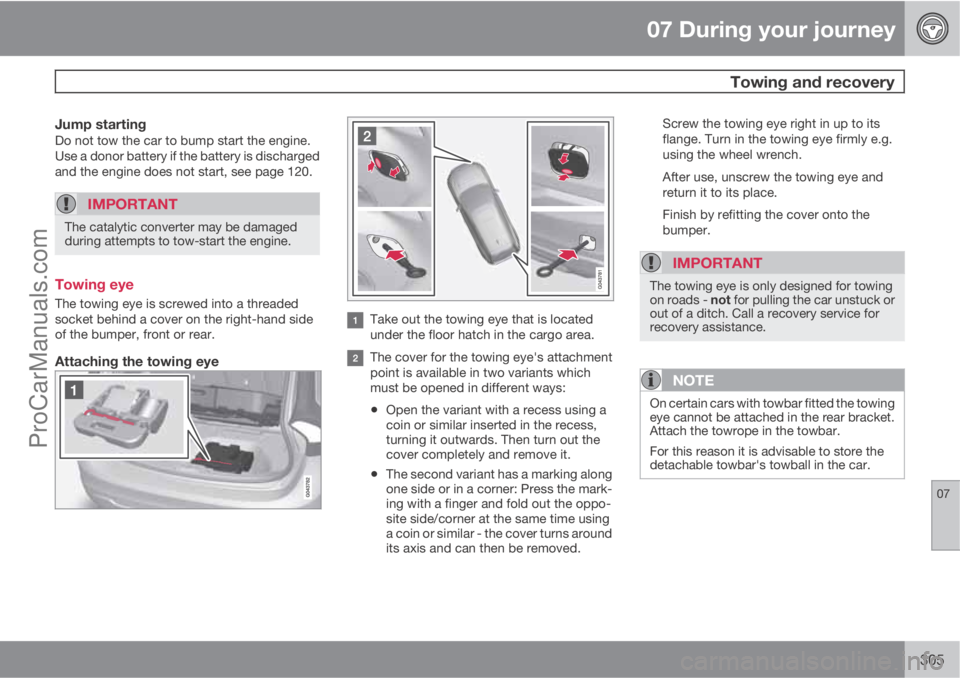
The towing eye is screwed into a threaded
socket behind a cover on the right-hand side
of the bumper, front or rear.
Attaching the towing eye
Take out the towing eye that is located
under the floor hatch in the cargo area.
The cover for the towing eye's attachment
point is available in two variants which
must be opened in different ways:
•Open the variant with a recess using a
coin or similar inserted in the recess,
turning it outwards. Then turn out the
cover completely and remove it.
•The second variant has a marking along
one side or in a corner: Press the mark-
ing with a finger and fold out the oppo-
site side/corner at the same time using
a coin or similar - the cover turns around
its axis and can then be removed.Screw the towing eye right in up to its
flange. Turn in the towing eye firmly e.g.
using the wheel wrench.
After use, unscrew the towing eye and
return it to its place.
Finish by refitting the cover onto the
bumper.
IMPORTANT
The towing eye is only designed for towing
on roads - not for pulling the car unstuck or
out of a ditch. Call a recovery service for
recovery assistance.
NOTE
On certain cars with towbar fitted the towing
eye cannot be attached in the rear bracket.
Attach the towrope in the towbar.
For this reason it is advisable to store the
detachable towbar's towball in the car.
ProCarManuals.com
Page 308 of 422
07 During your journey
Towing and recovery
07
306
Recovery
Call a recovery service for recovery assistance.
IMPORTANT
Note that the car must always be transpor-
ted with the wheels rolling forward.
•An All Wheel Drive car (AWD) with raised
front suspension must not be towed at
speeds above 70 km/h. It should not be
towed further than 50 km.
ProCarManuals.com
Page 310 of 422
308* Option/accessory, for more information, see Introduction.
General ................................................................................................. 310
Changing wheels .................................................................................. 314
Tyre pressure ....................................................................................... 317
Warning triangle and first-aid kit*.......................................................... 318
Tyre pressure monitoring (TPMS)*........................................................319
Emergency puncture repair (TMK) ....................................................... 321
ProCarManuals.com
Page 311 of 422
WHEELS AND TYRES
ProCarManuals.com
Page 312 of 422
08 Wheels and tyres
General
08
310
Driving characteristics
Tyres greatly affect the car's driving characte-
ristics. The type of tyre, dimensions, tyre pres-
sure and speed rating are important for how the
car performs.
Direction of rotation
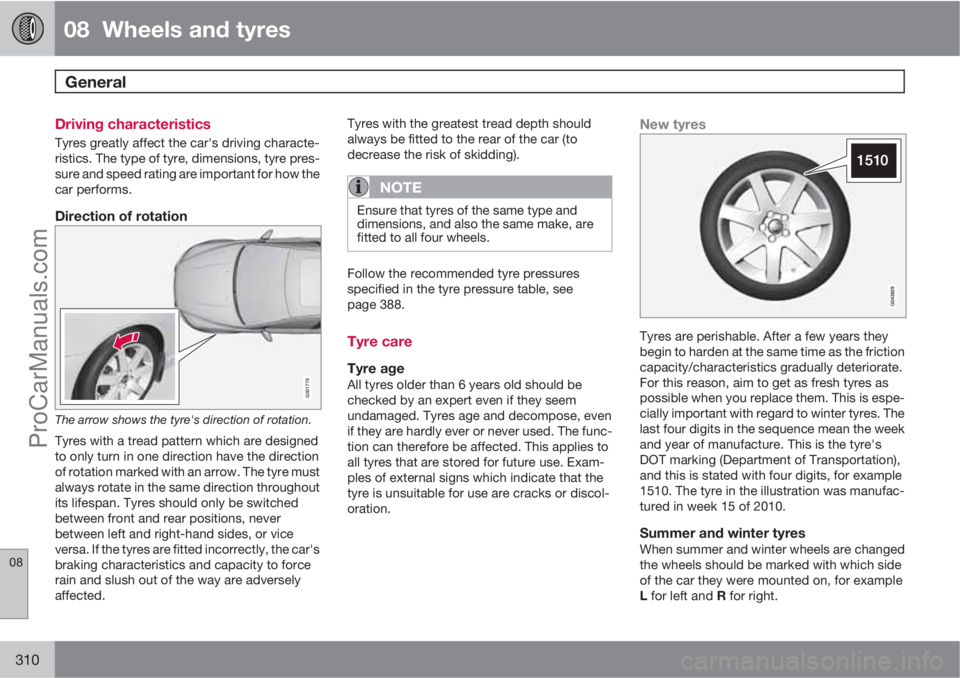
G021778
The arrow shows the tyre's direction of rotation.
Tyres with a tread pattern which are designed
to only turn in one direction have the direction
of rotation marked with an arrow. The tyre must
always rotate in the same direction throughout
its lifespan. Tyres should only be switched
between front and rear positions, never
between left and right-hand sides, or vice
versa. If the tyres are fitted incorrectly, the car's
braking characteristics and capacity to force
rain and slush out of the way are adversely
affected.Tyres with the greatest tread depth should
always be fitted to the rear of the car (to
decrease the risk of skidding).
NOTE
Ensure that tyres of the same type and
dimensions, and also the same make, are
fitted to all four wheels.
Follow the recommended tyre pressures
specified in the tyre pressure table, see
page 388.
Tyre care
Tyre ageAll tyres older than 6 years old should be
checked by an expert even if they seem
undamaged. Tyres age and decompose, even
if they are hardly ever or never used. The func-
tion can therefore be affected. This applies to
all tyres that are stored for future use. Exam-
ples of external signs which indicate that the
tyre is unsuitable for use are cracks or discol-
oration.
New tyres
Tyres are perishable. After a few years they
begin to harden at the same time as the friction
capacity/characteristics gradually deteriorate.
For this reason, aim to get as fresh tyres as
possible when you replace them. This is espe-
cially important with regard to winter tyres. The
last four digits in the sequence mean the week
and year of manufacture. This is the tyre's
DOT marking (Department of Transportation),
and this is stated with four digits, for example
1510. The tyre in the illustration was manufac-
tured in week 15 of 2010.
Summer and winter tyresWhen summer and winter wheels are changed
the wheels should be marked with which side
of the car they were mounted on, for example
L for left and R for right.
ProCarManuals.com
Page 313 of 422
08 Wheels and tyres
General
08
* Option/accessory, for more information, see Introduction.311
Wear and maintenanceThe correct tyre pressure results in more even
wear, see page 317. Driving style, tyre pres-
sure, climate and road condition affect how
quickly your tyres age and wear. To avoid dif-
ferences in tread depth and to prevent wear
patterns arising, the front and rear wheels can
be switched with each other. A suitable dis-
tance for the first change is approx. 5000 km
and then at 10 000 km intervals. Volvo recom-
mends that you contact an authorised Volvo
workshop for checking if you are uncertain
about tread depth. If significant differences in
wear (>1 mm difference in tread depth)
between tyres have already occurred, the least
worn tyres must always be placed on the rear.
Understeer is normally easier to correct than
oversteer, and leads to the car continuing for-
wards in a straight line rather than having the
rear end skidding to one side, resulting in pos-
sible complete loss of control over the car. This
is why it is important for the rear wheels never
to lose grip before the front wheels.
Wheels should be stored lying down or hanging
up - and not standing up.
WARNING
A damaged tyre can lead to loss of control
of the car.
Tyres with tread wear indicators
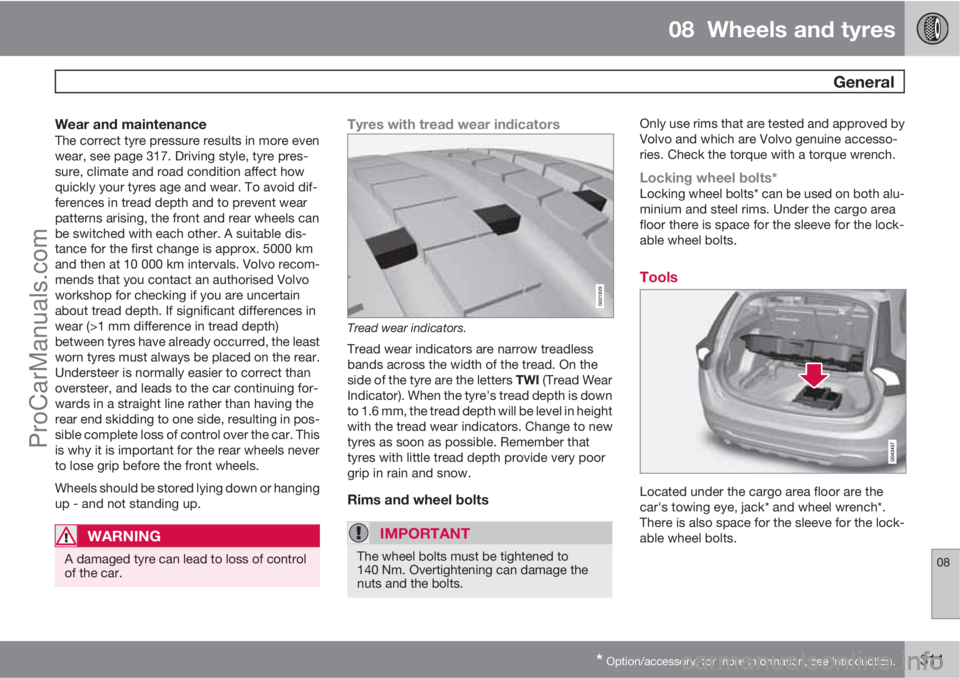
G021829
Tread wear indicators.
Tread wear indicators are narrow treadless
bands across the width of the tread. On the
side of the tyre are the letters TWI (Tread Wear
Indicator). When the tyre's tread depth is down
to 1.6 mm, the tread depth will be level in height
with the tread wear indicators. Change to new
tyres as soon as possible. Remember that
tyres with little tread depth provide very poor
grip in rain and snow.
Rims and wheel bolts
IMPORTANT
The wheel bolts must be tightened to
140 Nm. Overtightening can damage the
nuts and the bolts.
Only use rims that are tested and approved by
Volvo and which are Volvo genuine accesso-
ries. Check the torque with a torque wrench.
Locking wheel bolts*Locking wheel bolts* can be used on both alu-
minium and steel rims. Under the cargo area
floor there is space for the sleeve for the lock-
able wheel bolts.
Tools
Located under the cargo area floor are the
car's towing eye, jack* and wheel wrench*.
There is also space for the sleeve for the lock-
able wheel bolts.
ProCarManuals.com