wheel VOLVO V60 2013 Owners Manual
[x] Cancel search | Manufacturer: VOLVO, Model Year: 2013, Model line: V60, Model: VOLVO V60 2013Pages: 422, PDF Size: 9.59 MB
Page 324 of 422
08 Wheels and tyres
Emergency puncture repair (TMK)
08
322
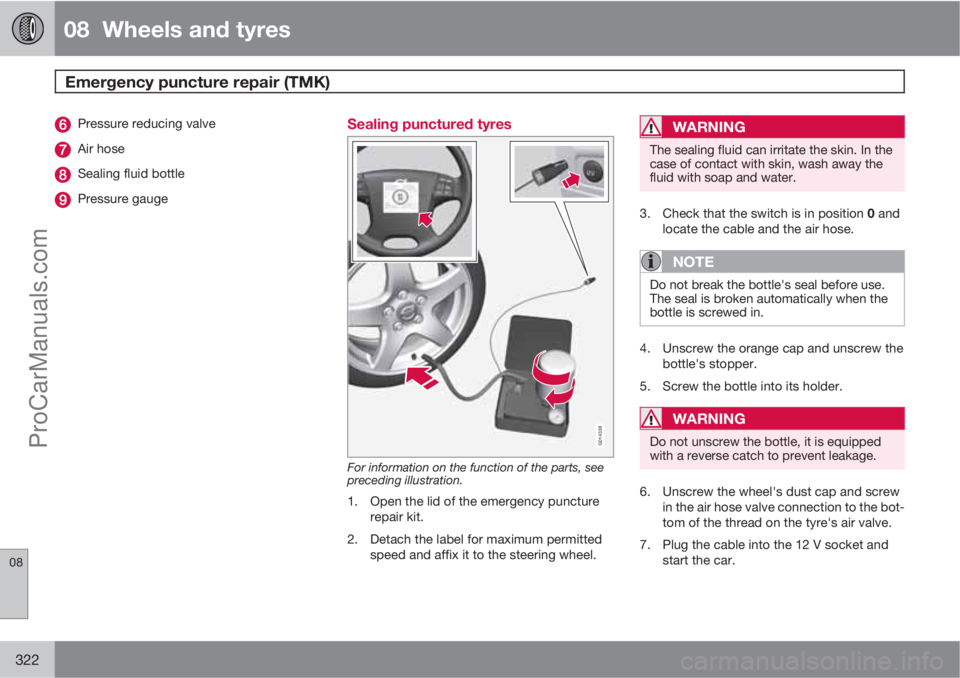
Pressure reducing valve
Air hose
Sealing fluid bottle
Pressure gauge
Sealing punctured tyres
G014338
For information on the function of the parts, see
preceding illustration.
1. Open the lid of the emergency puncture
repair kit.
2. Detach the label for maximum permitted
speed and affix it to the steering wheel.
WARNING
The sealing fluid can irritate the skin. In the
case of contact with skin, wash away the
fluid with soap and water.
3.
Check that the switch is in position 0 and
locate the cable and the air hose.
NOTE
Do not break the bottle's seal before use.
The seal is broken automatically when the
bottle is screwed in.
4. Unscrew the orange cap and unscrew the
bottle's stopper.
5. Screw the bottle into its holder.
WARNING
Do not unscrew the bottle, it is equipped
with a reverse catch to prevent leakage.
6. Unscrew the wheel's dust cap and screw
in the air hose valve connection to the bot-
tom of the thread on the tyre's air valve.
7. Plug the cable into the 12 V socket and
start the car.
ProCarManuals.com
Page 325 of 422
08 Wheels and tyres
Emergency puncture repair (TMK)
08
323
NOTE
If the compressor is connected to one of the
two 12 V sockets, in the tunnel console, no
other current consumer must be connected
to the other one.
WARNING
Do not leave children in the car without
supervision when the engine is running.
8.
Flick the switch to position I.
WARNING
Never stand next to the tyre when the com-
pressor is running. If cracks or unevenness
arise then the compressor must be
switched off immediately. The journey
should not be continued. Contacting an
authorised tyre centre is recommended.
NOTE
When the compressor starts, the pressure
can increase up to 6 bar but the pressure
drops after approximately 30 seconds.
9. Inflate the tyre for 7 minutes.
IMPORTANT
Risk of overheating. The compressor must
not run for more than 10 minutes.
10. Switch off the compressor to check the
pressure on the pressure gauge. Minimum
pressure is 1.8 bar and maximum 3.5 bar.
(Release air with the pressure reducing
valve if the tyre pressure is too high.)
WARNING
If the pressure is below 1.8 bar then the hole
in the tyre is too big. The journey should not
be continued. Contacting an authorised tyre
centre is recommended.
11. Switch off the compressor and unplug the
cable from the 12 V socket.
12. Detach the hose from the tyre valve and fit
the valve cap.
13. As soon as possible, drive approximately
3 km at a maximum speed of 80 km/h so
that the sealing fluid can seal the tyre.
Rechecking the repair and pressure1. Reconnect the equipment.2. Read the tyre pressure on the pressure
gauge.
•If it is below 1.3 bar then the tyre is
insufficiently sealed. The journey should
not be continued. Contact a tyre centre.
•If the tyre pressure is higher than 1.3
bar, the tyre must be inflated to the pres-
sure specified in accordance with the
tyre pressure table, see page 388 (1
bar=100 kPa). Release air using the
pressure reducing valve if the tyre pres-
sure is too high.
WARNING
Do not unscrew the bottle, it is equipped
with a reverse catch to prevent leakage.
3. Make sure the compressor is switched off.
Detach the air hose and cable. Refit the
dust cap.
NOTE
The sealing fluid bottle and the hose must
be replaced after use. Volvo recommends
that this replacement is performed by an
authorised Volvo workshop.
ProCarManuals.com
Page 326 of 422
08 Wheels and tyres
Emergency puncture repair (TMK)
08
324
WARNING
Check the tyre pressure regularly.
Volvo recommends that you drive to the near-
est authorised Volvo workshop for the replace-
ment/repair of the damaged tyre. Advise the
workshop that the tyre contains sealing fluid.
WARNING
You should not drive faster than 80 km/h
after the emergency tyre repair kit has been
used. Volvo recommends that you visit an
authorised Volvo workshop for inspection of
the sealed tyre (maximum driving distance
is 200 km). The staff there can determine
whether or not the tyre can be repaired or if
it needs to be replaced.
Inflating the tyres
The car's original tyres can be inflated by the
compressor.
1. The compressor must be switched off.
Make sure that the switch is in position 0
and locate the cable and air hose.
2. Unscrew the wheel's dust cap and screw
in the air hose valve connection to the bot-
tom of the thread on the tyre's air valve.
WARNING
Inhaling car exhaust fumes can result in
danger to life. Never leave the engine run-
ning in sealed areas or areas that lack suf-
ficient ventilation.
WARNING
Do not leave children in the car without
supervision when the engine is running.
3. Connect the cable to one of the car's 12 V
sockets and start the car.
4. Start the compressor by flicking the switch
to position I.
IMPORTANT
Risk of overheating. The compressor must
not run for more than 10 minutes.
5. Inflate the tyre to the pressure specified in
accordance with the tyre pressure table,
see page 388. (Release air using the pres-
sure reducing valve if the tyre pressure is
too high.)
6. Switch off the compressor. Detach the air
hose and cable.
7. Refit the dust cap.
Replacing the sealing fluid canister
Replace the bottle when the expiration date
has passed. Treat the old bottle as environ-
mentally hazardous waste.
WARNING
The bottle contains 1.2-Ethanol and natural
rubber-latex.
Harmful if ingested. Could result in allergic
reaction in the event of skin contact.
Avoid contact with the skin and eyes.
Store out of the reach of children.
ProCarManuals.com
Page 327 of 422
08 Wheels and tyres
08
325ProCarManuals.com
Page 333 of 422
09 Maintenance and service
Engine compartment09
331
5 minutes to allow the oil time to run back
to the sump.
2. Pull up and wipe the dipstick.
3. Re-insert the dipstick.
4. Pull it out and check the level.
5.
If the level is close to MIN then 0.5 litres
should be added. If the level is significantly
below, then an additional amount is
required.
6. If required, check the level again, do it after
driving a short distance. Then repeat steps
1 - 4.
WARNING
Never fill above the MAX mark. The level
should never be above MAX or below MIN
as this could lead to engine damage.
WARNING
Do not spill oil onto the hot exhaust manifold
due to the risk of fire.
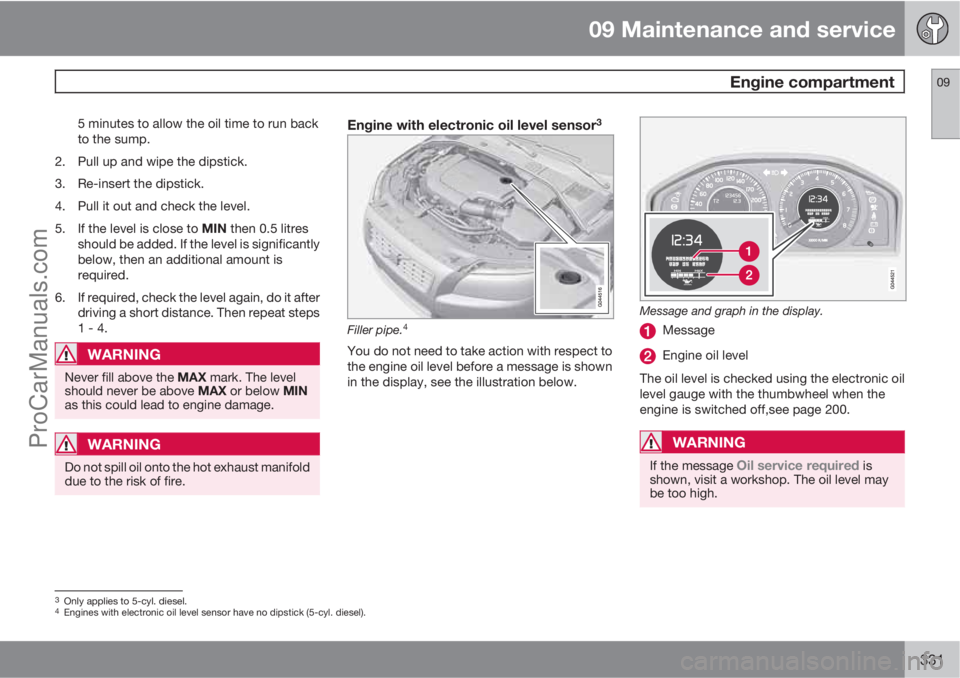
Engine with electronic oil level sensor3
Filler pipe.4
You do not need to take action with respect to
the engine oil level before a message is shown
in the display, see the illustration below.
Message and graph in the display.
Message
Engine oil level
The oil level is checked using the electronic oil
level gauge with the thumbwheel when the
engine is switched off,see page 200.
WARNING
If the message Oil service required is
shown, visit a workshop. The oil level may
be too high.
3Only applies to 5-cyl. diesel.4Engines with electronic oil level sensor have no dipstick (5-cyl. diesel).
ProCarManuals.com
Page 334 of 422
09 Maintenance and service
Engine compartment 09
332
IMPORTANT
In the event of the message Oil level low
Refill 0.5 Ltr, only fill with 0.5 litres.
NOTE
The oil level is only detected by the system
during driving. The system cannot directly
detect changes when the oil is filled or
drained. The car must be driven
about 30 km before the oil level display is
correct.
WARNING
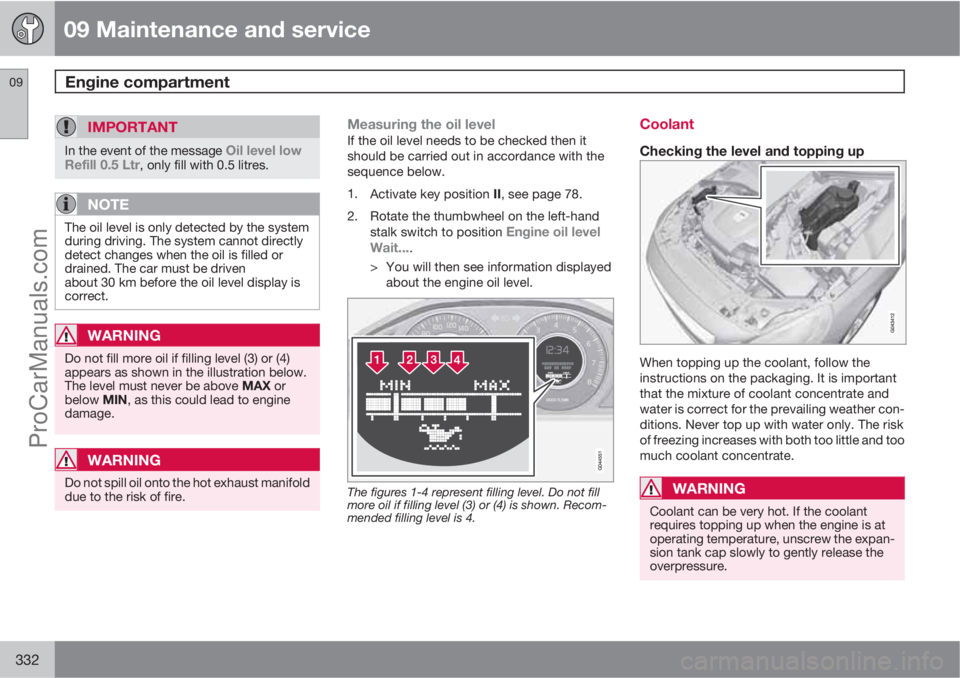
Do not fill more oil if filling level (3) or (4)
appears as shown in the illustration below.
The level must never be above MAX or
below MIN, as this could lead to engine
damage.
WARNING
Do not spill oil onto the hot exhaust manifold
due to the risk of fire.
Measuring the oil levelIf the oil level needs to be checked then it
should be carried out in accordance with the
sequence below.
1.
Activate key position II, see page 78.
2. Rotate the thumbwheel on the left-hand
stalk switch to position
Engine oil level
Wait....
> You will then see information displayed
about the engine oil level.
The figures 1-4 represent filling level. Do not fill
more oil if filling level (3) or (4) is shown. Recom-
mended filling level is 4.
Coolant
Checking the level and topping up
When topping up the coolant, follow the
instructions on the packaging. It is important
that the mixture of coolant concentrate and
water is correct for the prevailing weather con-
ditions. Never top up with water only. The risk
of freezing increases with both too little and too
much coolant concentrate.
WARNING
Coolant can be very hot. If the coolant
requires topping up when the engine is at
operating temperature, unscrew the expan-
sion tank cap slowly to gently release the
overpressure.
ProCarManuals.com
Page 358 of 422
09 Maintenance and service
Fuses 09
356* Option/accessory, for more information, see Introduction.
Box AFunctionA
--
Infotainment control module5
Audio control unit (ampli-
fier)*
Digital radio*; TV*10
Audio15
Telematics*; Bluetooth*5
--
Sunroof*; Interior lighting
roof; Climate sensor*;
Damper motors, air intake5
12 V socket, tunnel console15
Seat heating, rear right*15
Seat heating, rear left*15
--
Seat heating (passenger
side)15
Seat heating (driver's side)15
Box AFunctionA
Parking assistance*; Park-
ing camera*; Towbar control
module *
BLIS*5
AWD control module*15
Active chassis Four-C*10
Box BFunctionA
Rear window wiper15
--
Interior lighting; Driver's
door control panel, power
windows; Power seats,
front*; Remote controlled
garage door opener*7.5
Information display (DIM)5
Adaptive cruise control,
ACC*; collision warning sys-
tem*10
Interior lighting; Rain sensor7.5
Steering wheel module7.5
Box BFunctionA
Central locking system, fuel
filler flap10
Rear window washer15
Windscreen washers15
Unlocking, tailgate10
Folding head restraint*10
Fuel pump20
Movement detector alarm*;
Climate panel5
Steering lock15
Siren alarm*; Data link con-
nector OBDII5
--
Airbags10
Collision warning system*5
Accelerator pedal sensor,
PTC element air preheater*;
Dimming, interior rearview
mirror*; Seat heating, rear*7.5
ProCarManuals.com
Page 366 of 422
09 Maintenance and service
Car care 09
364
To achieve best results Volvo recommends
cleaning and the application of protective
cream once to four times per year (or more if
necessary). The Volvo Leather Care kit is avail-
able from your Volvo dealer.
IMPORTANT
•Certain items of coloured clothing (for
example, jeans and suede garments)
may stain the upholstery.
•Never use strong solvents. Such prod-
ucts may damage fabric, vinyl and
leather upholstery.
Washing instructions for leather
upholstery
1. Pour the leather cleaner on the dampened
sponge and squeeze out a strong foam.
2. Work the dirt away with gentle circular
movements.
3. Dab accurately with the sponge on the
stains. Allow the sponge to absorb the
stain. Do not rub.
4. Wipe off with soft paper or a cloth and
allow the leather to dry completely.
Protective treatment of leather
upholstery
1. Pour a small amount of the protective
cream on the felted cloth and massage in
a thin layer of cream with gentle circular
movements on the leather.
2. Allow the leather to dry for 20 minutes
before use.
The leather has now been given improved pro-
tection against stains and improved UV pro-
tection.
Washing instructions for the leather
steering wheel
•Remove dirt and dust with a soft pre-mois-
tened sponge and neutral soap.
•Leather needs to breathe. Never cover the
leather steering wheel with protective plas-
tic.
•Use natural oils. Volvo's leather care
agents are recommended for best results.
If the steering wheel has stains:
Group 1 (ink, wine, coffee, milk, sweat and
blood)
–Use a soft cloth or sponge. Mix a 5%
ammonia solution. (For blood stains, use a
solution of 2 dl water and 25g salt.)Group 2 (fats, oils, sauces and chocolate)
1. Same procedure as group 1.
2. Polish with an absorbent paper or cloth.
Group 3 (dry dirt, dust)
1. Use a soft brush to remove the dirt.
2. Same procedure as group 1.
Treating stains on interior plastic, metal
and wood parts
A fibrillated fibre or microfibre cloth, lightly
moistened with water, available from Volvo
dealers, is recommended for cleaning interior
parts and surfaces.
Do not scrape or rub stains. Never use strong
stain removers. A special cleaning agent avail-
able from Volvo dealers can be used for more
difficult cleaning.
Cleaning seatbeltsUse water and a synthetic detergent. A special
textile cleaning agent is available from your
Volvo dealer. Make sure the seatbelt is dry
before allowing it to retract.
ProCarManuals.com
Page 370 of 422
368
Type designations................................................................................. 370
Dimensions and weights....................................................................... 372
Engine specifications............................................................................ 376
Engine oil............................................................................................... 378
Fluids and lubricants............................................................................. 381
Fuel....................................................................................................... 384
Wheel and tyres, dimensions and pressure ......................................... 388
Electrical system................................................................................... 391
Type approval....................................................................................... 392
Symbols in the display.......................................................................... 404
ProCarManuals.com
Page 374 of 422
10 Specifications
Dimensions and weights
10
372
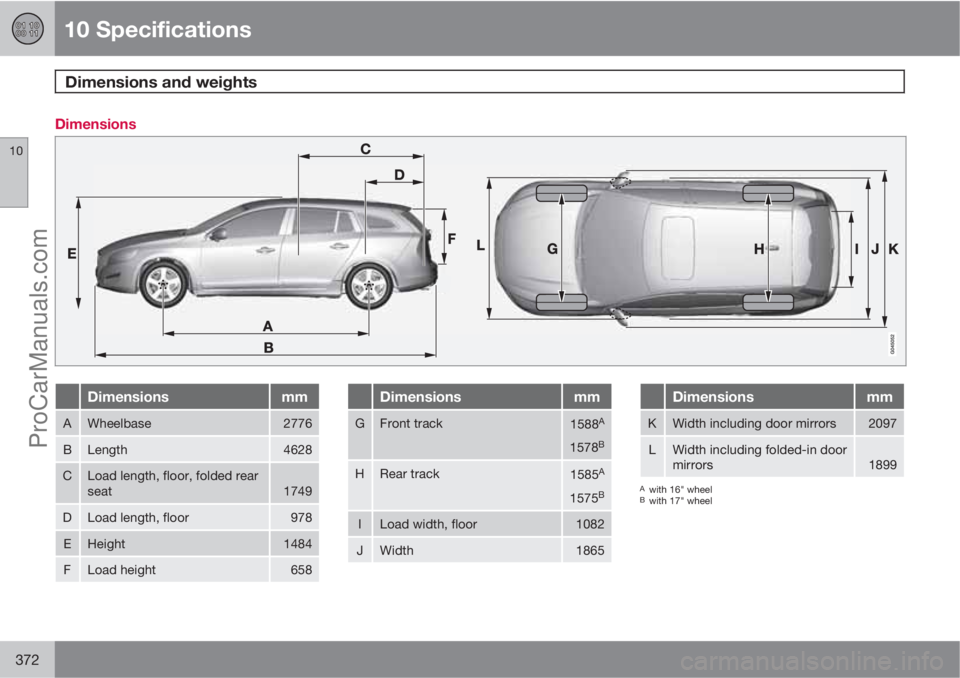
Dimensions
Dimensionsmm
AWheelbase2776
BLength4628
CLoad length, floor, folded rear
seat1749
DLoad length, floor978
EHeight1484
FLoad height658
Dimensionsmm
GFront track1588A
1578B
HRear track1585A
1575B
ILoad width, floor1082
JWidth1865
Dimensionsmm
KWidth including door mirrors2097
LWidth including folded-in door
mirrors1899
Awith 16" wheelBwith 17" wheel
ProCarManuals.com