ESP VOLVO V60 2013 Repair Manual
[x] Cancel search | Manufacturer: VOLVO, Model Year: 2013, Model line: V60, Model: VOLVO V60 2013Pages: 422, PDF Size: 9.59 MB
Page 276 of 422
06 Infotainment system
Voice recognition* mobile phone
06
274* Option/accessory, for more information, see Introduction.
the last spoken group of numbers) or
"Delete" (which deletes the whole spoken
phone number).
Dialling from the call registerThe following dialogue allows you to make a
phone call from one of your mobile phone's call
registers.
The user starts the dialogue by saying:Phone > call from the call register
or
Phone call from the call register
Continue by responding to the system's
prompts.
Call a contactThe following dialogue allows you to call your
pre-defined contacts in the mobile phone.
The user starts the dialogue by saying:Phone > call contact
or
Phone call contact
Continue by responding to the system's
prompts.
Consider the following when you call a contact:
•If there are several contacts with similar
names, they will be presented in the dis-play in the numbered rows and the system
prompts you to select a row number.
•If there are more rows in the list than can
be displayed simultaneously, saying
"Down" allows you to scroll down in the list
(and saying "Up" allows you to scroll up in
the list).
Calling voice mailboxThe following dialogue allows you to call your
voice mailbox to check if you have received
any messages. The phone number for your
voice mailbox must be registered in the
Bluetooth
Ÿ function, see page 265.
The user starts the dialogue by saying:Phone > call voice mailbox
or
Phone call voice mailbox
Continue by responding to the system's
prompts.
ProCarManuals.com
Page 281 of 422
06 Infotainment system
Remote control*
06
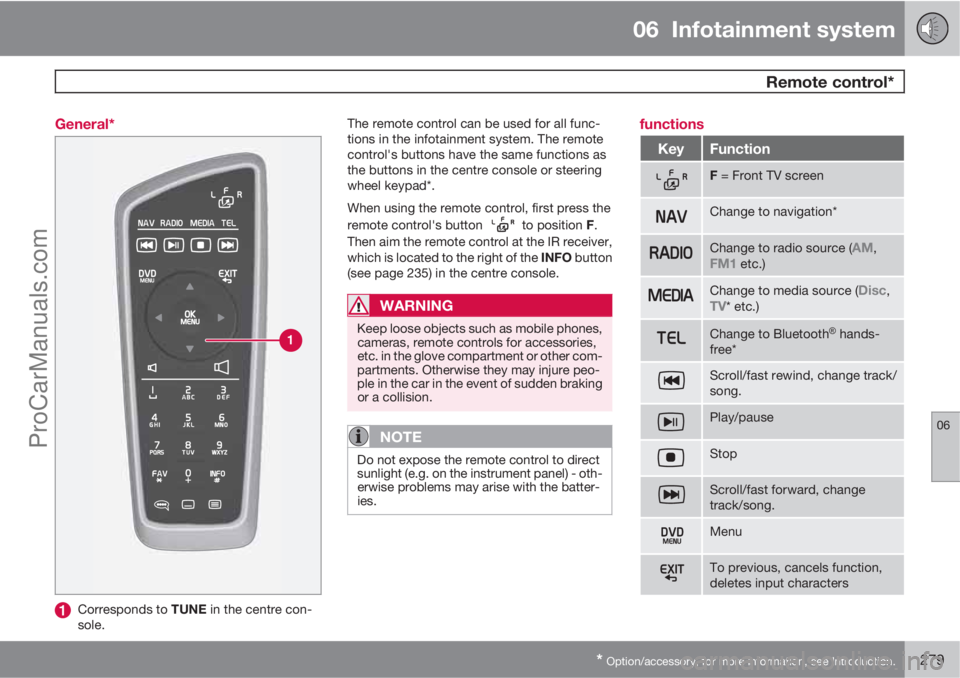
* Option/accessory, for more information, see Introduction.279 General*
Corresponds to TUNE in the centre con-
sole.The remote control can be used for all func-
tions in the infotainment system. The remote
control's buttons have the same functions as
the buttons in the centre console or steering
wheel keypad*.
When using the remote control, first press the
remote control's button
to position F.
Then aim the remote control at the IR receiver,
which is located to the right of the INFO button
(see page 235) in the centre console.
WARNING
Keep loose objects such as mobile phones,
cameras, remote controls for accessories,
etc. in the glove compartment or other com-
partments. Otherwise they may injure peo-
ple in the car in the event of sudden braking
or a collision.
NOTE
Do not expose the remote control to direct
sunlight (e.g. on the instrument panel) - oth-
erwise problems may arise with the batter-
ies.
functions
KeyFunction
F = Front TV screen
Change to navigation*
Change to radio source (AM,FM1 etc.)
Change to media source (Disc,TV* etc.)
Change to BluetoothŸ hands-
free*
Scroll/fast rewind, change track/
song.
Play/pause
Stop
Scroll/fast forward, change
track/song.
Menu
To previous, cancels function,
deletes input characters
ProCarManuals.com
Page 294 of 422

07 During your journey
Loading
07
292
General information on loading
Payload depends on the car's kerb weight. The
total of the weight of the passengers and all
accessories reduces the car's payload by a
corresponding weight. For more detailed infor-
mation on weights, see page 373.
The tailgate is opened via a button on
the lighting panel or the remote con-
trol key, see page 59.
WARNING
The car's driving characteristics change
depending on the weight and distribution of
the load.
To bear in mind when loading
•Position the load firmly against the rear
seat's backrest.
Note that objects must not prevent the function
of the WHIPS system for the front seats if any
of the rear seat's backrests is folded down,see
page 27.
•Centre the load.
•Heavy objects should be placed as low as
possible. Avoid placing heavy loads on
lowered backrests.
•Cover sharp edges with something soft to
avoid damaging the upholstery.
•Secure all loads to the load retaining eye-
lets with straps or web lashings.
WARNING
A loose object weighing 20 kg can, in a
frontal collision at a speed of 50 km/h, carry
the impact of an item weighing 1000 kg.
WARNING
The protection provided by the inflatable
curtain in the headlining may be compro-
mised or eliminated by high loads.
•Never load cargo above the backrest.
WARNING
Always secure the load. During heavy brak-
ing the load may otherwise shift, causing
injury to the car's occupants.
Cover sharp edges and sharp corners with
something soft.
Switch off the engine and apply the parking
brake when loading/unloading long items.
Otherwise you may accidentally knock the
gear lever or gear selector with the load into
a drive position - and the car could then
move off.
Front seat
The passenger seat backrest can also be
folded for an extra long load, see page 80.
Roof load
Using load carriersTo avoid damaging the car and for maximum
possible safety while driving, the load carriers
designed by Volvo are recommended.
Carefully follow the installation instructions
supplied with the carriers.
•Check periodically that the load carriers
and load are properly secured. Lash the
load securely with retaining straps.
•Distribute the load evenly over the load
carriers. Put the heaviest objects at the
bottom.
•The size of the area exposed to the wind,
and therefore fuel consumption, increase
with the size of the load.
•Drive gently. Avoid quick acceleration,
heavy braking and hard cornering.
WARNING
The car's centre of gravity and driving cha-
racteristics are altered by roof loads. For
information on maximum permitted roof
load, including load carriers and any space
box, see page 373.
ProCarManuals.com
Page 300 of 422
07 During your journey
Driving with a trailer
07
298* Option/accessory, for more information, see Introduction.
General
Payload depends on the car's kerb weight. The
total of the weight of the passengers and all
accessories, e.g. towbar, reduces the car's
payload by a corresponding weight. For more
detailed information on weights, see
page 373.
If the towing bracket is mounted by Volvo, then
the car is delivered with the necessary equip-
ment for driving with a trailer.
•The car's towing bracket must be of an
approved type.
•If the towbar is retrofitted, check with your
Volvo dealer that the car is fully equipped
for driving with a trailer.
•Distribute the load on the trailer so that the
weight on the towing bracket complies
with the specified maximum towball load.
•Increase the tyre pressure to the recom-
mended pressure for a full load. For tyre
pressure label location, see page 317.
•The engine is loaded more heavily than
usual when driving with a trailer.
•Do not tow a heavy trailer when the car is
brand new. Wait until it has been driven at
least 1000 km.
•The brakes are loaded much more than
usual on long and steep downhill slopes.
Downshift to a lower gear and adjust your
speed.
•For safety reasons, the maximum permit-
ted speed for the car when coupled with a
trailer should not be exceeded. Follow the
regulations in force for the permitted
speeds and weights.
•Maintain a low speed when driving with a
trailer up long, steep ascents.
•Avoid driving with a trailer on inclines of
more than 12%.
Trailer cableAn adapter is required if the car's towing
bracket has 13 pin electrics and the trailer has
7 pin electrics. Use an adapter cable approved
by Volvo. Make sure the cable does not drag
on the ground.
Direction indicators and brake lights on
the trailer
If any of the trailer's lamps for direction indica-
tors are broken, then the combined instrument
panel's symbol for direction indicators flashes
faster than normal and the display shows the
text
Bulb fail - Ind. signal trailer.
If any of the trailer's lamps for the brake light
are broken then the
Bulb fail - Stop lamp
trailer text is shown.
Level control*The rear shock absorbers maintain a constant
height irrespective of the car's load (up to the
maximum permissible weight). When the car isstationary the rear of the car lowers slightly,
which is normal.
Trailer weightsFor information on Volvo's permitted trailer
weights, see page 374.
NOTE
The stated maximum permitted trailer
weights are those permitted by Volvo.
National vehicle regulations can further limit
trailer weights and speeds. Towbars can be
certified for higher towing weights than the
car can actually tow.
WARNING
Follow the stated recommendations for
trailer weights. Otherwise, the car and trailer
may be difficult to control in the event of
sudden movement and braking.
Manual gearbox
OverheatingWhen driving with a trailer in hilly terrain in a hot
climate there may be a risk of overheating.
•Do not run the engine at higher revolutions
than 4500 rpm (diesel engines: 3500 rpm)
- otherwise the oil temperature may
become too high.
ProCarManuals.com
Page 312 of 422
08 Wheels and tyres
General
08
310
Driving characteristics
Tyres greatly affect the car's driving characte-
ristics. The type of tyre, dimensions, tyre pres-
sure and speed rating are important for how the
car performs.
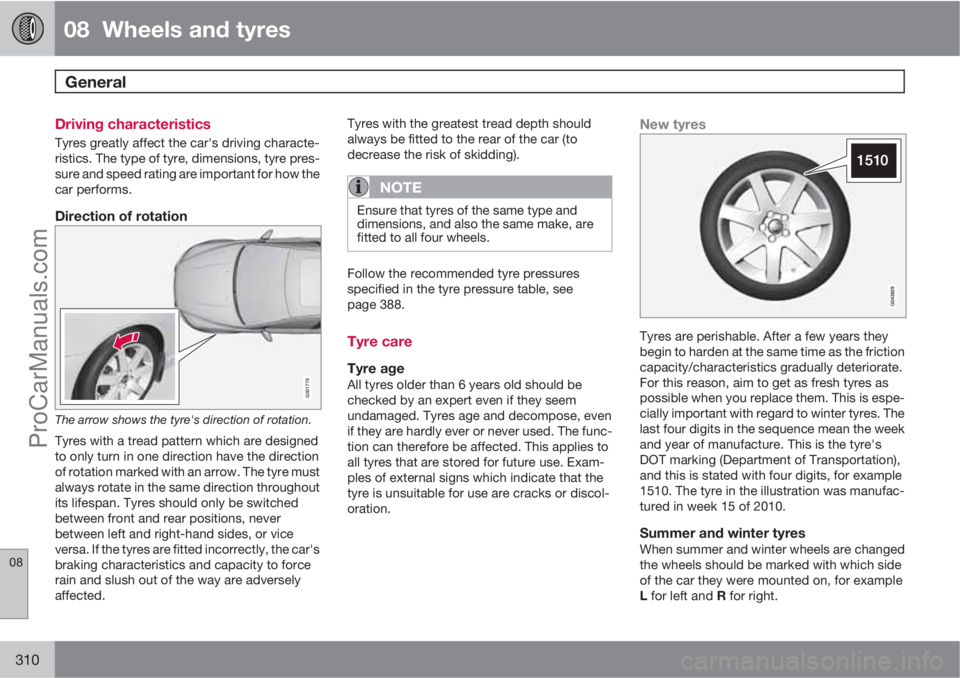
Direction of rotation
G021778
The arrow shows the tyre's direction of rotation.
Tyres with a tread pattern which are designed
to only turn in one direction have the direction
of rotation marked with an arrow. The tyre must
always rotate in the same direction throughout
its lifespan. Tyres should only be switched
between front and rear positions, never
between left and right-hand sides, or vice
versa. If the tyres are fitted incorrectly, the car's
braking characteristics and capacity to force
rain and slush out of the way are adversely
affected.Tyres with the greatest tread depth should
always be fitted to the rear of the car (to
decrease the risk of skidding).
NOTE
Ensure that tyres of the same type and
dimensions, and also the same make, are
fitted to all four wheels.
Follow the recommended tyre pressures
specified in the tyre pressure table, see
page 388.
Tyre care
Tyre ageAll tyres older than 6 years old should be
checked by an expert even if they seem
undamaged. Tyres age and decompose, even
if they are hardly ever or never used. The func-
tion can therefore be affected. This applies to
all tyres that are stored for future use. Exam-
ples of external signs which indicate that the
tyre is unsuitable for use are cracks or discol-
oration.
New tyres
Tyres are perishable. After a few years they
begin to harden at the same time as the friction
capacity/characteristics gradually deteriorate.
For this reason, aim to get as fresh tyres as
possible when you replace them. This is espe-
cially important with regard to winter tyres. The
last four digits in the sequence mean the week
and year of manufacture. This is the tyre's
DOT marking (Department of Transportation),
and this is stated with four digits, for example
1510. The tyre in the illustration was manufac-
tured in week 15 of 2010.
Summer and winter tyresWhen summer and winter wheels are changed
the wheels should be marked with which side
of the car they were mounted on, for example
L for left and R for right.
ProCarManuals.com
Page 314 of 422
08 Wheels and tyres
General
08
312* Option/accessory, for more information, see Introduction.
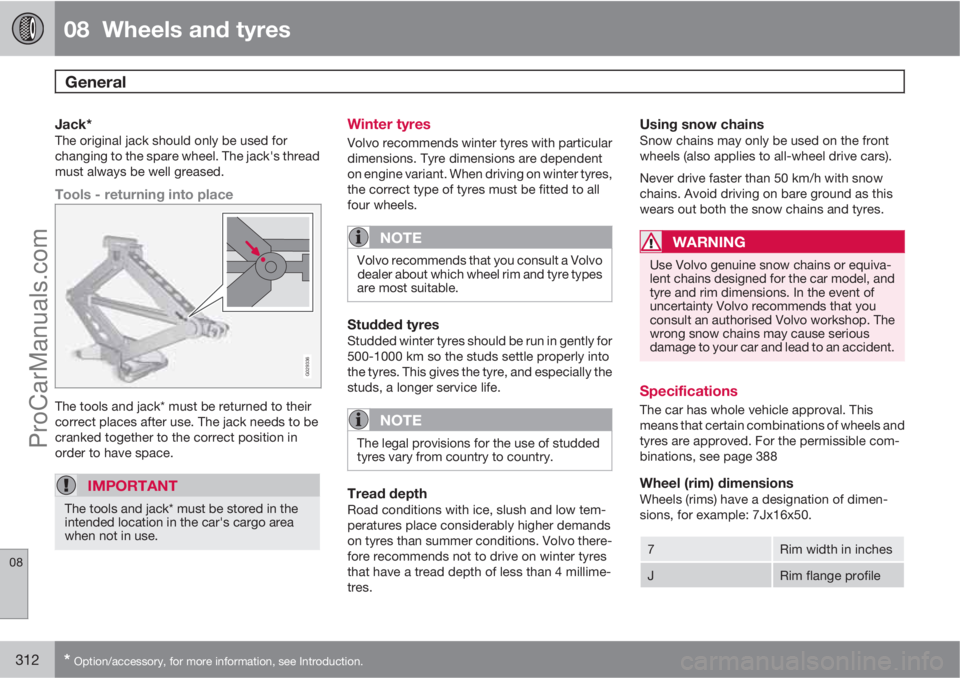
Jack*The original jack should only be used for
changing to the spare wheel. The jack's thread
must always be well greased.
Tools - returning into place
G029336
The tools and jack* must be returned to their
correct places after use. The jack needs to be
cranked together to the correct position in
order to have space.
IMPORTANT
The tools and jack* must be stored in the
intended location in the car's cargo area
when not in use.
Winter tyres
Volvo recommends winter tyres with particular
dimensions. Tyre dimensions are dependent
on engine variant. When driving on winter tyres,
the correct type of tyres must be fitted to all
four wheels.
NOTE
Volvo recommends that you consult a Volvo
dealer about which wheel rim and tyre types
are most suitable.
Studded tyresStudded winter tyres should be run in gently for
500-1000 km so the studs settle properly into
the tyres. This gives the tyre, and especially the
studs, a longer service life.
NOTE
The legal provisions for the use of studded
tyres vary from country to country.
Tread depthRoad conditions with ice, slush and low tem-
peratures place considerably higher demands
on tyres than summer conditions. Volvo there-
fore recommends not to drive on winter tyres
that have a tread depth of less than 4 millime-
tres.
Using snow chainsSnow chains may only be used on the front
wheels (also applies to all-wheel drive cars).
Never drive faster than 50 km/h with snow
chains. Avoid driving on bare ground as this
wears out both the snow chains and tyres.
WARNING
Use Volvo genuine snow chains or equiva-
lent chains designed for the car model, and
tyre and rim dimensions. In the event of
uncertainty Volvo recommends that you
consult an authorised Volvo workshop. The
wrong snow chains may cause serious
damage to your car and lead to an accident.
Specifications
The car has whole vehicle approval. This
means that certain combinations of wheels and
tyres are approved. For the permissible com-
binations, see page 388
Wheel (rim) dimensionsWheels (rims) have a designation of dimen-
sions, for example: 7Jx16x50.
7Rim width in inches
JRim flange profile
ProCarManuals.com
Page 315 of 422
08 Wheels and tyres
General
08
313
16Rim diameter in
inches
50Off-set in mm (dis-
tance from wheel
centre to wheel con-
tact surface against
the hub)
Tyre dimensionsThe dimensions are stated on all car tyres.
Example of designation: 215/55R16 97W.
215Tyre width (mm)
55Ratio between tyre wall height and
tyre width (%)
RRadial ply
16Rim diameter in inches (")
97Codes for the maximum permitted
tyre load, tyre load index (LI)
WSpeed rating for maximum permitted
speed, speed rating (SS). (In this case
270 km/h).
Load indexEach tyre has a certain capacity to carry a load,
a load index (LI). The car's weight determines
the load capacity required of the tyres. Mini-mum permitted index is specified in the table,
see page 388.
Speed ratingsEach tyre can withstand a certain maximum
speed, a speed rating (Speed Symbol; SS).
Tyre speed class must at least correspond with
the car's top speed. Minimum permitted speed
rating is specified in the table, see page 388.
The only exception to these conditions is win-
ter tyres (both those with metal studs and those
without), where a lower speed rating may be
used. If such a tyre is chosen, the car must not
be driven faster than the speed rating of the
tyre (for example, class Q can be driven at a
maximum of 160 km/h).
Traffic regulations determine how fast a car
can be driven, not the speed rating of the tyres.
NOTE
It is the maximum permitted speed that is
stated in the table.
Q160 km/h (used only on winter tyres)
T190 km/h
H210 km/h
V240 km/h
W270 km/h
Y300 km/h
WARNING
The car must be fitted with tyres which have
the same or a higher load index (LI) and
speed rating (SS) than specified. If a tyre
with too low a load index or speed rating is
used, it may overheat.
ProCarManuals.com
Page 319 of 422
08 Wheels and tyres
Tyre pressure
08
317
Tyre pressure
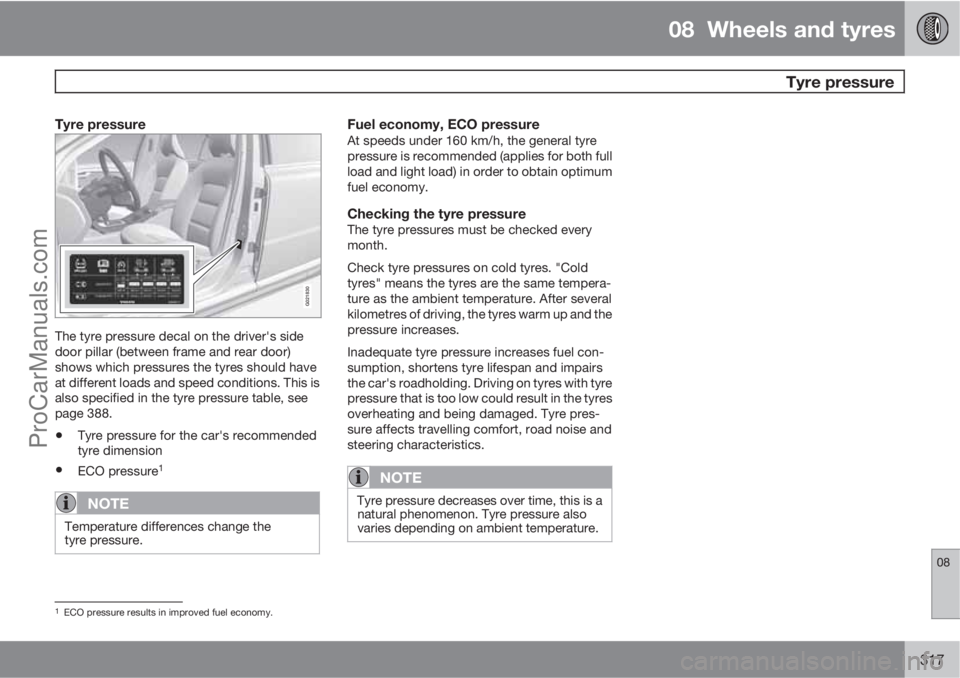
G021830
The tyre pressure decal on the driver's side
door pillar (between frame and rear door)
shows which pressures the tyres should have
at different loads and speed conditions. This is
also specified in the tyre pressure table, see
page 388.
•Tyre pressure for the car's recommended
tyre dimension
•ECO pressure1
NOTE
Temperature differences change the
tyre pressure.
Fuel economy, ECO pressureAt speeds under 160 km/h, the general tyre
pressure is recommended (applies for both full
load and light load) in order to obtain optimum
fuel economy.
Checking the tyre pressureThe tyre pressures must be checked every
month.
Check tyre pressures on cold tyres. "Cold
tyres" means the tyres are the same tempera-
ture as the ambient temperature. After several
kilometres of driving, the tyres warm up and the
pressure increases.
Inadequate tyre pressure increases fuel con-
sumption, shortens tyre lifespan and impairs
the car's roadholding. Driving on tyres with tyre
pressure that is too low could result in the tyres
overheating and being damaged. Tyre pres-
sure affects travelling comfort, road noise and
steering characteristics.
NOTE
Tyre pressure decreases over time, this is a
natural phenomenon. Tyre pressure also
varies depending on ambient temperature.
1ECO pressure results in improved fuel economy.
ProCarManuals.com
Page 322 of 422
08 Wheels and tyres
Tyre pressure monitoring (TPMS)*
08
320* Option/accessory, for more information, see Introduction.
>
A X is shown in the display if the system
is activated, the option disappears if the
system is deactivated.
Recommendations
•Volvo recommends that TPMS sensors are
fitted to all wheels on the car.
•Volvo recommends that sensors are not
moved between different wheels.
WARNING
When inflating a tyre equipped with TPMS,
hold the nozzle of the pump directly against
the valve to avoid damaging the valve.
Driveable punctured tyres*
If Self Supporting run flat Tyres (SST)* have
been selected then the car is also equipped
with TPMS.
This type of tyre has a specially reinforced side
wall that makes continued driving possible to
a limited extent despite the tyre losing all or
some of its pressure. These tyres are fitted on
a special rim. (Normal tyres can also be fitted
to this rim).
If an SST tyre loses tyre pressure then the yel-
low TPMS lamp on the instrument panel illumi-
nates and a message is shown in the text
panel. If this occurs, reduce speed tomax. 80 km/h. The tyre must be replaced as
soon as possible.
Drive carefully, in some cases it can be difficult
to see which tyre is faulty. In order to establish
which tyre needs attention, check all four tyres.
WARNING
SST tyres should only be fitted by individu-
als with expertise on SST tyres.
SST tyres must only be fitted together with
TPMS.
After a fault message on low tyre pressure
has been shown, do not drive faster than
80 km/h.
Maximum driving distance to tyre change is
80 km.
Avoid hard driving such as sudden braking
or turning.
SST tyres must be replaced if they are dam-
aged or punctured.
ProCarManuals.com
Page 332 of 422
09 Maintenance and service
Engine compartment 09
330
Volvo recommends Castrol oil products.
When driving under adverse conditions, see
page 378.
IMPORTANT
In order to fulfil the requirements for the
engine's service intervals all engines are
filled with a specially adapted synthetic
engine oil at the factory. The choice of oil
has been made very carefully with regard to
service life, starting characteristics, fuel
consumption and environmental impact.
An approved engine oil must be used in
order that the recommended service inter-
vals can be applied. Only use a prescribed
grade of oil for both filling and oil change,
otherwise you will risk affecting service life,
starting characteristics, fuel consumption
and environmental impact.
Volvo Car Corporation disclaims all war-
ranty liability if engine oil of the prescribed
grade and viscosity is not used.
Volvo recommends that oil changes are car-
ried out at an authorised Volvo workshop.
Volvo uses different systems for warning of
low/high oil level or low/high oil pressure. Cer-
tain variants have an oil pressure sensor, and
then the lamp for oil pressure is used. Other
variants have an oil level sensor, and then thedriver is informed via the warning symbol in the
centre of the instrument unit as well as by dis-
play texts. Certain models have both variants.
Contact a Volvo dealer for more information.
Change the engine oil and oil filter in accord-
ance with the intervals specified in the Service
and Warranty Booklet.
Using oil of a higher than specified grade is
permitted. If the car is driven in adverse con-
ditions, Volvo recommends using an oil of a
higher grade, see page 378.
For capacities,see page 379 and onwards.
Engine with oil dipstick2
G021734
Dipstick and filler pipe.
Checking the oil level in a new car is especially
important before the first scheduled oil change.
Volvo recommends checking the oil level every
2 500 km. The most accurate measurements
are made on a cold engine before starting. The
measurement will be inaccurate if taken imme-
diately after the engine is switched off. The
dipstick will indicate that the level is too low
because the oil has not had time to flow down
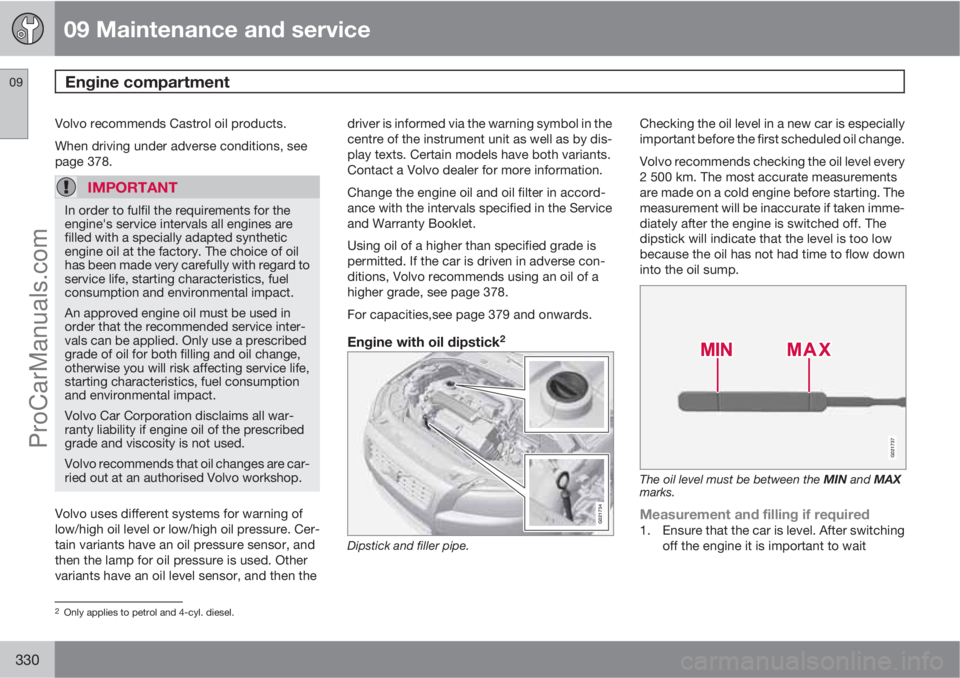
into the oil sump.
G021737
The oil level must be between the MIN and MAX
marks.
Measurement and filling if required1. Ensure that the car is level. After switching
off the engine it is important to wait
2Only applies to petrol and 4-cyl. diesel.
ProCarManuals.com