lock VOLVO V60 2014 Owners Manual
[x] Cancel search | Manufacturer: VOLVO, Model Year: 2014, Model line: V60, Model: VOLVO V60 2014Pages: 442, PDF Size: 13.85 MB
Page 280 of 442
08 Starting and driving
08
278
Gear selector inhibitor
There are two different types of gear selector inhibitor - mechanical and automatic.
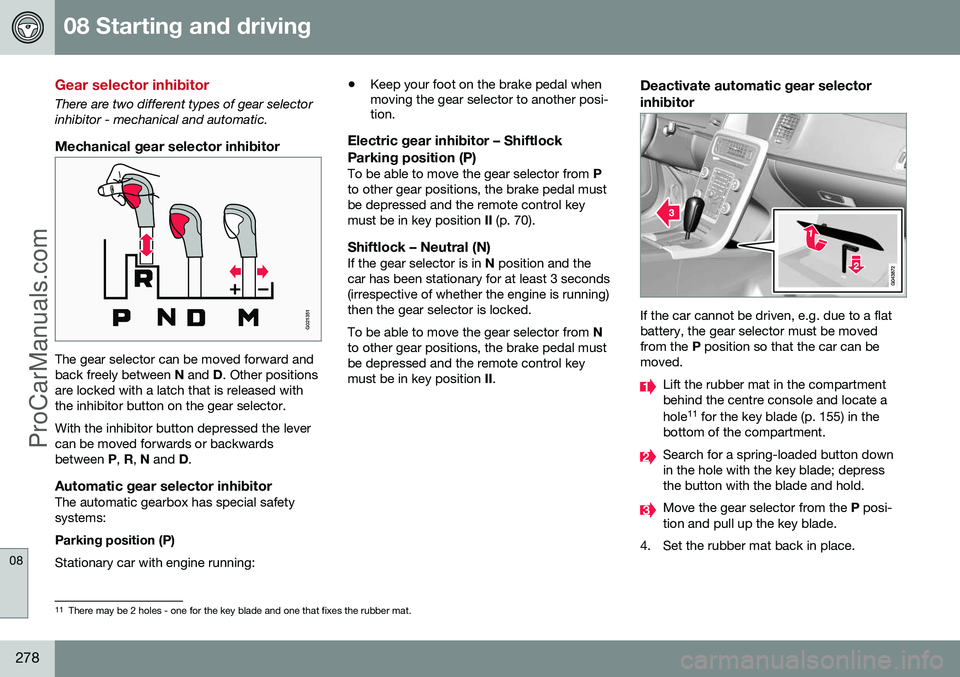
Mechanical gear selector inhibitor
G021351
The gear selector can be moved forward and back freely between N and D. Other positions
are locked with a latch that is released withthe inhibitor button on the gear selector. With the inhibitor button depressed the lever can be moved forwards or backwardsbetween P, R , N and D.
Automatic gear selector inhibitorThe automatic gearbox has special safetysystems: Parking position (P) Stationary car with engine running: •
Keep your foot on the brake pedal when moving the gear selector to another posi-tion.
Electric gear inhibitor – Shiftlock
Parking position (P)
To be able to move the gear selector from P
to other gear positions, the brake pedal must be depressed and the remote control keymust be in key position II (p. 70).
Shiftlock – Neutral (N)If the gear selector is in N position and the
car has been stationary for at least 3 seconds(irrespective of whether the engine is running)then the gear selector is locked. To be able to move the gear selector from N
to other gear positions, the brake pedal must be depressed and the remote control keymust be in key position II.
Deactivate automatic gear selector inhibitor
If the car cannot be driven, e.g. due to a flat battery, the gear selector must be movedfrom the P position so that the car can be
moved.
Lift the rubber mat in the compartment behind the centre console and locate a hole 11
for the key blade (p. 155) in the
bottom of the compartment.
Search for a spring-loaded button down in the hole with the key blade; depressthe button with the blade and hold.
Move the gear selector from the P posi-
tion and pull up the key blade.
4. Set the rubber mat back in place.
11 There may be 2 holes - one for the key blade and one that fixes the rubber mat.
ProCarManuals.co’
Page 293 of 442
08 Starting and driving
08
291
WARNING
If and illuminate at the same
time, there may be a fault in the brake sys- tem. If the level in the brake fluid reservoir is normal at this stage, drive carefully to thenearest workshop and have the brake sys-tem checked - an authorised Volvo work-shop is recommended. If the brake fluid is below the MIN level in
the brake fluid reservoir, do not drive fur- ther before topping up the brake fluid. The reason for the loss of brake fluid must be investigated.
Related information
• Parking brake (p. 293)
• Foot brake - emergency brake lights and automatic hazard warning flashers (p.291)
• Foot brake - emergency brake assistance(p. 292)
• Foot brake - anti-lock braking system (p.291)
Foot brake - anti-lock braking system
The anti-lock braking system, ABS (Anti-lock Braking System), prevents the wheels fromlocking up during braking. The function allows steering ability to be maintained, and it is easier to swerve to avoida hazard for example. Vibration may be felt inthe brake pedal when this is engaged and thisis normal. A short test of the ABS system is made auto- matically after the engine has been startedwhen the driver releases the brake pedal. Afurther automatic test of the ABS system maybe made when the car reaches 10 km/h. Thetest may be experienced as pulses in thebrake pedal.
Related information
•Foot brake (p. 290)
• Parking brake (p. 293)
• Foot brake - emergency brake lights and automatic hazard warning flashers (p.291)
• Foot brake - emergency brake assistance(p. 292)
Foot brake - emergency brake lights and automatic hazard warningflashers
Emergency brake lights are activated to alert vehicles behind about sudden braking. Thefunction means that the brake light flashesinstead of - as in normal braking - shining witha constant glow. Emergency brake lights are activated at speeds above 50 km/h in the event of suddenbraking. After the car's speed has beenslowed below 10 km/h the brake light returnsfrom flashing to the normal constant glow -while at the same time the hazard warningflashers (p. 86) are activated, and they flashuntil the driver changes engine speed with theaccelerator pedal or they are deactivated withtheir button.
Related information
•Foot brake (p. 290)
• Parking brake (p. 293)
• Foot brake - emergency brake assistance (p. 292)
• Foot brake - anti-lock braking system (p.291)
ProCarManuals.co’
Page 294 of 442
08 Starting and driving
08
292
Foot brake - emergency brake assistance
Emergency brake assistance EBA (Emergency Brake Assist) helps to increase the brakingforce and so reduce the braking distance. EBA detects the driver's braking style and increases the braking force when necessary.The brake force can be reinforced up to thelevel when the ABS system is engaged. TheEBA function is interrupted when the pressureon the brake pedal is reduced.
NOTE
When EBA is activated the brake pedal lowers slightly more than usual, depress(hold) the brake pedal as long as neces-sary. If the brake pedal is released then allbraking ceases.
Related information
•Foot brake (p. 290)
• Parking brake (p. 293)
• Foot brake - emergency brake lights and automatic hazard warning flashers (p.291)
• Foot brake - anti-lock braking system (p.291)
ProCarManuals.co’
Page 295 of 442
08 Starting and driving
08
}}
293
Parking brake
The parking brake holds the car stationary, when the driver's seat is empty, by mechani-cally locking/blocking two wheels.
FunctionA faint electric motor noise can be heardwhen the electrical parking brake is beingapplied. The noise can also be heard duringthe automatic function checking of the park-ing brake. If the car is stationary when the parking brake is applied then it only acts on the rear wheels.If it is applied when the car is moving then thenormal foot brake is used, i.e. the brake actson all four wheels. Brake function changesover to the rear wheels when the car is almoststationary.
Low battery voltageIf the battery voltage is too low then the park-ing brake can neither be released nor applied.Connect a donor battery if the battery voltageis too low, see Jump starting with battery (p.270).
Applying the parking brake
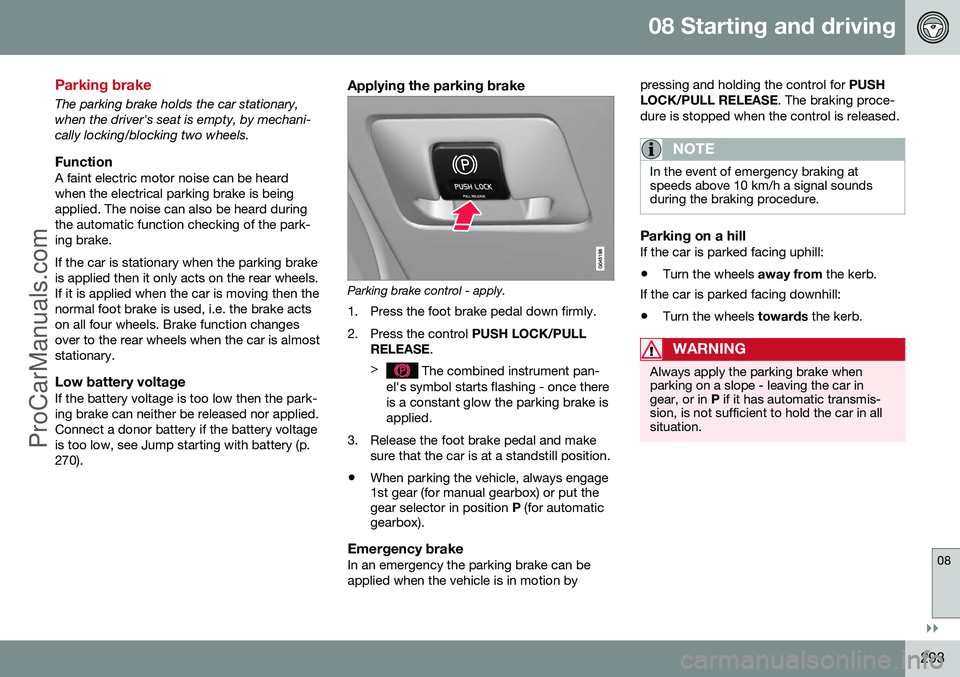
Parking brake control - apply.
1. Press the foot brake pedal down firmly.
2. Press the control PUSH LOCK/PULL
RELEASE .
>
The combined instrument pan-
el's symbol starts flashing - once there is a constant glow the parking brake isapplied.
3. Release the foot brake pedal and make sure that the car is at a standstill position.
• When parking the vehicle, always engage 1st gear (for manual gearbox) or put thegear selector in position
P (for automatic
gearbox).
Emergency brakeIn an emergency the parking brake can be applied when the vehicle is in motion by pressing and holding the control for
PUSH
LOCK/PULL RELEASE . The braking proce-
dure is stopped when the control is released.
NOTE
In the event of emergency braking at speeds above 10 km/h a signal soundsduring the braking procedure.
Parking on a hillIf the car is parked facing uphill:
• Turn the wheels
away from the kerb.
If the car is parked facing downhill: • Turn the wheels
towards the kerb.
WARNING
Always apply the parking brake when parking on a slope - leaving the car ingear, or in P if it has automatic transmis-
sion, is not sufficient to hold the car in allsituation.
ProCarManuals.co’
Page 296 of 442
||
08 Starting and driving
08
294
Disengaging the parking brake
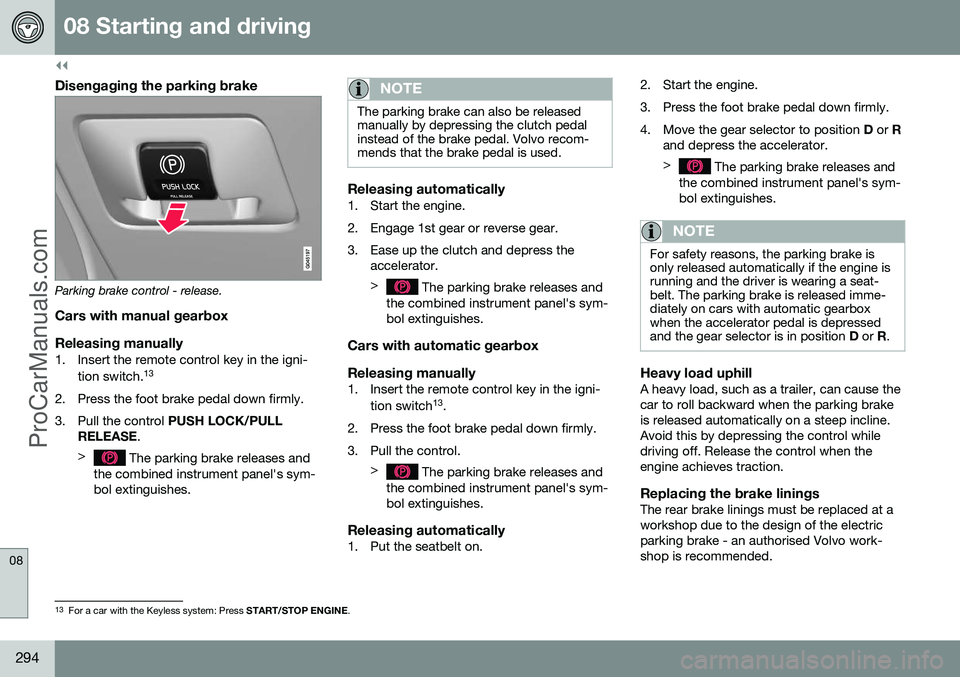
Parking brake control - release.
Cars with manual gearbox
Releasing manually
1. Insert the remote control key in the igni- tion switch. 13
2. Press the foot brake pedal down firmly.
3. Pull the control PUSH LOCK/PULL
RELEASE .
>
The parking brake releases and
the combined instrument panel's sym- bol extinguishes.
NOTE
The parking brake can also be released manually by depressing the clutch pedalinstead of the brake pedal. Volvo recom-mends that the brake pedal is used.
Releasing automatically1. Start the engine.
2. Engage 1st gear or reverse gear.
3. Ease up the clutch and depress the accelerator. >
The parking brake releases and
the combined instrument panel's sym- bol extinguishes.
Cars with automatic gearbox Releasing manually
1. Insert the remote control key in the igni-
tion switch 13
.
2. Press the foot brake pedal down firmly.
3. Pull the control. >
The parking brake releases and
the combined instrument panel's sym- bol extinguishes.
Releasing automatically1. Put the seatbelt on. 2. Start the engine.
3. Press the foot brake pedal down firmly.
4. Move the gear selector to position
D or R
and depress the accelerator. >
The parking brake releases and
the combined instrument panel's sym- bol extinguishes.
NOTE
For safety reasons, the parking brake is only released automatically if the engine isrunning and the driver is wearing a seat-belt. The parking brake is released imme-diately on cars with automatic gearboxwhen the accelerator pedal is depressedand the gear selector is in position D or R.
Heavy load uphillA heavy load, such as a trailer, can cause the car to roll backward when the parking brakeis released automatically on a steep incline.Avoid this by depressing the control whiledriving off. Release the control when theengine achieves traction.
Replacing the brake liningsThe rear brake linings must be replaced at aworkshop due to the design of the electricparking brake - an authorised Volvo work-shop is recommended.
13
For a car with the Keyless system: Press START/STOP ENGINE.
ProCarManuals.co’
Page 299 of 442
08 Starting and driving
08
297
Fording
Fording means that the car is driven through a water-covered roadway. Fording must be car-ried out with great caution. The car can be driven through water at a maximum depth of 25 cm at a maximumspeed of 10 km/h. Extra caution should beexercised when passing through flowingwater. During driving in water, maintain a low speed and do not stop the car. When the water hasbeen passed, depress the brake pedal lightlyand check that full brake function is achieved.Water and mud for example can make thebrake linings wet resulting in delayed brakefunction. •Clean the electric contacts of the electric engine block heater and trailer couplingafter driving in water and mud.
• Do not let the car stand with water overthe sills for any long period of time - thiscould cause electrical malfunctions.IMPORTANT
Engine damage can occur if water enters the air filter. In depths greater than 25 cm, water could enter the transmission. This reduces thelubricating ability of the oils and shortensthe service life of these systems. In the event of the engine stalling in water, do not try restart - tow the car from thewater to a workshop - an authorised Volvoworkshop is recommended. Risk of enginebreakdown.
Related information
•Recovery (p. 316)
• Towing (p. 313)
Overheating
Under special conditions, for example hard driving in hilly terrain and hot climate, there isa risk that the engine and drive system mayoverheat - in particular with a heavy load. For information about overheating when driv- ing with a trailer, see Driving with a trailer (p.306). • Remove any auxiliary lamps from in front of the grille when driving in hot climates.
• If the temperature in the engine's coolingsystem is too high then a warning symbolis illuminated in the combined instrumentpanel's information display and a text message
High engine temp Stop safelyis shown there - stop the car in a safe way and allow the engine to run at idlingspeed for several minutes in order to cooldown.
• If the text message
High engine temp
Stop engine or Coolant level low, Stop
engine is shown then the engine must be
switched off after stopping the car.
• In the event of overheating in the gearbox a built-in protection function is activatedwhich, amongst other things, illuminatesa warning symbol in the combined instru-ment panel, and its display shows the text message
Transmission hot Reduce
speed or Transmission hot Stop safely- follow the recommendation given and lower the speed and stop the car in a safeway and allow the engine to run at idling
ProCarManuals.co’
Page 302 of 442
08 Starting and driving
08
300
Fuel filler flap - Opening/closing
The fuel filler flap can be opened/closed as follows:
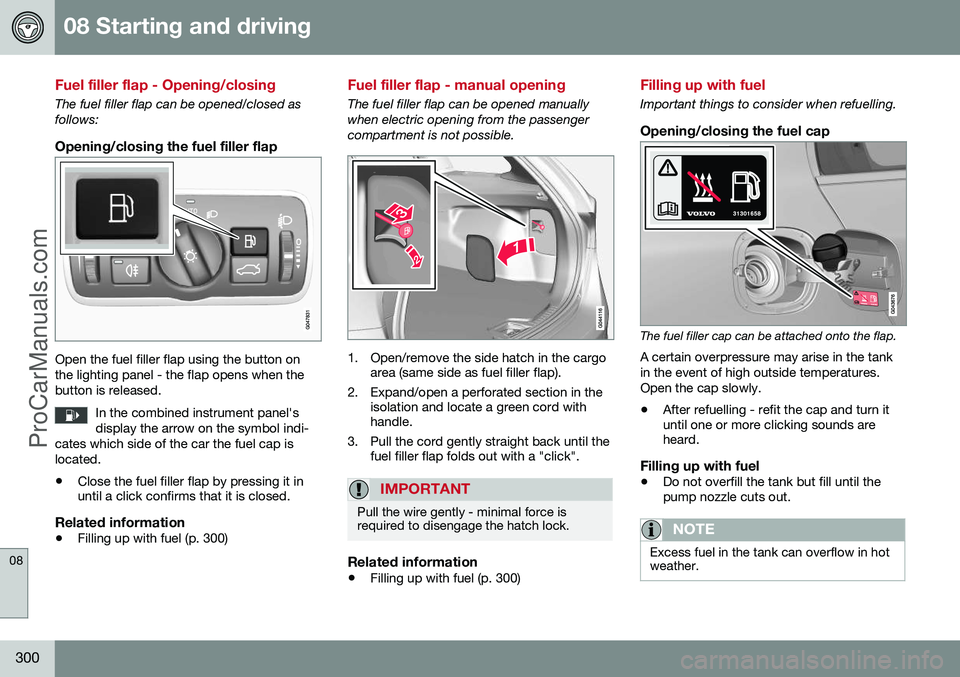
Opening/closing the fuel filler flap
Open the fuel filler flap using the button on the lighting panel - the flap opens when thebutton is released.In the combined instrument panel'sdisplay the arrow on the symbol indi-
cates which side of the car the fuel cap islocated.
• Close the fuel filler flap by pressing it in until a click confirms that it is closed.
Related information
•Filling up with fuel (p. 300)
Fuel filler flap - manual opening
The fuel filler flap can be opened manually when electric opening from the passengercompartment is not possible.
1. Open/remove the side hatch in the cargo
area (same side as fuel filler flap).
2. Expand/open a perforated section in the isolation and locate a green cord with handle.
3. Pull the cord gently straight back until the fuel filler flap folds out with a "click".
IMPORTANT
Pull the wire gently - minimal force is required to disengage the hatch lock.
Related information
•Filling up with fuel (p. 300)
Filling up with fuel
Important things to consider when refuelling.
Opening/closing the fuel cap
The fuel filler cap can be attached onto the flap.
A certain overpressure may arise in the tank in the event of high outside temperatures.Open the cap slowly.
• After refuelling - refit the cap and turn it until one or more clicking sounds areheard.
Filling up with fuel
• Do not overfill the tank but fill until thepump nozzle cuts out.
NOTE
Excess fuel in the tank can overflow in hot weather.
ProCarManuals.co’
Page 310 of 442
08 Starting and driving
08
308* Option/accessory, for more information, see Introduction.
Driving with a trailer - manual gearbox
When driving with a trailer in hilly terrain in a hot climate there may be a risk of overheating.
OverheatingWhen driving with a trailer in hilly terrain in ahot climate there may be a risk of overheat-ing. • Do not run the engine at higher revolu- tions than 4500 rpm(diesel engines: 3500 rpm) - otherwise theoil temperature may become too high.
Diesel engine 5-cyl
•In the event of a risk of overheating theoptimal speed for the engine is2300-3000 rpm for optimal circulation ofthe coolant.
Related information
•Driving with a trailer (p. 306)
Driving with a trailer - automatic gearbox
When driving with a trailer in hilly terrain in a hot climate there may be a risk of overheating.
• An automatic gearbox selects the opti- mum gear related to load and enginespeed.
• In the event of overheating a warningsymbol is illuminated in the combinedinstrument panel with a message that isshown in the information display - followthe recommendation given.
Steep inclines
•Do not lock the automatic transmission ina higher gear than the engine "can copewith" - it is not always a good idea todrive at a high gear with low engine revo-lutions.
Parking on a hill1. Depress the foot brake.
2. Activate the parking brake.
3. Move the gear selector to position
P.
4. Release the foot brake.
• Move the gear selector to park position
P
when parking an automatic car with a hitched trailer. Always use the parkingbrake.
• Block the wheels with chocks when park-ing a car with hitched trailer on a hill.
IMPORTANT
See also the specific information on slow driving with a trailer for cars with thePowershift automatic transmission, seeAutomatic gearbox -- Powershift* (p. 276).
Starting on a hill1. Depress the foot brake.
2. Move the gear selector to driving posi-
tion D.
3. Release the parking brake.
4. Release the foot brake and start driving off.
Related information
• Automatic gearbox -- Geartronic* (p. 273)
ProCarManuals.co’
Page 311 of 442
08 Starting and driving
08
309
Towing bracket/Towbar
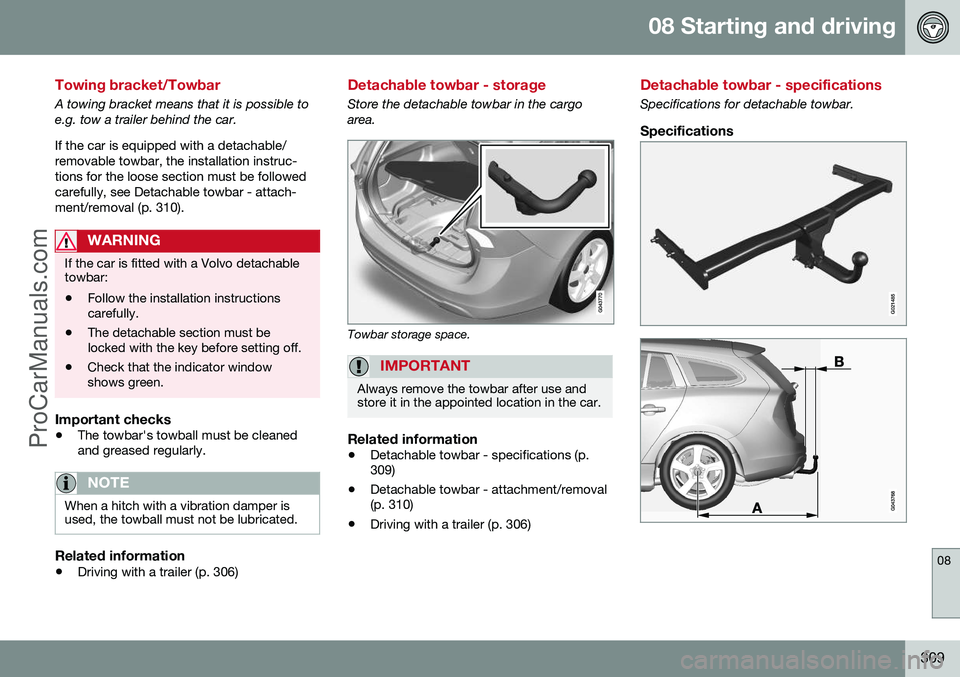
A towing bracket means that it is possible to e.g. tow a trailer behind the car. If the car is equipped with a detachable/ removable towbar, the installation instruc-tions for the loose section must be followedcarefully, see Detachable towbar - attach-ment/removal (p. 310).
WARNING
If the car is fitted with a Volvo detachable towbar:
• Follow the installation instructions carefully.
• The detachable section must belocked with the key before setting off.
• Check that the indicator windowshows green.
Important checks
•
The towbar's towball must be cleaned and greased regularly.
NOTE
When a hitch with a vibration damper is used, the towball must not be lubricated.
Related information
•
Driving with a trailer (p. 306)
Detachable towbar - storage
Store the detachable towbar in the cargo area.
Towbar storage space.
IMPORTANT
Always remove the towbar after use and store it in the appointed location in the car.
Related information
•Detachable towbar - specifications (p. 309)
• Detachable towbar - attachment/removal(p. 310)
• Driving with a trailer (p. 306)
Detachable towbar - specifications
Specifications for detachable towbar.
Specifications
G021485
ProCarManuals.com
Page 312 of 442
||
08 Starting and driving
08
310
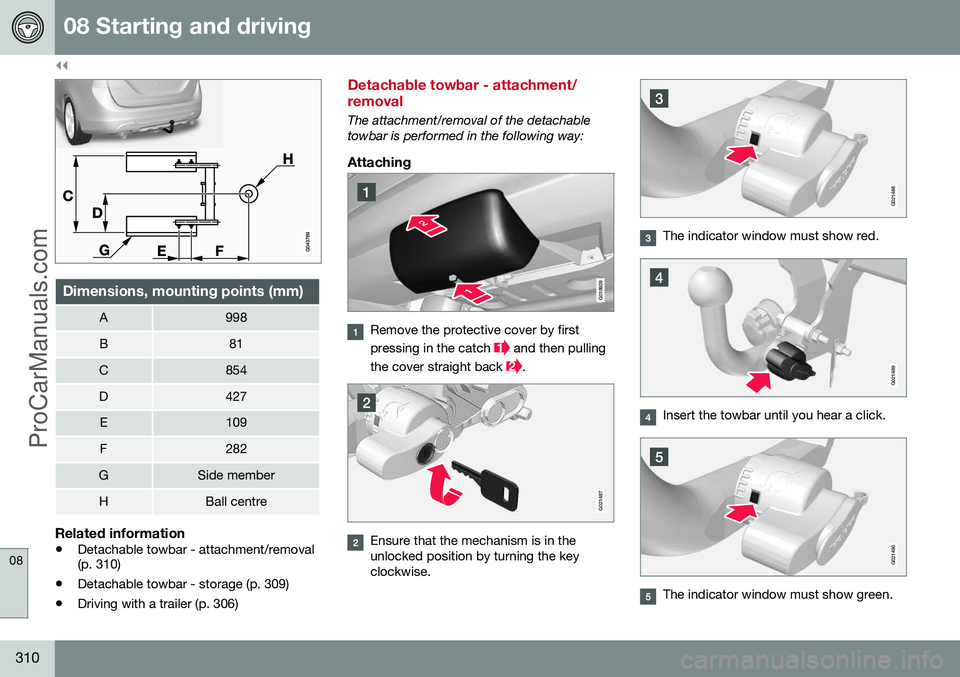
Dimensions, mounting points (mm)
A998
B81
C854
D427
E109
F282
GSide member
HBall centre
Related information
•Detachable towbar - attachment/removal (p. 310)
• Detachable towbar - storage (p. 309)
• Driving with a trailer (p. 306)
Detachable towbar - attachment/ removal
The attachment/removal of the detachable towbar is performed in the following way:
Attaching
G018928
Remove the protective cover by first pressing in the catch
and then pulling
the cover straight back
.
G021487
Ensure that the mechanism is in the unlocked position by turning the keyclockwise.
G021488
The indicator window must show red.
G021489
Insert the towbar until you hear a click.
G021490
The indicator window must show green.
ProCarManuals.co’