weight VOLVO V60 2014 User Guide
[x] Cancel search | Manufacturer: VOLVO, Model Year: 2014, Model line: V60, Model: VOLVO V60 2014Pages: 442, PDF Size: 13.85 MB
Page 145 of 442
05 Loading and storage
05
143
Loading - long load
To simplify loading (p. 142) in the cargo area, the rear seat backrest can be folded down.The passenger seat backrest can also be folded for an extra long load2
.
Lowering the rear seat backrestTo simplify loading in the cargo area, the rear seat backrest can be folded down, see Seats,rear (p. 74).
Roof load
The load carriers recommended for roof loads are the ones developed by Volvo. This is inorder to avoid damage to the car and in orderto achieve the maximum possible safety dur-ing a journey. Carefully follow the installation instructions supplied with the carriers.
• Check periodically that the load carriers and load are properly secured. Lash theload securely with retaining straps.
• Distribute the load evenly over the loadcarriers. Put the heaviest objects at thebottom.
• The size of the area exposed to the wind,and therefore fuel consumption, increasewith the size of the load.
• Drive gently. Avoid quick acceleration,heavy braking and hard cornering.
WARNING
The car's centre of gravity and driving cha- racteristics are altered by roof loads. Forinformation about the maximum allowableload on the roof, including load carriersand any space box, Weights (p. 390).
Related information
•
Loading (p. 142)
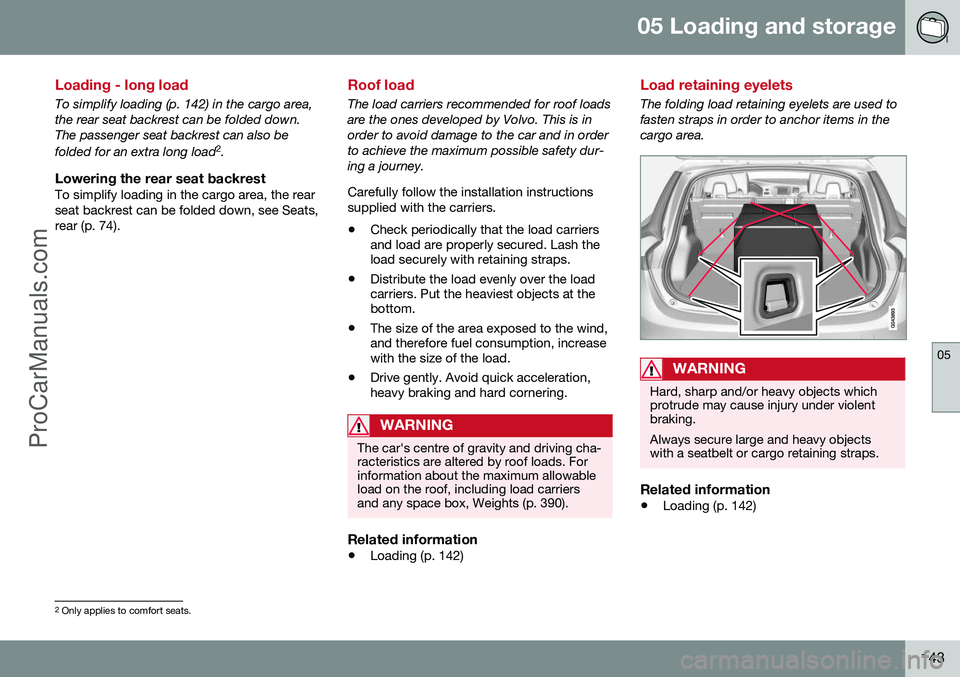
Load retaining eyelets
The folding load retaining eyelets are used to fasten straps in order to anchor items in thecargo area.
WARNING
Hard, sharp and/or heavy objects which protrude may cause injury under violentbraking. Always secure large and heavy objects with a seatbelt or cargo retaining straps.
Related information
• Loading (p. 142)
2
Only applies to comfort seats.
ProCarManuals.co’
Page 308 of 442
||
08 Starting and driving
08
306* Option/accessory, for more information, see Introduction.
• For lowest fuel consumption, activate ECO (p. 288)* 16
.
• Use the ECO Guide which indicates how fuel-efficiently the car is being driven, seeEco guide & Power guide* (p. 63).
• Drive in the highest gear possible, adap-ted to the current traffic situation androad - lower engine speeds result in lowerfuel consumption. Use the gear indicator(p. 272).
• Avoid sudden unnecessary accelerationand heavy braking.
• High speed results in increased fuel con-sumption - the wind resistance increaseswith speed.
• Do not run the engine to operating tem-perature at idling speed, but rather drivewith a light load as soon as possible - acold engine consumes more fuel than awarm one.
• Drive with the correct air pressure in thetyres and check this regularly - selectECO tyre pressure for best results, seeTyres - approved tyre pressures (p. 407).
• Choice of tyres can affect fuel consump-tion - seek advice on suitable tyres from adealer.
• Remove unnecessary items from the car -the greater the load the higher the con-sumption. •
Use engine braking to slow down, when itcan take place without risk to other roadusers.
• A roof load and ski box increase air resis-tance, leading to higher consumption -remove the load carriers when not in use.
• Avoid driving with open windows.
For information about Volvo Car Corpora- tion's environmental philosophy, see VolvoCars' environmental philosophy (p. 19). For more information about fuel consumption, see Fuel consumption and CO2 emissions (p.403).
WARNING
Never switch off the engine while moving, such as downhill, this deactivates impor-tant systems such as the power steeringand brake servo.
Related information
• Fuel - handling (p. 301)
• Fuel consumption and CO2 emissions (p. 403)
• Fuel tank - volume (p. 402)
Driving with a trailer
When driving with a trailer there are a number of important points to think about regardinge.g. the towing bracket, the trailer and howthe load is positioned in the trailer. Payload depends on the car's kerb weight. The total of the weight of the passengers andall accessories, e.g. towbar, reduces the car'spayload by a corresponding weight. For moredetailed information on weights, see Weights(p. 390). If the towing bracket is mounted by Volvo, then the car is delivered with the necessaryequipment for driving with a trailer. • The car's towing bracket must be of an approved type.
• If the towbar is retrofitted, check withyour Volvo dealer that the car is fullyequipped for driving with a trailer.
• Distribute the load on the trailer so thatthe weight on the towing bracket com-plies with the specified maximum towballload.
• Increase the tyre pressure to the recom-mended pressure for a full load. For tyrepressure label location, see Tyres - airpressure (p. 328).
• The engine is loaded more heavily thanusual when driving with a trailer.
16
Only applies to cars with automatic gearbox.
ProCarManuals.co’
Page 309 of 442
08 Starting and driving
08
* Option/accessory, for more information, see Introduction.307
•
Do not tow a heavy trailer when the car is brand new. Wait until it has been drivenat least 1000 km.
• The brakes are loaded much more thanusual on long and steep downhill slopes.Downshift to a lower gear and adjust yourspeed.
• For safety reasons, the maximum permit-ted speed for the car when coupled witha trailer should not be exceeded. Followthe regulations in force for the permittedspeeds and weights.
• Maintain a low speed when driving with atrailer up long, steep ascents.
• Avoid driving with a trailer on inclines ofmore than 12%.
Trailer cableAn adapter is required if the car's towing bracket has 13 pin electrics and the trailerhas 7 pin electrics. Use an adapter cableapproved by Volvo. Make sure the cable doesnot drag on the ground.
Direction indicators and brake lights on
the trailer
If any of the trailer's lamps for direction indi-cators are broken, then the combined instru-ment panel's symbol for direction indicatorsflashes faster than normal and the information display shows the text
Bulb fail - Ind. signal
trailer. If any of the trailer's lamps for the brake light are broken then the
Bulb fail - Stop lamp
trailer text is shown.
Level control*The rear shock absorbers maintain a constant height irrespective of the car's load (up to themaximum permissible weight). When the caris stationary the rear of the car lowers slightly,which is normal.
Trailer weightsFor information on Volvo's permitted trailerweights, see Towing capacity and towballload (p. 391).
NOTE
The stated maximum permitted trailer weights are those permitted by Volvo.National vehicle regulations can furtherlimit trailer weights and speeds. Towbarscan be certified for higher towing weightsthan the car can actually tow.
WARNING
Follow the stated recommendations for trailer weights. Otherwise, the car andtrailer may be difficult to control in theevent of sudden movement and braking.
Related information
• Driving with a trailer - manual gearbox (p. 308)
• Driving with a trailer - automatic gearbox(p. 308)
• Towing bracket/Towbar (p. 309)
• Lamp replacement (p. 352)
ProCarManuals.co’
Page 325 of 442
09 Wheels and tyres
09
323
WARNING
19-inch wheels must never be used on
cars that are not equipped with the R-
Design or Sport chassis options. The use of 19-inch wheels on cars with standard
chassis constitutes a safety risk, with a
risk of vehicle damage, and it impairs thecar's driving characteristics.
Related information
• Tyres - speed ratings (p. 323)
• Tyres - load index (p. 323)
• Tyres - direction of rotation (p. 318)
• Tyres - maintenance (p. 318)
• Tyres - approved tyre pressures (p. 407)
• Wheel and wheel rim dimensions (p. 322)
Tyres - load index
Load index indicates a tyre's ability to carry a certain load. Each tyre has a certain capacity to carry a load, a load index (LI). The car's weight deter-mines the load capacity required of the tyres.Minimum permissible index is indicated in theload index table.
Related information
•Tyres - dimensions (p. 322)
• Tyres - approved tyre pressures (p. 407)
• Tyres - speed ratings (p. 323)
• Tyres - maintenance (p. 318)
Tyres - speed ratings
Each tyre can withstand a certain maximum speed and therefore belongs to a particularspeed rating (SS - Speed Symbol). Tyre speed class must at least correspond with the car's top speed. Minimum speed rat-ing is indicated in the speed rating tablebelow. The only exception to these regula- tions is the winter tyre (p. 321) 1
, where a
lower speed rating may be used. If such a tyre is chosen, the car must not be drivenfaster than the speed rating of the tyre (forexample, class Q can be driven at a maxi-mum of 160 km/h). Traffic regulations deter-mine how fast a car can be driven, not thespeed rating of the tyres.
NOTE
The maximum permitted speed is speci- fied in the table.
Q160 km/h (used only on winter tyres)
T190 km/h
H210 km/h
V240 km/h
1 Both metal-studded and studless tyres.
ProCarManuals.co’
Page 389 of 442
11 Specifications
11
}}
387
Label location
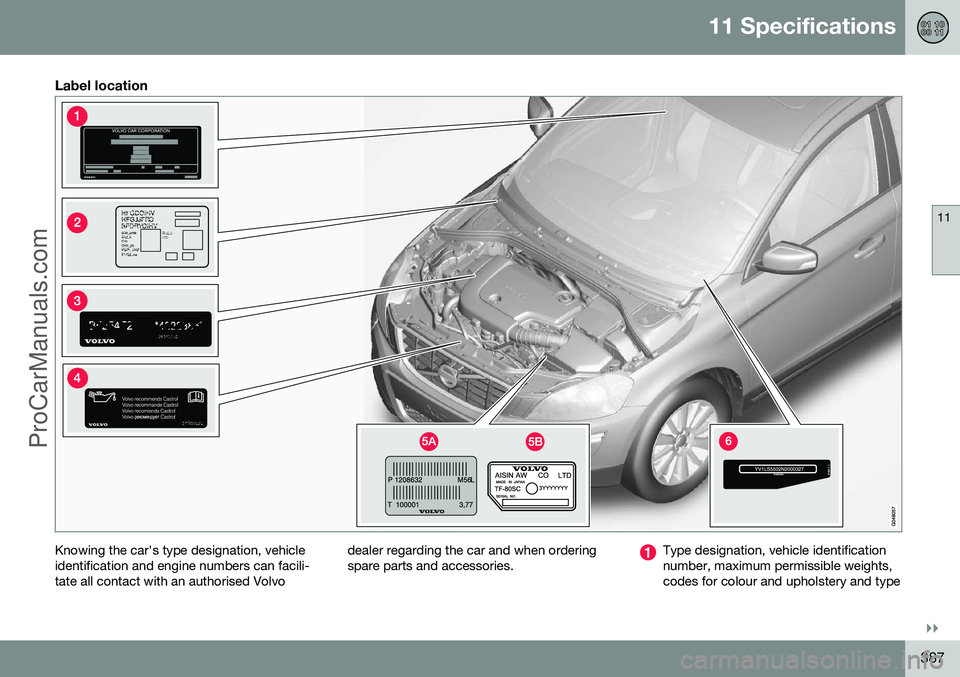
Knowing the car's type designation, vehicle identification and engine numbers can facili-tate all contact with an authorised Volvodealer regarding the car and when orderingspare parts and accessories.Type designation, vehicle identification number, maximum permissible weights,codes for colour and upholstery and type
ProCarManuals.co’
Page 390 of 442
||
11 Specifications
11
388
approval number. The label is visible when the right rear door is opened.
Label for parking heater.
Engine code and engine serial number.
Label for engine oil.
Gearbox type designation and serial num- ber.
Manual gearbox
Automatic gearbox
Car's identification number. (VIN Vehicle Identification Number)
Further information on the car is presented inthe registration document.
NOTE
It is not intended that the decals illustrated in the owner's manual should be exactreplicas of those in the car. They areincluded to show their approximateappearance and location in the car. Theinformation that applies to your particularcar is available on the respective decalsfor your car.
Related information
• Weights (p. 390)
• Engine specifications (p. 393)
ProCarManuals.co’
Page 392 of 442
11 Specifications
11
390
Weights
Max. gross vehicle weight, etc. can be read on a label in the car. Kerb weight includes the driver, the fuel tank 90% full and all fluids. The weight of passengers and accessories, and towball load (p. 391) (when a trailer ishitched) influence the load capacity and arenot included in the kerb weight. Permitted max. load = Gross vehicle weight - Kerb weight.
NOTE
The documented kerb weight applies to cars in the standard version - i.e. a carwithout extra equipment or accessories.This means that for every accessory addedthe loading capacity of the car is reducedcorrespondingly by the weight of theaccessory. Examples of accessories that reduce load- ing capacity are the Kinetic/Momentum/Summum equipment levels, as well asother accessories such as Towbar, Loadcarriers, Space box, Audio system, Auxili-ary lamps, GPS, Fuel-driven heater, Safetygrille, Carpets, Cargo cover, Power seats,etc. Weighing the car is a certain way of ascer- taining the kerb weight of your own partic-ular car.
WARNING
The car's driving characteristics change depending on how heavily it is loaded andhow the load is distributed.
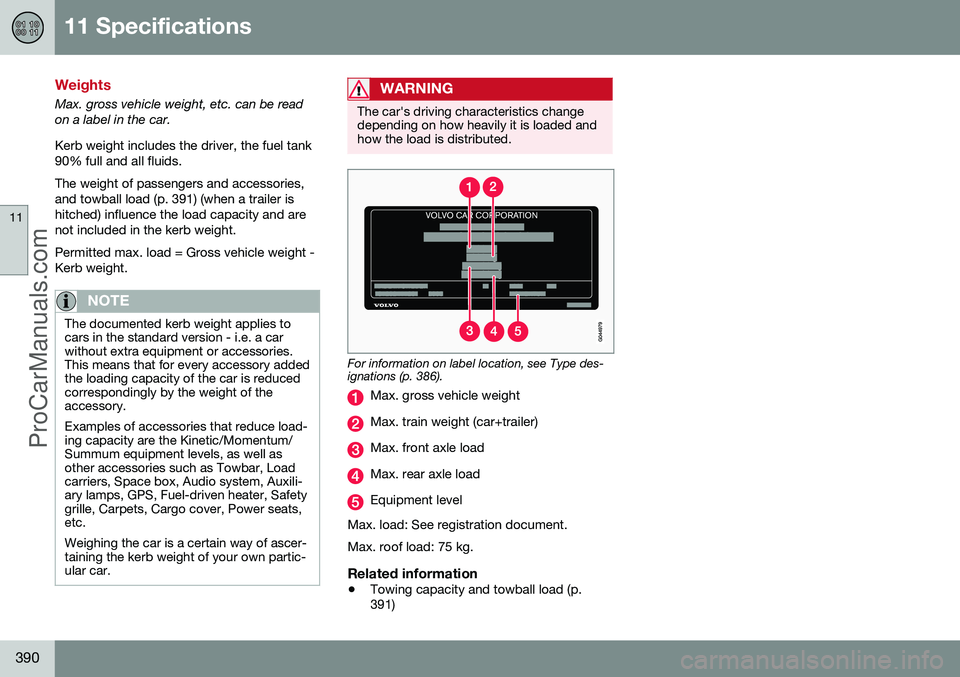
For information on label location, see Type des- ignations (p. 386).
Max. gross vehicle weight
Max. train weight (car+trailer)
Max. front axle load
Max. rear axle load
Equipment level
Max. load: See registration document. Max. roof load: 75 kg.
Related information
• Towing capacity and towball load (p. 391)
ProCarManuals.co’
Page 393 of 442
11 Specifications
11
}}
391
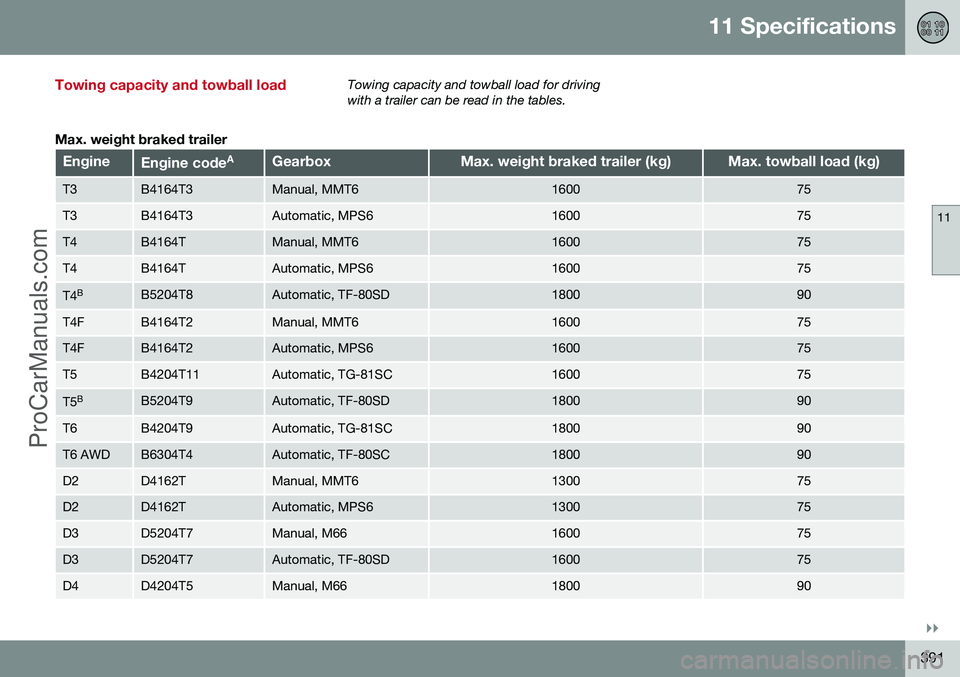
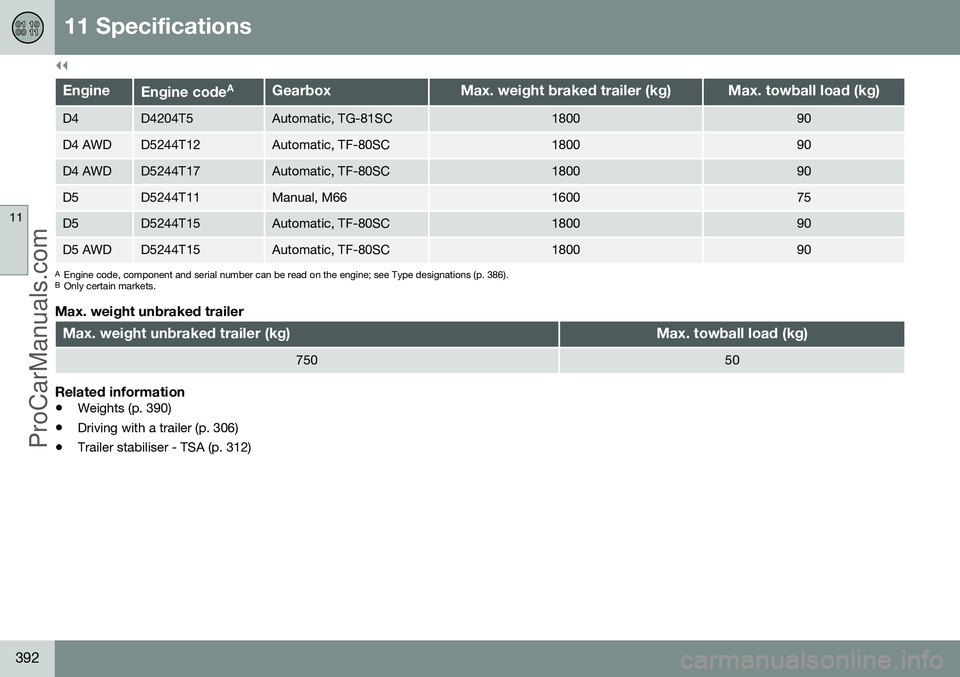
Towing capacity and towball loadTowing capacity and towball load for driving with a trailer can be read in the tables.
Max. weight braked trailer
EngineEngine codeAGearboxMax. weight braked trailer (kg)Max. towball load (kg)
T3B4164T3Manual, MMT6160075
T3B4164T3Automatic, MPS6160075
T4B4164TManual, MMT6160075
T4B4164TAutomatic, MPS6160075
T4
BB5204T8Automatic, TF-80SD180090
T4FB4164T2Manual, MMT6160075
T4FB4164T2Automatic, MPS6160075
T5B4204T11Automatic, TG-81SC160075
T5BB5204T9Automatic, TF-80SD180090
T6B4204T9Automatic, TG-81SC180090
T6 AWDB6304T4Automatic, TF-80SC180090
D2D4162TManual, MMT6130075
D2D4162TAutomatic, MPS6130075
D3D5204T7Manual, M66160075
D3D5204T7Automatic, TF-80SD160075
D4D4204T5Manual, M66180090
ProCarManuals.co’
Page 394 of 442
||
11 Specifications
11
392
EngineEngine codeAGearboxMax. weight braked trailer (kg)Max. towball load (kg)
D4D4204T5Automatic, TG-81SC180090
D4 AWDD5244T12Automatic, TF-80SC180090
D4 AWDD5244T17Automatic, TF-80SC180090
D5D5244T11Manual, M66160075
D5D5244T15Automatic, TF-80SC180090
D5 AWDD5244T15Automatic, TF-80SC180090
A
Engine code, component and serial number can be read on the engine; see Type designations (p. 386).
B Only certain markets.
Max. weight unbraked trailer
Max. weight unbraked trailer (kg)Max. towball load (kg)
75050
Related information
• Weights (p. 390)
• Driving with a trailer (p. 306)
• Trailer stabiliser - TSA (p. 312)
ProCarManuals.co’
Page 408 of 442
||
11 Specifications
11
406
NOTE
If the consumption and emission data is missing then it is included in the enclosedsupplement.
Fuel consumption and emission values in the table above are based on specific EU cycles3
,
that apply to cars with kerb weight in the basic version and without extra equipment.The car's weight may increase depending onequipment. This, as well as how heavily thecar is loaded, increases fuel consumption andcarbon dioxide emissions. There are several reasons for increased fuel consumption compared with the table's val-ues. Examples of this are:
• The driver's driving style.
• If the customer has specified wheels larger than those fitted as standard on themodel's basic version, then resistanceincreases.
• High speed results in increased windresistance.
• Fuel quality, road and traffic conditions,weather and the condition of the car. Even a combination of the above-mentioned examples can result in significantly improvedconsumption. For further information, please refer to the regulations referred to
3
.
Large deviations in fuel consumption may arise in a comparison with the EU driving cycles 3
which are used in the certification of
the car and on which the consumption figures in the table are based.
NOTE
Extreme weather conditions, driving with a trailer or driving at high altitudes in combi-nation with fuel grade are factors thatcould affect the car's performance.
Related information
• Economical driving (p. 305)
• Weights (p. 390)
3
Official fuel consumption figures are based on two standardised driving cycles in a laboratory environment ("EU driving cycles") all in accordance with EU Regulation no 692/2008 and 715/2007 (Euro 5 / Euro 6) and UN ECE Regulation no 101. The regulations cover the driving cycles for urban driving and extra-urban driving. - Urban driving - the measurement starts with cold starting theengine. The driving is simulated. - Extra-urban driving - the car is accelerated and braked at speeds between 0 and 120 km/h. The driving is simulated. - A car with T3, D2, D3, D4 or D5 engineand 6-speed manual gearbox is started in 2nd gear. The combined driving value given in the table is a combination of urban driving and extra-urban driving, in accordance with applicable legisla-tion. CO
2 emissions - the exhaust gases are collected in order to calculate the carbon dioxide emissions during the two driving cycles. These are then analysed and give the value for CO
2
emissions.
ProCarManuals.co’