heating VOLVO V60 2014 Owner's Manual
[x] Cancel search | Manufacturer: VOLVO, Model Year: 2014, Model line: V60, Model: VOLVO V60 2014Pages: 442, PDF Size: 13.85 MB
Page 299 of 442
08 Starting and driving
08
297
Fording
Fording means that the car is driven through a water-covered roadway. Fording must be car-ried out with great caution. The car can be driven through water at a maximum depth of 25 cm at a maximumspeed of 10 km/h. Extra caution should beexercised when passing through flowingwater. During driving in water, maintain a low speed and do not stop the car. When the water hasbeen passed, depress the brake pedal lightlyand check that full brake function is achieved.Water and mud for example can make thebrake linings wet resulting in delayed brakefunction. •Clean the electric contacts of the electric engine block heater and trailer couplingafter driving in water and mud.
• Do not let the car stand with water overthe sills for any long period of time - thiscould cause electrical malfunctions.IMPORTANT
Engine damage can occur if water enters the air filter. In depths greater than 25 cm, water could enter the transmission. This reduces thelubricating ability of the oils and shortensthe service life of these systems. In the event of the engine stalling in water, do not try restart - tow the car from thewater to a workshop - an authorised Volvoworkshop is recommended. Risk of enginebreakdown.
Related information
•Recovery (p. 316)
• Towing (p. 313)
Overheating
Under special conditions, for example hard driving in hilly terrain and hot climate, there isa risk that the engine and drive system mayoverheat - in particular with a heavy load. For information about overheating when driv- ing with a trailer, see Driving with a trailer (p.306). • Remove any auxiliary lamps from in front of the grille when driving in hot climates.
• If the temperature in the engine's coolingsystem is too high then a warning symbolis illuminated in the combined instrumentpanel's information display and a text message
High engine temp Stop safelyis shown there - stop the car in a safe way and allow the engine to run at idlingspeed for several minutes in order to cooldown.
• If the text message
High engine temp
Stop engine or Coolant level low, Stop
engine is shown then the engine must be
switched off after stopping the car.
• In the event of overheating in the gearbox a built-in protection function is activatedwhich, amongst other things, illuminatesa warning symbol in the combined instru-ment panel, and its display shows the text message
Transmission hot Reduce
speed or Transmission hot Stop safely- follow the recommendation given and lower the speed and stop the car in a safeway and allow the engine to run at idling
ProCarManuals.co’
Page 304 of 442
08 Starting and driving
08
302
Fuel - petrol
Petrol is used as fuel. Petrol must fulfil the EN 228 standard. Most engines can be run with octane ratings of 95and 98 RON. Only in exceptional casesshould 91 RON be used.
• 95 RON can be used for normal driving.
• 98 RON is recommended for optimum performance and minimum fuel consump-tion.
When driving in temperatures above +38 °C, fuel with the highest possible octane rating isrecommended for optimum performance andfuel economy.
IMPORTANT
• Always refuel with unleaded petrol so as not to damage the catalytic con-verter.
• Do not use additives not recom-mended by Volvo.
Related information
•
Fuel - handling (p. 301)
• Economical driving (p. 305)
• Fuel consumption and CO2 emissions (p. 403)
• Fuel tank - volume (p. 402)
Fuel - diesel
Diesel is used as fuel. Only use diesel fuel from well-known produc- ers. Never use diesel of dubious quality. Die-sel should fulfil the EN 590 or JIS K2204standards. Diesel engines are sensitive tocontaminants in the fuel, such as excessivelyhigh volumes of sulphur particles for exam-ple. At low temperatures (-6 °C to -40 °C), a par- affin precipitate may form in the diesel fuel,which may lead to ignition problems. Specialdiesel fuel designed for low temperaturesaround freezing point is available from themajor oil companies. This fuel is less viscousat low temperatures and reduces the risk ofparaffin precipitate. The risk of condensation in the fuel tank is reduced if the tank is kept well filled. Whenrefuelling, check that the area around the fuelfiller pipe is clean. Avoid spilling fuel onto thepaintwork. Wash off any spillage with deter-gent and water.
IMPORTANT
Only ever use fuel that fulfils the European diesel standard. The sulphur content must be a maximum of 50 ppm.
IMPORTANT
Diesel type fuels that must not be used:
• Special additives
• Marine diesel fuel
• Heating oil
• FAME 15
(Fatty Acid Methyl Ester) and
vegetable oil.
These fuels do not fulfil the requirements in accordance with Volvo recommendationsand generate increased wear and enginedamage that is not covered by the Volvowarranty.
Empty tankThe design of the fuel system in a diesel engine means that if the vehicle runs out offuel, the tank may need to be vented in theworkshop in order to restart the engine afterfuelling. Once the engine has stopped due to fuel starvation, the fuel system needs a fewmoments to carry out a check. Do this beforestarting the engine, once the fuel tank hasbeen filled with diesel:
1. Insert the remote control key in the igni- tion switch and push it in to the end posi-
15Diesel fuel may contain a certain amount of FAME, but further amounts must not be added.
ProCarManuals.co’
Page 310 of 442
08 Starting and driving
08
308* Option/accessory, for more information, see Introduction.
Driving with a trailer - manual gearbox
When driving with a trailer in hilly terrain in a hot climate there may be a risk of overheating.
OverheatingWhen driving with a trailer in hilly terrain in ahot climate there may be a risk of overheat-ing. • Do not run the engine at higher revolu- tions than 4500 rpm(diesel engines: 3500 rpm) - otherwise theoil temperature may become too high.
Diesel engine 5-cyl
•In the event of a risk of overheating theoptimal speed for the engine is2300-3000 rpm for optimal circulation ofthe coolant.
Related information
•Driving with a trailer (p. 306)
Driving with a trailer - automatic gearbox
When driving with a trailer in hilly terrain in a hot climate there may be a risk of overheating.
• An automatic gearbox selects the opti- mum gear related to load and enginespeed.
• In the event of overheating a warningsymbol is illuminated in the combinedinstrument panel with a message that isshown in the information display - followthe recommendation given.
Steep inclines
•Do not lock the automatic transmission ina higher gear than the engine "can copewith" - it is not always a good idea todrive at a high gear with low engine revo-lutions.
Parking on a hill1. Depress the foot brake.
2. Activate the parking brake.
3. Move the gear selector to position
P.
4. Release the foot brake.
• Move the gear selector to park position
P
when parking an automatic car with a hitched trailer. Always use the parkingbrake.
• Block the wheels with chocks when park-ing a car with hitched trailer on a hill.
IMPORTANT
See also the specific information on slow driving with a trailer for cars with thePowershift automatic transmission, seeAutomatic gearbox -- Powershift* (p. 276).
Starting on a hill1. Depress the foot brake.
2. Move the gear selector to driving posi-
tion D.
3. Release the parking brake.
4. Release the foot brake and start driving off.
Related information
• Automatic gearbox -- Geartronic* (p. 273)
ProCarManuals.co’
Page 330 of 442
09 Wheels and tyres
09
328
Tyres - air pressure
Tyres can have different air pressures which are measured in bar.
Check the air pressure in the tyresThe tyre pressures must be checked everymonth.
• Tyre pressure for the car's recommended tyre dimension
• ECO pressure 2
NOTE
•
Check the tyre pressure when the tyres are cold. "Cold tyres" means thatthe tyres are at the same temperatureas the outdoor temperature. The tyreswill heat up and the tyre pressures willincrease after driving for a few kilome-tres.
• Tyre pressures which are too low willincrease fuel consumption, reduce tyreservice life and impair the car's han-dling. Driving with tyre pressureswhich are too low may lead to thetyres overheating and sustaining dam-age. Tyre pressures affect ride com-fort, road noise and steering.
• Tyre pressure decreases over time,this is a natural phenomenon. Tyrepressure also varies depending onambient temperature.
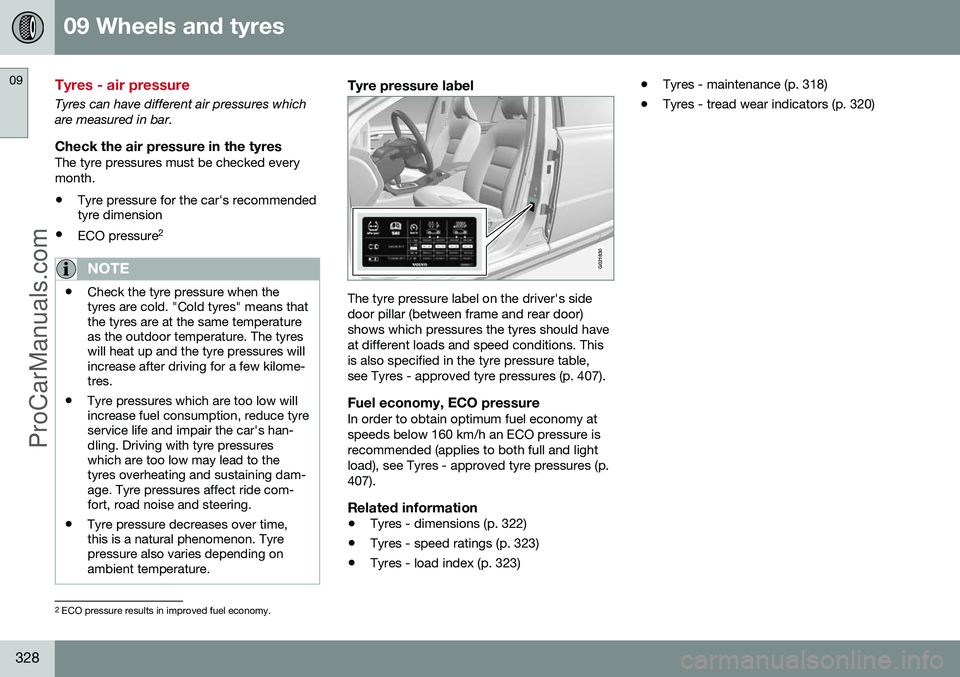
Tyre pressure label
G021830
The tyre pressure label on the driver's side door pillar (between frame and rear door)shows which pressures the tyres should haveat different loads and speed conditions. Thisis also specified in the tyre pressure table,see Tyres - approved tyre pressures (p. 407).
Fuel economy, ECO pressureIn order to obtain optimum fuel economy atspeeds below 160 km/h an ECO pressure isrecommended (applies to both full and lightload), see Tyres - approved tyre pressures (p.407).
Related information
•
Tyres - dimensions (p. 322)
• Tyres - speed ratings (p. 323)
• Tyres - load index (p. 323) •
Tyres - maintenance (p. 318)
• Tyres - tread wear indicators (p. 320)
2
ECO pressure results in improved fuel economy.
ProCarManuals.co’
Page 338 of 442
||
09 Wheels and tyres
09
336
7. Flick the switch to position I.
WARNING
Never stand next to the tyre when the compressor is running. If cracks orunevenness arise then the compressormust be switched off immediately. Thejourney should not be continued. Contact-ing an authorised tyre centre is recom-mended.
NOTE
When the compressor starts, the pressure can increase up to 6 bar but the pressuredrops after approximately 30 seconds.
8. Inflate the tyre for 7 minutes.
IMPORTANT
Risk of overheating. The compressor must not run for more than 10 minutes.
9. Switch off the compressor to check the
pressure on the pressure gauge. Mini- mum pressure is 1.8 bar and maximum3.5 bar. (Release air with the pressurereducing valve if the tyre pressure is toohigh.)
WARNING
If the pressure is below 1.8 bar then the hole in the tyre is too big. The journeyshould not be continued. Contacting anauthorised tyre centre is recommended.
10. Switch off the compressor and unplug thecable from the 12 V socket.
11. Detach the hose from the tyre valve and fit the valve cap.
12. As soon as possible, drive approximately 3 km at a maximum speed of 80 km/h so that the sealing fluid can seal the tyre.
Related information
• Emergency puncture repair (p. 333)
• Emergency puncture repair - rechecking (p. 336)
• Emergency puncture repair kit - overview(p. 334)
Emergency puncture repair - rechecking
Emergency puncture repair, where the emer- gency puncture repair kit (TMK - TemporaryMobility Kit) is used to seal a puncture andcheck and adjust the tyre pressure (p. 407).
Check tyre pressure1. Reconnect the equipment.
2. Read the tyre pressure on the pressure
gauge.
• If it is below 1.3 bar 8
then the tyre is
insufficiently sealed. The journey should not be continued. Contact atyre centre.
• If the tyre pressure is higher than 1.3 bar 8
, the tyre must be inflated to the
pressure specified in accordance with the tyre pressure table, see Tyres -approved tyre pressures (p. 407).Release air using the pressure reduc-ing valve if the tyre pressure is toohigh.
8 1 bar = 100 kPa.
ProCarManuals.co’
Page 340 of 442
||
09 Wheels and tyres
09
338
IMPORTANT
Risk of overheating. The compressor must not run for more than 10 minutes.
5. Inflate the tyre to the pressure specified inaccordance with the tyre pressure table, Tyres - approved tyre pressures (p. 407).Release air using the pressure reducingvalve if the tyre pressure is too high.
6. Switch off the compressor Detach the air hose and cable.
7. Refit the dust cap.
Related information
• Emergency puncture repair (p. 333)
• Emergency puncture repair kit - overview (p. 334)
• Emergency puncture repair - rechecking(p. 336)
Emergency puncture repair kit - sealant
The container (bottle) with the emergency puncture repair kit (p. 334) contains sealantand it can be replaced. Replace the bottle when the expiration date has passed. Treat the old bottle as environ-mentally hazardous waste.
WARNING
The bottle contains 1.2-Ethanol and natu- ral rubber-latex. Harmful if ingested. Could result in allergic reaction in the event of skin contact. Avoid contact with the skin and eyes.Store out of the reach of children.
Related information
•
Emergency puncture repair (p. 333)
ProCarManuals.co’
Page 367 of 442
10 Maintenance and service
10
* Option/accessory, for more information, see Introduction.365
For more information on the car's battery - Electrical system (p. 410).
Battery - Start/Stop
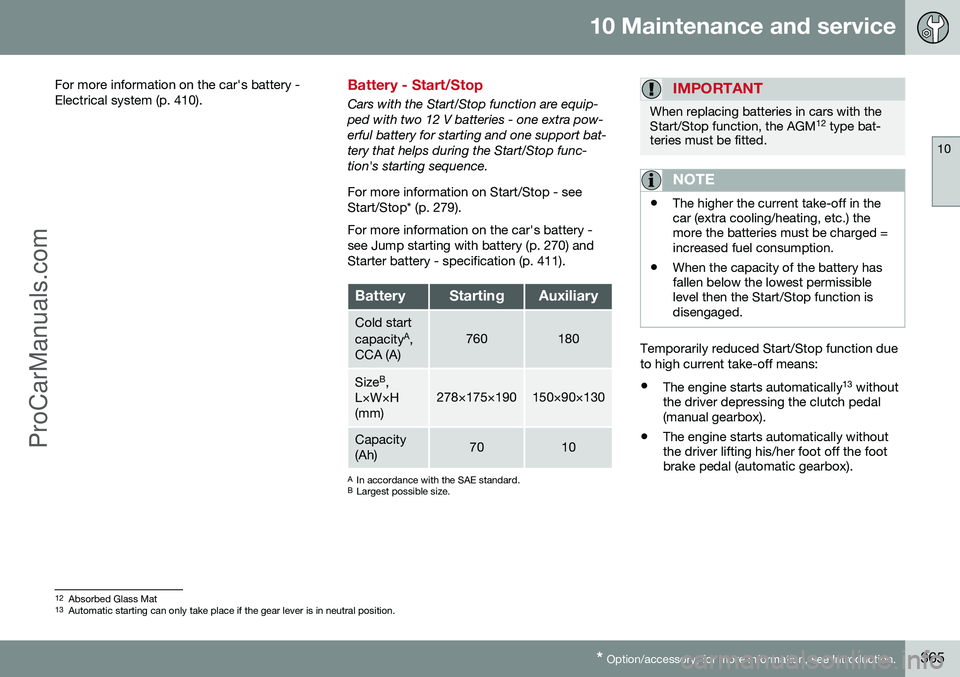
Cars with the Start/Stop function are equip- ped with two 12 V batteries - one extra pow-erful battery for starting and one support bat-tery that helps during the Start/Stop func-tion's starting sequence. For more information on Start/Stop - see Start/Stop* (p. 279). For more information on the car's battery - see Jump starting with battery (p. 270) andStarter battery - specification (p. 411).
BatteryStartingAuxiliary
Cold start capacity
A
,
CCA (A)760180
Size B
,
L×W×H (mm)278×175×190150×90×130
Capacity (Ah)7010
A In accordance with the SAE standard.
B Largest possible size.
IMPORTANT
When replacing batteries in cars with the Start/Stop function, the AGM 12
type bat-
teries must be fitted.
NOTE
• The higher the current take-off in the car (extra cooling/heating, etc.) themore the batteries must be charged =increased fuel consumption.
• When the capacity of the battery hasfallen below the lowest permissiblelevel then the Start/Stop function isdisengaged.
Temporarily reduced Start/Stop function due to high current take-off means: •
The engine starts automatically 13
without
the driver depressing the clutch pedal (manual gearbox).
• The engine starts automatically withoutthe driver lifting his/her foot off the footbrake pedal (automatic gearbox).
12
Absorbed Glass Mat
13 Automatic starting can only take place if the gear lever is in neutral position.
ProCarManuals.co’
Page 375 of 442
10 Maintenance and service
10
* Option/accessory, for more information, see Introduction.373
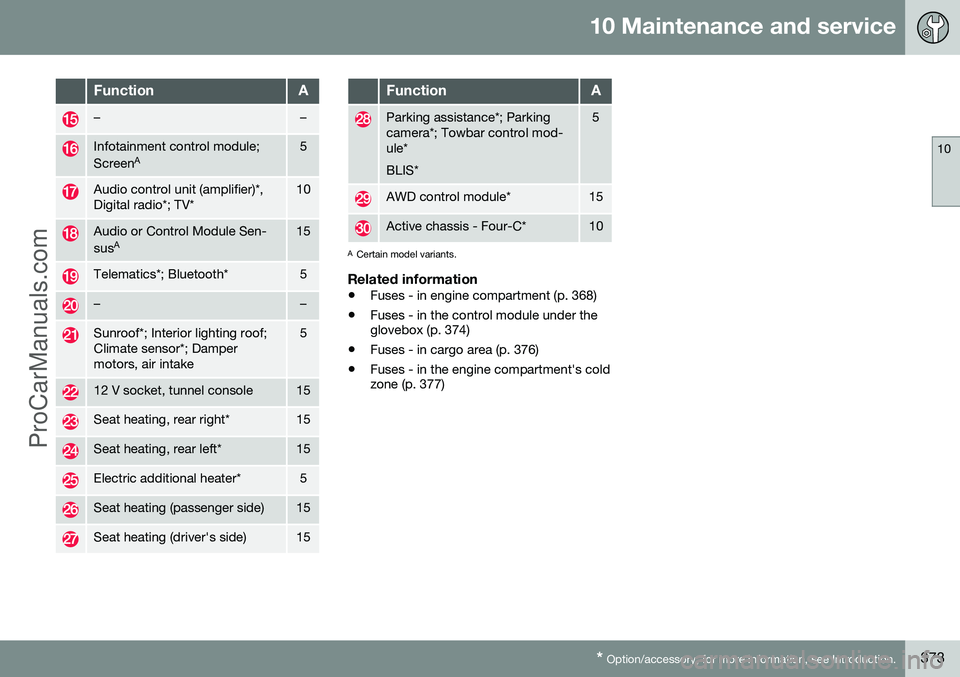
FunctionA
––
Infotainment control module; Screen A5
Audio control unit (amplifier)*, Digital radio*; TV*10
Audio or Control Module Sen- sus
A15
Telematics*; Bluetooth*5
––
Sunroof*; Interior lighting roof; Climate sensor*; Dampermotors, air intake5
12 V socket, tunnel console15
Seat heating, rear right*15
Seat heating, rear left*15
Electric additional heater*5
Seat heating (passenger side)15
Seat heating (driver's side)15
FunctionA
Parking assistance*; Parking camera*; Towbar control mod-ule* BLIS*5
AWD control module*15
Active chassis - Four-C*10
A
Certain model variants.
Related information
• Fuses - in engine compartment (p. 368)
• Fuses - in the control module under the glovebox (p. 374)
• Fuses - in cargo area (p. 376)
• Fuses - in the engine compartment's coldzone (p. 377)
ProCarManuals.co’
Page 377 of 442
10 Maintenance and service
10
* Option/accessory, for more information, see Introduction.375
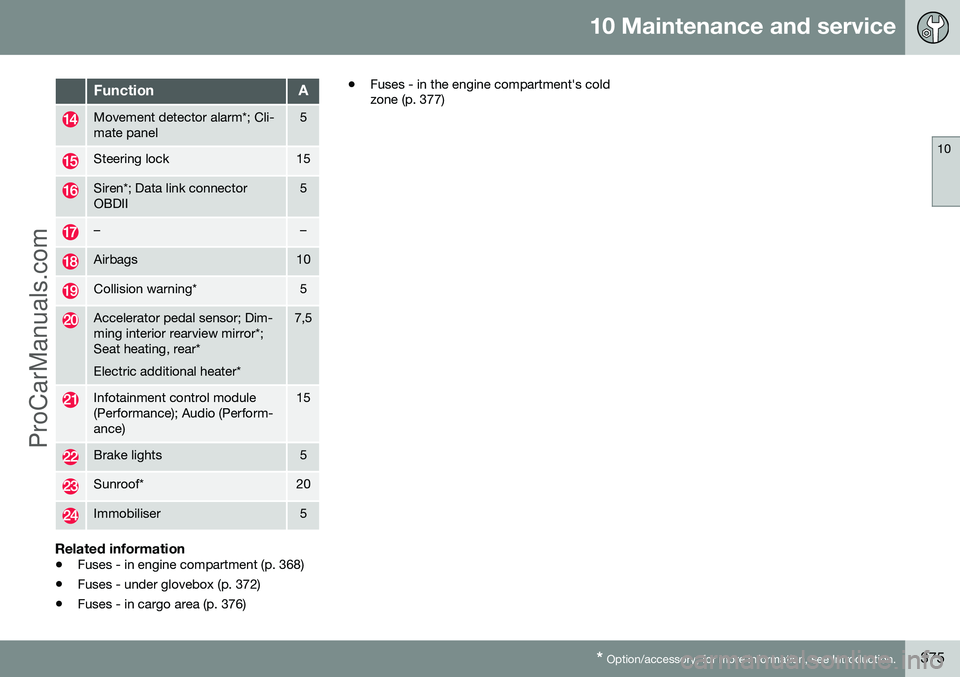
FunctionA
Movement detector alarm*; Cli- mate panel5
Steering lock15
Siren*; Data link connector OBDII5
––
Airbags10
Collision warning*5
Accelerator pedal sensor; Dim- ming interior rearview mirror*;Seat heating, rear* Electric additional heater*7,5
Infotainment control module (Performance); Audio (Perform-ance)15
Brake lights5
Sunroof*20
Immobiliser5
Related information
• Fuses - in engine compartment (p. 368)
• Fuses - under glovebox (p. 372)
• Fuses - in cargo area (p. 376) •
Fuses - in the engine compartment's cold zone (p. 377)
ProCarManuals.co’
Page 383 of 442
10 Maintenance and service
10
* Option/accessory, for more information, see Introduction.381
Water and dirt-repellent coating
The windows are treated with a surface coa- ting that improves visibility in difficult weatherconditions.
Water and dirt-repellent coating*There is natural wear of the water-repellent coating.
Maintenance:
• Never use products such as car wax, degreaser or similar on glass surfaces asthis could ruin their water-repellent prop-erties.
• Take care when cleaning so as not todamage the glass surface.
• To avoid damaging glass surfaces whenremoving ice – only use plastic ice scra-pers.
• Treatment with a special finishing agentavailable from Volvo dealers is recom-mended in order to maintain the water-repellent properties. This should be usedfirst after three years and then each year.
IMPORTANT
Do not use a metal ice scraper to remove ice from the windows. Use the heating toremove ice from the door mirrors, see Win-dows and rearview and door mirrors -heating (p. 96).
Related information
•Car washing (p. 379)
Rustproofing
The car received a thorough and complete rustproofing at the factory. Parts of the bodyare made of galvanised sheet metal. Theunderbody is protected by a wear-resistantanti-corrosion compound. A thin, penetratingrustproofing fluid was sprayed into theexposed members, cavities, closed sectionsand side doors.
Inspection and maintenanceDirt and road salt can lead to corrosion so itis important to keep the car clean. The car'srustproofing needs to be checked regularlyand touched-up if necessary in order for it tobe maintained. Under normal conditions the rustproofing does not require treatment for approximately12 years. After this period, it should be trea-ted at three-year intervals. Volvo recom-mends that you engage an authorised Volvoworkshop for assistance if the car needs fur-ther treatment.
Related information
•Paint damage (p. 383)
Cleaning the interior
Only use cleaning agents and car care prod- ucts recommended by Volvo. Clean regularlyand follow the instructions included with thecar care product. Vacuuming is important prior to using clean- ing agents.
Carpets and cargo areaRemove inlaid carpets for separate cleaningof the floor carpet and the inlaid carpets. Usea vacuum cleaner to remove dust and dirt.Each inlay mat is secured with pins. Take hold of the inlay mat at each pin and lift the mat straight up. Fit the inlay mat in place by pressing it in at each pin.
WARNING
Before setting off check that the inlaid mat in the driver area is firmly affixed andsecured in the bosses in order to avoidgetting caught adjacent to and under thepedals.
A special textile cleaner is recommended for stains on the floor mat after vacuuming. Floormats should be cleaned with agents recom-mended by your Volvo dealer.
ProCarManuals.co’