service VOLVO V60 2014 Owner's Guide
[x] Cancel search | Manufacturer: VOLVO, Model Year: 2014, Model line: V60, Model: VOLVO V60 2014Pages: 442, PDF Size: 13.85 MB
Page 303 of 442
08 Starting and driving
08
301
Filling with a fuel can14When filling with a fuel can, use the funnel located under the floor hatch in the cargoarea. The funnel is located by the spare wheelor in the well under the floor hatch. Make sure you insert the funnel's pipe firmly into the filler pipe. The filler pipe has an open-able cap and the funnel's pipe must bemoved past the cap before filling can begin.
Related information
•
Fuel filler flap - manual opening (p. 300)
• Fuel - handling (p. 301)
Fuel - handling
Fuel of a lower quality than that recom- mended by Volvo must not be used as enginepower and fuel consumption is negativelyaffected.
WARNING
Always avoid inhaling fuel vapour and get- ting fuel splashes in the eyes. In the event of fuel in the eyes, remove any contact lenses and rinse the eyes in plentyof water for at least 15 minutes and seekmedical attention. Never swallow fuel. Fuels such as petrol, bioethanol and mixtures of them and die-sel are highly toxic and could cause per-manent injury or be fatal if swallowed.Seek medical attention immediately if fuelhas been swallowed.
WARNING
Fuel which spills onto the ground can be ignited. Switch off the fuel-driven heater before starting to refuel. Never carry an activated mobile phone when refuelling. The ring signal couldcause spark build-up and ignite petrolfumes, leading to fire and injury.
IMPORTANT
Mixing different types of fuel or the use of fuel not recommended invalidates Volvo'sguarantees, and any associated serviceagreement. This applies to all engines.NOTE: It does not apply to cars withengines that are adapted to run on ethanolfuel (E85).
NOTE
Extreme weather conditions, driving with a trailer or driving at high altitudes in combi-nation with fuel grade are factors thatcould affect the car's performance.
Related information
•Economical driving (p. 305)
• Fuel - diesel (p. 302)
• Diesel particle filter (DPF) (p. 305)
• Fuel consumption and CO2 emissions (p. 403)
• Fuel tank - volume (p. 402)
14
Only applies to cars with diesel engine.
ProCarManuals.co’
Page 305 of 442
08 Starting and driving
08
303
tion, see Key positions (p. 70) for more information.
2. Press the START button without
depressing the brake and/or clutch pedal.
3. Wait approx. 1 minute.
4. To start the engine: Depress the brake and/or clutch pedal and then press the START button again.
NOTE
Before filling with fuel in the event of fuel shortage:
• Stop the car on as flat/level ground as possible - if the car is tilting there is arisk of air pockets in the fuel supply.
Draining condensation from the fuel filter
The fuel filter separates condensation from the fuel. Condensation can disrupt engineoperation. The fuel filter must be drained at the intervals specified in the Service and Warranty Bookletor if you suspect that the car has been filledwith contaminated fuel. For more information,see Volvo service programme (p. 340).
IMPORTANT
Certain special additives remove the water separation in the fuel filter.
Related information
•
Fuel - handling (p. 301)
• Diesel particle filter (DPF) (p. 305)
• Fuel consumption and CO2 emissions (p. 403)
Catalytic converters
The purpose of the catalytic converters is to purify exhaust gases. They are located closeto the engine so that operating temperature isreached quickly. The catalytic converters consist of a monolith (ceramic or metal) with channels. The channelwalls are lined with a thin layer of platinum/rhodium/palladium. These metals act as cata-lysts, i.e. they participate in and accelerate achemical reaction without being used upthemselves.
Lambda-sond TM
oxygen sensorThe Lambda-sond is part of a control systemintended to reduce emissions and improvefuel economy (see Fuel consumption andCO2 emissions (p. 403)). An oxygen sensor monitors the oxygen con- tent of the exhaust gases leaving the engine.This value is fed into an electronic systemthat continuously controls the injectors. Theratio of fuel to air directed to the engine iscontinuously adjusted. These adjustmentscreate optimal conditions for efficient com-bustion, and together with the three-way cat-alytic converter reduce harmful emissions(hydrocarbons, carbon monoxide and nitrousoxides).
ProCarManuals.co’
Page 317 of 442
08 Starting and driving
08
315
Towing eye
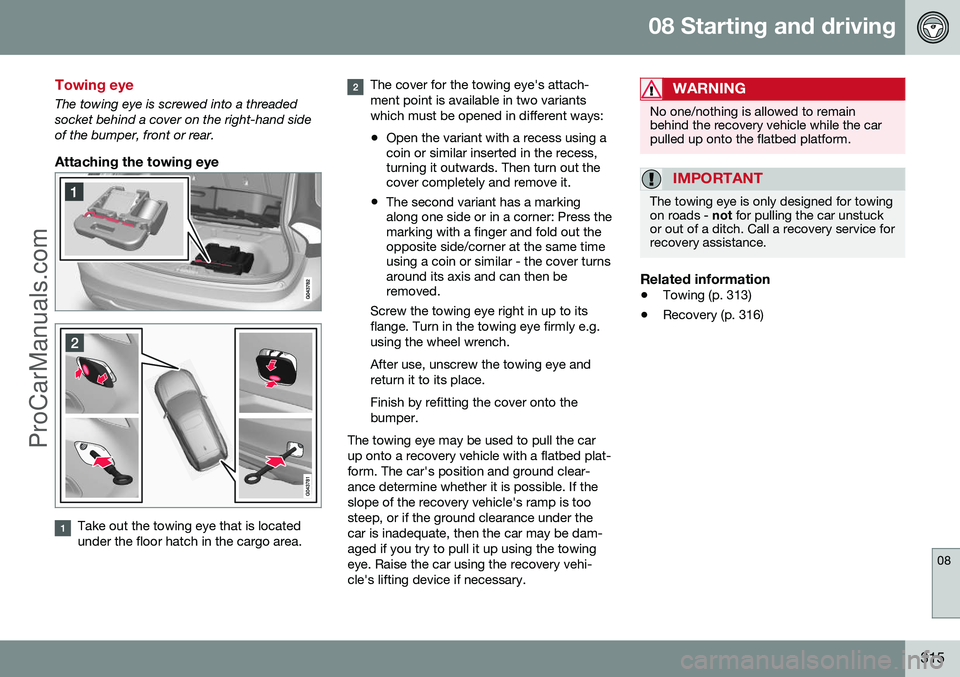
The towing eye is screwed into a threaded socket behind a cover on the right-hand sideof the bumper, front or rear.
Attaching the towing eye
Take out the towing eye that is located under the floor hatch in the cargo area.
The cover for the towing eye's attach- ment point is available in two variantswhich must be opened in different ways:
• Open the variant with a recess using a coin or similar inserted in the recess,turning it outwards. Then turn out thecover completely and remove it.
• The second variant has a markingalong one side or in a corner: Press themarking with a finger and fold out theopposite side/corner at the same timeusing a coin or similar - the cover turnsaround its axis and can then beremoved.
Screw the towing eye right in up to its flange. Turn in the towing eye firmly e.g.using the wheel wrench. After use, unscrew the towing eye and return it to its place. Finish by refitting the cover onto the bumper.
The towing eye may be used to pull the carup onto a recovery vehicle with a flatbed plat-form. The car's position and ground clear-ance determine whether it is possible. If theslope of the recovery vehicle's ramp is toosteep, or if the ground clearance under thecar is inadequate, then the car may be dam-aged if you try to pull it up using the towingeye. Raise the car using the recovery vehi-cle's lifting device if necessary.WARNING
No one/nothing is allowed to remain behind the recovery vehicle while the carpulled up onto the flatbed platform.
IMPORTANT
The towing eye is only designed for towing on roads - not for pulling the car unstuck
or out of a ditch. Call a recovery service forrecovery assistance.
Related information
• Towing (p. 313)
• Recovery (p. 316)
ProCarManuals.co’
Page 318 of 442
08 Starting and driving
08
316
Recovery
Recovery means that the vehicle is transpor- ted away by means of another vehicle. Call a recovery service for recovery assis- tance. The towing eye may be used to pull the car up onto a recovery vehicle with a flatbed plat-form. The car's position and ground clear-ance determine whether it is possible. If theslope of the recovery vehicle's ramp is toosteep, or if the ground clearance under thecar is inadequate, then the car may be dam-aged if you try to pull it up using the towingeye. Raise the car using the recovery vehi-cle's lifting device if necessary.
WARNING
No one/nothing is allowed to remain behind the recovery vehicle while the carpulled up onto the flatbed platform.
IMPORTANT
The towing eye is only designed for towing on roads - not for pulling the car unstuck
or out of a ditch. Call a recovery service forrecovery assistance.
IMPORTANT
Note that the car must always be transpor- ted with the wheels rolling forward.
• An All Wheel Drive car (AWD) with raised front suspension must not betowed at speeds above 70 km/h. Itshould not be towed further than 50km.
Related information
•
Towing (p. 313)
ProCarManuals.co’
Page 323 of 442
09 Wheels and tyres
09
* Option/accessory, for more information, see Introduction.321
Jack*
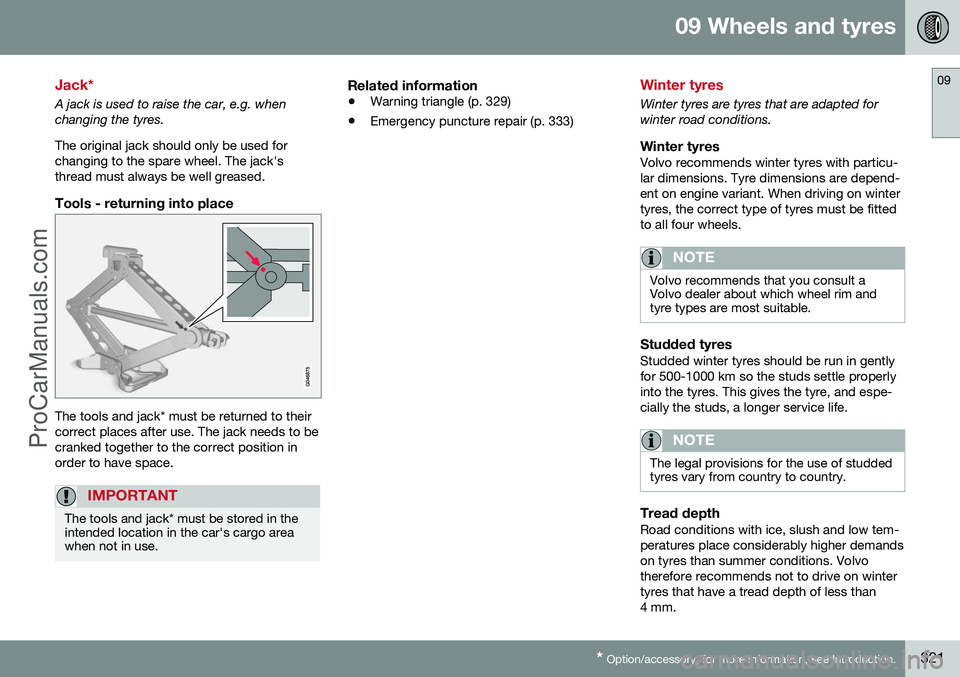
A jack is used to raise the car, e.g. when changing the tyres. The original jack should only be used for changing to the spare wheel. The jack'sthread must always be well greased.
Tools - returning into place
The tools and jack* must be returned to their correct places after use. The jack needs to becranked together to the correct position inorder to have space.
IMPORTANT
The tools and jack* must be stored in the intended location in the car's cargo areawhen not in use.
Related information
• Warning triangle (p. 329)
• Emergency puncture repair (p. 333)
Winter tyres
Winter tyres are tyres that are adapted for winter road conditions.
Winter tyresVolvo recommends winter tyres with particu-lar dimensions. Tyre dimensions are depend-ent on engine variant. When driving on wintertyres, the correct type of tyres must be fittedto all four wheels.
NOTE
Volvo recommends that you consult a Volvo dealer about which wheel rim andtyre types are most suitable.
Studded tyresStudded winter tyres should be run in gently for 500-1000 km so the studs settle properlyinto the tyres. This gives the tyre, and espe-cially the studs, a longer service life.
NOTE
The legal provisions for the use of studded tyres vary from country to country.
Tread depthRoad conditions with ice, slush and low tem- peratures place considerably higher demandson tyres than summer conditions. Volvotherefore recommends not to drive on wintertyres that have a tread depth of less than4 mm.
ProCarManuals.co’
Page 330 of 442
09 Wheels and tyres
09
328
Tyres - air pressure
Tyres can have different air pressures which are measured in bar.
Check the air pressure in the tyresThe tyre pressures must be checked everymonth.
• Tyre pressure for the car's recommended tyre dimension
• ECO pressure 2
NOTE
•
Check the tyre pressure when the tyres are cold. "Cold tyres" means thatthe tyres are at the same temperatureas the outdoor temperature. The tyreswill heat up and the tyre pressures willincrease after driving for a few kilome-tres.
• Tyre pressures which are too low willincrease fuel consumption, reduce tyreservice life and impair the car's han-dling. Driving with tyre pressureswhich are too low may lead to thetyres overheating and sustaining dam-age. Tyre pressures affect ride com-fort, road noise and steering.
• Tyre pressure decreases over time,this is a natural phenomenon. Tyrepressure also varies depending onambient temperature.
Tyre pressure label
G021830
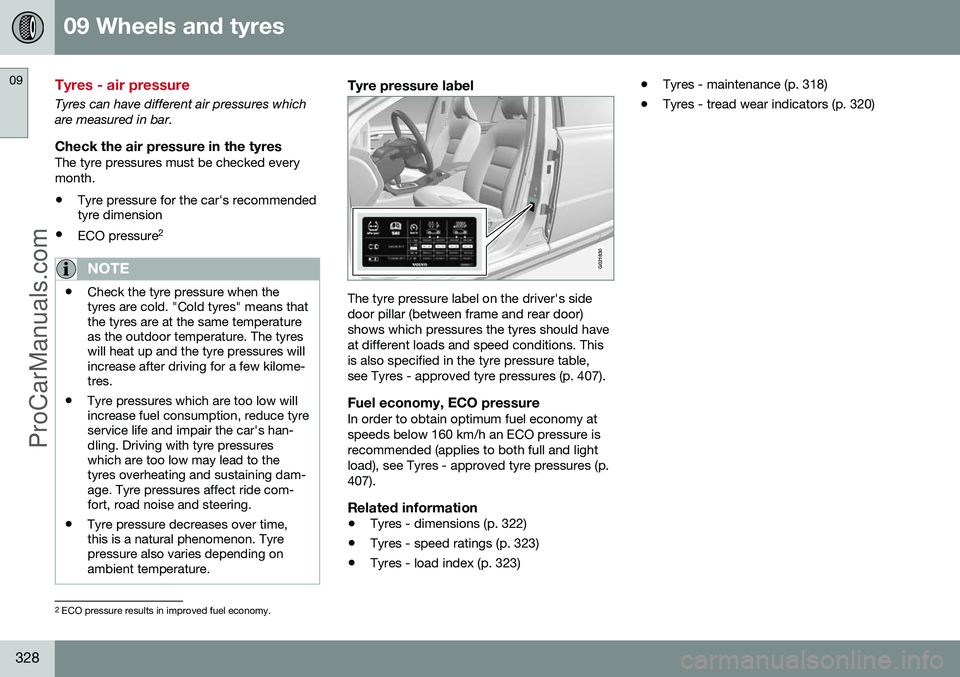
The tyre pressure label on the driver's side door pillar (between frame and rear door)shows which pressures the tyres should haveat different loads and speed conditions. Thisis also specified in the tyre pressure table,see Tyres - approved tyre pressures (p. 407).
Fuel economy, ECO pressureIn order to obtain optimum fuel economy atspeeds below 160 km/h an ECO pressure isrecommended (applies to both full and lightload), see Tyres - approved tyre pressures (p.407).
Related information
•
Tyres - dimensions (p. 322)
• Tyres - speed ratings (p. 323)
• Tyres - load index (p. 323) •
Tyres - maintenance (p. 318)
• Tyres - tread wear indicators (p. 320)
2
ECO pressure results in improved fuel economy.
ProCarManuals.co’
Page 332 of 442
09 Wheels and tyres
09
330* Option/accessory, for more information, see Introduction.
Tyre pressure monitoring*
Tyre pressure monitoring (TPMS) (Tyre Pressure Monitoring System) 3
warns the
driver when the pressure is too low in one or more of the car's tyres. Tyre pressure monitoring uses sensors located inside the air valve in each wheel.When the car is driven at about 40 km/h thesystem detects the tyre pressure. If the pres- sure is too low then a warning lamp
in the
combined instrument panel illuminates and a message is shown in the information display. Both factory-fitted and optional wheels can be equipped with TPMS sensors in thevalves. If wheels without TPMS sensors are used or if a sensor has failed then
Tyre press. syst
Service required will be shown.
Always check the system after changing a wheel in order to ensure that replacementwheels work with the system. For information on the correct tyre pressure, see Tyres - air pressure (p. 328). The system does not replace normal tyre maintenance.
IMPORTANT
If a fault should arise in the tyre pressure system a warning lamp
in the com-
bined instrument panel will illuminate and a message will be shown. This can be forvarious reasons, e.g. fitting a wheel notequipped with a sensor adapted for Vol-vo's tyre pressure monitoring system.
Related information
• Tyre pressure monitoring* - adjust (recali- bration) (p. 330)
• Tyre pressure monitoring* - rectifying lowtyre pressure (p. 331)
• Tyre pressure monitoring* - activate/deactivate (p. 331)
• Tyre pressure monitoring* - recommenda-tions (p. 332)
• Tyre pressure monitoring - driveablepunctured tyres* (p. 332)
Tyre pressure monitoring* - adjust (recalibration)
Tyre pressure monitoring (TPMS) (Tyre Pressure Monitoring System) 4
warns the
driver when the pressure is too low in one or more of the car's tyres. TPMS can be adjusted in order to follow Vol- vo's tyre pressure recommendations (p. 328),when driving with a heavy load for example.
NOTE
The engine must not be running when the tyres are calibrated.
The settings are made with the control in the centre console, see MY CAR (p. 103).
1. Inflate the tyres to the required pressure and select key position I or II.
2. Select the menu system MY CAR to open
the menus for tyre pressure.
3. Select
Calibrate tyre pressure.
4. Press OK.
5. Start the car and drive at least at 40 km/h for a total of at least 1 minute and check that the message disappears.
> Then the TPMS is recalibrated to thenew tyre pressure.
3Option only in certain markets.
4 Option only in certain markets.
ProCarManuals.co’
Page 342 of 442
10 Maintenance and service
10
340
Volvo service programme
To keep the car as safe and reliable as possi- ble, follow the Volvo service programme asspecified in the Service and Warranty Booklet. Volvo recommends engaging an authorised Volvo workshop to perform the service andmaintenance work. Volvo workshops have thepersonnel, special tools and service literatureto guarantee the highest quality of service.
IMPORTANT
For the Volvo warranty to apply, check and follow the instructions in the Service andWarranty Booklet.
Related information
•Climate control system - fault tracing and repair (p. 352)
ProCarManuals.co’
Page 343 of 442
10 Maintenance and service
10
}}
341
Raising the car
When raising the car it is important that the jack or lifting arms are fitted in the intendedpoints on the car's underbody.
NOTE
Volvo recommends only using the jack that belongs to the car model in question. If ajack is selected other than the one recom-mended by Volvo, follow the instructionssupplied with the equipment.
ProCarManuals.co’
Page 344 of 442
||
10 Maintenance and service
10
342
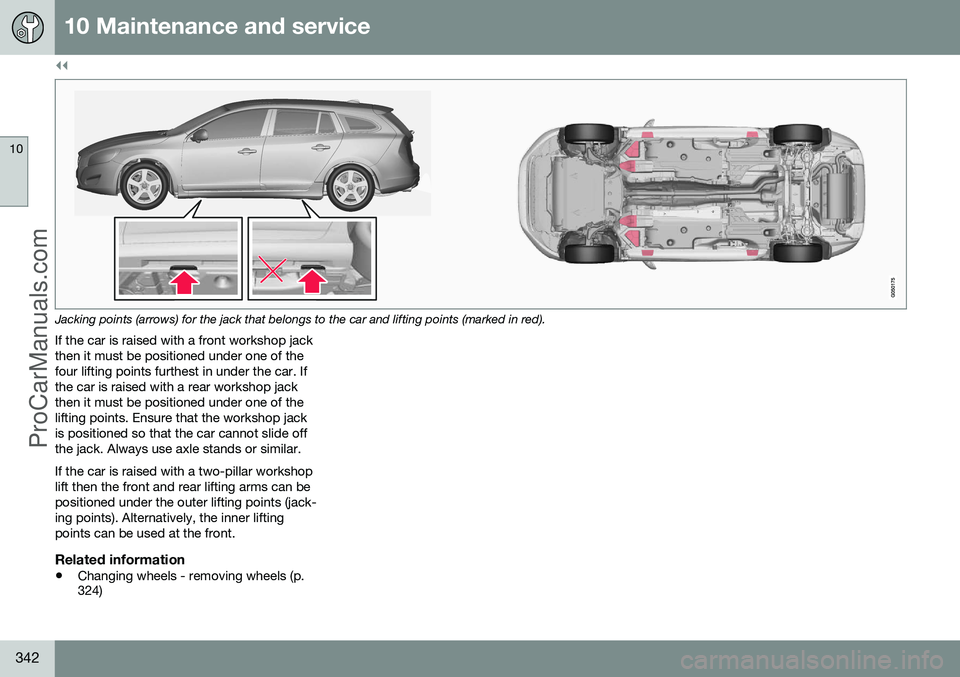
Jacking points (arrows) for the jack that belongs to the car and lifting points (marked in red).
If the car is raised with a front workshop jack then it must be positioned under one of thefour lifting points furthest in under the car. Ifthe car is raised with a rear workshop jackthen it must be positioned under one of thelifting points. Ensure that the workshop jackis positioned so that the car cannot slide offthe jack. Always use axle stands or similar. If the car is raised with a two-pillar workshop lift then the front and rear lifting arms can bepositioned under the outer lifting points (jack-ing points). Alternatively, the inner liftingpoints can be used at the front.
Related information
• Changing wheels - removing wheels (p. 324)
ProCarManuals.co’