key VOLVO V60 2014 Manual Online
[x] Cancel search | Manufacturer: VOLVO, Model Year: 2014, Model line: V60, Model: VOLVO V60 2014Pages: 442, PDF Size: 13.85 MB
Page 284 of 442
08 Starting and driving
08
282* Option/accessory, for more information, see Introduction.
Start/Stop* - the engine does not stop
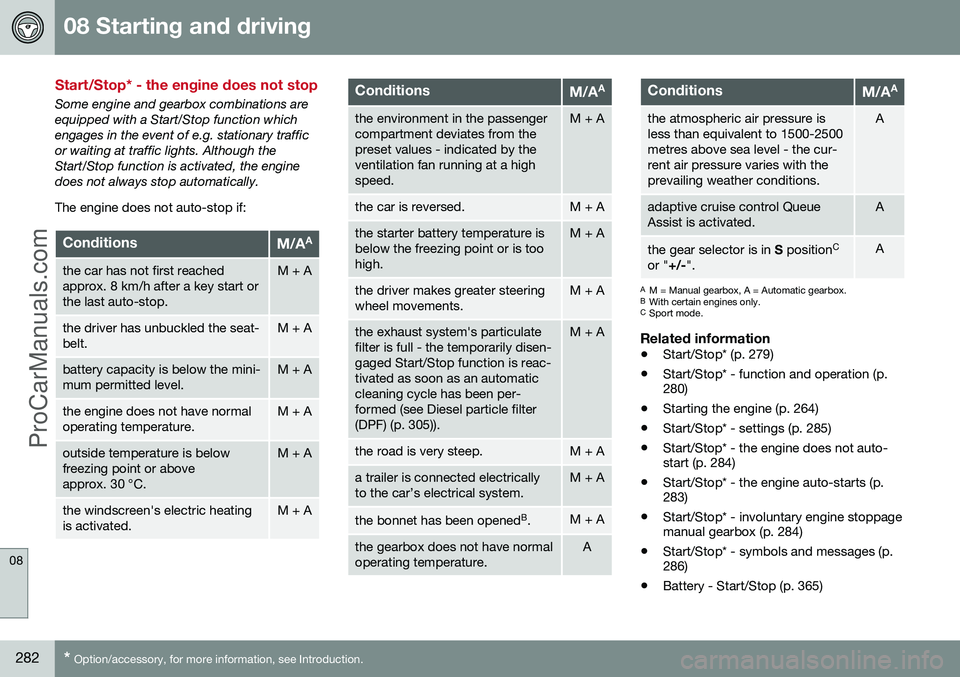
Some engine and gearbox combinations are equipped with a Start/Stop function whichengages in the event of e.g. stationary trafficor waiting at traffic lights. Although theStart/Stop function is activated, the enginedoes not always stop automatically. The engine does not auto-stop if:
ConditionsM/A A
the car has not first reached approx. 8 km/h after a key start orthe last auto-stop.M + A
the driver has unbuckled the seat- belt.M + A
battery capacity is below the mini- mum permitted level.M + A
the engine does not have normal operating temperature.M + A
outside temperature is below freezing point or aboveapprox. 30 °C.M + A
the windscreen's electric heating is activated.M + A
ConditionsM/AA
the environment in the passenger compartment deviates from thepreset values - indicated by theventilation fan running at a highspeed.M + A
the car is reversed.M + A
the starter battery temperature is below the freezing point or is toohigh.M + A
the driver makes greater steering wheel movements.M + A
the exhaust system's particulate filter is full - the temporarily disen-gaged Start/Stop function is reac-tivated as soon as an automaticcleaning cycle has been per-formed (see Diesel particle filter(DPF) (p. 305)).M + A
the road is very steep.M + A
a trailer is connected electrically to the car’s electrical system.M + A
the bonnet has been opened
B
.M + A
the gearbox does not have normal operating temperature.A
ConditionsM/A A
the atmospheric air pressure is less than equivalent to 1500-2500metres above sea level - the cur-rent air pressure varies with theprevailing weather conditions.A
adaptive cruise control Queue Assist is activated.A
the gear selector is in
S position C
or " +/-".A
A
M = Manual gearbox, A = Automatic gearbox.
B With certain engines only.
C Sport mode.
Related information
• Start/Stop* (p. 279)
• Start/Stop* - function and operation (p. 280)
• Starting the engine (p. 264)
• Start/Stop* - settings (p. 285)
• Start/Stop* - the engine does not auto-start (p. 284)
• Start/Stop* - the engine auto-starts (p.283)
• Start/Stop* - involuntary engine stoppagemanual gearbox (p. 284)
• Start/Stop* - symbols and messages (p.286)
• Battery - Start/Stop (p. 365)
ProCarManuals.co’
Page 296 of 442
||
08 Starting and driving
08
294
Disengaging the parking brake
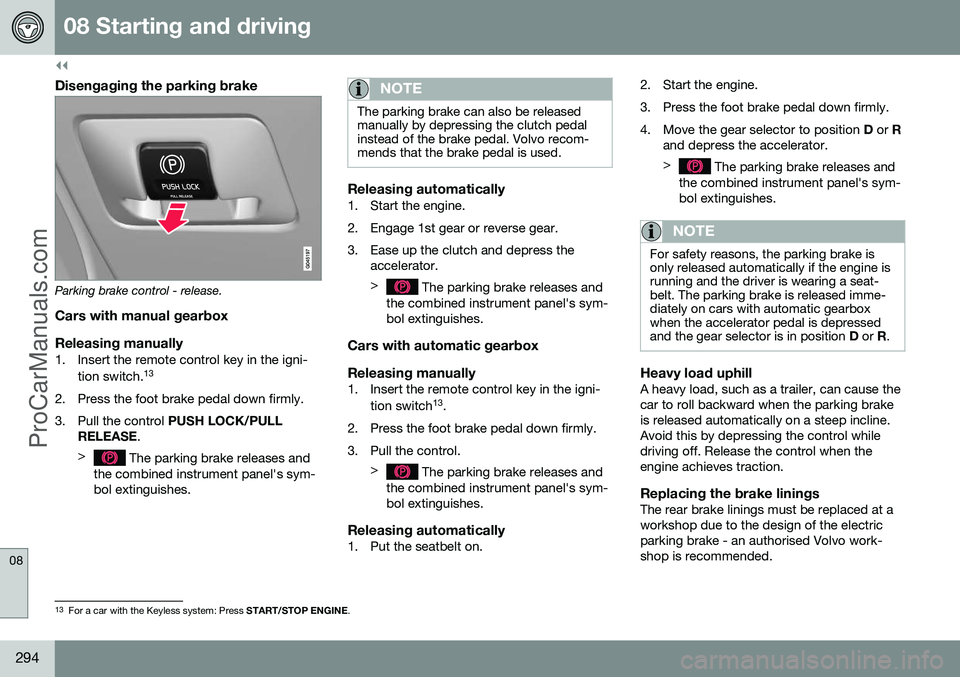
Parking brake control - release.
Cars with manual gearbox
Releasing manually
1. Insert the remote control key in the igni- tion switch. 13
2. Press the foot brake pedal down firmly.
3. Pull the control PUSH LOCK/PULL
RELEASE .
>
The parking brake releases and
the combined instrument panel's sym- bol extinguishes.
NOTE
The parking brake can also be released manually by depressing the clutch pedalinstead of the brake pedal. Volvo recom-mends that the brake pedal is used.
Releasing automatically1. Start the engine.
2. Engage 1st gear or reverse gear.
3. Ease up the clutch and depress the accelerator. >
The parking brake releases and
the combined instrument panel's sym- bol extinguishes.
Cars with automatic gearbox Releasing manually
1. Insert the remote control key in the igni-
tion switch 13
.
2. Press the foot brake pedal down firmly.
3. Pull the control. >
The parking brake releases and
the combined instrument panel's sym- bol extinguishes.
Releasing automatically1. Put the seatbelt on. 2. Start the engine.
3. Press the foot brake pedal down firmly.
4. Move the gear selector to position
D or R
and depress the accelerator. >
The parking brake releases and
the combined instrument panel's sym- bol extinguishes.
NOTE
For safety reasons, the parking brake is only released automatically if the engine isrunning and the driver is wearing a seat-belt. The parking brake is released imme-diately on cars with automatic gearboxwhen the accelerator pedal is depressedand the gear selector is in position D or R.
Heavy load uphillA heavy load, such as a trailer, can cause the car to roll backward when the parking brakeis released automatically on a steep incline.Avoid this by depressing the control whiledriving off. Release the control when theengine achieves traction.
Replacing the brake liningsThe rear brake linings must be replaced at aworkshop due to the design of the electricparking brake - an authorised Volvo work-shop is recommended.
13
For a car with the Keyless system: Press START/STOP ENGINE.
ProCarManuals.co’
Page 300 of 442
08 Starting and driving
08
298
speed for a few minutes in order to allow the gearbox to cool down.
• If the car overheats, the air conditioningmay be switched off temporarily.
• Do not turn the engine off immediatelyyou stop after a hard drive.
NOTE
It is normal for the engine's cooling fan to operate for a time after the engine hasbeen switched off.
Driving with open tailgate
When driving with the tailgate open, toxic exhaust fumes can be sucked into the carthrough the cargo area.
WARNING
Do not drive with an open tailgate! Toxic exhaust fumes could be drawn into the carthrough the cargo area.
Related information
•Loading (p. 142)
Overload - starter battery
The electrical functions in the car load the starter battery (p. 361) to varying degrees.Avoid using the key position (p. 70)
II when
the engine is switched off. Instead use the I
mode - which uses less power. Also, be aware of different accessories that load the electrical system. Do not use func-tions which use a lot of power when theengine is switched off. Examples of suchfunctions are: • ventilation fan
• headlamps
• windscreen wiper
• audio system (high volume).
If the starter battery voltage is low then the combined instrument panel's information dis- play shows the text
Low battery Power
save mode. The energy-saving function then
shuts down certain functions or reduces cer- tain functions such as the ventilation fanand/or audio system.
–In which case, charge the battery by star- ting the engine and then running it for atleast 15 minutes - starter battery chargingis more effective during driving than run-ning the engine at idling speed while sta-tionary.
ProCarManuals.co’
Page 304 of 442
08 Starting and driving
08
302
Fuel - petrol
Petrol is used as fuel. Petrol must fulfil the EN 228 standard. Most engines can be run with octane ratings of 95and 98 RON. Only in exceptional casesshould 91 RON be used.
• 95 RON can be used for normal driving.
• 98 RON is recommended for optimum performance and minimum fuel consump-tion.
When driving in temperatures above +38 °C, fuel with the highest possible octane rating isrecommended for optimum performance andfuel economy.
IMPORTANT
• Always refuel with unleaded petrol so as not to damage the catalytic con-verter.
• Do not use additives not recom-mended by Volvo.
Related information
•
Fuel - handling (p. 301)
• Economical driving (p. 305)
• Fuel consumption and CO2 emissions (p. 403)
• Fuel tank - volume (p. 402)
Fuel - diesel
Diesel is used as fuel. Only use diesel fuel from well-known produc- ers. Never use diesel of dubious quality. Die-sel should fulfil the EN 590 or JIS K2204standards. Diesel engines are sensitive tocontaminants in the fuel, such as excessivelyhigh volumes of sulphur particles for exam-ple. At low temperatures (-6 °C to -40 °C), a par- affin precipitate may form in the diesel fuel,which may lead to ignition problems. Specialdiesel fuel designed for low temperaturesaround freezing point is available from themajor oil companies. This fuel is less viscousat low temperatures and reduces the risk ofparaffin precipitate. The risk of condensation in the fuel tank is reduced if the tank is kept well filled. Whenrefuelling, check that the area around the fuelfiller pipe is clean. Avoid spilling fuel onto thepaintwork. Wash off any spillage with deter-gent and water.
IMPORTANT
Only ever use fuel that fulfils the European diesel standard. The sulphur content must be a maximum of 50 ppm.
IMPORTANT
Diesel type fuels that must not be used:
• Special additives
• Marine diesel fuel
• Heating oil
• FAME 15
(Fatty Acid Methyl Ester) and
vegetable oil.
These fuels do not fulfil the requirements in accordance with Volvo recommendationsand generate increased wear and enginedamage that is not covered by the Volvowarranty.
Empty tankThe design of the fuel system in a diesel engine means that if the vehicle runs out offuel, the tank may need to be vented in theworkshop in order to restart the engine afterfuelling. Once the engine has stopped due to fuel starvation, the fuel system needs a fewmoments to carry out a check. Do this beforestarting the engine, once the fuel tank hasbeen filled with diesel:
1. Insert the remote control key in the igni- tion switch and push it in to the end posi-
15Diesel fuel may contain a certain amount of FAME, but further amounts must not be added.
ProCarManuals.co’
Page 305 of 442
08 Starting and driving
08
303
tion, see Key positions (p. 70) for more information.
2. Press the START button without
depressing the brake and/or clutch pedal.
3. Wait approx. 1 minute.
4. To start the engine: Depress the brake and/or clutch pedal and then press the START button again.
NOTE
Before filling with fuel in the event of fuel shortage:
• Stop the car on as flat/level ground as possible - if the car is tilting there is arisk of air pockets in the fuel supply.
Draining condensation from the fuel filter
The fuel filter separates condensation from the fuel. Condensation can disrupt engineoperation. The fuel filter must be drained at the intervals specified in the Service and Warranty Bookletor if you suspect that the car has been filledwith contaminated fuel. For more information,see Volvo service programme (p. 340).
IMPORTANT
Certain special additives remove the water separation in the fuel filter.
Related information
•
Fuel - handling (p. 301)
• Diesel particle filter (DPF) (p. 305)
• Fuel consumption and CO2 emissions (p. 403)
Catalytic converters
The purpose of the catalytic converters is to purify exhaust gases. They are located closeto the engine so that operating temperature isreached quickly. The catalytic converters consist of a monolith (ceramic or metal) with channels. The channelwalls are lined with a thin layer of platinum/rhodium/palladium. These metals act as cata-lysts, i.e. they participate in and accelerate achemical reaction without being used upthemselves.
Lambda-sond TM
oxygen sensorThe Lambda-sond is part of a control systemintended to reduce emissions and improvefuel economy (see Fuel consumption andCO2 emissions (p. 403)). An oxygen sensor monitors the oxygen con- tent of the exhaust gases leaving the engine.This value is fed into an electronic systemthat continuously controls the injectors. Theratio of fuel to air directed to the engine iscontinuously adjusted. These adjustmentscreate optimal conditions for efficient com-bustion, and together with the three-way cat-alytic converter reduce harmful emissions(hydrocarbons, carbon monoxide and nitrousoxides).
ProCarManuals.co’
Page 311 of 442
08 Starting and driving
08
309
Towing bracket/Towbar
A towing bracket means that it is possible to e.g. tow a trailer behind the car. If the car is equipped with a detachable/ removable towbar, the installation instruc-tions for the loose section must be followedcarefully, see Detachable towbar - attach-ment/removal (p. 310).
WARNING
If the car is fitted with a Volvo detachable towbar:
• Follow the installation instructions carefully.
• The detachable section must belocked with the key before setting off.
• Check that the indicator windowshows green.
Important checks
•
The towbar's towball must be cleaned and greased regularly.
NOTE
When a hitch with a vibration damper is used, the towball must not be lubricated.
Related information
•
Driving with a trailer (p. 306)
Detachable towbar - storage
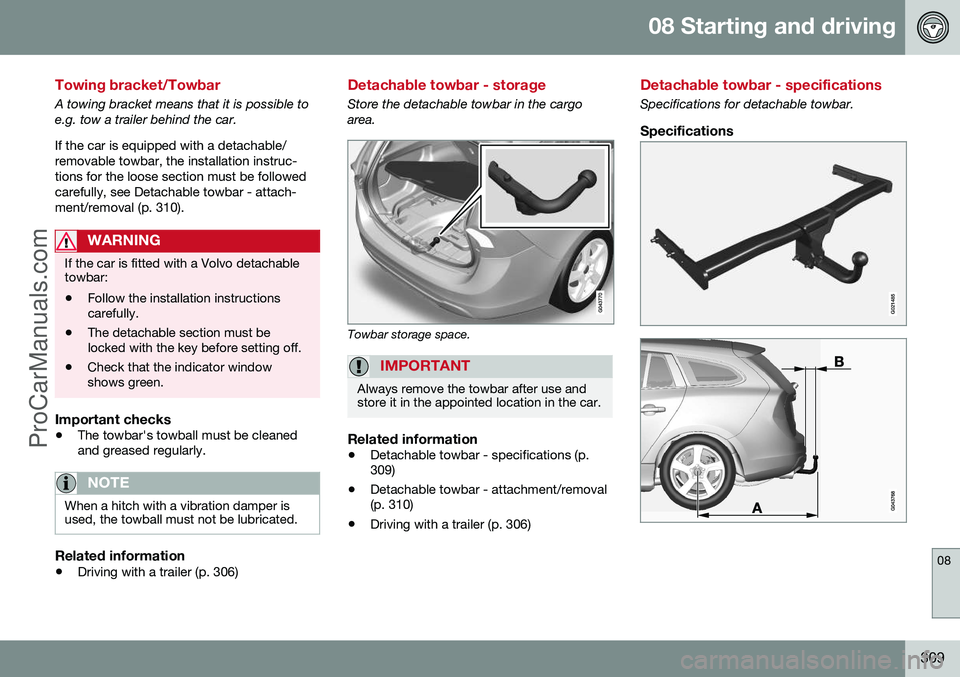
Store the detachable towbar in the cargo area.
Towbar storage space.
IMPORTANT
Always remove the towbar after use and store it in the appointed location in the car.
Related information
•Detachable towbar - specifications (p. 309)
• Detachable towbar - attachment/removal(p. 310)
• Driving with a trailer (p. 306)
Detachable towbar - specifications
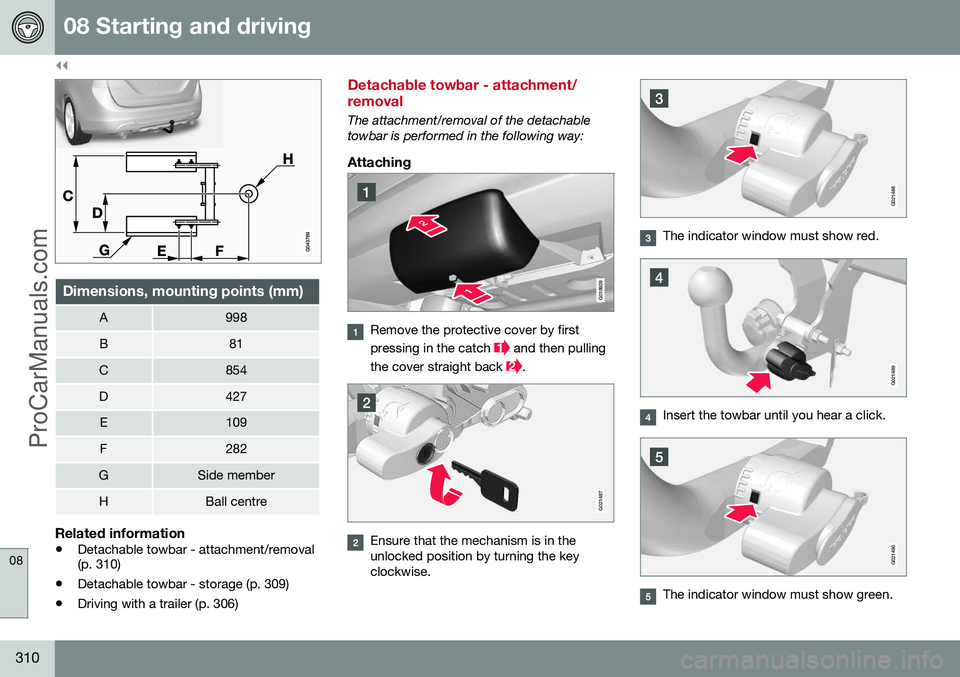
Specifications for detachable towbar.
Specifications
G021485
ProCarManuals.com
Page 312 of 442
||
08 Starting and driving
08
310
Dimensions, mounting points (mm)
A998
B81
C854
D427
E109
F282
GSide member
HBall centre
Related information
•Detachable towbar - attachment/removal (p. 310)
• Detachable towbar - storage (p. 309)
• Driving with a trailer (p. 306)
Detachable towbar - attachment/ removal
The attachment/removal of the detachable towbar is performed in the following way:
Attaching
G018928
Remove the protective cover by first pressing in the catch
and then pulling
the cover straight back
.
G021487
Ensure that the mechanism is in the unlocked position by turning the keyclockwise.
G021488
The indicator window must show red.
G021489
Insert the towbar until you hear a click.
G021490
The indicator window must show green.
ProCarManuals.co’
Page 313 of 442
08 Starting and driving
08
}}
311
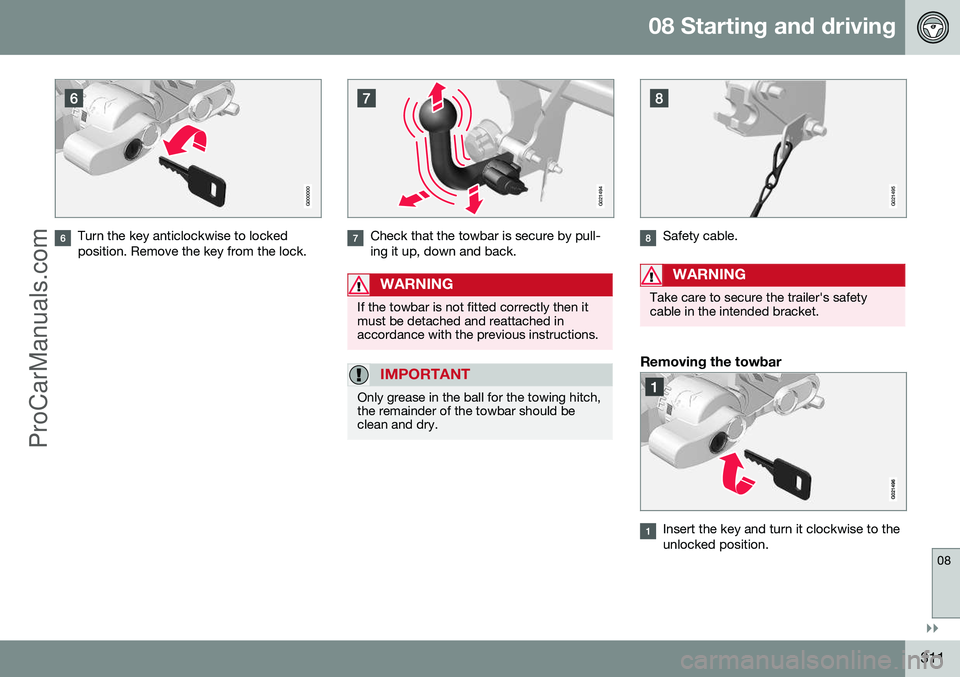
G000000
Turn the key anticlockwise to locked position. Remove the key from the lock.
G021494
Check that the towbar is secure by pull- ing it up, down and back.
WARNING
If the towbar is not fitted correctly then it must be detached and reattached inaccordance with the previous instructions.
IMPORTANT
Only grease in the ball for the towing hitch, the remainder of the towbar should beclean and dry.
G021495
Safety cable.
WARNING
Take care to secure the trailer's safety cable in the intended bracket.
Removing the towbar
Insert the key and turn it clockwise to the unlocked position.
ProCarManuals.co’
Page 315 of 442
08 Starting and driving
08
313
end up in the wrong lane or leave the car- riageway. The trailer stability assist continually monitors the car's movements, particularly lateralmovements. If snaking is detected, the frontwheels are individually braked. This serves tostabilise the car/trailer combination. This isoften enough to help the driver regain controlof the car. If snaking is not eliminated the first time the trailer stability assist comes into action, thecar/trailer combination is braked with allwheels and engine power is reduced. Oncesnaking has been gradually suppressed andthe car/trailer combination is stable onceagain, the system stops regulating and thedriver once again has full control of the car.For more information, see Stability and trac-tion control system (DSTC) - operation (p.176)
MiscellaneousThe trailer stability assist can engage withinthe speed interval 60-160 km/h.
NOTE
TSA function is switched off if the driver selects Sport mode, see Stability and
traction control system (DSTC) (p. 175).
The trailer stability assist may fail to engage if the driver uses sudden steering wheel move-ments to try to rectify the snaking because in such a situation the system cannot determinewhether it is the trailer or the driver that iscausing the snaking.
When the trailer stability assist isworking, the combined instrument
panel's DSTC symbol flashes.
Related information
•Stability and traction control system (DSTC) - symbols and messages (p. 178)
Towing
During towing, one vehicle is towed by another vehicle using a tow rope.
IMPORTANT
Note that the car must always be towed with the wheels rolling forward. Do not tow the vehicle at speeds higher than 80 km/h or for distances in excess of80 km.
Find out the statutory maximum speed limit for towing before towing begins.
1. Unlock the steering lock by inserting the
remote control key in the ignition switch and giving a long press on the START/
STOP ENGINE button - key position II is
activated, see Key positions (p. 70) formore information about key positions.
2. The remote control key must remain in the ignition switch while the car is beingtowed.
3. Keep the towline taut when the towing vehicle reduces speed by holding yourfoot gently pressed on the brake pedal -thereby avoiding unnecessary jerking.
4. Be prepared to brake to stop.
ProCarManuals.co’
Page 316 of 442
||
08 Starting and driving
08
314
WARNING
•Check that the steering lock is unlocked before towing.
• The remote control key must be in keyposition
II - in position I all airbags are
deactivated.
• Never remove the remote control keyfrom the ignition switch when the caris being towed.
WARNING
The brake servo and power steering do not work when the engine is switched off - thebrake pedal needs to be depressedabout 5 times more heavily and the steer-ing is considerably heavier than normal.
Manual gearboxPrior to towing:
–Move gear lever into neutral and release the parking brake.
Automatic gearbox GeartronicPrior to towing:
–Move the gear selector to position
N and
release the parking brake.
Automatic gearbox PowershiftThe model with Powershift transmission should not be towed as it is dependent on theengine running in order to receive sufficient lubrication. If towing still has to take place,the route must be as short as possible andthen with very low speed. In the event of uncertainty as to whether or not the car is equipped with Powershift trans-mission, this can be verified by checking thedesignation on the gearbox label under thebonnet, see Type designations (p. 386). Thedesignation ”MPS6” means that it isPowershift transmission - otherwise it isGeartronic automatic transmission.
IMPORTANT
Avoid towing.
• However, the car can be towed for a short distance at low speed to move itfrom a dangerous position - not furtherthan 10 km and not faster than10 km/h. Note that the car mustalways be towed with the wheels roll-ing forward.
• In the event of moving a longer dis-tance than 10 km, the car must betransported with the drive wheelsraised from the road - professionalrecovery is recommended.
Prior to towing:
–Move the gear selector to position
N and
release the parking brake.
Jump startingDo not tow the car to bump start the engine. Use a donor battery if the battery is dis-charged and the engine does not start, seeJump starting with battery (p. 270).
IMPORTANT
The catalytic converter may be damaged during attempts to tow-start the engine.
Related information
• Towing eye (p. 315)
ProCarManuals.co’