Eco VOLVO V60 2017 Owner´s Manual
[x] Cancel search | Manufacturer: VOLVO, Model Year: 2017, Model line: V60, Model: VOLVO V60 2017Pages: 406, PDF Size: 9.65 MB
Page 49 of 406
SAFETY
}}
47
Crash mode – moving the vehicle
If the message
Normal mode appears after an
attempt has been made to start the engine, Star- ting the vehicle after a crash (p. 46), the vehiclemay be moved carefully from its present position,if for example, it is blocking traffic. It should,however, not be moved farther than is absolutelynecessary.
WARNING
Even if the vehicle appears to be drivable after Crash mode has been set, it should not bedriven or towed (pulled by another vehicle).There may be concealed damage that couldmake it difficult or impossible to control. Thevehicle should be transported on a flatbedtow truck to a trained and qualified Volvoservice technician for inspection/repairs.
Related information
• Crash mode – general information (p. 45)
Child safety
Children should always be seated safely when traveling in the vehicle.
General informationVolvo recommends the proper use of restraint systems (p. 49) for all occupants including chil-dren. Remember that, regardless of age and size,a child should always be properly restrained in avehicle. Your vehicle is also equipped with ISOFIX/ LATCH attachments (p. 56), which make itmore convenient to install child seats. Some restraint systems for children are designed to be secured in the vehicle by lap belts or thelap portion of a lap-shoulder belt. Such childrestraint systems can help protect children invehicles in the event of an accident only if theyare used properly. However, children could beendangered in a crash if the child restraints arenot properly secured in the vehicle. Failure to fol-low the installation instructions for your childrestraint can result in your child striking the vehi-cle's interior in a sudden stop. Holding a child in your arms is NOT a suitable substitute for a child restraint system. In an acci-dent, a child held in a person's arms can becrushed between the vehicle's interior and anunrestrained person. The child could also beinjured by striking the interior, or by being ejectedfrom the vehicle during a sudden maneuver or impact. The same can also happen if the infant orchild rides unrestrained on the seat. Other occu-pants should also be properly restrained to helpreduce the chance of injuring or increasing theinjury of a child. All states and provinces have legislation govern- ing how and where children should be carried ina vehicle. Find out the regulations existing in yourstate or province. Recent accident statistics haveshown that children are safer in rear seatingpositions than front seating positions when prop-erly restrained. A child restraint system can helpprotect a child in a vehicle. Here's what to lookfor when selecting a child restraint system: It should have a label certifying that it meets applicable Federal Motor Vehicle Safety Stand-ards (FMVSS 213) – or in Canada, CMVSS 213. Make sure the child restraint system is approved for the child's height, weight and development –the label required by the standard or regulation,or instructions for infant restraints, typically pro-vide this information. In using any child restraint system, we urge you to carefully look over the instructions that areprovided with the restraint. Be sure you under-stand them and can use the device properly andsafely in this vehicle. A misused child restraintsystem can result in increased injuries for boththe infant or child and other occupants in thevehicle.
Page 50 of 406
||
SAFETY
48When a child has outgrown the child safety seat, you should use the rear seat with the standardseat belt fastened. The best way to help protectthe child here is to place the child on a cushionso that the seat belt is properly located on thehips (see Booster cushions (p. 55) for illustra-tion). Legislation in your state or province maymandate the use of a child seat or cushion incombination with the seat belt, depending on thechild's age and/or size. Please check local regu-lations. A specially designed and tested booster cushion and backrest can be obtained from your Volvoretailer. See also Booster cushions (p. 55)
WARNING
•
Do not use child safety seats or child booster cushions/backrests in the frontpassenger's seat. We also recommendthat children under 4 feet 7 inches(140 cm) in height who have outgrownthese devices sit in the rear seat with theseat belt fastened.
• Sedan models: Keep vehicle doors andtrunk locked and keep remote controlsout of a child
Page 52 of 406
||
SAFETY
50
WARNING
•When not in use, keep the child restraint system secured or remove it from thepassenger compartment to help prevent itfrom injuring passengers in the event of asudden stop or collision.
• A small child's head represents a consid-erable part of its total weight and its neckis still very weak. Volvo recommends thatchildren up to age 4 travel, properlyrestrained, facing rearward. In addition,Volvo recommends that children shouldride rearward facing, properly restrained,as long as possible.
Automatic Locking Retractor/ Emergency Locking Retractor (ALR/ELR)
To make child seat installation easier, each seat belt (except for the driver's belt) is equipped witha locking mechanism to help keep the seat belttaut.
When attaching the seat belt to a child seat:
1. Attach the seat belt to the child seat accord-
ing to the child seat manufacturer's instruc- tions.
2. Pull the seat belt out as far as possible.
3. Insert the seat belt latch plate into the buckle (lock) in the usual way.
4. Release the seat belt and pull it taut around the child seat. A sound from the seat belt retractor will be audi- ble at this time and is normal. The belt will nowbe locked in place. This function is automaticallydisabled when the seat belt is unlocked and thebelt is fully retracted.
WARNING
Do not use child safety seats or child booster cushions/backrests in the front passenger'sseat. We also recommend that children whohave outgrown these devices sit in the rearseat with the seat belt properly fastened.
Child restraint registration and recallsChild restraints could be recalled for safety rea- sons. You must register your child restraint to bereached in a recall. To stay informed about childsafety seat recalls, be sure to fill out and returnthe registration card that comes with new childrestraints. Child restraint recall information is readily availa- ble in both the U.S. and Canada. For recall infor-mation in the U.S., call the U.S. Government'sAuto Safety Hotline at 1-800-424-9393 or go tohttp://www-odi.nhtsa.dot.gov/cars/problems/recalls/register/childseat/index.cfm. In Canada,visit Transport Canada's Child Safety website athttp://www.tc.gc.ca/roadsafety/childsafety/menu.htm.
Related information
•
Child safety locks (p. 63)
• Integrated booster cushion – general infor-mation (p. 59)
Page 55 of 406
SAFETY
}}
53
WARNING
It should not be possible to move the child restraint (child seat) more than 1 in. (2.5 cm)in any direction along the seat belt path.
The infant seat can be removed by unbuckling the seat belt and letting it retract completely.
Related information
• Child safety (p. 47)
• Child restraints (p. 49)
• Convertible seats (p. 53)
• Integrated booster cushion – general infor-mation (p. 59)
• ISOFIX/LATCH lower anchors (p. 56)
• Top tether anchors (p. 58)
Convertible seats
Suitable child restraints should always be used when children (depending on their age/size) areseated in the vehicle.
Securing a convertible seat with a seat belt
G018630
Do not place the convertible seat in the front passeng- er's seat
NOTE
Refer to (p. 56) and (p. 58) for information on securing a child restraint using ISOFIX/LATCH lower anchors and/or top tetheranchorages.
Convertible seats can be used in either a forward or rearward-facing position, depending on theage and size of the child.
G022847
Route the seat belt through the convertible seat
WARNING
Always use a convertible seat that is suitable for the child's age and size. See the converti-ble seat manufacturer's recommendations.
1. Place the convertible seat in the rear seat of the vehicle.
Page 56 of 406
||
SAFETY
54
WARNING
•A small child's head represents a consider- able part of its total weight and its neck isstill very weak. Volvo recommends thatchildren up to age 4 travel, properlyrestrained, facing rearward. In addition,Volvo recommends that children shouldride rearward facing, properly restrained, aslong as possible.
• Convertible child seats should be installedin the rear seat only.
• A rear-facing convertible seat should notbe positioned behind the driver's seatunless there is adequate space for safeinstallation.
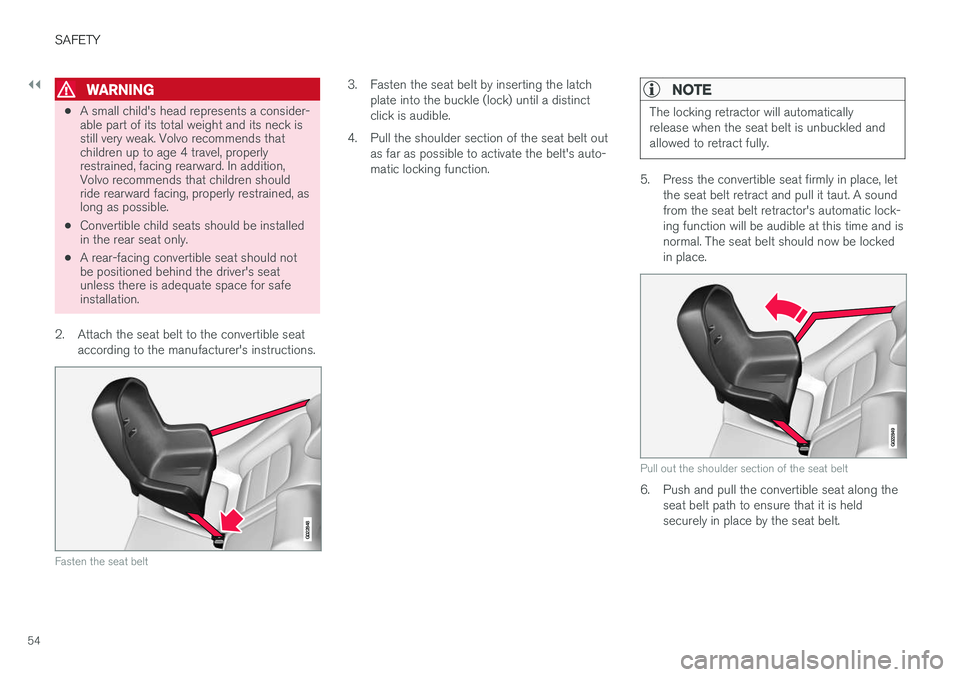
2. Attach the seat belt to the convertible seat according to the manufacturer's instructions.
G022848
Fasten the seat belt
3. Fasten the seat belt by inserting the latchplate into the buckle (lock) until a distinct click is audible.
4. Pull the shoulder section of the seat belt out as far as possible to activate the belt's auto-matic locking function.NOTE
The locking retractor will automatically release when the seat belt is unbuckled andallowed to retract fully.
5. Press the convertible seat firmly in place, let the seat belt retract and pull it taut. A sound from the seat belt retractor's automatic lock-ing function will be audible at this time and isnormal. The seat belt should now be lockedin place.
G022849
Pull out the shoulder section of the seat belt
6. Push and pull the convertible seat along theseat belt path to ensure that it is held securely in place by the seat belt.
Page 57 of 406
SAFETY
}}
55
WARNING
It should not be possible to move the child restraint (child seat) more than 1 in. (2.5 cm)in any direction along the seat belt path.
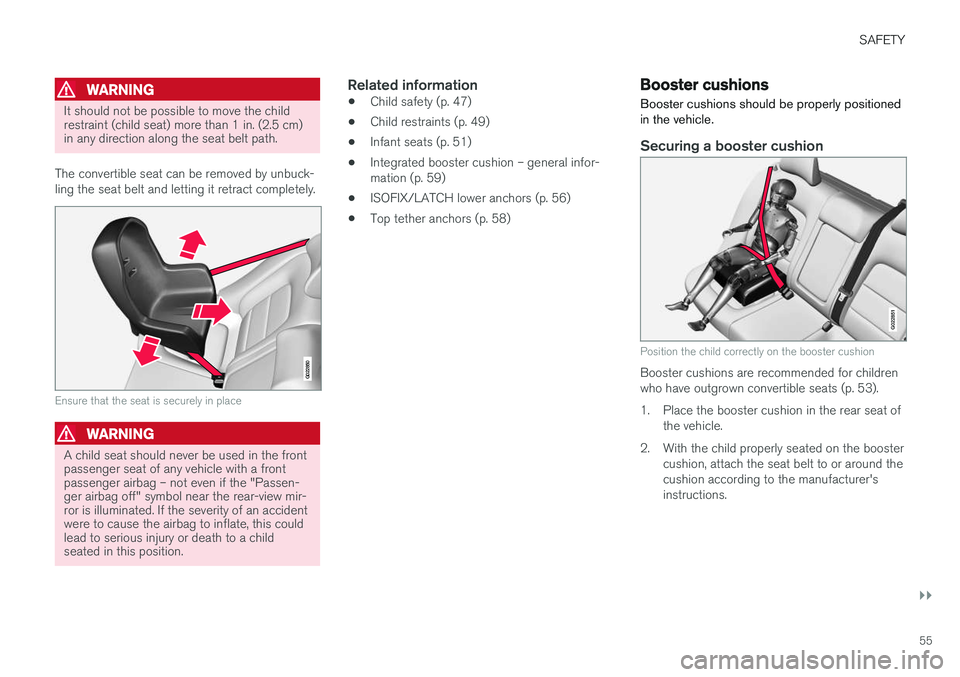
The convertible seat can be removed by unbuck- ling the seat belt and letting it retract completely.
G022850
Ensure that the seat is securely in place
WARNING
A child seat should never be used in the front passenger seat of any vehicle with a frontpassenger airbag – not even if the "Passen-ger airbag off" symbol near the rear-view mir-ror is illuminated. If the severity of an accidentwere to cause the airbag to inflate, this couldlead to serious injury or death to a childseated in this position.
Related information
• Child safety (p. 47)
• Child restraints (p. 49)
• Infant seats (p. 51)
• Integrated booster cushion – general infor- mation (p. 59)
• ISOFIX/LATCH lower anchors (p. 56)
• Top tether anchors (p. 58)
Booster cushions
Booster cushions should be properly positioned in the vehicle.
Securing a booster cushion
G022851
Position the child correctly on the booster cushion
Booster cushions are recommended for children who have outgrown convertible seats (p. 53).
1. Place the booster cushion in the rear seat of the vehicle.
2. With the child properly seated on the booster cushion, attach the seat belt to or around the cushion according to the manufacturer'sinstructions.
Page 60 of 406
SAFETY
58
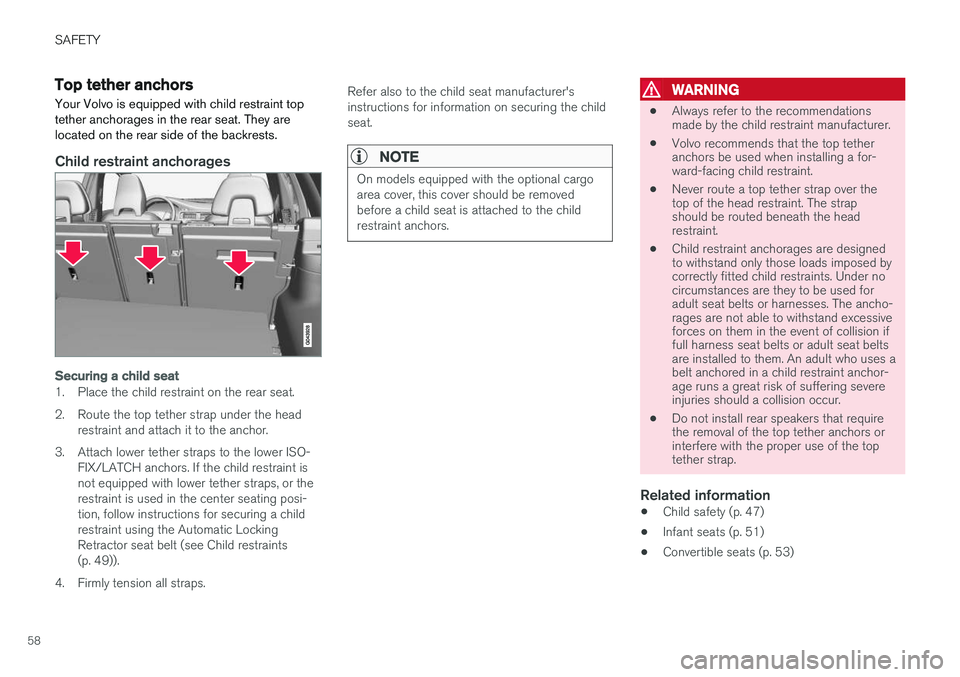
Top tether anchorsYour Volvo is equipped with child restraint top tether anchorages in the rear seat. They arelocated on the rear side of the backrests.
Child restraint anchorages
Securing a child seat
1. Place the child restraint on the rear seat.
2. Route the top tether strap under the head restraint and attach it to the anchor.
3. Attach lower tether straps to the lower ISO- FIX/LATCH anchors. If the child restraint is not equipped with lower tether straps, or therestraint is used in the center seating posi-tion, follow instructions for securing a childrestraint using the Automatic LockingRetractor seat belt (see Child restraints(p. 49)).
4. Firmly tension all straps. Refer also to the child seat manufacturer'sinstructions for information on securing the childseat.
NOTE
On models equipped with the optional cargo area cover, this cover should be removedbefore a child seat is attached to the childrestraint anchors.
WARNING
•
Always refer to the recommendations made by the child restraint manufacturer.
• Volvo recommends that the top tetheranchors be used when installing a for-ward-facing child restraint.
• Never route a top tether strap over thetop of the head restraint. The strapshould be routed beneath the headrestraint.
• Child restraint anchorages are designedto withstand only those loads imposed bycorrectly fitted child restraints. Under nocircumstances are they to be used foradult seat belts or harnesses. The ancho-rages are not able to withstand excessiveforces on them in the event of collision iffull harness seat belts or adult seat beltsare installed to them. An adult who uses abelt anchored in a child restraint anchor-age runs a great risk of suffering severeinjuries should a collision occur.
• Do not install rear speakers that requirethe removal of the top tether anchors orinterfere with the proper use of the toptether strap.
Related information
•Child safety (p. 47)
• Infant seats (p. 51)
• Convertible seats (p. 53)
Page 61 of 406
SAFETY
}}
59
•
Integrated booster cushion – general infor- mation (p. 59)
• ISOFIX/LATCH lower anchors (p. 56)
Integrated booster cushion – general information
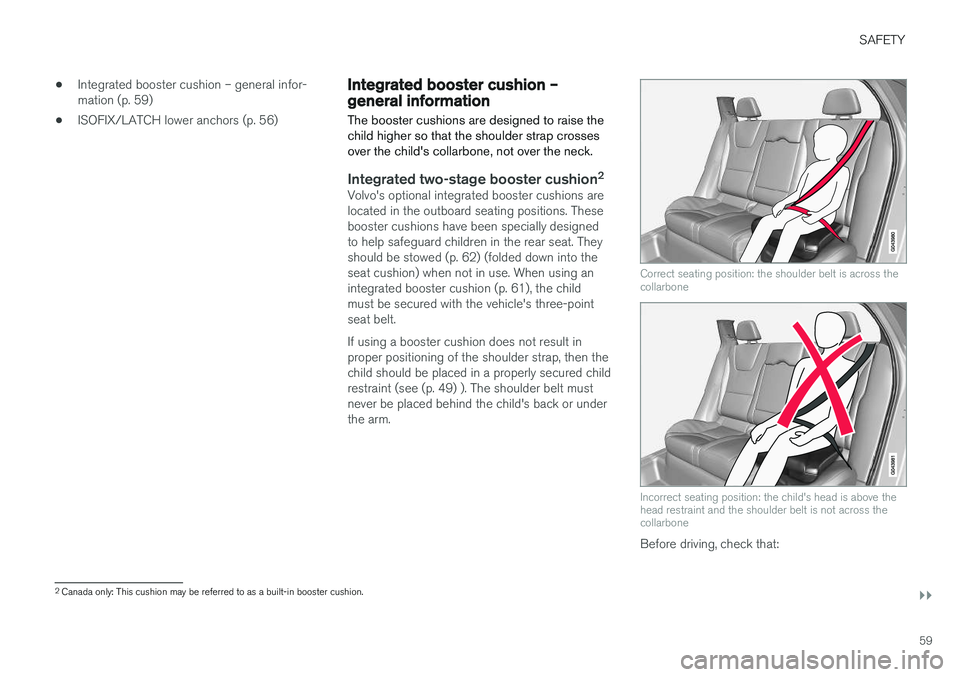
The booster cushions are designed to raise the child higher so that the shoulder strap crossesover the child's collarbone, not over the neck.
Integrated two-stage booster cushion 2Volvo's optional integrated booster cushions are located in the outboard seating positions. Thesebooster cushions have been specially designedto help safeguard children in the rear seat. Theyshould be stowed (p. 62) (folded down into theseat cushion) when not in use. When using anintegrated booster cushion (p. 61), the childmust be secured with the vehicle's three-pointseat belt. If using a booster cushion does not result in proper positioning of the shoulder strap, then thechild should be placed in a properly secured childrestraint (see (p. 49) ). The shoulder belt mustnever be placed behind the child's back or underthe arm.
Correct seating position: the shoulder belt is across the collarbone
Incorrect seating position: the child's head is above the head restraint and the shoulder belt is not across thecollarbone
Before driving, check that:
2
Canada only: This cushion may be referred to as a built-in booster cushion.
Page 70 of 406
||
INSTRUMENTS AND CONTROLS
* Option/accessory, for more information, see Introduction.
68
FunctionSee
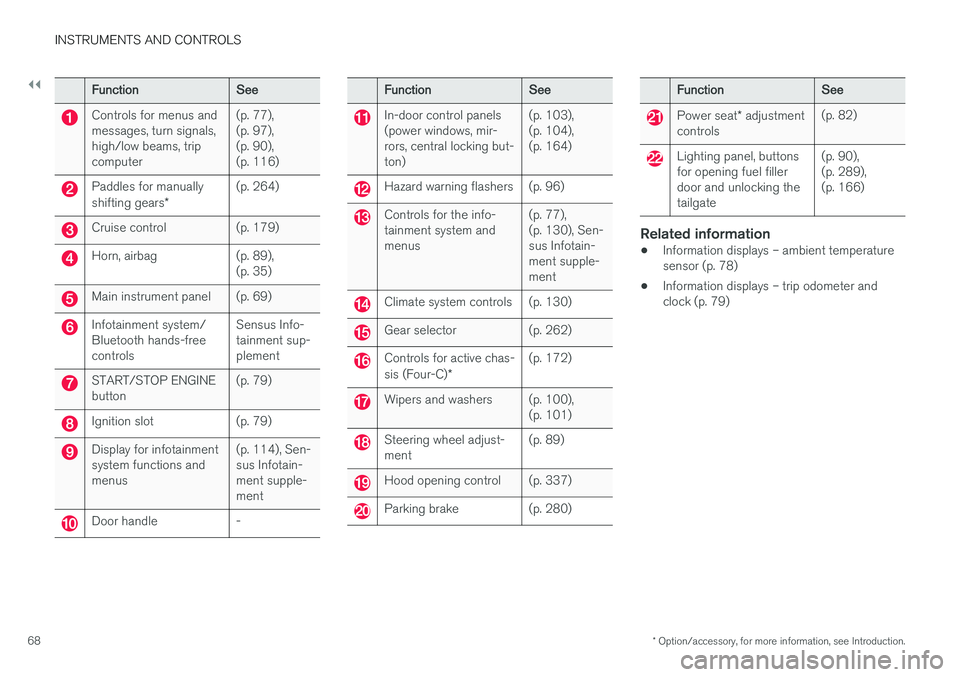
Controls for menus and messages, turn signals,high/low beams, tripcomputer(p. 77), (p. 97),(p. 90),(p. 116)
Paddles for manually shifting gears *(p. 264)
Cruise control(p. 179)
Horn, airbag(p. 89), (p. 35)
Main instrument panel(p. 69)
Infotainment system/ Bluetooth hands-freecontrolsSensus Info- tainment sup-plement
START/STOP ENGINE button(p. 79)
Ignition slot(p. 79)
Display for infotainment system functions andmenus(p. 114), Sen- sus Infotain-ment supple-ment
Door handle-
FunctionSee
In-door control panels (power windows, mir-rors, central locking but-ton)(p. 103), (p. 104),(p. 164)
Hazard warning flashers(p. 96)
Controls for the info- tainment system andmenus(p. 77), (p. 130), Sen-sus Infotain-ment supple-ment
Climate system controls(p. 130)
Gear selector(p. 262)
Controls for active chas- sis (Four-C)*(p. 172)
Wipers and washers(p. 100), (p. 101)
Steering wheel adjust- ment(p. 89)
Hood opening control(p. 337)
Parking brake(p. 280)
FunctionSee
Power seat* adjustment
controls(p. 82)
Lighting panel, buttons for opening fuel fillerdoor and unlocking thetailgate(p. 90), (p. 289),(p. 166)
Related information
• Information displays – ambient temperature sensor (p. 78)
• Information displays – trip odometer andclock (p. 79)
Page 71 of 406
INSTRUMENTS AND CONTROLS
}}
* Option/accessory, for more information, see Introduction.69
Information displays – introduction
The displays show information on some of the vehicle's functions, such as cruise control, thetrip computer and messages. The information isshown with text and symbols.
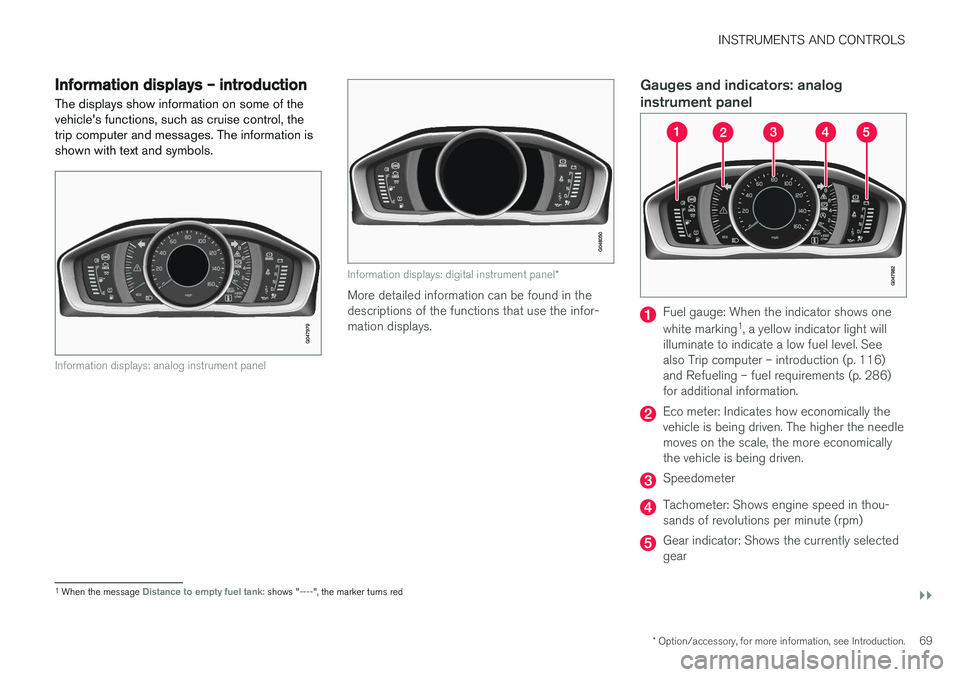
Information displays: analog instrument panel
Information displays: digital instrument panel *
More detailed information can be found in the descriptions of the functions that use the infor-mation displays.
Gauges and indicators: analog instrument panel
Fuel gauge: When the indicator shows one white marking1
, a yellow indicator light will
illuminate to indicate a low fuel level. See also Trip computer – introduction (p. 116)and Refueling – fuel requirements (p. 286)for additional information.
Eco meter: Indicates how economically the vehicle is being driven. The higher the needlemoves on the scale, the more economicallythe vehicle is being driven.
Speedometer
Tachometer: Shows engine speed in thou- sands of revolutions per minute (rpm)
Gear indicator: Shows the currently selected gear
1 When the message Distance to empty fuel tank: shows "----", the marker turns red