ad blue VOLVO V60 2021 Owners Manual
[x] Cancel search | Manufacturer: VOLVO, Model Year: 2021, Model line: V60, Model: VOLVO V60 2021Pages: 661, PDF Size: 12.68 MB
Page 12 of 661
10
AUDIO, MEDIA AND INTERNET
Audio, media and Internet448
Sound settings 448
Sound experience *
449
Apps 450
Download apps 451
Updating apps 451
Deleting apps 452
Radio 452
Starting the radio 453
Changing waveband and radio station 454
Searching for a radio station 454
Storing radio channels in the Radio favorites app 455
Radio settings 456
RBDS 456
HD Radio ™
457
Activating and deactivating the HDRadio ™ 458
HD Radio ™ sub-channels
459
HD Radio ™ limitations
459
SiriusXM ®
Satellite radio *
460
Using SiriusXM ®
Satellite radio *
461
Settings for SiriusXM ®
Satellite radio *
463
SiriusXM Travel Link ®
* 464
SiriusXM Travel Link ®
* - Weather
465
SiriusXM Travel Link ®
* - Notifications
467
SiriusXM Travel Link ®
* - Fuel
467
SiriusXM Travel Link ®
* - Sports
469
Media player 469
Playing media 470
Controlling and changing media 471
Media searches 472
Gracenote ®
473
Video 474
Playing video 474
Playing DivX ®
474
Video settings 475
Streaming media via Bluetooth ®
475
Connecting a device via Bluetooth ®
475
Playing media via the USB port 476
Connecting a device via the USB port 476
Technical specifications for USB devices 477
Compatible file formats for media 477
Apple ®
CarPlay ®
* 478
Using Apple ®
CarPlay ®
* 479
Settings for Apple ®
CarPlay ®
* 481
Tips for using Apple ®
CarPlay ®
* 481
Android Auto *
482
Using Android Auto*
483
Settings for Android Auto *
484
Tips for using Android Auto *
484
Phone 485
Connecting a phone to the car via Bluetooth for the first time 486
Connecting a phone to the car viaBluetooth automatically 488
Connecting a phone to the car viaBluetooth manually 488
Disconnecting a Bluetooth-con-nected phone 488
Switch between phones con-nected via Bluetooth 489
Disconnecting Bluetooth-con-nected devices 489
Handling phone calls 489
Handling text messages 490
Text message settings 491
Managing the phone book 492
Phone settings 492
Settings for Bluetooth devices 493
Wireless phone charger *
494
Using the wireless phone charger *
494
Certificate for wireless charger 496
Internet-connected vehicle *
500
Page 13 of 661
11
Connecting the vehicle to the Internet via a Bluetooth-connectedphone501
Connecting the vehicle to theInternet via a phone (Wi-Fi) 501
Connecting the vehicle to theInternet via vehicle modem (SIM card) 502
Vehicle modem settings 503
Sharing Internet from the vehiclevia Wi-Fi hotspot (tethering) 504
No or poor Internet connection 505
Deleting Wi-Fi networks 505
Wi-Fi technology and security 506
Terms of use and data sharing 506
Activating and deactivating datasharing 507
Data sharing for services 507
Hard disk storage space 508
License agreement for audio andmedia 509
WHEELS AND TIRES
Tires
520
Tire direction of rotation 522
Tread wear indicator 523
Tire terminology 523
Tire sidewall designations 524
Uniform Tire Quality Grading 526
Checking tire pressure 527
Adjusting tire pressure 528
Recommended tire pressure 529
Tire pressure monitoring system *
529
Saving new reference values for tire inflation pressure monitoring *531
Viewing tire pressure status in thecenter display * 532
Action when warned of low tire pressure 533
Tire inflation pressure monitoring system * messages 534
Changing a wheel 534
Tool kit 536
Jack *
537
Wheel bolts 537
Spare wheel 538
Handling the spare wheel 539
Snow tires 540
Snow chains 541
Tire sealing system542
Using the tire sealing system 543
Inflate tires with the compressor included in the tire sealing system 546
Determining the vehicle's permit-ted weight 547
Page 24 of 661
||
OWNER'S INFORMATION
* Option/accessory.
22
Option/accessoryIn addition to standard equipment, the Owner's Manual also describes options (fac-tory-installed equipment) and certain accesso-ries (extra retrofitted equipment). All, at the time of publication known, options and accessories are marked with an asterisk: * .
The equipment described in the Owner's Man- ual is not available in all vehicles. Vehicles maybe equipped differently depending on marketrequirements and national or local laws andregulations. For more information on which equipment is standard and which is an option or accessory,please contact your Volvo retailer.
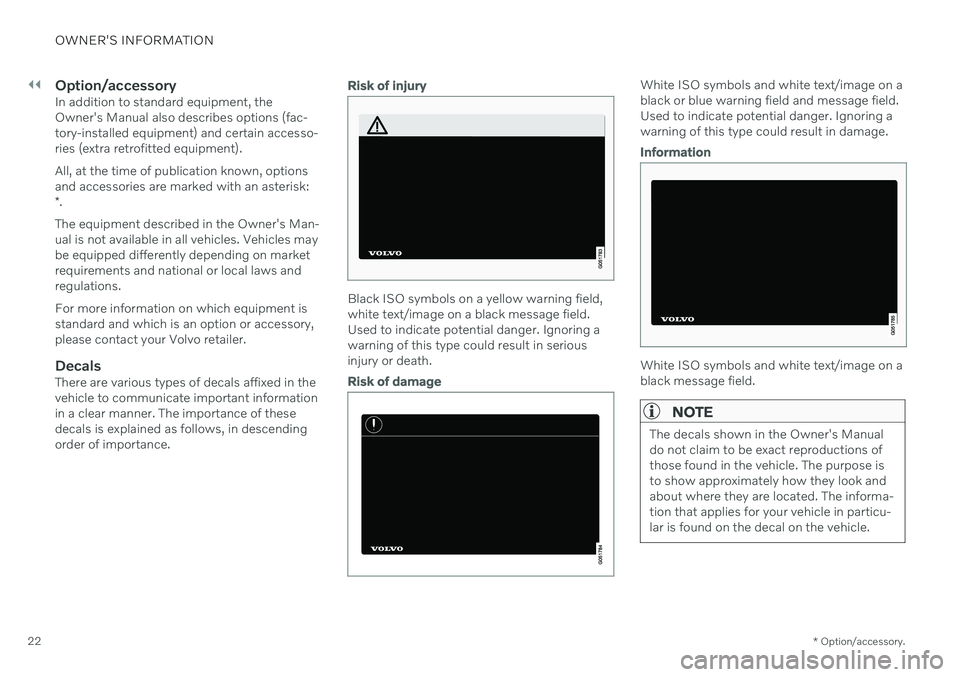
DecalsThere are various types of decals affixed in thevehicle to communicate important informationin a clear manner. The importance of thesedecals is explained as follows, in descendingorder of importance.
Risk of injury
Black ISO symbols on a yellow warning field, white text/image on a black message field.Used to indicate potential danger. Ignoring awarning of this type could result in seriousinjury or death.
Risk of damage
White ISO symbols and white text/image on a black or blue warning field and message field.Used to indicate potential danger. Ignoring awarning of this type could result in damage.
Information
White ISO symbols and white text/image on a black message field.
NOTE
The decals shown in the Owner's Manual do not claim to be exact reproductions ofthose found in the vehicle. The purpose isto show approximately how they look andabout where they are located. The informa-tion that applies for your vehicle in particu-lar is found on the decal on the vehicle.
Page 97 of 661
DISPLAYS AND VOICE CONTROL
}}
95
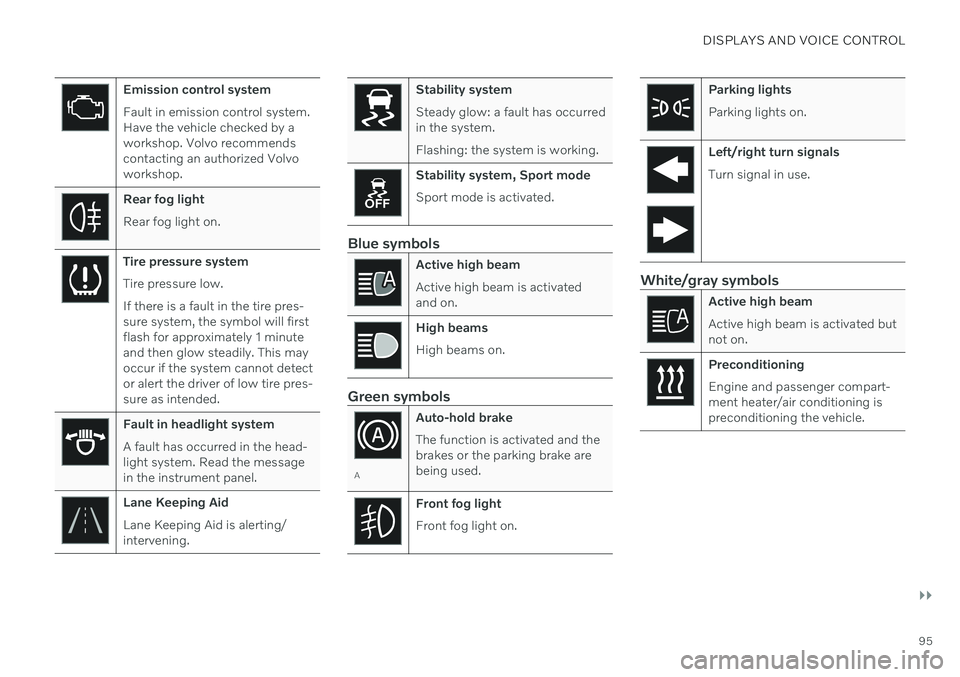
Emission control system Fault in emission control system. Have the vehicle checked by aworkshop. Volvo recommendscontacting an authorized Volvoworkshop.
Rear fog light Rear fog light on.
Tire pressure system Tire pressure low. If there is a fault in the tire pres- sure system, the symbol will firstflash for approximately 1 minuteand then glow steadily. This mayoccur if the system cannot detector alert the driver of low tire pres-sure as intended.
Fault in headlight system A fault has occurred in the head- light system. Read the messagein the instrument panel.
Lane Keeping Aid Lane Keeping Aid is alerting/ intervening.
Stability system Steady glow: a fault has occurred in the system. Flashing: the system is working.
Stability system, Sport mode Sport mode is activated.
Blue symbols
Active high beam Active high beam is activated and on.
High beams High beams on.
Green symbols
AAuto-hold brake The function is activated and the brakes or the parking brake arebeing used.
Front fog light Front fog light on.
Parking lights Parking lights on.
Left/right turn signals Turn signal in use.
White/gray symbols
Active high beam Active high beam is activated but not on.
Preconditioning Engine and passenger compart- ment heater/air conditioning ispreconditioning the vehicle.
Page 124 of 661
DISPLAYS AND VOICE CONTROL
122
Moving apps and buttons in the center display The apps and buttons for vehicle functions can be moved and organized in the App andFunction views.
1. Swipe from right to left11
to access App
view or swipe from left to right 11
to access
Function view.
2. Press and hold an app or button. > The app or button will change size andbecome slightly transparent. It can then be moved.
3. Drag the app or button to an available position in the view.
A maximum of 48 rows can be used to posi-tion apps or buttons. To move an app or but-ton outside the visible view, drag it to the bot-tom of the view. New rows will be added andthe app or button can be placed in one of these. Apps or buttons placed below the view's nor- mal display will not be visible on the screen. Swipe the screen to scroll up or down in the view to display information outside the view.
NOTE
Hide the apps that are rarely or never used by moving them far down, outside of thevisible view. This makes it easier to find theapps used more frequently.
NOTE
Apps and vehicle function buttons cannot be situated at spots already in use.
Related information
Function view in the center display (p. 120)
Apps (p. 450)
Handling the center display (p. 110)
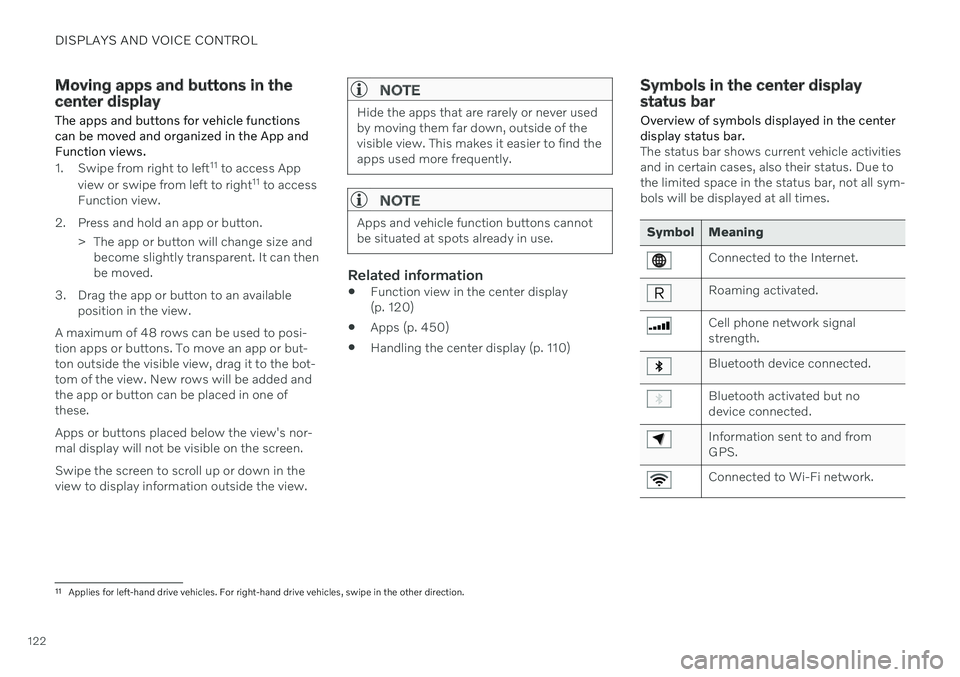
Symbols in the center display status bar
Overview of symbols displayed in the center display status bar.
The status bar shows current vehicle activities and in certain cases, also their status. Due tothe limited space in the status bar, not all sym-bols will be displayed at all times.
Symbol Meaning
Connected to the Internet.
Roaming activated.
Cell phone network signal strength.
Bluetooth device connected.
Bluetooth activated but no device connected.
Information sent to and from GPS.
Connected to Wi-Fi network.
11 Applies for left-hand drive vehicles. For right-hand drive vehicles, swipe in the other direction.
Page 135 of 661
DISPLAYS AND VOICE CONTROL
}}
* Option/accessory.133
Table of settings in the center display
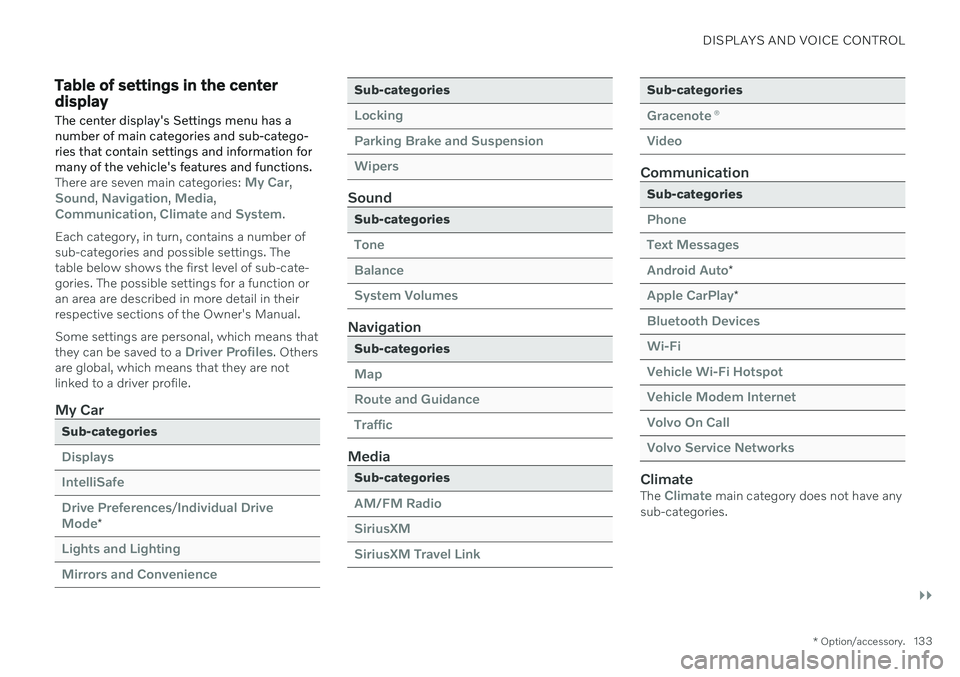
The center display's Settings menu has a number of main categories and sub-catego-ries that contain settings and information formany of the vehicle's features and functions.
There are seven main categories: My Car,Sound, Navigation, Media,Communication, Climate and System.
Each category, in turn, contains a number of sub-categories and possible settings. Thetable below shows the first level of sub-cate-gories. The possible settings for a function oran area are described in more detail in theirrespective sections of the Owner's Manual. Some settings are personal, which means that they can be saved to a
Driver Profiles. Others
are global, which means that they are not linked to a driver profile.
My Car
Sub-categories
Displays IntelliSafeDrive Preferences
/Individual Drive
Mode*
Lights and Lighting Mirrors and Convenience
Sub-categories
Locking Parking Brake and SuspensionWipers
Sound
Sub-categories
Tone BalanceSystem Volumes
Navigation
Sub-categories
Map Route and GuidanceTraffic
Media
Sub-categories
AM/FM Radio SiriusXMSiriusXM Travel Link
Sub-categories
Gracenote ®
Video
Communication
Sub-categories
Phone Text MessagesAndroid Auto
*
Apple CarPlay*
Bluetooth Devices Wi-FiVehicle Wi-Fi Hotspot Vehicle Modem Internet Volvo On Call Volvo Service Networks
ClimateThe Climate main category does not have any
sub-categories.
Page 145 of 661
DISPLAYS AND VOICE CONTROL
}}
* Option/accessory.143
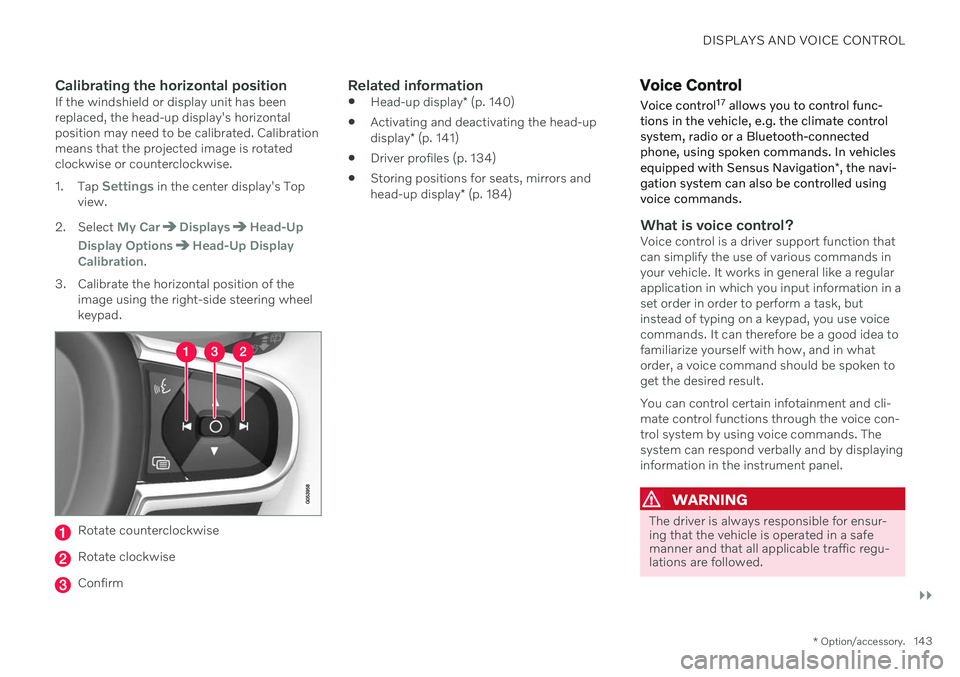
Calibrating the horizontal positionIf the windshield or display unit has been replaced, the head-up display's horizontalposition may need to be calibrated. Calibrationmeans that the projected image is rotatedclockwise or counterclockwise. 1.
Tap
Settings in the center display's Top
view.
2. Select
My CarDisplaysHead-Up
Display Options
Head-Up Display
Calibration.
3. Calibrate the horizontal position of the image using the right-side steering wheel keypad.
Rotate counterclockwise
Rotate clockwise
Confirm
Related information
Head-up display
* (p. 140)
Activating and deactivating the head-up display
* (p. 141)
Driver profiles (p. 134)
Storing positions for seats, mirrors andhead-up display
* (p. 184)
Voice Control
Voice control 17
allows you to control func-
tions in the vehicle, e.g. the climate control system, radio or a Bluetooth-connectedphone, using spoken commands. In vehicles equipped with Sensus Navigation *, the navi-
gation system can also be controlled using voice commands.
What is voice control?Voice control is a driver support function that can simplify the use of various commands inyour vehicle. It works in general like a regularapplication in which you input information in aset order in order to perform a task, butinstead of typing on a keypad, you use voicecommands. It can therefore be a good idea tofamiliarize yourself with how, and in whatorder, a voice command should be spoken toget the desired result. You can control certain infotainment and cli- mate control functions through the voice con-trol system by using voice commands. Thesystem can respond verbally and by displayinginformation in the instrument panel.
WARNING
The driver is always responsible for ensur- ing that the vehicle is operated in a safemanner and that all applicable traffic regu-lations are followed.
Page 148 of 661
||
DISPLAYS AND VOICE CONTROL
146
Numbers
Number commands can be given in different ways depending on the function to be con-trolled:
Phone numbers and zip codes
should be
given by stating each number individually,e.g. "zero, three, one, two, two, four, four,three" (03122443).
Addresses
can be given by stating each
number individually or in a group, e.g."two, two" or "twenty-two" (22). For Eng-lish and Dutch language settings, groupsof numbers can also be said in sequence,e.g. "twenty-two, twenty-two" (22 22).For English, double or triple digits can alsobe used, e.g. "double zero" (00). Numbersin the range 0-2300 can be used.
Frequencies
can be given as "ninety-eight
point eight" (98.8), "one hundred fourpoint two" or "hundred and four pointtwo" (104.2).
Speech rate and repeat mode
The speed at which the system speaks can be adjusted. With repeat mode on, the system will repeat what you have said. To change the speech rate or activate/deacti- vate repeat mode: 1. Tap
Settings in the Top view. 2. Tap
SystemVoice Control and select
settings.
Repeat Voice Command
Speech Rate
Related information
Voice Control (p. 143)
Voice control for cellular phones (p. 146)
Voice control for radio and media (p. 147)
Climate control system voice commands (p. 200)
Voice control settings (p. 148)
Voice control for cellular phones 20
Call a contact in the phone book, have a text message read aloud or dictate short mes-sages using voice commands to a Bluetooth-connected phone.
To access a contact in the phone book, the voice command must contain the contactinformation entered in the phone book. If a contact, e.g.
Robyn Smith, has several phone
numbers listed in the phone book, a number category such as
home or cellular can also be
specified, i.e. "Call Robyn Smith cellular".
Tap
and say one of the following com-
mands: "
Call [contact]" - call the selected con-
tact from the phone book.
"
Call [phone number]" - call a phone
number.
"
Recent calls" - display the list of recent
calls.
"
Read message" - read a text message
aloud. If there are several messages, select the message to read aloud.
"
Message to [contact]" – the user is
prompted to dictate a short message. The message will then be read aloud and theuser can choose to send or re-dictate themessage. The vehicle must be connectedto the Internet to access this function.
Page 149 of 661
DISPLAYS AND VOICE CONTROL
* Option/accessory.147
NOTE
Not all system languages support voice control. If a language supports voice con- trol, it is marked with a
symbol in the
list of available system languages. Read more about where the information is foundin the section on voice control settings.
Related information
Voice Control (p. 143)
Use voice recognition (p. 144)
Voice control for radio and media (p. 147)
Climate control system voice commands (p. 200)
Voice control settings (p. 148)
Internet-connected vehicle
* (p. 500)
Voice control for radio and media 21
Voice commands for the radio and media players are shown below.
Tap and say one of the following com-
mands: "
Media" - initiates a dialog for media and
radio and displays examples of com- mands.
"
Play [artist]" - plays music by the
selected artist.
"
Play [song title]" - plays the selected
song.
"
Play [song title] from [album]" - plays
the selected song from the selected album.
"
Play [radio station]" - starts the
selected radio station.
"
Tune to [frequency]" - tunes to the
selected radio frequency in the currently active waveband. If no radio source isactive, the FM band will be started asdefault.
"
Tune to [frequency] [waveband]" -
tunes to the selected radio frequency on the selected waveband.
"
Radio" - starts FM radio.
"
Radio FM" - starts FM radio.
"
Radio AM" - starts AM radio.
"
SiriusXM" - starts SiriusXM radio
*
"
USB" - starts playback from USB.
"
iPod" - starts playback from iPod.
"
Bluetooth" - starts playback from a
Bluetooth-connected media source.
"
Similar music" - plays music from a
USB-connected device with music similar to that currently playing.
NOTE
Not all system languages support voice control. If a language supports voice con- trol, it is marked with a
symbol in the
list of available system languages. Read more about where the information is foundin the section on voice control settings.
Related information
Voice Control (p. 143)
Use voice recognition (p. 144)
Voice control for cellular phones (p. 146)
Climate control system voice commands (p. 200)
Voice control settings (p. 148)
20
Certain markets only.
21 Certain markets only.
Page 157 of 661
LIGHTING
155
Active high beam
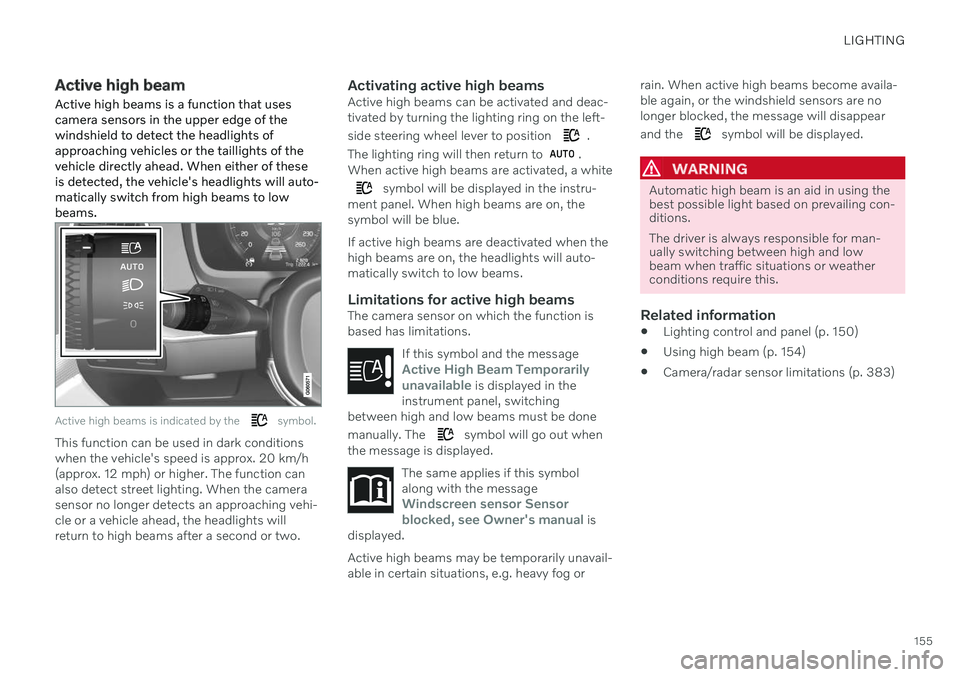
Active high beams is a function that uses camera sensors in the upper edge of thewindshield to detect the headlights ofapproaching vehicles or the taillights of thevehicle directly ahead. When either of theseis detected, the vehicle's headlights will auto-matically switch from high beams to lowbeams.
Active high beams is indicated by the symbol.
This function can be used in dark conditions when the vehicle's speed is approx. 20 km/h(approx. 12 mph) or higher. The function canalso detect street lighting. When the camerasensor no longer detects an approaching vehi-cle or a vehicle ahead, the headlights willreturn to high beams after a second or two.
Activating active high beamsActive high beams can be activated and deac-tivated by turning the lighting ring on the left- side steering wheel lever to position
.
The lighting ring will then return to
.
When active high beams are activated, a white
symbol will be displayed in the instru-
ment panel. When high beams are on, the symbol will be blue. If active high beams are deactivated when the high beams are on, the headlights will auto-matically switch to low beams.
Limitations for active high beamsThe camera sensor on which the function isbased has limitations.
If this symbol and the message
Active High Beam Temporarily
unavailable is displayed in the
instrument panel, switching
between high and low beams must be done manually. The
symbol will go out when
the message is displayed.
The same applies if this symbol along with the message
Windscreen sensor Sensor
blocked, see Owner's manual is
displayed.
Active high beams may be temporarily unavail- able in certain situations, e.g. heavy fog or rain. When active high beams become availa-ble again, or the windshield sensors are nolonger blocked, the message will disappear and the
symbol will be displayed.
WARNING
Automatic high beam is an aid in using the best possible light based on prevailing con-ditions. The driver is always responsible for man- ually switching between high and lowbeam when traffic situations or weatherconditions require this.
Related information
Lighting control and panel (p. 150)
Using high beam (p. 154)
Camera/radar sensor limitations (p. 383)