tyre pressure VOLVO V90 2017 User Guide
[x] Cancel search | Manufacturer: VOLVO, Model Year: 2017, Model line: V90, Model: VOLVO V90 2017Pages: 594, PDF Size: 15.07 MB
Page 486 of 594
WHEELS AND TYRES
484
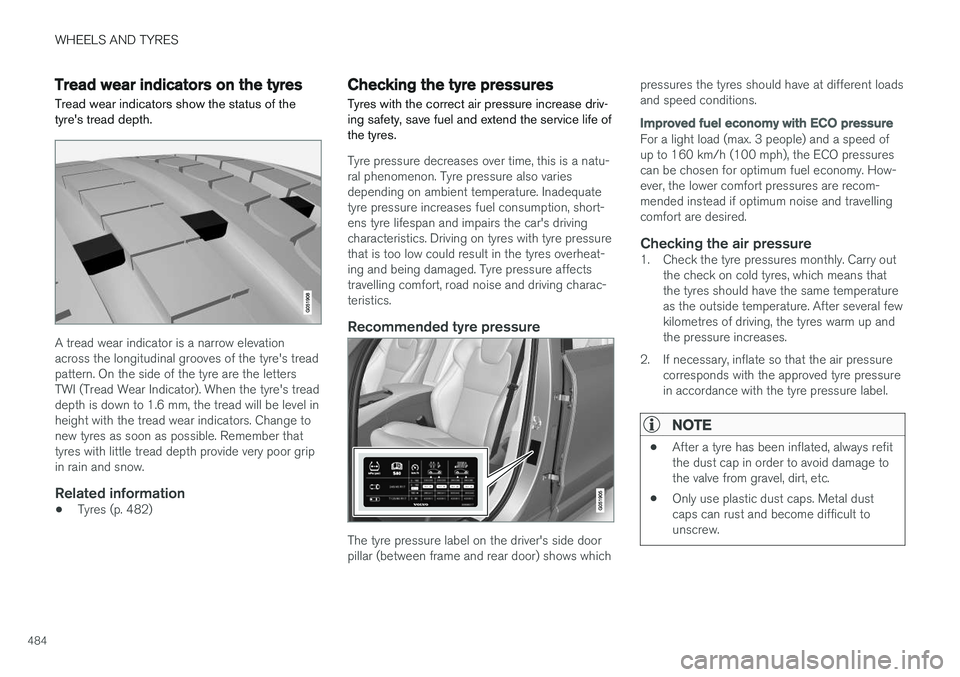
Tread wear indicators on the tyres Tread wear indicators show the status of the tyre's tread depth.
A tread wear indicator is a narrow elevation across the longitudinal grooves of the tyre's treadpattern. On the side of the tyre are the lettersTWI (Tread Wear Indicator). When the tyre's treaddepth is down to 1.6 mm, the tread will be level inheight with the tread wear indicators. Change tonew tyres as soon as possible. Remember thattyres with little tread depth provide very poor gripin rain and snow.
Related information
•Tyres (p. 482)
Checking the tyre pressures Tyres with the correct air pressure increase driv- ing safety, save fuel and extend the service life ofthe tyres.
Tyre pressure decreases over time, this is a natu- ral phenomenon. Tyre pressure also variesdepending on ambient temperature. Inadequatetyre pressure increases fuel consumption, short-ens tyre lifespan and impairs the car's drivingcharacteristics. Driving on tyres with tyre pressurethat is too low could result in the tyres overheat-ing and being damaged. Tyre pressure affectstravelling comfort, road noise and driving charac-teristics.
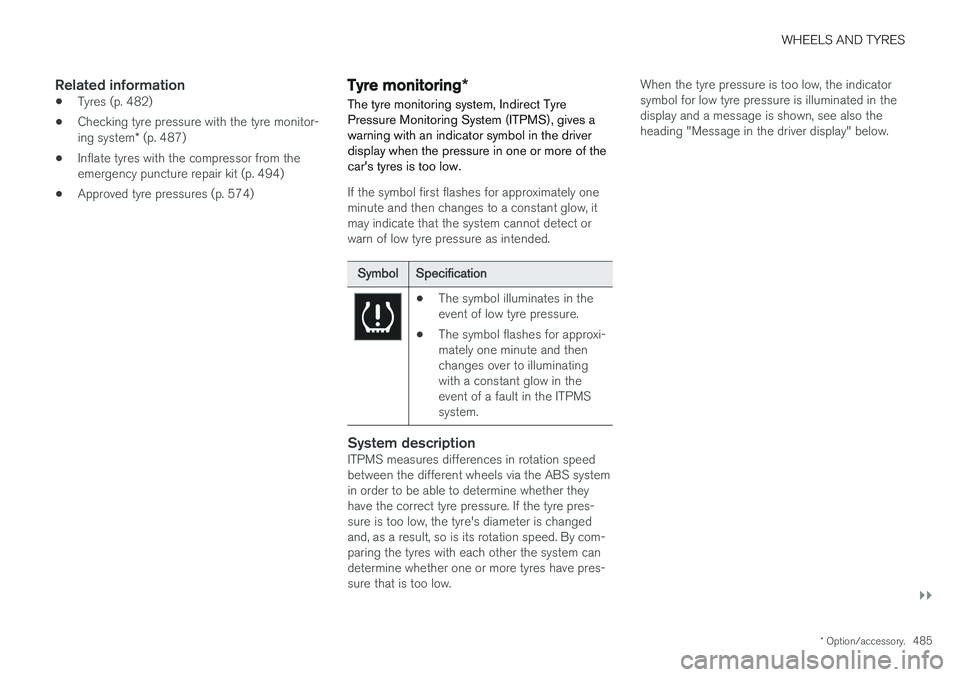
Recommended tyre pressure
The tyre pressure label on the driver's side door pillar (between frame and rear door) shows which pressures the tyres should have at different loadsand speed conditions.
Improved fuel economy with ECO pressure
For a light load (max. 3 people) and a speed of up to 160 km/h (100 mph), the ECO pressurescan be chosen for optimum fuel economy. How-ever, the lower comfort pressures are recom-mended instead if optimum noise and travellingcomfort are desired.
Checking the air pressure1. Check the tyre pressures monthly. Carry out
the check on cold tyres, which means thatthe tyres should have the same temperatureas the outside temperature. After several fewkilometres of driving, the tyres warm up andthe pressure increases.
2. If necessary, inflate so that the air pressure corresponds with the approved tyre pressurein accordance with the tyre pressure label.
NOTE
• After a tyre has been inflated, always refit the dust cap in order to avoid damage tothe valve from gravel, dirt, etc.
• Only use plastic dust caps. Metal dustcaps can rust and become difficult tounscrew.
Page 487 of 594
WHEELS AND TYRES
}}
* Option/accessory.485
Related information
•Tyres (p. 482)
• Checking tyre pressure with the tyre monitor- ing system
* (p. 487)
• Inflate tyres with the compressor from the emergency puncture repair kit (p. 494)
• Approved tyre pressures (p. 574)
Tyre monitoring
*
The tyre monitoring system, Indirect Tyre Pressure Monitoring System (ITPMS), gives awarning with an indicator symbol in the driverdisplay when the pressure in one or more of thecar's tyres is too low.
If the symbol first flashes for approximately one minute and then changes to a constant glow, itmay indicate that the system cannot detect orwarn of low tyre pressure as intended.
Symbol Specification
•The symbol illuminates in the event of low tyre pressure.
• The symbol flashes for approxi-mately one minute and thenchanges over to illuminatingwith a constant glow in theevent of a fault in the ITPMSsystem.
System descriptionITPMS measures differences in rotation speed between the different wheels via the ABS systemin order to be able to determine whether they have the correct tyre pressure. If the tyre pres-sure is too low, the tyre's diameter is changedand, as a result, so is its rotation speed. By com-paring the tyres with each other the system candetermine whether one or more tyres have pres-sure that is too low. When the tyre pressure is too low, the indicatorsymbol for low tyre pressure is illuminated in thedisplay and a message is shown, see also theheading "Message in the driver display" below.
Page 488 of 594
||
WHEELS AND TYRES
* Option/accessory.
486
General information on the tyre monitoring system
In the information below, the tyre monitoring sys- tem is referred to generically as TPMS. Each tyre, including the spare tyre *, should be
checked once a month. When checking, the tyre should be cold and have the air pressure recom-mended by the car manufacturer specified on thetyre pressure label or in the tyre pressure table. Ifthe car has tyres of a different size than that rec-ommended by the manufacturer, find out whatthe correct air pressure level is for these. As an extra safety feature, the car is equipped with a tyre pressure monitoring system (TPMS),which shows when the air pressure in one ormore tyres is too low. When the indicator symbolfor low air pressure is lit, stop and check the tyresas soon as possible and inflate to the correct airpressure. Driving with tyres that have tyre pressure that is too low may cause the tyre to overheat, whichcan cause a puncture. Low tyre pressure alsoreduces fuel efficiency as well as tyre service life,and can affect car handling and stopping ability.Note that TPMS does not replace regular tyremaintenance. It is the driver's responsibility tomaintain correct tyre pressure, even if the limit forlow tyre pressure has not been reached so thatthe indicator symbol illuminates. The car is also equipped with a TPMS system fault indicator, which indicates when the system is not functioning correctly. The TPMS systemfault indicator is combined with the indicator sym-bol for low tyre pressure. When the systemdetects a fault, the symbol in the driver displaywill flash for about one minute and then remainilluminated. This procedure will be repeated whenthe car is started until the fault has been rectified.When the symbol is illuminated, the system's abil-ity to detect or warn of low tyre pressure may beaffected. A TPMS system fault can occur for several rea- sons, such as after changing to a spare tyre, orchanging tyres or wheels that prevent TPMS fromfunctioning correctly. Always check the indicator symbol for TPMS after changing one or more tyres in order toensure the new tyre or wheel is working correctlywith TPMS.
Messages in the driver displayThe following messages may be shown when theindicator symbol is illuminated:
•
Tyre pressure low Check tyres, calibrate
after fill
•Tyre pressure system Temporarily
unavailable
•Tyre pressure system Service required.
If the system cannot determine which tyre has low pressure, all four tyres will be indicated in thecentre display.
To bear in mind
• Always calibrate the system after a wheelchange or tyre pressure adjustment. See thetyre pressure label on the driver's side doorpillar for Volvo's recommended tyre pres-sures.
• The system does not replace normal tyremaintenance.
• There is no option to deactivate ITPMS.
Related information
•Tyres (p. 482)
• Checking tyre pressure with the tyre monitor- ing system
* (p. 487)
• Calibrating tyre monitoring
* (p. 489)
• Rectifying low tyre pressure with tyre moni-toring
* (p. 488)
Page 489 of 594
WHEELS AND TYRES
* Option/accessory.487
Checking tyre pressure with the tyre monitoring system *
With the system for tyre monitoring, Indirect Tyre Pressure Monitoring System (ITPMS), tyre pres-sure status can be viewed in the centre display.
Checking status1. Open the Car status app in the app view.
2.Tap on Status to show the status of the
tyres.
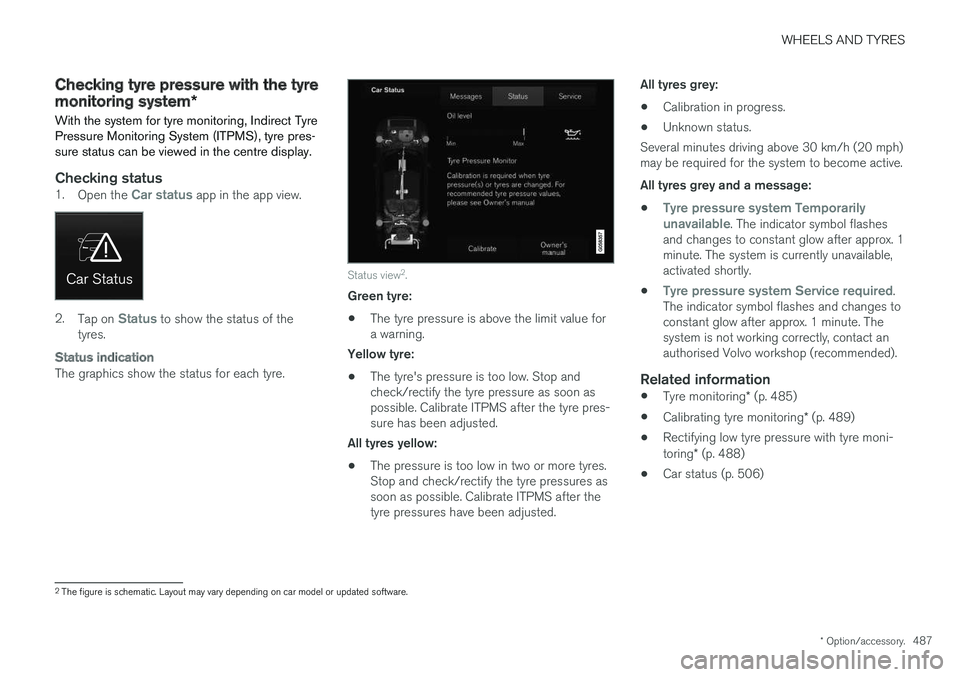
Status indication
The graphics show the status for each tyre.
Status view 2
.
Green tyre:
• The tyre pressure is above the limit value for a warning.
Yellow tyre:
• The tyre's pressure is too low. Stop andcheck/rectify the tyre pressure as soon aspossible. Calibrate ITPMS after the tyre pres-sure has been adjusted.
All tyres yellow:
• The pressure is too low in two or more tyres.Stop and check/rectify the tyre pressures assoon as possible. Calibrate ITPMS after thetyre pressures have been adjusted. All tyres grey:
• Calibration in progress.
• Unknown status.
Several minutes driving above 30 km/h (20 mph)may be required for the system to become active. All tyres grey and a message:
•
Tyre pressure system Temporarily
unavailable. The indicator symbol flashes
and changes to constant glow after approx. 1 minute. The system is currently unavailable,activated shortly.
•
Tyre pressure system Service required.
The indicator symbol flashes and changes to constant glow after approx. 1 minute. Thesystem is not working correctly, contact anauthorised Volvo workshop (recommended).
Related information
• Tyre monitoring
* (p. 485)
• Calibrating tyre monitoring
* (p. 489)
• Rectifying low tyre pressure with tyre moni- toring
* (p. 488)
• Car status (p. 506)
2
The figure is schematic. Layout may vary depending on car model or updated software.
Page 490 of 594
WHEELS AND TYRES
* Option/accessory.
488
Rectifying low tyre pressure with tyre monitoring *
When the tyre monitoring system, Indirect Tyre Pressure Monitoring System (ITPMS), gives awarning, the tyre pressure in one or more of thecar's tyres is too low.
Check and rectify the tyre pressure when the indicator symbol for ITPMS is illuminated and the message
Tyre
pressure low is shown. Calibrate
ITPMS after the tyre pressure has been adjusted.
1. Check the tyre pressure in all four tyres with a tyre pressure gauge.
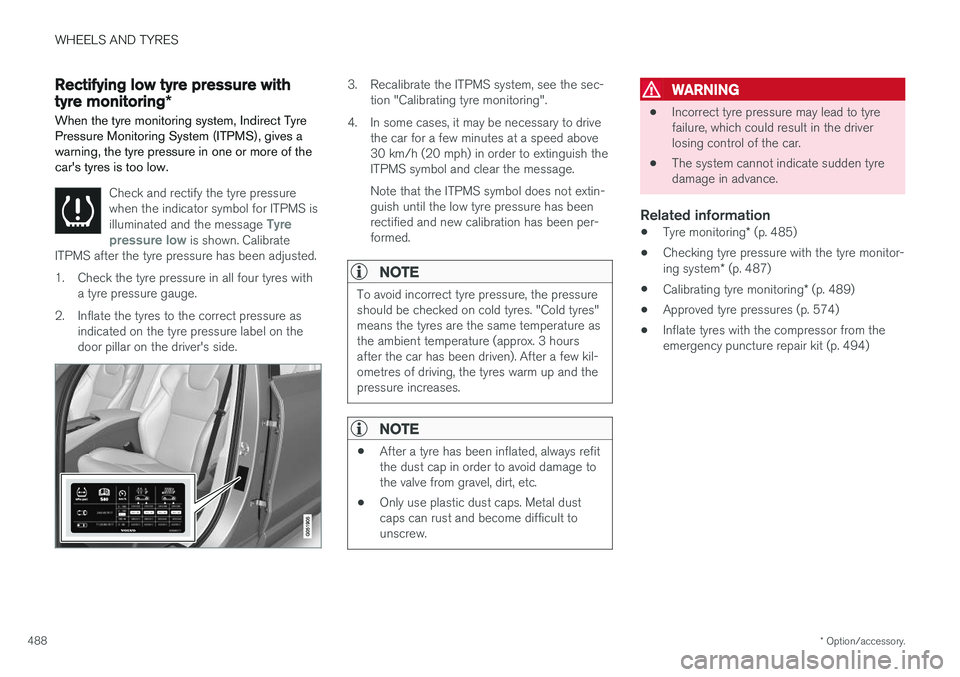
2. Inflate the tyres to the correct pressure as indicated on the tyre pressure label on the door pillar on the driver's side.
3. Recalibrate the ITPMS system, see the sec-tion "Calibrating tyre monitoring".
4. In some cases, it may be necessary to drive the car for a few minutes at a speed above 30 km/h (20 mph) in order to extinguish theITPMS symbol and clear the message. Note that the ITPMS symbol does not extin- guish until the low tyre pressure has beenrectified and new calibration has been per-formed.
NOTE
To avoid incorrect tyre pressure, the pressure should be checked on cold tyres. "Cold tyres"means the tyres are the same temperature asthe ambient temperature (approx. 3 hoursafter the car has been driven). After a few kil-ometres of driving, the tyres warm up and thepressure increases.
NOTE
• After a tyre has been inflated, always refit the dust cap in order to avoid damage tothe valve from gravel, dirt, etc.
• Only use plastic dust caps. Metal dustcaps can rust and become difficult tounscrew.
WARNING
• Incorrect tyre pressure may lead to tyre failure, which could result in the driverlosing control of the car.
• The system cannot indicate sudden tyredamage in advance.
Related information
•
Tyre monitoring
* (p. 485)
• Checking tyre pressure with the tyre monitor- ing system
* (p. 487)
• Calibrating tyre monitoring
* (p. 489)
• Approved tyre pressures (p. 574)
• Inflate tyres with the compressor from the emergency puncture repair kit (p. 494)
Page 491 of 594
WHEELS AND TYRES
* Option/accessory.489
Calibrating tyre monitoring *
In order for the Indirect Tyre Pressure Monitoring System (ITPMS) to work correctly, a referencevalue for the tyre pressure must be determined.This must be performed each time the tyres arechanged or the tyre pressure is changed.
For example, when driving with a heavy load or at high speed above 160 km/h (100 mph), the tyrepressure should be adjusted in accordance withVolvo's recommended tyre pressure values. Fol-lowing which, the system must be recalibrated.
1. Stop the engine.
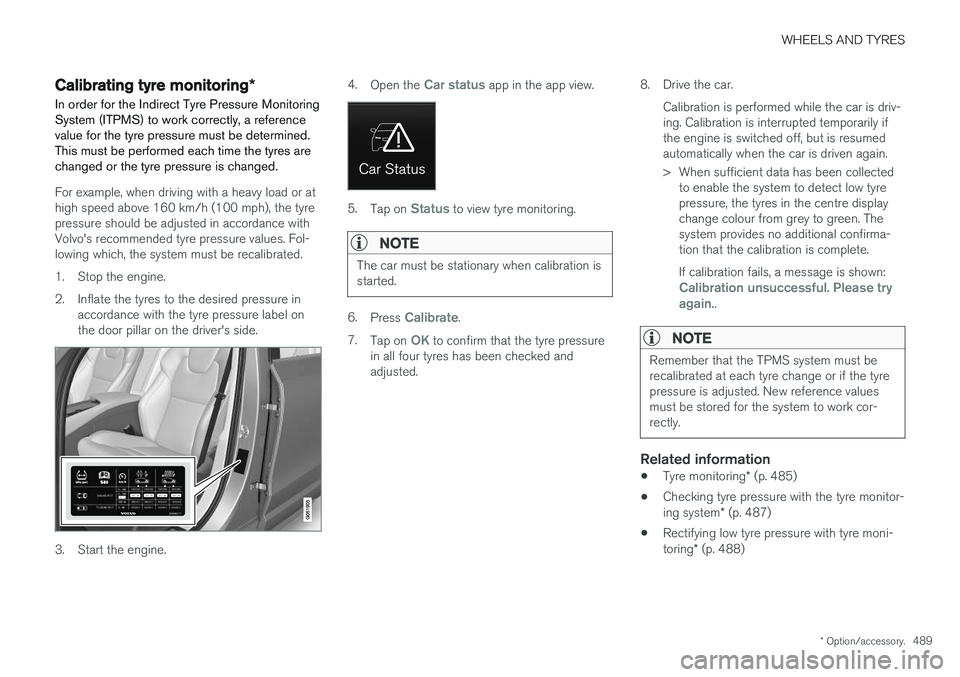
2. Inflate the tyres to the desired pressure in accordance with the tyre pressure label on the door pillar on the driver's side.
3. Start the engine. 4.
Open the
Car status app in the app view.
5.Tap on Status to view tyre monitoring.
NOTE
The car must be stationary when calibration is started.
6.Press Calibrate.
7. Tap on
OK to confirm that the tyre pressure
in all four tyres has been checked and adjusted. 8. Drive the car.
Calibration is performed while the car is driv-ing. Calibration is interrupted temporarily ifthe engine is switched off, but is resumedautomatically when the car is driven again.
> When sufficient data has been collectedto enable the system to detect low tyre pressure, the tyres in the centre displaychange colour from grey to green. Thesystem provides no additional confirma-tion that the calibration is complete. If calibration fails, a message is shown:
Calibration unsuccessful. Please try again..
NOTE
Remember that the TPMS system must be recalibrated at each tyre change or if the tyrepressure is adjusted. New reference valuesmust be stored for the system to work cor-rectly.
Related information
• Tyre monitoring
* (p. 485)
• Checking tyre pressure with the tyre monitor- ing system
* (p. 487)
• Rectifying low tyre pressure with tyre moni-toring
* (p. 488)
Page 492 of 594
WHEELS AND TYRES
490
Emergency puncture repair kitThe emergency puncture repair kit, Temporary Mobility Kit (TMK), is used to seal a puncture aswell as to check and adjust the air pressure.
The puncture repair kit consists of a compressor and a bottle with sealing fluid. The sealing worksas a temporary repair. The sealing fluid effectivelyseals tyres punctured in the tread. The puncture repair kit has limited capacity to seal tyres which have punctures in the wall. Donot use the puncture repair kit on tyres that havelarger slits, cracks or similar damage.
NOTE
The emergency puncture repair kit is only intended for sealing tyres with a puncture inthe tread.
NOTE
The compressor for temporary emergency puncture repair has been tested andapproved by Volvo.
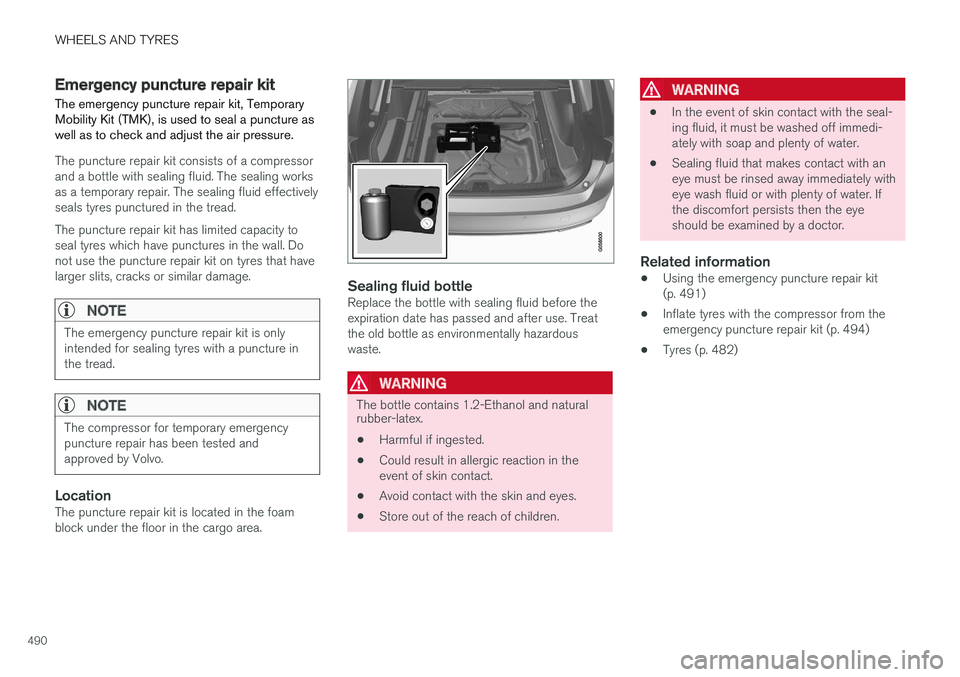
LocationThe puncture repair kit is located in the foam block under the floor in the cargo area.
Sealing fluid bottleReplace the bottle with sealing fluid before the expiration date has passed and after use. Treatthe old bottle as environmentally hazardouswaste.
WARNING
The bottle contains 1.2-Ethanol and natural rubber-latex.
• Harmful if ingested.
• Could result in allergic reaction in the event of skin contact.
• Avoid contact with the skin and eyes.
• Store out of the reach of children.
WARNING
• In the event of skin contact with the seal- ing fluid, it must be washed off immedi-ately with soap and plenty of water.
• Sealing fluid that makes contact with aneye must be rinsed away immediately witheye wash fluid or with plenty of water. Ifthe discomfort persists then the eyeshould be examined by a doctor.
Related information
• Using the emergency puncture repair kit(p. 491)
• Inflate tyres with the compressor from theemergency puncture repair kit (p. 494)
• Tyres (p. 482)
Page 493 of 594
WHEELS AND TYRES
}}
491
Using the emergency puncture repair kit Seal a puncture with the emergency puncture repair kit, Temporary Mobility Kit (TMK).
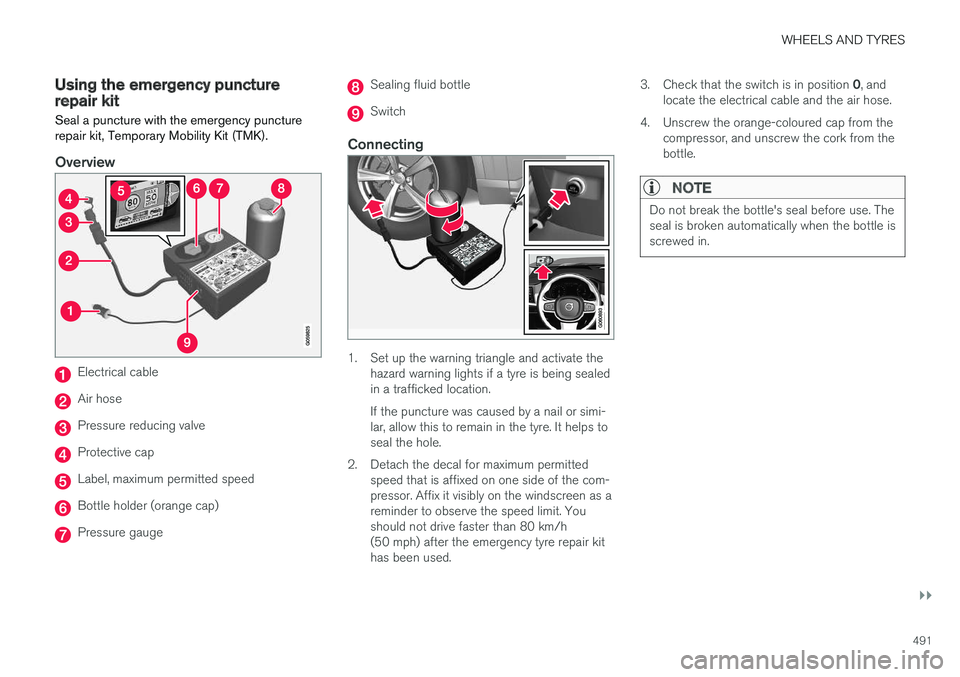
Overview
Electrical cable
Air hose
Pressure reducing valve
Protective cap
Label, maximum permitted speed
Bottle holder (orange cap)
Pressure gauge
Sealing fluid bottle
Switch
Connecting
1. Set up the warning triangle and activate thehazard warning lights if a tyre is being sealed in a trafficked location. If the puncture was caused by a nail or simi- lar, allow this to remain in the tyre. It helps toseal the hole.
2. Detach the decal for maximum permitted speed that is affixed on one side of the com-pressor. Affix it visibly on the windscreen as areminder to observe the speed limit. Youshould not drive faster than 80 km/h(50 mph) after the emergency tyre repair kithas been used. 3.
Check that the switch is in position 0, and
locate the electrical cable and the air hose.
4. Unscrew the orange-coloured cap from the compressor, and unscrew the cork from thebottle.
NOTE
Do not break the bottle's seal before use. The seal is broken automatically when the bottle isscrewed in.
Page 494 of 594
||
WHEELS AND TYRES
4925. Screw in the bottle to the bottom of the bot-
tle holder.
> The bottle and the bottle holder areequipped with a reverse catch to prevent sealant leakage. When the bottle isscrewed in it cannot be unscrewed fromthe bottle holder again. Bottle removalmust be performed at a workshop, Volvorecommends an authorised Volvo work-shop.
WARNING
•In the event of skin contact with the seal- ing fluid, it must be washed off immediatelywith soap and plenty of water.
• Sealing fluid that makes contact with aneye must be rinsed away immediately witheye wash fluid or with plenty of water. If thediscomfort persists then the eye should beexamined by a doctor.
WARNING
Do not unscrew the bottle, it is equipped with a reverse catch to prevent leakage. 6. Unscrew the tyre's dust cap.
Check that the pressure reducing valve on the air hose is fully screwed on, and screw inthe air hose's valve connection to the bottomof the tyre valve's thread.
7. Connect the electrical cable to the closest 12 V socket and start the car.
NOTE
Make sure that none of the other 12 V sock- ets is in use when the compressor is operat-ing.
WARNING
Do not leave children in the car without supervision when the engine is running. 8. Start the compressor by flicking the switch to
position I.
WARNING
Never stand next to the tyre when the com- pressor is running. If cracks or unevennessarise then the compressor must be switchedoff immediately. The journey should not becontinued. Contacting an authorised tyre cen-tre is recommended.
NOTE
When the compressor starts, the pressure can increase up to 6 bar but the pressuredrops after approximately 30 seconds.
9. Inflate the tyre for 7 minutes.
IMPORTANT
The compressor must not be operated for longer than 10 minutes - risk of overheating.
Page 495 of 594
WHEELS AND TYRES
}}
493
10. Switch off the compressor to check the pres-
sure on the pressure gauge. Minimum pres- sure is 1.8 bar and maximum 3.5 bar.(Release air with the pressure reducing valveif the tyre pressure is too high.)
WARNING
If the pressure is below 1.8 bar then the hole in the tyre is too big. The journey should notbe continued. Contacting an authorised tyrecentre is recommended.
11. Switch off the compressor and detach the electrical cable.
12. Unscrew the air hose from the tyre valve and refit the dust cap on the tyre.
13. Fit the protective cap on the air hose in order to avoid leakage of the remaining sealing fluid. 14. As soon as possible, drive at least 3 km at a
maximum speed of 80 km/h (50 mph) sothat the sealing fluid can seal the tyre.
NOTE
Sealant will spurt out of the puncture during the first few rotations of the tyre.
WARNING
Make sure that nobody is standing near the car and gets the sealing fluid splashed ontothem when the car is driven away. The dis-tance should be at least two metres.
15. Follow-up inspection Connect the air hose on the tyre valve and screw in the valve connection to the bottomof the tyre valve's thread. The compressormust be switched off. 16. Read the tyre pressure on the pressure
gauge.
• If it is below 1.3 bar then the tyre is insuf-ficiently sealed. The journey should not becontinued. Contact a tyre centre.
• If the tyre pressure is higher than 1.3 bar,the tyre must be inflated to the pressurespecified in accordance with the tyrepressure label on the driver side door pil-lar (1 bar = 100 kPa). Release air usingthe pressure reducing valve if the tyrepressure is too high.
17. If the tyre needs to be inflated: 1. Connect the electrical cable to the closest12 V socket and start the car.
2. Start the compressor and inflate the tyre to the pressure specified in accordancewith the tyre pressure label.
3. Switch off the compressor.
18. Remove the tyre sealing equipment, fit the protective cap on the air hose and fold thehose in the box. Place TMK in the cargo area.
WARNING
Do not unscrew the bottle, it is equipped with a reverse catch to prevent leakage.