dimensions VOLVO V90 2017 Owners Manual
[x] Cancel search | Manufacturer: VOLVO, Model Year: 2017, Model line: V90, Model: VOLVO V90 2017Pages: 594, PDF Size: 15.07 MB
Page 13 of 594
11
Wiper blades in service position527
Replacing a wiper blade 528
Filling washer fluid 529
Starter battery 530
Symbols on the batteries 533
Support battery 533
Fuses 535
Replacing a fuse 536
Fuses in engine compartment 537
Fuses under glovebox 542
Fuses in cargo area 546
Cleaning the exterior 549
Polishing and waxing 551
Rustproofing 552
Cleaning the interior 552
Cleaning the centre display 553
Paint damage 554
Repairing paint damage 555
SPECIFICATIONS
Type designations558
Dimensions 561
Weights 563
Towing capacity and towball load 564
Engine specifications 566
Engine oil — specifications 567
Adverse driving conditions for engine oil 569
Coolant — specifications 570
Transmission fluid — specifications 570
Brake fluid — specifications 570
Fuel tank - volume 571
Air conditioning — specifications 571
Fuel consumption and CO2 emissions 572
Approved tyre pressures 574
Performance 575
ALPHABETICAL INDEX
Alphabetical Index 577
Page 372 of 594
DRIVER SUPPORT
* Option/accessory.
370
Park assist lines and fields for the Park Assist Camera *
The Park Assist Camera indicates the position of the car in relation to its surroundings by display-ing lines on the camera image.
Park assist lines
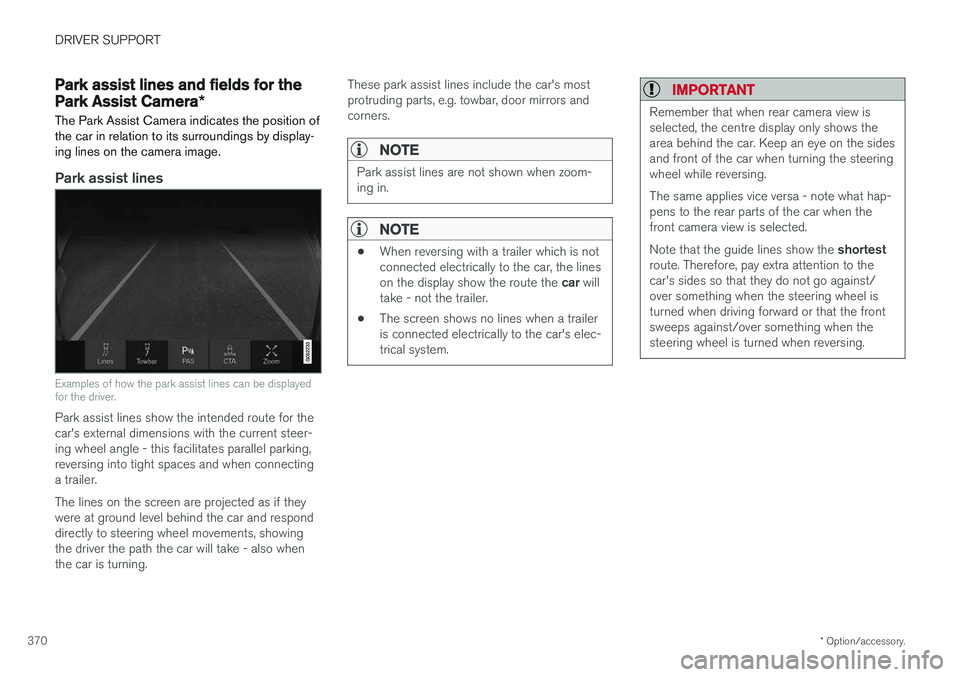
Examples of how the park assist lines can be displayed for the driver.
Park assist lines show the intended route for the car's external dimensions with the current steer-ing wheel angle - this facilitates parallel parking,reversing into tight spaces and when connectinga trailer. The lines on the screen are projected as if they were at ground level behind the car and responddirectly to steering wheel movements, showingthe driver the path the car will take - also whenthe car is turning. These park assist lines include the car's mostprotruding parts, e.g. towbar, door mirrors andcorners.
NOTE
Park assist lines are not shown when zoom- ing in.
NOTE
•
When reversing with a trailer which is not connected electrically to the car, the lines on the display show the route the
car will
take - not the trailer.
• The screen shows no lines when a trailer is connected electrically to the car's elec-trical system.
IMPORTANT
Remember that when rear camera view is selected, the centre display only shows thearea behind the car. Keep an eye on the sidesand front of the car when turning the steeringwheel while reversing. The same applies vice versa - note what hap- pens to the rear parts of the car when thefront camera view is selected. Note that the guide lines show the
shortest
route. Therefore, pay extra attention to the car's sides so that they do not go against/over something when the steering wheel isturned when driving forward or that the frontsweeps against/over something when thesteering wheel is turned when reversing.
Page 427 of 594

STARTING AND DRIVING
* Option/accessory.425
2. Lock the towing bracket by moving it back to
its retracted position, where it is locked.
> The indicator lamp will now illuminate witha constant glow if the towing bracket is correctly retracted.
Related information
• Towing bracket
* (p. 422)
• Towing bracket specifications
* (p. 425)
Towing bracket specifications *
Dimensions and mounting points for the towing bracket.Dimensions, mounting points (mm)
A 1229
B 111.8 C 875
D 437,5 E See the image aboveF 310.5
G Ball centre
Related information
• Towing bracket
* (p. 422)
Page 484 of 594
WHEELS AND TYRES
482
TyresAmongst other things, the function of the tyres is to carry load, provide grip on the road surface,dampen vibration and protect the wheel fromwear.
The tyres greatly affect the car's driving characte- ristics. The type of tyre, dimensions, tyre pressureand speed rating are important for how the carperforms.
Recommended tyresOn delivery, the car is equipped with Volvo origi- nal tyres that have the VOL 1
marking on the side
of the tyres. These tyres are carefully adapted to the car. In the event of changing tyres, it is there-fore important that the new tyres also have thismarking in order for the car's driving characteris-tics, comfort and fuel consumption to be main-tained.
New tyres
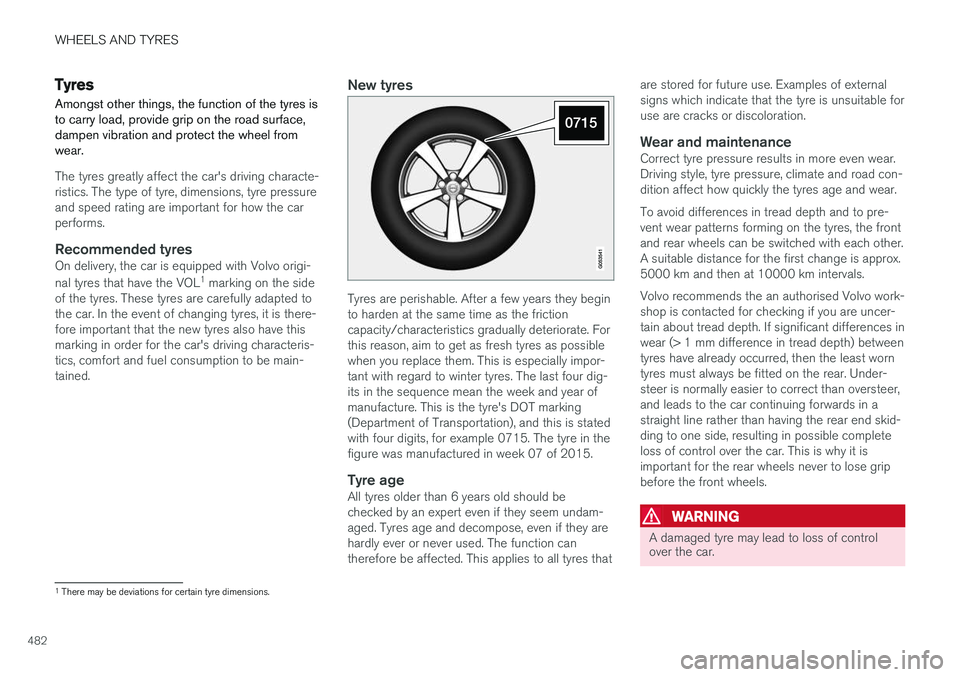
Tyres are perishable. After a few years they begin to harden at the same time as the frictioncapacity/characteristics gradually deteriorate. Forthis reason, aim to get as fresh tyres as possiblewhen you replace them. This is especially impor-tant with regard to winter tyres. The last four dig-its in the sequence mean the week and year ofmanufacture. This is the tyre's DOT marking(Department of Transportation), and this is statedwith four digits, for example 0715. The tyre in thefigure was manufactured in week 07 of 2015.
Tyre ageAll tyres older than 6 years old should bechecked by an expert even if they seem undam-aged. Tyres age and decompose, even if they arehardly ever or never used. The function cantherefore be affected. This applies to all tyres that are stored for future use. Examples of externalsigns which indicate that the tyre is unsuitable foruse are cracks or discoloration.
Wear and maintenanceCorrect tyre pressure results in more even wear.Driving style, tyre pressure, climate and road con-dition affect how quickly the tyres age and wear. To avoid differences in tread depth and to pre- vent wear patterns forming on the tyres, the frontand rear wheels can be switched with each other.A suitable distance for the first change is approx.5000 km and then at 10000 km intervals. Volvo recommends the an authorised Volvo work- shop is contacted for checking if you are uncer-tain about tread depth. If significant differences inwear (> 1 mm difference in tread depth) betweentyres have already occurred, then the least worntyres must always be fitted on the rear. Under-steer is normally easier to correct than oversteer,and leads to the car continuing forwards in astraight line rather than having the rear end skid-ding to one side, resulting in possible completeloss of control over the car. This is why it isimportant for the rear wheels never to lose gripbefore the front wheels.
WARNING
A damaged tyre may lead to loss of control over the car.
1
There may be deviations for certain tyre dimensions.
Page 501 of 594
WHEELS AND TYRES
* Option/accessory.499
Related information
•Removing a wheel (p. 495)
• Fitting the wheels (p. 497)
• Tool kit (p. 500)
• Jack
* (p. 501)
Winter wheels
Winter wheels are adapted for winter road con- ditions.
Volvo recommends winter tyres with particular dimensions. Tyre dimensions are dependent onengine variant. When driving on winter tyres, thecorrect type of tyres must be fitted to all fourwheels.
NOTE
Contact a Volvo dealer for advice about which wheel rim and type of tyre are most suitable.
Tips for changing to winter tyresWhen summer and winter wheels are changed, mark which side of the car they were mounted on, for example L for left and R for right.
Studded tyresStudded winter tyres should be run in gently for 500-1000 km so the studs settle properly intothe tyres. This gives the tyre, and especially thestuds, a longer service life.
NOTE
The legal provisions for the use of studded tyres vary from country to country.
Tread depthRoad conditions with ice, slush and low tempera- tures place considerably higher demands on tyresthan summer conditions. Volvo therefore recom-mends not to drive on winter tyres that have atread depth of less than 4 mm.
Snow chainsVolvo recommends that snow chains are notused on wheel dimensions greater than18 inches. Mounting instructions are supplied with Volvo original snow chains. Snow chains may only be used on the front wheels (also applies to all-wheel drive cars).Never drive faster than 50 km/h (30 mph) withsnow chains. Avoid driving on bare ground as thiswears out both the snow chains and tyres.
WARNING
Use Volvo genuine snow chains or equivalent chains designed for the car model, and tyre and rim dimensions. Only single-sided snow
chains are permitted. In the event of uncertainty about the show chain, Volvo recommends that an authorisedVolvo workshop should be contacted. Thewrong snow chains may cause serious dam-age to the car and lead to an accident.
Related information
• When changing wheels (p. 495)
Page 504 of 594
WHEELS AND TYRES
502
Dimension designation for wheel rim
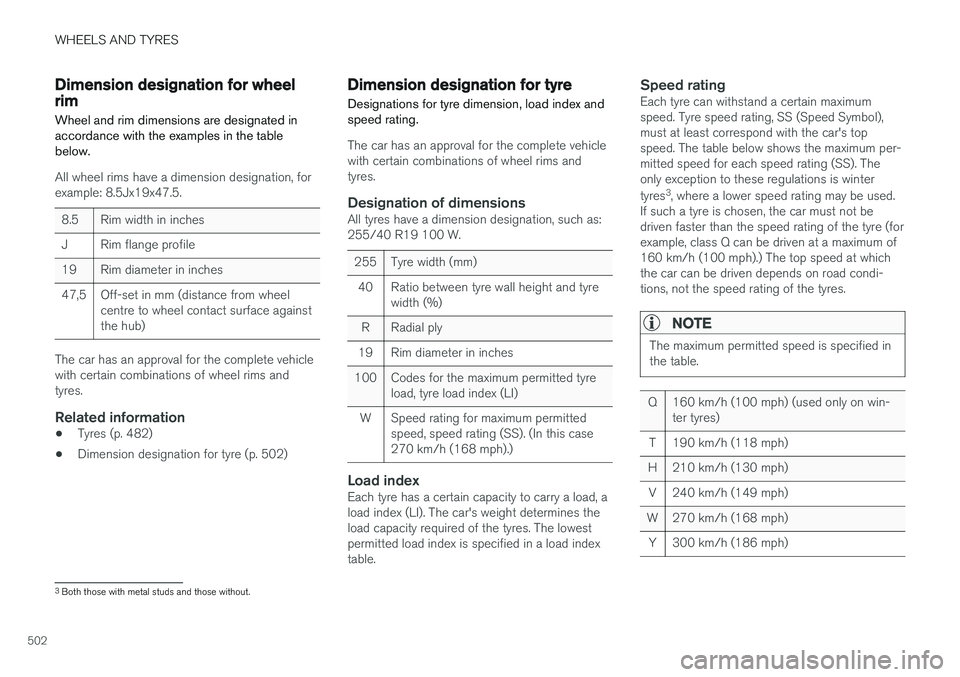
Wheel and rim dimensions are designated in accordance with the examples in the tablebelow.
All wheel rims have a dimension designation, for example: 8.5Jx19x47.5.
8.5 Rim width in inches
J Rim flange profile
19 Rim diameter in inches
47,5 Off-set in mm (distance from wheel centre to wheel contact surface against the hub)
The car has an approval for the complete vehicle with certain combinations of wheel rims andtyres.
Related information
•Tyres (p. 482)
• Dimension designation for tyre (p. 502)
Dimension designation for tyre
Designations for tyre dimension, load index and speed rating.
The car has an approval for the complete vehicle with certain combinations of wheel rims andtyres.
Designation of dimensionsAll tyres have a dimension designation, such as:255/40 R19 100 W.
255 Tyre width (mm)
40 Ratio between tyre wall height and tyre width (%)
R Radial ply
19 Rim diameter in inches
100 Codes for the maximum permitted tyre load, tyre load index (LI)
W Speed rating for maximum permitted speed, speed rating (SS). (In this case 270 km/h (168 mph).)
Load indexEach tyre has a certain capacity to carry a load, a load index (LI). The car's weight determines theload capacity required of the tyres. The lowestpermitted load index is specified in a load indextable.
Speed ratingEach tyre can withstand a certain maximumspeed. Tyre speed rating, SS (Speed Symbol),must at least correspond with the car's topspeed. The table below shows the maximum per-mitted speed for each speed rating (SS). Theonly exception to these regulations is winter tyres3
, where a lower speed rating may be used.
If such a tyre is chosen, the car must not be driven faster than the speed rating of the tyre (forexample, class Q can be driven at a maximum of160 km/h (100 mph).) The top speed at whichthe car can be driven depends on road condi-tions, not the speed rating of the tyres.
NOTE
The maximum permitted speed is specified in the table.
Q 160 km/h (100 mph) (used only on win- ter tyres)
T 190 km/h (118 mph)
H 210 km/h (130 mph) V 240 km/h (149 mph)
W 270 km/h (168 mph) Y 300 km/h (186 mph)
3 Both those with metal studs and those without.
Page 534 of 594
||
MAINTENANCE AND SERVICE
532
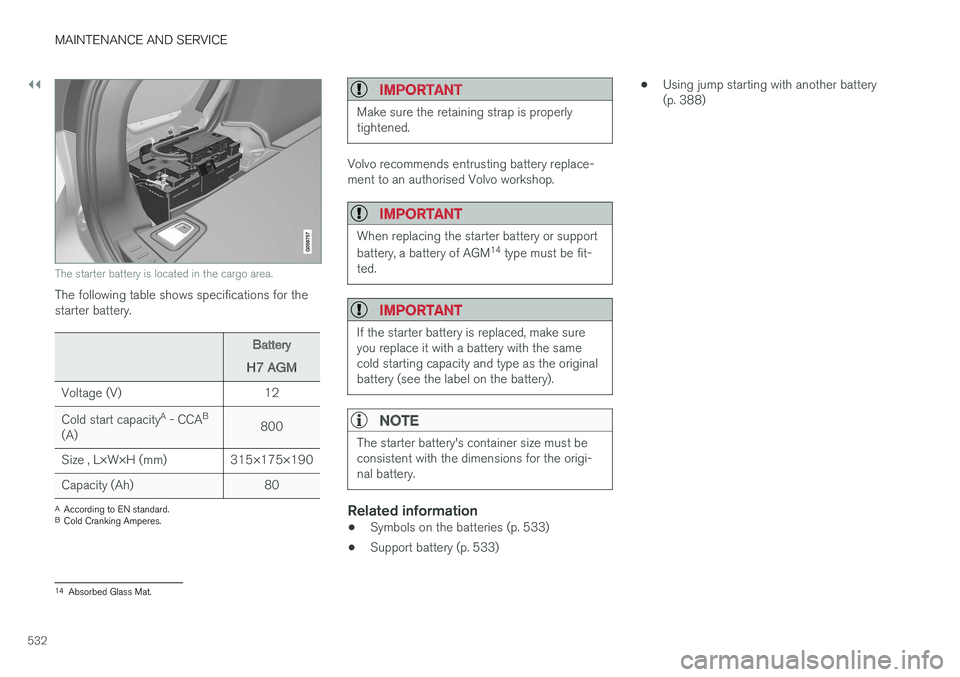
The starter battery is located in the cargo area.
The following table shows specifications for the starter battery.
Battery
H7 AGM
Voltage (V) 12 Cold start capacity A
- CCA B
(A) 800
Size , L×W×H (mm) 315×175×190
Capacity (Ah) 80
A According to EN standard.
B Cold Cranking Amperes.
IMPORTANT
Make sure the retaining strap is properly tightened.
Volvo recommends entrusting battery replace- ment to an authorised Volvo workshop.
IMPORTANT
When replacing the starter battery or support battery, a battery of AGM 14
type must be fit-
ted.
IMPORTANT
If the starter battery is replaced, make sure you replace it with a battery with the samecold starting capacity and type as the originalbattery (see the label on the battery).
NOTE
The starter battery's container size must be consistent with the dimensions for the origi-nal battery.
Related information
• Symbols on the batteries (p. 533)
• Support battery (p. 533) •
Using jump starting with another battery (p. 388)
14
Absorbed Glass Mat.
Page 563 of 594
SPECIFICATIONS
}}
561
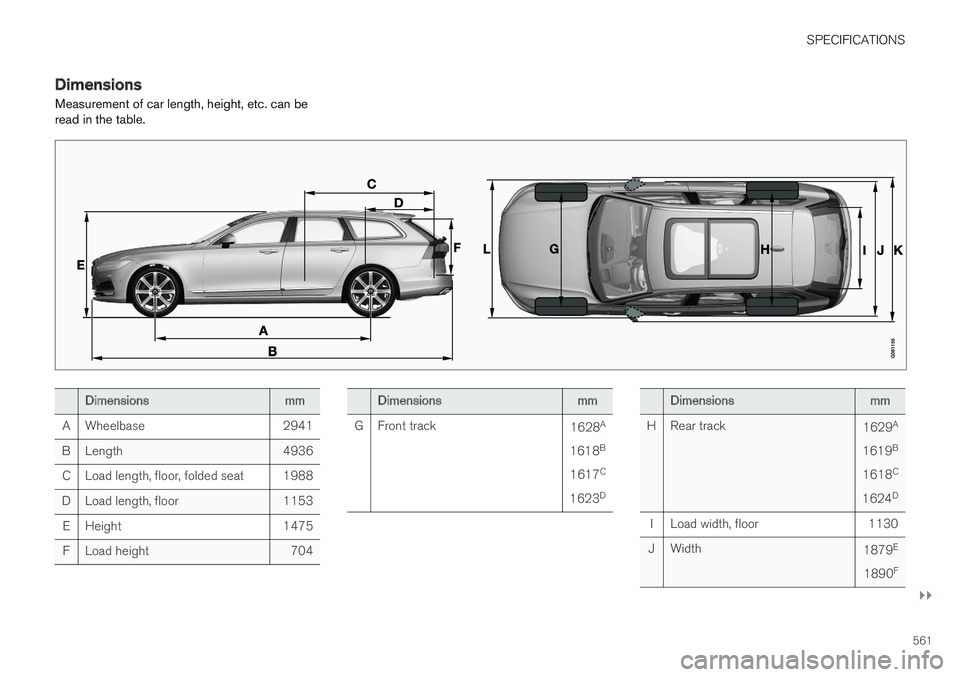
DimensionsMeasurement of car length, height, etc. can be read in the table.
Dimensions mm
A Wheelbase 2941
B Length 4936 C Load length, floor, folded seat 1988
D Load length, floor 1153 E Height 1475F Load height 704Dimensions mm
G Front track 1628A
1618 B
1617 C
1623 DDimensions
mm
H Rear track 1629A
1619 B
1618 C
1624 D
I Load width, floor 1130
J Width 1879E
1890 F
Page 564 of 594
||
SPECIFICATIONS
562
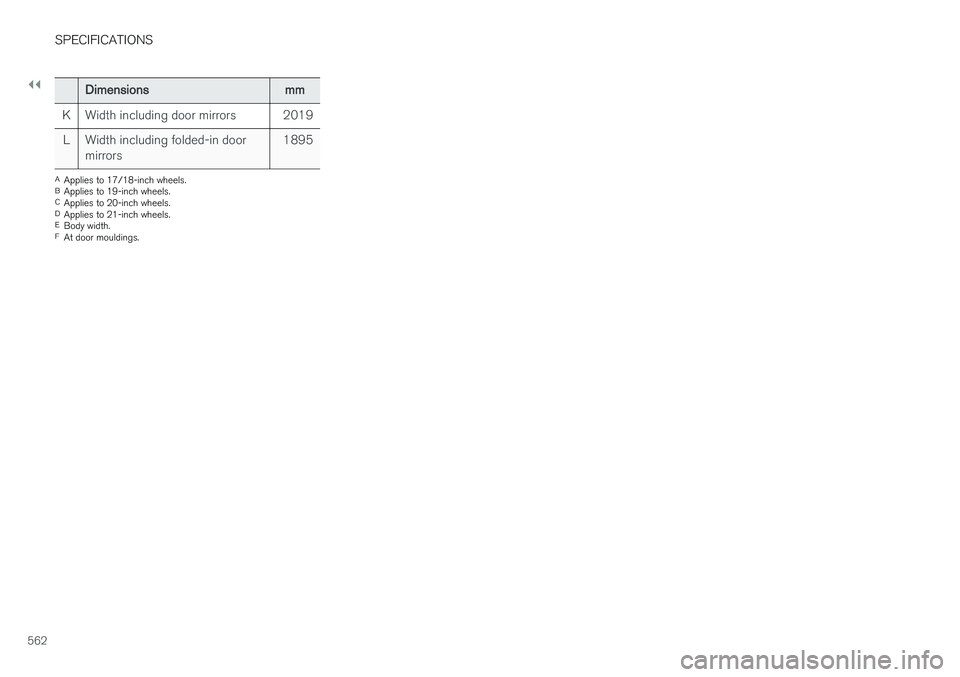
Dimensionsmm
K Width including door mirrors 2019 L Width including folded-in door mirrors 1895
A
Applies to 17/18-inch wheels.
B Applies to 19-inch wheels.
C Applies to 20-inch wheels.
D Applies to 21-inch wheels.
E Body width.
F At door mouldings.
Page 582 of 594
ALPHABETICAL INDEX
580Deadlock 246
deactivation 246
Defrosting 194
Diesel 420 run out of fuel 420
Diesel particle filter 421
Digital radio (DAB) 440
Dimensions 561 Towing bracket 425
dipped beam 137
Dipstick, electronic 517
Direction indicator 144
Direction indicators 144
direction of rotation 483
Disengaging the gear selector inhibitor 394
Display lighting 135
Distance Warning 288, 289 Limitations 290
Door mirrors 153 automatic dimming 154
resetting 154
Drive-E Environmental philosophy 25
Driver Alert Control 352 operation 353
Driver display
application menu 105
messages 106
Driver performance 168
Driver profile 174, 175, 176, 177 edit 175
import/export from/to USB 177
select 174
Drivetrain Gearbox 389
Driving cooling system 414
with a tailer 426
Driving economy 422
Driving in water 413
Driving mode 400Driving with a trailer towball load 564
towing capacity 564
E
ECO mode 402
Economical driving 402, 422
ECO pressure 484, 574
Electrical socket 220
Electrical system 530
Electric parking brake 409low battery voltage 411
Emergency equipment first aid kit 501
warning triangle 500
Emergency puncture repair 490, 494 action 491
inflating the tyres 494
rechecking 491
Emergency puncture repair kit 491 location 490
overview 491
sealing fluid 490
Emissions of carbon dioxide 572 Engine deactivate 387
overheating 414
start 386
Start/Stop 396
Engine compartment coolant 518
Engine oil 516
overview 515
Engine drag control 273
Engine oil 516, 569 adverse driving conditions 569