heating VOLVO V90 2017 Owner's Manual
[x] Cancel search | Manufacturer: VOLVO, Model Year: 2017, Model line: V90, Model: VOLVO V90 2017Pages: 594, PDF Size: 15.07 MB
Page 388 of 594
||
STARTING AND DRIVING
* Option/accessory.
386
NOTE
To reach level I or II without starting the
engine - do not depress the brake pedal, or
the clutch pedal for cars with manual gear changing, when these ignition positions are tobe selected.
• Ignition position I
- Turn the ignition dial to
START and release it. The control automati-
cally returns to its starting position.
• Ignition position II
- Turn the ignition dial to
START and hold it in the START position for
approx. 4 seconds. Then release the knob, which automatically returns to its startingposition.
• Back to ignition position 0
- To return to
ignition position 0 from position I and II -
Turn the ignition dial to STOP and release it.
The control automatically returns to its star-ting position.
Related information
• Starting the car (p. 386)
• Switching off the car (p. 387)
• Driver display (p. 90)
Starting the car
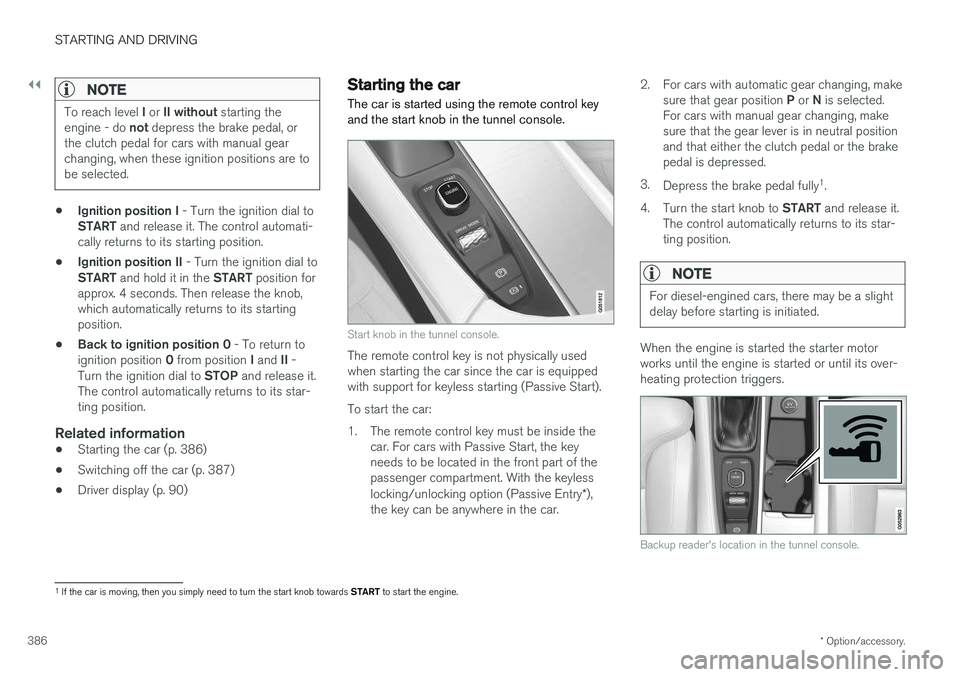
The car is started using the remote control key and the start knob in the tunnel console.
Start knob in the tunnel console.
The remote control key is not physically used when starting the car since the car is equippedwith support for keyless starting (Passive Start). To start the car:
1. The remote control key must be inside the car. For cars with Passive Start, the key needs to be located in the front part of thepassenger compartment. With the keyless locking/unlocking option (Passive Entry *),
the key can be anywhere in the car. 2. For cars with automatic gear changing, make
sure that gear position P or N is selected.
For cars with manual gear changing, make sure that the gear lever is in neutral positionand that either the clutch pedal or the brakepedal is depressed.
3. Depress the brake pedal fully 1
.
4. Turn the start knob to START and release it.
The control automatically returns to its star-ting position.
NOTE
For diesel-engined cars, there may be a slight delay before starting is initiated.
When the engine is started the starter motor works until the engine is started or until its over-heating protection triggers.
Backup reader's location in the tunnel console.
1 If the car is moving, then you simply need to turn the start knob towards START to start the engine.
Page 391 of 594
STARTING AND DRIVING
}}
389
11. Start the engine in the car with the dis-
charged battery.
IMPORTANT
Do not touch the connections between cable and car during the starting attempt. There is arisk of sparks forming.
12. Remove the jump leads in reverse order -first the black and then the red. Make sure that none of the black jump lead's clamps comes into contact with the car'spositive jump-starting point/donor battery'spositive terminal or the clamp connected tothe red jump lead.
WARNING
• The battery can generate oxyhydrogen gas, which is highly explosive. A spark canbe formed if a jump lead is connectedincorrectly, and this can be enough forthe battery to explode.
• The battery contains sulphuric acid, whichcan cause serious burns.
• If sulphuric acid comes into contact witheyes, skin or clothing, flush with largequantities of water. If acid splashes intothe eyes - seek medical attention imme-diately.
Related information
•Starter battery (p. 530)
• Ignition positions (p. 385)
• Starting the car (p. 386)
• Opening and closing the bonnet (p. 514)
Gearbox
The gearbox is part of the car's driveline (power transmission) between engine and drive wheels.The function of the gearbox is to change thegear ratio depending on speed and powerrequirements.
There are two main types of gearbox, manual and automatic. The manual gearbox has six gears. The automatic gearbox can have either eight gears or six gearsdepending on which engine the car is equippedwith. The number of gear changes means thatthe engine's torque and power range can beused effectively. It is also possible to select gears manually with the automatic gearbox. The driver display respec-tively shows which gear or gear position is cur-rently in use.
IMPORTANT
To prevent damage to any drive system com- ponents, the working temperature of thegearbox is checked. If there is a risk of over-heating, a warning symbol illuminates in thedriver display and a text message is shown -follow the recommendation given.
Symbols in the driver displayIf a fault should occur in the gearbox, the driver display shows a symbol and a message.
Page 400 of 594
||
STARTING AND DRIVING
* Option/accessory.
398
With 8-inch driver display
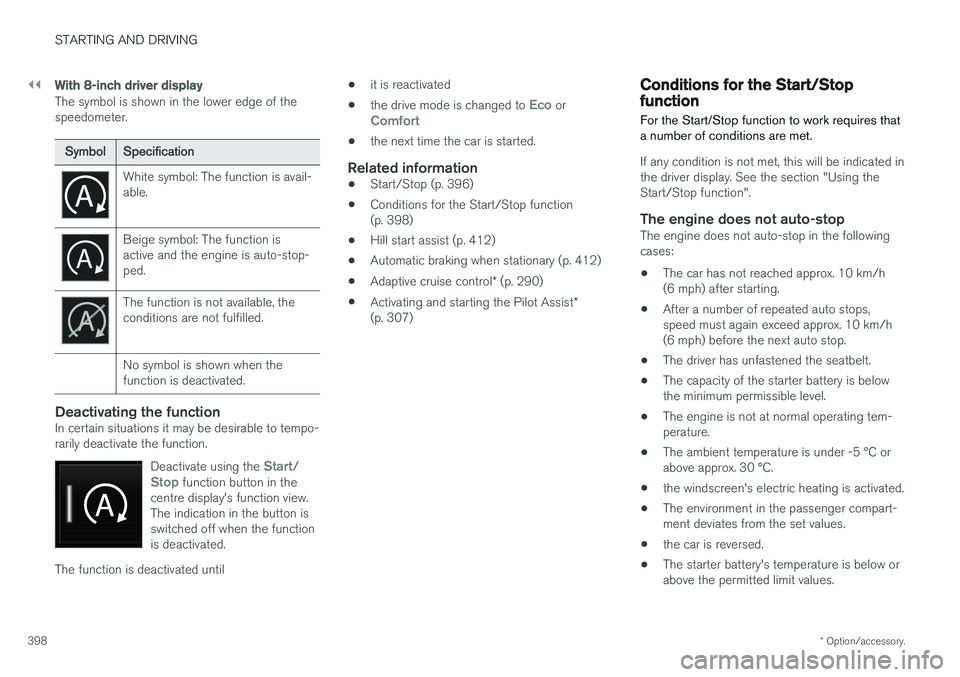
The symbol is shown in the lower edge of the speedometer.
Symbol Specification
White symbol: The function is avail- able.
Beige symbol: The function is active and the engine is auto-stop-ped.
The function is not available, the conditions are not fulfilled. No symbol is shown when the function is deactivated.
Deactivating the functionIn certain situations it may be desirable to tempo- rarily deactivate the function.
Deactivate using the
Start/
Stop function button in the
centre display's function view. The indication in the button isswitched off when the functionis deactivated.
The function is deactivated until •
it is reactivated
• the drive mode is changed to
Eco orComfort
• the next time the car is started.
Related information
•
Start/Stop (p. 396)
• Conditions for the Start/Stop function (p. 398)
• Hill start assist (p. 412)
• Automatic braking when stationary (p. 412)
• Adaptive cruise control
* (p. 290)
• Activating and starting the Pilot Assist
*
(p. 307)
Conditions for the Start/Stop function For the Start/Stop function to work requires that a number of conditions are met.
If any condition is not met, this will be indicated in the driver display. See the section "Using theStart/Stop function".
The engine does not auto-stopThe engine does not auto-stop in the followingcases: • The car has not reached approx. 10 km/h (6 mph) after starting.
• After a number of repeated auto stops,speed must again exceed approx. 10 km/h(6 mph) before the next auto stop.
• The driver has unfastened the seatbelt.
• The capacity of the starter battery is belowthe minimum permissible level.
• The engine is not at normal operating tem-perature.
• The ambient temperature is under -5 °C orabove approx. 30 °C.
• the windscreen's electric heating is activated.
• The environment in the passenger compart-ment deviates from the set values.
• the car is reversed.
• The starter battery's temperature is below orabove the permitted limit values.
Page 416 of 594
||
STARTING AND DRIVING
414
IMPORTANT
Engine damage can occur if water enters the air filter. In depths greater than 25 cm, water could enter the transmission. This reduces the lubri-cating ability of the oils and shortens theservice life of these systems. Damage to any component, engine, transmis- sion, turbocharger, differential or its internalcomponents caused by flooding, hydrostaticlocking or oil shortage, is not covered by thewarranty. In the event of the engine stalling in water, do not try restart - tow the car from the water toa workshop - an authorised Volvo workshop isrecommended. Risk of engine breakdown.
Related information
•Towing (p. 431)
• Recovering the car (p. 432)
Overheating in the engine and drive system
Under special conditions, for example hard driv- ing in hilly terrain and hot climate, there is a riskthat the engine and drive system may overheat -in particular with a heavy load.
• In the event of overheating, the engine's power may be limited temporarily.
• Remove any auxiliary lamps from in front ofthe grille when driving in hot climates.
• If the temperature in the engine's coolingsystem becomes too high then a warningsymbol is illuminated and the driver display shows the message
Engine temperature
High temperature Stop safely. Stop the
car in a safe way and allow the engine to run at idling speed for several minutes and cooldown.
• If the message
Engine temperature High
temperature Turn off engine or Engine
coolant Level low, turn off engine is
shown, stop the car and switch off the engine.
• In the event of overheating in the gearbox, analternative gear shift program will beselected. In addition, a built-in protectionfunction is activated that, amongst otherthings, illuminates a warning symbol and thedriver display shows the message
Transmission warm Reduce speed to
lower temperature or Transmission hot Stop safely, wait for cooling
. Follow the
recommendation given, reduce speed or stop the car in a safe way and allow the engine torun at idling speed for several minutes toenable the gearbox to cool down.
• If the car overheats, the air conditioning maybe switched off temporarily.
• Do not turn the engine off immediately youstop after a hard drive.
NOTE
It is normal for the engine's cooling fan to operate for a time after the engine has beenswitched off.
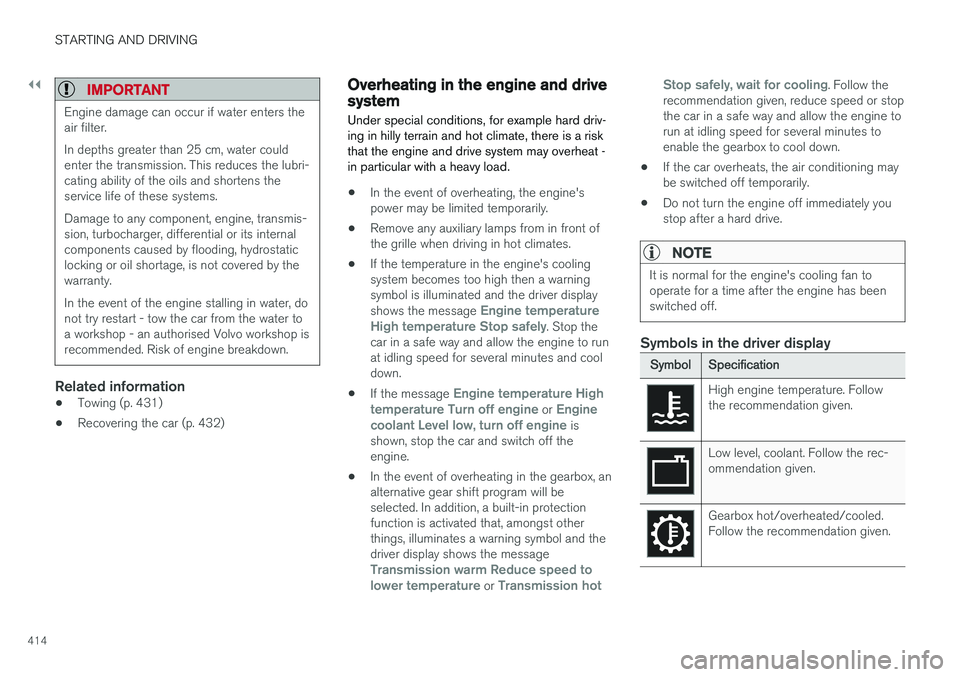
Symbols in the driver display
Symbol
Specification
High engine temperature. Follow the recommendation given.
Low level, coolant. Follow the rec- ommendation given.
Gearbox hot/overheated/cooled. Follow the recommendation given.
Page 422 of 594
STARTING AND DRIVING
420
Diesel Diesel is a type of engine fuel that is intended for cars with a diesel engine.
Only use diesel fuel from well-known producers. Never use fuel of dubious quality. Diesel fuelmust fulfil the EN 590 or SS 155435 standard.Diesel engines are sensitive to contaminants inthe fuel, such as excessively high volumes of sul-phur and metals. At low temperatures (lower than 0 °C) a paraffin precipitate may form in the diesel fuel, which maylead to ignition problems. The fuel qualities thatare sold must be adapted for season and climatezone, but for extreme weather conditions, old fuelor moving between climate zones, paraffin precip-itate may occur. The risk of condensation in the fuel tank is reduced if the tank is kept well filled. When refuelling, check that the area around the fuel filler pipe is clean. Avoid spilling fuel onto thepaintwork. Wash off any spillage with detergentand water.
IMPORTANT
Diesel fuel must: •fulfil the EN 590 and/or SS 155435 standards
• have a sulphur content not exceeding10 mg/kg
• have a maximum of 7 vol % FAME 15
(B7).
IMPORTANT
Diesel type fuels that must not be used:
• Special additives
• Marine diesel fuel
• Heating oil
• FAME 16
and vegetable oil.
These fuels do not fulfil the requirements in accordance with Volvo recommendations andgenerate increased wear and engine damagethat is not covered by the Volvo warranty.
Related information
• Empty tank and diesel engine (p. 420)
• Diesel particulate filter (p. 421)
Empty tank and diesel engine
Once the engine has stopped due to fuel starva- tion, the fuel system needs a few moments tocarry out a check.
Before starting the engine after the fuel tank has
been filled with diesel - proceed as follows:
1. The remote control key must be inside the car.
2. Set the car in ignition position II - turn the
ignition dial to START without depressing
the brake pedal and hold the knob in the START position for approx. 4 seconds. Then
release the knob, which automatically returns to its starting position.
3. Wait approx. one minute.
4. To start the engine: Depress the brake pedal and turn the ignition dial to START again.
NOTE
Before filling with fuel in the event of fuel shortage:
• Stop the car on as flat/level ground aspossible - if the car is tilting there is a riskof air pockets in the fuel supply.
15
Fatty Acid Methyl Ester
16 Diesel fuel with maximum 7 vol % FAME (B7) is permitted.
Page 430 of 594
STARTING AND DRIVING
* Option/accessory.
428
Driving with a trailer under special conditions
When driving with a trailer in hilly terrain in a hot climate there may be a risk of overheating.
In the event of overheating, a warning symbol illu- minates in the driver display together with a mes-sage, see section "Overheating in the engine anddrive system". The following only applies to cars with automatic gearbox. The automatic gearbox selects the optimum gear related to load and engine speed.
Steep inclinesDo not lock the automatic gearbox in a highergear than the engine "can cope with" - it is notalways a good idea to drive at a high gear withlow engine speed.
Parking on a hill1. Depress the brake pedal fully.
2. Activate the parking brake.3. Select gear position P.
4. Release the brake pedal.Block the wheels with chocks when parking a car with hitched trailer on a hill.
Starting on a hill1. Depress the brake pedal fully. 2.
Select gear position D.
3. Releasing the parking brake.
4. Release the brake pedal and start driving off.
Related information
• Driving with a trailer (p. 426)
• Overheating in the engine and drive system (p. 414)
• Using the parking brake (p. 410)
Trailer Stability Assist
*
The function of the trailer stability assist Trailer Stability Assist (TSA) is to stabilise cars withattached trailers in situations where they begin
Page 494 of 594
||
WHEELS AND TYRES
4925. Screw in the bottle to the bottom of the bot-
tle holder.
> The bottle and the bottle holder areequipped with a reverse catch to prevent sealant leakage. When the bottle isscrewed in it cannot be unscrewed fromthe bottle holder again. Bottle removalmust be performed at a workshop, Volvorecommends an authorised Volvo work-shop.
WARNING
•In the event of skin contact with the seal- ing fluid, it must be washed off immediatelywith soap and plenty of water.
• Sealing fluid that makes contact with aneye must be rinsed away immediately witheye wash fluid or with plenty of water. If thediscomfort persists then the eye should beexamined by a doctor.
WARNING
Do not unscrew the bottle, it is equipped with a reverse catch to prevent leakage. 6. Unscrew the tyre's dust cap.
Check that the pressure reducing valve on the air hose is fully screwed on, and screw inthe air hose's valve connection to the bottomof the tyre valve's thread.
7. Connect the electrical cable to the closest 12 V socket and start the car.
NOTE
Make sure that none of the other 12 V sock- ets is in use when the compressor is operat-ing.
WARNING
Do not leave children in the car without supervision when the engine is running. 8. Start the compressor by flicking the switch to
position I.
WARNING
Never stand next to the tyre when the com- pressor is running. If cracks or unevennessarise then the compressor must be switchedoff immediately. The journey should not becontinued. Contacting an authorised tyre cen-tre is recommended.
NOTE
When the compressor starts, the pressure can increase up to 6 bar but the pressuredrops after approximately 30 seconds.
9. Inflate the tyre for 7 minutes.
IMPORTANT
The compressor must not be operated for longer than 10 minutes - risk of overheating.
Page 497 of 594
WHEELS AND TYRES
}}
* Option/accessory.495
IMPORTANT
Risk of overheating. The compressor must not run for more than 10 minutes.
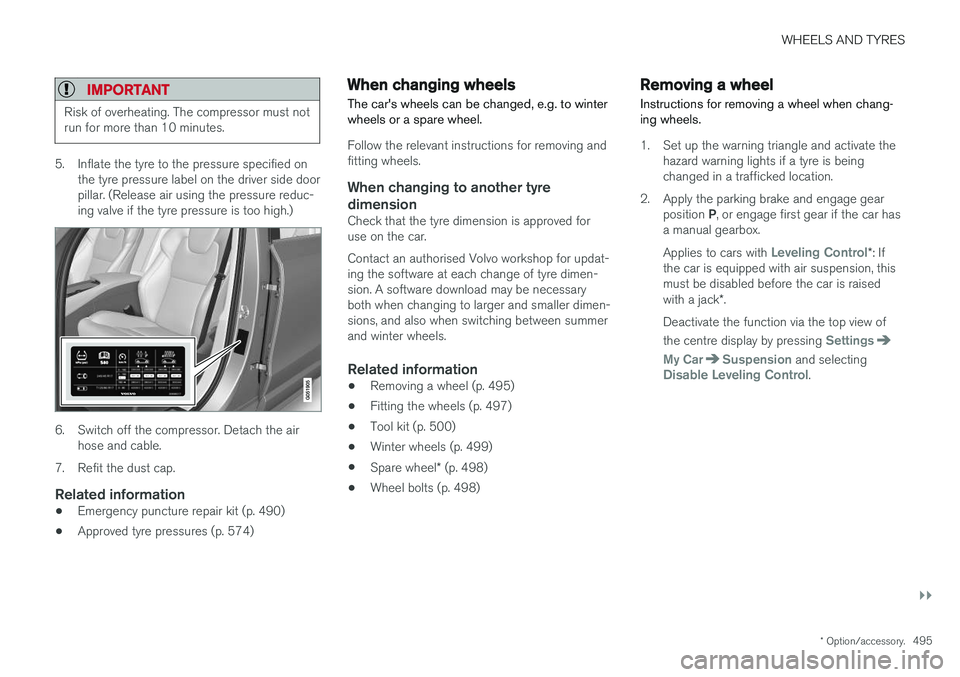
5. Inflate the tyre to the pressure specified on
the tyre pressure label on the driver side door pillar. (Release air using the pressure reduc-ing valve if the tyre pressure is too high.)
6. Switch off the compressor. Detach the airhose and cable.
7. Refit the dust cap.
Related information
• Emergency puncture repair kit (p. 490)
• Approved tyre pressures (p. 574)
When changing wheels
The car's wheels can be changed, e.g. to winter wheels or a spare wheel.
Follow the relevant instructions for removing and fitting wheels.
When changing to another tyre
dimension
Check that the tyre dimension is approved foruse on the car. Contact an authorised Volvo workshop for updat- ing the software at each change of tyre dimen-sion. A software download may be necessaryboth when changing to larger and smaller dimen-sions, and also when switching between summerand winter wheels.
Related information
• Removing a wheel (p. 495)
• Fitting the wheels (p. 497)
• Tool kit (p. 500)
• Winter wheels (p. 499)
• Spare wheel
* (p. 498)
• Wheel bolts (p. 498)
Removing a wheel
Instructions for removing a wheel when chang- ing wheels.
1. Set up the warning triangle and activate the hazard warning lights if a tyre is being changed in a trafficked location.
2. Apply the parking brake and engage gear position P, or engage first gear if the car has
a manual gearbox. Applies to cars with
Leveling Control* : If
the car is equipped with air suspension, this must be disabled before the car is raised with a jack *.
Deactivate the function via the top view of the centre display by pressing
Settings
My CarSuspension and selectingDisable Leveling Control.
Page 541 of 594
MAINTENANCE AND SERVICE
}}
* Option/accessory.539
•
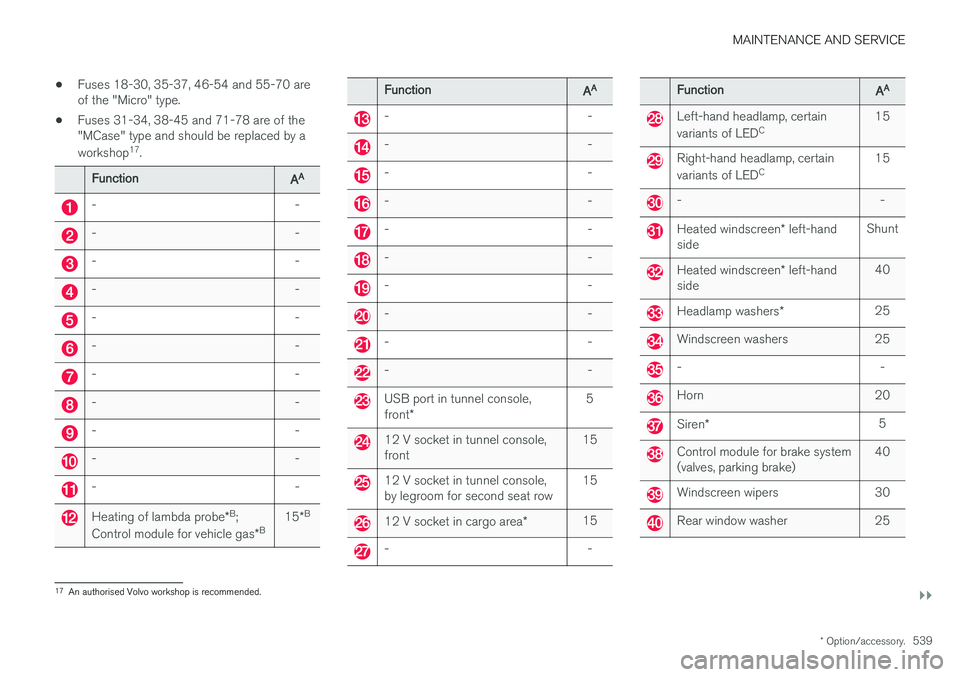
Fuses 18-30, 35-37, 46-54 and 55-70 are of the "Micro" type.
• Fuses 31-34, 38-45 and 71-78 are of the"MCase" type and should be replaced by a workshop 17
.
Function AA
- -
- -
- -
- -
- -
- -
- -
- -
- -
- -
- -
Heating of lambda probe
*B
;
Control module for vehicle gas *B 15
*B
Function
AA
- -
- -
- -
- -
- -
- -
- -
- -
- -
- -
USB port in tunnel console, front
* 5
12 V socket in tunnel console, front
15
12 V socket in tunnel console, by legroom for second seat row15
12 V socket in cargo area
*15
- -
Function
AA
Left-hand headlamp, certain variants of LED C 15
Right-hand headlamp, certain variants of LED
C 15
- -
Heated windscreen
* left-hand
side Shunt
Heated windscreen
* left-hand
side 40
Headlamp washers
*25
Windscreen washers 25
- -
Horn 20
Siren
* 5
Control module for brake system (valves, parking brake) 40
Windscreen wipers 30
Rear window washer 25
17
An authorised Volvo workshop is recommended.
Page 547 of 594
MAINTENANCE AND SERVICE
* Option/accessory.545
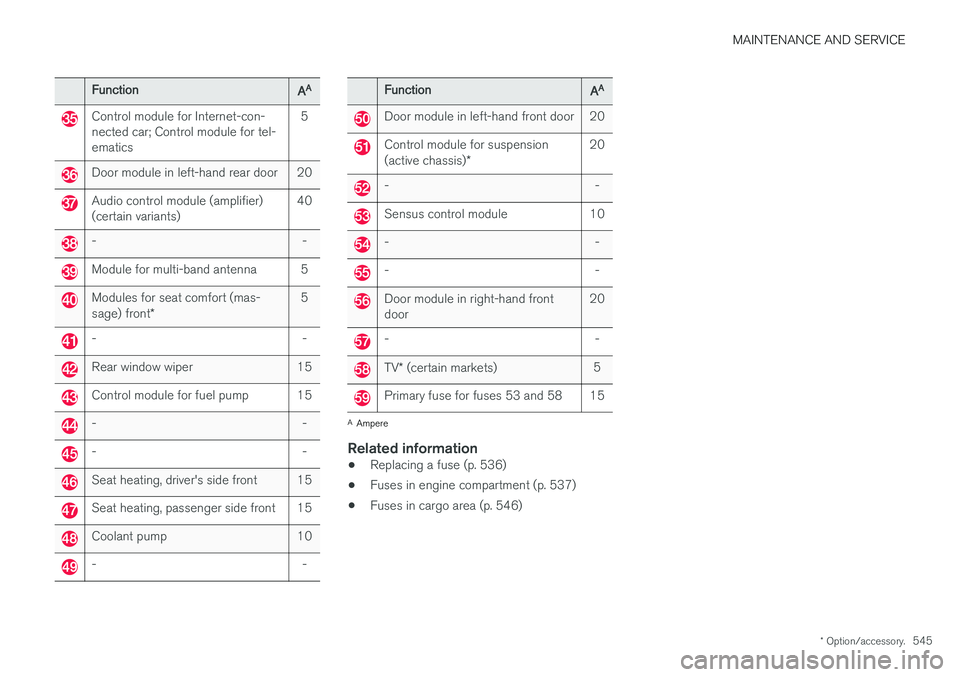
Function
AA
Control module for Internet-con- nected car; Control module for tel-ematics 5
Door module in left-hand rear door 20
Audio control module (amplifier) (certain variants)
40
- -
Module for multi-band antenna 5
Modules for seat comfort (mas- sage) front
* 5
- -
Rear window wiper 15
Control module for fuel pump 15
- -
- -
Seat heating, driver's side front 15
Seat heating, passenger side front 15
Coolant pump 10
- -
Function
AA
Door module in left-hand front door 20
Control module for suspension (active chassis)
* 20
- -
Sensus control module 10
- -
- -
Door module in right-hand front door
20
- -
TV
* (certain markets) 5
Primary fuse for fuses 53 and 58 15
A
Ampere
Related information
• Replacing a fuse (p. 536)
• Fuses in engine compartment (p. 537)
• Fuses in cargo area (p. 546)