trailer VOLVO V90 2017 Owner's Manual
[x] Cancel search | Manufacturer: VOLVO, Model Year: 2017, Model line: V90, Model: VOLVO V90 2017Pages: 594, PDF Size: 15.07 MB
Page 424 of 594
STARTING AND DRIVING
* Option/accessory.
422
Economical driving
Drive economically and eco-consciously by driv- ing smoothly, thinking ahead, and adjusting yourdriving style and speed to the prevailing condi-tions.
• For lower fuel consumption, activate ECO drive mode.
• Use the Eco Coast 17
freewheel function -
engine braking will cease and the car'skinetic energy can be used to freewheel forlonger distances.
• Drive in the highest gear 18
possible, adapted
to the current traffic situation and road -lower engine speeds result in lower fuel con-sumption. Use the gear shift indicator.
• Drive at a steady speed and keep a good dis-tance to other vehicles and objects to mini-mise braking.
• High speed results in increased fuel con-sumption - the wind resistance increaseswith speed.
• Do not run the engine to operating tempera-ture at idling speed, but rather drive with anormal load right after starting - a coldengine consumes more fuel than a warmone. •
Drive with the correct air pressure in thetyres and check this regularly - select ECOtyre pressure for best results.
• Choice of tyres can affect fuel consumption -seek advice on suitable tyres from a dealer.
• Remove unnecessary items from the car -the greater the load the higher the consump-tion.
• Use engine braking to slow down, when itcan take place without risk to other roadusers.
• A roof load and space box increase windresistance, leading to higher consumption -remove the load carriers when not in use.
• Avoid driving with open windows.
WARNING
Never switch off the engine while moving, such as downhill, this deactivates importantsystems such as the power steering andbrake servo.
Related information
•
Drive mode ECO (p. 402)
• Approved tyre pressures (p. 574)
• Fuel consumption and CO2 emissions (p. 572)
• Drive-E - cleaner driving pleasure (p. 25)
Towing bracket
*
The car can be equipped with a towing bracket that makes it possible to tow e.g. a trailer afterthe car.
There may be different towing bracket variants available for the car; contact a Volvo dealer formore information. For information on towing capacity and towball load, see the section "Towing capacity and tow-ball load".
IMPORTANT
When the engine is switched off, the constant battery voltage to the trailer connector can beswitched off automatically so as not to drainthe starter battery.
IMPORTANT
The towball needs regular cleaning and lubri- cation with grease in order to prevent wear.
17 See the section "Drive mode ECO".
18 Applies to driving with manual gear changing.
Page 425 of 594
STARTING AND DRIVING
}}
* Option/accessory.423
NOTE
When a hitch with a vibration damper is used, the towball must not be lubricated. This also applies when fitting a bicycle rack that is clamped in around the towball.
NOTE
If the car is equipped with a towing bracket, there is no rear mounting for a towing eye.
Related information
•Driving with a trailer (p. 426)
• Towing capacity and towball load (p. 564)
• Trailer Stability Assist
* (p. 428)
• Towing bracket specifications
* (p. 425)
• Extendable/retractable towing brackets
*
(p. 423)
Extendable/retractable towing brackets *
The extendable/retractable towing hitch is always easily accessible and simple to extend orretract as needed. In the retracted position, thetowing hitch is completely concealed.
WARNING
Follow the instructions for retracting and extending the towing bracket carefully.
Extending the towing hitch
WARNING
Avoid standing close to the bumper in the centre behind the car when extending thetowing hitch.
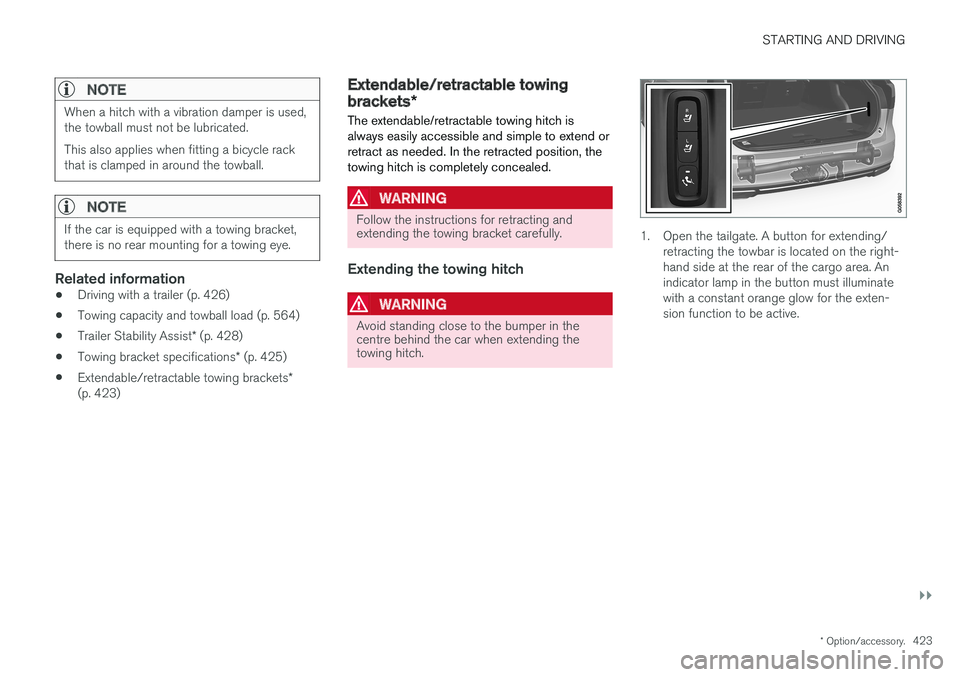
1. Open the tailgate. A button for extending/ retracting the towbar is located on the right- hand side at the rear of the cargo area. Anindicator lamp in the button must illuminatewith a constant orange glow for the exten-sion function to be active.
Page 426 of 594
||
STARTING AND DRIVING
424
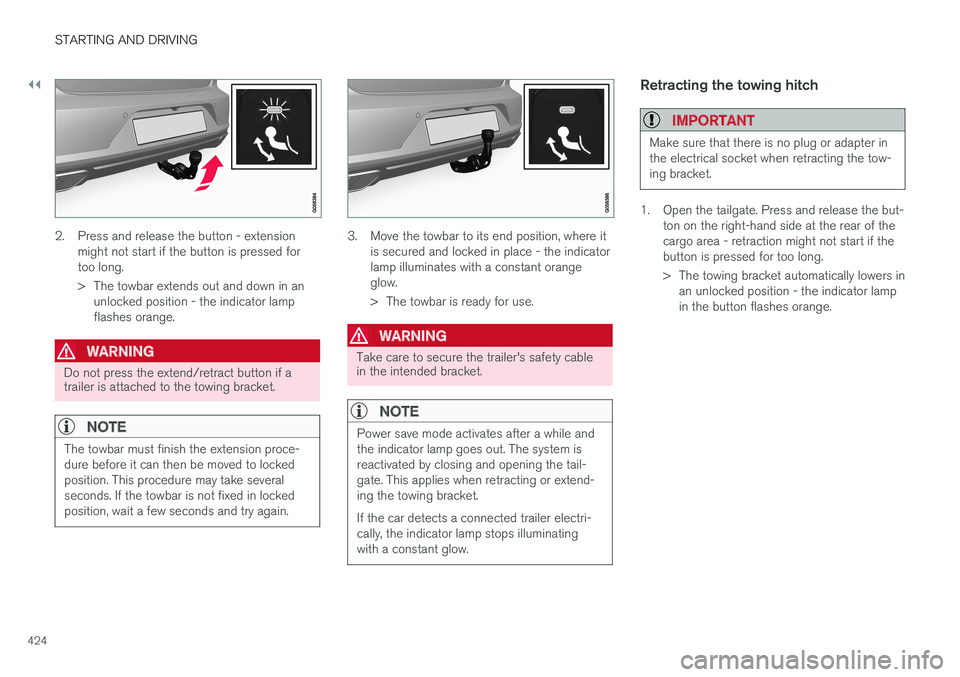
2. Press and release the button - extensionmight not start if the button is pressed for too long.
> The towbar extends out and down in anunlocked position - the indicator lamp flashes orange.
WARNING
Do not press the extend/retract button if a trailer is attached to the towing bracket.
NOTE
The towbar must finish the extension proce- dure before it can then be moved to lockedposition. This procedure may take severalseconds. If the towbar is not fixed in lockedposition, wait a few seconds and try again.
3. Move the towbar to its end position, where it is secured and locked in place - the indicator lamp illuminates with a constant orangeglow.
> The towbar is ready for use.
WARNING
Take care to secure the trailer's safety cable in the intended bracket.
NOTE
Power save mode activates after a while and the indicator lamp goes out. The system isreactivated by closing and opening the tail-gate. This applies when retracting or extend-ing the towing bracket. If the car detects a connected trailer electri- cally, the indicator lamp stops illuminatingwith a constant glow.
Retracting the towing hitch
IMPORTANT
Make sure that there is no plug or adapter in the electrical socket when retracting the tow-ing bracket.
1. Open the tailgate. Press and release the but- ton on the right-hand side at the rear of the cargo area - retraction might not start if thebutton is pressed for too long.
> The towing bracket automatically lowers inan unlocked position - the indicator lamp in the button flashes orange.
Page 428 of 594
STARTING AND DRIVING
426
Driving with a trailer
When driving with a trailer, there are a number of points that are important to think about regar-ding the towing bracket, the trailer and how theload is positioned in the trailer.
Payload depends on the car's kerb weight. The total of the weight of the passengers and allaccessories, e.g. towbar, reduces the car's pay-load by a corresponding weight. The car is supplied with the necessary equipment for towing a trailer.
• The car's towing bracket must be of anapproved type.
• Distribute the load on the trailer so that theweight on the towing bracket complies withthe specified maximum towball load. Towballload is calculated as part of the car's payload.
• Increase the tyre pressure to the recom-mended pressure for a full load. For moreinformation on tyre pressure, see the section"Approved tyre pressures".
• The engine is loaded more heavily than usualwhen driving with a trailer.
• Do not tow a heavy trailer when the car isbrand new. Wait until it has been driven atleast 1000 km.
• The brakes are loaded much more than usualon long and steep downhill slopes. Downshiftto a lower gear and adjust your speed. •
Follow the regulations in force for the permit-ted speeds and weights.
• Maintain a low speed when driving with atrailer up long, steep ascents.
• The maximum trailer weights given only applyto altitudes up to 1000 metres above sealevel. At higher altitudes, engine power andthus the car's climbing ability is decreaseddue to the reduced air density, and the maxi-mum trailer weight must therefore bereduced. The weight of the car and trailermust be decreased by 10 % for each addi-tional 1000 m (or part thereof).
• Avoid driving with a trailer on inclines of morethan 12%.
NOTE
Extreme weather conditions, driving with a trailer or driving at high altitudes in combina-tion with fuel quality are factors that consider-ably increase the car's fuel consumption.
Trailer connectorAn adapter is required if the car's towing bracket has a 13 pin connector and the trailer has a 7 pinconnector. Use an adapter approved by Volvo.Make sure the cable does not drag on theground.
IMPORTANT
When the engine is switched off, the constant battery voltage to the trailer connector can beswitched off automatically so as not to drainthe starter battery.
Trailer weightsInformation about Volvo's permitted trailer weights is available in the article "Towingcapacity and towball load".
WARNING
Follow the stated recommendations for trailer weights. Otherwise, the car and trailer may bedifficult to control in the event of suddenmovement and braking.
NOTE
The stated maximum permitted trailer weights are those permitted by Volvo. National vehicleregulations can further limit trailer weightsand speeds. Towbars can be certified forhigher towing weights than the car canactually tow.
Direction indicators and brake lights on the trailer
If one or more of the trailer's direction indicators or brake light bulbs is broken, the driver display
Page 429 of 594
STARTING AND DRIVING
* Option/accessory.427
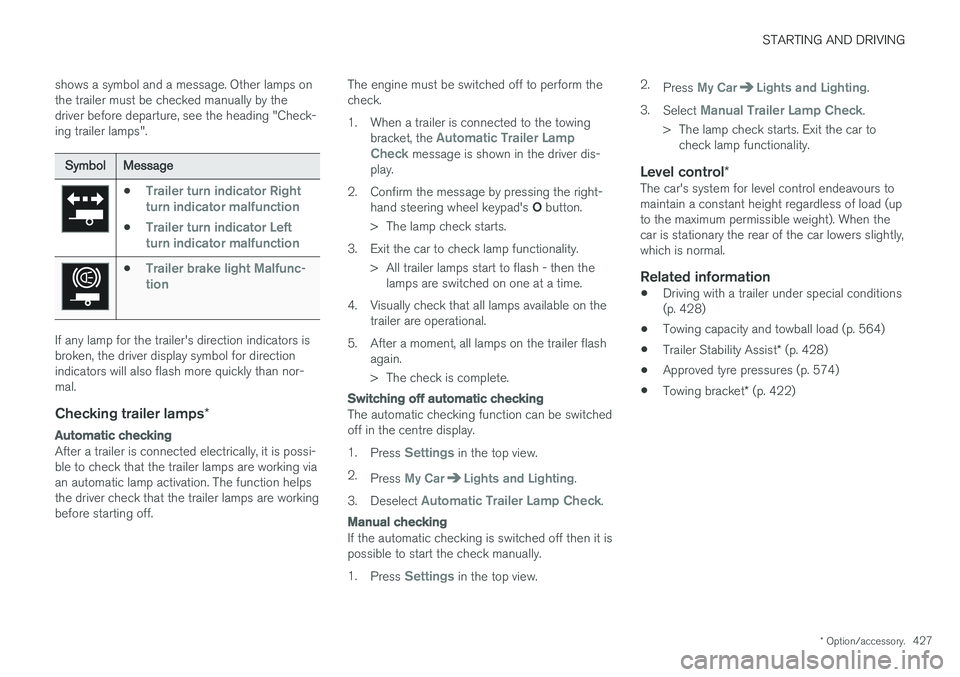
shows a symbol and a message. Other lamps on the trailer must be checked manually by thedriver before departure, see the heading "Check-ing trailer lamps".
Symbol
Message
•Trailer turn indicator Right
turn indicator malfunction
•Trailer turn indicator Left
turn indicator malfunction
•Trailer brake light Malfunc-
tion
If any lamp for the trailer's direction indicators is broken, the driver display symbol for directionindicators will also flash more quickly than nor-mal.
Checking trailer lamps *
Automatic checking
After a trailer is connected electrically, it is possi- ble to check that the trailer lamps are working viaan automatic lamp activation. The function helpsthe driver check that the trailer lamps are workingbefore starting off. The engine must be switched off to perform thecheck.
1. When a trailer is connected to the towing
bracket, the
Automatic Trailer Lamp
Check message is shown in the driver dis-
play.
2. Confirm the message by pressing the right- hand steering wheel keypad's O button.
> The lamp check starts.
3. Exit the car to check lamp functionality. > All trailer lamps start to flash - then thelamps are switched on one at a time.
4. Visually check that all lamps available on the trailer are operational.
5. After a moment, all lamps on the trailer flash again.
> The check is complete.
Switching off automatic checking
The automatic checking function can be switched off in the centre display. 1.Press
Settings in the top view.
2. Press
My CarLights and Lighting.
3. Deselect
Automatic Trailer Lamp Check.
Manual checking
If the automatic checking is switched off then it is possible to start the check manually. 1.Press
Settings in the top view. 2.
Press
My CarLights and Lighting.
3. Select
Manual Trailer Lamp Check.
> The lamp check starts. Exit the car to check lamp functionality.
Level control *The car's system for level control endeavours to maintain a constant height regardless of load (upto the maximum permissible weight). When thecar is stationary the rear of the car lowers slightly,which is normal.
Related information
•Driving with a trailer under special conditions(p. 428)
• Towing capacity and towball load (p. 564)
• Trailer Stability Assist
* (p. 428)
• Approved tyre pressures (p. 574)
• Towing bracket
* (p. 422)
Page 430 of 594
STARTING AND DRIVING
* Option/accessory.
428
Driving with a trailer under special conditions
When driving with a trailer in hilly terrain in a hot climate there may be a risk of overheating.
In the event of overheating, a warning symbol illu- minates in the driver display together with a mes-sage, see section "Overheating in the engine anddrive system". The following only applies to cars with automatic gearbox. The automatic gearbox selects the optimum gear related to load and engine speed.
Steep inclinesDo not lock the automatic gearbox in a highergear than the engine "can cope with" - it is notalways a good idea to drive at a high gear withlow engine speed.
Parking on a hill1. Depress the brake pedal fully.
2. Activate the parking brake.3. Select gear position P.
4. Release the brake pedal.Block the wheels with chocks when parking a car with hitched trailer on a hill.
Starting on a hill1. Depress the brake pedal fully. 2.
Select gear position D.
3. Releasing the parking brake.
4. Release the brake pedal and start driving off.
Related information
• Driving with a trailer (p. 426)
• Overheating in the engine and drive system (p. 414)
• Using the parking brake (p. 410)
Trailer Stability Assist
*
The function of the trailer stability assist Trailer Stability Assist (TSA) is to stabilise cars withattached trailers in situations where they begin
Page 431 of 594
STARTING AND DRIVING
429
snaking. The function is included in the stability system ESC19
.
Reasons for snakingThe snaking phenomenon can occur with any car/trailer combination. Snaking normally occursat high speeds. But, there is a risk of it occurringat lower speeds if the trailer is overloaded or theload is improperly distributed, e.g. too far back. In order for snaking to occur, there must be a triggering factor, e.g.: • Car with trailer subjected to a sudden and powerful side wind.
• Car with trailer drives on an uneven road sur-face or in a pothole.
• Sweeping steering wheel movements.
If snaking has started, it could be difficult or evenimpossible to suppress. This makes the car/trailer combination difficult to control and there isa risk that you could, for example, end up in thewrong lane or leave the carriageway.
Trailer Stability Assist functionThe trailer stability assist function continuallymonitors car movements, particularly lateralmovements. If snaking is detected, the frontwheels are individually braked. This serves to sta-bilise the car/trailer combination. This is oftenenough to help the driver regain control of thecar. If snaking is not eliminated the first time thattrailer stability assist comes into action, the car/trailer combination is braked with all wheels andengine power is reduced. Once snaking has beengradually suppressed and the car/trailer combi-nation is stable once again, the system stopsregulating and the driver once again has full con-trol of the car.
NOTE
The stability function is deactivated if the driver selects Sport mode by deactivating
ESC via the menu system in the centre dis-
play.
The trailer stability assist may fail to engage if the driver uses severe steering wheel movements totry to rectify the snaking because in such a situa-tion the system cannot determine whether it isthe trailer or the driver that is causing the snak-ing.
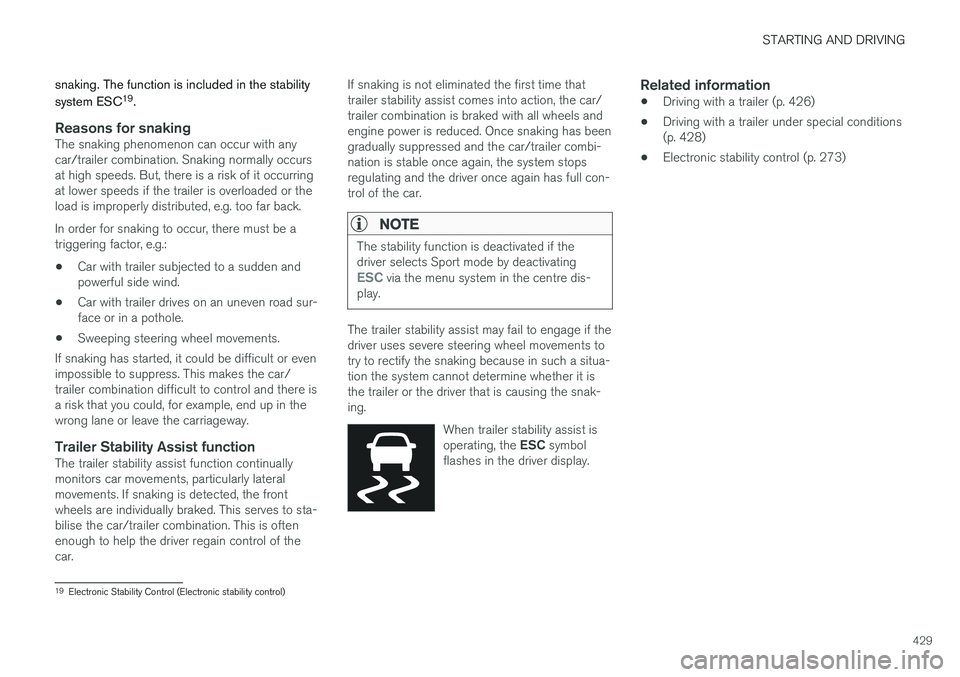
When trailer stability assist is operating, the ESC symbol
flashes in the driver display.
Related information
• Driving with a trailer (p. 426)
• Driving with a trailer under special conditions (p. 428)
• Electronic stability control (p. 273)
19
Electronic Stability Control (Electronic stability control)
Page 565 of 594
SPECIFICATIONS
563
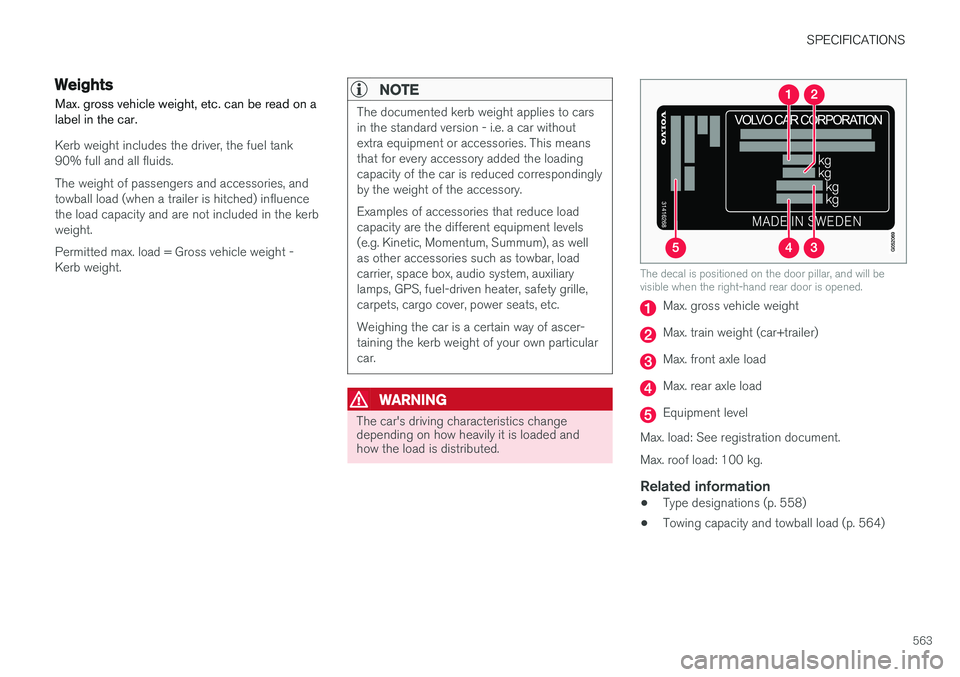
Weights Max. gross vehicle weight, etc. can be read on a label in the car.
Kerb weight includes the driver, the fuel tank 90% full and all fluids. The weight of passengers and accessories, and towball load (when a trailer is hitched) influencethe load capacity and are not included in the kerbweight. Permitted max. load = Gross vehicle weight - Kerb weight.
NOTE
The documented kerb weight applies to cars in the standard version - i.e. a car withoutextra equipment or accessories. This meansthat for every accessory added the loadingcapacity of the car is reduced correspondinglyby the weight of the accessory. Examples of accessories that reduce load capacity are the different equipment levels(e.g. Kinetic, Momentum, Summum), as wellas other accessories such as towbar, loadcarrier, space box, audio system, auxiliarylamps, GPS, fuel-driven heater, safety grille,carpets, cargo cover, power seats, etc. Weighing the car is a certain way of ascer- taining the kerb weight of your own particularcar.
WARNING
The car's driving characteristics change depending on how heavily it is loaded andhow the load is distributed.
The decal is positioned on the door pillar, and will be visible when the right-hand rear door is opened.
Max. gross vehicle weight
Max. train weight (car+trailer)
Max. front axle load
Max. rear axle load
Equipment level
Max. load: See registration document. Max. roof load: 100 kg.
Related information
• Type designations (p. 558)
• Towing capacity and towball load (p. 564)
Page 566 of 594
SPECIFICATIONS
564
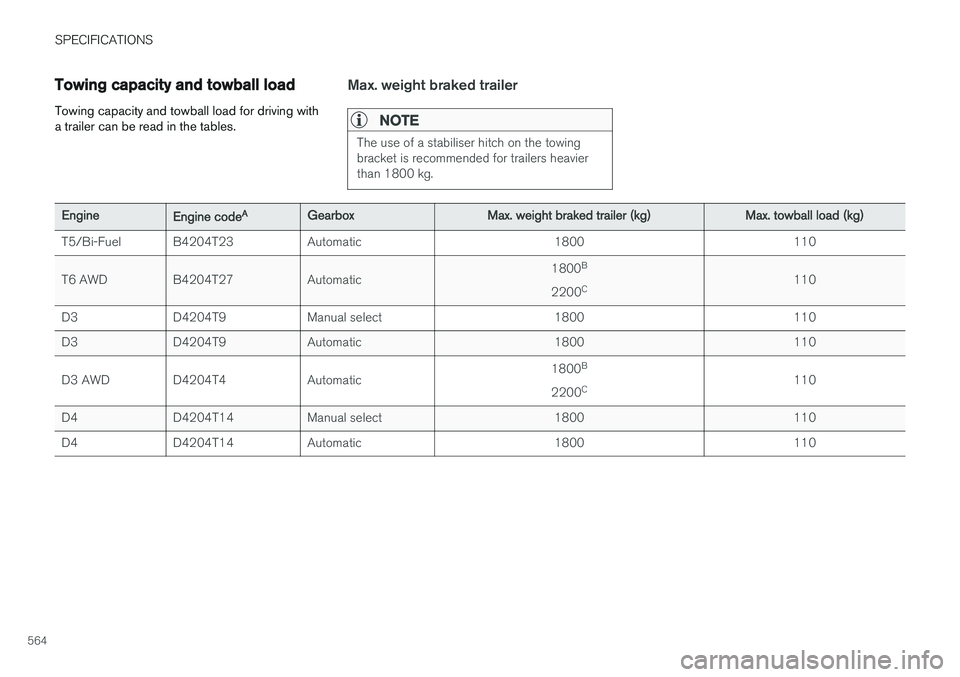
Towing capacity and towball load
Towing capacity and towball load for driving with a trailer can be read in the tables.Max. weight braked trailer
NOTE
The use of a stabiliser hitch on the towing bracket is recommended for trailers heavierthan 1800 kg.
Engine Engine codeA
Gearbox Max. weight braked trailer (kg) Max. towball load (kg)
T5/Bi-Fuel B4204T23 Automatic 1800 110
T6 AWD B4204T27 Automatic 1800
B
2200 C 110
D3 D4204T9 Manual select 1800 110
D3 D4204T9 Automatic 1800 110
D3 AWD D4204T4 Automatic 1800
B
2200 C 110
D4 D4204T14 Manual select 1800 110
D4 D4204T14 Automatic 1800 110
Page 567 of 594
SPECIFICATIONS
* Option/accessory.565
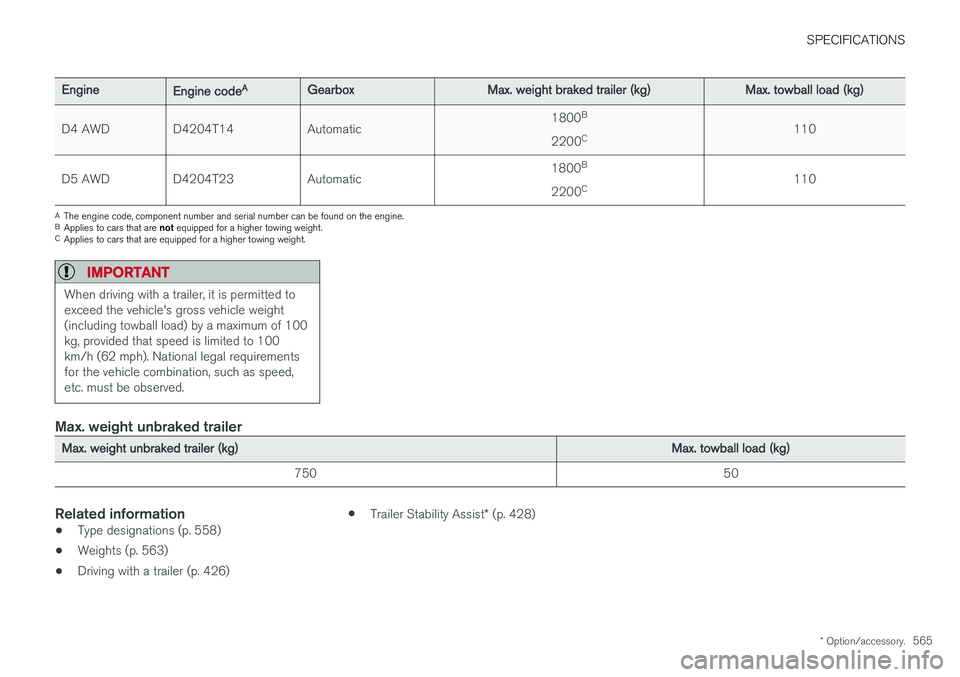
Engine
Engine codeA
Gearbox Max. weight braked trailer (kg) Max. towball load (kg)
D4 AWD D4204T14 Automatic 1800
B
2200 C 110
D5 AWD D4204T23 Automatic 1800
B
2200 C 110
A
The engine code, component number and serial number can be found on the engine.
B Applies to cars that are not equipped for a higher towing weight.
C Applies to cars that are equipped for a higher towing weight.
IMPORTANT
When driving with a trailer, it is permitted to exceed the vehicle's gross vehicle weight(including towball load) by a maximum of 100kg, provided that speed is limited to 100km/h (62 mph). National legal requirementsfor the vehicle combination, such as speed,etc. must be observed.
Max. weight unbraked trailer
Max. weight unbraked trailer (kg) Max. towball load (kg)
750 50
Related information
•Type designations (p. 558)
• Weights (p. 563)
• Driving with a trailer (p. 426) •
Trailer Stability Assist
* (p. 428)