brakes VOLVO XC60 2009 Owner´s Manual
[x] Cancel search | Manufacturer: VOLVO, Model Year: 2009, Model line: XC60, Model: VOLVO XC60 2009Pages: 297, PDF Size: 21.16 MB
Page 219 of 297
05 During your trip
Towing a trailer05
}}
217
Introduction
Volvo recommends the use of Volvo trailer
hitches that are specially designed for the vehi-
cle.
NOTE
See page 282 for the maximum trailer and
tongue weights recommended by Volvo.
\b
Observe the legal requirements of the
state/province in which the vehicles are
\b All Volvo models are equipped with
energy-absorbing shock-mounted bump-
ers. Trailer hitch installation should not
interfere with the proper operation of this
bumper system.
Trailer towing does not normally present any
particular problems, but take into considera-
tion:
\b Increase tire pressure to recommended
full. See the tire inflation tables beginning
on page 258.
\b When your vehicle is new, avoid towing
heavy trailers during the first 620 miles
(1,000 km).
\b Maximum speed when towing a trailer:
50 mph (80 km/h).
\b Engine and transmission are subject to
increased loads. Therefore, engine coolant
temperature should be closely watched when driving in hot climates or hilly terrain.
Use a lower gear and turn off the air con-
ditioner if the temperature gauge needle
enters the red range.
\b If the automatic transmission begins to
overheat, a message will be displayed in
the text window.
\b Avoid overload and other abusive opera-
tion.
\b Hauling a trailer affects handling, durabil-
ity, and economy.
\b It is necessary to balance trailer brakes
with the towing vehicle brakes to provide a
safe stop (check and observe state/local
regulations).
\b Do not connect the trailer\fs brake system
directly to the vehicle\fs brake system.
\b More frequent vehicle maintenance is
required.
\b Remove the ball and drawbar assembly
when the hitch is not being used.
\b Volvo recommends the use of synthetic
engine oil when towing a trailer over long
distances or in mountainous areas.
WARNING \b
Bumper-attached trailer hitches must
not be used on Volvos, nor should
safety chains be attached to the
bumper.
\b Trailer hitches attaching to the vehicle
rear axle must not be used.
\b Never connect a trailer\fs hydraulic
brake system directly to the vehicle
brake system, nor a trailer\fs lighting
system directly to the vehicle lighting
system. Consult your nearest author-
ized Volvo retailer for correct installa-
tion.
\b When towing a trailer, the trailer\fs safety
wire must be correctly fastened to the
hole or hook provided in the trailer hitch
on the vehicle. The safety wire should
never be fastened to or wound around
the drawbar ball.
Page 221 of 297
05 During your trip
Towing a trailer05
219
in the trailer, there is risk of swaying at speeds
between approximately 45-55 mph
(70-90 km/h).
NOTE
\b
The TSA system intervenes at speeds
above approximately 40 mph
(60 km/h).
\b The DSTC symbol ( ) in the instru-
ment panel will flash when TSA is work-
ing.
\b If the driver switches off the
DSTC sys-
tem\fs Spin Control function (see
page 155), TSA will also be switched off.
\b TSA may not intervene when the vehicle
and trailer begin to sway if the driver
tries to compensate for the swaying
motion by moving the steering wheel
rapidly. Swaying may be caused by one of the following
factors:
\b
The vehicle and trailer are hit by a sudden,
strong crosswind
\b The vehicle and trailer are traveling on an
uneven road surface or drive over a bump
\b Sudden movements of the steering wheel
How TSA worksOnce swaying has begun, it can be very diffi-
cult to stop, which makes it difficult to control
the vehicle and trailer.
The TSA system continuously monitors the
vehicle\fs movements, particularly lateral
movement. If the system detects a tendency to
sway, the brakes are applied individually on the
front wheels, which has a stabilizing effect on
the vehicle and trailer. This is often enough to
enable the driver to regain control of the vehi-
cle.
If this is not adequate to stop the swaying
motion, the brakes are applied to all of the
wheels on the vehicle and on the trailer if it is
equipped with brakes, and engine power is
temporarily reduced. As the swaying motion
begins to decrease and the vehicle-trailer have
once again become stable, TSA will no stop
regulating the brakes/engine power and the
driver regains control of the vehicle.
Page 222 of 297
05 During your tripEmergency towing 05
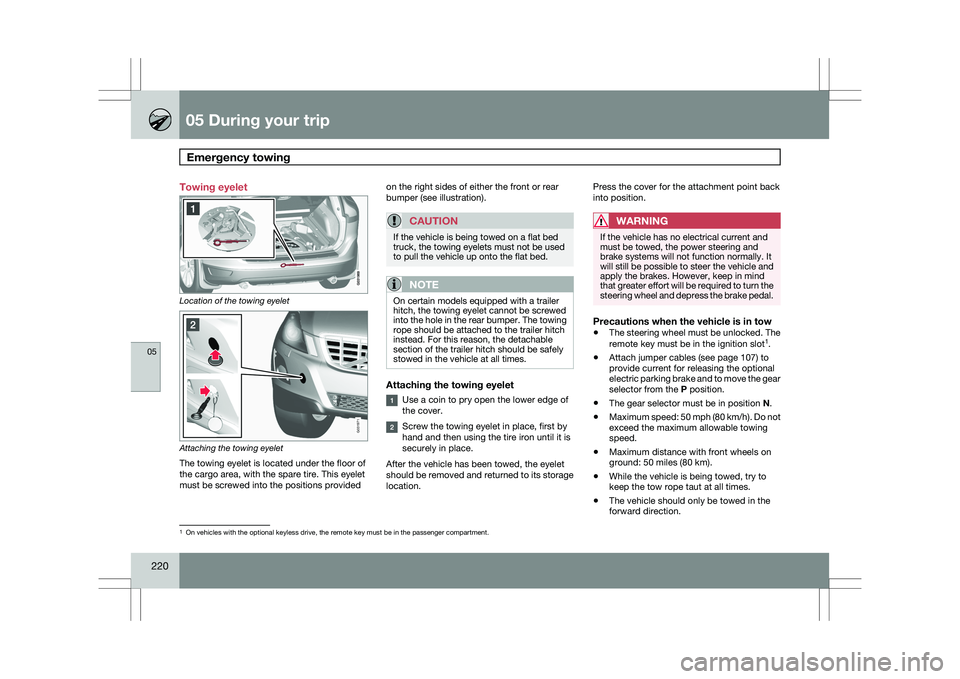
220 Towing eyelet
Location of the towing eyelet
Attaching the towing eyelet
The towing eyelet is located under the floor of
the cargo area, with the spare tire. This eyelet
must be screwed into the positions provided on the right sides of either the front or rear
bumper (see illustration).
CAUTION If the vehicle is being towed on a flat bed
truck, the towing eyelets must not be used
to pull the vehicle up onto the flat bed.
NOTE
On certain models equipped with a trailer
hitch, the towing eyelet cannot be screwed
into the hole in the rear bumper. The towing
rope should be attached to the trailer hitch
instead. For this reason, the detachable
section of the trailer hitch should be safely
stowed in the vehicle at all times.
Attaching the towing eyelet
Use a coin to pry open the lower edge of
the cover.
Screw the towing eyelet in place, first by
hand and then using the tire iron until it is
securely in place.
After the vehicle has been towed, the eyelet
should be removed and returned to its storage
location. Press the cover for the attachment point back
into position.
WARNING If the vehicle has no electrical current and
must be towed, the power steering and
brake systems will not function normally. It
will still be possible to steer the vehicle and
apply the brakes. However, keep in mind
that greater effort will be required to turn the
steering wheel and depress the brake pedal.
Precautions when the vehicle is in tow
\b
The steering wheel must be unlocked. The
remote key must be in the ignition slot 1
.
\b Attach jumper cables (see page 107) to
provide current for releasing the optional
electric parking brake and to move the gear
selector from the
P position.
\b The gear selector must be in position
N.
\b Maximum speed: 50 mph (80 km/h). Do not
exceed the maximum allowable towing
speed.
\b Maximum distance with front wheels on
ground: 50 miles (80 km).
\b While the vehicle is being towed, try to
keep the tow rope taut at all times.
\b The vehicle should only be towed in the
forward direction. 1
On vehicles with the optional keyless drive, the remote key must be in t\
he passenger compartment. G031971
Page 251 of 297
06 Maintenance and specifications
Fuses06
}}
* Option/accessory, for more information, see Introduction. 249
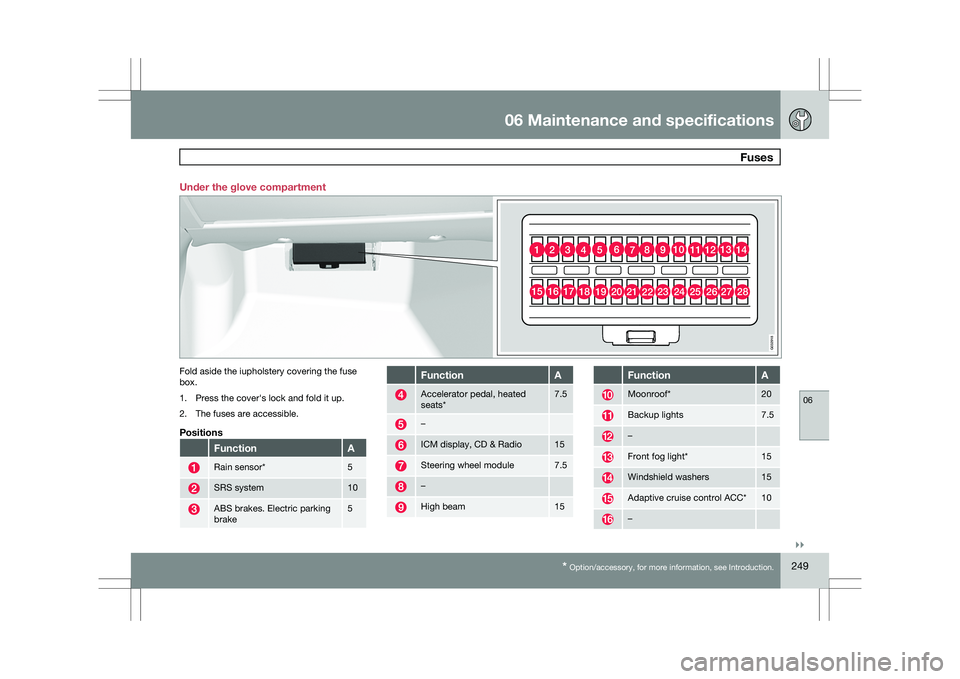
Under the glove compartment
Fold aside the iupholstery covering the fuse
box.
1. Press the cover\fs lock and fold it up.
2. The fuses are accessible.
Positions
Function A
Rain sensor* 5
SRS system 10
ABS brakes. Electric parking
brake 5 Function A
Accelerator pedal, heated
seats* 7.5
–
ICM display, CD & Radio 15
Steering wheel module 7.5
–
High beam 15 Function A
Moonroof* 20
Backup lights 7.5
–
Front fog light* 15
Windshield washers 15
Adaptive cruise control ACC* 10
– 1011121314123456789
2322212019181716152425262728
G032918
Page 265 of 297
06 Maintenance and specifications
Wheels and tires06
}}
263
chains in some cases CANNOT be used.
Sufficient clearances between chains and
brakes, suspension and body components
must be maintained.
\b Some strap-on type chains will interfere
with brake components and therefore
CANNOT be used.
\b All Wheel Drive models: Snow chains
should only be installed on the front
wheels. Only chains adapted for AWD
models should be used.
Consult your Volvo retailer for additional snow
chain information.
CAUTION \b
Check local regulations regarding the
use of snow chains before installing.
\b Use single-sided snow chains only.
\b Always follow the chain manufacturer\fs
installation instructions carefully. Install
chains as tightly as possible and
retighten periodically.
\b Never exceed the chain manufacturer\fs
specified maximum speed limit. (Under
no circumstances should you exceed
31 mph (50 km/h).
\b Avoid bumps, holes or sharp turns
when driving with snow chains.
\b The handling of the vehicle can be
adversely affected when driving with
chains. Avoid fast or sharp turns as well
as locked wheel braking.
Snow tires, studded tires 2
Tires for winter use:
\b Owners who live in or regularly commute
through areas with sustained periods of
snow or icy driving conditions are strongly
advised to fit suitable winter tires to help
retain the highest degree of traction.
\b It is important to install winter tires on all
four wheels to help retain traction during cornering, braking, and accelerating. Fail-
ure to do so could reduce traction to an
unsafe level or adversely affect handling.
\b Do not mix tires of different design as this
could also negatively affect overall tire road
grip.
\b Winter tires wear more quickly on dry roads
in warm weather. They should be removed
when the winter driving season has ended.
\b Studded tires should be run-in
300 – 600 miles (500 – 1000 km) during
which the vehicle should be driven as
smoothly as possible to give the studs the
opportunity to seat properly in the tires.
The tires should have the same rotational
direction throughout their entire lifetime.
NOTE Please consult state or provincial regula-
tions restricting the use of studded winter
tires before installing such tires.
2
Where permitted
Page 277 of 297
06 Maintenance and specifications
Vehicle care06
}}
275
fully. Solvents or stain removers should not be
used.
CAUTION
\b
Avoid waxing or polishing plastic or rub-
ber components
\b Polishing chromed strips can wear
away or damage the surface
\b Polishes containing abrasive sub-
stances should not be used
Automatic car wash
\b
We do NOT recommend washing your car
in an automatic wash during the first six
months (because the paint will not have
hardened sufficiently).
\b An automatic wash is a simple and quick
way to clean your car, but it is worth
remembering that it may not be as thor-
ough as when you yourself go over the car
with sponge and water. Keeping the under-
body clean is most important, especially in
the winter. Some automatic washers do
not have facilities for washing the under-
body.
CAUTION \b
Before driving into an automatic car
wash, turn off the optional rain sensor
to avoid damaging the windshield wip-
ers.
\b Make sure that side view mirrors, auxil-
iary lamps, etc, are secure, and that any
antenna(s) are retracted or removed.
Otherwise there is risk of the machine
dislodging them.
\b Chromed wheels: Clean chrome-
plated wheels using the same deter-
gents used for the body of the vehicle.
Aggressive wheel-cleaning agents can
permanently stain chrome-plated
wheels.
WARNING \b
When the vehicle is driven immediately
after being washed, apply the brakes,
including the parking brake, several
times in order to remove any moisture
from the brake linings.
\b Engine cleaning agents should not be
used when the engine is warm. This
constitutes a fire risk.
Exterior lightingCondensation may form temporarily on the
inside of the lenses of exterior lights such as headlights, fog lights, or taillights. This is nor-
mal and the lights are designed to withstand
moisture. Normally, condensation will dissi-
pate after the lights have been on for a short
time.
Polishing and waxing
\b
Normally, polishing is not required during
the first year after delivery, however, wax-
ing may be beneficial.
\b Before applying polish or wax the vehicle
must be washed and dried. Tar spots can
be removed with kerosene or tar remover.
Difficult spots may require a fine rubbing
compound.
\b After polishing use liquid or paste wax.
\b Several commercially available products
contain both polish and wax.
\b Waxing alone does not substitute for pol-
ishing a dull surface.
\b A wide range of polymer-based waxes can
be purchased today. These waxes are easy
to use and produce a long-lasting, high-
gloss finish that protects the bodywork
against oxidation, road dirt and fading.
\b Do not polish or wax your vehicle in direct
sunlight (the surface of the vehicle should
not be warmer than 113 °F (45 °C).
Page 284 of 297
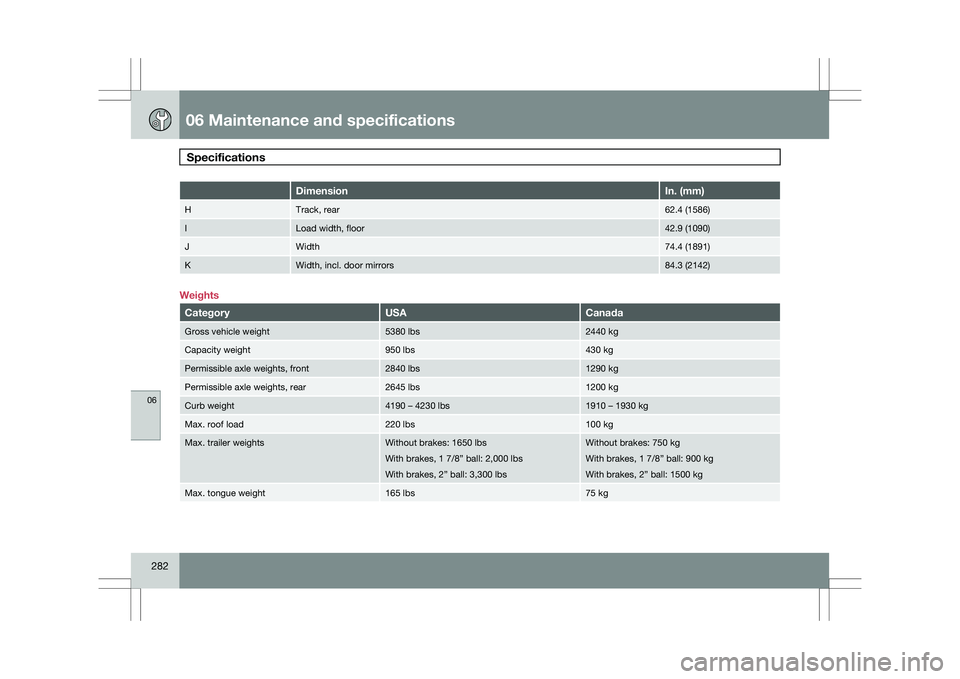
06 Maintenance and specificationsSpecifications 06
282 Dimension In. (mm)
H Track, rear 62.4 (1586)
I Load width, floor 42.9 (1090)
J Width 74.4 (1891)
K Width, incl. door mirrors 84.3 (2142)
Weights
Category USA Canada
Gross vehicle weight 5380 lbs 2440 kg
Capacity weight 950 lbs 430 kg
Permissible axle weights, front 2840 lbs 1290 kg
Permissible axle weights, rear 2645 lbs 1200 kg
Curb weight 4190 – 4230 lbs 1910 – 1930 kg
Max. roof load 220 lbs 100 kg
Max. trailer weights Without brakes: 1650 lbs
With brakes, 1 7/8” ball: 2,000 lbs
With brakes, 2” ball: 3,300 lbs Without brakes: 750 kg
With brakes, 1 7/8” ball: 900 kg
With brakes, 2” ball: 1500 kg
Max. tongue weight 165 lbs 75 kg