weight VOLVO XC60 2009 Owner´s Manual
[x] Cancel search | Manufacturer: VOLVO, Model Year: 2009, Model line: XC60, Model: VOLVO XC60 2009Pages: 297, PDF Size: 21.16 MB
Page 212 of 297
05 During your tripLoading 05
210
* Option/accessory, for more information, see Introduction.
Introduction
The load carrying capacity of your vehicle is
determined by factors such as the number of
passengers, the amount of cargo, the weight
of any accessories that may be installed, etc.
To increase loading space, the rear seat backr-
ests can be folded down, see page 83.
When loading the cargo area, keep the follow-
ing in mind:
\b
Load objects in the cargo area against the
backrest whenever possible.
\b Unstable loads can be secured to the load
anchoring eyelets with straps or web lash-
ings to help keep them from shifting.
\b Stop the engine and apply the parking
brake when loading or unloading long
objects. The gear selector can be knocked
out of position by long loads, which could
set the vehicle in motion.
WARNING \b
Stop the engine, put the gear selector in
P, and apply the parking brake when
loading or unloading long objects.
\b The vehicle\fs driving characteristics
may change depending on the weight
and distribution of the load.
\b A 44-pound (20 kg) object produces a
force of 2,200 pounds (1,000 kg) in a
headon collision at 30 mph (50 km/h).
\b The cargo area and rear seat should not
be loaded to a level higher than 2 in.
(5 cm) below the upper edge of the rear
side windows. Objects placed higher
than this level could impede the func-
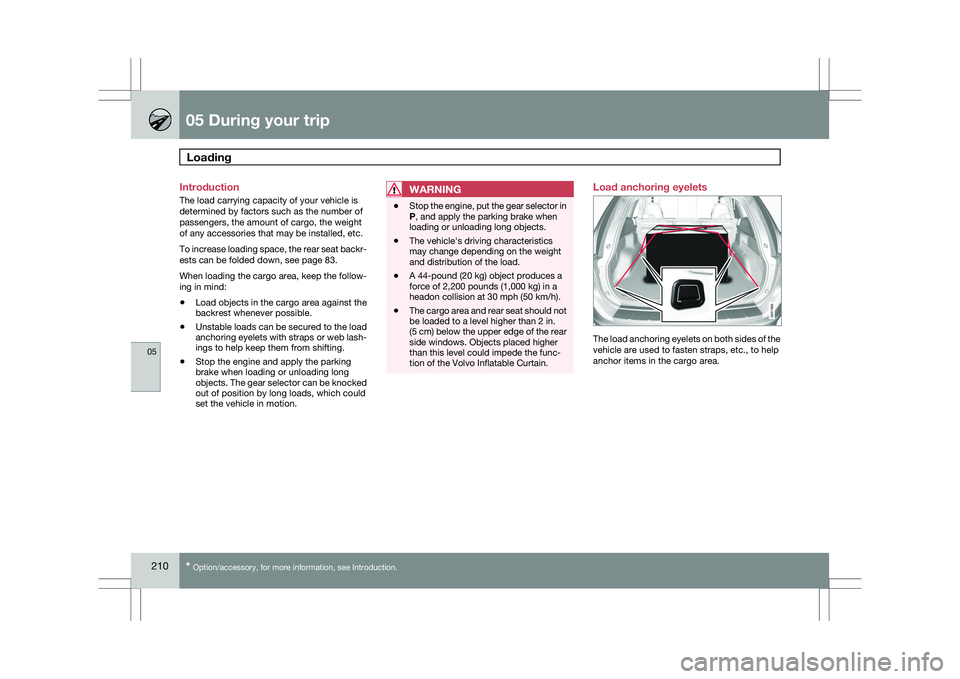
tion of the Volvo Inflatable Curtain. Load anchoring eyelets
The load anchoring eyelets on both sides of the
vehicle are used to fasten straps, etc., to help
anchor items in the cargo area. G031966
Page 213 of 297
05 During your trip
Loading05
}}
211
WARNING\b
Cover sharp edges on long loads to help
prevent injury to occupants. Secure the
load to help prevent shifting during sud-
den stops.
\b Always secure large and heavy objects
with a seat belt or cargo retaining
straps.
\b Always secure the load to help prevent
it from moving in the event of sudden
stops.
\b Switch off the engine, apply the parking
brake and put the gear selector in P
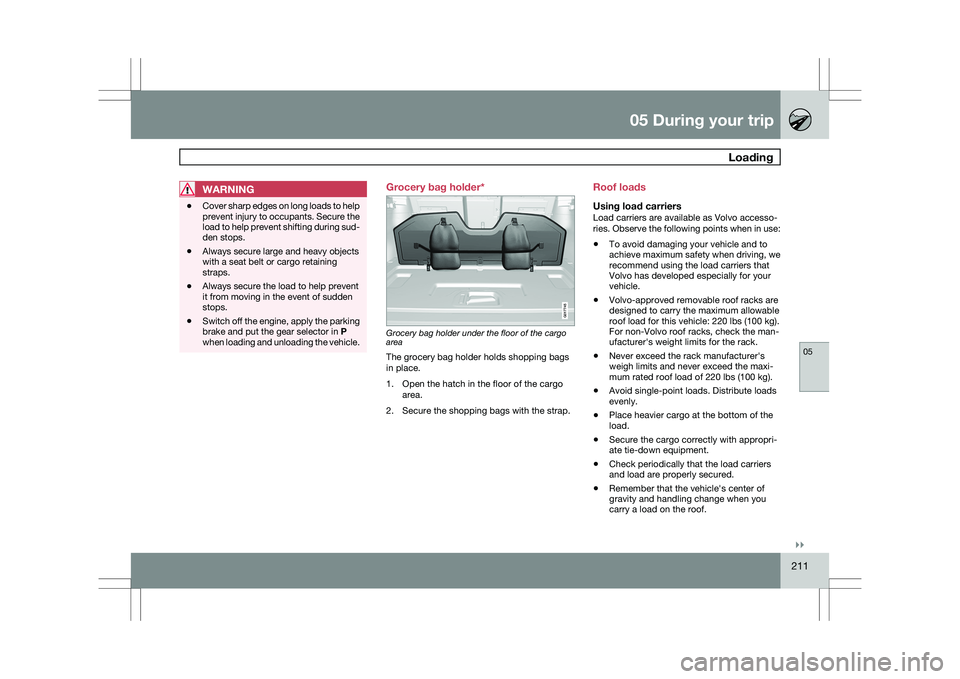
when loading and unloading the vehicle. Grocery bag holder*
Grocery bag holder under the floor of the cargo
area
The grocery bag holder holds shopping bags
in place.
1. Open the hatch in the floor of the cargo
area.
2. Secure the shopping bags with the strap. Roof loads
Using load carriersLoad carriers are available as Volvo accesso-
ries. Observe the following points when in use:
\b
To avoid damaging your vehicle and to
achieve maximum safety when driving, we
recommend using the load carriers that
Volvo has developed especially for your
vehicle.
\b Volvo-approved removable roof racks are
designed to carry the maximum allowable
roof load for this vehicle: 220 lbs (100 kg).
For non-Volvo roof racks, check the man-
ufacturer\fs weight limits for the rack.
\b Never exceed the rack manufacturer\fs
weigh limits and never exceed the maxi-
mum rated roof load of 220 lbs (100 kg).
\b Avoid single-point loads. Distribute loads
evenly.
\b Place heavier cargo at the bottom of the
load.
\b Secure the cargo correctly with appropri-
ate tie-down equipment.
\b Check periodically that the load carriers
and load are properly secured.
\b Remember that the vehicle\fs center of
gravity and handling change when you
carry a load on the roof. G017745
Page 219 of 297
05 During your trip
Towing a trailer05
}}
217
Introduction
Volvo recommends the use of Volvo trailer
hitches that are specially designed for the vehi-
cle.
NOTE
See page 282 for the maximum trailer and
tongue weights recommended by Volvo.
\b
Observe the legal requirements of the
state/province in which the vehicles are
\b All Volvo models are equipped with
energy-absorbing shock-mounted bump-
ers. Trailer hitch installation should not
interfere with the proper operation of this
bumper system.
Trailer towing does not normally present any
particular problems, but take into considera-
tion:
\b Increase tire pressure to recommended
full. See the tire inflation tables beginning
on page 258.
\b When your vehicle is new, avoid towing
heavy trailers during the first 620 miles
(1,000 km).
\b Maximum speed when towing a trailer:
50 mph (80 km/h).
\b Engine and transmission are subject to
increased loads. Therefore, engine coolant
temperature should be closely watched when driving in hot climates or hilly terrain.
Use a lower gear and turn off the air con-
ditioner if the temperature gauge needle
enters the red range.
\b If the automatic transmission begins to
overheat, a message will be displayed in
the text window.
\b Avoid overload and other abusive opera-
tion.
\b Hauling a trailer affects handling, durabil-
ity, and economy.
\b It is necessary to balance trailer brakes
with the towing vehicle brakes to provide a
safe stop (check and observe state/local
regulations).
\b Do not connect the trailer\fs brake system
directly to the vehicle\fs brake system.
\b More frequent vehicle maintenance is
required.
\b Remove the ball and drawbar assembly
when the hitch is not being used.
\b Volvo recommends the use of synthetic
engine oil when towing a trailer over long
distances or in mountainous areas.
WARNING \b
Bumper-attached trailer hitches must
not be used on Volvos, nor should
safety chains be attached to the
bumper.
\b Trailer hitches attaching to the vehicle
rear axle must not be used.
\b Never connect a trailer\fs hydraulic
brake system directly to the vehicle
brake system, nor a trailer\fs lighting
system directly to the vehicle lighting
system. Consult your nearest author-
ized Volvo retailer for correct installa-
tion.
\b When towing a trailer, the trailer\fs safety
wire must be correctly fastened to the
hole or hook provided in the trailer hitch
on the vehicle. The safety wire should
never be fastened to or wound around
the drawbar ball.
Page 220 of 297
05 During your tripTowing a trailer 05
218
NOTE \b
When parking the vehicle with a trailer
on a hill, apply the parking brake before
putting the gear selector in
P. Always
follow the trailer manufacturer\fs recom-
mendations for wheel chocking.
\b When starting on a hill, put the gear
selector in
D before releasing the park-
ing brake. See page 116 for more
detailed information about starting off
on a hill while towing a trailer.
\b If you use the manual (Geartronic) shift
positions while towing a trailer, make
sure the gear you select does not put
too much strain on the engine (using too
high a gear).
\b The drawbar assembly/trailer hitch may
be rated for trailers heavier than the
vehicle is designed to tow. Please
adhere to Volvo\fs recommended trailer
weights.
\b Avoid driving with a trailer on inclines of
more than 15 %.
Trailer cableAn adapter is required if the vehicle\fs trailer
hitch has a 13-pin connector and the trailer has
7 pins. Use an adapter cable approved by
Volvo. Make sure the cable does not drag on
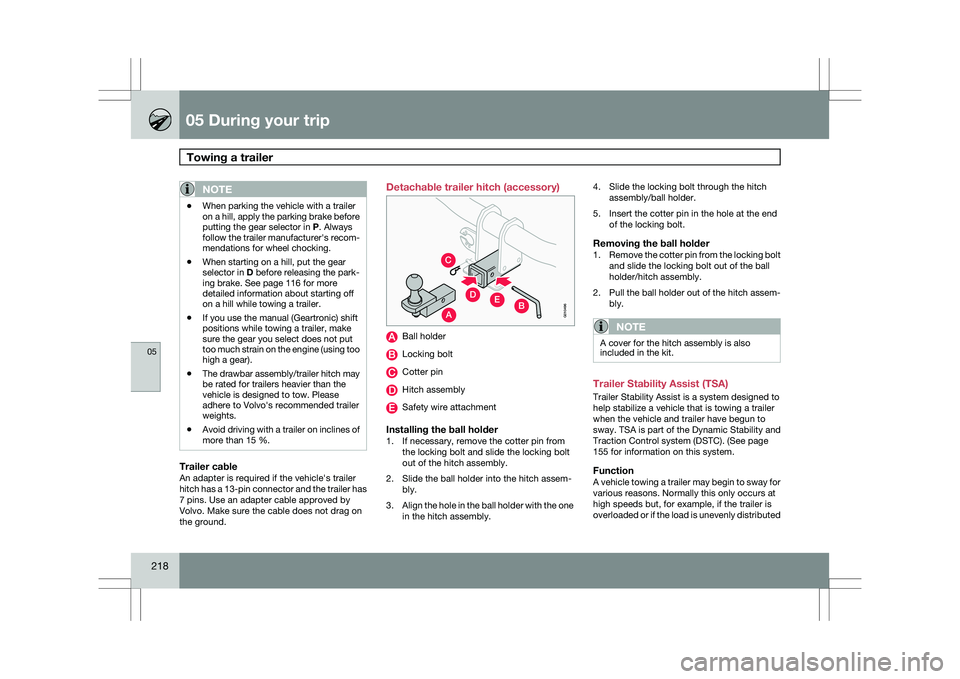
the ground. Detachable trailer hitch (accessory)
Ball holder
Locking bolt
Cotter pin
Hitch assembly
Safety wire attachment
Installing the ball holder1. If necessary, remove the cotter pin from
the locking bolt and slide the locking bolt
out of the hitch assembly.
2. Slide the ball holder into the hitch assem- bly.
3. Align the hole in the ball holder with the one
in the hitch assembly. 4. Slide the locking bolt through the hitch
assembly/ball holder.
5. Insert the cotter pin in the hole at the end of the locking bolt.
Removing the ball holder1.Remove the cotter pin from the locking bolt
and slide the locking bolt out of the ball
holder/hitch assembly.
2. Pull the ball holder out of the hitch assem-
bly.
NOTE A cover for the hitch assembly is also
included in the kit.
Trailer Stability Assist (TSA)
Trailer Stability Assist is a system designed to
help stabilize a vehicle that is towing a trailer
when the vehicle and trailer have begun to
sway.
TSA is part of the Dynamic Stability and
Traction Control system (DSTC). (See page
155 for information on this system.
FunctionA vehicle towing a trailer may begin to sway for
various reasons. Normally this only occurs at
high speeds but, for example, if the trailer is
overloaded or if the load is unevenly distributed
A
C
EDB
G010496
Page 227 of 297
06 Maintenance and specifications
Maintaining your car06
}}
225
Owner maintenance
Periodic maintenance requirements and inter-
vals are described in your vehicle\fs Warranty
and Service Records Information booklet.
The following points can be carried out
between the normally scheduled maintenance
services.
Each time the car is refueled:
\b
Check the engine oil level.
\b Clean the windshield, windshield wipers,
headlights, and tail lights.
Monthly:
\bCheck cold tire pressure in all tires. Inspect
the tires for wear.
\b Check that engine coolant and other fluid
levels are between the indicated "min" and
"max" markings.
\b Clean interior glass surfaces with a glass
cleaner and soft paper towels.
\b Wipe driver information displays with a soft
cloth.
\b Visually inspect battery terminals for cor-
rosion. Corrosion may indicate a loose ter-
minal connector, or a battery near the end
of its useful service life. Consult your Volvo
retailer for additional information.
As needed:Wash the car, including the undercarriage, to
reduce wear that can be caused by a buildup
of dirt, and corrosion that can be caused by salt
residues.
Clean leaves and twigs from air intake vents at
the base of the windshield, and from other pla-
ces where they may collect.
NOTE Complete service information for qualified
technicians is available online for purchase
or subscription at www.volvotechinfo.com.
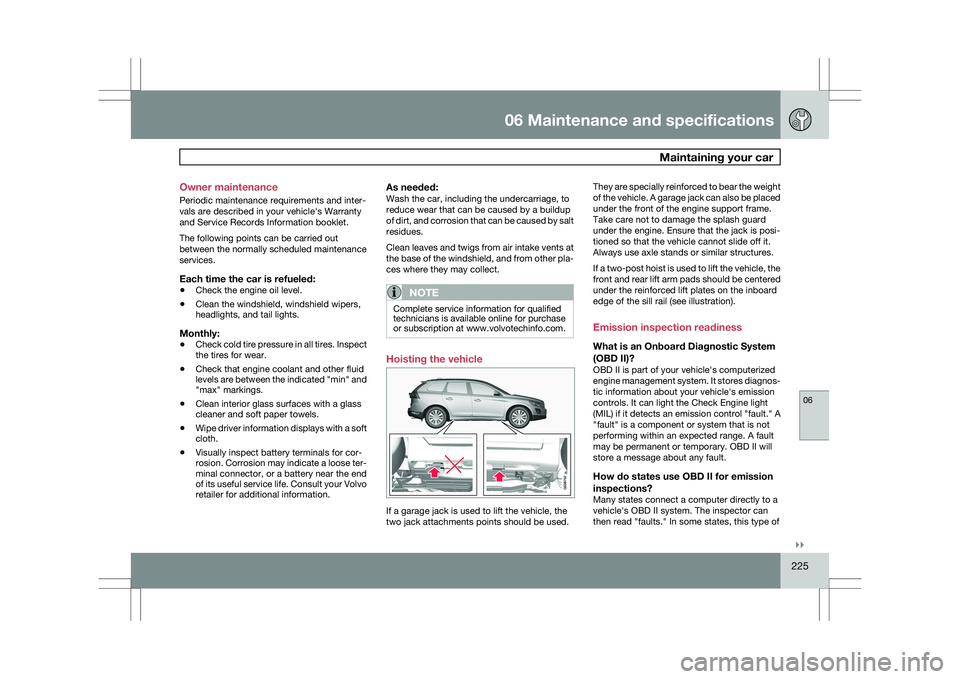
Hoisting the vehicle
If a garage jack is used to lift the vehicle, the
two jack attachments points should be used.They are specially reinforced to bear the weight
of the vehicle. A garage jack can also be placed
under the front of the engine support frame.
Take care not to damage the splash guard
under the engine. Ensure that the jack is posi-
tioned so that the vehicle cannot slide off it.
Always use axle stands or similar structures.
If a two-post hoist is used to lift the vehicle, the
front and rear lift arm pads should be centered
under the reinforced lift plates on the inboard
edge of the sill rail (see illustration).
Emission inspection readiness
What is an Onboard Diagnostic System
(OBD II)?
OBD II is part of your vehicle\fs computerized
engine management system. It stores diagnos-
tic information about your vehicle\fs emission
controls. It can light the Check Engine light
(MIL) if it detects an emission control "fault." A
"fault" is a component or system that is not
performing within an expected range. A fault
may be permanent or temporary. OBD II will
store a message about any fault.
How do states use OBD II for emission
inspections?
Many states connect a computer directly to a
vehicle\fs OBD II system. The inspector can
then read "faults." In some states, this type of
Page 262 of 297
06 Maintenance and specificationsWheels and tires 06
260 10.
Maximum Load: Indicates the maximum
load in pounds and kilograms that can be
carried by the tire. Refer to the vehicle\fs tire
information placard or the safety certifica-
tion label, located on the B-Pillar or the
driver\fs door or on the inside of the fuel filler
door on Canadian models, for the correct
tire pressure for your vehicle.
11. Treadwear, Traction, and Temperature
grades: see page 262 for more informa-
tion.
12. Maximum permissible inflation pressure: the greatest amount of air pressure that
should ever be put in the tire. This limit is
set by the tire manufacturer.
Glossary of tire terminology
The tire suppliers may have additional mark-
ings, notes or warnings such as standard load,
radial tubeless, etc.
\b Tire information placard: A placard
showing the OE (Original Equipment) tire
sizes, recommended inflation pressure,
and the maximum weight the vehicle can
carry.
\b Tire Identification Number (TIN)
: A num-
ber on the sidewall of each tire providing
information about the tire brand and man-
ufacturing plant, tire size and date of man-
ufacturer. \b
Inflation pressure: A measure of the
amount of air in a tire.
\b Standard load: A class of P-metric or Met-
ric tires designed to carry a maximum load
at 35 psi [37 psi (2.5 bar) for Metric tires].
Increasing the inflation pressure beyond
this pressure will not increase the tires load
carrying capability.
\b Extra load: A class of P-metric or Metric
tires designed to carry a heavier maximum
load at 41 psi [43 psi (2.9 bar) for Metric
tires]. Increasing the inflation pressure
beyond this pressure will not increase the
tire\fs load carrying capability.
\b kPa: Kilopascal, a metric unit of air pres-
sure.
\b PSI: Pounds per square inch, a standard
unit of air pressure.
\b B-pillar: The structural member at the side
of the vehicle behind the front door.
\b Bead area of the tire: Area of the tire next
to the rim.
\b Sidewall of the tire: Area between the
bead area and the tread.
\b Tread area of the tire: Area of the perim-
eter of the tire that contacts the road when
mounted on the vehicle.
\b Rim: The metal support (wheel) for a tire or
a tire and tube assembly upon which the
tire beads are seated. \b
Maximum load rating: a figure indicating
the maximum load in pounds and kilo-
grams that can be carried by the tire. This
rating is established by the tire manufac-
turer.
\b Maximum permissible inflation
pressure: the greatest amount of air pres-
sure that should ever be put in the tire. This
limit is set by the tire manufacturer.
\b Recommended tire inflation pressure:
inflation pressure, established by Volvo,
which is based on the type of tires that are
mounted on a vehicle at the factory. This
inflation pressure is affected by the number
of occupants in the vehicle, the amount of
cargo, and the speed at which the vehicle
will be driven for a prolonged period. This
information can be found on the tire infla-
tion placard(s) located on the driver\fs side
B-pillar or on the inside of the fuel filler door
on Canadian models, and in the tire infla-
tion table in this chapter.
\b Cold tires: The tires are considered to be
cold when they have the same temperature
as the surrounding (ambient) air. This tem-
perature is normally reached after the vehi-
cle has been parked for at least 3 hours.
Page 263 of 297
06 Maintenance and specifications
Wheels and tires06
}}
261
Vehicle loading
Properly loading your vehicle will provide maxi-
mum return of vehicle design performance.
Before loading your vehicle, familiarize yourself
with the following terms for determining your
vehicle\fs weight ratings, with or without a
trailer, from the vehicle\fs Federal/Canadian
Motor Vehicle Safety Standards (FMVSS/
CMVSS) label, and the vehicle\fs tire informa-
tion placard:
Curb weightThe weight of the vehicle including a full tank
of fuel and all standard equipment. It does not
include passengers, cargo, or optional equip-
ment.
Capacity weightAll weight added to the curb weight, including
cargo and optional equipment. When towing,
trailer hitch tongue load is also part of cargo
weight.
NOTE
For trailer towing information, please refer to
the section "Towing a trailer"
on page 217.
Permissible axle weightThe maximum allowable weight that can be
carried by a single axle (front or rear). These
numbers are shown on the Federal/Canadian
Motor Vehicle Safety Standards (FMVSS/
CMVSS) label. The total load on each axle must
never exceed its maximum permissible weight.
Gross vehicle weight (GVW)The vehicle\fs curb weight + cargo + passen-
gers.
NOTE \b
The location of the various labels in your
vehicle can be found on page 279
.
\b A table listing important weight limits for
your vehicle can be found on page
282.
Steps for Determining Correct Load
Limit
1. Locate the statement "the combined
weight of occupants and cargo should
never exceed XXX pounds" on your vehi-
cle\fs placard. 2. Determine the combined weight of the
driver and passengers that will be riding in
your vehicle.
3. Subtract the combined weight of the driver
and passengers from XXX kilograms or
XXX pounds.
4. The resulting figure equals the available amount of cargo and luggage load
capacity. For example, if the "XXX" amount
equals 1400 lbs. and there will be five
150 lb. passengers in your vehicle, the
amount of available cargo and luggage
load capacity is 650 lbs. (1400 – 750
(5 × 150) = 650 lbs.)
5. Determine the combined weight of luggage
and cargo being loaded on the vehicle.
That weight may not safely exceed the
available cargo and luggage load capacity
calculated in Step 4.
6. If your vehicle will be towing a trailer, load from your trailer will be transferred to your
vehicle. Consult this manual 1
to determine
how this reduces the available cargo and
luggage load capacity of your vehicle. 1
See the section "Trailer Towing on page
217.
Page 264 of 297
06 Maintenance and specificationsWheels and tires 06
262
WARNING \b
Exceeding the permissible axle weight,
gross vehicle weight, or any other
weight rating limits can cause tire over-
heating resulting in permanent defor-
mation or catastrophic failure.
\b Do not use replacement tires with lower
load carrying capacities than the tires
that were original equipment on the
vehicle because this will lower the vehi-
cle\fs GVW rating. Replacement tires
with a higher limit than the originals do
not increase the vehicle\fs GVW rating
limitations. Uniform Tire Quality Grading
ALL PASSENGER VEHICLE TIRES MUST
CONFORM TO FEDERAL SAFETY
REQUIREMENTS IN ADDITION TO THESE
GRADES
Quality grades can be found, where appli-
cable, on the tire sidewall between the tread
shoulder and maximum section width. For
example:
Treadwear 200 Traction AA Temperature A
TREADWEARThe treadwear grade is a comparative rating
based on the wear rate of the tire when tested
under controlled conditions on a specified gov- ernment test course. For example, a tire gra-
ded 150 would wear one and one half (1 1/2)
times as well on the government course as a
tire graded 100. The relative performance of
tires depends upon the actual conditions of
their use, however, and many depart signifi-
cantly from the norm due to variation in driving
habits, maintenance practices and differences
in road characteristics and climate.
TRACTIONThe traction grades, from highest to lowest, are
AA, A, B, and C, as measured under controlled
conditions on specified government test sur-
faces of asphalt and concrete. A tire marked C
may have poor traction performance. The trac-
tion grade assigned to this tire is based on
braking (straight-ahead) traction tests and is
not a measure of cornering (turning) traction.
WARNING
The traction grade assigned to this tire is
based on braking (straight-ahead) traction
tests and is not a measure of cornering
(turning) traction.
TEMPERATUREThe temperature grades are AA (the highest),
A, B, and C, representing the tire\fs resistance
to the generation of heat and its ability to dis-
sipate heat when tested under controlled con-ditions on a specified indoor laboratory test
wheel. Sustained high temperature can cause
the material of the tire to degenerate and
reduce tire life, and excessive temperature can
lead to sudden tire failure. The grade C corre-
sponds to a minimum level of performance that
all passenger vehicle tires must meet under the
Federal Motor Safety Standard No. 109.
Grades B and A represent higher levels of per-
formance on the laboratory test wheel than the
minimum required by law.
WARNING
The temperature grade for this tire is estab-
lished for a tire that is properly inflated and
not overloaded. Excessive speed, under-
inflation, or excessive loading, either sepa-
rately or in combination, can cause heat
buildup and tire failure.
Snow chains, snow tires, studded tires
Snow chainsSnow chains can be used on your Volvo with
the following restrictions:
\b
Snow chains should be installed on front
wheels only. Use only Volvo approved
snow chains.
\b If accessory, aftermarket or "custom" tires
and wheels are installed and are of a size
different than the original tires and wheels,
Page 284 of 297
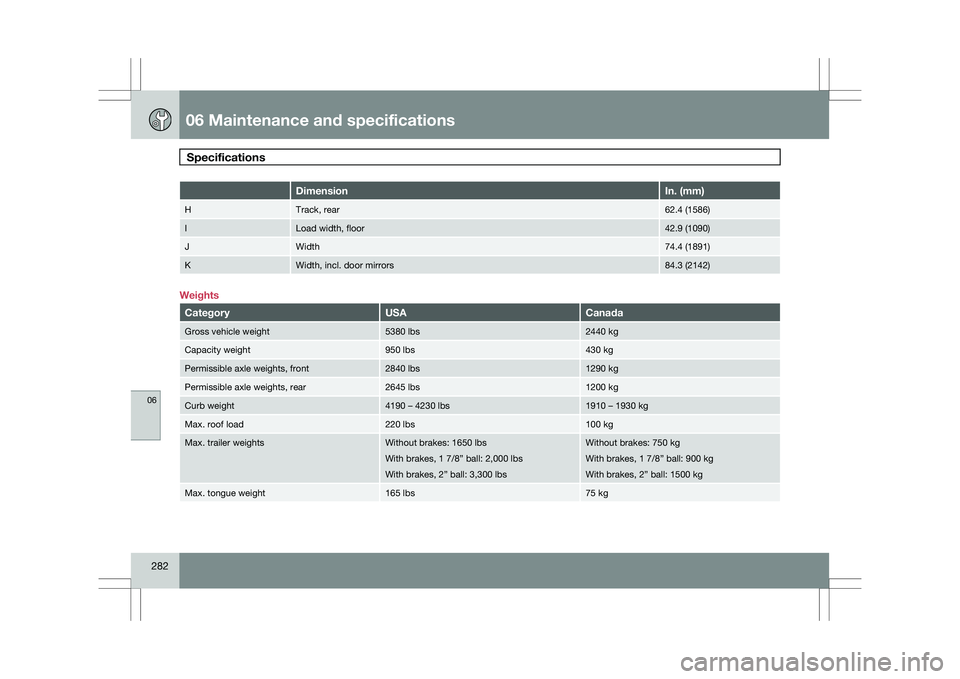
06 Maintenance and specificationsSpecifications 06
282 Dimension In. (mm)
H Track, rear 62.4 (1586)
I Load width, floor 42.9 (1090)
J Width 74.4 (1891)
K Width, incl. door mirrors 84.3 (2142)
Weights
Category USA Canada
Gross vehicle weight 5380 lbs 2440 kg
Capacity weight 950 lbs 430 kg
Permissible axle weights, front 2840 lbs 1290 kg
Permissible axle weights, rear 2645 lbs 1200 kg
Curb weight 4190 – 4230 lbs 1910 – 1930 kg
Max. roof load 220 lbs 100 kg
Max. trailer weights Without brakes: 1650 lbs
With brakes, 1 7/8” ball: 2,000 lbs
With brakes, 2” ball: 3,300 lbs Without brakes: 750 kg
With brakes, 1 7/8” ball: 900 kg
With brakes, 2” ball: 1500 kg
Max. tongue weight 165 lbs 75 kg
Page 290 of 297
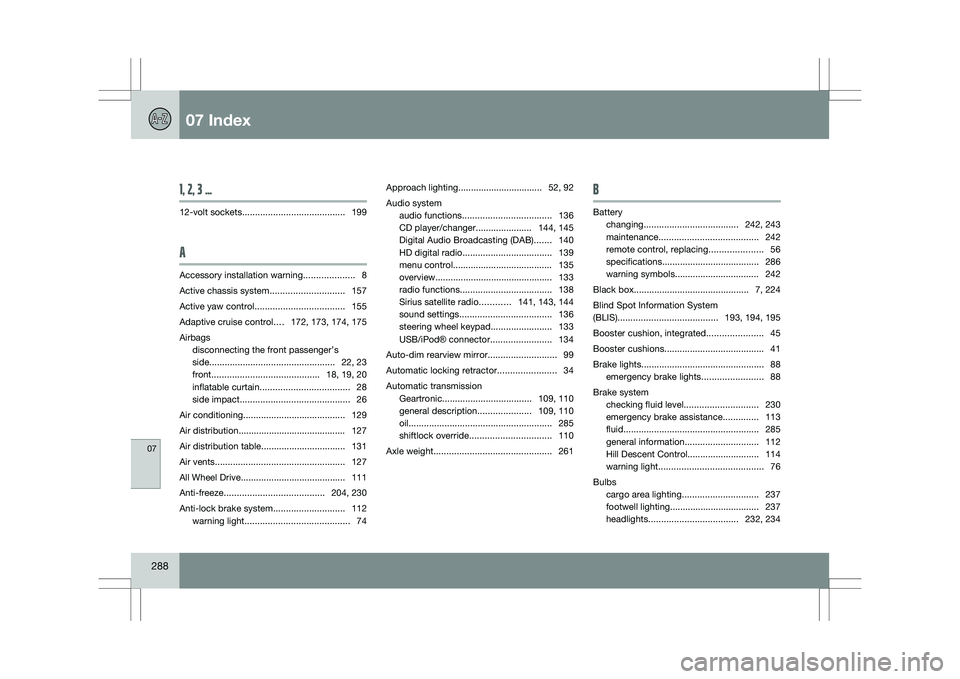
07 Index07
288 1, 2, 3 ...
12-volt sockets
........................................ 199
A Accessory installation warning
.................... 8
Active chassis system .............................157
Active yaw control ................................... 155
Adaptive cruise control ....172, 173, 174, 175
Airbags disconnecting the front passenger’s
side................................................. 22, 23
front.......................................... 18, 19, 20
inflatable curtain ................................... 28
side impact........................................... 26
Air conditioning ........................................ 129
Air distribution..........................................
127
Air distribution table................................. 131
Air vents................................................... 127
All Wheel Drive ......................................... 111
Anti-freeze ....................................... 204, 230
Anti-lock brake system ............................112
warning light ......................................... 74Approach lighting................................. 52, 92
Audio system
audio functions ................................... 136
CD player/changer
...................... 144, 145
Digital Audio Broadcasting (DAB) .......140
HD digital radio ................................... 139
menu control....................................... 135
overview.............................................. 133
radio functions .................................... 138
Sirius satellite radio ............141, 143, 144
sound settings .................................... 136
steering wheel keypad ........................133
USB/iPod® connector ........................134
Auto-dim rearview mirror ...........................99
Automatic locking retractor .......................34
Automatic transmission Geartronic ................................... 109, 110
general description .....................109, 110
oil ........................................................ 285
shiftlock override ................................ 110
Axle weight .............................................. 261B Battery
changing ..................................... 242, 243
maintenance ....................................... 242
remote control, replacing .....................56
specifications ...................................... 286
warning symbols.................................
242
Black box............................................. 7, 224
Blind Spot Information System
(BLIS)....................................... 193, 194, 195
Booster cushion, integrated ......................45
Booster cushions ....................................... 41
Brake lights ................................................ 88
emergency brake lights ........................88
Brake system checking fluid level ............................. 230
emergency brake assistance ..............113
fluid..................................................... 285
general information ............................. 112
Hill Descent Control ............................114
warning light ......................................... 76
Bulbs cargo area lighting .............................. 237
footwell lighting................................... 237
headlights ................................... 232, 234