On Call VOLVO XC60 2018 Owner´s Manual
[x] Cancel search | Manufacturer: VOLVO, Model Year: 2018, Model line: XC60, Model: VOLVO XC60 2018Pages: 660, PDF Size: 11.77 MB
Page 35 of 660
YOUR VOLVO
}}
33
Software Updates
So that you as a Volvo customer shall have the best possible experience from your car, Volvo iscontinuously developing the systems in the carsand the services that you are offered.
You can update the software in your Volvo to the latest version when your car is serviced at anauthorized Volvo dealer. The latest softwareupdate gives you access to new functions andimprovements, as well as previous improvementsincluded with previous software updates. For more information about released updates and answers to frequently asked questions, please go to support.volvocars.com.
NOTE
Functionality after updating may vary depend- ing on market, model, model year and options.
Related information
• Sensus - connection and entertainment (p. 30)
• Handling system updates via Download Cen-ter (p. 575)
Data recording
As part of Volvo's commitment to safety and quality, certain information is recorded regardingvehicle operation, functionality and incidents.
This vehicle is equipped with an event data recorder (EDR). The main purpose of an EDR isto record, in certain crash or near crash-like sit-uations, such as an airbag deployment or hittinga road obstacle, data that will assist in under-standing how a vehicle's systems performed. TheEDR is designed to record data related to vehicledynamics and safety systems for a short period oftime, typically 30 seconds or less. The EDR inthis vehicle is designed to record such data as:
• How various systems in your vehicle wereoperating;
• Whether or not the driver and passengersafety belts were buckled/fastened;
• How far (if at all) the driver was depressingthe accelerator and/or brake pedal; and,
• How fast the vehicle was traveling.
These data can help provide a better understand-ing of the circumstances in which crashes andinjuries occur. EDR data is only recorded by the vehicle if a more serious collision situation occurs. No data isrecorded by the EDR under normal driving condi-tions and the EDR never registers who is drivingthe vehicle or the location of a crash or a nearcrash-like situation. However, other parties, such as law enforcement, could combine the EDR datawith the type of personally identifying data rou-tinely acquired during a crash investigation. Toread data recorded by an EDR, special equipmentis required, and access to the vehicle or the EDRis needed. Furthermore, your vehicle is equipped with a number of computers whose task is to continu-ously control and monitor the vehicle's operation.They can also register some of this informationduring normal driving conditions, most importantlyif they detect a fault relating to the vehicle'soperation and functionality or upon activation ofthe vehicle's active safety systems (e.g. CitySafety and the auto-brake function). Some of theregistered information is required by technicianswhen carrying out service and maintenance toenable them to diagnose and rectify any faultsthat have occurred in the vehicle and to enableVolvo to fulfill legal and other regulatory require-ments. Information thus registered in the vehicleis registered in the vehicle's computers until thevehicle is serviced or repaired. In addition to theabove, the registered information may - on anaggregated basis - be used for research andproduct development purposes in order to contin-uously improve the safety and quality of Volvovehicles. For additional information, please contact Volvo.
Page 38 of 660
YOUR VOLVO
36
Accessory installation
We strongly recommend that Volvo owners use only genuine, Volvo-approved accessories, andthat accessory installations be performed only bya trained and qualified Volvo service technician.Certain accessories only work when the associ-ated software is installed in the vehicle's com-puter system.
• Genuine Volvo accessories are tested to ensure compatibility with the performance,safety, and emission systems in your vehicle.Additionally, a trained and qualified Volvoservice technician knows where accessoriesmay and may not be safely installed in yourVolvo. In all cases, please consult a trainedand qualified Volvo service technician beforeinstalling any accessory in or on your vehicle.
• Accessories that have not been approved byVolvo may or may not be specifically testedfor compatibility with your vehicle.
• Any of your vehicle's performance and safetysystems could be adversely affected if youinstall accessories that Volvo has not tested,or if you allow accessories to be installed bysomeone unfamiliar with your vehicle.
• Damage caused by unapproved or improperlyinstalled accessories may not be covered byyour new vehicle warranty. See your Warrantyand Service Records Information booklet formore warranty information. Volvo assumes noresponsibility for death, injury, or expenses that may result from the installation of non-genuine accessories.
Related information
•
Important information on accessories andextra equipment (p. 35)
Connecting equipment to thevehicle's data link connector
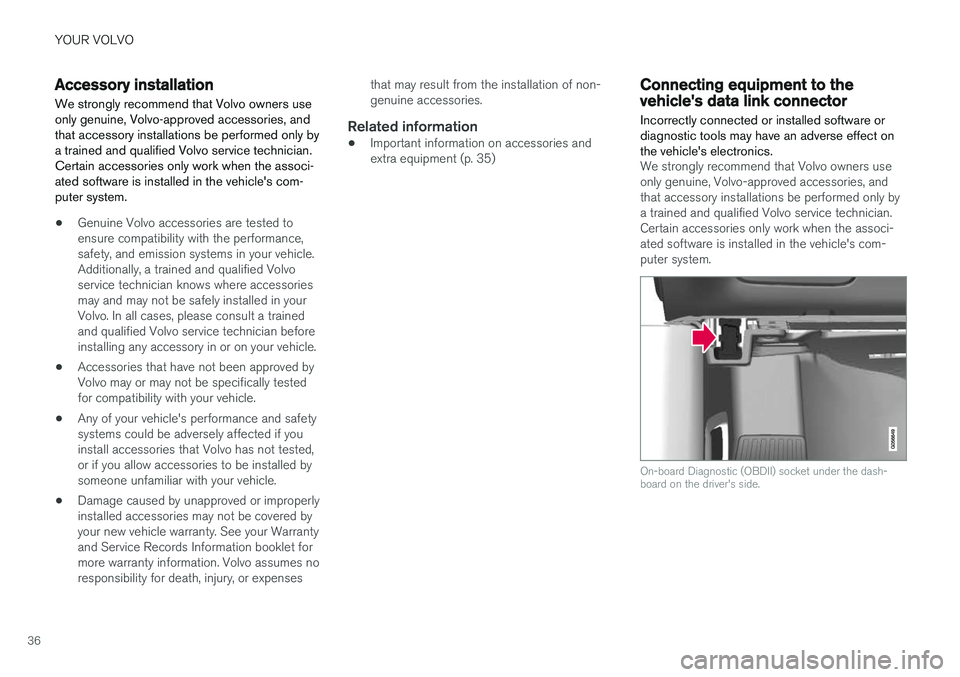
Incorrectly connected or installed software or diagnostic tools may have an adverse effect onthe vehicle's electronics.
We strongly recommend that Volvo owners use only genuine, Volvo-approved accessories, andthat accessory installations be performed only bya trained and qualified Volvo service technician.Certain accessories only work when the associ-ated software is installed in the vehicle's com-puter system.
On-board Diagnostic (OBDII) socket under the dash- board on the driver's side.
Page 40 of 660
YOUR VOLVO
38
Viewing the Vehicle IdentificationNumber (VIN) When contacting a Volvo retailer, about e.g. your Volvo On Call subscription, your Vehicle Identifi- cation Number (VIN5
) may be needed.
1. Tap Settings in the Top view in the center
display.
2. Proceed to
SystemSystem Information
Vehicle Identification Number.
> The vehicle identification number will be displayed.
Volvo Structural Parts Statement
Volvo is one of the leading companies for car safety.
Volvo engineers and manufactures vehicles designed to help protect vehicle occupants in theevent of a collision. Volvos are designed to absorb the impact of a collision. This energy absorption system including,but not limited to, structural components such asbumper reinforcement bars, bumper energyabsorbers, frames, rails, fender aprons, A-pillars,B-pillars and body panels must work together tomaintain cabin integrity and protect the vehicleoccupants. The supplemental restraint system including but not limited to air bags, side curtain air bags, anddeployment sensors work together with theabove components to provide proper timing forair bag deployment. Due to the above, Volvo Car USA does not sup- port the use of aftermarket, alternative or any-thing other than original Volvo parts for collisionrepair. Volvo Car USA also recommends using Volvo- approved replacement glass. The use of after-market glass, particularly a windshield, can havean adverse effect on collision avoidance andadvanced lighting systems. In addition Volvo does not support the use or re-use of structural components from an existingvehicle that has been previously damaged.Although these parts may appear equivalent, it isdifficult to tell if the parts have been previouslyreplaced with non-OE parts or if the part hasbeen damaged as a result of a prior collision. Thequality of these used parts may also have beenaffected due to environmental exposure.
Related information
•
Data recording (p. 33)
5
Vehicle Identification Number
Page 44 of 660

SAFETY
42
Safety
The vehicle is equipped with a number of safety systems that work together to help protect thevehicle's driver and passengers in the event ofan accident.
The vehicle is equipped with a number of sensors that may react in the event of an accident andactivate different safety systems, such as the air-bag system and seat belt tensioners. Dependingon the specific conditions of the accident, e.g.collisions at certain angles, overturning or swerv-ing, the systems react differently to help providethe best protection. There are also mechanical safety systems such as the Whiplash Protection System. The vehicle is also built so that a large part of the force of a collision is distributed to the vehicle's members,pillars, floor, roof and other parts of the body. After an accident, the vehicle's safety mode may be activated if any important function in the vehi-cle has been damaged.
Warning symbol in the instrument panelThe warning symbol in the instrumentpanel illuminates when the vehicle's electrical system is in ignition mode II.
The symbol will go out after approx. 6
seconds if no faults are detected in the vehicle's safety systems.
WARNING
If the warning symbol remains illuminated or switches on while driving and the message
SRS airbag Service urgent Drive to
workshop is displayed in the instrument
panel, this indicates that something in the safety system is not functioning properly.Volvo recommends contacting an authorizedVolvo workshop for repairs as soon as possi-ble.
WARNING
Never attempt to alter or repair any of the vehicle's safety systems yourself. Incorrectlyperformed repairs to any system could impairfunction and lead to serious injury. Volvo rec-ommends contacting an authorized Volvoworkshop.
If this dedicated warning symbol is not functioning, the general warning sym-bol will illuminate instead and the samemessage will be displayed in the instru-
ment panel.
Related information
• Safety during pregnancy (p. 43)
• Occupant safety (p. 43)
• Reporting safety defects (p. 44)
• Recall information (p. 45)
• Seat belts (p. 47) •
Airbags (p. 52)
• Whiplash Protection System (p. 46)
• Safety mode (p. 61)
• Child safety (p. 63)
Page 45 of 660
SAFETY
}}
* Option/accessory.43
Safety during pregnancy It is important that seat belts are worn correctly during pregnancy and that pregnant driversadjust their seating position accordingly.
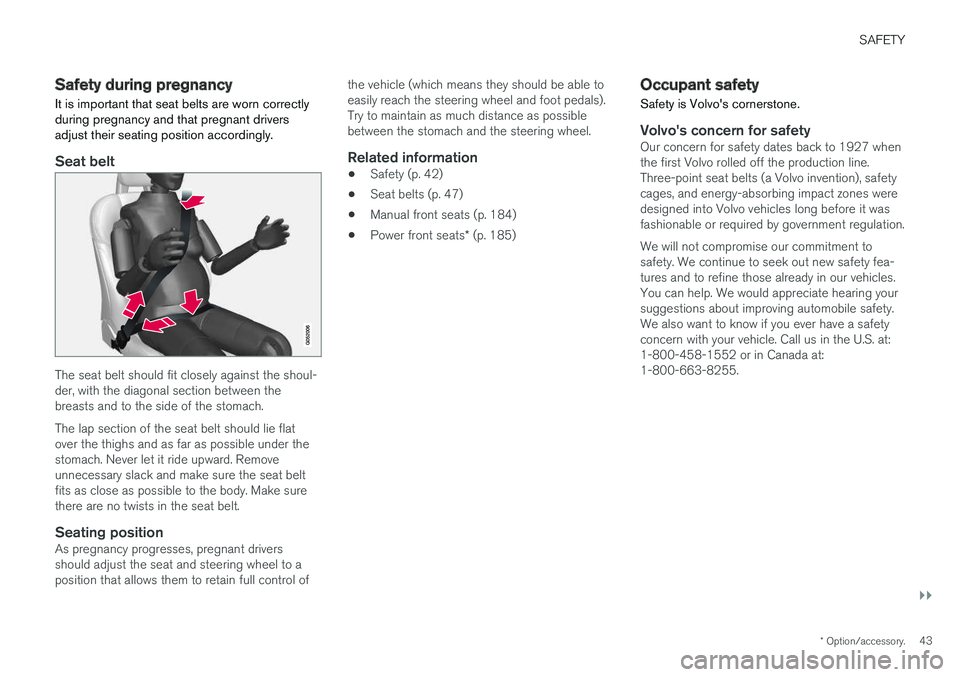
Seat belt
The seat belt should fit closely against the shoul- der, with the diagonal section between thebreasts and to the side of the stomach. The lap section of the seat belt should lie flat over the thighs and as far as possible under thestomach. Never let it ride upward. Removeunnecessary slack and make sure the seat beltfits as close as possible to the body. Make surethere are no twists in the seat belt.
Seating positionAs pregnancy progresses, pregnant driversshould adjust the seat and steering wheel to aposition that allows them to retain full control of the vehicle (which means they should be able toeasily reach the steering wheel and foot pedals).Try to maintain as much distance as possiblebetween the stomach and the steering wheel.
Related information
•
Safety (p. 42)
• Seat belts (p. 47)
• Manual front seats (p. 184)
• Power front seats
* (p. 185)
Occupant safety Safety is Volvo's cornerstone.
Volvo's concern for safetyOur concern for safety dates back to 1927 when the first Volvo rolled off the production line.Three-point seat belts (a Volvo invention), safetycages, and energy-absorbing impact zones weredesigned into Volvo vehicles long before it wasfashionable or required by government regulation. We will not compromise our commitment to safety. We continue to seek out new safety fea-tures and to refine those already in our vehicles. You can help. We would appreciate hearing your suggestions about improving automobile safety. We also want to know if you ever have a safety concern with your vehicle. Call us in the U.S. at: 1-800-458-1552 or in Canada at: 1-800-663-8255.
Page 46 of 660
||
SAFETY
44
Occupant safety reminders
How safely you drive doesn't depend on how old you are but rather on:
• How well you see.
• Your ability to concentrate.
• How quickly you make decisions understress to avoid an accident.
The following suggestions are intended to helpyou cope with the ever changing traffic environ-ment.
• Never drink and drive.
• If you are taking any medication, consult yourphysician about its potential effects on your driving abilities.
• Take a driver-retraining course.
• Have your eyes checked regularly.
• Keep your windshield and headlights clean.
• Replace wiper blades when they start to leave streaks.
• Take into account the traffic, road, andweather conditions, particularly with regard tostopping distance.
• Never send text messages while driving.
• Refrain from using or minimize the use of acell phone while driving.Related information
• Safety (p. 42)
• Reporting safety defects (p. 44)
• Recall information (p. 45)
Reporting safety defects
The following information will help you report any perceived safety-related defects in your vehicle.
Reporting safety defects in the U.S.
If you believe that your vehicle has a defect which could cause a crash orcould cause injury or death, you shouldimmediately inform the National High-way Traffic Safety Administration(NHTSA) in addition to notifying VolvoCar USA, LLC. If NHTSA receives simi-lar complaints, it may open an investi-gation, and if it finds that a safetydefect exists in a group of vehicles, itmay order a recall and remedy cam-paign. However, NHTSA cannotbecome involved in individual problemsbetween you, your retailer, or Volvo CarUSA, LLC. To contact NHTSA, you mayeither call the Auto Safety Hotline toll-free at 1-888-327-4236(TTY: 1-800-424-9153) or write to: NHTSA, U.S. Department of Transpor-tation, Washington D.C. 20590.
Page 47 of 660
SAFETY
}}
45
You can also obtain other information about motor vehicle safety from http://www.safercar.gov, where you can alsoenter your vehicle's VIN (Vehicle Identi-fication Number) to see if it has anyopen recalls. Volvo strongly recommends that if your vehicle is covered under a service cam-paign, safety or emission recall or simi-lar action, it should be completed assoon as possible. Please check withyour local retailer or Volvo Car USA,LLC if your vehicle is covered underthese conditions. NHTSA can be reached at:Internet:http://www.nhtsa.govTelephone:1-888-DASH-2-DOT (1-888-327-4236).
Reporting safety defects in CanadaIf you believe your vehicle has a defect that could cause a crash or could cause injury or death, youshould immediately inform Transport Canada inaddition to notifying Volvo Car Canada Ltd.
Transport Canada can be contacted at:
1-800-333-0510 Teletypewriter (TTY): 613 990-4500Fax: 1-819-994-3372Mailing Address: Transport Canada - Road Safety, 80 rue Noël, Gatineau, (Quebec) J8Z 0A1
Related information
•
Safety (p. 42)
• Occupant safety (p. 43)
• Recall information (p. 45)
• Viewing the Vehicle Identification Number(VIN) (p. 38)
Recall information
On our website, select the "Own" tab on the upper left side of the screen and click the head-ing "Recall Information" on the right side of thescreen. Enter your Vehicle Identification Number(VIN) for your vehicle (found at the base of thewindshield). If your vehicle has any open Recalls,they will be displayed on this page. You can also enter the Vehicle Identification Number in the search field on the NationalHighway Traffic Safety Administration's (NHTSA)website at: www.nhtsa.gov.
Volvo customers in Canada
For any questions regarding open recalls for your vehicle, please contact your authorized Volvoretailer. If your retailer is unable to answer yourquestions, please contact Volvo Customer Rela-tions at 800-663-8255, Monday through Friday,8:30 A.M. to 5:00 P.M. EST or volvocars.com/ca.You may also write us at: Volvo Car Canada Ltd.Customer Care Centre9130 Leslie Street, Suite 101Richmond Hill, Ontario L4B 0B9www.tc.gc.ca
Page 49 of 660
SAFETY
}}
* Option/accessory.47
WARNING
Do not squeeze box-like cargo between the rear seat cushion and the front seat backrest. If the rear seat backrests are folded down, cargo must be secured to prevent it from slid-ing forward against the front seat backrests inthe event of a collision.
WARNING
If a rear seat backrest is folded down or if a rear-facing child restraint is being used in therear seat, the seat in front must be moved for-ward so that it does not come into contactwith the backrest or child restraint.
Seating positionFor WHIPS to provide optimal protection, the driver and passenger must be seated correctlyand the system's function must not be impededin any way. Set the front seat to the correct seating position before starting to drive. The driver and the front seat passenger should sit in the center of the seat with their heads asclose as possible to the head restraints.
Related information
•Safety (p. 42)
• Manual front seats (p. 184)
• Power front seats
* (p. 185) •
Rear Collision Warning (p. 340)
Seat belts
Seat belts should always be worn by all occu- pants in your vehicle. Children should be prop-erly restrained using an infant seat, adjustablechild seat or booster cushion as determined byage, weight and height.
Most states and provinces make it mandatory for occupants of a vehicle to use seat belts.
Seat belt maintenanceCheck periodically that the seat belts are in goodcondition. Use water and a mild detergent forcleaning. Check the seat belt mechanism's func-tion as follows: attach the seat belt and pull rap-idly on the strap.
Page 50 of 660
||
SAFETY
48
WARNING
•Never repair the belt yourself. Repairs should only be performed by a trainedand qualified Volvo service technician.
• Any device used to induce slack into theshoulder belt portion of the three-pointbelt system will have a detrimental effecton the amount of protection available inthe event of a collision.
• The seat back should not be tilted too farback. The shoulder belt must be taut inorder to function properly.
• Do not use any type of child restraint inthe front passenger seat. We recommendthat children who have outgrown thesedevices sit in the rear seat with the seatbelt properly fastened.
Related information
• Safety (p. 42)
• Seat belt tensioners (p. 50)
• Buckling and unbuckling seat belts (p. 48)
• Door and seat belt reminders (p. 51)
Buckling and unbuckling seat belts
Make sure that all passengers have buckled their seat belts before starting to drive.
Buckling seat belts1. Pull out the belt slowly and make sure it is not twisted or damaged.
NOTE
Each seat belt is equipped with a retractor that will lock up in the following situations:
• if the belt is pulled out rapidly
• during braking and acceleration
• if the vehicle is leaning excessively
• when driving in turns
• if the automatic locking retractor/emer-gency locking retractor (ALR/ELR) is acti-vated. Each seat belt (except for the driv-er's) is equipped with an ALR function,which is designed to keep the seat belttaut when installing a child restraint. ALRis activated when the seat belt is pulledout as far as possible. If this is done, asound from the seat belt retractor will beaudible, which is normal. The seat belt cannow only be fed into the retractor, notpulled out. This function is automaticallydisabled when the seat belt is unbuckledand fully retracted.
2. Buckle the seat belt by pushing the latch
plate into the receptacle.
> A distinct "click" indicates that the belt islocked into place.
WARNING
Always insert the seat belt latch plate into the belt buckle on the correct side. Failure to doso could cause the seat belts and belt buck-les to malfunction in a collision. There is a riskof serious injury.
Page 52 of 660
||
SAFETY
* Option/accessory.
50
Related information
• Seat belts (p. 47)
• Seat belt tensioners (p. 50)
• Door and seat belt reminders (p. 51)
Seat belt tensioners
The vehicle is equipped with standard and elec- tric * seat belt tensioners that can help tension
the seat belt in a critical situation or collision.
Standard seat belt tensionersAll seat belts are equipped with a standard seat belt tensioner. In a collision of sufficiently violent force, the seat belt tensioners will tension the seat belts in orderto more effectively restrain the occupants.
Electric seat belt tensioners *The driver's and front passenger's seat belts areequipped with electric seat belt tensioners. The seat belt tensioners interact and can be acti- vated in conjunction with the City Safety andRear Collision Warning driver support systems. Incritical situations, such as if the vehicle brakessuddenly, begins to skid or runs off the road (e.gif the vehicle rolls into a ditch, lifts off the groundor hits an obstacle in the road), or if there is a riskof collision, the seat belts can be pulled taut bythe seat belt tensioner's electric motor. The electric seat belt tensioner helps to position the occupant more effectively in the seat, whichreduces the risk of the occupant striking the inte-rior of the passenger compartment and improvesthe effect of other safety systems such as theairbags. When a critical situation has passed, the seat beltand the electric seat belt tensioner are resetautomatically. However, they can also be resetmanually.
WARNING
Never attempt to alter or repair the seat belt on your own. Volvo recommends contactingan authorized Volvo workshop. If the seat belt has been exposed to extreme forces, e.g. in conjunction with a collision, theentire seat belt must be replaced. Even if theseat belt appears undamaged, some of itsprotective properties may have been lost. Alsoreplace the seat belt if it is worn or damaged.The new seat belt must be type approved andintended for the same seating position as thereplaced seat belt.
Related information
•
Seat belts (p. 47)
• Buckling and unbuckling seat belts (p. 48)
• Resetting the electric seat belt tensioners
*
(p. 51)
• City Safety
™ (p. 327)
• Rear Collision Warning (p. 340)