instrument panel VOLVO XC60 T8 2018 Owner´s Manual
[x] Cancel search | Manufacturer: VOLVO, Model Year: 2018, Model line: XC60 T8, Model: VOLVO XC60 T8 2018Pages: 674, PDF Size: 11.93 MB
Page 105 of 674
DISPLAYS AND VOICE CONTROL
}}
103
Handling messages saved from theinstrument panel
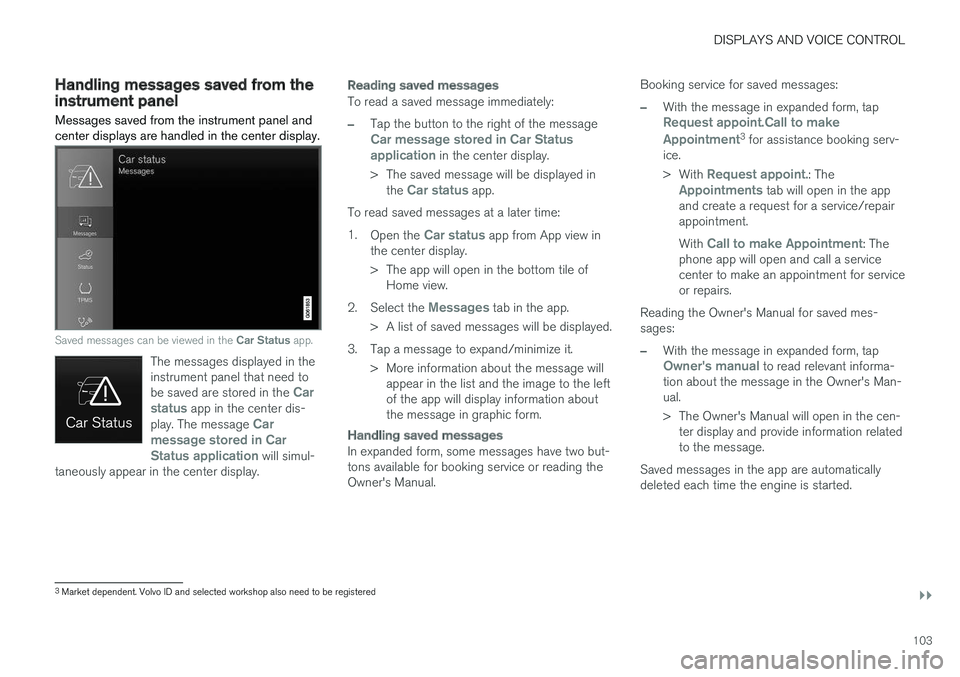
Messages saved from the instrument panel and center displays are handled in the center display.
Saved messages can be viewed in the Car Status app.
The messages displayed in the instrument panel that need to be saved are stored in the
Car
status app in the center dis-
play. The message Car
message stored in Car Status application
will simul-
taneously appear in the center display.
Reading saved messages
To read a saved message immediately:
–Tap the button to the right of the messageCar message stored in Car Status application in the center display.
> The saved message will be displayed in the
Car status app.
To read saved messages at a later time: 1. Open the
Car status app from App view in
the center display.
> The app will open in the bottom tile of Home view.
2. Select the
Messages tab in the app.
> A list of saved messages will be displayed.
3. Tap a message to expand/minimize it. > More information about the message willappear in the list and the image to the left of the app will display information aboutthe message in graphic form.
Handling saved messages
In expanded form, some messages have two but- tons available for booking service or reading theOwner's Manual. Booking service for saved messages:
–With the message in expanded form, tapRequest appoint.Call to make Appointment3
for assistance booking serv-
ice. > With
Request appoint.: TheAppointments tab will open in the app
and create a request for a service/repair appointment. With
Call to make Appointment: The
phone app will open and call a service center to make an appointment for serviceor repairs.
Reading the Owner's Manual for saved mes-sages:
–With the message in expanded form, tapOwner's manual to read relevant informa-
tion about the message in the Owner's Man- ual.
> The Owner's Manual will open in the cen- ter display and provide information related to the message.
Saved messages in the app are automaticallydeleted each time the engine is started.
3 Market dependent. Volvo ID and selected workshop also need to be registered
Page 106 of 674
||
DISPLAYS AND VOICE CONTROL
104
Related information
•Messages in the instrument panel (p. 101)
• Handling messages in the instrument panel (p. 102)
• Messages in the center display (p. 136)
Page 130 of 674
DISPLAYS AND VOICE CONTROL
128
Changing system units ofmeasurement
Unit settings are adjusted in the
Settings menu
in the center display.
1. Tap Settings in the Top view in the center
display.
2. Proceed to
SystemSystem Languages
and Units
Units of Measurement.
3. Select one of the following measurement standards:
•
Metric - kilometers, liters and degrees
Celsius.
•
Imperial - miles, gallons and degrees
Celsius.
•
US - miles, gallons and degrees Fahren-
heit.
> The units in the instrument panel, center display and head-up display are changed.
Related information
• Center display overview (p. 105)
• Opening settings in the center display (p. 128)
• Changing settings in the center display(p. 130)
• Changing system language (p. 128)
Changing system language Language settings are adjusted in the
Settingsmenu in the center display.
NOTE
Changing languages in the center display could mean that certain owner's informationwill not comply with national or local laws andregulations. Do not change to a language thatyou do not fully understand, as this couldmake it difficult to navigate back through themenu.
1.
Tap Settings in the Top view in the center
display.
2. Proceed to
SystemSystem Languages
and Units.
3. Select
System Language. A voice control
symbol indicates that the language can be used for voice commands.
> Languages in the instrument panel, center display and head-up display are changed.
Related information
• Center display overview (p. 105)
• Opening settings in the center display (p. 128)
• Changing settings in the center display(p. 130)
• Changing system units of measurement(p. 128)
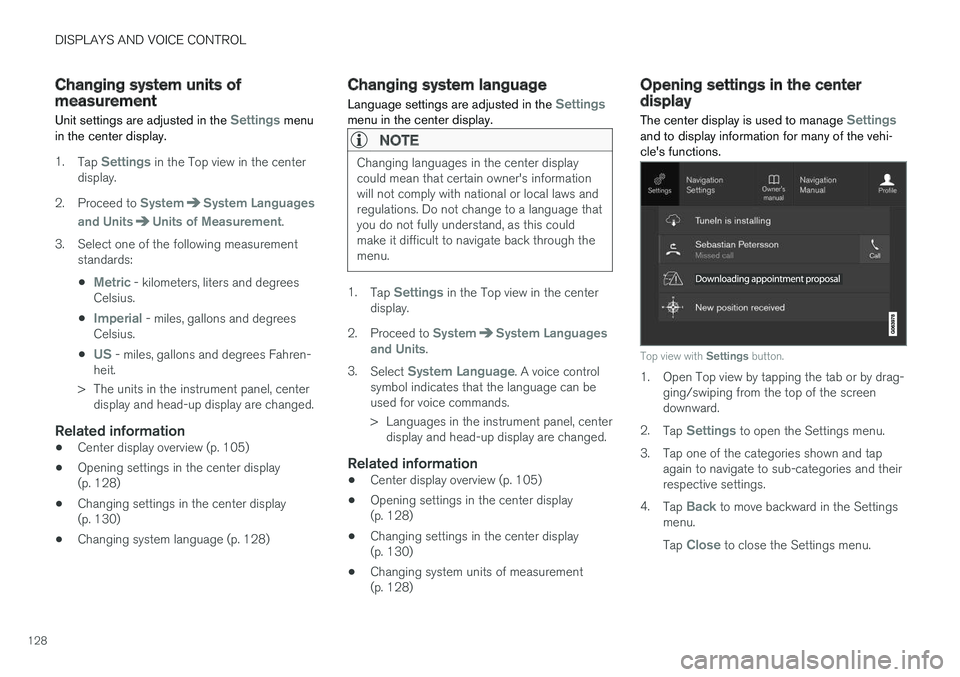
Opening settings in the centerdisplay The center display is used to manage
Settingsand to display information for many of the vehi- cle's functions.
Top view with
Settings button.
1. Open Top view by tapping the tab or by drag-
ging/swiping from the top of the screen downward.
2. Tap
Settings to open the Settings menu.
3. Tap one of the categories shown and tap again to navigate to sub-categories and their respective settings.
4. Tap
Back to move backward in the Settings
menu. Tap
Close to close the Settings menu.
Page 139 of 674
DISPLAYS AND VOICE CONTROL
137
Pop-up messages
Messages are sometimes shown as pop-up win- dows. Pop-up messages have a higher prioritythan messages shown in the status bar andrequire acknowledgment/action before they dis-appear. Messages that need to be saved arestored in Top view in the center display.
Related information
•Handling messages in the center display(p. 137)
• Handling messages saved from the centerdisplay (p. 138)
• Messages in the instrument panel (p. 101)
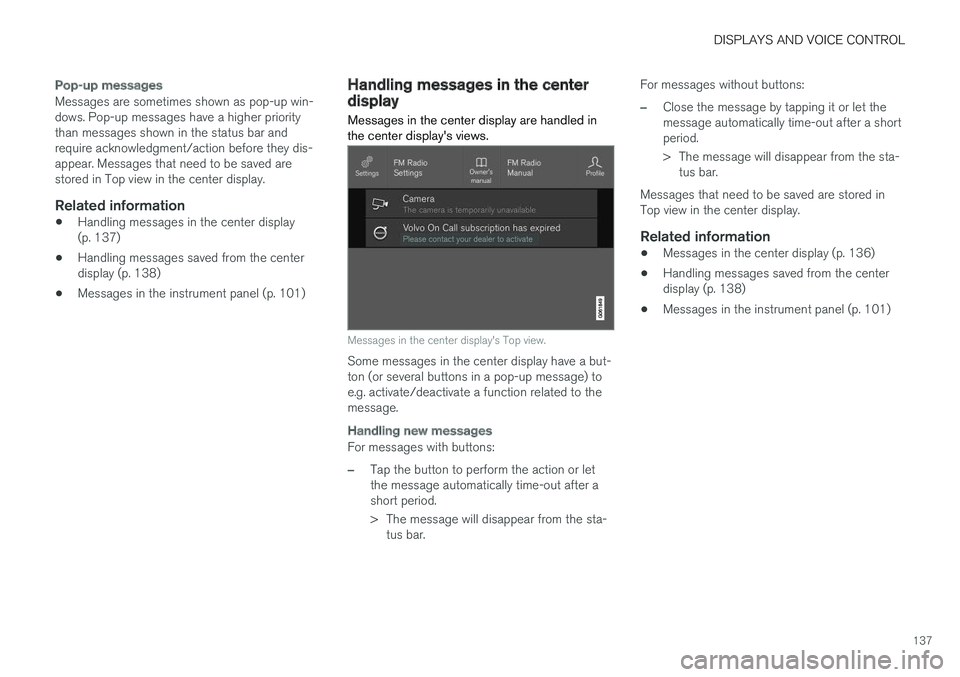
Handling messages in the centerdisplay Messages in the center display are handled in the center display's views.
Messages in the center display's Top view.
Some messages in the center display have a but- ton (or several buttons in a pop-up message) toe.g. activate/deactivate a function related to themessage.
Handling new messages
For messages with buttons:
–Tap the button to perform the action or let the message automatically time-out after ashort period.
> The message will disappear from the sta-
tus bar. For messages without buttons:
–Close the message by tapping it or let the message automatically time-out after a shortperiod.
> The message will disappear from the sta-
tus bar.
Messages that need to be saved are stored in Top view in the center display.
Related information
• Messages in the center display (p. 136)
• Handling messages saved from the centerdisplay (p. 138)
• Messages in the instrument panel (p. 101)
Page 140 of 674
DISPLAYS AND VOICE CONTROL
* Option/accessory.
138
Handling messages saved from thecenter display
Messages saved from the instrument panel and center displays are handled in the center display.
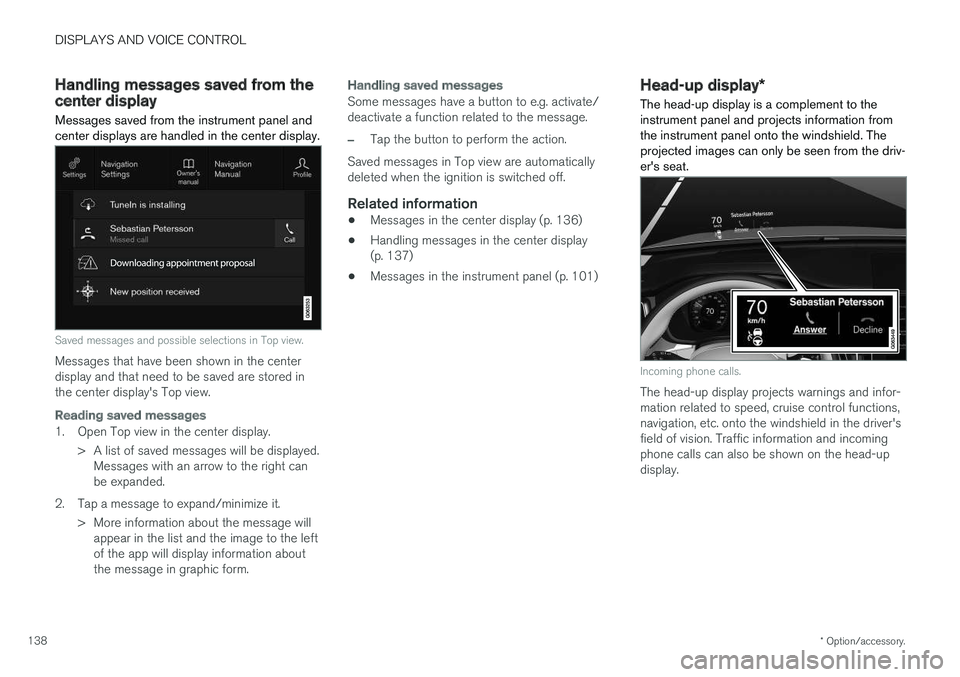
Saved messages and possible selections in Top view.
Messages that have been shown in the center display and that need to be saved are stored inthe center display's Top view.
Reading saved messages
1. Open Top view in the center display.
> A list of saved messages will be displayed.Messages with an arrow to the right can be expanded.
2. Tap a message to expand/minimize it. > More information about the message willappear in the list and the image to the leftof the app will display information aboutthe message in graphic form.
Handling saved messages
Some messages have a button to e.g. activate/ deactivate a function related to the message.
–Tap the button to perform the action.
Saved messages in Top view are automatically deleted when the ignition is switched off.
Related information
• Messages in the center display (p. 136)
• Handling messages in the center display(p. 137)
• Messages in the instrument panel (p. 101)
Head-up display
*
The head-up display is a complement to the instrument panel and projects information fromthe instrument panel onto the windshield. Theprojected images can only be seen from the driv-er's seat.
Incoming phone calls.
The head-up display projects warnings and infor- mation related to speed, cruise control functions,navigation, etc. onto the windshield in the driver'sfield of vision. Traffic information and incomingphone calls can also be shown on the head-updisplay.
Page 141 of 674
DISPLAYS AND VOICE CONTROL
* Option/accessory.139
NOTE
The driver's ability to see information in the head-up display may be impeded by:
• the use of polarizing sunglasses
• a driving posture in which the driver is notcentered in the seat
• objects on the display unit's glass cover
• unfavorable lighting conditions.
CAUTION
The information is projected from a display unit located in the dashboard. To help preventdamage to the display unit's glass cover, donot place any objects on the glass and pre-vent objects from falling onto it.
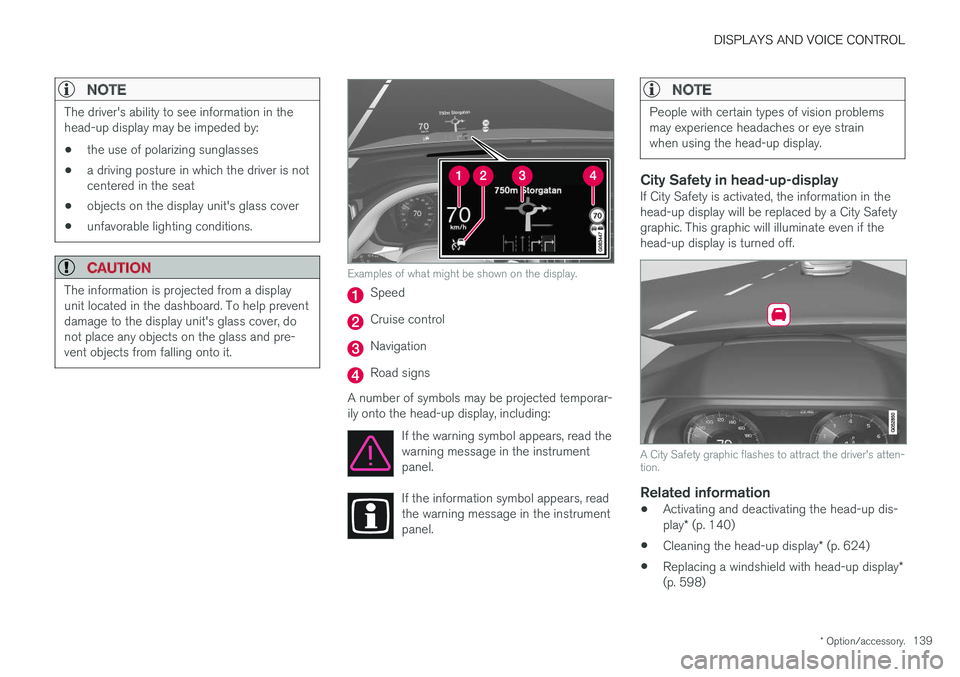
Examples of what might be shown on the display.
Speed
Cruise control
Navigation
Road signs
A number of symbols may be projected temporar- ily onto the head-up display, including: If the warning symbol appears, read thewarning message in the instrumentpanel.
If the information symbol appears, read the warning message in the instrumentpanel.
NOTE
People with certain types of vision problems may experience headaches or eye strainwhen using the head-up display.
City Safety in head-up-displayIf City Safety is activated, the information in the head-up display will be replaced by a City Safety graphic. This graphic will illuminate even if the head-up display is turned off.
A City Safety graphic flashes to attract the driver's atten- tion.
Related information
•Activating and deactivating the head-up dis- play
* (p. 140)
• Cleaning the head-up display
* (p. 624)
• Replacing a windshield with head-up display
*
(p. 598)
Page 144 of 674
||
DISPLAYS AND VOICE CONTROL
* Option/accessory.
142 Voice control is carried out as a dialog, with spo- ken commands from the user and verbal respon-ses from the system. The voice control systemuses the same microphone as devices connectedwith Bluetooth, and the voice control systemresponds through the vehicle's loudspeakers. Incertain cases, text messages will also be dis-played in the instrument panel. The functions arecontrolled using the right-side steering wheelkeypad and settings are made in the center dis-play.
System updates
The voice control system is continuously improved. For optimal functionality, always down-load the latest update at support.volvocars.com.
Related information
•
Using voice commands (p. 142)
• Voice control for cellular phones (p. 143)
• Voice control for radio and media (p. 144)
• Climate control system voice commands(p. 197)
• Voice control settings (p. 144)
Using voice commands15
Press the button for voice con- trol
on the right-side
steering wheel keypad to acti- vate the system and initiate avoice command dialog.
These may include:
• Wait until after the tone, and then speak in your normal voice at a normal speed.
• Do not speak while the system is responding(the system is unable to process commandsduring this time).
• Avoid background noises in the passengercompartment by keeping doors, windows and the panoramic roof
* closed.
Voice control can be canceled by:
• saying "
Cancel".
• pressing and holding the steering wheel key- pad's voice command button
.
To speed up the voice command dialog and skip system responses, press the voice command but- ton
while the system is responding and give
your next command.
Voice command examples
Press , say "Call [First name] [Last name]
[number category]" - calls the selected contact
from the phone book. If the contact has several phone numbers (e.g. home, cell, work), the rightcategory must also be given. Press
and say "Call Robyn Smith
cellular".
Commands/phrasesThe following commands can always be used: • "
Repeat" - repeats the most recent voice
command in the current dialog.
• "
Cancel" - cancels the dialog.
• "
Help" - initiates a help dialog. The system
responds with commands that can be used in the current situation, an instruction or anexample.
Commands for specific functions, such as phoneand audio, are described in the sections relatedto that function.
15 Certain markets only.
Page 151 of 674
LIGHTING
* Option/accessory.149
WARNING
The vehicle lighting system cannot in all situa- tions determine when the daylight is too weakor not strong enough, e.g. when there is fogor rain. The driver is always responsible for driving the vehicle with lighting that is safe for the trafficconditions and as specified by applicable traf-fic regulations.
Thumbwheel in instrument panel
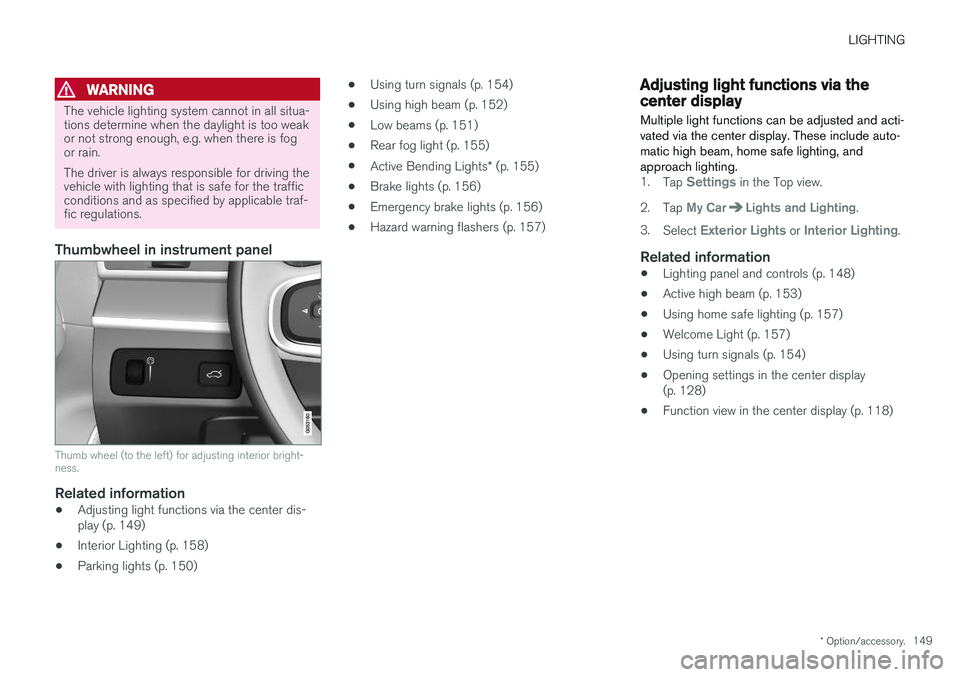
Thumb wheel (to the left) for adjusting interior bright- ness.
Related information
•Adjusting light functions via the center dis- play (p. 149)
• Interior Lighting (p. 158)
• Parking lights (p. 150) •
Using turn signals (p. 154)
• Using high beam (p. 152)
• Low beams (p. 151)
• Rear fog light (p. 155)
• Active Bending Lights
* (p. 155)
• Brake lights (p. 156)
• Emergency brake lights (p. 156)
• Hazard warning flashers (p. 157)
Adjusting light functions via thecenter display
Multiple light functions can be adjusted and acti- vated via the center display. These include auto-matic high beam, home safe lighting, andapproach lighting.
1. Tap Settings in the Top view.
2. Tap
My CarLights and Lighting.
3. Select
Exterior Lights or Interior Lighting.
Related information
• Lighting panel and controls (p. 148)
• Active high beam (p. 153)
• Using home safe lighting (p. 157)
• Welcome Light (p. 157)
• Using turn signals (p. 154)
• Opening settings in the center display (p. 128)
• Function view in the center display (p. 118)
Page 154 of 674
||
LIGHTING
152
Tunnel detection
The vehicle will detect if it enters a tunnel and shift from daytime running lights to low beams. Note that the left-hand steering wheel lever must be in
position for tunnel detection to work.
Related information
•Lighting panel and controls (p. 148)
• Ignition modes (p. 417)
• Daytime running lights (p. 150)
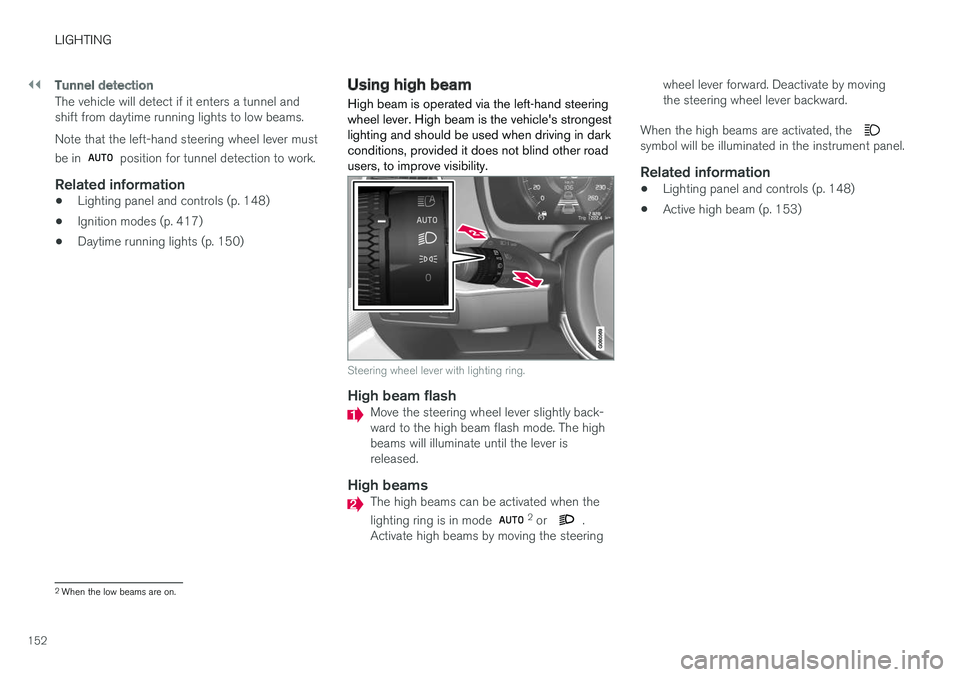
Using high beam High beam is operated via the left-hand steering wheel lever. High beam is the vehicle's strongestlighting and should be used when driving in darkconditions, provided it does not blind other roadusers, to improve visibility.
Steering wheel lever with lighting ring.
High beam flashMove the steering wheel lever slightly back- ward to the high beam flash mode. The highbeams will illuminate until the lever isreleased.
High beamsThe high beams can be activated when the lighting ring is in mode 2
or .
Activate high beams by moving the steering wheel lever forward. Deactivate by moving the steering wheel lever backward.
When the high beams are activated, the
symbol will be illuminated in the instrument panel.
Related information
• Lighting panel and controls (p. 148)
• Active high beam (p. 153)
2
When the low beams are on.
Page 155 of 674
LIGHTING
}}
* Option/accessory.153
Active high beam
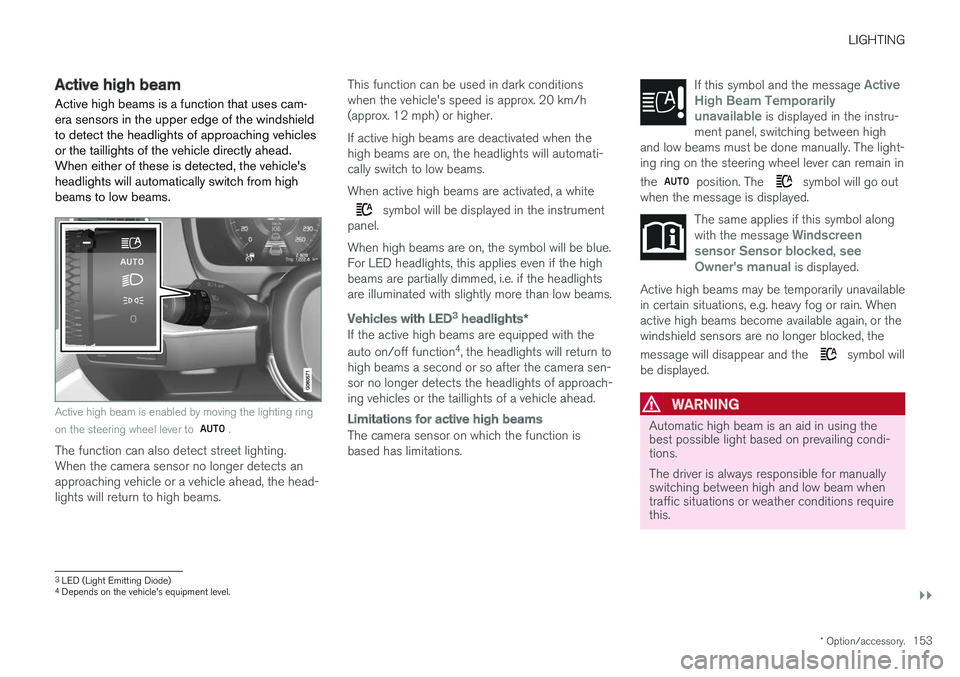
Active high beams is a function that uses cam- era sensors in the upper edge of the windshieldto detect the headlights of approaching vehiclesor the taillights of the vehicle directly ahead.When either of these is detected, the vehicle'sheadlights will automatically switch from highbeams to low beams.
Active high beam is enabled by moving the lighting ring on the steering wheel lever to
.
The function can also detect street lighting. When the camera sensor no longer detects anapproaching vehicle or a vehicle ahead, the head-lights will return to high beams. This function can be used in dark conditionswhen the vehicle's speed is approx. 20 km/h(approx. 12 mph) or higher. If active high beams are deactivated when the high beams are on, the headlights will automati-cally switch to low beams. When active high beams are activated, a white
symbol will be displayed in the instrument
panel. When high beams are on, the symbol will be blue. For LED headlights, this applies even if the highbeams are partially dimmed, i.e. if the headlightsare illuminated with slightly more than low beams.
Vehicles with LED3 headlights *
If the active high beams are equipped with the auto on/off function 4
, the headlights will return to
high beams a second or so after the camera sen- sor no longer detects the headlights of approach-ing vehicles or the taillights of a vehicle ahead.
Limitations for active high beams
The camera sensor on which the function is based has limitations. If this symbol and the message
Active
High Beam Temporarily
unavailable is displayed in the instru-
ment panel, switching between high
and low beams must be done manually. The light- ing ring on the steering wheel lever can remain in the
position. The symbol will go out
when the message is displayed.
The same applies if this symbol along with the message Windscreen
sensor Sensor blocked, see
Owner's manual is displayed.
Active high beams may be temporarily unavailable in certain situations, e.g. heavy fog or rain. Whenactive high beams become available again, or thewindshield sensors are no longer blocked, the message will disappear and the
symbol will
be displayed.
WARNING
Automatic high beam is an aid in using the best possible light based on prevailing condi-tions. The driver is always responsible for manually switching between high and low beam whentraffic situations or weather conditions requirethis.
3 LED (Light Emitting Diode)4
Depends on the vehicle's equipment level.