light VOLVO XC60 TWIN ENGINE 2019 Owners Manual
[x] Cancel search | Manufacturer: VOLVO, Model Year: 2019, Model line: XC60 TWIN ENGINE, Model: VOLVO XC60 TWIN ENGINE 2019Pages: 695, PDF Size: 14.96 MB
Page 596 of 695
||
LOADING, STORAGE AND PASSENGER COMPARTMENT
* Option/accessory.594
The illustration is generic – the design may vary.
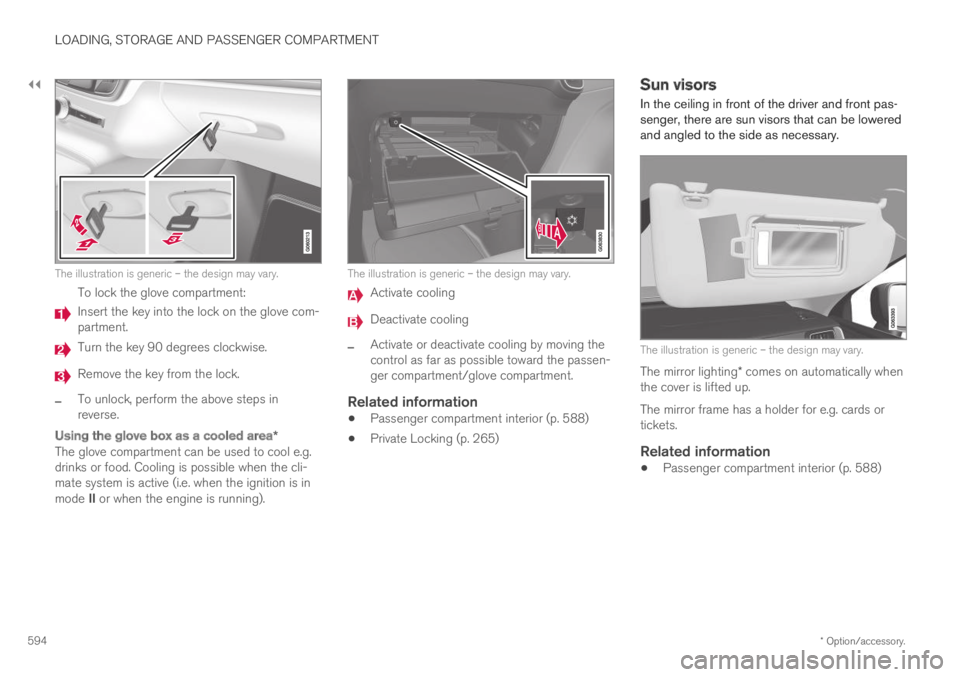
To lock the glove compartment:
Insert the key into the lock on the glove com-partment.
Turn the key 90 degrees clockwise.
Remove the key from the lock.
–To unlock, perform the above steps inreverse.
Using the glove box as a cooled area *
The glove compartment can be used to cool e.g.drinks or food. Cooling is possible when the cli-mate system is active (i.e. when the ignition is inmode II or when the engine is running).
The illustration is generic – the design may vary.
Activate cooling
Deactivate cooling
–Activate or deactivate cooling by moving thecontrol as far as possible toward the passen-ger compartment/glove compartment.
Related information
Passenger compartment interior (p. 588)
Private Locking (p. 265)
Sun visors
In the ceiling in front of the driver and front pas-senger, there are sun visors that can be loweredand angled to the side as necessary.
The illustration is generic – the design may vary.
The mirror lighting* comes on automatically whenthe cover is lifted up.
The mirror frame has a holder for e.g. cards ortickets.
Related information
Passenger compartment interior (p. 588)
Page 601 of 695
LOADING, STORAGE AND PASSENGER COMPARTMENT
}}
599
Then put the other end piece in the recess inthe side panel on the opposite side.
Make sure the front flap is pointed downwardbehind the backrest before the cassette isput into place.
Push the end piece down on both sides, oneat a time.
>When a click is heard and the red markson each end piece are no longer visible,the cover is in place. Check that it issecure.
Fitting the tailgate flap
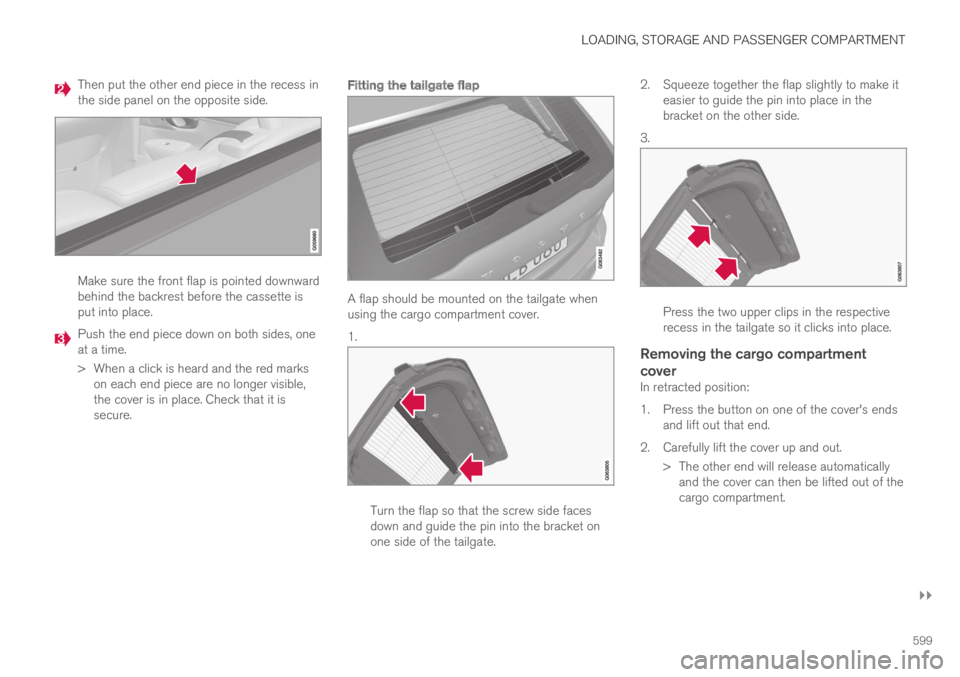
A flap should be mounted on the tailgate whenusing the cargo compartment cover.
1.
Turn the flap so that the screw side facesdown and guide the pin into the bracket onone side of the tailgate.
2.Squeeze together the flap slightly to make iteasier to guide the pin into place in thebracket on the other side.
3.
Press the two upper clips in the respectiverecess in the tailgate so it clicks into place.
Removing the cargo compartment
cover
In retracted position:
1. Press the button on one of the cover's endsand lift out that end.
2. Carefully lift the cover up and out.
> The other end will release automaticallyand the cover can then be lifted out of thecargo compartment.
Page 602 of 695
||
LOADING, STORAGE AND PASSENGER COMPARTMENT
* Option/accessory.600
Removing the tailgate flap
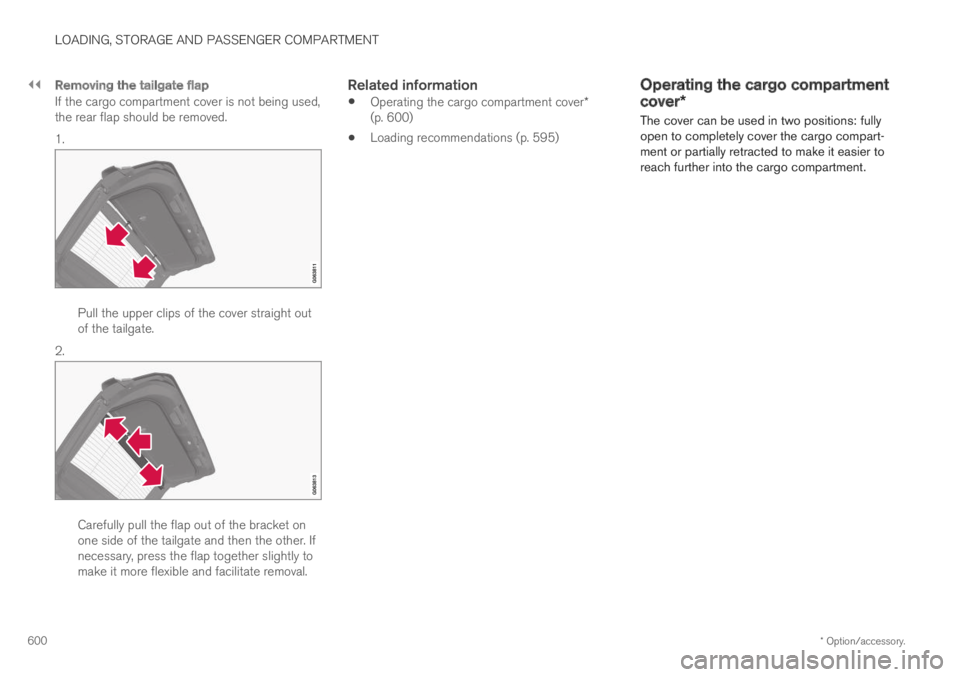
If the cargo compartment cover is not being used,the rear flap should be removed.
1.
Pull the upper clips of the cover straight outof the tailgate.
2.
Carefully pull the flap out of the bracket onone side of the tailgate and then the other. Ifnecessary, press the flap together slightly tomake it more flexible and facilitate removal.
Related information
Operating the cargo compartment cover*(p. 600)
Loading recommendations (p. 595)
Operating the cargo compartment
cover*
The cover can be used in two positions: fullyopen to completely cover the cargo compart-ment or partially retracted to make it easier toreach further into the cargo compartment.
Page 603 of 695
LOADING, STORAGE AND PASSENGER COMPARTMENT
}}
601
Fully open
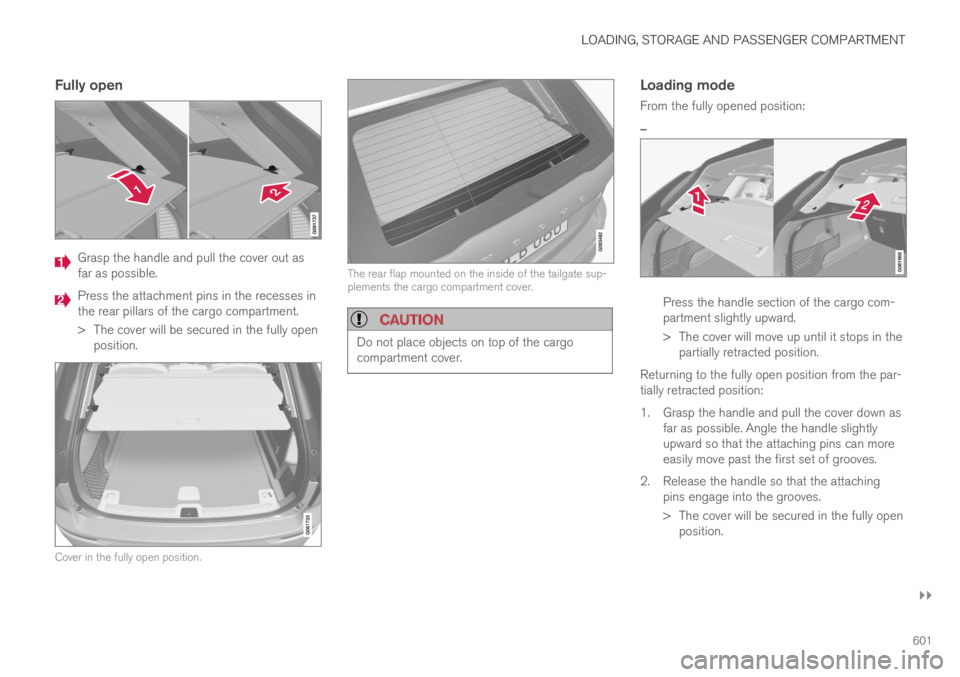
Grasp the handle and pull the cover out asfar as possible.
Press the attachment pins in the recesses inthe rear pillars of the cargo compartment.
>The cover will be secured in the fully openposition.
Cover in the fully open position.
The rear flap mounted on the inside of the tailgate sup-plements the cargo compartment cover.
CAUTION
Do not place objects on top of the cargocompartment cover.
Loading mode
From the fully opened position:
–
Press the handle section of the cargo com-partment slightly upward.
>The cover will move up until it stops in thepartially retracted position.
Returning to the fully open position from the par-tially retracted position:
1. Grasp the handle and pull the cover down asfar as possible. Angle the handle slightlyupward so that the attaching pins can moreeasily move past the first set of grooves.
2. Release the handle so that the attachingpins engage into the grooves.
> The cover will be secured in the fully openposition.
Page 607 of 695
LOADING, STORAGE AND PASSENGER COMPARTMENT
605
Front mounting.
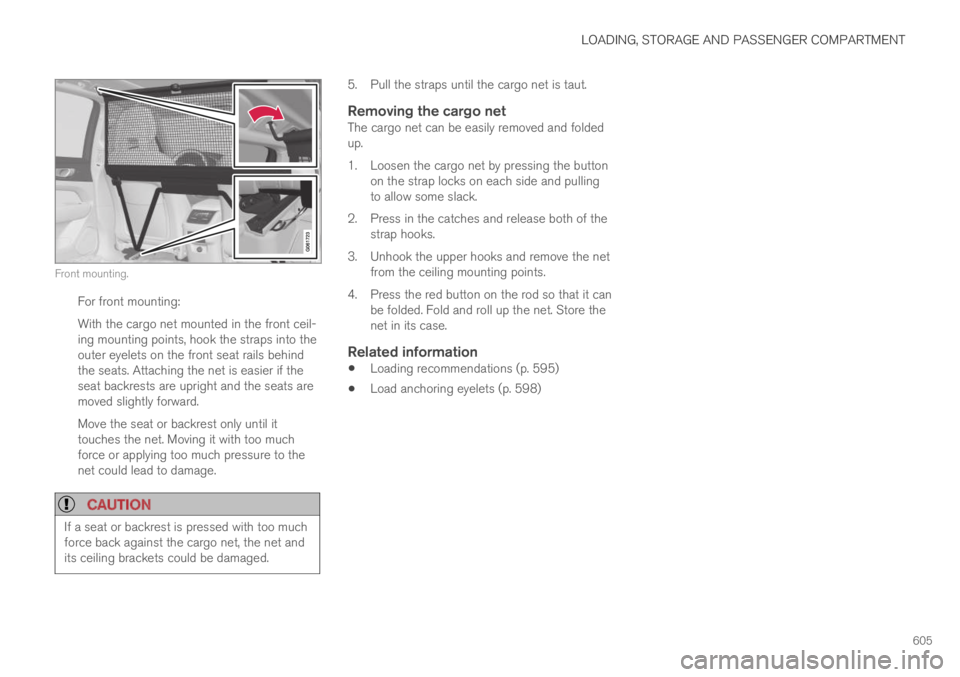
For front mounting:
With the cargo net mounted in the front ceil-ing mounting points, hook the straps into theouter eyelets on the front seat rails behindthe seats. Attaching the net is easier if theseat backrests are upright and the seats aremoved slightly forward.
Move the seat or backrest only until ittouches the net. Moving it with too muchforce or applying too much pressure to thenet could lead to damage.
CAUTION
If a seat or backrest is pressed with too muchforce back against the cargo net, the net andits ceiling brackets could be damaged.
5. Pull the straps until the cargo net is taut.
Removing the cargo net
The cargo net can be easily removed and foldedup.
1. Loosen the cargo net by pressing the buttonon the strap locks on each side and pullingto allow some slack.
2. Press in the catches and release both of thestrap hooks.
3. Unhook the upper hooks and remove the netfrom the ceiling mounting points.
4. Press the red button on the rod so that it canbe folded. Fold and roll up the net. Store thenet in its case.
Related information
Loading recommendations (p. 595)
Load anchoring eyelets (p. 598)
Page 611 of 695
MAINTENANCE AND SERVICE
}}
609
Periodic maintenance helps minimize
emissions
NOTE
Refer to your Service and Warranty Book-let for a comprehensive service and main-tenance schedule up to 240,000 km(150,000 miles). This program containsinspections and services necessary forthe proper function of your vehicle andincludes components that affect vehicleemissions.
The Warranty and Service Records Infor-mation booklet also contains detailedinformation concerning the warrantiesthat apply to your vehicle.
On-board Diagnostic System
OBD II is part of your vehicle's computerizedengine management system. It stores diagnosticinformation about your vehicle's emission con-trols. It can light the Check Engine light (MIL) if itdetects an emission control "fault." A "fault" is acomponent or system that is not performingwithin an expected range. A fault may be perma-nent or temporary. OBD II will store a messageabout any fault.
Emission inspection readiness
How do states use OBD II for emission
inspections?
Many states connect a computer directly to avehicle's OBD II system. The inspector can thenread "faults." In some states, this type of inspec-tion has replaced the tailpipe emission test.
How can my vehicle fail OBD II emission
inspection?
Your vehicle can fail OBD II emission inspectionfor any of the following reasons:
If your Check Engine (MIL) light is lit, yourvehicle may fail inspection.
If your vehicle's Check Engine light was lit,but went out without any action on your part,OBD II will still have a recorded fault. Yourvehicle may pass or fail, depending on theinspection practices in your area.
If you had recent service that required dis-connecting the battery, OBD II diagnosticinformation may be incomplete and "notready" for inspection. A vehicle that is notready may fail inspection.
How can I prepare for my next OBD II
emission inspection?
If your Check Engine (MIL) light is lit or waslit but went out without service, have your
vehicle diagnosed and, if necessary, servicedby a qualified Volvo technician.
If you recently had service for a lit CheckEngine light, or if you had service thatrequired disconnecting the battery, a periodof driving is necessary to bring the OBD IIsystem to "ready" for inspection. Two half-hour trips of mixed stop-and-go/highwaydriving are typically needed to allow OBD II toreach readiness. Your Volvo retailer can pro-vide you with more information on planning atrip.
Maintain your vehicle in accordance with yourvehicle's maintenance schedule.
Owner maintenance
Periodic maintenance requirements and intervalsare described in your vehicle's Warranty andService Records Information booklet.
The following points can be carried out betweenthe normally scheduled maintenance services.
Each time the car is refueled:
Check the engine oil level.
Clean the windshield, windshield wipers,headlights, and taillights.
Page 621 of 695
MAINTENANCE AND SERVICE
* Option/accessory.619
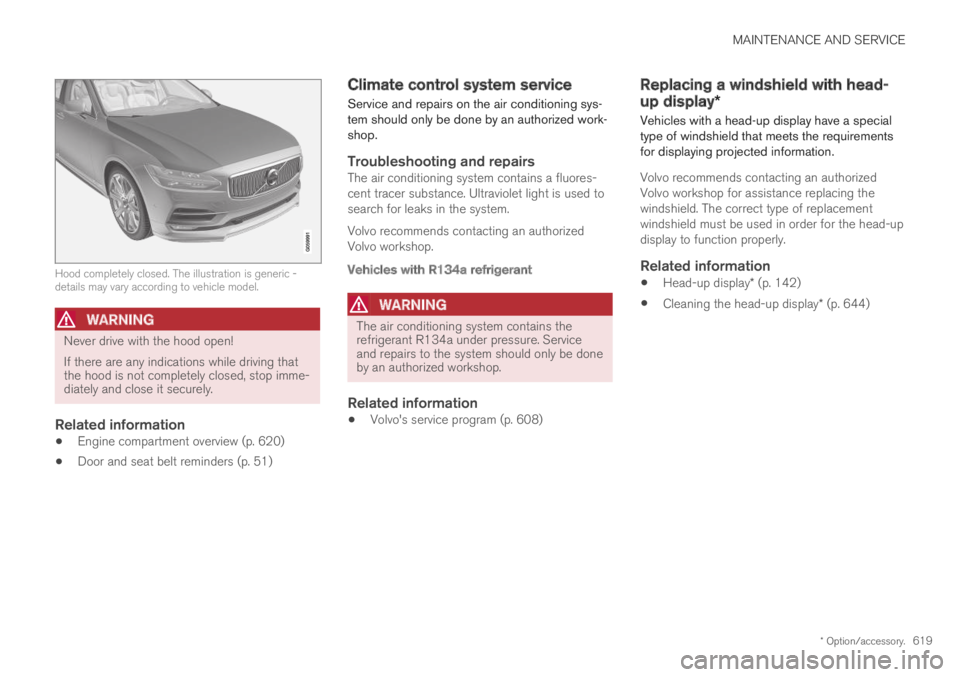
Hood completely closed. The illustration is generic -details may vary according to vehicle model.
WARNING
Never drive with the hood open!
If there are any indications while driving thatthe hood is not completely closed, stop imme-diately and close it securely.
Related information
Engine compartment overview (p. 620)
Door and seat belt reminders (p. 51)
Climate control system service
Service and repairs on the air conditioning sys-tem should only be done by an authorized work-shop.
Troubleshooting and repairs
The air conditioning system contains a fluores-cent tracer substance. Ultraviolet light is used tosearch for leaks in the system.
Volvo recommends contacting an authorizedVolvo workshop.
Vehicles with R134a refrigerant
WARNING
The air conditioning system contains therefrigerant R134a under pressure. Serviceand repairs to the system should only be doneby an authorized workshop.
Related information
Volvo's service program (p. 608)
Replacing a windshield with head-
up display*
Vehicles with a head-up display have a specialtype of windshield that meets the requirementsfor displaying projected information.
Volvo recommends contacting an authorizedVolvo workshop for assistance replacing thewindshield. The correct type of replacementwindshield must be used in order for the head-updisplay to function properly.
Related information
Head-up display* (p. 142)
Cleaning the head-up display* (p. 644)
Page 626 of 695
||
MAINTENANCE AND SERVICE
* Option/accessory.624
Unscrew the cover in the plastic covering.
Unscrew the expansion tank cap and fillcoolant as needed. The level should notexceed the yellow MAX mark inside theexpansion tank.
Put the components back in place in the reverseorder.
CAUTION
Do not ingest the contents. May causedamage to organs (kidneys).
Use premixed coolant according to Vol-vo's recommendations. If concentratedcoolant is used, make sure that the cool-ant mixture is 50% coolant and 50%water of acceptable quality.
Do not mix different types of coolant.
To help ensure sufficient corrosion pro-tection in the system, only use new cool-ant when replacing larger components inthe cooling system.
Never run the engine unless the coolingsystem is properly filled. An improperlyfilled cooling system could lead to hightemperatures and cracks in the cylinderheads.
High levels of chlorine, chlorides andother salts may cause corrosion in thecooling system.
Related information
Engine compartment overview (p. 620)
Coolant specifications (p. 671)
Replacing bulbs
Halogen headlights are not available on all mod-els and markets. Contact a Volvo retailer formore information.
LED14 bulbs must be replaced by a workshop.An authorized Volvo workshop is recommended.
NOTE
For information on lights not mentioned inthis article, contact a Volvo dealer or a certi-fied Volvo service technician.
NOTE
Exterior lighting such as headlights and tail-lights may develop temporary condensationon the inside of the lens. This is normal. Allexterior lighting is designed to resist this.Condensation is normally vented out of thelamp housing once the light has been lit forsome period of time.
NOTE
Bulbs for active curve lighting* contain tracesof mercury and should therefore always besubmitted to a certified Volvo service techni-cian.
Page 627 of 695
MAINTENANCE AND SERVICE
}}
625
Start battery
The vehicle has a single-pole electrical systemthat uses the chassis and engine mount as con-ductors.
The start battery is used to start the electricalsystem and power electrical equipment in thevehicle. The hybrid battery is used to start thecombustion engine.
The start battery should only be replaced by a
workshop15.
The start battery is a 12 V AGM (Absorbed GlassMat) battery, dimensioned for regenerative charg-ing and to support the function of the vehicle'svarious systems.
The service life and performance of the start bat-tery are affected by factors such as driving style,driving conditions, climate, battery discharges,number of starts, etc.
Never disconnect the start battery while theengine is running.
Make sure the cables to the start battery arecorrectly connected and the clamps aresecurely tightened.
WARNING
Batteries generate hydrogen gas, whichis flammable and explosive.
Do not connect the jumper cable to anypart of the fuel system or to any movingparts. Avoid touching hot manifolds.
Battery fluid contains sulfuric acid. Do notallow battery fluid to contact eyes, skin,fabrics or painted surfaces.
If contact occurs, flush the affected areaimmediately with water. Obtain medicalhelp immediately if eyes are affected.
Never expose the battery to open flameor electric spark. Do not smoke near thebattery. Failure to follow the instructionsfor jump starting can lead to injury.
Connection points
WARNING
PROPOSITION 65 WARNING
Battery posts, terminals, and related accesso-ries contain lead and lead compounds, chemi-cals known to the state of California to causecancer and reproductive harm. Wash handsafter handling.
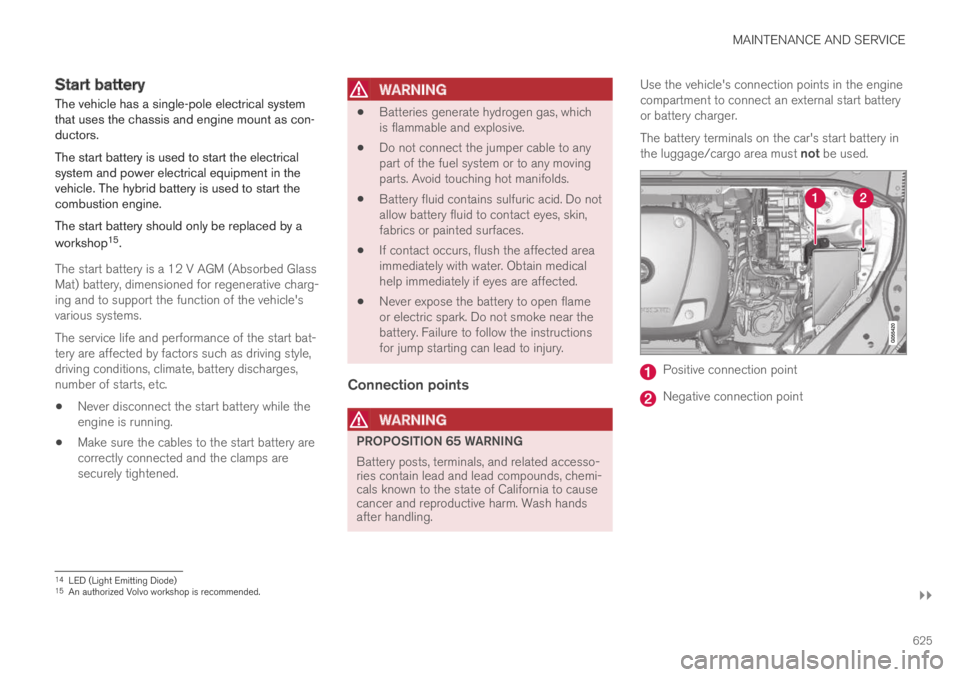
Use the vehicle's connection points in the enginecompartment to connect an external start batteryor battery charger.
The battery terminals on the car's start battery inthe luggage/cargo area must not be used.
Positive connection point
Negative connection point
14LED (Light Emitting Diode)15An authorized Volvo workshop is recommended.
Page 636 of 695
||
MAINTENANCE AND SERVICE
* Option/accessory.634
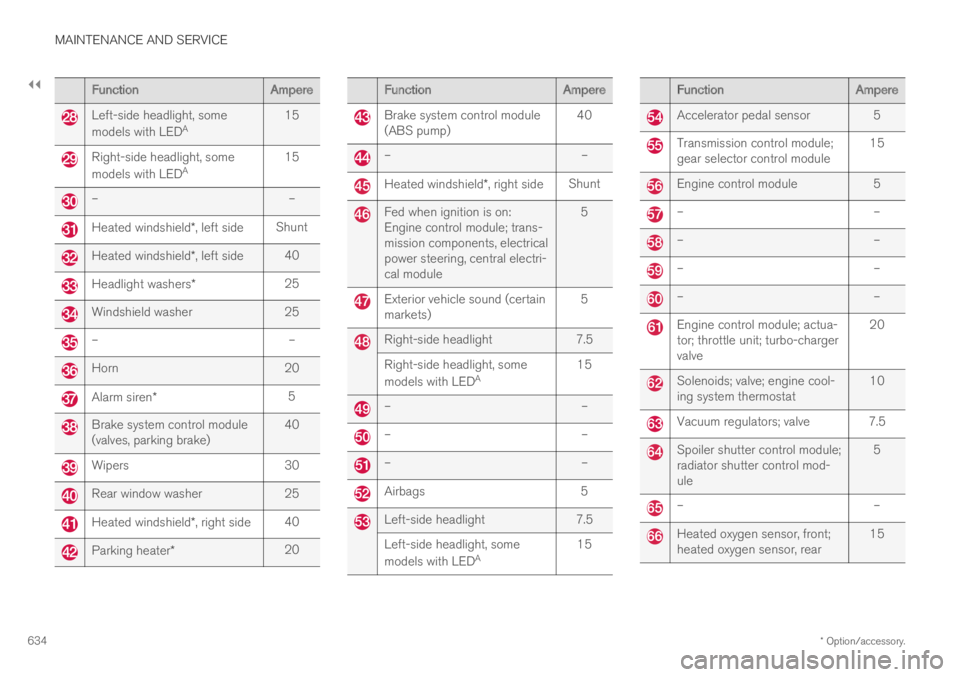
FunctionAmpere
Left-side headlight, some
models with LEDA15
Right-side headlight, some
models with LEDA15
––
Heated windshield*, left sideShunt
Heated windshield*, left side40
Headlight washers*25
Windshield washer25
––
Horn20
Alarm siren*5
Brake system control module(valves, parking brake)40
Wipers30
Rear window washer25
Heated windshield*, right side40
Parking heater*20
FunctionAmpere
Brake system control module(ABS pump)40
––
Heated windshield*, right sideShunt
Fed when ignition is on:Engine control module; trans-mission components, electricalpower steering, central electri-cal module
5
Exterior vehicle sound (certainmarkets)5
Right-side headlight7.5
Right-side headlight, some
models with LEDA15
––
––
––
Airbags5
Left-side headlight7.5
Left-side headlight, some
models with LEDA15
FunctionAmpere
Accelerator pedal sensor 5
Transmission control module;gear selector control module15
Engine control module5
––
––
––
––
Engine control module; actua-tor; throttle unit; turbo-chargervalve
20
Solenoids; valve; engine cool-ing system thermostat10
Vacuum regulators; valve 7.5
Spoiler shutter control module;radiator shutter control mod-ule
5
––
Heated oxygen sensor, front;heated oxygen sensor, rear15