light VOLVO XC60 TWIN ENGINE 2019 Owners Manual
[x] Cancel search | Manufacturer: VOLVO, Model Year: 2019, Model line: XC60 TWIN ENGINE, Model: VOLVO XC60 TWIN ENGINE 2019Pages: 695, PDF Size: 14.96 MB
Page 438 of 695
||
STARTING AND DRIVING
436
Symbols in the instrument panel
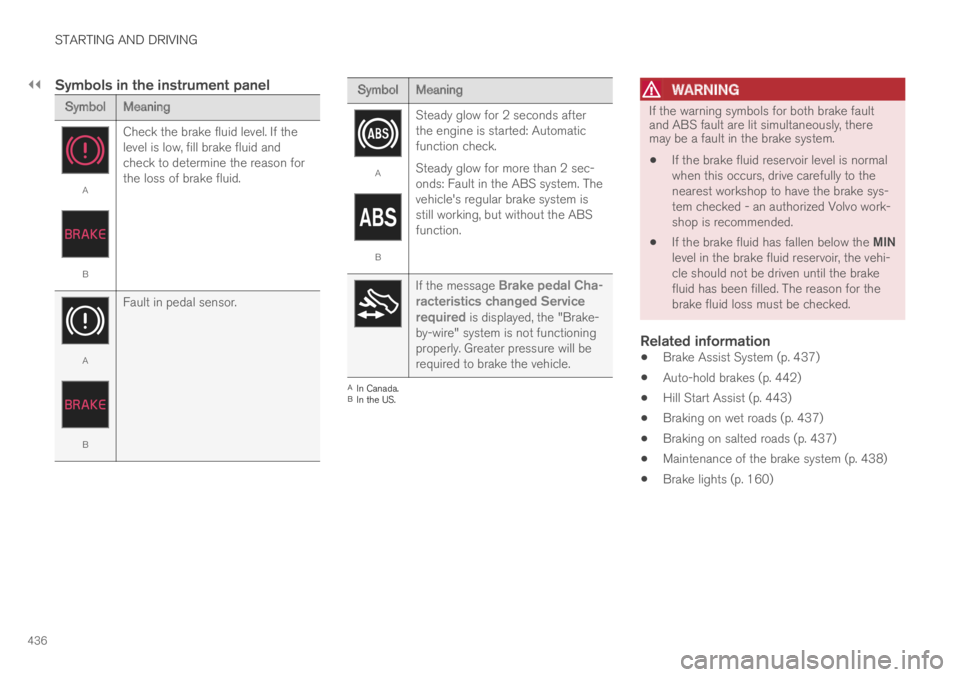
SymbolMeaning
A
B
Check the brake fluid level. If thelevel is low, fill brake fluid andcheck to determine the reason forthe loss of brake fluid.
A
B
Fault in pedal sensor.
SymbolMeaning
A
B
Steady glow for 2 seconds afterthe engine is started: Automaticfunction check.
Steady glow for more than 2 sec-onds: Fault in the ABS system. Thevehicle's regular brake system isstill working, but without the ABSfunction.
If the message Brake pedal Cha-racteristics changed Servicerequired is displayed, the "Brake-by-wire" system is not functioningproperly. Greater pressure will berequired to brake the vehicle.
AIn Canada.BIn the US.
WARNING
If the warning symbols for both brake faultand ABS fault are lit simultaneously, theremay be a fault in the brake system.
If the brake fluid reservoir level is normalwhen this occurs, drive carefully to thenearest workshop to have the brake sys-tem checked - an authorized Volvo work-shop is recommended.
If the brake fluid has fallen below the MINlevel in the brake fluid reservoir, the vehi-cle should not be driven until the brakefluid has been filled. The reason for thebrake fluid loss must be checked.
Related information
Brake Assist System (p. 437)
Auto-hold brakes (p. 442)
Hill Start Assist (p. 443)
Braking on wet roads (p. 437)
Braking on salted roads (p. 437)
Maintenance of the brake system (p. 438)
Brake lights (p. 160)
Page 439 of 695
STARTING AND DRIVING
437
Brake Assist System
The brake enhancing system, Brake AssistSystem (BAS), helps increase braking force andthereby reduce braking distance.
The system monitors the driver's braking habitsand increases braking force when necessary.Braking force can be increased up to the point atwhich the ABS intervenes. The function is deacti-vated when pressure on the brake pedal isdecreased.
Related information
Brakes (p. 435)
Braking on wet roads
Prolonged driving in heavy rain without brakingmay cause braking effect to be slightly delayedthe first time the brakes are applied.
This may also occur after washing the vehicle. Itwill then be necessary to apply greater pressureto the brake pedal. You should therefore maintaina greater distance to the vehicle ahead.
Firmly apply the brakes after washing the vehicleor driving on wet roads. This helps warm up thebrake discs, enabling them to dry more quicklyand protecting them against corrosion. Considerthe current traffic situation when braking.
Related information
Brakes (p. 435)
Braking on salted roads (p. 437)
Braking on salted roads
When driving on salted roads, a layer of salt mayform on the brake discs and brake pads.
This could increase stopping distance. Maintainan extra large safety distance to the vehicleahead. Make sure to also:
Apply the brakes from time to time to helpremove salt. Make sure braking does notpose a risk to any other road users.
Gently apply the brakes when you have fin-ished driving and before driving again.
Related information
Brakes (p. 435)
Braking on wet roads (p. 437)
Page 444 of 695
STARTING AND DRIVING
442
Auto-hold brakes
With the Auto-hold brake function, the driver canrelease the brake pedal and the brakes willremain applied, for example, when the vehiclehas stopped at a traffic light or intersection.
When the vehicle stops, the brakes are activatedautomatically. The function can use either thenormal brakes or the parking brakes to keep thevehicle stationary and works on flat surfaces orhills. When driving off, the brakes will be automat-ically released if the driver's seat belt is buckled.
NOTE
When braking to a stop on an uphill or down-hill gradient, depress the brake pedal withslightly more force than usual before releas-ing to ensure that the vehicle cannot move atall.
The parking brake is activated if:
the vehicle is switched off
the driver's door is opened
the driver's seat belt is removed
the vehicle has been stationary for a pro-longed period of time (5-10 minutes)
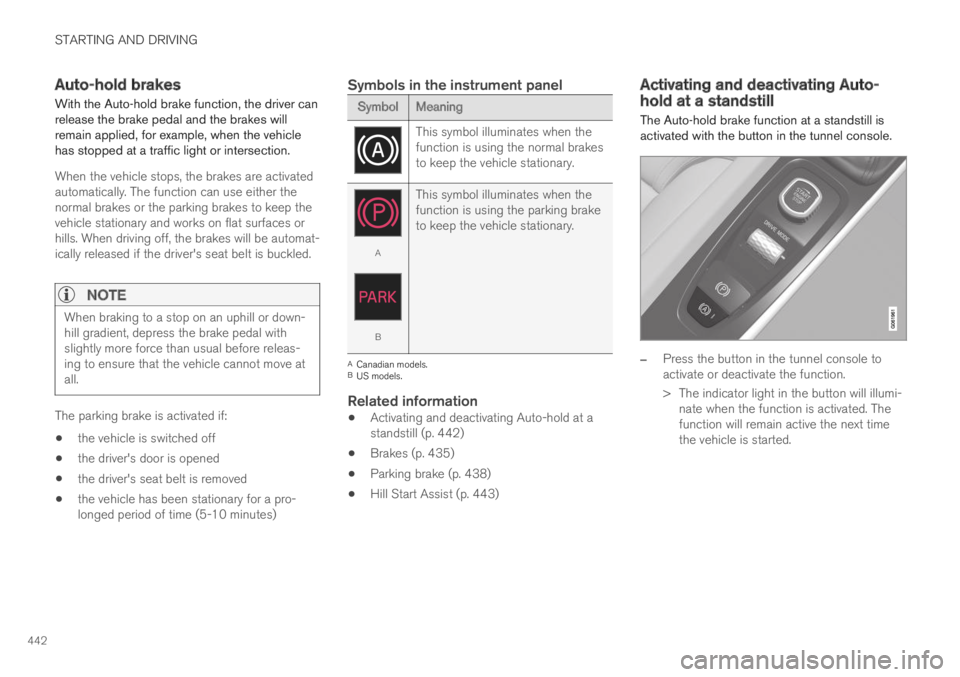
Symbols in the instrument panel
SymbolMeaning
This symbol illuminates when thefunction is using the normal brakesto keep the vehicle stationary.
A
B
This symbol illuminates when thefunction is using the parking braketo keep the vehicle stationary.
ACanadian models.BUS models.
Related information
Activating and deactivating Auto-hold at astandstill (p. 442)
Brakes (p. 435)
Parking brake (p. 438)
Hill Start Assist (p. 443)
Activating and deactivating Auto-hold at a standstill
The Auto-hold brake function at a standstill isactivated with the button in the tunnel console.
–Press the button in the tunnel console toactivate or deactivate the function.
>The indicator light in the button will illumi-nate when the function is activated. Thefunction will remain active the next timethe vehicle is started.
Page 445 of 695
STARTING AND DRIVING
}}
443
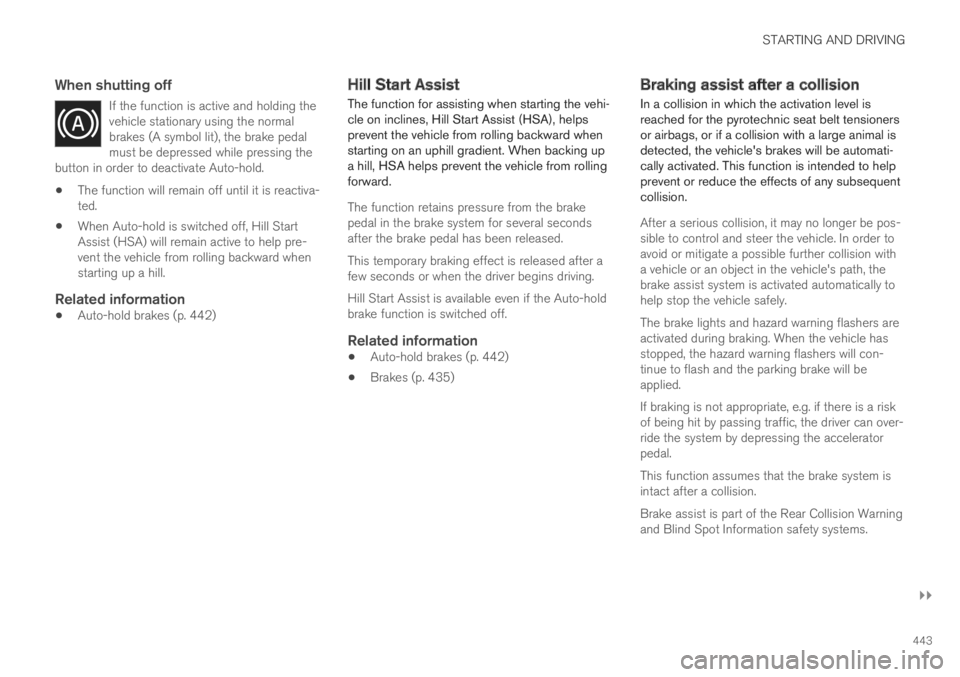
When shutting off
If the function is active and holding thevehicle stationary using the normalbrakes (A symbol lit), the brake pedalmust be depressed while pressing thebutton in order to deactivate Auto-hold.
The function will remain off until it is reactiva-ted.
When Auto-hold is switched off, Hill StartAssist (HSA) will remain active to help pre-vent the vehicle from rolling backward whenstarting up a hill.
Related information
Auto-hold brakes (p. 442)
Hill Start Assist
The function for assisting when starting the vehi-cle on inclines, Hill Start Assist (HSA), helpsprevent the vehicle from rolling backward whenstarting on an uphill gradient. When backing upa hill, HSA helps prevent the vehicle from rollingforward.
The function retains pressure from the brakepedal in the brake system for several secondsafter the brake pedal has been released.
This temporary braking effect is released after afew seconds or when the driver begins driving.
Hill Start Assist is available even if the Auto-holdbrake function is switched off.
Related information
Auto-hold brakes (p. 442)
Brakes (p. 435)
Braking assist after a collision
In a collision in which the activation level isreached for the pyrotechnic seat belt tensionersor airbags, or if a collision with a large animal isdetected, the vehicle's brakes will be automati-cally activated. This function is intended to helpprevent or reduce the effects of any subsequentcollision.
After a serious collision, it may no longer be pos-sible to control and steer the vehicle. In order toavoid or mitigate a possible further collision witha vehicle or an object in the vehicle's path, thebrake assist system is activated automatically tohelp stop the vehicle safely.
The brake lights and hazard warning flashers areactivated during braking. When the vehicle hasstopped, the hazard warning flashers will con-tinue to flash and the parking brake will beapplied.
If braking is not appropriate, e.g. if there is a riskof being hit by passing traffic, the driver can over-ride the system by depressing the acceleratorpedal.
This function assumes that the brake system isintact after a collision.
Brake assist is part of the Rear Collision Warningand Blind Spot Information safety systems.
Page 453 of 695
STARTING AND DRIVING
}}
451
Available drive modes
WARNING
Keep in mind that the vehicle does not emitany engine noise when using the electricmotor and may therefore be difficult to detectfor children, pedestrians, cyclists or animals.This is particularly true at low speeds, e.g. inparking lots.
WARNING
Do not leave the vehicle in an unventilatedarea with a drive mode activated and the com-bustion engine switched off. The engine willstart automatically if the charge level in thehybrid battery is low and the resulting exhaustgases can be very harmful to people and ani-mals.
HYBRID
This is the default mode in which the electricmotor and combustion engine work together.
The vehicle starts in Hybrid mode. The controlsystem uses both the electric motor and the gas-oline engine - separately or in tandem - and cal-culates optimal utilization with regard to perform-ance, fuel consumption and comfort. At highspeeds, ground clearance is automatically low-
ered3 to reduce air resistance. Driving capacity onthe electric motor alone is determined by factors
such as the hybrid battery's charge level, theneed for heat/cooling in the passenger compart-ment, etc.
If there is sufficient charge in the battery, it ispossible to drive solely on electric power. Whenthe accelerator pedal is pressed, only the electricmotor will be activated until the battery reaches acertain charge level. Above this level, the currentin the battery cannot supply the power requestedby the accelerator pedal and the combustionengine will start.
When the hybrid battery's charge level is low, thecombustion engine will start more frequently tosave the remaining current in the battery. Chargethe hybrid battery from a 120-240 volt outletusing a charging cable, or activate Charge inFunction view to reset the option of only usingthe electric motor.
This drive mode is designed for low energy con-sumption with an optimized mix between theelectric motor and gasoline engine, without com-promising on climate comfort or driving experi-ence. When faster acceleration is requested bythe driver, the electric driveline will be utilized tohelp provide maximum additional power. Thevehicle also monitors the driving conditions andautomatically engages all-wheel drive if neces-sary. All-wheel drive and extra electric power arealways available regardless of the battery'scharging status.
Information in the instrument panel
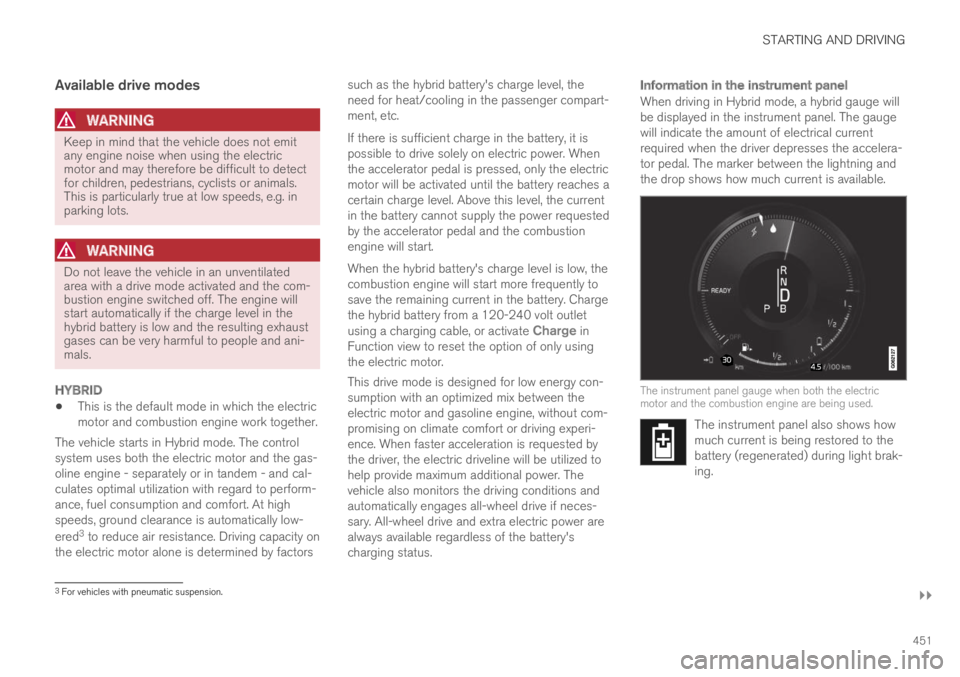
When driving in Hybrid mode, a hybrid gauge willbe displayed in the instrument panel. The gaugewill indicate the amount of electrical currentrequired when the driver depresses the accelera-tor pedal. The marker between the lightning andthe drop shows how much current is available.
The instrument panel gauge when both the electricmotor and the combustion engine are being used.
The instrument panel also shows howmuch current is being restored to thebattery (regenerated) during light brak-ing.
3For vehicles with pneumatic suspension.
Page 454 of 695
||
STARTING AND DRIVING
452
PURE
Uses the electric motor only, with the lowestpossible energy consumption and carbondioxide emissions.
This drive mode maximizes the use of the hybrid
battery. Ground clearance is lowered3 to reduceair resistance and certain climate system func-tions are reduced to provide the longest possibledriving distance using only electricity.
Pure mode is available when the hybrid battery issufficiently charged. Even in Pure mode, the com-bustion engine will start if the charge level in thebattery gets too low. The combustion engine willalso start
if the vehicle's speed goes above 125 km/h(78 mph)
if the driver requests more power than theelectric motor can provide
if factors such as cold weather affect thesystem or components.
This drive mode is optimized for maximum drivingdistance with electric propulsion and is primarilyintended for use in city driving. Pure helps pro-vide the lowest possible consumption even whenthe hybrid battery is fully discharged. ECO climateis activated to control the climate in the passen-ger compartment, and in slippery road conditionsslightly more wheel spin may be permitted beforeall-wheel drive is automatically activated.
ECO Climate
In Pure mode, ECO climate is automatically acti-vated in the passenger compartment to helpreduce energy consumption.
NOTE
When the Pure drive mode is activated, set-tings for certain climate system and electricityconsuming functions are reduced. Some ofthese settings can be reset manually, but fullfunctionality will only be restored by leavingPure mode or adapting the Individual drivemode to full climate system functionality.
If condensation forms on the windows, tap themax defroster button, which will function normally.
OFF ROAD
Maximizes the vehicle's ability to traverse dif-ficult terrain or poor roads.
In this mode, ground clearance3 is high, steeringis light, and all-wheel drive and Hill DescentControl are activated.
This drive mode is only available at low speeds,up to 40 km/h (25 mph). If this speed is excee-ded, Off road mode will be cancelled and AWDmode will be activated instead.
All-wheel drive requires both the combustion andelectric motor to be in continuous operation,which results in higher fuel consumption.
In Off road mode, a compass will be displayedbetween the speedometer and the tachometer inthe instrument panel. The permissible speedrange will be shown in the speedometer.
3For vehicles with pneumatic suspension.
Page 462 of 695
STARTING AND DRIVING
* Option/accessory.460
Leveling control settings*
Turn off leveling control before lifting the vehiclewith a jack to help avoid problems with thepneumatic suspension.
The vehicle can be lowered or raised to make iteasier to load or for passengers to get in andout.
Adjusting loading mode
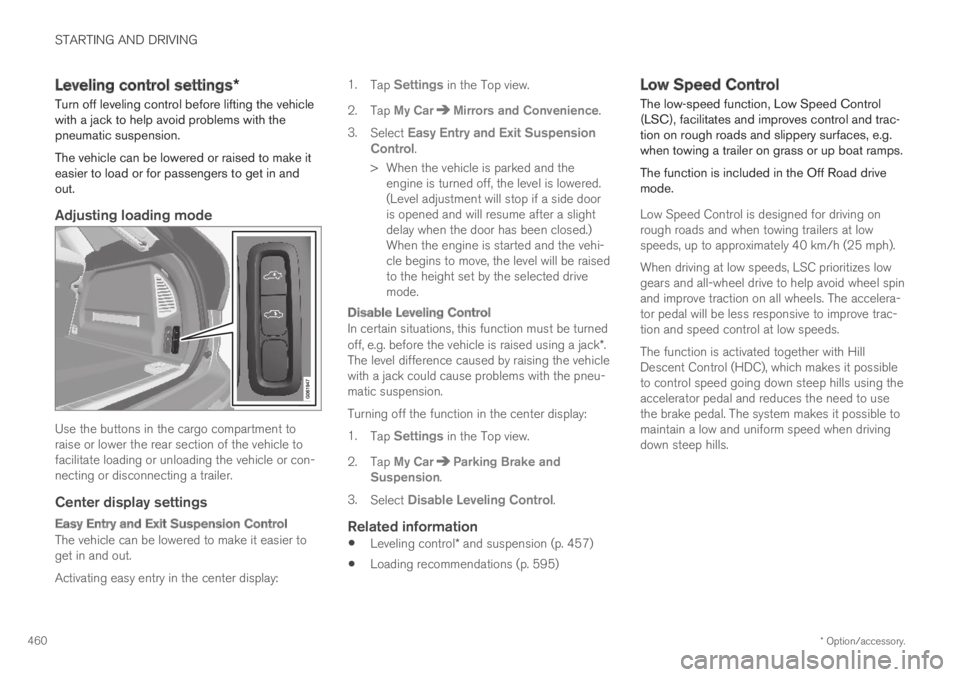
Use the buttons in the cargo compartment toraise or lower the rear section of the vehicle tofacilitate loading or unloading the vehicle or con-necting or disconnecting a trailer.
Center display settings
Easy Entry and Exit Suspension Control
The vehicle can be lowered to make it easier toget in and out.
Activating easy entry in the center display:
1.Tap Settings in the Top view.
2.Tap My CarMirrors and Convenience.
3.Select Easy Entry and Exit SuspensionControl.
>When the vehicle is parked and theengine is turned off, the level is lowered.(Level adjustment will stop if a side dooris opened and will resume after a slightdelay when the door has been closed.)When the engine is started and the vehi-cle begins to move, the level will be raisedto the height set by the selected drivemode.
Disable Leveling Control
In certain situations, this function must be turnedoff, e.g. before the vehicle is raised using a jack*.The level difference caused by raising the vehiclewith a jack could cause problems with the pneu-matic suspension.
Turning off the function in the center display:
1.Tap Settings in the Top view.
2.Tap My CarParking Brake andSuspension.
3.Select Disable Leveling Control.
Related information
Leveling control* and suspension (p. 457)
Loading recommendations (p. 595)
Low Speed Control
The low-speed function, Low Speed Control(LSC), facilitates and improves control and trac-tion on rough roads and slippery surfaces, e.g.when towing a trailer on grass or up boat ramps.
The function is included in the Off Road drivemode.
Low Speed Control is designed for driving onrough roads and when towing trailers at lowspeeds, up to approximately 40 km/h (25 mph).
When driving at low speeds, LSC prioritizes lowgears and all-wheel drive to help avoid wheel spinand improve traction on all wheels. The accelera-tor pedal will be less responsive to improve trac-tion and speed control at low speeds.
The function is activated together with HillDescent Control (HDC), which makes it possibleto control speed going down steep hills using theaccelerator pedal and reduces the need to usethe brake pedal. The system makes it possible tomaintain a low and uniform speed when drivingdown steep hills.
Page 463 of 695
STARTING AND DRIVING
461
NOTE
When LSC with HDC is activated in the OFFROAD drive mode, the feel of the acceleratorpedal and engine response will change.
NOTE
This drive mode is not designed to be usedfor normal street driving.
NOTE
The function is deactivated when driving athigh speeds and must be reactivated at lowerspeeds if so desired.
Related information
Activating and deactivating Low Speed Con-trol using the function button (p. 461)
Changing drive mode (p. 455)
Hill Descent Control (p. 462)
All Wheel Drive (AWD) (p. 448)
Activating and deactivating LowSpeed Control using the functionbutton
There is a function button for driving at lowspeeds with Hill Descent Control in the centerdisplay's Function view if the vehicle is notequipped with a drive mode control in the tunnelconsole.
Selecting Low Speed Control in the
center display's Function view
–Tap the Hill Descent Control button toactivate or deactivate the function.
> An indicator light in the button will illumi-nate when the function is activated.
When the engine is switched off, the function willbe automatically deactivated.
NOTE
The function is deactivated when driving athigh speeds and must be reactivated at lowerspeeds if so desired.
Related information
Low Speed Control (p. 460)
Changing drive mode (p. 455)
Page 464 of 695
STARTING AND DRIVING
462
Hill Descent Control
The function for assisting when driving downhill,Hill Descent Control (HDC), is a low-speedfunction with increased engine braking. Thefunction makes it possible to increase ordecrease the vehicle's speed on steep downhillgradients by only using the accelerator pedal,without applying the brakes.
The function is included in the Off Road drivemode.
HDC is designed for driving on rough roads atlow speeds and downhill gradients with slipperyor otherwise difficult road surfaces. The driverdoes not need to use the brake pedal but caninstead focus on steering.
WARNING
HDC is only intended to be a supplementarybraking aid and it does not function in all sit-uations.
The driver is always ultimately responsible foroperating the vehicle in a safe manner.
Function
Hill Descent Control allows the vehicle to moveforward or backward at very low speeds assistedby the brake system. The driver can increase thespeed by pressing the accelerator pedal. Whenthe accelerator pedal is released, the vehicle willreturn to very low speed regardless of how steep
the hill is and without the brakes needing to beapplied. The brake lights will illuminate when thefunction is activated.
The driver can brake to stop or slow the vehicleat any time by depressing the brake pedal.
HDC is activated along with Low Speed Control(LSC), which facilitates and improves traction andcontrol on rough and slippery surfaces. The sys-tem is intended to be used at low speeds, up toapproximately 40 km/h (25 mph).
To keep in mind when using HDC
If the function is switched off while driving ona steep downhill gradient, braking effect willbe gradually reduced.
HDC can be used in gear positions D and R,and in manual gears 1 or 2.
It is not possible to manually shift to thirdgear or higher when HDC is active.
NOTE
When LSC with HDC is activated in the OFFROAD drive mode, the feel of the acceleratorpedal and engine response will change.
NOTE
This drive mode is not designed to be usedfor normal street driving.
NOTE
The function is deactivated when driving athigh speeds and must be reactivated at lowerspeeds if so desired.
Related information
Activating and deactivating Hill Descent Con-trol using the function button (p. 463)
Changing drive mode (p. 455)
Low Speed Control (p. 460)
All Wheel Drive (AWD) (p. 448)
Page 465 of 695
STARTING AND DRIVING
}}
463
Activating and deactivating HillDescent Control using the functionbutton
There is a function button for assistance onsteep gradients with Hill Descent Control inthe center display's Function view if the vehicleis not equipped with a drive mode control in thetunnel console.
Selecting Hill Descent Control in the
center display's Function view
HDC only works at low speeds.
–Tap the Hill Descent Control button toactivate or deactivate the function.
> An indicator light in the button will illumi-nate when the function is activated.
When the engine is switched off, the function willbe automatically deactivated.
NOTE
The function is deactivated when driving athigh speeds and must be reactivated at lowerspeeds if so desired.
Related information
Hill Descent Control (p. 462)
Changing drive mode (p. 455)
Economical driving
Drive economically and more environmentallyconscious by thinking ahead, avoiding rapidstarts and stops and adapting driving style andspeed to the current traffic conditions.
To help achieve the greatest distance with thelowest fuel consumption with Twin Engine,observe the following:
Charge
Charge the vehicle regularly by plugging itinto an electrical outlet. Make it a habit toalways begin trips with the hybrid battery fullycharged.
Locate charging stations along your route.
If possible, choose parking spots with charg-ing stations.
NOTE
Charge the vehicle from the electricity grid asoften as possible!