height VOLVO XC60 TWIN ENGINE 2019 Owner's Manual
[x] Cancel search | Manufacturer: VOLVO, Model Year: 2019, Model line: XC60 TWIN ENGINE, Model: VOLVO XC60 TWIN ENGINE 2019Pages: 695, PDF Size: 14.96 MB
Page 462 of 695
STARTING AND DRIVING
* Option/accessory.460
Leveling control settings*
Turn off leveling control before lifting the vehiclewith a jack to help avoid problems with thepneumatic suspension.
The vehicle can be lowered or raised to make iteasier to load or for passengers to get in andout.
Adjusting loading mode
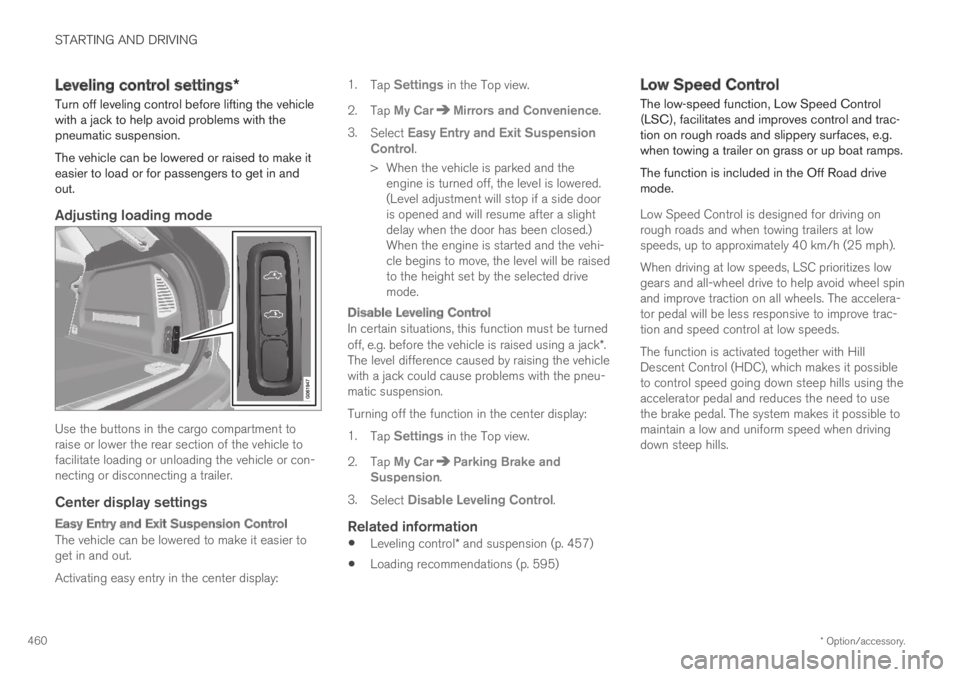
Use the buttons in the cargo compartment toraise or lower the rear section of the vehicle tofacilitate loading or unloading the vehicle or con-necting or disconnecting a trailer.
Center display settings
Easy Entry and Exit Suspension Control
The vehicle can be lowered to make it easier toget in and out.
Activating easy entry in the center display:
1.Tap Settings in the Top view.
2.Tap My CarMirrors and Convenience.
3.Select Easy Entry and Exit SuspensionControl.
>When the vehicle is parked and theengine is turned off, the level is lowered.(Level adjustment will stop if a side dooris opened and will resume after a slightdelay when the door has been closed.)When the engine is started and the vehi-cle begins to move, the level will be raisedto the height set by the selected drivemode.
Disable Leveling Control
In certain situations, this function must be turnedoff, e.g. before the vehicle is raised using a jack*.The level difference caused by raising the vehiclewith a jack could cause problems with the pneu-matic suspension.
Turning off the function in the center display:
1.Tap Settings in the Top view.
2.Tap My CarParking Brake andSuspension.
3.Select Disable Leveling Control.
Related information
Leveling control* and suspension (p. 457)
Loading recommendations (p. 595)
Low Speed Control
The low-speed function, Low Speed Control(LSC), facilitates and improves control and trac-tion on rough roads and slippery surfaces, e.g.when towing a trailer on grass or up boat ramps.
The function is included in the Off Road drivemode.
Low Speed Control is designed for driving onrough roads and when towing trailers at lowspeeds, up to approximately 40 km/h (25 mph).
When driving at low speeds, LSC prioritizes lowgears and all-wheel drive to help avoid wheel spinand improve traction on all wheels. The accelera-tor pedal will be less responsive to improve trac-tion and speed control at low speeds.
The function is activated together with HillDescent Control (HDC), which makes it possibleto control speed going down steep hills using theaccelerator pedal and reduces the need to usethe brake pedal. The system makes it possible tomaintain a low and uniform speed when drivingdown steep hills.
Page 470 of 695
STARTING AND DRIVING
468
Preparing for a long trip
It is important to have the vehicle's systems andequipment checked carefully before driving longdistances.
Check that:
the engine is running properly and that fuelconsumption is normal
there are no leaks (fuel, oil or other fluid)
the brake pedal is functioning optimally
all lights are working ‒ adjust the headlightheight if the vehicle is carrying a heavy load
tire tread depth and air pressure are at cor-rect levels. Change to snow tires when driv-ing in areas where there is a risk of snowy oricy roads
the start battery is sufficiently charged
the wiper blades are in good condition
Related information
Checking tire pressure (p. 563)
Filling washer fluid (p. 660)
Winter driving (p. 468)
Economical driving (p. 463)
Vehicle modem settings (p. 541)
Loading recommendations (p. 595)
Driving with a trailer (p. 479)
Pilot Assist (p. 310)
Speed limiter (p. 277)
Tire sealing system (p. 578)
Winter driving
It is important to check the vehicle before drivingin cold/snowy conditions to make sure it can bedriven safely.
Before the cold season arrives:
Make sure the engine coolant contains 50%antifreeze. This mixture helps protect theengine from frost erosion down toapprox. -35 °C (-31 °F). Do not mix differenttypes of antifreeze as this could pose ahealth risk.
Keep the fuel tank well filled to prevent con-densation from forming.
Check the viscosity of the engine oil. Oil withlow viscosity (thinner oil) improves cold-weather starting and reduces fuel consump-tion when driving with a cold engine.
CAUTION
Low-viscosity oil should not be used with harddriving or in hot weather.
Check the condition and charge level of thestart battery. Cold weather places greaterdemands on the start battery and reduces itscapacity.
Use washer fluid containing antifreeze tohelp prevent ice from forming in the washerfluid reservoir.
Page 561 of 695
WHEELS AND TIRES
}}
559
Tread wear indicator
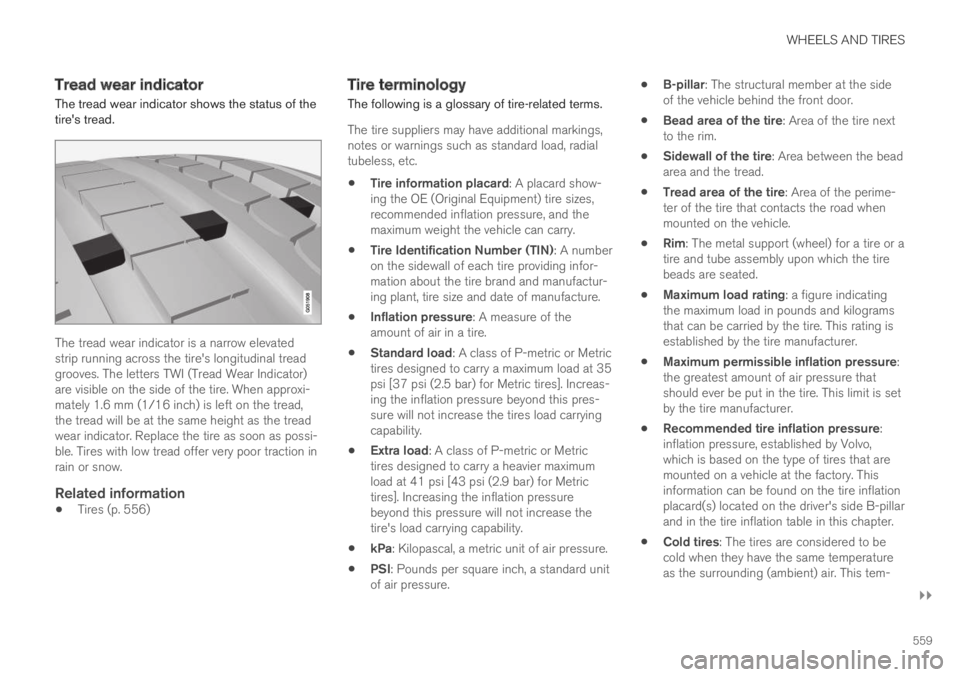
The tread wear indicator shows the status of thetire's tread.
The tread wear indicator is a narrow elevatedstrip running across the tire's longitudinal treadgrooves. The letters TWI (Tread Wear Indicator)are visible on the side of the tire. When approxi-mately 1.6 mm (1/16 inch) is left on the tread,the tread will be at the same height as the treadwear indicator. Replace the tire as soon as possi-ble. Tires with low tread offer very poor traction inrain or snow.
Related information
Tires (p. 556)
Tire terminology
The following is a glossary of tire-related terms.
The tire suppliers may have additional markings,notes or warnings such as standard load, radialtubeless, etc.
Tire information placard: A placard show-ing the OE (Original Equipment) tire sizes,recommended inflation pressure, and themaximum weight the vehicle can carry.
Tire Identification Number (TIN): A numberon the sidewall of each tire providing infor-mation about the tire brand and manufactur-ing plant, tire size and date of manufacture.
Inflation pressure: A measure of theamount of air in a tire.
Standard load: A class of P-metric or Metrictires designed to carry a maximum load at 35psi [37 psi (2.5 bar) for Metric tires]. Increas-ing the inflation pressure beyond this pres-sure will not increase the tires load carryingcapability.
Extra load: A class of P-metric or Metrictires designed to carry a heavier maximumload at 41 psi [43 psi (2.9 bar) for Metrictires]. Increasing the inflation pressurebeyond this pressure will not increase thetire's load carrying capability.
kPa: Kilopascal, a metric unit of air pressure.
PSI: Pounds per square inch, a standard unitof air pressure.
B-pillar: The structural member at the sideof the vehicle behind the front door.
Bead area of the tire: Area of the tire nextto the rim.
Sidewall of the tire: Area between the beadarea and the tread.
Tread area of the tire: Area of the perime-ter of the tire that contacts the road whenmounted on the vehicle.
Rim: The metal support (wheel) for a tire or atire and tube assembly upon which the tirebeads are seated.
Maximum load rating: a figure indicatingthe maximum load in pounds and kilogramsthat can be carried by the tire. This rating isestablished by the tire manufacturer.
Maximum permissible inflation pressure:the greatest amount of air pressure thatshould ever be put in the tire. This limit is setby the tire manufacturer.
Recommended tire inflation pressure:inflation pressure, established by Volvo,which is based on the type of tires that aremounted on a vehicle at the factory. Thisinformation can be found on the tire inflationplacard(s) located on the driver's side B-pillarand in the tire inflation table in this chapter.
Cold tires: The tires are considered to becold when they have the same temperatureas the surrounding (ambient) air. This tem-
Page 562 of 695
||
WHEELS AND TIRES
560
perature is normally reached after the vehiclehas been parked for at least 3 hours.
Related information
Tires (p. 556)
Tire sidewall designations
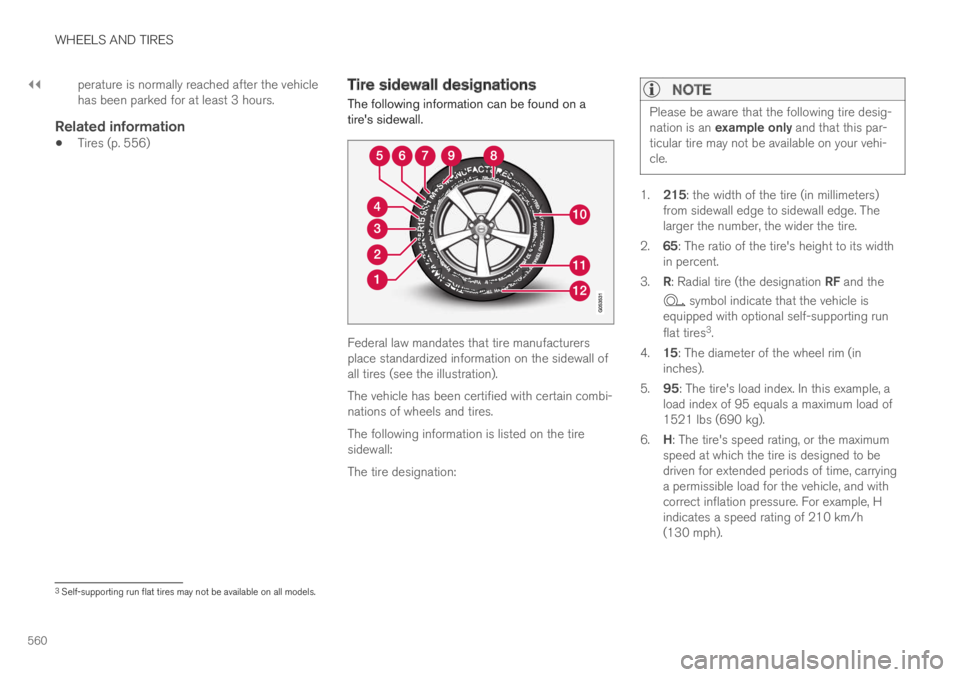
The following information can be found on atire's sidewall.
Federal law mandates that tire manufacturersplace standardized information on the sidewall ofall tires (see the illustration).
The vehicle has been certified with certain combi-nations of wheels and tires.
The following information is listed on the tiresidewall:
The tire designation:
NOTE
Please be aware that the following tire desig-nation is an example only and that this par-ticular tire may not be available on your vehi-cle.
1.215: the width of the tire (in millimeters)from sidewall edge to sidewall edge. Thelarger the number, the wider the tire.
2.65: The ratio of the tire's height to its widthin percent.
3.R: Radial tire (the designation RF and the
symbol indicate that the vehicle isequipped with optional self-supporting run
flat tires3.
4.15: The diameter of the wheel rim (ininches).
5.95: The tire's load index. In this example, aload index of 95 equals a maximum load of1521 lbs (690 kg).
6.H: The tire's speed rating, or the maximumspeed at which the tire is designed to bedriven for extended periods of time, carryinga permissible load for the vehicle, and withcorrect inflation pressure. For example, Hindicates a speed rating of 210 km/h(130 mph).
3Self-supporting run flat tires may not be available on all models.
Page 598 of 695
||
LOADING, STORAGE AND PASSENGER COMPARTMENT
* Option/accessory.596
Extra cargo space
The rear seat backrests can be folded down toincrease cargo compartment space and simplifyloading. If the rear seat backrests are foldeddown, make sure that no objects loaded into thevehicle prevent the WHIPS system for the frontseats from functioning correctly.
The ski hatch in the rear seat can be folded downto carry skis or other long, thin objects.
Raising/lowering the rear end of the
vehicle *
The rear end of the vehicle can be lowered orraised for easier loading or to facilitate attachinga trailer*.
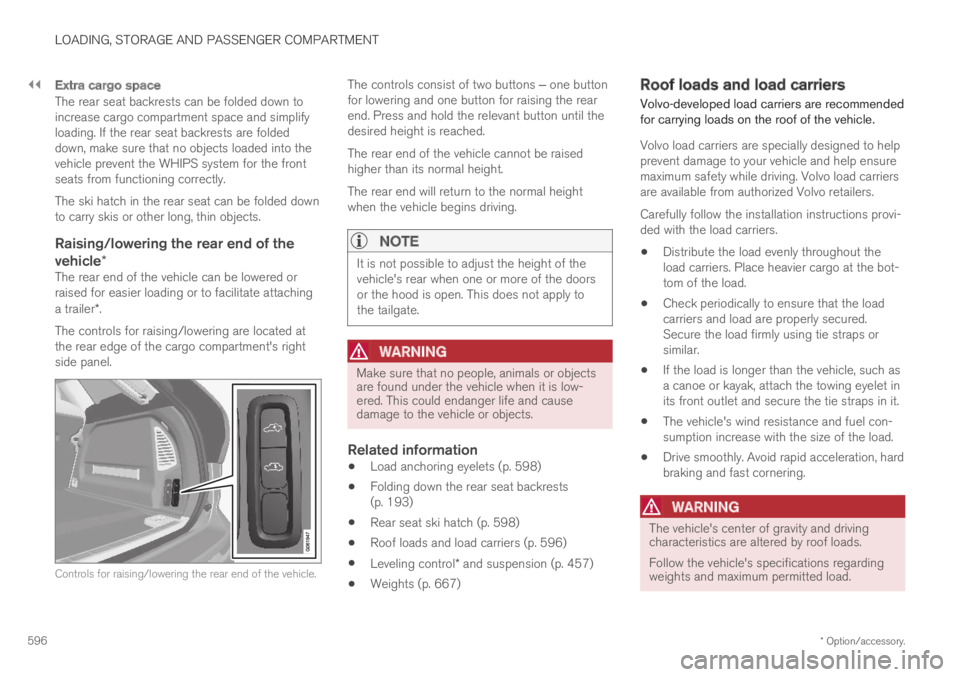
The controls for raising/lowering are located atthe rear edge of the cargo compartment's rightside panel.
Controls for raising/lowering the rear end of the vehicle.
The controls consist of two buttons ‒ one buttonfor lowering and one button for raising the rearend. Press and hold the relevant button until thedesired height is reached.
The rear end of the vehicle cannot be raisedhigher than its normal height.
The rear end will return to the normal heightwhen the vehicle begins driving.
NOTE
It is not possible to adjust the height of thevehicle's rear when one or more of the doorsor the hood is open. This does not apply tothe tailgate.
WARNING
Make sure that no people, animals or objectsare found under the vehicle when it is low-ered. This could endanger life and causedamage to the vehicle or objects.
Related information
Load anchoring eyelets (p. 598)
Folding down the rear seat backrests(p. 193)
Rear seat ski hatch (p. 598)
Roof loads and load carriers (p. 596)
Leveling control* and suspension (p. 457)
Weights (p. 667)
Roof loads and load carriers
Volvo-developed load carriers are recommendedfor carrying loads on the roof of the vehicle.
Volvo load carriers are specially designed to helpprevent damage to your vehicle and help ensuremaximum safety while driving. Volvo load carriersare available from authorized Volvo retailers.
Carefully follow the installation instructions provi-ded with the load carriers.
Distribute the load evenly throughout theload carriers. Place heavier cargo at the bot-tom of the load.
Check periodically to ensure that the loadcarriers and load are properly secured.Secure the load firmly using tie straps orsimilar.
If the load is longer than the vehicle, such asa canoe or kayak, attach the towing eyelet inits front outlet and secure the tie straps in it.
The vehicle's wind resistance and fuel con-sumption increase with the size of the load.
Drive smoothly. Avoid rapid acceleration, hardbraking and fast cornering.
WARNING
The vehicle's center of gravity and drivingcharacteristics are altered by roof loads.
Follow the vehicle's specifications regardingweights and maximum permitted load.
Page 667 of 695
SPECIFICATIONS
}}
665
Dimensions
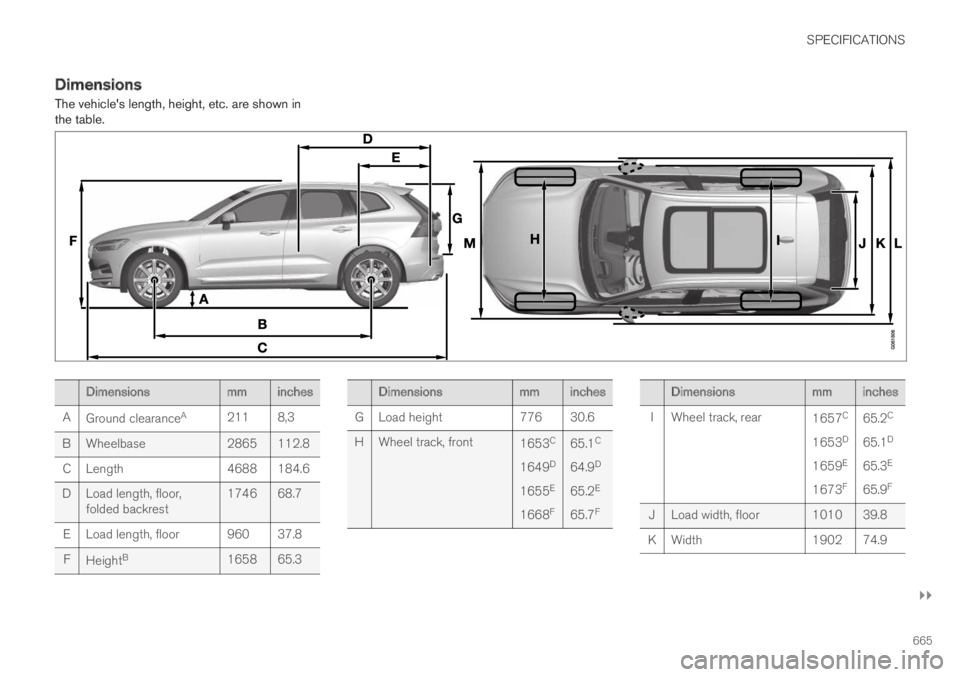
The vehicle's length, height, etc. are shown inthe table.
Dimensionsmminches
AGround clearanceA2118,3
B Wheelbase2865 112.8
C Length4688 184.6
D Load length, floor,folded backrest1746 68.7
E Load length, floor 960 37.8
FHeightB1658 65.3
Dimensionsmminches
GLoad height776 30.6
H Wheel track, front1653C
1649D
1655E
1668F
65.1C
64.9D
65.2E
65.7F
Dimensionsmminches
IWheel track, rear1657C
1653D
1659E
1673F
65.2C
65.1D
65.3E
65.9F
J Load width, floor 1010 39.8
K Width1902 74.9
Page 682 of 695
INDEX
680
G
Gasoline grade472
Gauge
fuel gauge87
Gear selector positions
automatic transmission445
Glass
laminated/reinforced166
Glove compartment593
Gracenote®517
Grocery bag holders 597
Gross vehicle weight667
Guide lines for Park Assist Camera 394
H
Handbrake438, 439
Hand wash649
Hard disk
space544
Hazard warning flashers161
HDC462
HD radio501
Head restraint196
Head-up display142
activate and deactivate143
cleaning644
replacing windshield619
settings144
store position144, 186, 187
Heated wiper blades176
Heater232
auxiliary heater232
parking heater232
Heating
Seats213, 214
steering wheel215, 216
windows219, 221
Height adjustment457, 460
high beams156, 157
High engine temperature475
Hill Descent Control461, 462, 463
activate with function button 463
Hill Start Assist443
Hill Start Assist (HSA)443
Hoisting the vehicle616
Hold
vehicle function467
HomeLink®485
programming486
use487
HomeLink® remote control
programmable 485
Home safe lighting161
Honk197
Hood, opening618
Horn197
Hybrid battery629
Charging413
Hybrid battery gauge88
Hybrid gauge87
Hybrid mode450, 456
I
IAQS (Interior Air Quality System) 204
IC (Inflatable Curtain)60
ID, Volvo26
Identification number38
Ignition mode433, 434
Immobilizer251
Electronic immobilizer251
Indicator symbols94
Individual drive mode450
Infant seats67
Inflatable curtain60