Led VOLVO XC60 TWIN ENGINE 2020 Owners Manual
[x] Cancel search | Manufacturer: VOLVO, Model Year: 2020, Model line: XC60 TWIN ENGINE, Model: VOLVO XC60 TWIN ENGINE 2020Pages: 687, PDF Size: 14.65 MB
Page 619 of 687
MAINTENANCE AND SERVICE
}}
* Option/accessory.617
Function Ampere Type
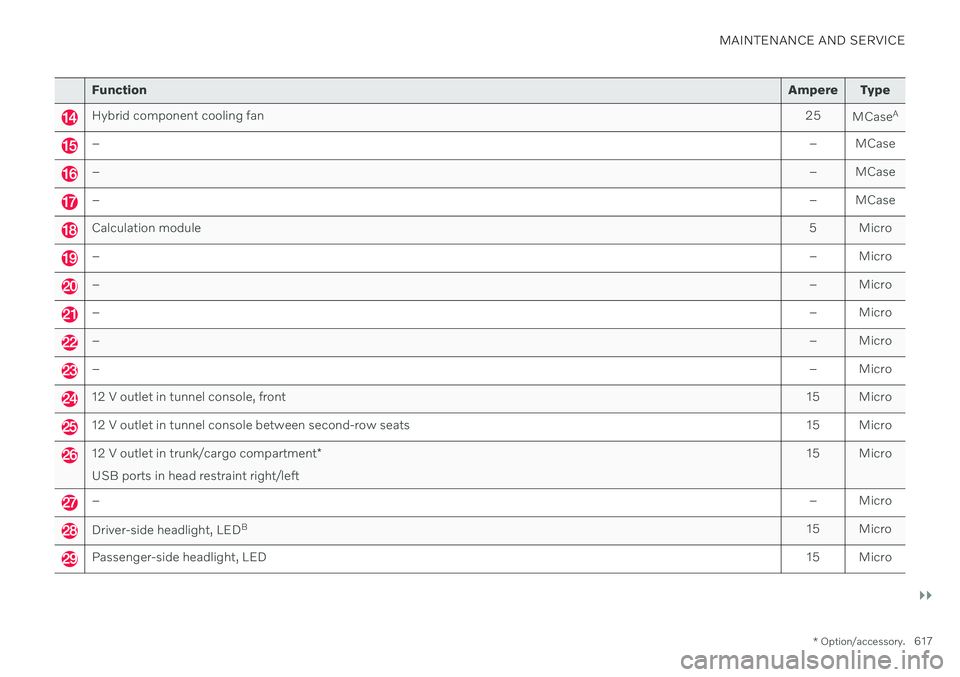
Hybrid component cooling fan 25
MCaseA
–
– MCase
–– MCase
–– MCase
Calculation module 5 Micro
–– Micro
–– Micro
–– Micro
–– Micro
–– Micro
12 V outlet in tunnel console, front15 Micro
12 V outlet in tunnel console between second-row seats15 Micro
12 V outlet in trunk/cargo compartment*
USB ports in head restraint right/left 15 Micro
–
– Micro
Driver-side headlight, LEDB
15 Micro
Passenger-side headlight, LED 15 Micro
Page 621 of 687
MAINTENANCE AND SERVICE
}}
619
FunctionAmpere Type
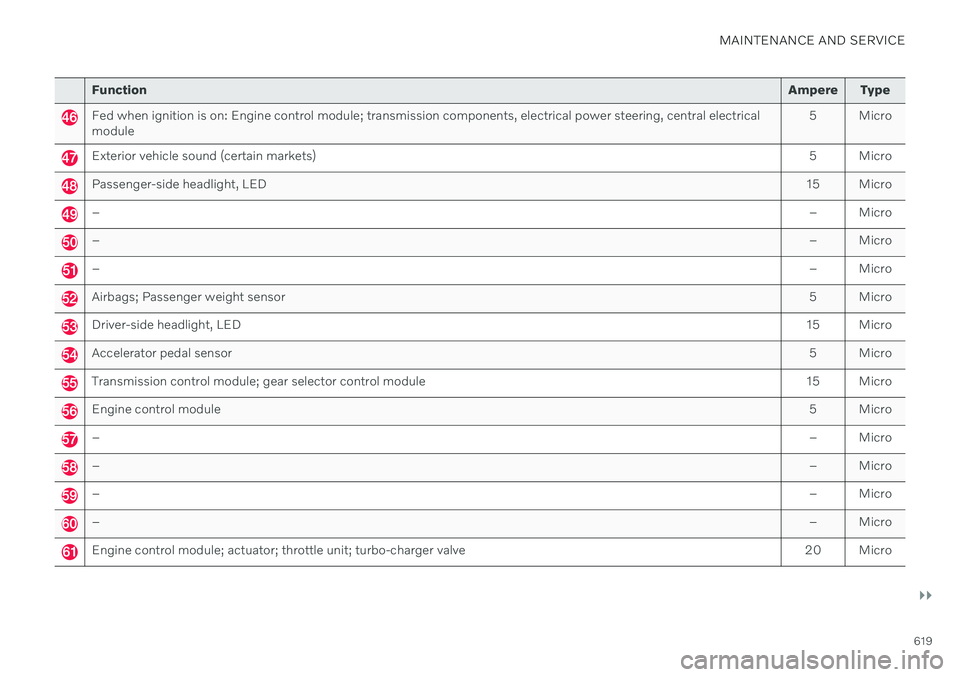
Fed when ignition is on: Engine control module; transmission components, electrical power steering, central electrical module 5 Micro
Exterior vehicle sound (certain markets)
5 Micro
Passenger-side headlight, LED15 Micro
– – Micro
–– Micro
–– Micro
Airbags; Passenger weight sensor 5 Micro
Driver-side headlight, LED15 Micro
Accelerator pedal sensor 5 Micro
Transmission control module; gear selector control module15 Micro
Engine control module 5 Micro
–– Micro
–– Micro
–– Micro
–– Micro
Engine control module; actuator; throttle unit; turbo-charger valve20 Micro
Page 623 of 687

MAINTENANCE AND SERVICE
621
FunctionAmpere Type
– – MCase
–– MCase
A
This type of fuse should be replaced by a workshop. An authorized Volvo workshop is recommended.
B LED (Light Emitting Diode)
Related information
Fuses and fuseboxes (p. 613)
Replacing fuses (p. 613)
Page 641 of 687
MAINTENANCE AND SERVICE
}}
639
CAUTION
Avoid waxing and polishing plastic and rubber. If using degreaser on plastic and rubber, only rub (if necessary) with slight pressure.Use a soft sponge. Polishing glossy trim moldings can wear away or damage the glossy surface layer. Polish containing abrasives must not be used.
CAUTION
Only use paintwork treatments recom- mended by Volvo. Other treatments, suchas preservation, sealing, protection, lustersealing or similar, could damage the paint-work. Paintwork damage caused by suchtreatments are not covered by Volvo's war-ranty.
Related information
Cleaning the exterior (p. 638)
Hand washing (p. 639)
Automatic car washes (p. 641)
High-pressure washing (p. 642)
Cleaning the wiper blades (p. 642)
Cleaning exterior plastic, rubber and trim components (p. 643)
Cleaning rims (p. 644)
Corrosion protection (p. 644)
Hand washing
The vehicle should be washed as soon as it becomes dirty. This makes the vehicle easierto clean because dirt does not attach asstrongly. It also reduces the risk of scratchesand keeps the vehicle looking new. Wash thevehicle in a car wash or garage with an oilseparator and use car washing detergent.
Important to keep in mind when handwashing your vehicle
Avoid washing the vehicle in direct sun- light. This could cause the detergent orwax to dry out and become abrasive.
Remove bird droppings from paintwork assoon as possible. It contains chemicalsthat affect and discolor paintwork veryquickly. Use e.g. soft paper or a spongesoaked in lots of water. Consult an author-ized Volvo workshop for assistanceremoving discoloration.
Hose down the underbody, including thewheel housings and bumper.
Hose down the entire vehicle and removeany loose dirt, droppings etc. to reducethe risk of scratches from washing. Do notspray directly onto locks.
If necessary, use cold degreaser on heavilysoiled surfaces. Note that in such casesthe surfaces must not be hot from the sun.
Page 643 of 687
MAINTENANCE AND SERVICE
}}
* Option/accessory.641
Automatic car washes
The vehicle should be washed as soon as it becomes dirty. The longer the dirt remains,the more difficult it will be to keep the vehicleclean. It could also lead to paint damage.
Washing your vehicle in an automatic car wash is a fast and easy way to keep your vehi-cle clean, but it does not reach all areas of thevehicle. Volvo recommends washing yourvehicle by hand or supplementing automaticcar washes with a hand wash.
NOTE
Volvo recommends not washing the vehi- cle in an automatic car wash during thefirst few months; the paintwork on newvehicles takes some time to fully harden.
CAUTION
Before driving the vehicle into a car wash, deactivate the Automatic Braking whenStationary and Automatic Parking BrakeApplication functions. If the functions arenot deactivated, the brake system willseize when the vehicle is stationary and thevehicle will not be able to roll.
CAUTION
For automatic car washes in which the vehicle is pulled forward on rolling wheels:
1. Before washing the vehicle, make sure that the automatic rain sensor is deac- tivated. If it is not deactivated andinadvertently starts, the wiper armscould be damaged.
2. To help prevent damage from the auto- matic car wash machinery, make surethat the door mirrors are folded in,antennas retracted or removed, andany auxiliary lights secured.
3. Drive into the automatic car wash.
4. Turn off the "Automatic Braking when Stationary" function using the
but-
ton in the tunnel console.
5. Turn off the "Automatic Parking Brake Application" function in the center dis- play's Top view.
6. Turn off the engine by turning the start knob in the tunnel console clockwise.Hold the knob in position for at least2 seconds.
The vehicle is now ready for the automaticcar wash.
CAUTION
The system will automatically change to P
mode if the above steps are not followed. In P mode, the wheels are locked, which
they should not be when the vehicle isbeing washed in a car wash.
NOTE
Keep in mind that if the vehicle is equipped with the keyless locking and unlocking function *, the doors and tailgate/trunk lid
may open when washing the vehicle if the remote key is within range.
Related information
Cleaning the exterior (p. 638)
Polishing and waxing (p. 638)
Hand washing (p. 639)
High-pressure washing (p. 642)
Cleaning the wiper blades (p. 642)
Cleaning exterior plastic, rubber and trim components (p. 643)
Cleaning rims (p. 644)
Corrosion protection (p. 644)
Auto-hold brakes (p. 414)
Page 649 of 687

MAINTENANCE AND SERVICE
}}
647
Sample color code (1): Canadian models.
Exterior color code
Secondary exterior color code (if applica- ble)
Related information
Paintwork (p. 645)
Touching up minor paint damage (p. 645)
Changing rear window wipers The wiper blades help remove water from the windshield and rear window. Along with thewasher fluid, they are designed to clean theglass and help improve visibility while driving.The windshield and rear window wiperblades can be replaced.Changing rear window wipers
Lift the wiper arm from the window and pull the lower section of the blade to the right.
Grasp the center of the wiper blade and lift it from the window to the stop posi-tion.
NOTE
When the wiper arm is halfway folded out, it will stop in a locking position that helpsprevent the arm from falling back onto therear window. The wiper arm must bepulled past the locking position stop inorder to change the wiper blade.
Grip the lower part of the blade and pull to the right until the blade loosens from thearm.
Page 665 of 687

SPECIFICATIONS
663
Coolant specifications
Recommended grade: Volvo-approved pre-
mixed coolant. If concentrated coolant is used, mix with 50% water of acceptablequality (i.e. not salt water, etc.). Consult aVolvo retailer if you have any questions.
To avoid deterioration of the cooling system, engine trouble, etc., only approved Volvo cool-ant should be used.
WARNING
Coolant is hazardous if ingested and could cause damage to organs (kidneys). Theproduct contains ethylene glycol, inhibitor,water, etc.
Related information
Refilling coolant (p. 604)
Transmission fluid specifications
Under normal driving conditions, the trans- mission fluid will not need to be changed dur-ing the transmission's service life. However,it may need to be changed if the vehicle isdriven frequently in adverse driving condi-tions.
Automatic transmission
Prescribed transmission fluid: AW-1
Related information
Type designations (p. 654)
Brake fluid specifications
The medium in the hydraulic brake system is called brake fluid and is used to transfer brak-ing force from e.g. pressure on the brakepedal via a master brake cylinder to one ormore slave cylinders, which in turn act on amechanical brake.
Recommended grade: Volvo Original or simi-
lar fluid that meets a combination of Dot 4, 5.1 and ISO 4925 class 6.
NOTE
Changing or filling brake fluid should be entrusted to an authorized Volvo work-shop.
Related information
Engine compartment overview (p. 601)
Page 666 of 687
SPECIFICATIONS
664
Fuel tank volume
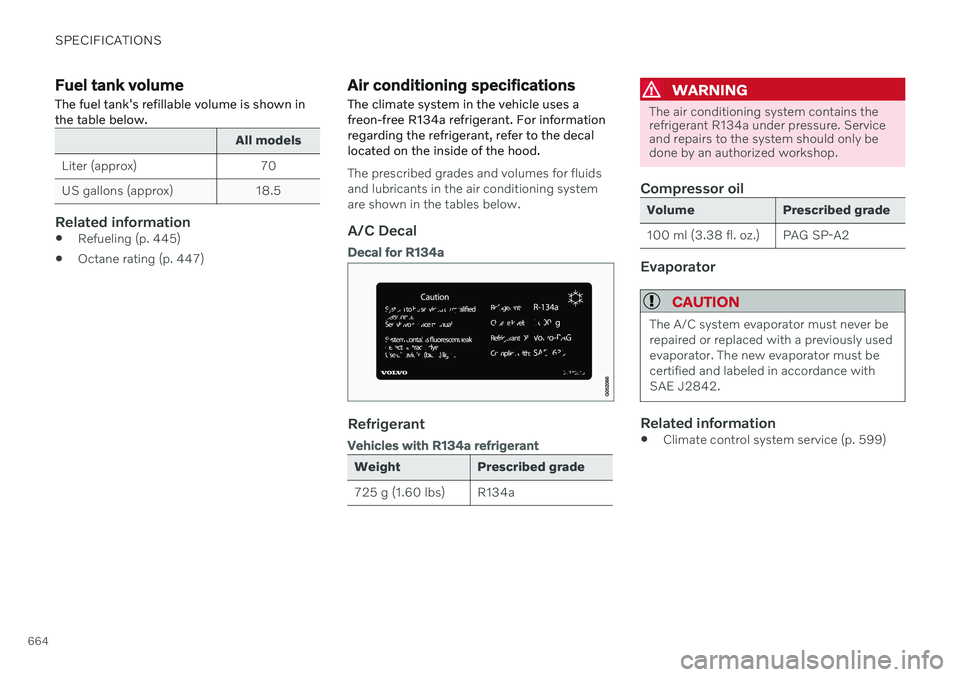
The fuel tank's refillable volume is shown in the table below.
All models
Liter (approx) 70
US gallons (approx) 18.5
Related information
Refueling (p. 445)
Octane rating (p. 447)
Air conditioning specifications
The climate system in the vehicle uses a freon-free R134a refrigerant. For informationregarding the refrigerant, refer to the decallocated on the inside of the hood.
The prescribed grades and volumes for fluids and lubricants in the air conditioning systemare shown in the tables below.
A/C Decal
Decal for R134a
Refrigerant
Vehicles with R134a refrigerant
Weight Prescribed grade
725 g (1.60 lbs) R134a
WARNING
The air conditioning system contains the refrigerant R134a under pressure. Serviceand repairs to the system should only bedone by an authorized workshop.
Compressor oil
Volume Prescribed grade
100 ml (3.38 fl. oz.) PAG SP-A2
Evaporator
CAUTION
The A/C system evaporator must never be repaired or replaced with a previously usedevaporator. The new evaporator must becertified and labeled in accordance withSAE J2842.
Related information
Climate control system service (p. 599)
Page 667 of 687
SPECIFICATIONS
665
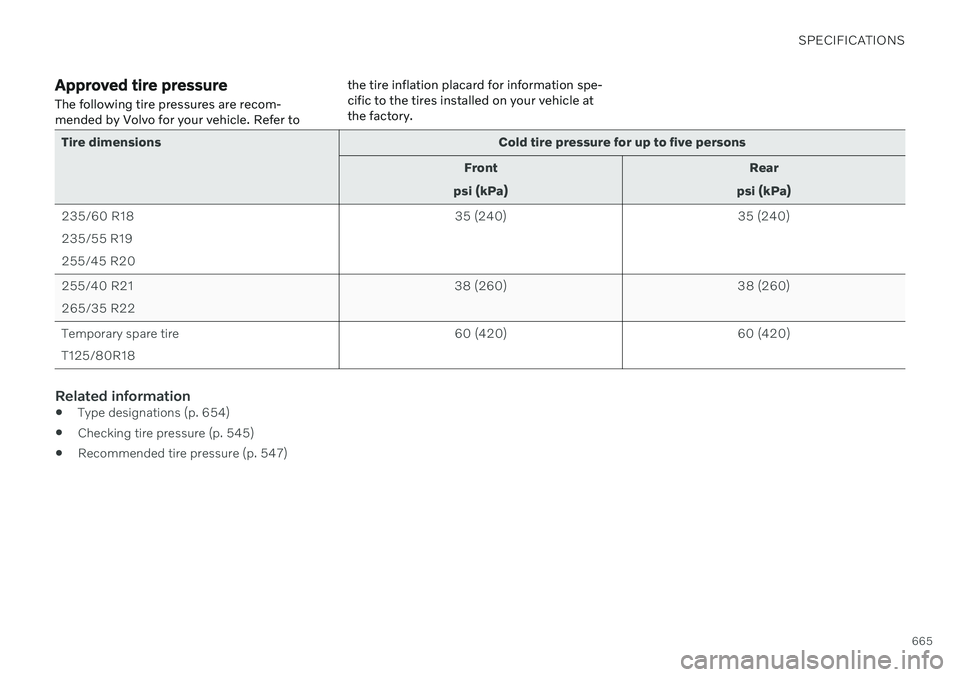
Approved tire pressure The following tire pressures are recom- mended by Volvo for your vehicle. Refer tothe tire inflation placard for information spe-cific to the tires installed on your vehicle atthe factory.
Tire dimensions
Cold tire pressure for up to five persons
Front
psi (kPa) Rear
psi (kPa)
235/60 R18 235/55 R19255/45 R20 35 (240)
35 (240)
255/40 R21265/35 R22 38 (260)
38 (260)
Temporary spare tireT125/80R18 60 (420)
60 (420)
Related information
Type designations (p. 654)
Checking tire pressure (p. 545)
Recommended tire pressure (p. 547)