battery VOLVO XC90 2003 Owners Manual
[x] Cancel search | Manufacturer: VOLVO, Model Year: 2003, Model line: XC90, Model: VOLVO XC90 2003Pages: 242, PDF Size: 6.5 MB
Page 45 of 242
2003 VOLVO XC90
WARNING!
The Never adjust the steering wheel while
driving.
pg. 31 Instruments and controls
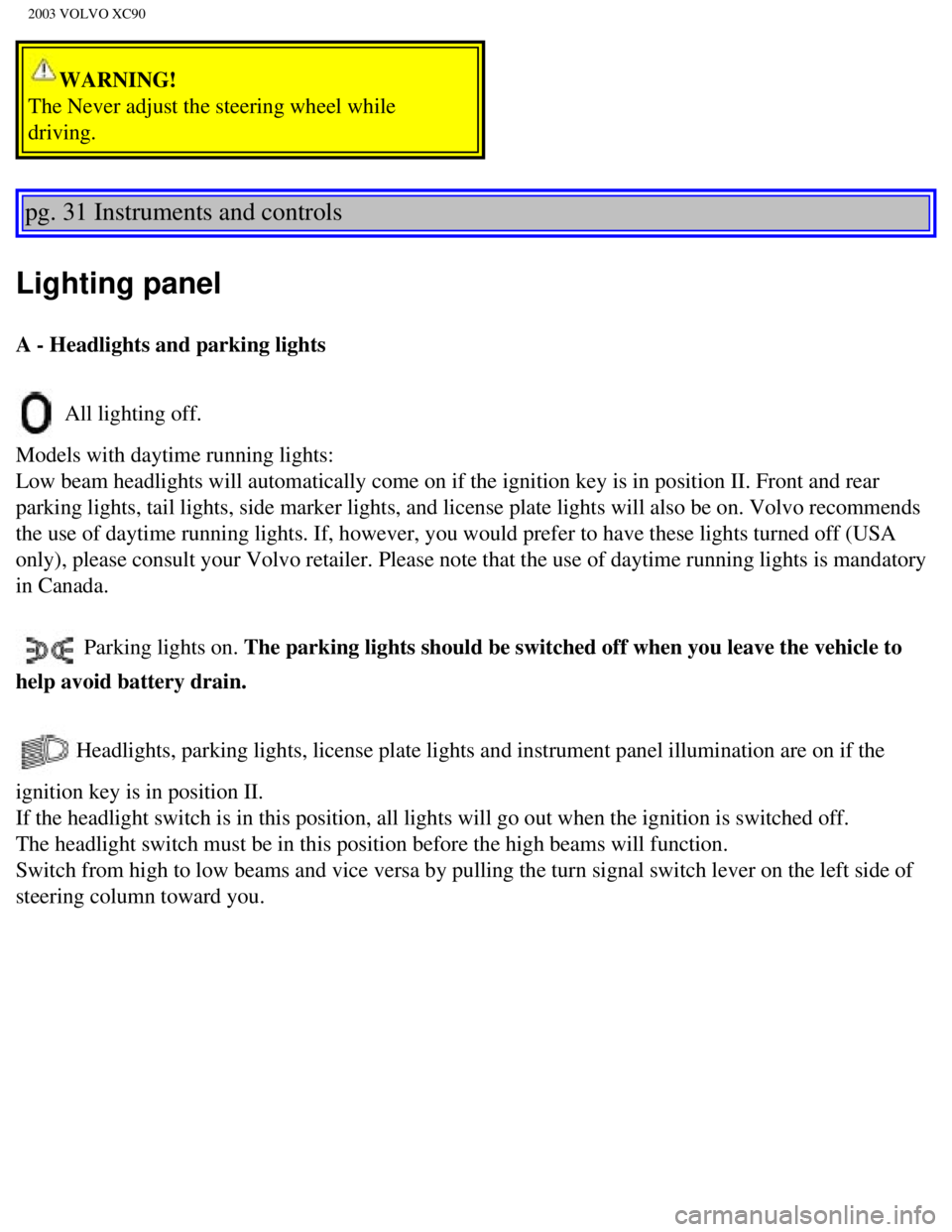
Lighting panel
A - Headlights and parking lights
All lighting off.
Models with daytime running lights:
Low beam headlights will automatically come on if the ignition key is in\
position II. Front and rear
parking lights, tail lights, side marker lights, and license plate light\
s will also be on. Volvo recommends
the use of daytime running lights. If, however, you would prefer to have\
these lights turned off (USA
only), please consult your Volvo retailer. Please note that the use of \
daytime running lights is mandatory
in Canada.
Parking lights on. The parking lights should be switched off when you leave the vehicle to \
help avoid battery drain.
Headlights, parking lights, license plate lights and instrument panel il\
lumination are on if the
ignition key is in position II.
If the headlight switch is in this position, all lights will go out when\
the ignition is switched off.
The headlight switch must be in this position before the high beams will\
function.
Switch from high to low beams and vice versa by pulling the turn signal \
switch lever on the left side of
steering column toward you.
file:///K|/ownersdocs/2003/2003_XC90/03xc90_02a.htm (11 of 16)12/30/20\
06 4:18:52 PM
Page 57 of 242
 downwar\
d.
To fold down the lower section of the tailgate, pull handle (B) upward\
.
12-volt s")
2003 VOLVO XC90
Opening the tailgate
To open the upper section of the tailgate, pull the handle (A) downwar\
d.
To fold down the lower section of the tailgate, pull handle (B) upward\
.
12-volt socket at the rear of the center console
Auxiliary 12-volt sockets
These 12 volt sockets can be used to plug in certain accessories such as\
cellular telephones, etc.
12-volt socket in the cargo compartment
Fold down the lid to use the socket.
NOTE!
l If the 12-volt sockets are used while the engine is not running, there i\
s a risk that the vehicle's battery
will be discharged.
file:///K|/ownersdocs/2003/2003_XC90/03xc90_02b.htm (7 of 14)12/30/200\
6 4:18:53 PM
Page 58 of 242

2003 VOLVO XC90
12-volt socket in the cargo compartment
l If the ignition is switched off and a device drawing more than 0.1A is c\
onnected to a socket, a battery
warning will be displayed in the text window.
l The covers should be kept on when the auxiliary sockets are not in use. \
l Maximum current from the sockets is 15A.
Ashtrays/cigarette lighter
The auxiliary sockets can also be used for cigarette lighters.
Ashtrays and lighters are available as accessories. Please contact your \
Volvo retailer.
pg. 40 Instruments and controls
Electrically operated windows
The electrically operated windows are controlled by buttons in the arm r\
ests.
l The ignition switch must be ON* (ignition key in position I, II or the \
engine running) for the
electrically operated windows to function.
l To lower: Press down the front edge of the button to the first detent (\
"stop").
l To raise: Lightly pull up the front edge of the button to the first dete\
nt ("stop").
* The electrically operated windows will also function after the ignitio\
n has been switched off as long as
neither of the front doors has been opened.
Auto up/down function (front doors only):
Either front door window can be opened or closed automatically.
Auto down: Press the front part of the button as far down as possible and release i\
t immediately. To
stop the window at any time, pull the button up.
Auto up: Pull the front part of the button up as far as possible and release it i\
mmediately. To stop the
file:///K|/ownersdocs/2003/2003_XC90/03xc90_02b.htm (8 of 14)12/30/200\
6 4:18:53 PM
Page 66 of 242

2003 VOLVO XC90
Acceleration
The air conditioning is momentarily disengaged during full-throttle acce\
leration.
Climate control maintenance
All maintenance on the climate control systems should be carried out by \
an authorized Volvo service technician only.
Refrigerant
Volvo cares about the environment. The air conditioning system in your v\
ehicle contains a CFC-free refrigerant - R134a.
This substance will not deplete the ozone layer. The system contains 2.2\
lbs (1000 g) R134a and uses PAG oil.
Passenger compartment blower
Approximately 50 minutes after the ignition is turned off, the blower ma\
y come on automatically, and run for seven
minutes, to remove condensation in the A/C evaporator.
Blower function to reduce battery drain
The climate system's blower functions normally while the engine is runni\
ng.
However, when the engine is switched off (even if the ignition is switc\
hed to positions I or II), the blower control will be
automatically switched off to avoid unnecessary battery drain. The follo\
wing points pertain if the ignition key is on but the
engine is not running:
l To restart the blower, turn the control knob to the setting of your choi\
ce.
l After approximately 2 minutes, the blower speed will be reduced to avoid\
battery drain.
You can reset the blower speed at any time. Please be aware that the sys\
tem has been designed to reduce the blower's speed
again after 2 minutes, until the engine is started. If the battery becom\
es drained:
l LOW BATTERY, FAN IS REDUCED will be displayed in the text window in the \
instrument panel.
l The yellow warning light in the instrument panel (see page 25) will also light up.
pg. 47 Climate control
Air distribution
Air distribution
The incoming air is distributed through the ventilation points in the pa\
ssenger compartment shown above.
file:///K|/ownersdocs/2003/2003_XC90/03xc90_03.htm (2 of 7)12/30/2006 \
4:18:54 PM
Page 98 of 242

2003 VOLVO XC90
Replacing the battery in the remote control
If the range of the transmitter is noticeably reduced, this indicates th\
at the battery is weak and should be
replaced.
To replace the battery
l Remove the screw on the transmitter cover with a small screwdriver.
l Remove the cover carefully pressing it rearward/upward.
l Replace the battery with a new 3-volt, CR 2032 battery. The battery shou\
ld be inserted with the minus
side upward. Avoid touching the contact surfaces of the battery with you\
r fingers.
l Reinstall the cover and tighten the screw to help protect the transmitte\
r.
pg. 77 Locks and Alarm
Locking and unlocking
Locking and unlocking the vehicle from the inside
The switch on the driver's door armrest can be used to lock or unlock al\
l doors and the tailgate, and to
file:///K|/ownersdocs/2003/2003_XC90/03xc90_05.htm (6 of 11)12/30/2006\
4:18:56 PM
Page 101 of 242

2003 VOLVO XC90
Alarm
Alarm
The alarm is automatically armed whenever you lock your vehicle.
When armed, the alarm continuously monitors a number of points on the ve\
hicle. The following
conditions will set off the alarm:
l The hood is forced open.
l The tailgate is forced open.
l A door is forced open.
l The ignition switch is tampered with.
l If there is movement in the passenger compartment (if the vehicle is eq\
uipped with the optional
movement sensor).
l The vehicle is lifted or towed (if the vehicle is equipped with the opt\
ional inclination sensor).
l The battery is disconnected (while the alarm is armed).
l The siren is disconnected when the alarm is disarmed.
Arming the alarm
Press the LOCK button on the remote control, lock the vehicle using the \
key in the driver's door or press
the central lock button on one of the front doors with the door open. On\
e long flash of the turn signals
will confirm that the alarm is armed.
Disarming the alarm
Press the UNLOCK button on the remote control or unlock the doors with t\
he key.
Turning off (stopping) the alarm
If the alarm is sounding, it can be stopped by pressing the UNLOCK butto\
n on the remote control or by
unlocking the driver's door with the key.
Audible/visual alarm signal
An audible alarm signal is given by a battery powered siren. The alarm c\
ycle lasts for 25 seconds.
The visual alarm signal is given by flashing all turn signals and turnin\
g on the interior lighting for
approximately 5 minutes.
"Panic" button
In an emergency situation, this feature can be used to attract attention\
.
Activate the "panic" button by pressing the red button on the remote con\
trol (see illustration on
page 75)
for at least 3 seconds or by pressing this button twice within 3 seconds\
. The turn signals will flash, the
interior lights will go on and the vehicle's horn will sound.
file:///K|/ownersdocs/2003/2003_XC90/03xc90_05.htm (9 of 11)12/30/2006\
4:18:56 PM
Page 113 of 242

2003 VOLVO XC90
WARNING!
Avoid driving diagonally across steep inclines as this could increase th\
e risk of a roll-over. Try to
drive straight up or down the slope.
If the road is very steep, avoid turning the vehicle around to help avoi\
d the risk of rolling over. Back
the vehicle up or down the incline instead.
NOTE: Avoid driving on steep inclines if the fuel tank is nearly empty. If the\
flow of fuel to the engine
is interrupted due to the vehicle's angle of inclination, this could res\
ult in damage to the three-way
catalytic converter. We recommend keeping the fuel tank at least half fu\
ll when driving on steep inclines.
Driving through water
l The vehicle should not be driven through water that is deeper than 18 in\
ches (48 cm). Driving through
deeper water could result in damage to transmission components or the di\
fferential, or to the engine if
excess water is drawn in through the air intake system.
l Drive slowly and avoid stopping when driving through water.
l After having driven through water, apply the brakes lightly several time\
s to remove water, mud, etc
from the brake discs.
l Never allow the vehicle to stand in water above the door sills. This cou\
ld result in damage to the
electrical system.
Conserving electrical current
Keep the following in mind to help minimize battery drain:
l When the engine is not running, avoid turning the ignition key to positi\
on II (see page 88). Many
electrical systems (the audio system, the optional infotainment/navigat\
ion systems, power windows, etc)
will function with the ignition key in position I. This position reduces\
drain on the battery.
l Please keep in mind that using systems, accessories, etc that consume a \
great deal of current when the
engine is not running could result in the battery being completely drain\
ed.
NOTE: A warning message will be displayed in the text window in the instrument\
panel when the
battery charge is low.
pg. 91 Starting and driving
Automatic transmission with Geartronic
file:///K|/ownersdocs/2003/2003_XC90/03xc90_06a.htm (10 of 15)12/30/20\
06 4:18:58 PM
Page 126 of 242

2003 VOLVO XC90
in place.
After the vehicle has been towed, the eyelet should be removed and retur\
ned to the tool bag. Press the
cover back into position.
Precautions when the vehicle is in tow
l The steering wheel must be unlocked. Turn the ignition key to position I\
or II.
l The gear selector must be in position N.
l Maximum speed: 50 mph (80 km/h). Do not exceed the maximum allowable t\
owing speed.
l Maximum distance with front wheels on ground: 50 miles (80 km).
l While the vehicle is being towed, try to keep the tow rope taut at all t\
imes.
l The vehicle should only be towed in forward direction.
CAUTION
- Please check with state and local authorities before attempting this t\
ype of towing, as vehicles being
towed are subject to regulations regarding maximum towing speed, length \
and type of towing device,
lighting, etc.
- If the vehicle's battery is dead, do not attempt to start the vehicle \
by pushing or pulling it as this will
damage the three-way catalytic converter(s). The engine must be jump s\
tarted using an auxiliary
battery (see
page 102).
- If the vehicle is being towed on a flat bed truck, the towing eyelets \
must not be used to secure the
vehicle on the flat bed. Consult the tow truck operator.
WARNING!
- Remember that the power brakes and power steering will not function wh\
en engine is not running.
The braking and steering systems will function but the brake pedal press\
ure required is 3 - 4 times
above normal and greater steering effort must be exerted.
- The towing eyelets must not be used for pulling the vehicle out of a d\
itch or for any similar purpose
involving severe strain. Do not use the towing eyelets to pull the vehic\
le up onto a flat bed tow truck.
pg. 101 Starting and driving
file:///K|/ownersdocs/2003/2003_XC90/03xc90_06b.htm (8 of 17)12/30/200\
6 4:18:59 PM
Page 128 of 242

2003 VOLVO XC90
Follow these instructions to jump start your vehicle's dead battery or t\
o jump start another vehicle's dead
battery using your vehicle. Although your vehicle's battery is located u\
nder the floor of the cargo area,
jumper cables should be connected in the engine compartment, to the points shown in the illustrations.
If the 12-volt auxiliary battery to be used is in another vehicle, check\
that the vehicles are not touching
to prevent premature completion of a circuit. Be sure to follow jump sta\
rting instructions provided for
the other vehicle.
To jump start your vehicle:
l Switch off the ignition.
l First connect the auxiliary battery positive (+) terminal (1) to the\
positive (+) terminal in your
vehicle's engine compartment (2), located under a small black plastic \
cover attached to the fuse box
cover, marked with a "+" sign. Remove the cover on the main fuse box if \
necessary to access this
terminal.Then connect the auxiliary battery's negative (-) terminal (\
3) to the ground point in your
vehicle's engine compartment (4).
l Start the engine in the assisting vehicle, then start the engine in the \
vehicle with dead battery.
l After the engine has started, first remove the negative (-) terminal j\
umper cable. Then remove the
positive (+) terminal jumper cable.
WARNING!
PROPOSITION 65 WARNING!
Battery posts, terminals, and related accessories contain lead and lead \
compounds, chemicals known
to the state of California to cause cancer and reproductive harm. Wash h\
ands after handling
WARNING!
- Do not connect the jumper cable to any part of the fuel system or to a\
ny moving parts. Avoid
touching hot manifolds.
Never expose the battery to open flame or electric spark.
- Do not smoke near the battery.
- Batteries generate hydrogen gas, which is flammable and explosive.
- Battery fluid contains sulphuric acid. Do not allow battery fluid to c\
ontact eyes, skin, fabrics or
painted surfaces. If contact occurs, flush the affected area immediately\
with water. Obtain medical
help immediately if eyes are affected.
- Failure to follow the instructions for jump starting can lead to perso\
nal injury.
file:///K|/ownersdocs/2003/2003_XC90/03xc90_06b.htm (10 of 17)12/30/20\
06 4:18:59 PM
Page 133 of 242
. See")
2003 VOLVO XC90
Load carrier cover
The vehicle's ignition key or the stud on the edge of the supplied torqu\
e wrench can be used to undo or
tighten the cover. Turn a quarter turn (90 degrees). See illustration.\
pg. 107 Starting and driving
Cold weather precautions
If you wish to check your vehicle before the approach of cold weather, t\
he following advice is worth
noting:
l Make sure that the engine coolant contains 50 percent antifreeze. Any ot\
her mixture will reduce
freeze protection. This gives protection against freezing down to -31°\
F (-35°C). See section "Coolant".
The use of "recycled" antifreeze is not approved by Volvo. Different typ\
es of antifreeze must not
be mixed.
l Volvo recommends using only genuine Volvo antifreeze in your vehicle's r\
adiator. Your Volvo
retailer stocks plenty of Volvo engine coolant to help protect your vehi\
cle during cold weather.
l Try to keep the fuel tank well filled - this prevents the formation of condensation in the tank. \
In
addition, in extremely cold weather conditions it is worthwhile to add f\
uel line de-icer before refueling.
l The viscosity of the engine oil is important. Oil with low viscosity (thinner oil) improves cold-
weather starting as well as decreasing fuel consumption while the engine\
is warming up. For winter use,
5W-30 oil, particularly the synthetic type*, is recommended. Be sure to \
use good quality oil but do not
use cold-weather oil for hard driving or in warm weather. See section "E\
ngine oil" for more information.
l The load placed on the battery is greater during the winter since the windshield wipers, lighting, etc\
.
are used more often. Moreover, the capacity of the battery decreases as \
the temperature drops. In very
cold weather, a poorly charged battery can freeze and be damaged. It is \
therefore advisable to check the
state of charge more frequently and spray an antirust oil on the battery\
posts.
l Volvo recommends the use of snow tires on all four wheels for winter driving - see section "Wheels
and tires."
l To prevent the washer fluid reservoir from freezing, add washer solvents containing antifreeze (see
file:///K|/ownersdocs/2003/2003_XC90/03xc90_06b.htm (15 of 17)12/30/20\
06 4:18:59 PM