fuel VOLVO XC90 2006 Owner's Manual
[x] Cancel search | Manufacturer: VOLVO, Model Year: 2006, Model line: XC90, Model: VOLVO XC90 2006Pages: 256, PDF Size: 6.87 MB
Page 125 of 256
.
l To access the (MAN")
2006 VOLVO XC90
l A "lock-up" feature 1 reduces engine speed and help saves fuel.
The currently selected gear will be displayed in the instrument panel (\
see
page 22).
l To access the (MAN)ual shifting position from (D)rive, move the gear selector to the left to MAN.
l To return to the (D)rive position from MAN, move the gear selector to the right.
While driving
If you select the (MAN)ual position while driving, the gear that was being used in the (D)rive position
will also initially be selected in (MAN)ual position.
l Move the gear selector forward (toward "+") to shift to a higher gear \
or rearward (toward "-") to shift
to a lower gear.
l If you hold the gear selector toward "-", the transmission will downshif\
t one gear and will utilize the
braking power of the engine. If the current speed is too high for using \
a lower gear, the downshift will
not occur until the speed has decreased enough to allow the lower gear t\
o be used.
l If you slow down to a very low speed, the transmission will automaticall\
y shift down.
l When starting in the (MAN)ual position, 3rd gear is the highest gear that may be selected.
1 Five-speed transmission: gears 3, 4, and 5
Six-speed transmission: gears 2, 3, 4, 5, and 6.
5-cylinder turbo and V8 models
W - Winter/Wet driving mode - enhanced vehicle traction
l Mode W will only function if the gear selector is in the (D)rive position.
l Press the button at the base of the gear selector to engage/disengage th\
is driving mode (see
illustration).
l When the W driving mode is engaged, this is displayed in the instrument \
panel (see page 22).
This mode may be selected for starting/moving off on slippery roads.
file:///K|/ownersdocs/2006/2006_XC90/06xc90_06a.htm (13 of 14)12/30/20\
06 5:32:45 PM
Page 126 of 256
 - general information
Your Volvo can be equipped with permanent All Wheel Drive (option), wh\
ich means that power")
2006 VOLVO XC90
pg. 95 Starting and driving
All Wheel Drive
All Wheel Drive (AWD) - general information
Your Volvo can be equipped with permanent All Wheel Drive (option), wh\
ich means that power is
distributed automatically between the front and rear wheels. Under norma\
l driving conditions, most of
the engine's power is directed to the front wheels. However, if there is\
any tendency for the front wheels
to spin, an electronically controlled coupling distributes power to the \
wheels that have the best traction.
Tire dimensions
Volvo recommends that you always drive on tires of the same brand, size,\
construction (radial), tread
pattern, load-, speed-, traction-, temperature-, and treadwear rating. N\
ever drive on mixed tires, except
for brief periods when the temporary spare tire is in use.
Always use properly inflated tires of correct dimensions. Tire size and \
inflation pressures are shown on
the tire inflation pressure placards, located on the driver's side B-pil\
lar (the structural member at the side
of the vehicle, at the rear of the driver's door opening), or on the in\
side of the fuel filler door on
Canadian models.
Temporary Spare
The temporary spare tire is for temporary, lowspeed, short-distance use \
only. Replace it with a full-sized
tire as soon as possible. Do not drive on the temporary spare at speeds \
above 50 m.p.h. (80km/h) or for
distances greater than 50 miles (80 km).
Never install snow chains on a temporary spare.
Contents | Top of Page
file:///K|/ownersdocs/2006/2006_XC90/06xc90_06a.htm (14 of 14)12/30/20\
06 5:32:45 PM
Page 137 of 256

2006 VOLVO XC90
WARNING!
- Do not connect the jumper cable to any part of the fuel system or to a\
ny moving parts. Avoid
touching hot manifolds.
Never expose the battery to open flame or electric spark.
- Do not smoke near the battery.
- Batteries generate hydrogen gas, which is flammable and explosive.
- Battery fluid contains sulphuric acid. Do not allow battery fluid to c\
ontact eyes, skin, fabrics or
painted surfaces. If contact occurs, flush the affected area immediately\
with water. Obtain medical
help immediately if eyes are affected.
- Failure to follow the instructions for jump starting can lead to perso\
nal injury.
pg. 104 Starting and driving
Towing a trailer
The maximum weights recommended by Volvo for trailers with brakes are sh\
own in the table below.
No. of
occupants 1
2 3 4 5 6 7
Seating
position Front
seat Front
seat 2nd row
of seats2nd row
of seats2nd row
of seatsOptional 3rd
row of seats Optional 3rd row of
seats
All Wheel
Drive 5,000
lbs
(2250
kg)5,000
lbs
(2250
kg)4,500
lbs
(2050
kg)3,700
lbs
(1700
kg)2,900
lbs
(1350
kg)
1,800 lbs
(800 kg)
Trailer towing not
recommended
Max. trailer
hitch tongue
load 500 lbs
(225 kg)
500 lbs
(225 kg)450 lbs
(205 kg)370 lbs
(170 kg)290 lbs
(135 kg)180 lbs (80
kg)
-
Front Wheel
Drive 4,000
lbs
(1800
kg)4,000
lbs
(1800
kg)4,000
lbs
(1800
kg)4,000
lbs
(1800
kg)3,700
lbs
(1650
kg)
2,500 lbs
(1150 kg)
1,400 lbs (650 kg)
file:///K|/ownersdocs/2006/2006_XC90/06xc90_06b.htm (11 of 18)12/30/20\
06 5:32:46 PM
Page 142 of 256
\
, including the weight of the
load carriers and any other load carrying equipment (ski boxes, bicycl")
2006 VOLVO XC90
WARNING!
Loads carried on the vehicle's roof should not exceed 220 lbs (100 kg)\
, including the weight of the
load carriers and any other load carrying equipment (ski boxes, bicycle\
racks, etc.). Excessive loads
on the roof can adversely affect the handling and roadholding characteri\
stics of the vehicle.
Load carrier cover
The vehicle's ignition key or the stud on the edge of the supplied torqu\
e wrench can be used to undo or
tighten the cover. Turn a quarter turn (90 degrees). See illustration.\
pg. 108 Starting and driving
Cold weather precautions
If you wish to check your vehicle before the approach of cold weather, t\
he following advice is worth
noting:
l Make sure that the engine coolant contains 50 percent antifreeze. Any ot\
her mixture will reduce
freeze protection. This gives protection against freezing down to -31°\
F (-35°C). See section "Coolant".
The use of "recycled" antifreeze is not approved by Volvo. Different typ\
es of antifreeze must not
be mixed.
l Volvo recommends using only genuine Volvo antifreeze in your vehicle's r\
adiator. Your Volvo
retailer stocks plenty of Volvo engine coolant to help protect your vehi\
cle during cold weather.
l Try to keep the fuel tank well filled - this prevents the formation of condensation in the tank. \
In
addition, in extremely cold weather conditions it is worthwhile to add f\
uel line de-icer before refueling.
l The viscosity of the engine oil is important. Oil with low viscosity (thinner oil) improves cold-
weather starting as well as decreasing fuel consumption while the engine\
is warming up. For winter use,
5W-30 oil, particularly the synthetic type*, is recommended. Be sure to \
use good quality oil but do not
use cold-weather oil for hard driving or in warm weather. See section "E\
ngine oil" for more information.
l The load placed on the battery is greater during the winter since the windshield wipers, lighting, etc\
.
file:///K|/ownersdocs/2006/2006_XC90/06xc90_06b.htm (16 of 18)12/30/20\
06 5:32:46 PM
Page 143 of 256

2006 VOLVO XC90
are used more often. Moreover, the capacity of the battery decreases as \
the temperature drops. In very
cold weather, a poorly charged battery can freeze and be damaged. It is \
therefore advisable to check the
state of charge more frequently and spray an antirust oil on the battery\
posts.
l Volvo recommends the use of snow tires on all four wheels for winter driving - see section "Wheels
and tires."
l To prevent the washer fluid reservoir from freezing, add washer solvents containing antifreeze (see
page 147 for the location of the washer fluid reservoir).
This is important since dirt is often splashed on the windshield during \
winter driving, requiring the
frequent use of the washers and wipers. Volvo Washer Solvent should be d\
iluted as follows:
Down to 14° F (-10° C): 1 part washer solvent and 4 parts water \
Down to 5° F (-15° C): 1 part washer solvent and 3 parts water
Down to 0° F (-18° C): 1 part washer solvent and 2 parts water
Down to -18° F (-28° C): 1 part washer solvent and 1 part water \
l Use Volvo Teflon Lock Spray in the locks.
NOTE: Avoid the use of de-icing sprays as they can cause damage to the locks.
W Winter/Wet driving mode-enhanced vehicle traction
l Mode W will only function if the gear selector is in the (D)rive position.
l Press the button at the base of the gear selector to engage/disengage th\
is driving mode.
l An LED in the button will light up to indicate that W is engaged and thi\
s will also be displayed in the
instrument panel (see
page 22).
l This mode may be selected for starting/moving off on slippery roads.
* Synthetic oil is not used when the oil is changed at the normal mainte\
nance intervals except at owner request and at additional
charge. Please consult your Volvo retailer.
pg. 109 Starting and driving
Before a long distance trip
It is always worthwhile to have your vehicle checked at a Volvo retailer\
before driving long distances.
Your retailer will also be able to supply you with bulbs, fuses, spark p\
lugs and wiper blades for your use
in the event that problems occur.
As a minimum, the following items should be checked before any long trip\
:
l Check that engine runs smoothly and that fuel consumption is normal.
l Check for fuel, oil, and fluid leakage
l Check transmission oil level*.
l Check condition of drive belts.
l Check state of the battery's charge.
file:///K|/ownersdocs/2006/2006_XC90/06xc90_06b.htm (17 of 18)12/30/20\
06 5:32:46 PM
Page 144 of 256
, and replace those th\
at are worn. Check tire pressures.
l The brakes, front wheel alignment, and steering gear should be")
2006 VOLVO XC90
l Examine tires carefully (the spare tire as well), and replace those th\
at are worn. Check tire pressures.
l The brakes, front wheel alignment, and steering gear should be checked b\
y your Volvo retailer only.
l Check all lights, including high beams.
l Reflective warning triangles are legally required in some states/provinc\
es.
l Have a word with your Volvo retailer if you intend to drive in countries\
where it may be difficult to
obtain the correct fuel.
l Consider your destination. If you will be driving through an area where \
snow or ice are likely to
occur, consider snow tires.
* To prevent injury from contact with hot surfaces, do not inspect your \
vehicle's transmission fluid
yourself. Have your vehicle's transmission fluid level inspected by a qu\
alified Volvo service technician.
pg. 110 Starting and driving
Contents | Top of Page
file:///K|/ownersdocs/2006/2006_XC90/06xc90_06b.htm (18 of 18)12/30/20\
06 5:32:46 PM
Page 152 of 256
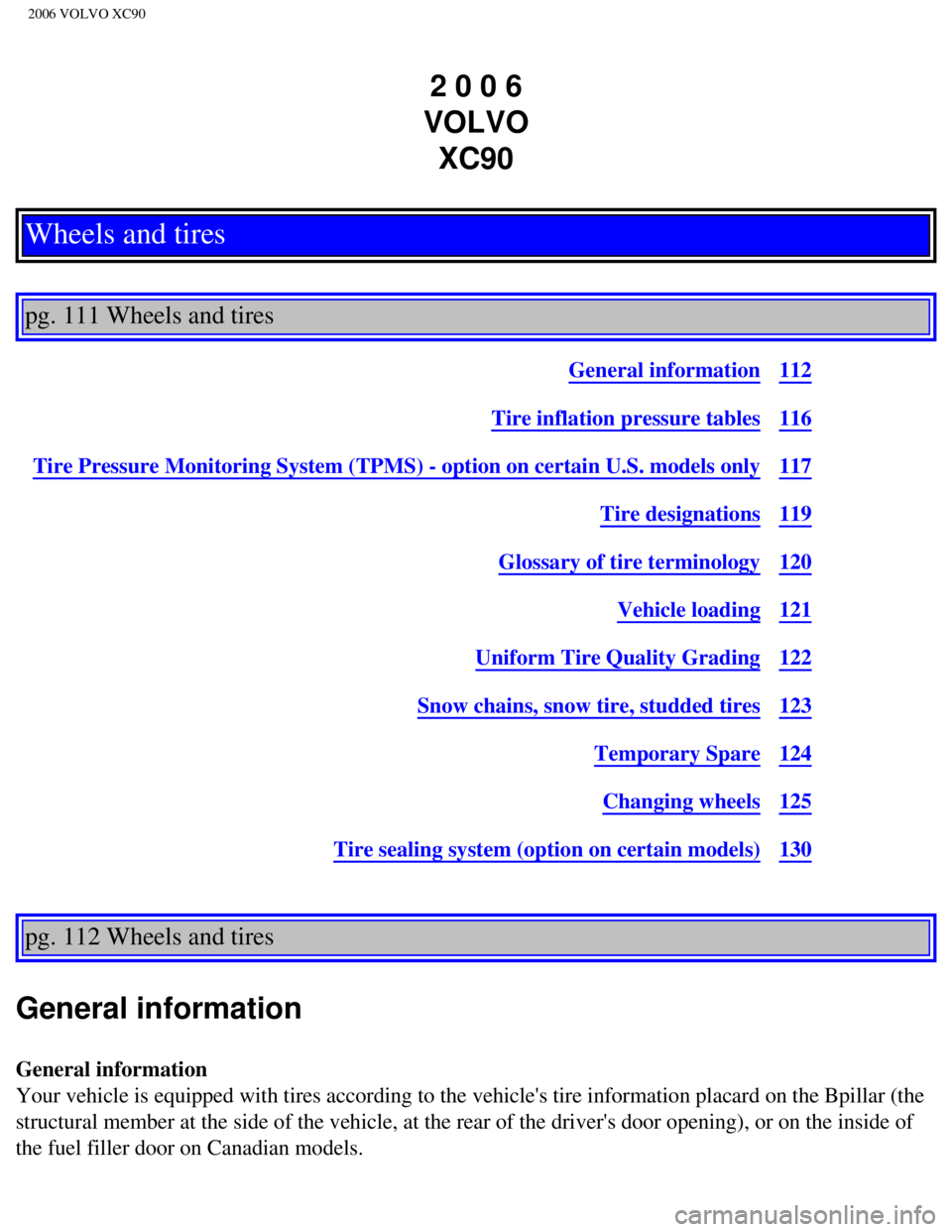
2006 VOLVO XC90
2 0 0 6
VOLVO XC90
Wheels and tires
pg. 111 Wheels and tires
General information112
Tire inflation pressure tables116
Tire Pressure Monitoring System (TPMS) - option on certain U.S. models\
only117
Tire designations119
Glossary of tire terminology120
Vehicle loading121
Uniform Tire Quality Grading122
Snow chains, snow tire, studded tires123
Temporary Spare124
Changing wheels125
Tire sealing system (option on certain models)130
pg. 112 Wheels and tires
General information
General information
Your vehicle is equipped with tires according to the vehicle's tire info\
rmation placard on the Bpillar (the
structural member at the side of the vehicle, at the rear of the driver'\
s door opening), or on the inside of
the fuel filler door on Canadian models.
file:///K|/ownersdocs/2006/2006_XC90/06xc90_08.htm (1 of 22)12/30/2006\
5:32:49 PM
Page 155 of 256

2006 VOLVO XC90
l Unbalanced wheels impair tire economy and driving comfort.
l Tires must maintain the same direction of rotation throughout their life\
time.
l When replacing tires, the tires with the most tread should be mounted on\
the rear wheels to reduce the
chance of oversteer during hard braking. Hitting curbs or potholes can d\
amage the tires and/or wheels
permanently.
pg. 114 Wheels and tires
Tire inflation placards on U.S. models
Tire inflation
Check tire inflation pressure regularly. A table listing the recommended\
inflation pressure for your
vehicle can be found on
page 116. Tire inflation pressure placards are also located on the driver's side\
B-
pillar (the structural member at the side of the vehicle, at the rear o\
f the driver's door opening), or on the
inside of the fuel filler door on Canadian models. These placards indica\
te the designation of the factory-
mounted tires on your vehicle, as well as load limits and inflation pres\
sure.
file:///K|/ownersdocs/2006/2006_XC90/06xc90_08.htm (4 of 22)12/30/2006\
5:32:49 PM
Page 159 of 256

2006 VOLVO XC90
WARNING!
The TPMS system uses a radio frequency of 315 MHz. Accessory electrical \
equipment using the
same frequency could interfere with TPMS and should not be installed in \
the vehicle. Please consult
your Volvo retailer, a qualified Volvo service technician, or the access\
ory equipment's supplier for
further information.
When low inflation pressure is detected, TPMS will light up the tire pre\
ssure warning light (
) (also
referred to as a telltale) in the instrument panel, and will display a \
message in the text window. The
wording of this message is determined by the degree of inflation pressur\
e loss.
NOTE: If a fault occurs in TPMS, the tire pressure warning light will flash fo\
r approximately 1 minute
and TIRE PRESS SYST SERVICE REQUIRED will be displayed.
Each tire, including the spare (if provided), should be checked monthl\
y when cold and inflated to the
inflation pressure recommended by the vehicle manufacturer on the vehicl\
e placard or tire inflation
pressure label. (If your vehicle has tires of a different size than the\
size indicated on the vehicle placard
or tire inflation pressure label, you should consult the appropriate sec\
tion of this owner's manual to
determine the proper tire inflation pressure.) When the low tire pressu\
re telltale is illuminated, one or
more of your tires is significantly underinflated. You should stop and c\
heck your tires as soon as
possible, and inflate them to the proper pressure. Driving on a signific\
antly underinflated tire causes the
tire to overheat and can lead to tire failure. Under-inflation also redu\
ces fuel efficiency and tire tread
life, and may affect the vehicle's handling and stopping ability. Your v\
ehicle has also been equipped
with a TPMS malfunction telltale to indicate when the system is not oper\
ating properly. When the
malfunction telltale is illuminated, the system may not be able to detec\
t or signal low tire pressure as
intended. TPMS malfunctions may occur for a variety of reasons, includin\
g the installation of
incompatible replacement tires on the vehicle. Always check the TPMS mal\
function telltale after
replacing one or more tires on your vehicle to ensure that the replaceme\
nt tires are compatible with the
TPMS.
NOTE: TPMS indicates low tire pressure but does not replace normal tire maint\
enance. For information
on correct tire pressure, please refer to the table on
page 116, or consult your Volvo retailer.
Erasing warning messages
When a low tire pressure warning message has been displayed, and the tir\
e pressure warning light has
come on:
1. Use a tire pressure gauge to check the inflation pressure of all four\
tires.
2. Re-inflate the tire(s) to the correct pressure (consult the tire p\
ressure placard or the table on
page 116).
3. Drive the car for at least one minute at a speed of 20 mph (30 km/h)\
or faster.
This will erase the warning text and the warning light will go out.
file:///K|/ownersdocs/2006/2006_XC90/06xc90_08.htm (8 of 22)12/30/2006\
5:32:49 PM
Page 162 of 256
: This begins with the let\
ters \"DOT\" and indicates that the
tire meets all federal standards. The next two numbers or letters are th\
e")
2006 VOLVO XC90
8. U.S. DOT Tire Identification Number (TIN): This begins with the let\
ters "DOT" and indicates that the
tire meets all federal standards. The next two numbers or letters are th\
e plant code where it was
manufactured, the next two are the tire size code and the last four numb\
ers represent the week and year
the tire was built. For example, the numbers 317 mean the 31st week of 1\
997. After 2000 the numbers
go to four digits. For example, 2501 means the 25th week of 2001. The nu\
mbers in between are
marketing codes used at the manufacturer's discretion. This information \
helps a tire manufacturer
identify a tire for safety recall purposes.
9. Tire Ply Composition and Material Used: Indicates the number of plies\
indicates or the number of
layers of rubber-coated fabric in the tire tread and sidewall. Tire manu\
facturers also must indicate the
ply materials in the tire and the sidewall, which include steel, nylon, \
polyester, and others.
10. Maximum Load: Indicates the maximum load in pounds and kilograms tha\
t can be carried by the
tire. Refer to the vehicle's tire information placard or the safety cert\
ification label, located on the B-Pillar
or the driver's door or on the inside of the fuel filler door on Canadia\
n models, for the correct tire
pressure for your vehicle.
11. Treadwear, Traction, and Temperature grades: See
page 122 for more information.
12. Maximum permissible inflation pressure: the greatest amount of air p\
ressure that should ever be put
in the tire. This limit is set by the tire manufacturer.
pg. 120 Wheels and tires
Glossary of tire terminology
The tire suppliers may have additional markings, notes or warnings such \
as standard load, radial
tubeless, etc.
Glossary of tire terminology
l Tire information placard: A placard showing the OE (Original Equipment) tire sizes, recommende\
d
inflation pressure, and the maximum weight the vehicle can carry.
l Tire Identification Number (TIN): A number on the sidewall of each tire providing information
about the tire brand and manufacturing plant, tire size and date of manu\
facturer.
l Inflation pressure: A measure of the amount of air in a tire.
l Standard load: A class of P-metric or Metric tires designed to carry a maximum load a\
t 35 psi [37
psi (2.5 bar) for Metric tires]. Increasing the inflation pressure bey\
ond this pressure will not increase the
tires load carrying capability.
l Extra load: A class of P-metric or Metric tires designed to carry a heavier maximu\
m load at 41 psi
[43 psi (2.9 bar) for Metric tires]. Increasing the inflation pressure\
beyond this pressure will not increase
the tires load carrying capability.
l kPa: Kilopascal, a metric unit of air pressure.
file:///K|/ownersdocs/2006/2006_XC90/06xc90_08.htm (11 of 22)12/30/200\
6 5:32:49 PM