fuel VOLVO XC90 2006 Owner's Guide
[x] Cancel search | Manufacturer: VOLVO, Model Year: 2006, Model line: XC90, Model: VOLVO XC90 2006Pages: 256, PDF Size: 6.87 MB
Page 163 of 256

2006 VOLVO XC90
l PSI: Pounds per square inch, a standard unit of air pressure.
l B-pillar: The structural member at the side of the vehicle behind the front door\
.
l Bead area of the tire: Area of the tire next to the rim.
l Sidewall of the tire: Area between the bead area and the tread.
l Tread area of the tire: Area of the perimeter of the tire that contacts the road when mounted \
on the
vehicle.
l Rim: The metal support (wheel) for a tire or a tire and tube assembly upo\
n which the tire beads are
seated.
l Maximum load rating: a figure indicating the maximum load in pounds and kilograms that can \
be
carried by the tire. This rating is established by the tire manufacturer\
.
l Maximum permissible inflation pressure: the greatest amount of air pressure that should ever be
put in the tire. This limit is set by the tire manufacturer.
l Recommended tire inflation pressure: inflation pressure, established by Volvo, which is based on
the type of tires that are mounted on a vehicle at the factory. This inf\
lation pressure is affected by the
number of occupants in the car, the amount of cargo, and the speed at wh\
ich the vehicle will be driven
for a prolonged period. This information can be found on the tire inflat\
ion placard(s) located on the
driver's side B-pillar or on the inside of the fuel filler door on Canad\
ian models, and in the tire inflation
table in this chapter.
l Cold tires: The tires are considered to be cold when they have the same temperatur\
e as the
surrounding (ambient) air. This temperature is normally reached after \
the car has been parked for at least
3 hours.
pg. 121 Wheels and tires
Vehicle loading
Properly loading your vehicle will provide maximum return of vehicle des\
ign performance. Before
loading your vehicle, familiarize yourself with the following terms for \
determining your vehicle's weight
ratings, with or without a trailer, from the vehicle's Federal/Canadian \
Motor Vehicle Safety Standards
(FMVSS/CMVSS) label, and the vehicle's tire information placard:
Curb weight
The weight of the vehicle including a full tank of fuel and all standard\
equipment. It does not include
passengers, cargo, or optional equipment.
Capacity weight
All weight added to the curb weight, including cargo and optional equipm\
ent. When towing, trailer hitch
tongue load is also part of cargo weight.
NOTE: For trailer towing information, please refer to the section "Towin\
g a trailer" on
page 104.
Permissible axle weight
file:///K|/ownersdocs/2006/2006_XC90/06xc90_08.htm (12 of 22)12/30/200\
6 5:32:49 PM
Page 176 of 256

2006 VOLVO XC90
pg. 143 Maintenance
Owner maintenance
Periodic maintenance requirements and intervals are described in your ve\
hicle's Warranty and Service
Records Information booklet.
The following points can be carried out between the normally scheduled m\
aintenance services.
Each time the car is refueled:
l Check the engine oil level
l Clean the windshield, windshield wipers, headlights, and tail lights
Monthly:
l Check cold tire pressure in all tires. Inspect the tires for wear.
l Check that engine coolant and other fluid levels are between the indicat\
ed "min" and "max" markings.
l Clean interior glass surfaces with a glass cleaner and soft paper towels\
.
l Wipe driver information displays with a soft cloth.
l Visually inspect battery terminals for corrosion. Corrosion may indicate\
a loose terminal connector, or
a battery near the end of its useful service life. Consult your Volvo re\
tailer for additional information.
As needed:
l Wash the car, including the undercarriage, to reduce wear that can be ca\
used by a buildup of dirt, and
corrosion that can be caused by salt residues.
l Clean leaves and twigs from air intake vents at the base of the windshie\
ld, and from other places
where they may collect.
NOTE: Complete service information for qualified technicians is available onli\
ne for purchase or
subscription at
www.volvotechinfo.com.
pg. 144 Maintenance
Emission inspection readiness
What is an Onboard Diagnostic System (OBD II)?
OBD II is part of your vehicle's computerized engine management system. \
It stores diagnostic
information about your vehicle's emission controls. It can light the Che\
ck Engine light (MIL) if it detects
an emission control "fault." A "fault" is a component or system that is \
not performing within an expected
range. A fault may be permanent or temporary. OBD II will store a messag\
e about any fault.
How do states use OBD II for emission inspections?
file:///K|/ownersdocs/2006/2006_XC90/06xc90_09a.htm (3 of 15)12/30/200\
6 5:32:50 PM
Page 180 of 256
2006 VOLVO XC90
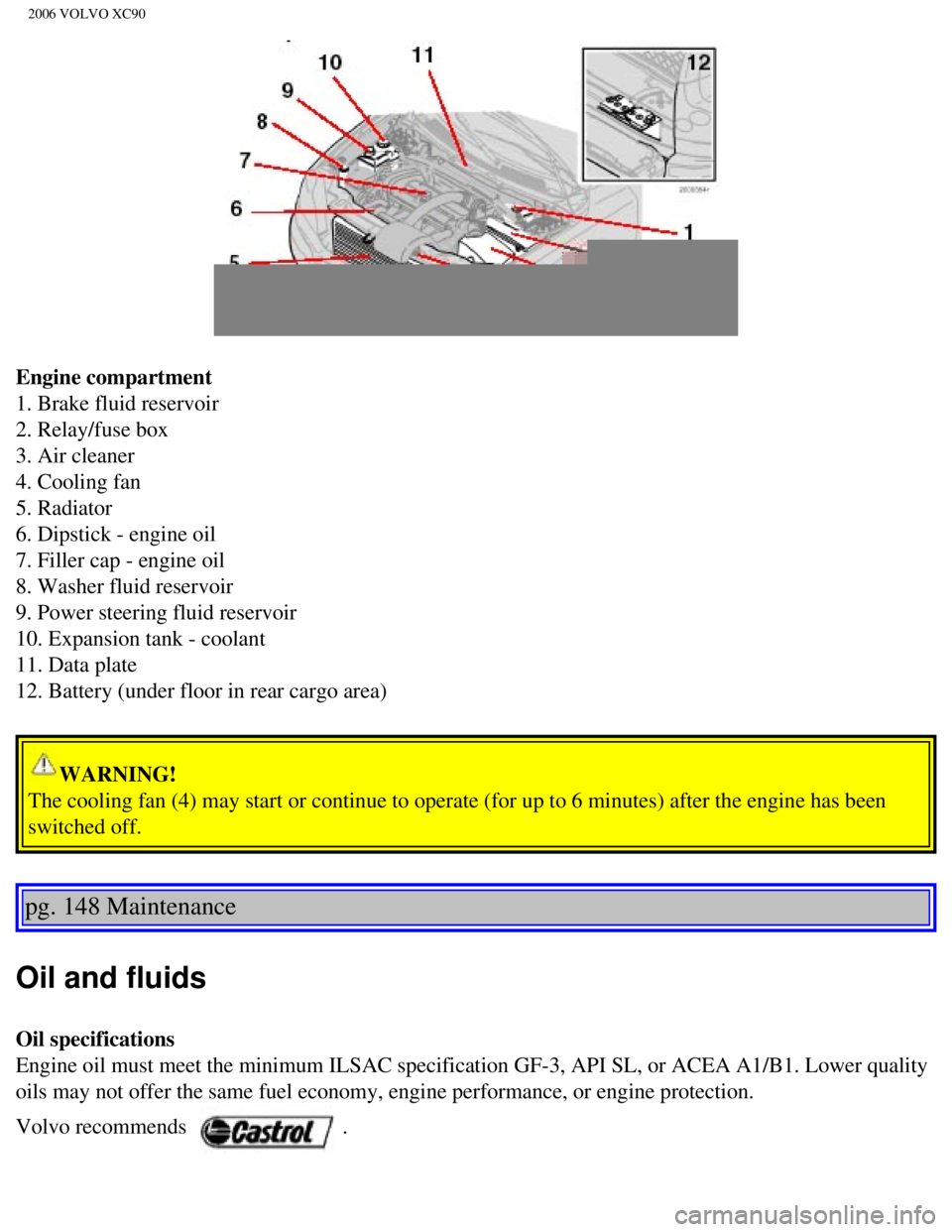
Engine compartment
1. Brake fluid reservoir
2. Relay/fuse box
3. Air cleaner
4. Cooling fan
5. Radiator
6. Dipstick - engine oil
7. Filler cap - engine oil
8. Washer fluid reservoir
9. Power steering fluid reservoir
10. Expansion tank - coolant
11. Data plate
12. Battery (under floor in rear cargo area)
WARNING!
The cooling fan (4) may start or continue to operate (for up to 6 min\
utes) after the engine has been
switched off.
pg. 148 Maintenance
Oil and fluids
Oil specifications
Engine oil must meet the minimum ILSAC specification GF-3, API SL, or AC\
EA A1/B1. Lower quality
oils may not offer the same fuel economy, engine performance, or engine \
protection.
Volvo recommends
.
file:///K|/ownersdocs/2006/2006_XC90/06xc90_09a.htm (7 of 15)12/30/200\
6 5:32:50 PM
Page 181 of 256

2006 VOLVO XC90
Depending on your driving habits, premium or synthetic oils may provide \
superior fuel economy and
engine protection. Consult your Volvo retailer for recommendations on pr\
emium or synthetic oils.
Oil additives must not be used.
NOTE: Synthetic oil is not used when the oil is changed when the normal mainte\
nance is carried out.
This oil is only used at customer request, at additional charge. Please \
consult your Volvo retailer.
Oil Viscosity
Operation in hot climates.
For the protection of your engine when temperatures in your area exceed \
86° F (30° C), Volvo
recommends that you use an oil with suitable viscosity, as shown in the \
chart below.
Operation in temperate climates
Incorrect viscosity oil can shorten engine life. Under normal use when t\
emperatures do not exceed 86° F
(30° C), SAE 5W-30 will provide good fuel economy and engine protec\
tion. See the viscosity chart
above.
Extreme engine operation
Synthetic oils meeting ACEA A5/B5 requirements are recommended for drivi\
ng in areas of sustained
temperature extremes (hot or cold), when towing a trailer over long di\
stances, and for prolonged driving
in mountainous areas.
American Petroleum Institute (API) symbol
American Petroleum Institute (API) symbol
file:///K|/ownersdocs/2006/2006_XC90/06xc90_09a.htm (8 of 15)12/30/200\
6 5:32:50 PM
Page 182 of 256
2006 VOLVO XC90
l The API Service Symbol "donut" is divided into three parts:
l The upper section describes the oil's performance level.
l The center identifies the oil's viscosity.
l The lower section indicates whether the oil has demonstrated energy-cons\
erving properties in a
standard test in comparison to a reference oil.
pg. 149 Maintenance
Changing engine oil and oil filter
See the previous page for oil specifications and
page 176 for oil volumes. Refer to the Warranty and
Service Records Information booklet for information on the oil change in\
tervals.
NOTE:
l Volvo does not recommend the use of oil additives.
l Synthetic oil is not used when the oil is changed at the normal maintena\
nce intervals except at ower
request and at additional charge. Please consult your Volvo retailer.
Checking and adding oil
The oil level should be checked every time the vehicle is refueled. This\
is especially important during
the period up to the first scheduled maintenance service.
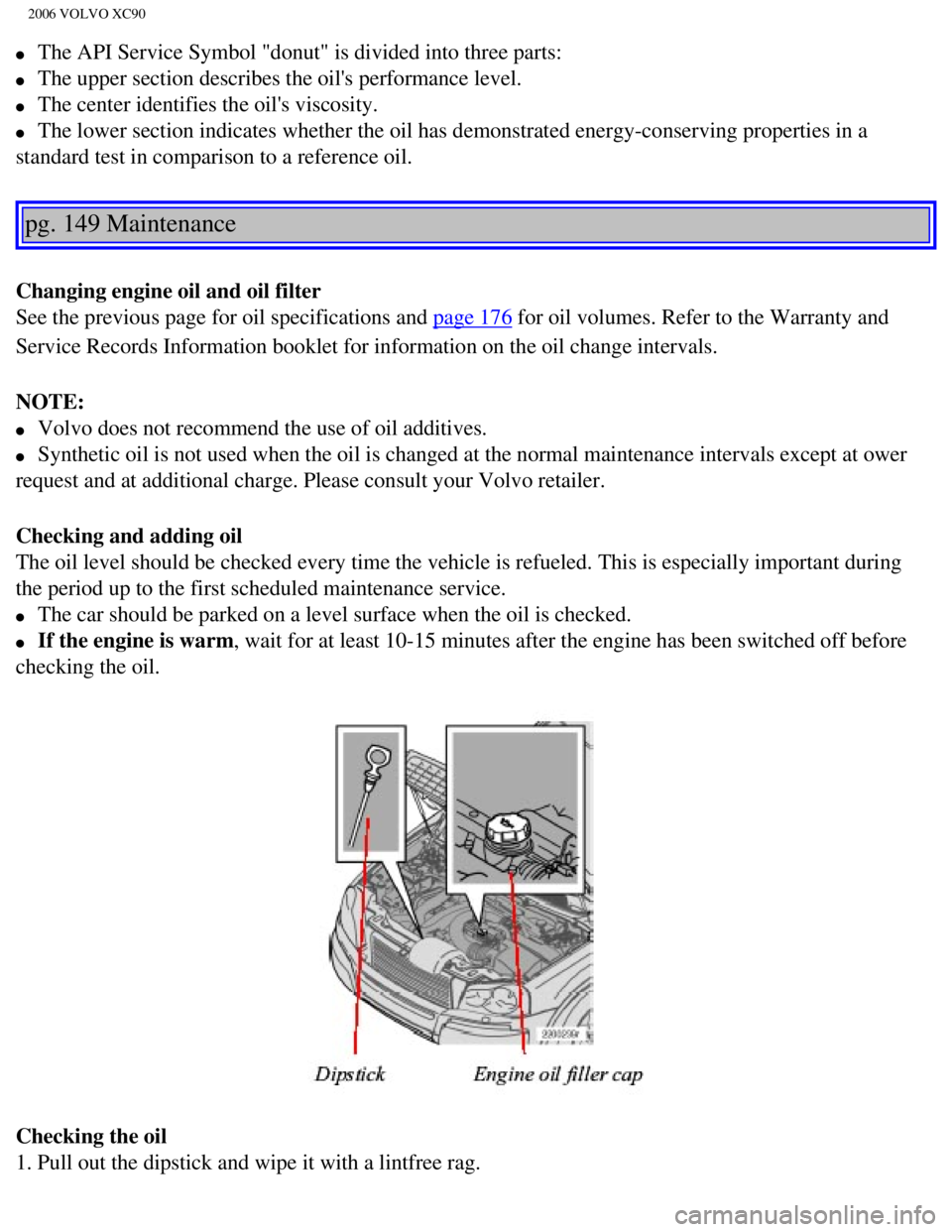
l The car should be parked on a level surface when the oil is checked.
l If the engine is warm, wait for at least 10-15 minutes after the engine has been switched off\
before
checking the oil.
Checking the oil
1. Pull out the dipstick and wipe it with a lintfree rag.
file:///K|/ownersdocs/2006/2006_XC90/06xc90_09a.htm (9 of 15)12/30/200\
6 5:32:50 PM
Page 206 of 256

2006 VOLVO XC90
A-To open, press the plastice catches on the rear side of the fuse box c\
over and lift.
Fuse box in the engine compartment
When replacing fuses, be sure to replace a blown fuse with a new one of \
the same color and amperage
(written on the fuse). Fuses in positions marked X are replacement fus\
es.
Fuses in the engine compartment
No. Amperage
1. ABS 30A
2. ABS 30A
3. Headlight washers 35A
4. -
5. Auxiliary lights (option) 20A
6. Starter motor relay 35A
7. Windshield wipers 25A
8. -
9. Fuel pump 15A
10. Ignition coils, engine control module 20A
11. Throttle pedal sensor, A/C compressor, e-box fan 10A
12. Engine control module, fuel injectors, mass airflow sensor 15A
13. -
14. Heated oxygen sensor(s) 20A
15. Crankcase ventilation heater, solenoid valves (V8), mass airflow s\
ensor (V8), engine
control module (V8) 15A
16. Driver's side low beam headlight 20A
17. Passenger's side low beam headlight 20A
18. -
file:///K|/ownersdocs/2006/2006_XC90/06xc90_09b.htm (18 of 24)12/30/20\
06 5:32:52 PM
Page 214 of 256

2006 VOLVO XC90
Label information
1. Vehicle Emission Control Information
Your Volvo is designed to meet all applicable emission standards, as evi\
denced by the certification label
on the underside of the hood. For further information regarding these re\
gulations, please consult your
Volvo retailer.
2. Vacuum hose routing
(underside of hood)
3. Loads and Tire Pressures
(on inside of fuel filler door). Canadian models only.
4. Child safety lock label
5. Federal Motor Vehicle Safety
file:///K|/ownersdocs/2006/2006_XC90/06xc90_10.htm (2 of 10)12/30/2006\
5:32:53 PM
Page 218 of 256
2006 VOLVO XC90
Fluid Capacities
Fuel tank 21.1 US gallons (80 liters).
Minimum octane requirement - AKI 87 (RON 91) - unleaded fuel (See
also
page 86)
Transmission oil
AW55-51 (5-cyl. turbo) 7.6 US qts. (7.2 liters) JWS 3309
TF-80SC (V8) 7.4 US qts. (7.0 liters) JWS 3309
Miscellaneous
Power steering 1.1 US qts. (1.0 liters)
Windshield washer
reservoir 6.9 US qts. (6.5 liters)
Brake fluid 0.63 US qts. (0.6 liters)
Air conditioning system Front - 2.2 lb. (1 kg), Rear (option) 2.9 lb. (1.3 kg) R 134a (HF\
C134a)
WARNING!
When adding accessories, equipment, luggage and other cargo to your vehi\
cle, the total capacity
weight must not be exceeded.
pg. 176 Specifications
Engine oil
Specifications
Engine oil must meet the minimum ILSAC specification GF-3, API SL, or AC\
EA A1/B1. Lower quality
oils may not offer the same fuel economy, engine performance, or engine \
protection.
Volume
Engine
designation Volume between MIN-MAX on dipstick
Volume
a
2.5T B5254T2 1.3 US qts (1.2 liters) 5.8 US qts. (5.5 liters)
V8 AWD B8444S 1.3 US qts (1.2 liters) 7.1 US qts. (6.7 liters)
a. Including filter replacement
file:///K|/ownersdocs/2006/2006_XC90/06xc90_10.htm (6 of 10)12/30/2006\
5:32:53 PM
Page 220 of 256

2006 VOLVO XC90
Front suspension
Spring strut suspension with integrated shock absorbers and control arms\
linked to the support frame.
Power-assisted rack and pinion steering. Safety type steering column.
pg. 178 Specifications
Three-way catalytic converter cautions
l Keep your engine properly tuned. Certain engine malfunctions, particular\
ly involving the electrical,
fuel or distributor ignition systems, may cause unusually high three-way\
catalytic converter
temperatures. Do not continue to operate your vehicle if you detect engi\
ne misfire, noticeable loss of
power or other unusual operating conditions, such as engine overheating \
or backfiring. A properly tuned
engine will help avoid malfunctions that could damage the three-way cata\
lytic converter.
l Do not park your vehicle over combustible materials, such as grass or le\
aves, which can come into
contact with the hot exhaust system and cause such materials to ignite u\
nder certain wind and weather
conditions.
l Excessive starter cranking (in excess of one minute), or an intermitte\
ntly firing or flooded engine can
cause three-way catalytic converter or exhaust system overheating.
l Remember that tampering or unauthorized modifications to the engine, the\
Electronic Control
Module, or the vehicle may be illegal and can cause three-way catalytic \
converter or exhaust system
overheating. This includes:
- Altering fuel injection setting or components.
- Altering emission system components or location or removing components\
.
- Repeated use of leaded fuel.
NOTE: Unleaded fuel is required for vehicles with three-way catalytic converte\
rs.
pg. 179 Specifications
Electrical system
12-volt system with voltage controlled generator. Single wire system in \
which the chassis and engine
block are used as conductors, grounded on the chassis.
Battery 2.5TV8
Voltage 12 V12 V
Cold start capacity
(CCA) 600 A
600 A
file:///K|/ownersdocs/2006/2006_XC90/06xc90_10.htm (8 of 10)12/30/2006\
5:32:53 PM
Page 222 of 256
2006 VOLVO XC90
Fuel system
The engine is equipped with a multiport fuel injection system.
pg. 181 Specifications
Volvo On Call Roadside Assistance
Your new Volvo comes with a four year ON CALL roadside assistance. Addit\
ional information,
features, and benefits are described in a separate information package i\
n your glove compartment.
If you have misplaced your package, dial:
In the U.S.A.
1-800-638-6586 (1-800-63-VOLVO)
In Canada:
1-800-263-0475
Technician certification
In addition to Volvo factory training, Volvo supports certification by t\
he National Institute for
Automotive Service Excellence (A.S.E.). Certified technicians have dem\
onstrated a high degree of
competence in specific areas. Besides passing exams, each technician mus\
t also have worked in the field
for two or more years before a certificate is issued. These professional\
technicians are best able to
analyze vehicle problems and perform the necessary maintenance procedure\
s to keep your Volvo at peak
operating condition.
pg. 182 Specifications
This page intentionally left blank
Contents | Top of Page
file:///K|/ownersdocs/2006/2006_XC90/06xc90_10.htm (10 of 10)12/30/200\
6 5:32:53 PM