ignition VOLVO XC90 2006 Owner's Guide
[x] Cancel search | Manufacturer: VOLVO, Model Year: 2006, Model line: XC90, Model: VOLVO XC90 2006Pages: 256, PDF Size: 6.87 MB
Page 122 of 256

2006 VOLVO XC90
Vehicle load, tire design and inflation pressure all affect vehicle hand\
ling. Therefore, check that the tires
are inflated to the recommended pressure according to the vehicle load. \
See "Tire pressure" section.
Loads should be distributed so that capacity weight or maximum permissib\
le axle loads are not exceeded.
Driving on rough/unpaved surfaces
The Volvo XC90 is designed primarily for onroad driving, and it has exce\
llent handling characteristics
on very rough or unpaved roads.
When driving on poorly maintained or unpaved roads, please keep the foll\
owing in mind:
l Reduce speed on rough surfaces to minimize possible damage to the vehicl\
e's underbody.
l When driving on soft surfaces such as dry sand or snow, try to avoid sto\
pping if at all possible.
WARNING!
Avoid driving diagonally across steep inclines as this could increase th\
e risk of a roll-over. Try to
drive straight up or down the slope.
If the road is very steep, avoid turning the vehicle around to help avoi\
d the risk of rolling over. Back
the vehicle up or down the incline instead.
NOTE: Avoid driving on steep inclines if the fuel tank is nearly empty. If the\
flow of fuel to the engine
is interrupted due to the vehicle's angle of inclination, this could res\
ult in damage to the three-way
catalytic converter. We recommend keeping the fuel tank at least half fu\
ll when driving on steep inclines.
Driving through water
l The vehicle should not be driven through water that is deeper than 18 in\
ches (48 cm). Driving through
deeper water could result in damage to transmission components or the di\
fferential, or to the engine if
excess water is drawn in through the air intake system.
l Drive slowly and avoid stopping when driving through water.
l After having driven through water, apply the brakes lightly several time\
s to remove water, mud, etc
from the brake discs.
l Never allow the vehicle to stand in water above the door sills. This cou\
ld result in damage to the
electrical system.
Conserving electrical current
Keep the following in mind to help minimize battery drain:
l When the engine is not running, avoid turning the ignition key to positi\
on II (see page 90). Many
electrical systems (the audio system, the optional infotainment/navigat\
ion systems, power windows, etc)
will function with the ignition key in position I. This position reduces\
drain on the battery.
l Please keep in mind that using systems, accessories, etc that consume a \
great deal of current when the
engine is not running could result in the battery being completely drain\
ed.
file:///K|/ownersdocs/2006/2006_XC90/06xc90_06a.htm (10 of 14)12/30/20\
06 5:32:45 PM
Page 131 of 256

2006 VOLVO XC90
The button must be pressed for at least a half second to prevent SC from\
being switched off
inadvertently.
When the system has been switched off, the green indicator lamp in the b\
utton will go out and "DSTC
SPIN CONTROL OFF" will be displayed in the text window.
All DSTC functions are (re)activated each time the engine is started.
pg. 99 Starting and driving
Dynamic Stability Traction Control (DSTC) (contd)
The Stability Control indicator light
The Stability Control indicator light will come on for approximately 2 s\
econds when the ignition is
switched on as the system performs a self-diagnostic test.
The Stability Control indicator light will flash when:
l Traction Control is actively functioning to help avoid drive-wheel spin.\
l Spin Control is actively functioning to help avoid loss of traction duri\
ng acceleration.
l Active Yaw Control is actively functioning to help avoid skids or latera\
l slides.
l Roll Stability Control is actively functioning to help avoid a roll-over\
situation.
The warning symbol in the instrument panel
A steady yellow glow indicates:
l That the system has been automatically disengaged due to a fault. "ANTI \
SKID SERVICE
REQUIRED" will be displayed in the text window. If this occurs, stop the\
vehicle in a suitable place,
switch off and restart the engine. If the light remains on, an authorize\
d Volvo retailer should check the
system.
l In the event of high brake temperature, "TRACTION CONTROL TEMPORARILY OF\
F" will be
displayed in the text window.
The system will automatically switch on again when the brakes have coole\
d.
pg. 100 Starting and driving
Park assist
file:///K|/ownersdocs/2006/2006_XC90/06xc90_06b.htm (5 of 18)12/30/200\
6 5:32:46 PM
Page 134 of 256
.
B Screw the towing eyelet (C) in place (B), first by hand and then us\
ing the tire iron until")
2006 VOLVO XC90
To attach the towing eyelet:
A Use a coin to pry open the lower edge of the cover (A).
B Screw the towing eyelet (C) in place (B), first by hand and then us\
ing the tire iron until it is securely
in place.
After the vehicle has been towed, the eyelet should be removed and retur\
ned to the tool bag. Press the
cover back into position.
Precautions when the vehicle is in tow
l The steering wheel must be unlocked. Turn the ignition key to position I\
or II.
l The gear selector must be in position N.
l Maximum speed: 50 mph (80 km/h). Do not exceed the maximum allowable t\
owing speed.
l Maximum distance with front wheels on ground: 50 miles (80 km).
l While the vehicle is being towed, try to keep the tow rope taut at all t\
imes.
l The vehicle should only be towed in forward direction.
CAUTION
- Please check with state and local authorities before attempting this t\
ype of towing, as vehicles being
towed are subject to regulations regarding maximum towing speed, length \
and type of towing device,
lighting, etc.
- If the vehicle's battery is dead, do not attempt to start the vehicle \
by pushing or pulling it as this will
damage the three-way catalytic converter(s). The engine must be jump s\
tarted using an auxiliary
battery (see
page 103).
- If the vehicle is being towed on a flat bed truck, the towing eyelets \
must not be used to secure the
vehicle on the flat bed. Consult the tow truck operator.
WARNING!
- Remember that the power brakes and power steering will not function wh\
en engine is not running.
The braking and steering systems will function but the brake pedal press\
ure required is 3 - 4 times
above normal and greater steering effort must be exerted.
- The towing eyelets must not be used for pulling the vehicle out of a d\
itch or for any similar purpose
involving severe strain. Do not use the towing eyelets to pull the vehic\
le up onto a flat bed tow truck.
pg. 102 Starting and driving
Towing (contd)
file:///K|/ownersdocs/2006/2006_XC90/06xc90_06b.htm (8 of 18)12/30/200\
6 5:32:46 PM
Page 136 of 256

2006 VOLVO XC90
Jump starting
Follow these instructions to jump start your vehicle's dead battery or t\
o jump start another vehicle's dead
battery using your vehicle.
Although your vehicle's battery is located under the floor of the cargo \
area, jumper cables should be
connected in the engine compartment, to the points shown in the illustrations.
If the 12-volt auxiliary battery to be used is in another vehicle, check\
that the vehicles are not touching
to prevent premature completion of a circuit. Be sure to follow jump sta\
rting instructions provided for
the other vehicle.
To jump start your vehicle:
l Switch off the ignition.
l First connect the auxiliary battery positive (+) terminal (1) to the\
positive (+) terminal in your
vehicle's engine compartment (2), located under a small black plastic \
cover attached to the fuse box
cover, marked with a "+" sign.
Remove the cover on the main fuse box if necessary to access this termin\
al. Then connect the auxiliary
battery's negative (- ) terminal (3) to the ground point in your veh\
icle's engine compartment (4).
l Start the engine in the assisting vehicle, then start the engine in the \
vehicle with dead battery.
l After the engine has started, first remove the negative (-) terminal j\
umper cable. Then remove the
positive (+) terminal jumper cable.
WARNING!
PROPOSITION 65 WARNING!
Battery posts, terminals, and related accessories contain lead and lead \
compounds, chemicals known
to the state of California to cause cancer and reproductive harm. Wash h\
ands after handling
file:///K|/ownersdocs/2006/2006_XC90/06xc90_06b.htm (10 of 18)12/30/20\
06 5:32:46 PM
Page 142 of 256
\
, including the weight of the
load carriers and any other load carrying equipment (ski boxes, bicycl")
2006 VOLVO XC90
WARNING!
Loads carried on the vehicle's roof should not exceed 220 lbs (100 kg)\
, including the weight of the
load carriers and any other load carrying equipment (ski boxes, bicycle\
racks, etc.). Excessive loads
on the roof can adversely affect the handling and roadholding characteri\
stics of the vehicle.
Load carrier cover
The vehicle's ignition key or the stud on the edge of the supplied torqu\
e wrench can be used to undo or
tighten the cover. Turn a quarter turn (90 degrees). See illustration.\
pg. 108 Starting and driving
Cold weather precautions
If you wish to check your vehicle before the approach of cold weather, t\
he following advice is worth
noting:
l Make sure that the engine coolant contains 50 percent antifreeze. Any ot\
her mixture will reduce
freeze protection. This gives protection against freezing down to -31°\
F (-35°C). See section "Coolant".
The use of "recycled" antifreeze is not approved by Volvo. Different typ\
es of antifreeze must not
be mixed.
l Volvo recommends using only genuine Volvo antifreeze in your vehicle's r\
adiator. Your Volvo
retailer stocks plenty of Volvo engine coolant to help protect your vehi\
cle during cold weather.
l Try to keep the fuel tank well filled - this prevents the formation of condensation in the tank. \
In
addition, in extremely cold weather conditions it is worthwhile to add f\
uel line de-icer before refueling.
l The viscosity of the engine oil is important. Oil with low viscosity (thinner oil) improves cold-
weather starting as well as decreasing fuel consumption while the engine\
is warming up. For winter use,
5W-30 oil, particularly the synthetic type*, is recommended. Be sure to \
use good quality oil but do not
use cold-weather oil for hard driving or in warm weather. See section "E\
ngine oil" for more information.
l The load placed on the battery is greater during the winter since the windshield wipers, lighting, etc\
.
file:///K|/ownersdocs/2006/2006_XC90/06xc90_06b.htm (16 of 18)12/30/20\
06 5:32:46 PM
Page 178 of 256

2006 VOLVO XC90
the engine. Ensure that the jack is positioned so that the vehicle canno\
t slide off it. Always use axle
stands or similar structures. The car's gross vehicle weight is between \
5770 lb (2630 kg) and 6080 lb
(2760 kg). Use a jack and stands rated for this weight.
If a two-post hoist is used to lift the vehicle, the front and rear lift\
arm pads should be centered under the
reinforced lift plates on the inboard edge of the sill rail (see illust\
ration).
Please note the following before you begin working on your vehicle:
Battery (see also
page 155 for more information on handling the battery)
l Ensure that the battery cables are correctly connected and tightened.
l Never disconnect the battery when the engine is running (e.g. when repl\
acing the battery).
l The battery contains acid that is both corrosive and poisonous. It is im\
portant that the battery is
handled in an environmentally friendly way. Let your Volvo retailer assi\
st you.
l Never use a fast charger to charge the battery. The battery cables shoul\
d be disconnected when
recharging.
WARNING!
The ignition system has very high voltage! The voltage in the ignition s\
ystem is dangerous!
Do not touch spark plugs, ignition cables or the ignition coil when the \
engine is running or the
ignition is switched on!
The ignition should be switched off when:
- Conducting engine tests.
- Replacing parts in the ignition system, such as spark plugs, ignition \
coil, distributor, ignition cables,
etc.
- Never try to repair any part of the SRS/SIPS/WHIPS/IC systems yourself\
. Any interference in the
system could cause malfunction and serious injury. Any work should only \
be performed by an
authorized Volvo workshop.
pg. 146 Maintenance
Belt check
Check the belt regularly to make sure it is in good condition and is cle\
an. A worn or dirty belt can cause
poor cooling and low alternator output as well as impair the operation o\
f the power steering and the air
conditioning unit.
NOTE: The drive belt is equipped with a self-tensioning mechanism and requires\
no adjustment
between changes.
file:///K|/ownersdocs/2006/2006_XC90/06xc90_09a.htm (5 of 15)12/30/200\
6 5:32:50 PM
Page 191 of 256

2006 VOLVO XC90
Replacing the battery
1. Switch off the ignition.
2. Wait at least 5 minutes after switching off the ignition before disconne\
cting the battery so that
all information in the vehicle's electrical system can be stored in the \
control modules.
3. Remove the retaining bracket and unscrew the cover over the battery. \
Wait at least 5 minutes after
switching off the ignition before disconnecting the battery so that all \
information in the vehicle's
electrical system can be stored in the control modules.
4. Disconnect the negative (ground) cable first. Disconnect the positi\
ve cable and pull the ventilation
hose (see next page) from the battery.
5. Lift out the old battery and put a new battery into place.
6. Connect the positive cable first.
7. Connect the negative (ground) cable.
8. Be sure that the ventilation hose (see below) is securely connected\
to the battery and that the other end
of the hose is properly routed through the ventilation opening in the fl\
oor of the battery compartment.
file:///K|/ownersdocs/2006/2006_XC90/06xc90_09b.htm (3 of 24)12/30/200\
6 5:32:52 PM
Page 194 of 256
2006 VOLVO XC90
6. Side turn signals WY5W W2,1x9,5d
7. Brake lights, backup lights P21W BAY15d
8. Rear turn signals PY21W BA15s
9. Rear parking lights P21/4W BAZ15s
10. Vanity mirror lighting 1.2W SV5.5
11. Front footwell lighting, cargo area lighting C5W SV8.5
WARNING!
Bi-Xenon headlights (option) - due to the high voltage used by these h\
eadlights, these bulbs should
only be replaced by an authorized Volvo service technician.
pg. 157 Maintenance
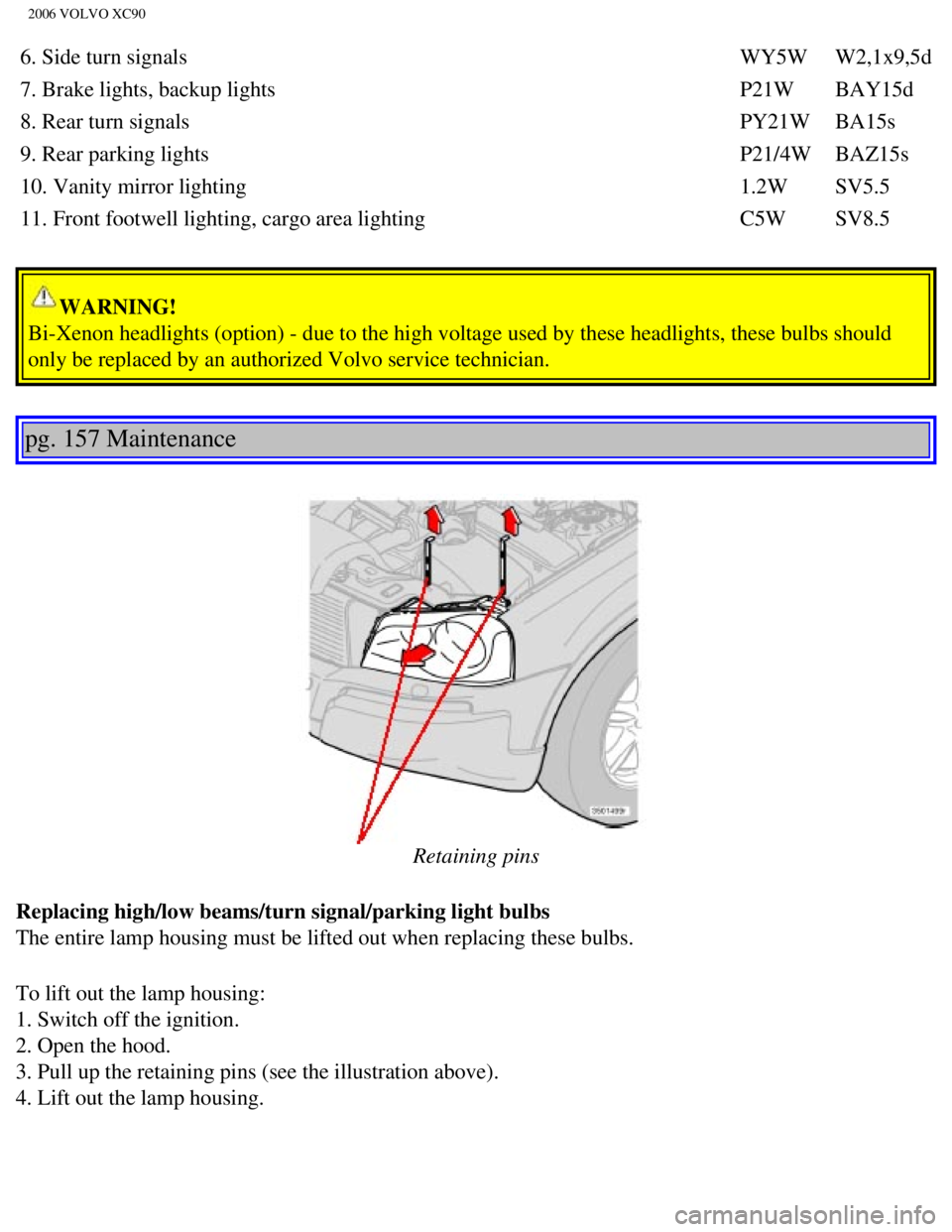
Retaining pins
Replacing high/low beams/turn signal/parking light bulbs
The entire lamp housing must be lifted out when replacing these bulbs.
To lift out the lamp housing:
1. Switch off the ignition.
2. Open the hood.
3. Pull up the retaining pins (see the illustration above).
4. Lift out the lamp housing.
file:///K|/ownersdocs/2006/2006_XC90/06xc90_09b.htm (6 of 24)12/30/200\
6 5:32:52 PM
Page 198 of 256

2006 VOLVO XC90
Replacing the turn signal bulb
1. Turn the lamp holder approximately 1/4 turn counterclockwise and pull\
it out of the headlight housing.
2. Press in the bulb slightly and pull it out of the holder.
3. Align the guide lugs on the side of the base of the new bulb in the g\
rooves in the holder. Press it in
and turn it slightly clockwise.
4. Press the lamp holder into the place in the headlight housing and tur\
n it approximately 1/4 turn
clockwise.
Replacing the side turn signal bulb
1. Switch off the ignition.
2. Pry out the lens by inserting a small screw driver under the lower ed\
ge.
3. Turn the lamp holder 1/4 turn counterclockwise and pull it straight o\
ut.
4. Pull the bulb straight out of the holder.
5. Press the new bulb into the holder.
6. Reinsert the bulb holder in the lens and turn 1/4 turn clockwise.
file:///K|/ownersdocs/2006/2006_XC90/06xc90_09b.htm (10 of 24)12/30/20\
06 5:32:52 PM
Page 199 of 256
2006 VOLVO XC90
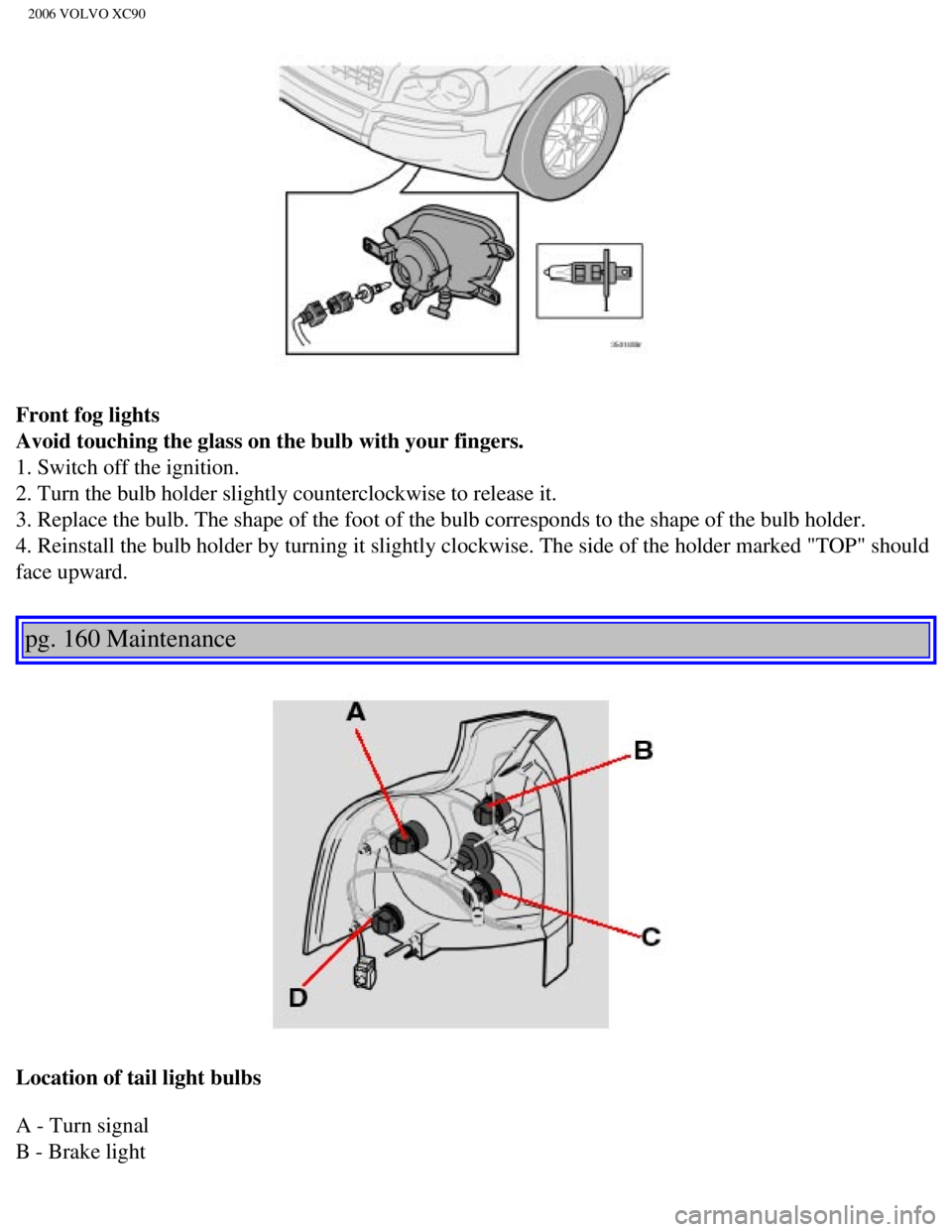
Front fog lights
Avoid touching the glass on the bulb with your fingers.
1. Switch off the ignition.
2. Turn the bulb holder slightly counterclockwise to release it.
3. Replace the bulb. The shape of the foot of the bulb corresponds to th\
e shape of the bulb holder.
4. Reinstall the bulb holder by turning it slightly clockwise. The side \
of the holder marked "TOP" should
face upward.
pg. 160 Maintenance
Location of tail light bulbs
A - Turn signal
B - Brake light
file:///K|/ownersdocs/2006/2006_XC90/06xc90_09b.htm (11 of 24)12/30/20\
06 5:32:52 PM