light VOLVO XC90 2007 Repair Manual
[x] Cancel search | Manufacturer: VOLVO, Model Year: 2007, Model line: XC90, Model: VOLVO XC90 2007Pages: 268, PDF Size: 8.57 MB
Page 142 of 268

2007 Volvo XC90
WARNING!
The stability system is intended to help improve driving safety. It supp\
lements, but can never replace, the driver's
judgement and responsibility when operating the vehicle. Speed and drivi\
ng style should always be adapted to traffic
and road conditions.
pg. 132 Starting and driving
Front/rear park assist (accessory/option)
Front/rear park assist
The park assist system(s) are designed to assist you when driving into\
parking spaces, garages, etc. They utilize ultrasound
sensors located in the bumpers to measure the distance to a vehicle or o\
ther object, or a person who may be close to the
front or rear of the vehicle.
When is park assist active
Front: the system is active from the time the engine is started until the vehi\
cle exceeds a speed of approximately 10 mph
(15 km/h). It is also active when the vehicle is backing up. Front par\
k assist reactivates automatically when the vehicle's
speed goes under 10 mph (15 km/h).
Rear: the system is active when the engine is running and reverse gear is sel\
ected.
NOTE:
l If the vehicle is equipped with front and rear park assist, both systems\
will either be activated or deactivated together.
They cannot be used separately.
l The indicator light in the button (see the illustration on page 52) will light up to indicate that park assist system(s) are
activated.
When park assist is actively working:
l The audio system's volume will be reduced.
l An intermittent signal will be audible from the speakers to indicate tha\
t you are approaching a person, object, parked
vehicle, etc. The signals begin when the distance between the bumper and\
the object is:
Rear: approximately 5 feet (1.5 meters)
Front: approximately 2.5 ft (0.8 meters)
file:///K|/ownersdocs/2007/2007_XC90/07xc90_06.htm (18 of 32)12/30/200\
6 5:53:44 PM
Page 143 of 268
, the signal will become \
constant. If objects are close to both the front and
rear bumpers, the signal will alternate between th")
2007 Volvo XC90
l At a distance of approximately 1 foot (30 cm), the signal will become \
constant. If objects are close to both the front and
rear bumpers, the signal will alternate between the front and rear speak\
ers.
Deactivating the system(s)
- Press the Park assist button on the center console (see
page 52) to temporarily deactivate the system(s).
- The indicator light in the button will go out when the system(s) hav\
e been deactivated.
- If the vehicle is equipped with front and rear park assist, both syste\
ms will be deactivated by pressing the button.
Park assist will be automatically reactivated the next time the engine i\
s started.
NOTE: It may be necessary to deactivate one or both of the park assist system\
s in certain cases.
l Rear park assist: towing a trailer, carrying bicycles in a rear-mounted carrier, etc, co\
uld trigger the rear park assist
system's sensors.
l Front park assist: it may not be possible to combine auxiliary headlights and front park \
assist since these lights could
trigger the system's sensors.
pg. 133 Starting and driving
Front/rear park assist (accessory/option)
Faults in the system
If the yellow warning symbol illuminates and a message is shown in the i\
nformation display, the system is not
functioning properly. Consult a Volvo retailer or authorized service tec\
hnician.
Cleaning the sensors
For the system to function properly, the sensors in the front and/or rea\
r bumpers should be kept clean. They can be cleaned
with car washing detergent and a sponge.
WARNING!
These systems are designed to be a supplementary aid when parking the ve\
hicle. They are not, however, intended to
replace the driver's attention and judgement.
CAUTION!
In certain circumstances, the park assist system may give unexpected war\
ning signals that can be caused by external
sound sources that use the same ultrasound frequencies as the system. Th\
is may include such things as the horns of
other vehicles, wet tires on asphalt, pneumatic brakes, motorcycle exhau\
st pipes, etc. This does not indicate a fault in
the system.
pg. 134 Starting and driving
Towing
file:///K|/ownersdocs/2007/2007_XC90/07xc90_06.htm (19 of 32)12/30/200\
6 5:53:44 PM
Page 144 of 268

2007 Volvo XC90
Emergency towing
The towing eyelet is located in the tool bag, under the floor of the car\
go area. This eyelet must be screwed into the
positions provided on the right sides of either the front or rear bumper\
(see illustrations).
To attach the towing eyelet:
A. Use a coin to pry open the lower edge of the cover (A).
B. Screw the towing eyelet (C) in place (B), first by hand and then \
using the tire iron until it is securely in place.
After the vehicle has been towed, the eyelet should be removed and retur\
ned to the tool bag. Press the cover back into
position.
Precautions when the vehicle is in tow
l The steering wheel must be unlocked. Turn the ignition key to position I\
or II.
l The gear selector must be in position N.
l Maximum speed: 50 mph (80 km/h). Do not exceed the maximum allowable t\
owing speed.
l Maximum distance with front wheels on ground: 50 miles (80 km).
l While the vehicle is being towed, try to keep the tow rope taut at all t\
imes.
l The vehicle should only be towed in forward direction.
CAUTION!
- Please check with state and local authorities before attempting this t\
ype of towing, as vehicles being towed are subject
to regulations regarding maximum towing speed, length and type of towing\
device, lighting, etc.
- If the vehicle's battery is dead, do not attempt to start the vehicle \
by pushing or pulling it as this will damage the three-
way catalytic converter(s). The engine must be jump started using an a\
uxiliary battery (see
page 136).
- If the vehicle is being towed on a flat bed truck, the towing eyelets \
must not be used to secure the vehicle on the flat
bed. Consult the tow truck operator.
pg. 135 Starting and driving
Towing
file:///K|/ownersdocs/2007/2007_XC90/07xc90_06.htm (20 of 32)12/30/200\
6 5:53:44 PM
Page 148 of 268

2007 Volvo XC90
watched when driving in hot climates or hilly terrain. Use a lower gear \
and turn off the air conditioner if the temperature
gauge needle enters the red range.
l If the automatic transmission begins to overheat, a message will be disp\
layed in the text window.
l Hauling a trailer affects handling, durability, and economy.
l It is necessary to balance trailer brakes with the towing vehicle brakes\
to provide a safe stop (check and observe state/
local regulations).
l Do not connect the trailer's brake system directly to the vehicle's brak\
e system.
l Remove the ball and drawbar assembly when the hitch is not being used.
l Volvo recommends the use of synthetic engine oil when towing a trailer o\
ver long distances or in mountainous areas.
NOTE:
l When parking the vehicle with a trailer on a hill, apply the parking bra\
ke before putting the gear selector in (P)ark.
When starting on a hill, put the gear selector in (D)rive before relea\
sing the parking brake. Always follow the trailer
manufacturer's recommendations for wheel chocking.
l If you use the manual (Geartronic) shift positions while towing a trai\
ler, make sure the gear you select does not put too
much strain on the engine (using too high a gear).
WARNING!
l Bumper-attached trailer hitches must not be used on Volvos, nor should s\
afety chains be attached to the bumper.
l Trailer hitches attaching to the vehicle rear axle must not be used.
l Never connect a trailer's hydraulic brake system directly to the vehicle\
brake system, nor a trailer's lighting system
directly to the vehicle lighting system. Consult your nearest authorized\
Volvo retailer for correct installation.
l When towing a trailer, the trailer's safety wire must be correctly faste\
ned to the hole or hook provided in the trailer
hitch on the vehicle. The safety wire should never be fastened to or wou\
nd around the drawbar ball.
pg. 139 Starting and driving
Towing a trailer
Smoother starts with a trailer
Models equipped with the V8-engine and the 6-speed automatic transmissio\
n have a built-in function that reduces
acceleration slightly in first gear when the vehicle is towing a trailer\
. This is done to help avoid wheel spin and to make
starting off smoother.
l This function is activated when the trailer's electrical connector is pl\
ugged into the electrical socket mounted near the
trailer hitch.
l The function is automatically deactivated when the trailer's wiring is d\
isconnected from the socket. The vehicle will
then accelerate normally.
NOTE: Since this function is activated when a connector is plugged into the e\
lectrical socket near the trailer hitch, it will
be activated by any electrical equipment (e.g. bicycle racks with light\
ing, etc) that is plugged in, and will remain active
until the equipment is unplugged from the socket.
Leveling
If your vehicle is equipped with automatic leveling, the rear suspension\
always retains the correct ride height regardless of
the load.
l The system adjusts the rear suspension to the correct level after the ve\
hicle has been driven a short distance.
file:///K|/ownersdocs/2007/2007_XC90/07xc90_06.htm (24 of 32)12/30/200\
6 5:53:44 PM
Page 151 of 268
. Se")
2007 Volvo XC90
Load carrier cover
The vehicle's ignition key or the stud on the edge of the supplied torqu\
e wrench can be used to undo or tighten the cover.
Turn a quarter turn (90 degrees). See illustration.
pg. 143 Starting and driving
Cold weather precautions
If you wish to check your vehicle before the approach of cold weather, t\
he following advice is worth noting:
l Make sure that the engine coolant contains 50 percent antifreeze. Any ot\
her mixture will reduce freeze protection. This
gives protection against freezing down to -31°F (-35°C). See sec\
tion "Coolant". The use of "recycled" antifreeze is not
approved by Volvo. Different types of antifreeze must not be mixed.
l Volvo recommends using only genuine Volvo antifreeze in your vehicle's r\
adiator. Your Volvo retailer stocks plenty of
Volvo engine coolant to protect your vehicle during cold weather.
l Try to keep the fuel tank well filled - this prevents the formation of condensation in the tank. \
In addition, in extremely
cold weather conditions it is worthwhile to add fuel line de-icer before\
refueling.
l The viscosity of the engine oil is important. Oil with low viscosity (thinner oil) improves cold-weat\
her starting as well
as decreasing fuel consumption while the engine is warming up. For winte\
r use, 5W-30 oil, particularly the synthetic type
1,
is recommended. Be sure to use good quality oil but do not use cold-weat\
her oil for hard driving or in warm weather. See
section "Engine oil" for more information.
l The load placed on the battery is greater during the winter since the windshield wipers, lighting, etc\
. are used more
often. Moreover, the capacity of the battery decreases as the temperatur\
e drops. In very cold weather, a poorly charged
battery can freeze and be damaged. It is therefore advisable to check th\
e state of charge more frequently and spray an
antirust oil on the battery posts.
l Volvo recommends the use of snow tires on all four wheels for winter driving - see section "Wheels and tires."\
l To prevent the washer fluid reservoir from freezing, add washer solvents containing antifreeze (see page 188 for the
location of the washer fluid reservoir). This is important since dirt i\
s often splashed on the windshield during winter
driving, requiring the frequent use of the washers and wipers. Volvo Was\
her Solvent should be diluted as follows:
- Down to 14° F (-10° C): 1 part washer solvent and 4 parts water
- Down to 5° F (-15° C): 1 part washer solvent and 3 parts water
- Down to 0° F (-18° C): 1 part washer solvent and 2 parts water
- Down to -18° F (-28° C): 1 part washer solvent and 1 part water
l Use Volvo Teflon Lock Spray in the locks.
NOTE: Avoid the use of de-icing sprays as they can cause damage to the locks.
file:///K|/ownersdocs/2007/2007_XC90/07xc90_06.htm (27 of 32)12/30/200\
6 5:53:44 PM
Page 152 of 268

2007 Volvo XC90
W - Winter/Wet driving mode - enhanced vehicle traction
l Mode W will only function if the gear selector is in the (D)rive position.
l Press the button at the base of the gear selector to engage/disengage th\
is driving mode.
l An LED in the button will light up to indicate that W is engaged and thi\
s will also be displayed in the instrument panel
(see
page 46).
l This mode may be selected for starting/ moving off on slippery roads.
1. Synthetic oil is not used when the oil is changed at the normal maint\
enance service intervals except at owner request and at
additional charge. Please consult your Volvo retailer.
pg. 144 Starting and driving
Before a long distance trip
It is always worthwhile to have your vehicle checked at a Volvo retailer\
before driving long distances. Your retailer will
also be able to supply you with bulbs, fuses, spark plugs and wiper blad\
es for your use in the event that problems occur.
As a minimum, the following items should be checked before any long trip\
:
l Check that engine runs smoothly and that fuel consumption is normal.
l Check for fuel, oil, and fluid leakage.
l Check transmission oil level1.
l Check condition of drive belts.
l Check state of the battery's charge.
l Examine tires carefully (the spare tire as well), and replace those th\
at are worn. Check tire pressures.
l The brakes, front wheel alignment, and steering gear should be checked b\
y your Volvo retailer only.
l Check all lights, including high beams.
l Reflective warning triangles are legally required in some states/provinc\
es.
l Have a word with your Volvo retailer if you intend to drive in countries\
where it may be difficult to obtain the correct
fuel.
l Consider your destination. If you will be driving through an area where \
snow or ice are likely to occur, consider snow
tires.
1. To prevent injury from contact with hot surfaces, do not inspect your\
vehicle's transmission fluid yourself. Have your vehicle's
transmission fluid level inspected by a qualified Volvo service technici\
an.
pg. 145 Starting and driving
Blind Spot Information System (BLIS) - option
file:///K|/ownersdocs/2007/2007_XC90/07xc90_06.htm (28 of 32)12/30/200\
6 5:53:44 PM
Page 153 of 268

2007 Volvo XC90
BLIS is an information system that indicates the presence of another veh\
icle moving in the same direction as your vehicle
in the sideview mirror's "blind area."
The system is based on digital camera technology. The cameras (1) are \
located beneath the side-view mirrors.
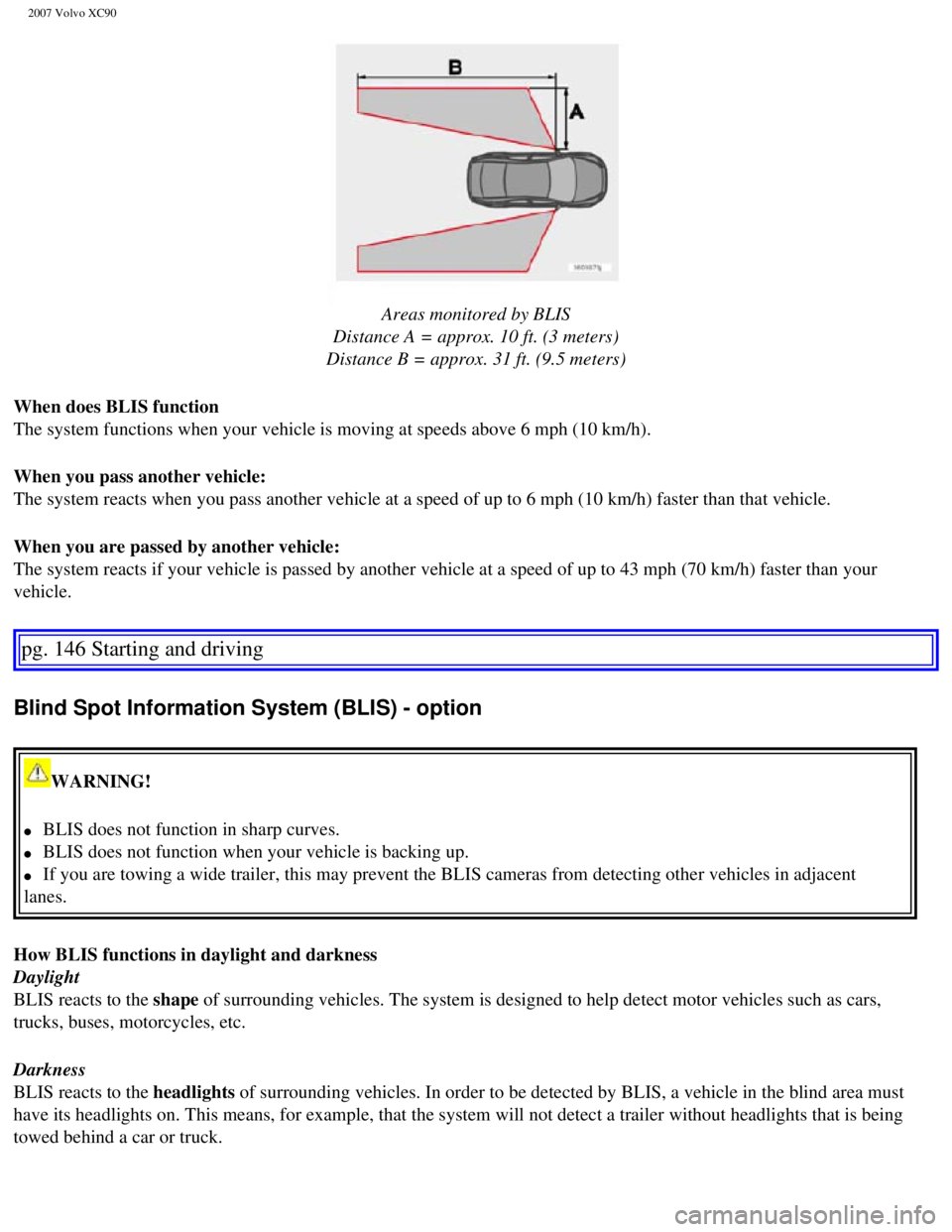
When one (or both) of the cameras have detected a vehicle in the blind\
area (up to approximately 10 ft. (3 meters) from the
side of your vehicle, and up to approximately 31 ft. (9.5 meters) behi\
nd the side-view mirror), see the illustration in the
right column, the indicator light in the door panel (2) illuminates.
WARNING!
l BLIS is an information system, NOT a warning or safety system.
l BLIS does not eliminate the need for you to visually confirm the conditi\
ons around you, and the need for you to turn
your head and shoulders to make sure that you can safely change lanes.
l As the driver, you have full responsibility for changing lanes in a safe\
manner.
The light will glow continuously to alert the driver of the vehicle in t\
he blind area.
NOTE: The door panel indicator light illuminates on the side of the vehicle wh\
ere the system has detected another vehicle.
If your vehicle is passed on both sides at the same time, both lights wi\
ll illuminate.
BLIS has an integrated function that alerts the driver if a fault should\
occur with the system. For example, if one or both of
the system's cameras are obscured, a message (see the table on
page 147) will appear in the information display in the
instrument panel. If this occurs, clean the camera lenses. If necessary,\
the system can be temporarily switched off (for
instructions, see
page 147).
file:///K|/ownersdocs/2007/2007_XC90/07xc90_06.htm (29 of 32)12/30/200\
6 5:53:44 PM
Page 154 of 268
2007 Volvo XC90
Areas monitored by BLIS
Distance A = approx. 10 ft. (3 meters)
Distance B = approx. 31 ft. (9.5 meters)
When does BLIS function
The system functions when your vehicle is moving at speeds above 6 mph (\
10 km/h).
When you pass another vehicle:
The system reacts when you pass another vehicle at a speed of up to 6 mp\
h (10 km/h) faster than that vehicle.
When you are passed by another vehicle:
The system reacts if your vehicle is passed by another vehicle at a spee\
d of up to 43 mph (70 km/h) faster than your
vehicle.
pg. 146 Starting and driving
Blind Spot Information System (BLIS) - option
WARNING!
l BLIS does not function in sharp curves.
l BLIS does not function when your vehicle is backing up.
l If you are towing a wide trailer, this may prevent the BLIS cameras from\
detecting other vehicles in adjacent
lanes.
How BLIS functions in daylight and darkness
Daylight
BLIS reacts to the shape of surrounding vehicles. The system is designed to help detect motor ve\
hicles such as cars,
trucks, buses, motorcycles, etc.
Darkness
BLIS reacts to the headlights of surrounding vehicles. In order to be detected by BLIS, a vehicle in \
the blind area must
have its headlights on. This means, for example, that the system will no\
t detect a trailer without headlights that is being
towed behind a car or truck.
file:///K|/ownersdocs/2007/2007_XC90/07xc90_06.htm (30 of 32)12/30/200\
6 5:53:44 PM
Page 155 of 268
2007 Volvo XC90
WARNING!
l BLIS does not react to cyclists or mopeds.
l BLIS does not react to vehicles that are standing still.
l The function of the BLIS cameras may be affected by intense light, or wh\
en driving at night in areas where there are
no external sources of light (e.g., street lights, other vehicles, etc.\
). In such cases, the system may react as if the cameras
were obscured.
In both of the above mentioned conditions, a message will appear in the \
information display.
When driving in such conditions, the system can be temporarily switched \
off. See
page 147 for instructions.
When the message is no longer displayed, BLIS will return to normal func\
tion.
l The BLIS cameras have the same limitation as the human eye. In other wor\
ds, their "vision is impaired" by adverse
weather conditions such as heavy snowfall, dense fog, etc.
Cleaning the BLIS camera lenses
In order to function optimally, the BLIS camera lenses must be kept clea\
n. They can be wiped clean with a soft cloth or
wet sponge. CAUTION!
Clean the lenses carefully to avoid scratching.
The lenses are electrically heated to help melt ice or snow. If necessar\
y, gently brush away snow from the
lenses.
pg. 147 Starting and driving
Blind Spot Information System (BLIS) - option
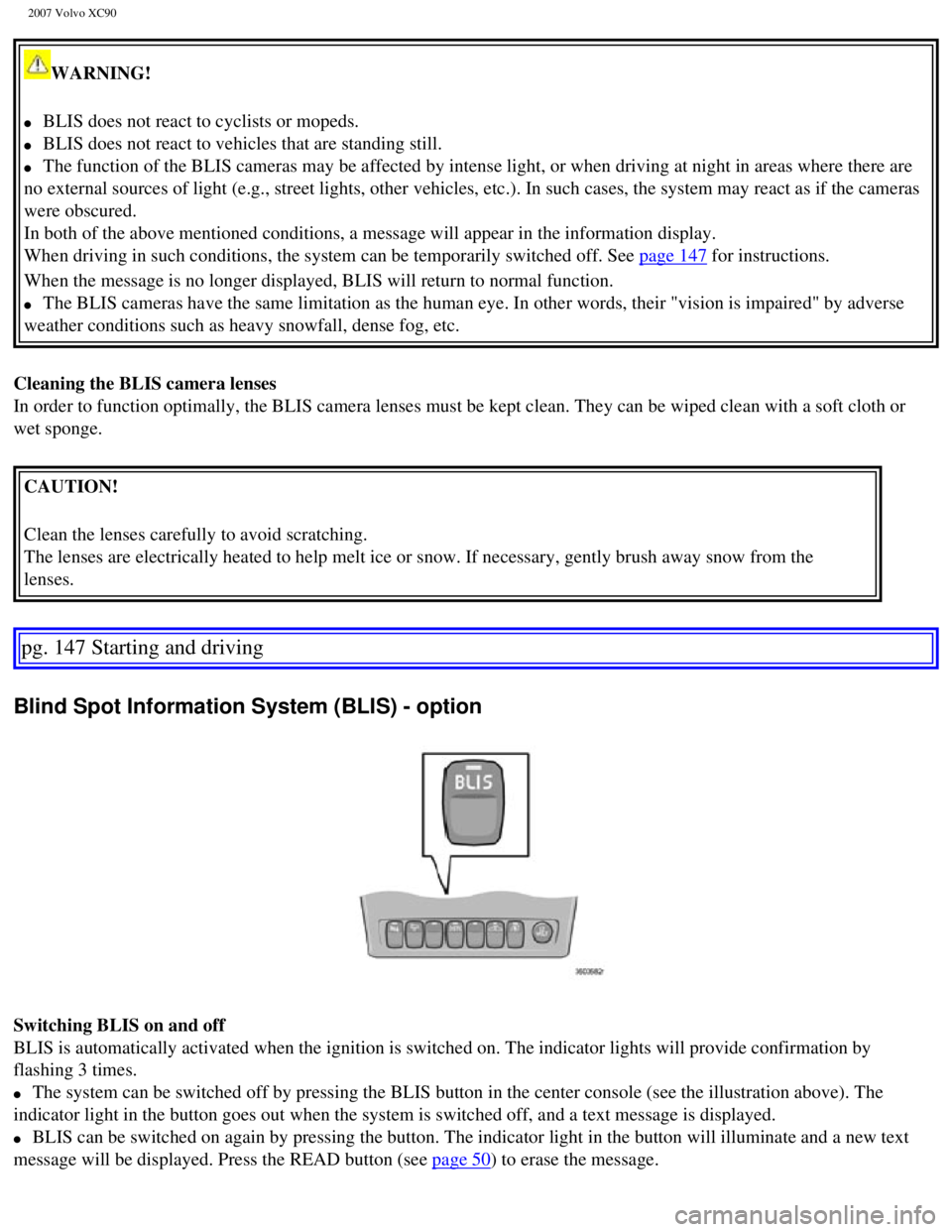
Switching BLIS on and off
BLIS is automatically activated when the ignition is switched on. The in\
dicator lights will provide confirmation by
flashing 3 times.
l The system can be switched off by pressing the BLIS button in the center\
console (see the illustration above). The
indicator light in the button goes out when the system is switched off, \
and a text message is displayed.
l BLIS can be switched on again by pressing the button. The indicator ligh\
t in the button will illuminate and a new text
message will be displayed. Press the READ button (see
page 50) to erase the message.
file:///K|/ownersdocs/2007/2007_XC90/07xc90_06.htm (31 of 32)12/30/200\
6 5:53:44 PM
Page 163 of 268

2007 Volvo XC90
pg. 155 Wheels and tires
Tire inflation pressure tables - Canadian models
The following tire pressures are recommended by Volvo for your vehicle. \
Refer to the tire inflation
placard for information specific to the tires installed on your vehicle \
at the factory.
Tire size Cold tire pressures
up to five persons psi (kPa) Optional pressure
up to three persons psi (kPa)
FrontRear Front Rear
225/70R16
235/65R17
235/60R18
255/50R19 39 (270
39 (270) 32 (220) 32 (220)
Temporary spare tire
T155/85R18 61 (420)
61 (420) 61 (420) 61 (420)
pg. 156 Wheels and tires
Tire Pressure Monitoring System (TPMS) - option
The tire pressure monitoring system uses sensors mounted in the tire val\
ves to check inflation pressure
levels. When the vehicle is moving at a speed of approximately 20 mph (\
30 km/h) or faster, these
sensors transmit inflation pressure data to a receiver located in the ve\
hicle.
USA - FCC ID: MRXTG315AM04
This device complies with part 15 of the FCC rules. Operation is subject\
to the following conditions:
(1) This device may not cause harmful interference, and (2) this dev\
ice must accept any interference
received, including interference that may cause undesired operation.
When low inflation pressure is detected, TPMS will light up the tire pre\
ssure warning light (
) (also
referred to as a telltale) in the instrument panel, and will display a \
message in the text window. The
wording of this message is determined by the degree of inflation pressur\
e loss.
NOTE: If a fault occurs in TPMS, the tire pressure warning light will flash f\
or approximately 1 minute
and TIRE PRESS SYST SERVICE REQUIRED will be displayed.
file:///K|/ownersdocs/2007/2007_XC90/07xc90_07.htm (7 of 23)12/30/2006\
5:53:47 PM