steering VOLVO XC90 2014 Owner´s Manual
[x] Cancel search | Manufacturer: VOLVO, Model Year: 2014, Model line: XC90, Model: VOLVO XC90 2014Pages: 308, PDF Size: 13.31 MB
Page 147 of 308
06 Starting and driving
Ignition switch and steering wheel lock
06
145
Ignition switch and steering wheel lock
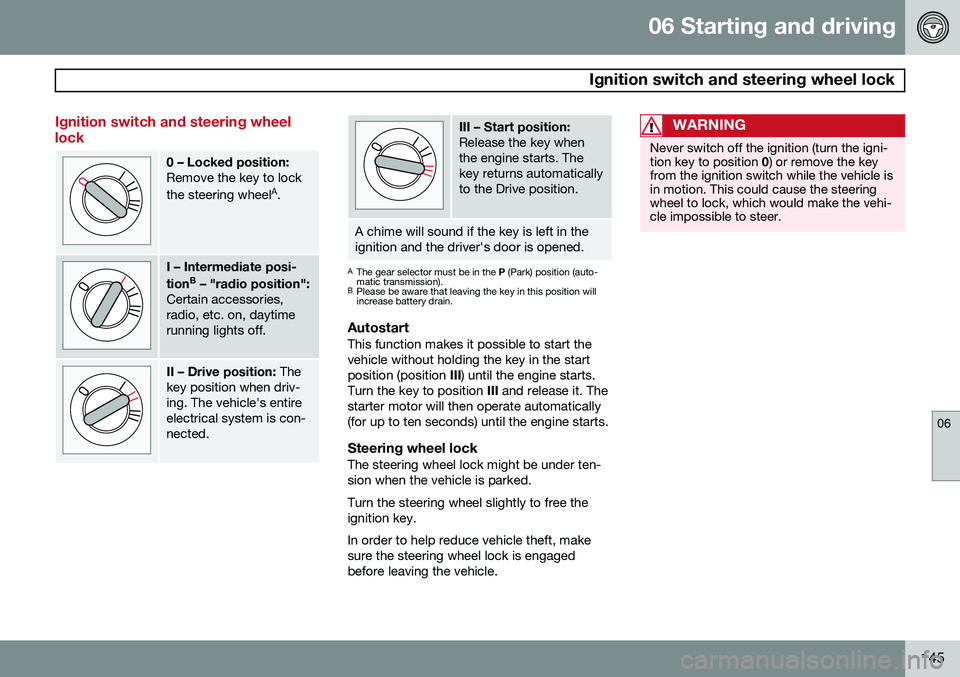
0 – Locked position: Remove the key to lock the steering wheelA
.
I – Intermediate posi- tion B
– "radio position":
Certain accessories, radio, etc. on, daytimerunning lights off.
II – Drive position: The
key position when driv- ing. The vehicle's entireelectrical system is con-nected.
III – Start position: Release the key when the engine starts. Thekey returns automaticallyto the Drive position.
A chime will sound if the key is left in the ignition and the driver's door is opened.
A The gear selector must be in the P (Park) position (auto-
matic transmission).
B Please be aware that leaving the key in this position will increase battery drain.
AutostartThis function makes it possible to start the vehicle without holding the key in the startposition (position III) until the engine starts.
Turn the key to position III and release it. The
starter motor will then operate automatically(for up to ten seconds) until the engine starts.
Steering wheel lockThe steering wheel lock might be under ten-sion when the vehicle is parked. Turn the steering wheel slightly to free the ignition key. In order to help reduce vehicle theft, make sure the steering wheel lock is engagedbefore leaving the vehicle.
WARNING
Never switch off the ignition (turn the igni- tion key to position 0) or remove the key
from the ignition switch while the vehicle isin motion. This could cause the steeringwheel to lock, which would make the vehi-cle impossible to steer.
Page 157 of 308
06 Starting and driving
Brake system
06
155
WARNING
•Use the jack intended for the vehicle when changing a tire. For any otherjob, use stands to support the vehicle.
• The jack should be kept well-greasedand clean, and should not be dam-aged.
• Be sure the jack is on a firm, level,non-slippery surface.
• No objects should be placed betweenthe base of jack and the ground, orbetween the jack and the attachmentbar on the vehicle.
• The jack must correctly engage thejack attachment.
• Never allow any part of your body tobe extended under a vehicle suppor-ted by a jack.
Power brakes function only when the engine is running
The power brakes utilize vacuum pressure which is only created when the engine is run-ning. Never let the vehicle roll to a stop withthe engine switched off. If the power brakes are not working, consid- erably higher pressure will be required on thebrake pedal to compensate for the lack ofpower assistance. This can happen for exam- ple when towing your vehicle or if the engineis switched off when the vehicle is rolling. Thebrake pedal feels harder than usual.
Water on brake discs and brake pads
affects braking
Driving in rain and slush or passing throughan automatic car wash can cause water tocollect on the brake discs and pads. This willcause a delay in braking effect when thepedal is depressed. To avoid such a delaywhen the brakes are needed, depress thepedal occasionally when driving through rain,slush etc. This will remove the water from thebrakes. Check that brake application feelsnormal. This should also be done after wash-ing or starting in very damp or cold weather.
Severe strain on the brake systemThe brakes will be subject to severe strainwhen driving in mountains or hilly areas, orwhen towing a trailer. Vehicle speed is usuallyslower, which means that the cooling of thebrakes is less efficient than when driving onlevel roads. To reduce the strain on thebrakes, shift into a lower gear and let theengine help with the braking. Do not forgetthat, if you are towing a trailer, the brakes willbe subjected to a greater than normal load.
Anti-lock brakes (ABS)If the ABS warning lamp lights up there is a
malfunction in the ABS system (the standardbraking system will however function) and thevehicle should be driven cautiously to atrained and qualified Volvo service technicianfor inspection. The Anti-lock Braking System(ABS) helps to improve vehicle control (stop-ping and steering) during severe braking con-ditions by limiting brake lockup. When thesystem "senses" impending lockup, brakingpressure is automatically modulated in orderto help prevent lockup, which could lead to askid. The system performs a self-diagnostic test when the engine is started and when thevehicle first reaches a speed of approxi- mately 12 mph (20 km/h). The brake pedal
will pulsate several times and a sound may be audible from the ABS control module. This isnormal. To obtain optimal effect from the ABS sys- tem, constant pressure should be kept on thebrake pedal. Do not pump the brake pedal. The switching of the ABS modulator will be audible and the brake pedal will pulsate dur-ing braking. Please be aware that ABS doesnot increase the absolute braking potential ofthe vehicle. While control will be enhanced,ABS will not shorten stopping distances onslippery surfaces.
Page 160 of 308
06 Starting and driving
Stability system
06
158
Dynamic Stability Traction Control (DSTC)
The stability system consists of a number of functions designed help reduce wheel spin,counteract skidding, and to generally helpimprove directional stability.
NOTE
A pulsating sound will be audible when the system is actively operating and is normal.
Traction control (TC)This function is designed to help reduce wheel spin by transferring power from a drivewheel that begins to lose traction to thewheel on the opposite side of the vehicle (onthe same axle). TC is most active at low speeds.This is one of DSTC's permanent functions and cannot be switched off.
Spin control (SC)The spin control function is designed to helpprevent the drive wheels from spinning whilethe vehicle is accelerating. Under certain circumstances, such as when driving with snow chains, or driving in deepsnow or loose sand, it may be advisable totemporarily switch off this function for maxi-mum tractive force.
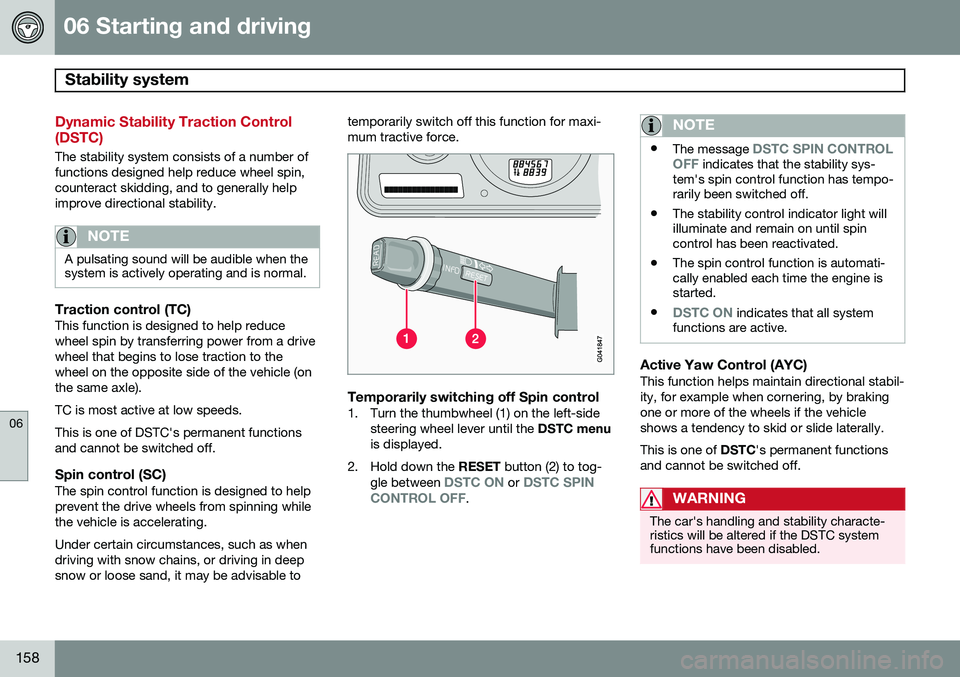
Temporarily switching off Spin control1. Turn the thumbwheel (1) on the left-side
steering wheel lever until the DSTC menu
is displayed.
2. Hold down the RESET button (2) to tog-
gle between
DSTC ON or DSTC SPIN
CONTROL OFF.
NOTE
• The message DSTC SPIN CONTROL
OFF indicates that the stability sys-
tem's spin control function has tempo- rarily been switched off.
• The stability control indicator light willilluminate and remain on until spincontrol has been reactivated.
• The spin control function is automati-cally enabled each time the engine isstarted.
•
DSTC ON indicates that all system
functions are active.
Active Yaw Control (AYC)This function helps maintain directional stabil- ity, for example when cornering, by brakingone or more of the wheels if the vehicleshows a tendency to skid or slide laterally. This is one of DSTC's permanent functions
and cannot be switched off.
WARNING
The car's handling and stability characte- ristics will be altered if the DSTC systemfunctions have been disabled.
Page 164 of 308
06 Starting and driving
Towing
06
162
G027042
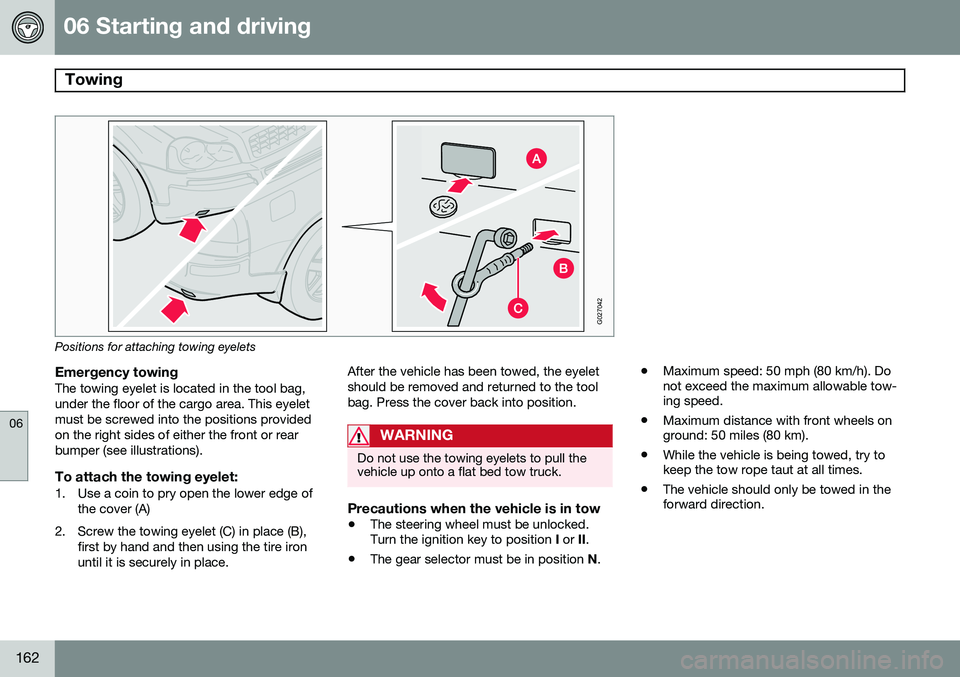
Positions for attaching towing eyelets
Emergency towingThe towing eyelet is located in the tool bag, under the floor of the cargo area. This eyeletmust be screwed into the positions providedon the right sides of either the front or rearbumper (see illustrations).
To attach the towing eyelet:1. Use a coin to pry open the lower edge ofthe cover (A)
2. Screw the towing eyelet (C) in place (B), first by hand and then using the tire ironuntil it is securely in place. After the vehicle has been towed, the eyeletshould be removed and returned to the toolbag. Press the cover back into position.
WARNING
Do not use the towing eyelets to pull the vehicle up onto a flat bed tow truck.
Precautions when the vehicle is in tow
•
The steering wheel must be unlocked. Turn the ignition key to position
I or II.
• The gear selector must be in position
N. •
Maximum speed: 50 mph (80 km/h). Donot exceed the maximum allowable tow-ing speed.
• Maximum distance with front wheels onground: 50 miles (80 km).
• While the vehicle is being towed, try tokeep the tow rope taut at all times.
• The vehicle should only be towed in theforward direction.
Page 165 of 308
06 Starting and driving
Towing
06
163
CAUTION
Vehicles with AWD (All Wheel Drive) with the front wheels off the ground should notbe towed at speeds above 50 mph(70 km/h) or for distances longer than30 miles (50 km).
CAUTION
•Please check with state and local authorities before attempting this typeof towing, as vehicles being towed aresubject to regulations regarding maxi-mum towing speed, length and type oftowing device, lighting, etc.
• If the vehicle's battery is dead, do notattempt to start the vehicle by pushingor pulling it as this will damage thethree-way catalytic converter(s). Theengine must be jump started using anauxiliary battery (see page 152).
• If the vehicle is being towed on a flatbed truck, the towing eyelets must notbe used to pull the vehicle up onto theflat bed or to secure the vehicle on theflat bed. Consult the tow truck opera-tor.
WARNING
•The power brakes and power steering will not function when the engine is notrunning. Approximately 5 times morepressure will be required on the brakepedal and the steering wheel will beconsiderably harder to turn.
• The towing eyelets must not be usedfor pulling the vehicle out of a ditch orfor any similar purpose involvingsevere strain.
G030862
Towing vehicles with front wheel drive/All Wheel Drive
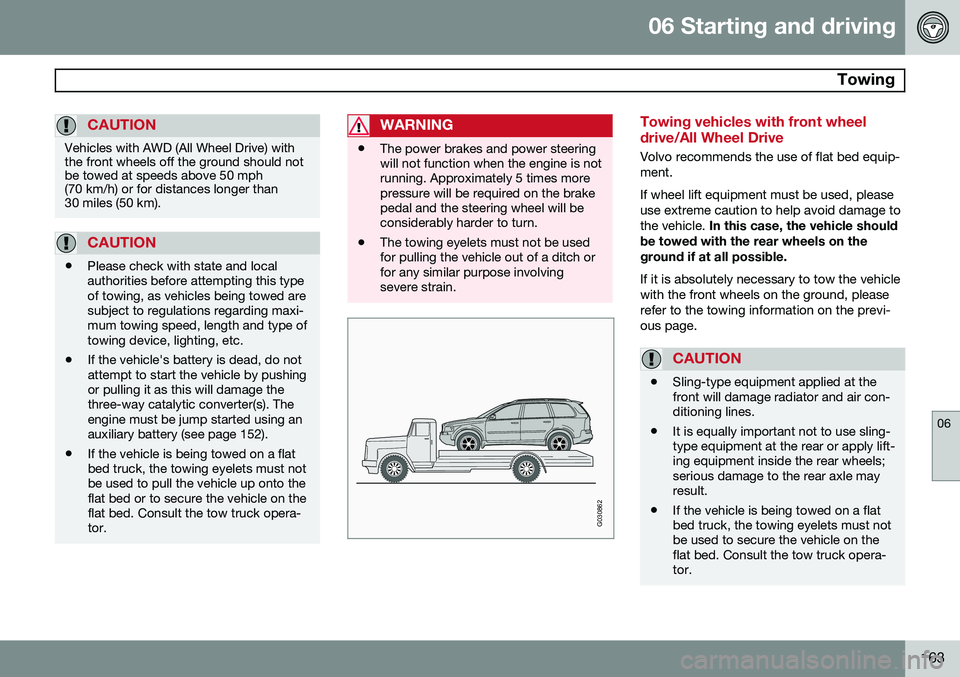
Volvo recommends the use of flat bed equip- ment. If wheel lift equipment must be used, please use extreme caution to help avoid damage tothe vehicle.
In this case, the vehicle should
be towed with the rear wheels on theground if at all possible. If it is absolutely necessary to tow the vehicle with the front wheels on the ground, pleaserefer to the towing information on the previ-ous page.
CAUTION
• Sling-type equipment applied at the front will damage radiator and air con-ditioning lines.
• It is equally important not to use sling-type equipment at the rear or apply lift-ing equipment inside the rear wheels;serious damage to the rear axle mayresult.
• If the vehicle is being towed on a flatbed truck, the towing eyelets must notbe used to secure the vehicle on theflat bed. Consult the tow truck opera-tor.
Page 172 of 308
06 Starting and driving
Before a long distance trip
06
170
It is always worthwhile to have your vehicle checked by a trained and qualified Volvoservice technician before driving long dis-tances. Your retailer or service technician willalso be able to supply you with bulbs, fuses,spark plugs and wiper blades for your use inthe event that problems occur. As a minimum, the following items should be checked before any long trip:• Check that engine runs smoothly and that fuel consumption is normal.
• Check for fuel, oil, and fluid leakage.
• Check transmission oil level 1
.
• Check condition of drive belts.
• Check state of the battery's charge.
• Examine tires carefully (the spare tire aswell), and replace those that are worn.Check tire pressures.
• The brakes, front wheel alignment, andsteering gear should be checked by atrained and qualified Volvo service techni-cian only.
• Check all lights, including high beams.
• Reflective warning triangles are legallyrequired in some states/provinces. •
Have a word with your Volvo retailer ifyou intend to drive in countries where itmay be difficult to obtain the correct fuel.
• Consider your destination. If you will bedriving through an area where snow or iceare likely to occur, consider snow tires.
1
To prevent injury from contact with hot surfaces, do not inspect your vehicle’s transmission fluid yourself. Have your vehicle’s transmission fluid level inspected by a qualified Volvo service techni- cian.
Page 196 of 308
07 Wheels and tires
Tire Sealing System
07
194
WARNING
•Never leave the tire sealing system unattended when it is operating.
• Keep the tire sealing system awayfrom children.
• Be sure the vehicle is parked safely offthe road and away from moving traffic.
• Apply the parking brake.
Stage 1: Sealing the hole1. Peel off the speed limit sticker and affix it
to the steering wheel hub where it will be clearly visible to the driver.
2. Ensure that the on/off switch is in position 0 (the 0 side of the switch should be
pressed down).
3. Put on the gloves included in the tire sealing system.
WARNING
Contact with the sealing compound may cause skin irritation. If contact occurs,wash the affected area immediately withsoap and water.
4. Unscrew the orange cover over the bottleholder and unscrew the cap on the bottle of sealing compound.
NOTE
Do not break the seal on the bottle. This occurs automatically when the bottle isscrewed into the holder.
5. Screw the bottle into the bottle holder.
WARNING
The bottle is equipped with a catch to keep it securely in place and help preventsealing compound leakage. Once in place,the bottle cannot be unscrewed. This mustbe done by a trained and qualified Volvoservice technician.
6. Remove the valve cap from the tire’sinflation valve and screw the tire sealing system’s hose connector onto the valveas tightly as possible by hand.
7. Connect the electrical wire to the nearest 12-volt socket in the vehicle.
NOTE
Be sure that none of the other 12-volt sockets is being used while the compres-sor is in operation.
8. Start the vehicle’s engine.
9. Start the tire sealing system’s compres- sor by pressing the on/off switch to posi- tion I.
WARNING
• Never stand next to the tire being infla- ted when the compressor is in opera-tion.
• If cracks, bubbles, etc. form on the tire,switch off the compressor immediately.
• If there is visible damage to the sidewallor the rim, the tire cannot be repaired.The vehicle should not be driven if thisoccurs. Contact a towing service orVolvo On Call Roadside Assistance ifapplicable.
Page 197 of 308
07 Wheels and tires
Tire Sealing System
07
195
NOTE
The air pressure gauge will temporarily show an increase in pressure to approxi-mately 88 psi (6 bar) while the sealingcompound is being pumped into the tire.The pressure should return to a normallevel after approximately 30 seconds.
10. Within seven minutes, inflate the tire tobetween 22—44 psi (1.8—3.0 bar). Switch off the compressor briefly to get aclear reading from the pressure gauge.
CAUTION
The compressor should not be used for more than 10 minutes at a time to avoidoverheating.
WARNING
If the pressure remains below 22 psi (1.8 bar) after approximately sevenminutes, turn off the compressor. In thiscase, the hole is too large to be sealed andthe vehicle should not be driven.
11. Switch off the compressor and discon-nect the electrical wire from the 12-volt socket. 12. Unscrew the hose from the tire’s inflation
valve and reinstall the valve cap.
CAUTION
•After pumping the tires, always reinstall the valve cap to help avoid damage tothe valve from dirt, gravel, etc.
• Use plastic valve caps only. Metal capscould corrode and become difficult toremove.
13. Immediately drive the vehicle for approxi-
mately 2 miles (3 km) at a maximum speed of 50 mph (80 km/h) to distributethe sealing compound in the tire.
CAUTION
If your vehicle is equipped with the Tire Pressure Monitoring System (TPMS), theuse of the sealing compound may lead toincorrect tire pressure readings or in rarecases, damage to the tire pressure sensor.Use the tire sealing system to check andadjust the damaged tire's inflation pres-sure.
NOTE
•Safely stow the tire sealing system in a convenient place as it will soon beused again to check the tire’s inflationpressure.
• The empty bottle of sealing compoundcannot be removed from the bottleholder. Consult a trained and qualifiedVolvo service technician to have thebottle removed and properly disposedof.
WARNING
If heavy vibrations, unsteady steering behavior, or noises should occur whiledriving, reduce speed and park the vehiclein a safe place. Recheck the tire forbumps, cracks, or other visible damage,and recheck its inflation pressure. If thepressure is below 19 psi (1.3 bar), do notcontinue driving. Have the vehicle towedto a trained and qualified Volvo servicetechnician.
Stage 2: Checking inflation pressure1. Connect the tire sealing system as
described in stage 1.
2. Refer to the inflation pressure tables for the correct inflation pressure. If the tire needs to be inflated, start the tire sealing
Page 206 of 308
07 Wheels and tires
Tire Pressure Monitoring System (TPMS)
07
204
properly. Always check the TPMS malfunc- tion telltale after replacing one or more tiresor wheels on your vehicle to ensure that thereplacement or alternate tires and wheelsallow the TPMS to continue to function prop-erly.
NOTE
TPMS indicates low tire pressure but does not replace normal tire maintenance. Forinformation on correct tire pressure, pleaserefer to the tire inflation pressure table inthis chapter or consult your Volvo retailer.
Erasing warning messagesWhen a low tire pressure warning message has been displayed, and the tire pressurewarning light has come on:
1. Use a tire pressure gauge to check theinflation pressure of all four tires.
2. Re-inflate the tire(s) to the correct pres- sure (consult the tire pressure placard or the table see page 183).
3. Drive the vehicle for several minutes at a speed of 20 mph (30 km/h) or faster.
> This will erase the warning text and thewarning light will go out.
WARNING
Incorrect inflation pressure could lead to tire failure, resulting in a loss of control ofthe vehicle.
Changing wheels with TPMSPlease note the following when changing or replacing the factory installed TPMS wheels/tires on the vehicle:
• Only the factory-mounted wheels are equipped with TPMS sensors in thevalves.
• If the vehicle is equipped with a tempo-rary spare tire, this tire does not have aTPMS sensor.
• If wheels without TPMS sensors are mounted on the vehicle,
TIRE PRESS
SYST. SERVICE REQUIRED will be dis-
played each time the vehicle is driven above 25 mph (40 km/h) for 10 minutes ormore.
• Once TPMS sensors are properly instal-led, the warning message should notreappear.
• Volvo recommends that TPMS sensorsbe fitted on all wheels used on the vehi-cle. Volvo does not recommend movingsensors back and forth between sets ofwheels.
NOTE
If a tire is changed or if the TPMS sensor is moved to another wheel, the sensor’svalve and valve core should be replaced.
CAUTION
When inflating tires with TPMS valves, press the pump's mouthpiece straightonto the valve to help avoid bending orotherwise damaging the valve.
Recalibrating TPMS (Canadian models only)
In certain cases, it may be necessary to reca- librate TPMS to conform to Volvo's recom-mended tire inflation pressures (see the infla-tion pressure table on page 183), for exam-ple, if higher inflation pressure is necessarywhen transporting heavy loads, etc. To recalibrate:
1. Switch off the engine.
2. Inflate the tires to the desired pressure
and turn the ignition key to position I or II
(see page 145 for additional information).
3. Turn the thumb wheel on the left-side steering wheel lever until
Tire pressure
Calibration appears in the display.
Page 207 of 308
07 Wheels and tires
Tire Pressure Monitoring System (TPMS)
07
* Option/accessory, for more information, see Introduction.205
4. Press and hold the
Reset button on the
left-side steering wheel lever until
TIRE
PRESSURE CALIBRATED is displayed.
Activating/deactivating TPMS (Canadian models only)
1. Switch off the engine.
2. Turn the ignition key to position I or II.
3. Press and hold the Reset button on the
left-side steering wheel lever until
TIRE
PRESS SYST OFF is displayed.
Repeat steps 1-3 to turn TPMS on again.
Self-supporting run flat tires (SST)*
Self-supporting run flat tires are available as optional equipment. The vehicle must beequipped with the Tire Pressure MonitoringSystem (TPMS) if tires of this type are instal-led. Tires of this type have specially reinforced sidewalls that make it possible to continuedriving to a limited extent even though the tirehas lost some or all of its inflation pressure.These tires are mounted on special rims (nor-mal tires can also be mounted on these rims). If an SST tire loses inflation pressure, the yel- low TPMS symbol illuminates in the instru-ment panel and a text message is also dis-played. If this happens, reduce speed to not more than 50 mph (80 km/h). The tire shouldbe replaced as soon as possible. Drive carefully; it may be difficult to determine which tire is damaged. To find the damagedtire, check the inflation pressure in all fourtires.
WARNING
•
SST tires should only be mounted by service technicians who are familiarwith tires of this type.
• SST tires may only be mounted onvehicles equipped with TPMS.
• Do not drive faster than 50 mph(80 km/h) if TPMS indicates that a tirehas lost inflation pressure.
• Do not drive farther than 50 miles(80 km) before replacing a damagedSST tire.
• Drive carefully and avoid e.g., hardbraking or fast turns.
• SST tires must be replaced if they aredamaged. A tire of this type cannot berepaired.