warning light VOLVO XC90 2014 Owner´s Manual
[x] Cancel search | Manufacturer: VOLVO, Model Year: 2014, Model line: XC90, Model: VOLVO XC90 2014Pages: 308, PDF Size: 13.31 MB
Page 97 of 308
03 Climate
Climate control system – general information
03
95
Climate system blower
The climate system blower will be automati- cally switched off when the engine is not run-ning (even if the ignition key is in position I or
II ) to avoid unnecessary battery drain. To
activate the blower, turn the control to thedesired setting. The climate system blower may start auto- matically during a period of up to approxi-mately 50 minutes after the ignition has beenturned off to remove condensation in the A/Cevaporator. It will run for 15 minutes andswitch off automatically.
Passenger compartment blower
Approximately 50 minutes after the ignition is turned off, the blower may come on automati-cally, and run for seven minutes, to removecondensation in the A/C evaporator.
Blower function to reduce battery drain
The climate system's blower functions nor- mally while the engine is running. However, when the engine is switched off (even if the ignition is switched to positions I
or II), the blower control will be automatically
switched off to avoid unnecessary batterydrain. The following points pertain if the ignition ison but the engine in not running:
• To restart the blower, turn the control knob to the setting of your choice.
• After approximately 2 minutes, the blowerspeed will be reduced to avoid batterydrain.
You can reset the blower speed at any time. Please be aware that the system has beendesigned to reduce the blower's speed againafter 2 minutes, until the engine is started. If the battery becomes drained: • LOW BATTERY, FAN IS REDUCED
will
be displayed in the text window in the instrument panel.
• The yellow warning light in the instrumentpanel (see page 58) will also light up.
Page 117 of 308
04 Interior
Storage compartments
04
* Option/accessory, for more information, see Introduction.115
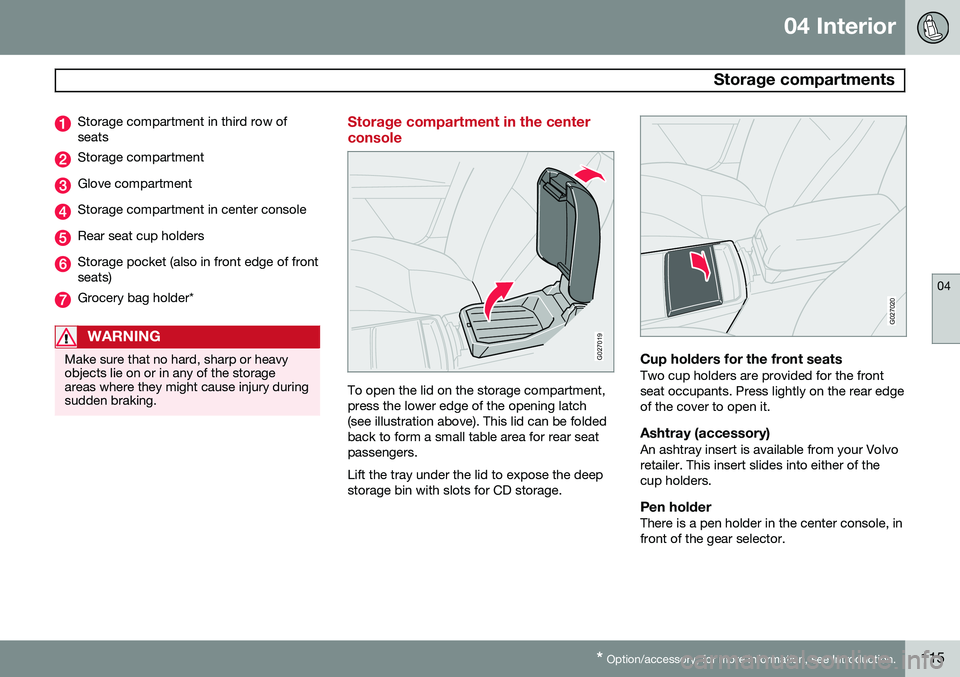
Storage compartment in third row of seats
Storage compartment
Glove compartment
Storage compartment in center console
Rear seat cup holders
Storage pocket (also in front edge of front seats)
Grocery bag holder*
WARNING
Make sure that no hard, sharp or heavy objects lie on or in any of the storageareas where they might cause injury duringsudden braking.
Storage compartment in the center console
G027019
To open the lid on the storage compartment, press the lower edge of the opening latch(see illustration above). This lid can be foldedback to form a small table area for rear seatpassengers. Lift the tray under the lid to expose the deep storage bin with slots for CD storage.
G027020
Cup holders for the front seatsTwo cup holders are provided for the front seat occupants. Press lightly on the rear edgeof the cover to open it.
Ashtray (accessory)An ashtray insert is available from your Volvoretailer. This insert slides into either of thecup holders.
Pen holderThere is a pen holder in the center console, infront of the gear selector.
Page 131 of 308
05 Locks and alarm
Remote keys and key blades
05
129
WARNING
Never use the transmitter to lock the doors from inside the vehicle.• Doing so would ACTIVATE:
• the break-in alarm, which would sound if one of the doors were opened
• the optional interior motion and incli-nation alarm sensors.
• Doing so would DEACTIVATE:
• the moonroof and interior courtesylight controls.
• the central locking buttons on the frontdoor armrests, although the interiordoor handles would still function toallow occupants to leave the vehicle.
• Disabled features would remain disa-bled until the remote is used again tounlock the vehicle.
• In addition, locking an occupied vehi-cle would hinder rapid access to theoccupants in an accident or emer-gency.
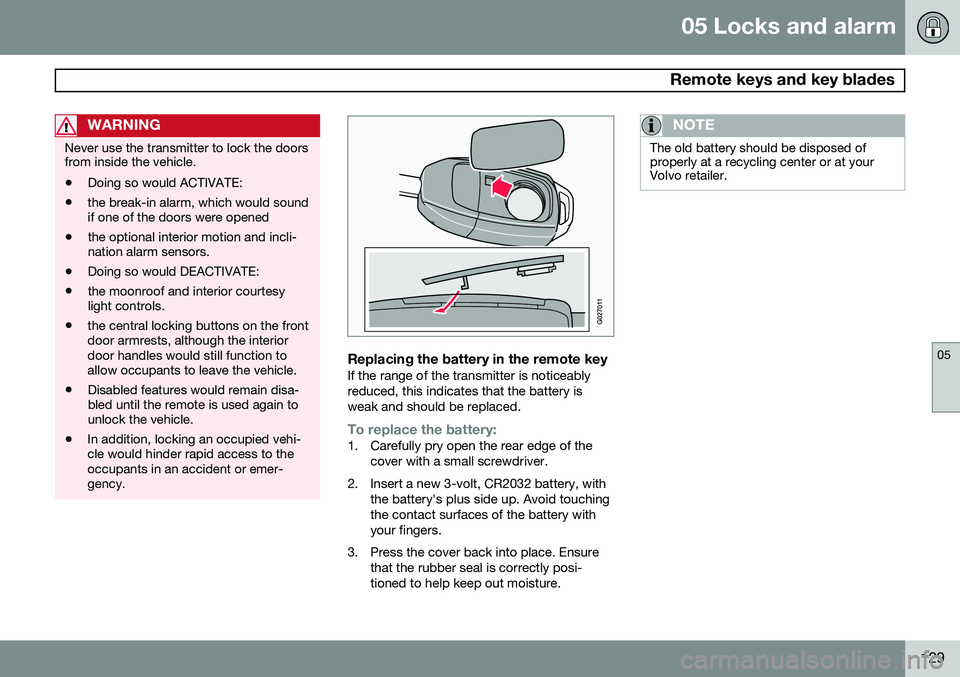
Replacing the battery in the remote keyIf the range of the transmitter is noticeably reduced, this indicates that the battery isweak and should be replaced.
To replace the battery:1. Carefully pry open the rear edge of the
cover with a small screwdriver.
2. Insert a new 3-volt, CR2032 battery, with the battery's plus side up. Avoid touching the contact surfaces of the battery withyour fingers.
3. Press the cover back into place. Ensure that the rubber seal is correctly posi-tioned to help keep out moisture.
NOTE
The old battery should be disposed of properly at a recycling center or at yourVolvo retailer.
Page 134 of 308
05 Locks and alarm
Child safety locks
05
132* Option/accessory, for more information, see Introduction.
G021513
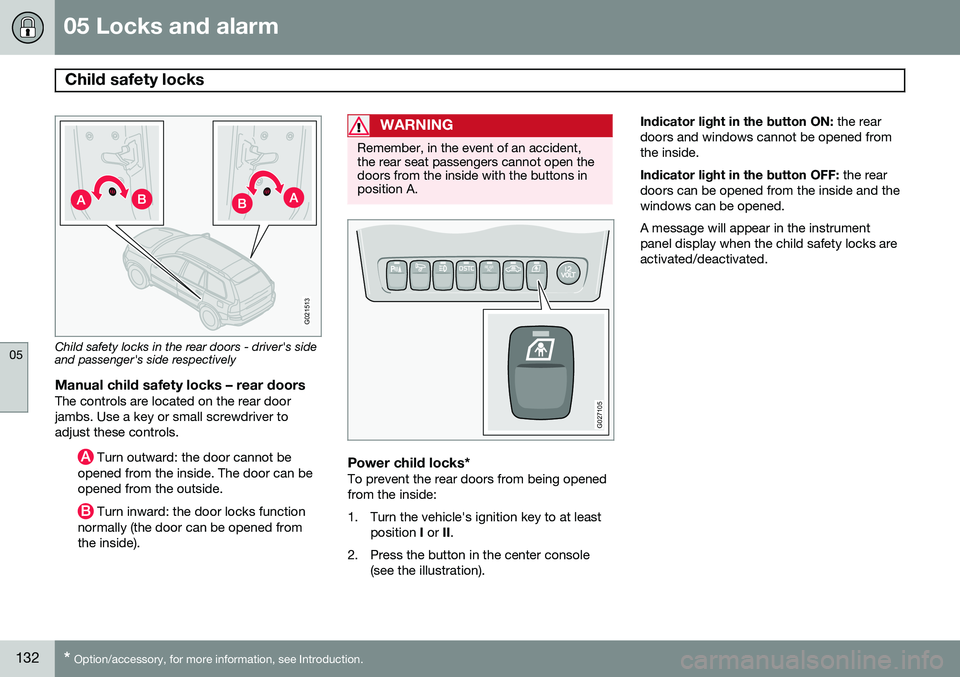
Child safety locks in the rear doors - driver's side and passenger's side respectively
Manual child safety locks – rear doorsThe controls are located on the rear door jambs. Use a key or small screwdriver toadjust these controls.
Turn outward: the door cannot be
opened from the inside. The door can be opened from the outside.
Turn inward: the door locks function
normally (the door can be opened from the inside).
WARNING
Remember, in the event of an accident, the rear seat passengers cannot open thedoors from the inside with the buttons inposition A.
REAR AC
G027105
Power child locks*To prevent the rear doors from being opened from the inside:
1. Turn the vehicle's ignition key to at least
position I or II.
2. Press the button in the center console (see the illustration). Indicator light in the button ON:
the rear
doors and windows cannot be opened from the inside. Indicator light in the button OFF: the rear
doors can be opened from the inside and the windows can be opened. A message will appear in the instrument panel display when the child safety locks areactivated/deactivated.
Page 143 of 308
06 Starting and driving
Refueling
06
141
Fuel filler door
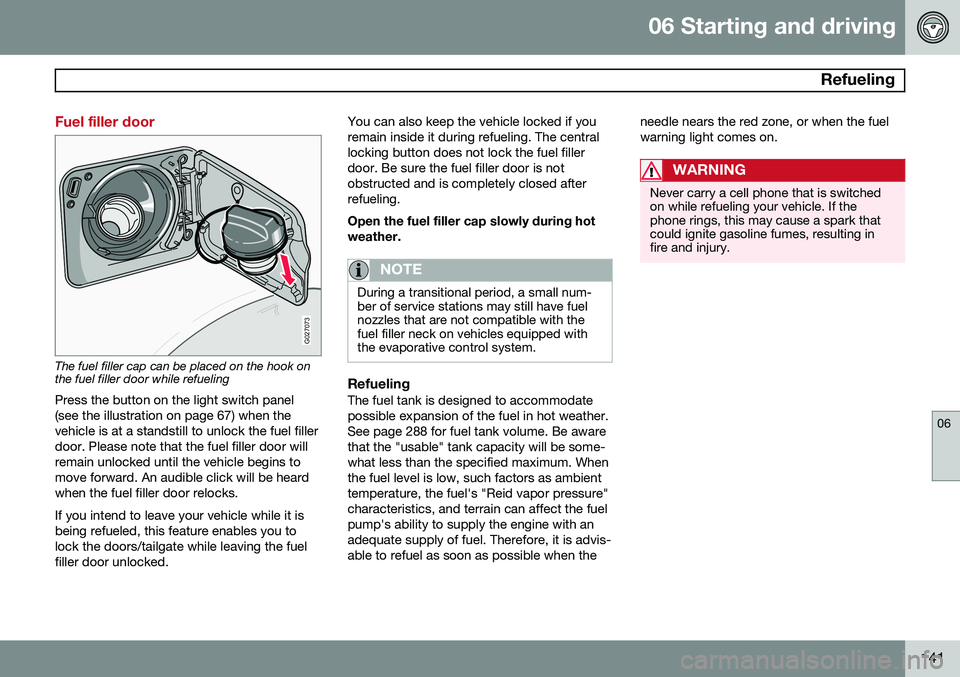
G027073
The fuel filler cap can be placed on the hook on the fuel filler door while refuelingPress the button on the light switch panel (see the illustration on page 67) when thevehicle is at a standstill to unlock the fuel fillerdoor. Please note that the fuel filler door willremain unlocked until the vehicle begins tomove forward. An audible click will be heardwhen the fuel filler door relocks. If you intend to leave your vehicle while it is being refueled, this feature enables you tolock the doors/tailgate while leaving the fuelfiller door unlocked. You can also keep the vehicle locked if youremain inside it during refueling. The centrallocking button does not lock the fuel fillerdoor. Be sure the fuel filler door is notobstructed and is completely closed afterrefueling. Open the fuel filler cap slowly during hot weather.
NOTE
During a transitional period, a small num- ber of service stations may still have fuelnozzles that are not compatible with thefuel filler neck on vehicles equipped withthe evaporative control system.
RefuelingThe fuel tank is designed to accommodate possible expansion of the fuel in hot weather.See page 288 for fuel tank volume. Be awarethat the "usable" tank capacity will be some-what less than the specified maximum. Whenthe fuel level is low, such factors as ambienttemperature, the fuel's "Reid vapor pressure"characteristics, and terrain can affect the fuelpump's ability to supply the engine with anadequate supply of fuel. Therefore, it is advis-able to refuel as soon as possible when the
needle nears the red zone, or when the fuelwarning light comes on.
WARNING
Never carry a cell phone that is switched on while refueling your vehicle. If thephone rings, this may cause a spark thatcould ignite gasoline fumes, resulting infire and injury.
Page 145 of 308

06 Starting and driving
Starting the vehicle
06
143
Starting the engine
WARNING
Before starting, check that the seat, steer- ing wheel and mirrors are adjusted prop-erly. Make sure the brake pedal can bedepressed completely. Adjust the seat ifnecessary, see page 104.
1. Fasten the seat belt.
2. Apply the parking brake (hand brake) ifnot already set. The gear selector is locked in the P position (SHIFTLOCK).
3. Without touching the accelerator pedal, turn the ignition key 1
to the starting posi-
tion. Allow the starter to operate for up to10 seconds. Release the key as soon as the engine starts 2
. If the engine fails to
start, repeat this step.
CAUTION
If the engine does not start after the third try, wait for approximately 3 minutesbefore trying to start it again to give thebattery time to recover its startingcapacity.
WARNING
• Never use more than one floor mat at a time on the driver's floor. An extramat on the driver's floor can cause theaccelerator and/or brake pedal tocatch. Check that the movement ofthese pedals is not impeded.
• Volvo's floor mats are specially manu-factured for your car. They must befirmly secured in the clips on the floorso that they cannot slide and becometrapped under the pedals on the driv-er's side.
NOTE
•If the key blade section of the remote is not fully folded out when starting thevehicle, the immobilizer function maymake it impossible to start the engine.
• After a cold start, idle speed may benoticeably higher than normal for ashort period. This is done to help bringcomponents in the emission controlsystem to their normal operating tem-perature as quickly as possible, whichenables them to control emissions andhelp reduce the vehicle's impact onthe environment.
• To release the gear selector from the
P
(Park) position, the engine must berunning (or the ignition key must be inposition II) and the brake pedal must
be depressed.
• Select the desired gear. The gearengages after a very slight delay whichis especially noticeable when selecting R.
1
If two of the keys to your vehicle are close together, e.g. on the same key ring when you try to start the vehicle, this could cause interference in the immobilizer system and result in the vehicle not starting. If this should occur, remove one of the keys from the key ring before trying to start the vehicle again.
2 On vehicles equipped with the autostart feature, release the key immediately. See also page 145.
Page 146 of 308
06 Starting and driving
Starting the vehicle
06
144
NOTE
Your vehicle is equipped with a KEYLOCK
system. When the engine is switched off, the gear selector must be in the P position
before the key can be removed from theignition switch. When starting in cold weather, the trans- mission may shift up at slightly higherengine speeds than normal until the auto-matic transmission fluid reaches normaloperating temperature.
NOTE
Do not race a cold engine immediately after starting. Oil flow may not reach somelubrication points fast enough to preventengine damage.
WARNING
Always place the gear selector in Park and apply the parking brake before leaving thevehicle. Never leave the vehicle unatten-ded with the engine running.
• Always open garage doors fully before starting the engine inside a garage toensure adequate ventilation. Theexhaust gases contain carbon monox-ide, which is invisible and odorless butvery poisonous.
CAUTION
Automatic transmission
• The engine should be idling when you move the gear selector. Never acceler-ate until after you feel the transmissionengage! Accelerating immediately afterselecting a gear will cause harshengagement and premature transmis-sion wear.
• Selecting
P or N when idling at a
standstill for prolonged periods of timewill help prevent overheating of theautomatic transmission fluid.
Page 147 of 308
06 Starting and driving
Ignition switch and steering wheel lock
06
145
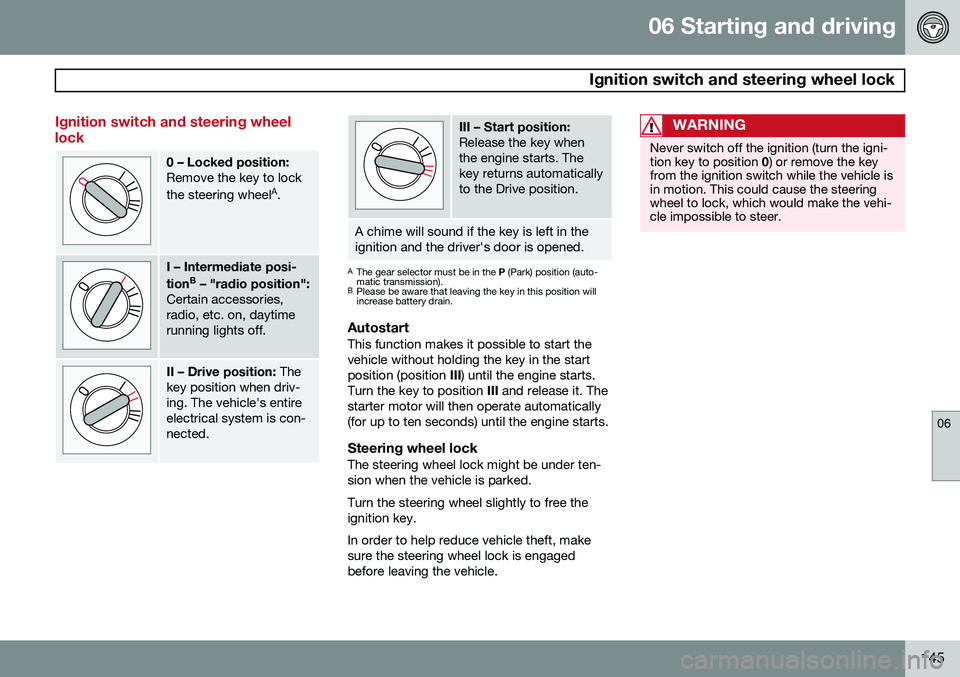
Ignition switch and steering wheel lock
0 – Locked position: Remove the key to lock the steering wheelA
.
I – Intermediate posi- tion B
– "radio position":
Certain accessories, radio, etc. on, daytimerunning lights off.
II – Drive position: The
key position when driv- ing. The vehicle's entireelectrical system is con-nected.
III – Start position: Release the key when the engine starts. Thekey returns automaticallyto the Drive position.
A chime will sound if the key is left in the ignition and the driver's door is opened.
A The gear selector must be in the P (Park) position (auto-
matic transmission).
B Please be aware that leaving the key in this position will increase battery drain.
AutostartThis function makes it possible to start the vehicle without holding the key in the startposition (position III) until the engine starts.
Turn the key to position III and release it. The
starter motor will then operate automatically(for up to ten seconds) until the engine starts.
Steering wheel lockThe steering wheel lock might be under ten-sion when the vehicle is parked. Turn the steering wheel slightly to free the ignition key. In order to help reduce vehicle theft, make sure the steering wheel lock is engagedbefore leaving the vehicle.
WARNING
Never switch off the ignition (turn the igni- tion key to position 0) or remove the key
from the ignition switch while the vehicle isin motion. This could cause the steeringwheel to lock, which would make the vehi-cle impossible to steer.
Page 149 of 308
06 Starting and driving
Difficult driving conditions
06
147
Driving on rough/unpaved surfaces
The Volvo XC90 is designed primarily for on- road driving, and it has excellent handlingcharacteristics on very rough or unpavedroads. When driving on poorly maintained or unpaved roads, please keep the following inmind:
• Reduce speed on rough surfaces to mini- mize possible damage to the vehicle'sunderbody.
• When driving on soft surfaces such as drysand or snow, try to avoid stopping if atall possible.
WARNING
•Avoid driving diagonally across steep inclines as this could increase the riskof a roll-over. Try to drive straight upor down the slope.
• If the road is very steep, avoid turningthe vehicle around to help avoid therisk of rolling over. Back the vehicle upor down the incline instead.
NOTE
Avoid driving on steep inclines if the fuel tank is nearly empty. If the flow of fuel tothe engine is interrupted due to the vehi-cle's angle of inclination, this could resultin damage to the three-way catalytic con-verter. We recommend keeping the fueltank at least half full when driving on steepinclines.
Driving through water
The vehicle can be driven through water up to a depth of approximately 16 inches (40 cm),at a maximum speed of 6 mph (10 km/h). Take particular care when driving through flowing water. Clean the electrical connections for trailer wir- ing after driving in mud or water. When driving through water, maintain low speed and do not stop in the water.
WARNING
• Avoid driving through standing or rushing water. Doing so can be dan-gerous and it may also be difficult todetermine the actual depth of thewater.
• If water cannot be avoided, after driv-ing through the water, press lightly onthe brake pedal to ensure that thebrakes are functioning normally. Wateror mud can make the brake liningsslippery, resulting in delayed brakingeffect.
Page 156 of 308
06 Starting and driving
Brake system
06
154* Option/accessory, for more information, see Introduction.
BRAKE Brake circuit malfunction
The brake system is a hydraulic system con- sisting of two master cylinders and two sepa-rate brake circuits. If a problem should occurin one of these circuits, it is still possible tostop the vehicle with the other brake circuit. If the brake pedal must be depressed farther than normal and requires greater foot pres-sure, the stopping distance will be longer. A warning light in the instrument panel will light up to warn the driver that a fault hasoccurred. If this light comes on while driving or braking, stop immediately and check the brake fluidlevel in the reservoir.
NOTE
Press the brake pedal hard and maintain pressure on the pedal – do not pump thebrakes.
WARNING
If the fluid level is below the MIN mark in
the reservoir or if a BRAKE FAILURE
STOP SAFELY message is displayed in
the text window: DO NOT DRIVE. Have
the vehicle towed to a trained and qualified Volvo service technician and have thebrake system inspected.
NOTE
When the vehicle is at a standstill and the engine is idling, e.g. at a traffic light andthe brake pedal is depressed, the pedalmay go down slightly. This is a normalfunction of the power-assisted brake sys-tem.
Brake pad inspectionOn vehicles equipped with a jack*, the condi- tion of the brake pads can be checked byraising the vehicle (see page 198 for informa-tion about using the jack and removing awheel) and performing a visual inspection ofthe brake pads.
WARNING
• If the vehicle has been driven immedi- ately prior to a brake pad inspection,the wheel hub, brake components,etc., will be very hot. Allow time forthese components to cool before car-rying out the inspection.
• Apply the parking brake and put thegear selector in the Park (
P) position.
• Block the wheels standing on theground, use rigid wooden blocks orlarge stones.