warning light VOLVO XC90 2014 Owner´s Manual
[x] Cancel search | Manufacturer: VOLVO, Model Year: 2014, Model line: XC90, Model: VOLVO XC90 2014Pages: 308, PDF Size: 13.31 MB
Page 174 of 308
06 Starting and driving
Blind Spot Information System*
06
172* Option/accessory, for more information, see Introduction.
When you pass another vehicle: The system reacts when you pass another vehicle at a speed of up to 6 mph (10 km/h)faster than that vehicle. When you are passed by another vehicle:The system reacts if your vehicle is passed by another vehicle at a speed of up to 43 mph(70 km/h) faster than your vehicle.
WARNING
• BLIS does not function in sharp curves.
• BLIS does not function when yourvehicle is backing up.
• If you are towing a wide trailer, thismay prevent the BLIS cameras fromdetecting other vehicles in adjacentlanes.
How BLIS functions in daylight and darkness
Daylight BLIS reacts to the
shape of surrounding vehi-
cles. The system is designed to help detect motor vehicles such as cars, trucks, buses,motorcycles, etc. Darkness BLIS reacts to the
headlights of surrounding
vehicles. In order to be detected by BLIS, a vehicle in the blind area must have its head-lights on. This means, for example, that thesystem will not detect a trailer without head-lights that is being towed behind a car ortruck.
WARNING
• BLIS does not react to cyclists or mopeds.
• BLIS does not react to vehicles thatare standing still.
• The BLIS cameras have the same limi-tation as the human eye. In otherwords, their "vision is impaired" byadverse weather conditions such asheavy snowfall, intense light directlyinto the camera, dense fog, etc.
Cleaning the BLIS camera lensesIn order to function optimally, the BLIS cam- era lenses must be kept clean. They can bewiped clean with a soft cloth or wet sponge.
CAUTION
• Clean the lenses carefully to avoid scratching.
• The lenses are electrically heated tohelp melt ice or snow. If necessary,gently brush away snow from the len-ses.
LimitationsIn certain situations, the BLIS indicator light(s) may illuminate even when there are no othervehicles in the area monitored by the system.
NOTE
If the BLIS indicator lights illuminate occa- sionally even when there are no other vehi-cles in the blind area, this does not indi-cate a fault in the system. In the event of a fault,
Blind spot syst.
service required will be displayed.
The following are several examples of situa- tions in which the BLIS indicator light(s) mayilluminate even when there are no other vehi-cles in the area monitored by the system.
Page 201 of 308
07 Wheels and tires
Changing wheels
07
199
WARNING
When raising or lowering the spare wheel, please keep in mind that components inthe exhaust system may be very hot.
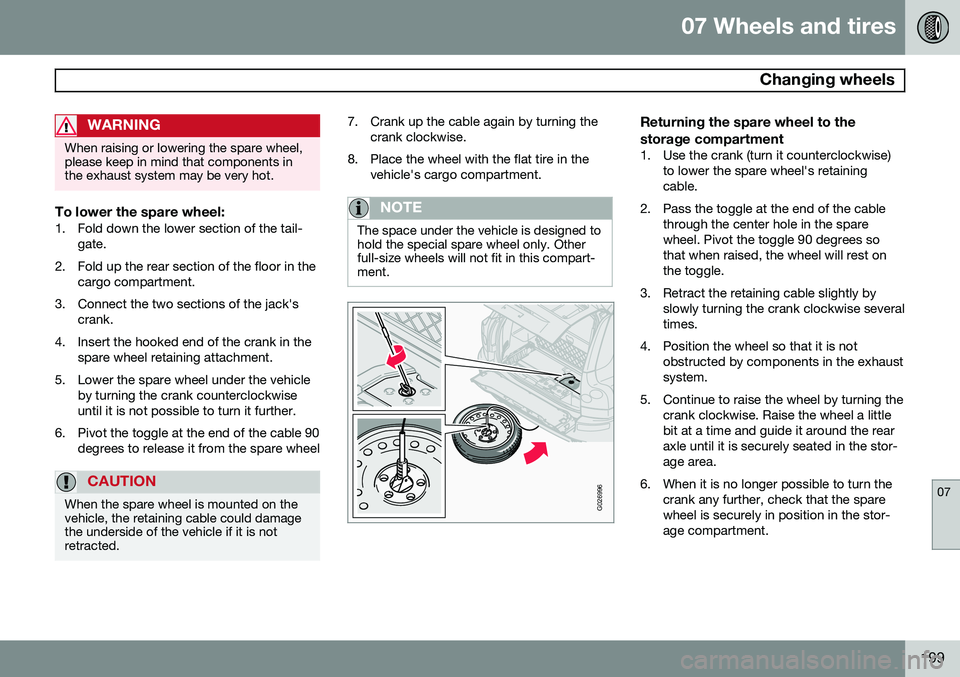
To lower the spare wheel:1. Fold down the lower section of the tail-gate.
2. Fold up the rear section of the floor in the cargo compartment.
3. Connect the two sections of the jack's crank.
4. Insert the hooked end of the crank in the spare wheel retaining attachment.
5. Lower the spare wheel under the vehicle by turning the crank counterclockwise until it is not possible to turn it further.
6. Pivot the toggle at the end of the cable 90 degrees to release it from the spare wheel
CAUTION
When the spare wheel is mounted on the vehicle, the retaining cable could damagethe underside of the vehicle if it is notretracted.
7. Crank up the cable again by turning thecrank clockwise.
8. Place the wheel with the flat tire in the vehicle's cargo compartment.
NOTE
The space under the vehicle is designed to hold the special spare wheel only. Otherfull-size wheels will not fit in this compart-ment.
G026996
Returning the spare wheel to the storage compartment
1. Use the crank (turn it counterclockwise) to lower the spare wheel's retaining cable.
2. Pass the toggle at the end of the cable through the center hole in the sparewheel. Pivot the toggle 90 degrees sothat when raised, the wheel will rest onthe toggle.
3. Retract the retaining cable slightly by slowly turning the crank clockwise severaltimes.
4. Position the wheel so that it is not obstructed by components in the exhaustsystem.
5. Continue to raise the wheel by turning the crank clockwise. Raise the wheel a littlebit at a time and guide it around the rearaxle until it is securely seated in the stor-age area.
6. When it is no longer possible to turn the crank any further, check that the sparewheel is securely in position in the stor-age compartment.
Page 205 of 308
07 Wheels and tires
Tire Pressure Monitoring System (TPMS)
07
203
The tire pressure monitoring system
1
uses
sensors mounted in the tire valves to check inflation pressure levels. When the vehicle ismoving at a speed of approximately 20 mph(30 km/h) or faster, these sensors transmitinflation pressure data to a receiver located inthe vehicle.
USA – FCC ID: MRXG403MA4 A
This device complies with part 15 of the
FCC rules. Operation is subject to the fol- lowing conditions: (1) This device may notcause harmful interference, and (2) thisdevice must accept any interferencereceived, including interference that maycause undesired operation. When low inflation pressure is detected, TPMS will light up the tire pressure warn-ing light (also referred to as a telltale) in theinstrument panel (see page 61), and willdisplay a message in the text window. Thewording of this message is determined bythe degree of inflation pressure loss.
A On certain models, the FCC code is MRXTG315AM04
When low inflation pressure is detected, TPMS will light up the tire pressure warning light
(also referred to as a telltale) in the instrument panel and will display one of the following messages in the text window:
LOW
TIRE PRESS. CHECK TIRES or VERY LOW
TIRE PRESSURE.
NOTE
If a fault occurs in TPMS, the tire pressure warning light will flash for approximately 1 minute and
TIRE PRESS SYST
SERVICE REQUIRED will be displayed.
Each tire, including the spare (if provided), should be checked monthly when cold andinflated to the inflation pressure recom-mended by the vehicle manufacturer on thevehicle placard or tire inflation pressure label.(If your vehicle has tires of a different sizethan the size indicated on the vehicle placardor tire inflation pressure label, you shoulddetermine the proper tire inflation pressure forthose tires.) As an added safety feature, your vehicle has been equipped with a tire pressure monitor-ing system (TPMS) that illuminates a low tirepressure telltale when one or more of yourtires is significantly under-inflated. Accord-ingly, when the low tire pressure telltale illu-minates, you should stop and check yourtires as soon as possible, and inflate them to the proper pressure. Driving on a significantlyunder-inflated tire causes the tire to overheatand can lead to tire failure. Under-inflationalso reduces fuel efficiency and tire tread life,and may affect the vehicle's handling andstopping ability. Please note that the TPMS is not a substitute for proper tire maintenance, and it is the driv-er's responsibility to maintain correct tirepressure, even if under-inflation has notreached the level to trigger illumination of theTPMS low tire pressure telltale. Your vehicle has also been equipped with a TPMS malfunction indicator to indicate whenthe system is not operating properly. TheTPMS malfunction indicator is combined withthe low tire pressure telltale. When the sys-tem detects a malfunction, the telltale willflash for approximately one minute and thenremain continuously illuminated. Thissequence will continue upon subsequentvehicle start-ups as long as the malfunctionexists. When the malfunction indicator is illu-minated, the system may not be able todetect or signal low tire pressure as intended.TPMS malfunctions may occur for a variety ofreasons, including the installation of replace-ment or alternate tires or wheels on the vehi-cle that prevent the TPMS from functioning
1
This system is standard on U.S. models and optional on Canadian models
Page 206 of 308
07 Wheels and tires
Tire Pressure Monitoring System (TPMS)
07
204
properly. Always check the TPMS malfunc- tion telltale after replacing one or more tiresor wheels on your vehicle to ensure that thereplacement or alternate tires and wheelsallow the TPMS to continue to function prop-erly.
NOTE
TPMS indicates low tire pressure but does not replace normal tire maintenance. Forinformation on correct tire pressure, pleaserefer to the tire inflation pressure table inthis chapter or consult your Volvo retailer.
Erasing warning messagesWhen a low tire pressure warning message has been displayed, and the tire pressurewarning light has come on:
1. Use a tire pressure gauge to check theinflation pressure of all four tires.
2. Re-inflate the tire(s) to the correct pres- sure (consult the tire pressure placard or the table see page 183).
3. Drive the vehicle for several minutes at a speed of 20 mph (30 km/h) or faster.
> This will erase the warning text and thewarning light will go out.
WARNING
Incorrect inflation pressure could lead to tire failure, resulting in a loss of control ofthe vehicle.
Changing wheels with TPMSPlease note the following when changing or replacing the factory installed TPMS wheels/tires on the vehicle:
• Only the factory-mounted wheels are equipped with TPMS sensors in thevalves.
• If the vehicle is equipped with a tempo-rary spare tire, this tire does not have aTPMS sensor.
• If wheels without TPMS sensors are mounted on the vehicle,
TIRE PRESS
SYST. SERVICE REQUIRED will be dis-
played each time the vehicle is driven above 25 mph (40 km/h) for 10 minutes ormore.
• Once TPMS sensors are properly instal-led, the warning message should notreappear.
• Volvo recommends that TPMS sensorsbe fitted on all wheels used on the vehi-cle. Volvo does not recommend movingsensors back and forth between sets ofwheels.
NOTE
If a tire is changed or if the TPMS sensor is moved to another wheel, the sensor’svalve and valve core should be replaced.
CAUTION
When inflating tires with TPMS valves, press the pump's mouthpiece straightonto the valve to help avoid bending orotherwise damaging the valve.
Recalibrating TPMS (Canadian models only)
In certain cases, it may be necessary to reca- librate TPMS to conform to Volvo's recom-mended tire inflation pressures (see the infla-tion pressure table on page 183), for exam-ple, if higher inflation pressure is necessarywhen transporting heavy loads, etc. To recalibrate:
1. Switch off the engine.
2. Inflate the tires to the desired pressure
and turn the ignition key to position I or II
(see page 145 for additional information).
3. Turn the thumb wheel on the left-side steering wheel lever until
Tire pressure
Calibration appears in the display.
Page 211 of 308
08 Car care
Washing and cleaning the vehicle
08
209
Exterior componentsVolvo recommends the use of special clean- ing products, available at your Volvo retailer,for cleaning colored plastic, rubber, or orna-mental components such as chromed stripson the exterior of your vehicle. The instruc-tions for using these products should be fol-lowed carefully. Solvents or stain removersshould not be used.
CAUTION
•Avoid waxing or polishing plastic or rubber components
• Polishing chromed strips can wearaway or damage the surface
• Polishes containing abrasive sub-stances should not be used
NOTE
When washing the vehicle, remember to remove dirt from the drain holes in thedoors and sills.
WARNING
•When the vehicle is driven immediately after being washed, apply the brakesseveral times in order to remove anymoisture from the brake linings.
• Engine cleaning agents should not beused when the engine is warm. Thisconstitutes a fire risk.
Automatic washing – simple and quick
•
We do NOT recommend washing your vehicle in an automatic wash during thefirst few months (because the paint willnot have hardened sufficiently).
• An automatic wash is a simple and quickway to clean your vehicle, but it is worthremembering that it may not be as thor-ough as when you yourself go over thevehicle with sponge and water. Keepingthe underbody clean is most important,especially in the winter. Some automaticwashers do not have facilities for washingthe underbody.
• Before driving into an automatic carwash, make sure that side view mirrors,auxiliary lamps, etc, are secure, and thatany antenna(s) are retracted or removed.Otherwise there is risk of the machinedislodging them.
Exterior lightingCondensation may form temporarily on the inside of the lenses of exterior lights such asheadlights, fog lights, or tail lights. This is nor-mal and the lights are designed to withstandmoisture. Normally, condensation will dissi-pate after the lights have been on for a shorttime.
Polishing and waxing
•
Normally, polishing is not required during the first year after delivery, however, wax-ing may be beneficial.
• Before applying polish or wax the vehiclemust be washed and dried. Tar spots canbe removed with kerosene or tar remover.Difficult spots may require a fine rubbingcompound.
• After polishing use liquid or paste wax.
• Several commercially available productscontain both polish and wax.
• Waxing alone does not substitute for pol-ishing a dull surface.
• A wide range of polymer-based carwaxes can be purchased today. Thesewaxes are easy to use and produce along-lasting, high-gloss finish that pro-
Page 229 of 308
09 Maintenance and servicing
Battery09
227
Battery maintenance
The battery in your vehicle is located under the floor of the cargo compartment. Driving habits and conditions, climate, the number of starts, etc. all affect the service lifeand function of the battery. In order for yourbattery to perform satisfactorily, keep the fol-lowing in mind:
• Use a screw driver to open the caps or cover and a flashlight to inspect the level.
• If necessary, add distilled water. The levelshould never be above the indicator.
• The fluid level should be checked if thebattery has been recharged.
• After inspection, be sure the cap overeach battery cell or the cover is securelyin place.
• Check that the battery cables are cor-rectly connected and properly tightened.
• Never disconnect the battery when theengine is running, or when the key is inthe ignition. This could damage the vehi-cle's electrical system.
• The battery should be disconnected fromthe vehicle when a battery charger isused directly on the battery.
• To help keep the battery in good condi-tion, the vehicle should be driven for atleast 15 minutes a week or connected to a charger with an automatic chargingfunction.
• If the battery is fully discharged a numberof times, this may shorten its service life.Keeping the battery fully charged helpsprolong its service life.
• The service life of a battery is affected byfactors such as driving conditions and cli-mate. Extreme cold may also furtherdecrease the battery’s starting capacity.
• Because the battery’s starting capacitydecreases with time, it may be necessaryto recharge it if the vehicle is not drivenfor an extended period of time or if thevehicle is usually only driven short dis-tances.
•
WARNING
PROPOSITION 65 WARNING! Battery posts, terminals, and related accessories contain lead and lead com-pounds, chemicals known to the state ofCalifornia to cause cancer and reproduc-tive harm. Wash hands after handling.
WARNING
• Never expose the battery to open flame or electric spark.
• Do not smoke near the battery.
• Battery fluid contains sulfuric acid. Donot allow battery fluid to contact eyes,skin, fabrics or painted surfaces. Ifcontact occurs, flush the affected areaimmediately with water. Obtain medi-cal help immediately if eyes are affec-ted.
NOTE
Used batteries should be properly dis- posed of at a recycling station or similarfacility, or taken to your Volvo retailer.
Page 231 of 308
09 Maintenance and servicing
Battery09
229
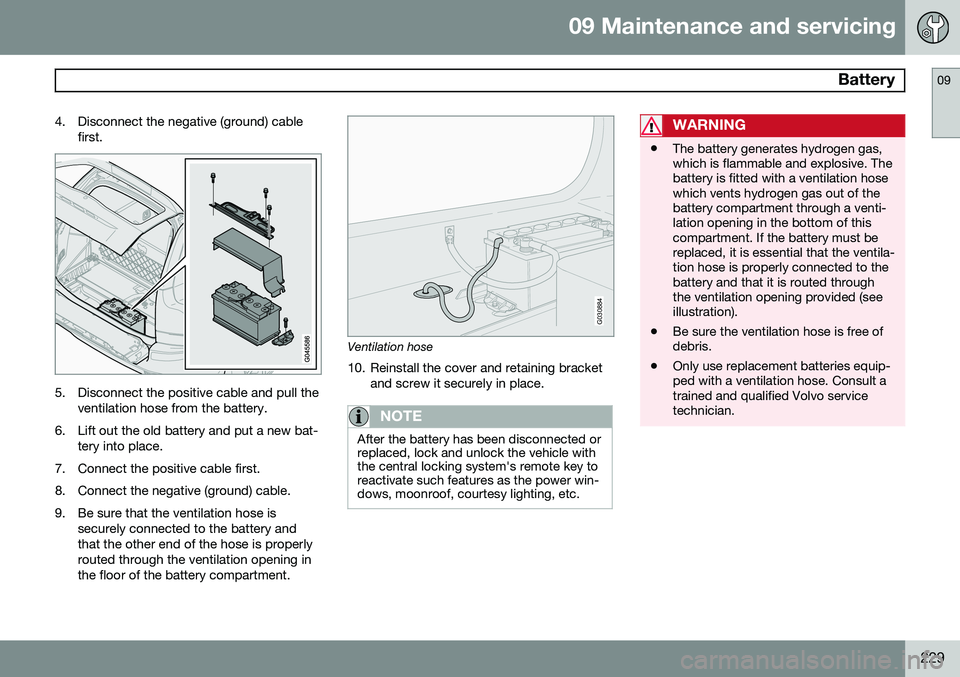
4. Disconnect the negative (ground) cable
first.
5. Disconnect the positive cable and pull theventilation hose from the battery.
6. Lift out the old battery and put a new bat- tery into place.
7. Connect the positive cable first.
8. Connect the negative (ground) cable.
9. Be sure that the ventilation hose is securely connected to the battery and that the other end of the hose is properlyrouted through the ventilation opening inthe floor of the battery compartment.
G030884
Ventilation hose
10. Reinstall the cover and retaining bracket and screw it securely in place.
NOTE
After the battery has been disconnected or replaced, lock and unlock the vehicle withthe central locking system's remote key toreactivate such features as the power win-dows, moonroof, courtesy lighting, etc.
WARNING
•The battery generates hydrogen gas, which is flammable and explosive. Thebattery is fitted with a ventilation hosewhich vents hydrogen gas out of thebattery compartment through a venti-lation opening in the bottom of thiscompartment. If the battery must bereplaced, it is essential that the ventila-tion hose is properly connected to thebattery and that it is routed throughthe ventilation opening provided (seeillustration).
• Be sure the ventilation hose is free ofdebris.
• Only use replacement batteries equip-ped with a ventilation hose. Consult atrained and qualified Volvo servicetechnician.
Page 232 of 308
09 Maintenance and servicing
Replacing bulbs 09
230* Option/accessory, for more information, see Introduction.
When replacing bulbs, keep the following points in mind:
• Never touch the glass of bulbs with your fingers. Grease and oils from your fingersvaporize in the heat and will leave adeposit on the reflector, which will dam-age it.
• The optional Active Bending Light bulbscontain trace amounts of mercury. Thesebulbs should always be disposed of by anauthorized Volvo retailer.
The following bulbs should only be replaced by a trained and qualified Volvo service tech-nician:
• Active Bending Lights (ABL)
• Daytime running lights (DRL) under the front bumper
• Turn signals and courtesy lights in theside door mirrors
• Reading lights and glove compartmentlight
• Courtesy (dome) lighting
• Rear parking lights
• Brake lights
• High-mounted brake lights
If a problem occurs with the daytime running lights (DRL) under the front bumper, the entirelamp housing will have to be replaced. If a problem occurs with the rear parkinglights or the brake lights, the entire taillighthousing will have to be replaced. See page 236 for a list of bulb specifications.
Replacing high/low beams/turn signal/parking light bulbs
WARNING
•
The engine should not be running when changing bulbs.
• If the engine has been running justprior to replacing bulbs in the head-light housing, please keep in mind thatcomponents in the engine compart-ment will be hot.
WARNING
Active Bending Lights* - due to the high voltage used by these headlights, thesebulbs should only be replaced by a trainedand qualified Volvo service technician.
G027081
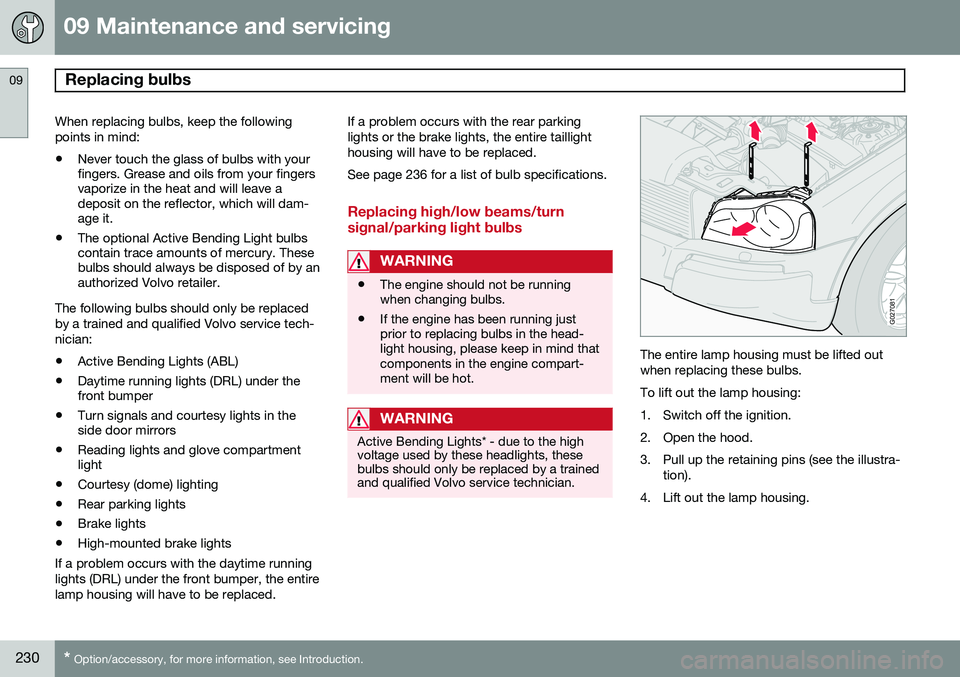
The entire lamp housing must be lifted out when replacing these bulbs. To lift out the lamp housing:
1. Switch off the ignition.
2. Open the hood.
3. Pull up the retaining pins (see the illustra-
tion).
4. Lift out the lamp housing.
Page 296 of 308
11 Specifications
Overview of information and warning symbols
11
294
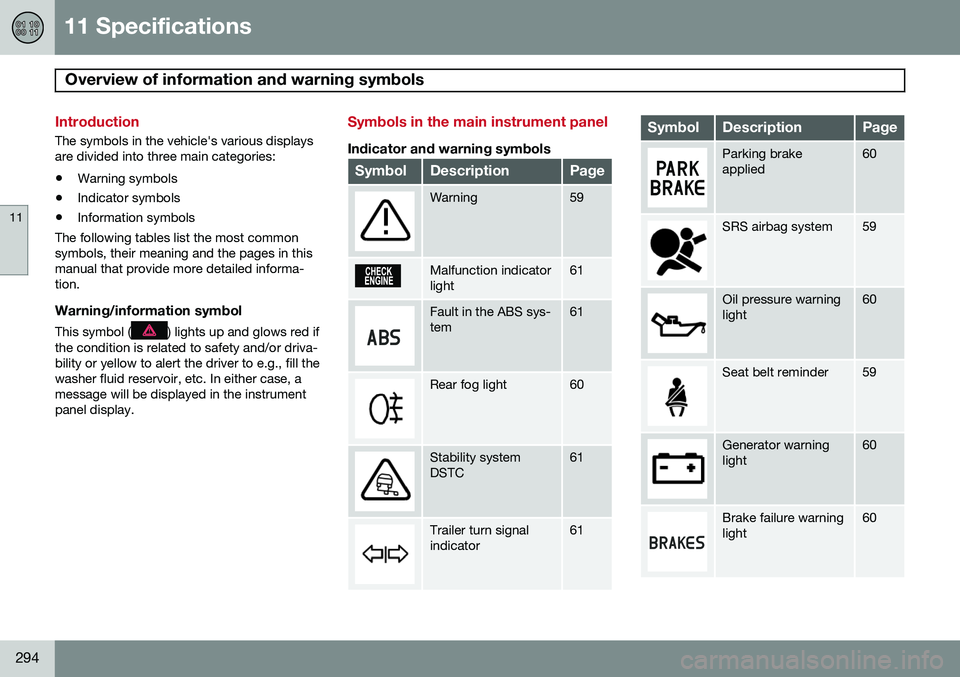
Introduction
The symbols in the vehicle's various displays are divided into three main categories:• Warning symbols
• Indicator symbols
• Information symbols
The following tables list the most commonsymbols, their meaning and the pages in thismanual that provide more detailed informa-tion.
Warning/information symbol
This symbol () lights up and glows red if
the condition is related to safety and/or driva- bility or yellow to alert the driver to e.g., fill thewasher fluid reservoir, etc. In either case, amessage will be displayed in the instrumentpanel display.
Symbols in the main instrument panel
Indicator and warning symbols
SymbolDescriptionPage
Warning59
Malfunction indicator light61
Fault in the ABS sys- tem61
Rear fog light60
Stability system DSTC61
Trailer turn signal indicator61
SymbolDescriptionPage
Parking brake applied60
SRS airbag system59
Oil pressure warning light60
Seat belt reminder59
Generator warning light60
Brake failure warning light60
Page 300 of 308
12 Index
12
298
1, 2, 3 ...
12-volt sockets.......................................... 80
A
A/C (air conditioning)........................... 98, 99
ABS.......................................................... 155Accessory installation warning.................. 14
Airbag system............................................ 23
Air cleaner................................................ 221
Air conditioning.......................................... 94
Air distribution...................................... 96, 99
Air quality sensor....................................... 98
Air vents..................................................... 96
Alarm........................................................ 133
All Wheel Drive......................................... 153
All Wheel Drive – towing.......................... 163Anti-lock brake system warning light......................................... 60
Anti-lock Brake System (ABS)................. 155
Ashtray..................................................... 115 Audio
system introduction............................ 252
Audio system Bluetooth streaming audio................. 268
HD digital radio................................... 260SiriusXM ™ satellite radio.................... 263
AUTO (climate control)....................... 99, 100
Automatic locking retractor....................... 39
Automatic transmission........................... 149 shiftlock override.................................. 23
Autostart.......................................... 143, 145
AUX (audio system)................................. 267
Average speed........................................... 76
AWD......................................................... 153
B
Bass......................................................... 255
Battery..................................................... 219 maintenance....................................... 227
specifications...................................... 292
Battery – replacing................................... 228
Belt check................................................ 220
Blind Spot Information System (BLIS)..... 171 Blower (fan).............................................. 100
Bluetooth cell phone connection............. 274Booster cushion
accessory............................................. 48
integrated.............................................. 52
Brake fluid................................................ 225
Brake system........................................... 154 Brake pad inspection.......................... 154
Bulbs........................................................ 230 specifications...................................... 236
Bulbs, replacing....................................... 230
C
Capacities, fluids..................................... 288
Capacity weight....................................... 187
Cargo area cover..................................... 122
Cargo grid................................................ 121
Cargo net................................................. 119
Catalytic converter, three-way................. 293
CD Pause................................................. 270
Cell phone, hands-free connection......... 274
Center console buttons............................. 64