belt VOLVO XC90 2014 Owner´s Manual
[x] Cancel search | Manufacturer: VOLVO, Model Year: 2014, Model line: XC90, Model: VOLVO XC90 2014Pages: 308, PDF Size: 13.31 MB
Page 59 of 308
02 Instruments and controls
Instrument overview
02
* Option/accessory, for more information, see Introduction.57
Headlights/Parking lights
Panel vents
Display
Temperature gauge
Odometer/Trip odometer/Cruise control indicator
Speedometer
Turn signal indicator lights
Tachometer
Ambient temperature gauge, clock, gear indicator
Fuel gauge
Indicator and warning symbols
Panel vents
Glove compartment
Hazard warning flashers
Audio system
Climate system controls
Windshield wiper/washer lever
Audio control buttons in steering wheel
Instrument panel
Horn
Cruise control buttons in steering wheel
Turn signals, High/low beams, READ-
button
Parking brake pedal
Parking brake release handle
Reading lights
Courtesy light
Moonroof control*
Seat belt reminder
Rearview mirror
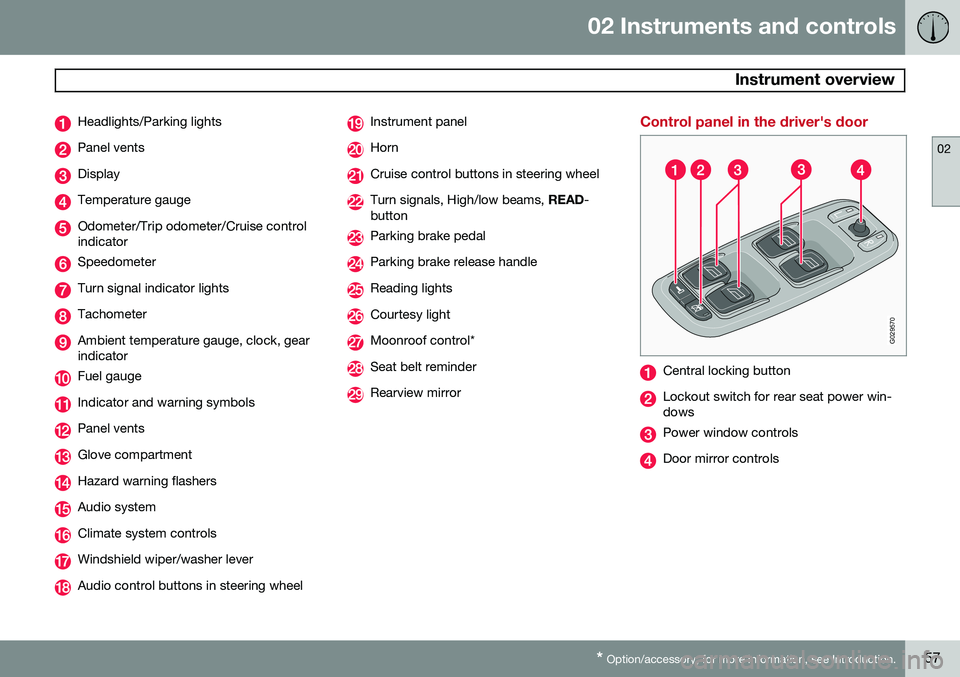
Control panel in the driver's door
G029570
Central locking button
Lockout switch for rear seat power win- dows
Power window controls
Door mirror controls
Page 62 of 308
02 Instruments and controls
Instrument panel
02
60
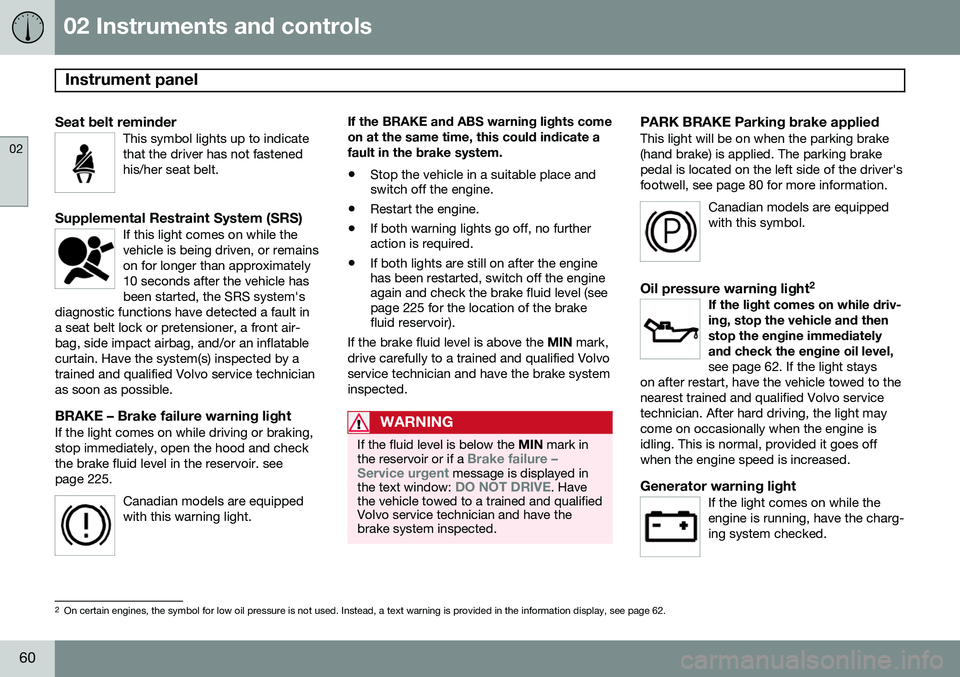
Seat belt reminderThis symbol lights up to indicate that the driver has not fastenedhis/her seat belt.
Supplemental Restraint System (SRS)If this light comes on while the vehicle is being driven, or remainson for longer than approximately10 seconds after the vehicle hasbeen started, the SRS system's
diagnostic functions have detected a fault ina seat belt lock or pretensioner, a front air-bag, side impact airbag, and/or an inflatablecurtain. Have the system(s) inspected by atrained and qualified Volvo service technicianas soon as possible.
BRAKE – Brake failure warning lightIf the light comes on while driving or braking, stop immediately, open the hood and checkthe brake fluid level in the reservoir. seepage 225.
Canadian models are equippedwith this warning light.
If the BRAKE and ABS warning lights come on at the same time, this could indicate afault in the brake system.
• Stop the vehicle in a suitable place and switch off the engine.
• Restart the engine.
• If both warning lights go off, no furtheraction is required.
• If both lights are still on after the enginehas been restarted, switch off the engineagain and check the brake fluid level (seepage 225 for the location of the brakefluid reservoir).
If the brake fluid level is above the MIN mark,
drive carefully to a trained and qualified Volvo service technician and have the brake systeminspected.
WARNING
If the fluid level is below the MIN mark in
the reservoir or if a Brake failure –
Service urgent message is displayed in
the text window: DO NOT DRIVE. Have
the vehicle towed to a trained and qualified Volvo service technician and have thebrake system inspected.
PARK BRAKE Parking brake appliedThis light will be on when the parking brake (hand brake) is applied. The parking brakepedal is located on the left side of the driver'sfootwell, see page 80 for more information.
Canadian models are equippedwith this symbol.
Oil pressure warning light 2If the light comes on while driv- ing, stop the vehicle and thenstop the engine immediatelyand check the engine oil level, see page 62. If the light stays
on after restart, have the vehicle towed to the nearest trained and qualified Volvo servicetechnician. After hard driving, the light maycome on occasionally when the engine isidling. This is normal, provided it goes offwhen the engine speed is increased.
Generator warning lightIf the light comes on while the engine is running, have the charg-ing system checked.
2 On certain engines, the symbol for low oil pressure is not used. Instead, a text warning is provided in the information display, see page 62.
Page 111 of 308
04 Interior
Rear seats
04
109
G027015
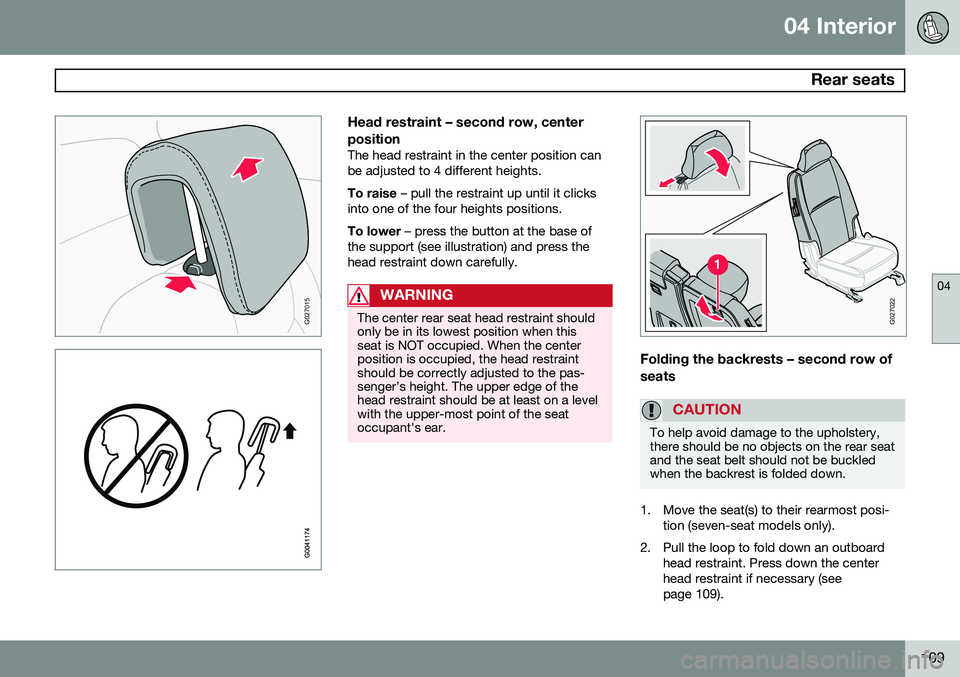
Head restraint – second row, center position
The head restraint in the center position can be adjusted to 4 different heights. To raise – pull the restraint up until it clicks
into one of the four heights positions.To lower – press the button at the base of
the support (see illustration) and press the head restraint down carefully.
WARNING
The center rear seat head restraint should only be in its lowest position when thisseat is NOT occupied. When the centerposition is occupied, the head restraintshould be correctly adjusted to the pas-senger’s height. The upper edge of thehead restraint should be at least on a levelwith the upper-most point of the seatoccupant's ear.G027022
Folding the backrests – second row of seats
CAUTION
To help avoid damage to the upholstery, there should be no objects on the rear seatand the seat belt should not be buckledwhen the backrest is folded down.
1. Move the seat(s) to their rearmost posi- tion (seven-seat models only).
2. Pull the loop to fold down an outboard head restraint. Press down the center head restraint if necessary (seepage 109).
Page 121 of 308
04 Interior
Securing cargo
04
119
G027031
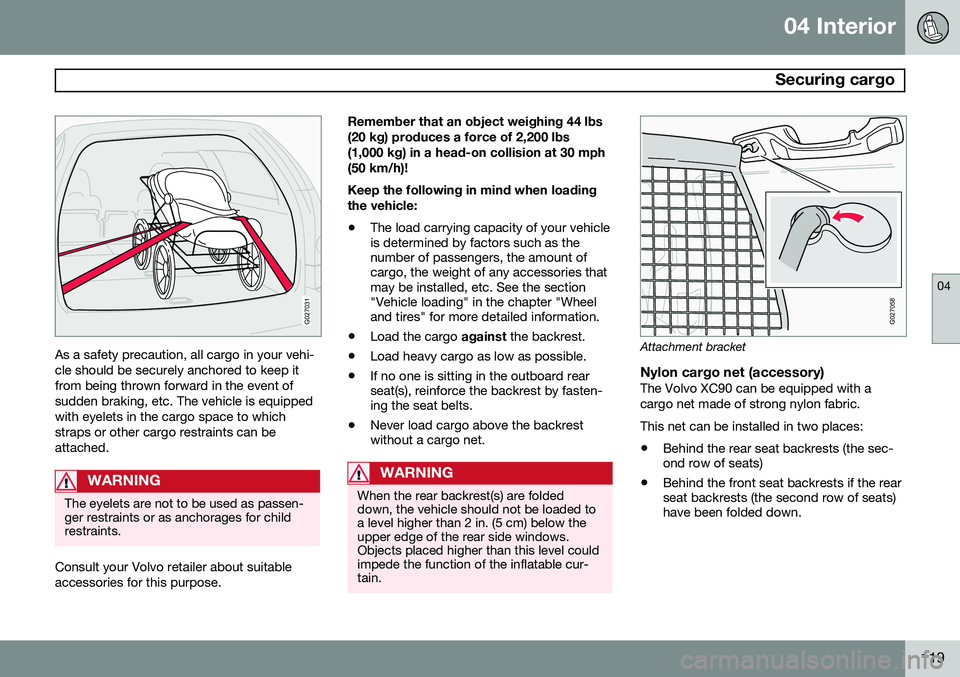
As a safety precaution, all cargo in your vehi- cle should be securely anchored to keep itfrom being thrown forward in the event ofsudden braking, etc. The vehicle is equippedwith eyelets in the cargo space to whichstraps or other cargo restraints can beattached.
WARNING
The eyelets are not to be used as passen- ger restraints or as anchorages for childrestraints.
Consult your Volvo retailer about suitable accessories for this purpose.Remember that an object weighing 44 lbs(20 kg) produces a force of 2,200 lbs(1,000 kg) in a head-on collision at 30 mph(50 km/h)! Keep the following in mind when loading the vehicle:
• The load carrying capacity of your vehicle is determined by factors such as thenumber of passengers, the amount ofcargo, the weight of any accessories thatmay be installed, etc. See the section"Vehicle loading" in the chapter "Wheeland tires" for more detailed information.
• Load the cargo
against the backrest.
• Load heavy cargo as low as possible.
• If no one is sitting in the outboard rearseat(s), reinforce the backrest by fasten-ing the seat belts.
• Never load cargo above the backrestwithout a cargo net.
WARNING
When the rear backrest(s) are folded down, the vehicle should not be loaded toa level higher than 2 in. (5 cm) below theupper edge of the rear side windows.Objects placed higher than this level couldimpede the function of the inflatable cur-tain.
G027058
Attachment bracket
Nylon cargo net (accessory)The Volvo XC90 can be equipped with a cargo net made of strong nylon fabric. This net can be installed in two places:
• Behind the rear seat backrests (the sec- ond row of seats)
• Behind the front seat backrests if the rearseat backrests (the second row of seats)have been folded down.
Page 145 of 308

06 Starting and driving
Starting the vehicle
06
143
Starting the engine
WARNING
Before starting, check that the seat, steer- ing wheel and mirrors are adjusted prop-erly. Make sure the brake pedal can bedepressed completely. Adjust the seat ifnecessary, see page 104.
1. Fasten the seat belt.
2. Apply the parking brake (hand brake) ifnot already set. The gear selector is locked in the P position (SHIFTLOCK).
3. Without touching the accelerator pedal, turn the ignition key 1
to the starting posi-
tion. Allow the starter to operate for up to10 seconds. Release the key as soon as the engine starts 2
. If the engine fails to
start, repeat this step.
CAUTION
If the engine does not start after the third try, wait for approximately 3 minutesbefore trying to start it again to give thebattery time to recover its startingcapacity.
WARNING
• Never use more than one floor mat at a time on the driver's floor. An extramat on the driver's floor can cause theaccelerator and/or brake pedal tocatch. Check that the movement ofthese pedals is not impeded.
• Volvo's floor mats are specially manu-factured for your car. They must befirmly secured in the clips on the floorso that they cannot slide and becometrapped under the pedals on the driv-er's side.
NOTE
•If the key blade section of the remote is not fully folded out when starting thevehicle, the immobilizer function maymake it impossible to start the engine.
• After a cold start, idle speed may benoticeably higher than normal for ashort period. This is done to help bringcomponents in the emission controlsystem to their normal operating tem-perature as quickly as possible, whichenables them to control emissions andhelp reduce the vehicle's impact onthe environment.
• To release the gear selector from the
P
(Park) position, the engine must berunning (or the ignition key must be inposition II) and the brake pedal must
be depressed.
• Select the desired gear. The gearengages after a very slight delay whichis especially noticeable when selecting R.
1
If two of the keys to your vehicle are close together, e.g. on the same key ring when you try to start the vehicle, this could cause interference in the immobilizer system and result in the vehicle not starting. If this should occur, remove one of the keys from the key ring before trying to start the vehicle again.
2 On vehicles equipped with the autostart feature, release the key immediately. See also page 145.
Page 172 of 308
06 Starting and driving
Before a long distance trip
06
170
It is always worthwhile to have your vehicle checked by a trained and qualified Volvoservice technician before driving long dis-tances. Your retailer or service technician willalso be able to supply you with bulbs, fuses,spark plugs and wiper blades for your use inthe event that problems occur. As a minimum, the following items should be checked before any long trip:• Check that engine runs smoothly and that fuel consumption is normal.
• Check for fuel, oil, and fluid leakage.
• Check transmission oil level 1
.
• Check condition of drive belts.
• Check state of the battery's charge.
• Examine tires carefully (the spare tire aswell), and replace those that are worn.Check tire pressures.
• The brakes, front wheel alignment, andsteering gear should be checked by atrained and qualified Volvo service techni-cian only.
• Check all lights, including high beams.
• Reflective warning triangles are legallyrequired in some states/provinces. •
Have a word with your Volvo retailer ifyou intend to drive in countries where itmay be difficult to obtain the correct fuel.
• Consider your destination. If you will bedriving through an area where snow or iceare likely to occur, consider snow tires.
1
To prevent injury from contact with hot surfaces, do not inspect your vehicle’s transmission fluid yourself. Have your vehicle’s transmission fluid level inspected by a qualified Volvo service techni- cian.
Page 213 of 308
08 Car care
Washing and cleaning the vehicle
08
211
3. Dampen the stain thoroughly with the
sponge. Let the sponge absorb the stain, do not rub.
4. Dry the stain with soft paper towels or a towel, and allow the leather to dry com-pletely.
Protecting leather upholstery1. Put a small amount of protectant cream on a cloth and apply a thin coating of cream to the upholstery with light circularmovements.
2. Allow the leather to dry for 20 minutes. This will help the leather resist staining and protect against sunlight's harmful UV rays.
CAUTION
• Under no circumstances should gaso- line, naphtha or similar cleaning agentsbe used on the plastic or the leathersince these can cause damage.
• Take extra care when removing stainssuch as ink or lipstick since the color-ing can spread.
• Use solvents sparingly. Too much sol-vent can damage the seat padding.
• Start from the outside of the stain andwork toward the center.
• Sharp objects (e.g. pencils or pens in apocket) or velcro fasteners on clothingmay damage the textile upholstery.
• Clothing that is not colorfast, such asnew jeans or suede garments, maystain the upholstery.
Cleaning a leather-covered steering wheel
•
Remove soil, dust, etc., with a damp sponge and a neutral soap solution.
• Leather should be allowed to breath.Never cover the steering wheel with aplastic protector.
• Volvo recommends cleaning, protectingand conditioning the steering wheel withVolvo's Leather Care Kit 951 0251 andLeather Softener 943 7429. If there are stains on the steering wheel: Type 1
(ink, wine, coffee, milk, sweat or
blood)
–Use a soft cloth or sponge. Wipe the wheel with a solution with 5% ammonia.For blood stains, mix approx. 1 cup (2 dl)of water and one ounce (25g) of salt andwipe the stain.
Type 2 (fat, oil, sauces, or chocolate)
1. Same procedure as for type I stains.
2. Finish by rubbing the wheel with absorb- ent paper or a towel.
Type 3 (dry soil or dust)
1. Remove the soil/dust with a soft brush.
2. Same procedure as for type I stains.
CAUTION
Sharp objects, such as rings, could dam- age the leather on the steering wheel.
Cleaning the seat beltsClean only with lukewarm water and a mild soap solution.
Cleaning floor matsThe floor mats should be vacuumed orbrushed clean regularly, especially duringwinter when they should be taken out for dry-
Page 218 of 308
09 Maintenance and servicing
Volvo service 09
216
Maintenance service
Periodic maintenance will help keep your vehicle running well. The maintenance serv-ices contain several checks that require spe-cial instruments and tools and therefore mustbe performed by a qualified technician. Tokeep your Volvo in top condition, specifytime-tested and proven Genuine Volvo Partsand Accessories.
The Federal Clean Air Act – U.S.
The Federal Clean Air Act requires vehicle manufacturers to furnish written instructionsto the ultimate purchaser to assure the properservicing and function of the components thatcontrol emissions. These services, which arelisted in the "Warranty and Service RecordsInformation booklet," are not covered by thewarranty. You will be required to pay for laborand material used.
Maintenance services
Your Volvo passed several major inspections before it was delivered to you, in accordancewith Volvo specifications. The maintenanceservices outlined in the Warranty and ServiceRecords Information booklet, many of whichwill positively affect your vehicle's emissions,should be performed as indicated. It is rec-ommended that receipts for vehicle emissionservices be retained in case questions ariseconcerning maintenance. Inspection and service should also be per- formed anytime a malfunction is observed orsuspected.
Applicable warranties
In accordance with applicable U.S. and Canadian regulations, the following list ofwarranties is provided.
• New Car Limited Warranty
• Parts and Accessories Limited Warranty
• Corrosion Protection Limited Warranty
• Seat Belt and Supplemental Restraint Systems Limited Warranty
• Emission Design and Defect Warranty
• Emission Performance Warranty
NOTE
•Refer to your Warranty and Service Records Information booklet for acomprehensive service and mainte-nance schedule up to 150,000 miles(240,000 km). This program containsinspections and services necessary forthe proper function of your vehicle andincludes components that affect vehi-cle emissions.
• The Warranty and Service RecordsInformation booklet also containsdetailed information concerning thewarranties that apply to your vehicle.
Page 222 of 308
09 Maintenance and servicing
Working on your vehicle 09
220
Belt check
Check the belt regularly to make sure it is in good condition and is clean. A worn or dirtybelt can cause poor cooling and low alterna-tor output as well as impair the operation ofthe power steering and the air conditioningunit.
NOTE
The drive belt is equipped with a self-ten- sioning mechanism and requires noadjustment between changes.
WARNING
The engine must not be running when this check is performed.
Check coolant level
The cooling system must be filled with cool- ant and not leak to operate at maximum effi-ciency. Check the coolant level regularly. Thelevel should be between the MAX and MIN
marks on the expansion tank. The checkshould be made with particular thoroughnesswhen the engine is new or when the coolingsystem has been drained. Do not remove the filler cap other than for topping up with coolant. Frequent removalmay prevent coolant circulation between the engine and the expansion tank during enginewarm up and cooling.
Changing coolant
Normally, the coolant does not need to be changed. If the system must be drained, con-sult a trained and qualified Volvo servicetechnician. Do not top off with water only. This reduces the rust-protective and antifreeze qualities ofthe coolant and has a lower boiling point. Itcan also cause damage to the cooling systemif it should freeze. Top off with Volvo GenuineCoolant/Antifreeze only (a 50/50 mix of waterand antifreeze.
CAUTION
The cooling system must always be kept filled to the correct level. If it is not keptfilled, there can be high local temperaturesin the engine which could result in dam-age. Different types of antifreeze/coolantmay not be mixed.
WARNING
•
Never remove the expansion tank cap while the engine is warm. Wait until theengine cools.
• If it is necessary to top off the coolantwhen the engine is warm, unscrew theexpansion tank cap slowly so that theoverpressure dissipates.
Page 296 of 308
11 Specifications
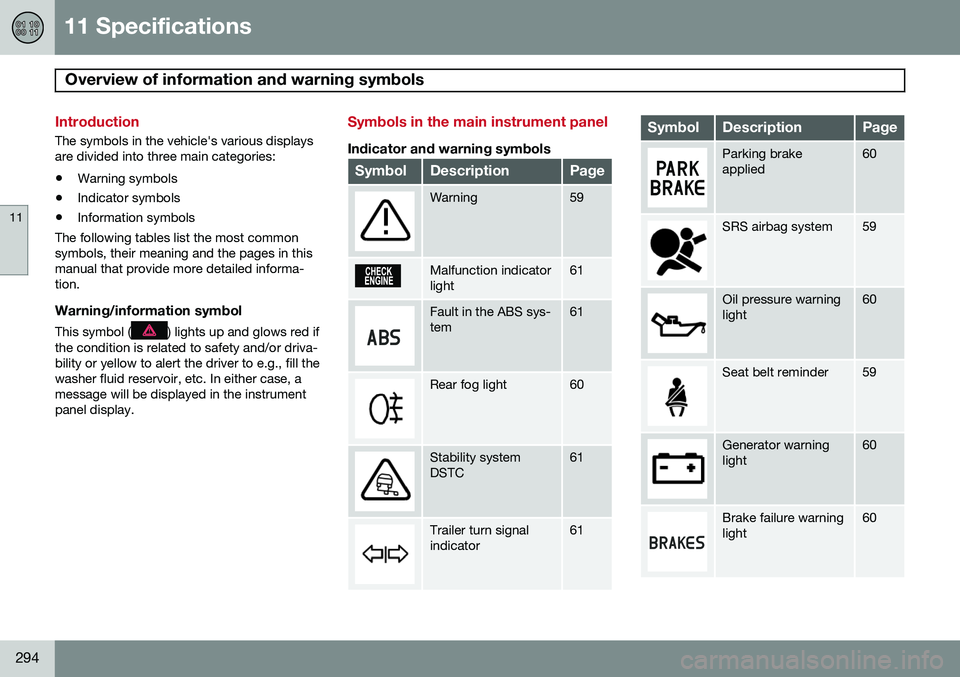
Overview of information and warning symbols
11
294
Introduction
The symbols in the vehicle's various displays are divided into three main categories:• Warning symbols
• Indicator symbols
• Information symbols
The following tables list the most commonsymbols, their meaning and the pages in thismanual that provide more detailed informa-tion.
Warning/information symbol
This symbol () lights up and glows red if
the condition is related to safety and/or driva- bility or yellow to alert the driver to e.g., fill thewasher fluid reservoir, etc. In either case, amessage will be displayed in the instrumentpanel display.
Symbols in the main instrument panel
Indicator and warning symbols
SymbolDescriptionPage
Warning59
Malfunction indicator light61
Fault in the ABS sys- tem61
Rear fog light60
Stability system DSTC61
Trailer turn signal indicator61
SymbolDescriptionPage
Parking brake applied60
SRS airbag system59
Oil pressure warning light60
Seat belt reminder59
Generator warning light60
Brake failure warning light60