belt VOLVO XC90 2014 Owner´s Manual
[x] Cancel search | Manufacturer: VOLVO, Model Year: 2014, Model line: XC90, Model: VOLVO XC90 2014Pages: 308, PDF Size: 13.31 MB
Page 27 of 308
01 Safety
Front airbags01
25
Front airbag deployment
•The front airbags are designed to deploy during certain frontal or front-angular col-lisions, impacts, or decelerations,depending on the crash severity, angle,speed and object impacted. The airbagsmay also deploy in certain non-frontalcollisions where rapid decelerationoccurs.
• The SRS sensors, which trigger the frontairbags, are designed to react to both theimpact of the collision and the inertialforces generated by it, and to determine ifthe intensity of the collision is sufficientfor the seat belt pretensioners and/or air-bags to be deployed.
However, not all frontal collisions activate the front airbags.
• If the collision involves a nonrigid object (e.g., a snow drift or bush), or a rigid,fixed object at a low speed, the front air-bags will not necessarily deploy.
• Front airbags do not normally deploy in aside impact collision, in a collision fromthe rear or in a rollover situation.
• The amount of damage to the bodyworkdoes not reliably indicate if the airbagsshould have deployed or not.NOTE
•Deployment of front airbags occurs only one time during an accident. In acollision where deployment occurs,the airbags and seat belt pretensionersactivate. Some noise occurs and asmall amount of powder is released.The release of the powder may appearas smoke-like matter. This is a normalcharacteristic and does not indicatefire.
• Volvo's front airbags use special sen-sors that are integrated with the frontseat buckles. The point at which theairbag deploys is determined bywhether or not the seat belt is beingused, as well as the severity of the col-lision.
• Collisions can occur where only one ofthe airbags deploys. If the impact isless severe, but severe enough topresent a clear injury risk, the airbagsare triggered at partial capacity. If theimpact is more severe, the airbags aretriggered at full capacity.
Should you have questions about any com- ponent in the SRS system, please contact atrained and qualified Volvo service technicianor Volvo customer support:
In the USAVolvo Cars of North America, LLC Customer Care Center1 Volvo DriveP.O. Box 914Rockleigh, New Jersey 076471-800-458-1552www.volvocars.us
In CanadaVolvo Cars of Canada Corp.National Customer Service9130 Leslie Street, Suite 101Richmond Hill, Ontario L4B 0B91-800-663-8255www.volvocars.ca
Page 28 of 308
01 Safety
Front airbags 01
26
WARNING
•Do not use child safety seats or child booster cushions/backrests in thefront passenger's seat. We also rec-ommend that occupants under 4 feet7 inches (140 cm) in height who haveoutgrown these devices sit in the rearseat with the seat belt fastened.
• Never drive with the airbags deployed.The fact that they hang out can impairthe steering of your vehicle. Othersafety systems can also be damaged.
• The smoke and dust formed when theairbags are deployed can cause skinand eye irritation in the event of pro-longed exposure.
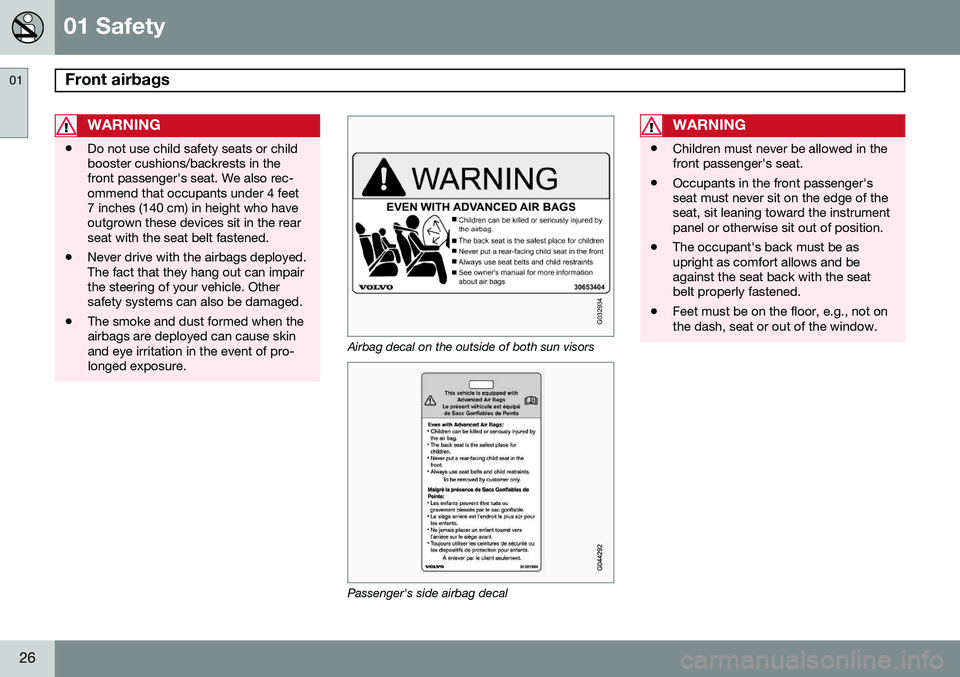
G032934
Airbag decal on the outside of both sun visors
Passenger's side airbag decal
WARNING
•Children must never be allowed in the front passenger's seat.
• Occupants in the front passenger'sseat must never sit on the edge of theseat, sit leaning toward the instrumentpanel or otherwise sit out of position.
• The occupant's back must be asupright as comfort allows and beagainst the seat back with the seatbelt properly fastened.
• Feet must be on the floor, e.g., not onthe dash, seat or out of the window.
Page 30 of 308
01 Safety
Occupant Weight Sensor 01
28
Disabling the passenger's side front airbag
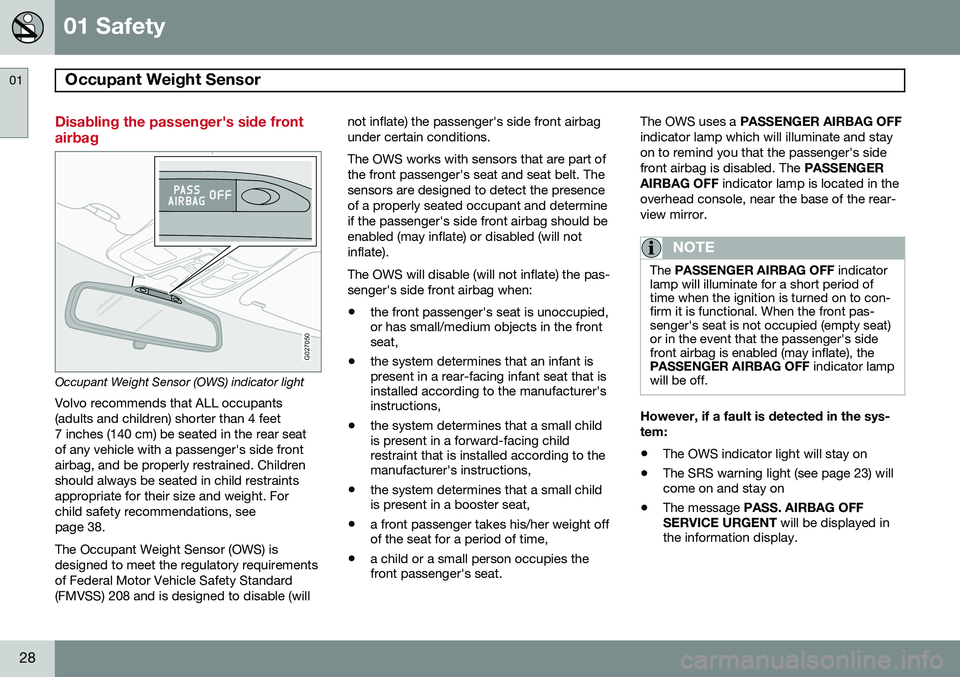
G027050
Occupant Weight Sensor (OWS) indicator light
Volvo recommends that ALL occupants (adults and children) shorter than 4 feet7 inches (140 cm) be seated in the rear seatof any vehicle with a passenger's side frontairbag, and be properly restrained. Childrenshould always be seated in child restraintsappropriate for their size and weight. Forchild safety recommendations, seepage 38. The Occupant Weight Sensor (OWS) is designed to meet the regulatory requirementsof Federal Motor Vehicle Safety Standard(FMVSS) 208 and is designed to disable (will not inflate) the passenger's side front airbagunder certain conditions. The OWS works with sensors that are part of the front passenger's seat and seat belt. Thesensors are designed to detect the presenceof a properly seated occupant and determineif the passenger's side front airbag should beenabled (may inflate) or disabled (will notinflate). The OWS will disable (will not inflate) the pas- senger's side front airbag when:
• the front passenger's seat is unoccupied, or has small/medium objects in the frontseat,
• the system determines that an infant ispresent in a rear-facing infant seat that isinstalled according to the manufacturer'sinstructions,
• the system determines that a small childis present in a forward-facing childrestraint that is installed according to themanufacturer's instructions,
• the system determines that a small childis present in a booster seat,
• a front passenger takes his/her weight offof the seat for a period of time,
• a child or a small person occupies thefront passenger's seat. The OWS uses a
PASSENGER AIRBAG OFF
indicator lamp which will illuminate and stay on to remind you that the passenger's sidefront airbag is disabled. The PASSENGER
AIRBAG OFF indicator lamp is located in the
overhead console, near the base of the rear-view mirror.
NOTE
The PASSENGER AIRBAG OFF indicator
lamp will illuminate for a short period of time when the ignition is turned on to con-firm it is functional. When the front pas-senger's seat is not occupied (empty seat)or in the event that the passenger's sidefront airbag is enabled (may inflate), thePASSENGER AIRBAG OFF indicator lamp
will be off.
However, if a fault is detected in the sys- tem: • The OWS indicator light will stay on
• The SRS warning light (see page 23) will come on and stay on
• The message
PASS. AIRBAG OFF
SERVICE URGENT will be displayed in
the information display.
Page 31 of 308
01 Safety
Occupant Weight Sensor01
29
WARNING
•If a fault in the system is detected and indicated as explained, be aware thatthe passenger's side front airbag willnot deploy in the event of a collision.
• In this case, the safety systems andOccupant Weight Sensor should beinspected by a trained and qualifiedVolvo service technician as soon aspossible.
WARNING
•Never try to open, remove, or repair any components in the OWS system.This could result in system malfunc-tion. Maintenance or repairs shouldonly be carried out by a trained andqualified Volvo service technician.
• The front passenger's seat should notbe modified in any way. This couldreduce pressure on the seat cushion,which might interfere with the OWSsystem's function.
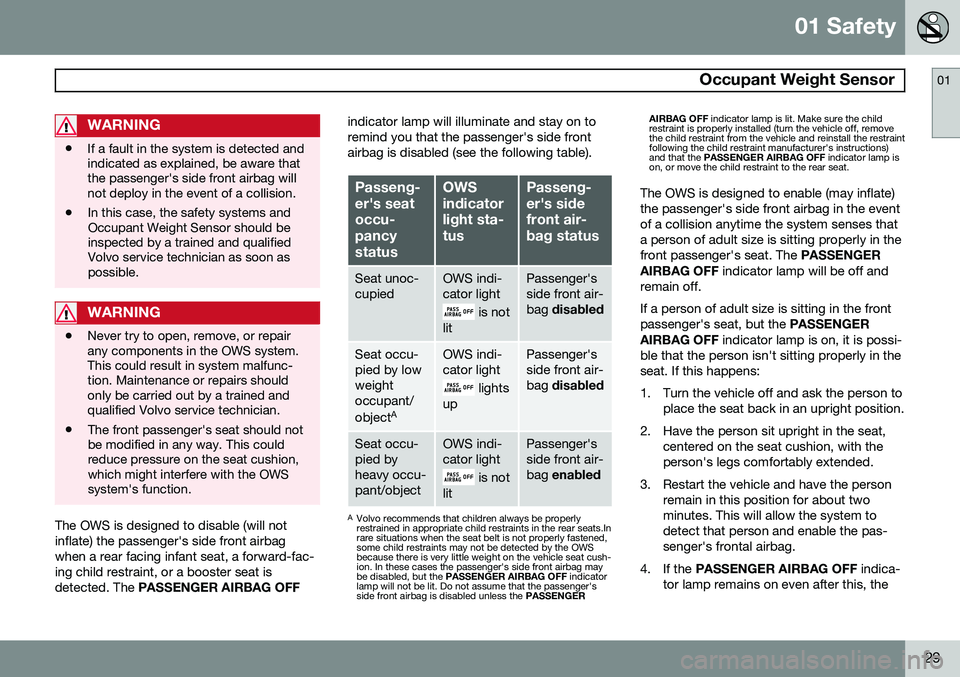
The OWS is designed to disable (will not inflate) the passenger's side front airbagwhen a rear facing infant seat, a forward-fac-ing child restraint, or a booster seat isdetected. The
PASSENGER AIRBAG OFF indicator lamp will illuminate and stay on toremind you that the passenger's side frontairbag is disabled (see the following table).
Passeng- er's seatoccu-pancystatusOWS indicatorlight sta-tusPasseng- er's sidefront air-bag status
Seat unoc- cupiedOWS indi- cator light
is not
lit
Passenger's side front air-bag disabled
Seat occu- pied by lowweightoccupant/ object AOWS indi- cator light
lights
up
Passenger's side front air-bag disabled
Seat occu- pied byheavy occu-pant/objectOWS indi- cator light
is not
lit
Passenger's side front air-bag enabled
A
Volvo recommends that children always be properly restrained in appropriate child restraints in the rear seats.Inrare situations when the seat belt is not properly fastened,some child restraints may not be detected by the OWSbecause there is very little weight on the vehicle seat cush-ion. In these cases the passenger's side front airbag maybe disabled, but the PASSENGER AIRBAG OFF indicator
lamp will not be lit. Do not assume that the passenger'sside front airbag is disabled unless the PASSENGERAIRBAG OFF
indicator lamp is lit. Make sure the child
restraint is properly installed (turn the vehicle off, removethe child restraint from the vehicle and reinstall the restraintfollowing the child restraint manufacturer's instructions)and that the PASSENGER AIRBAG OFF indicator lamp is
on, or move the child restraint to the rear seat.
The OWS is designed to enable (may inflate) the passenger's side front airbag in the eventof a collision anytime the system senses thata person of adult size is sitting properly in thefront passenger's seat. The PASSENGER
AIRBAG OFF indicator lamp will be off and
remain off. If a person of adult size is sitting in the front passenger's seat, but the PASSENGER
AIRBAG OFF indicator lamp is on, it is possi-
ble that the person isn't sitting properly in theseat. If this happens:
1. Turn the vehicle off and ask the person to place the seat back in an upright position.
2. Have the person sit upright in the seat, centered on the seat cushion, with the person's legs comfortably extended.
3. Restart the vehicle and have the person remain in this position for about twominutes. This will allow the system todetect that person and enable the pas-senger's frontal airbag.
4. If the PASSENGER AIRBAG OFF indica-
tor lamp remains on even after this, the
Page 32 of 308
01 Safety
Occupant Weight Sensor 01
30
person should be advised to ride in the rear seat.
This condition reflects limitations of the OWSclassification capability. It does not indicateOWS malfunction.
ModificationsIf you are considering modifying your vehiclein any way to accommodate a disability, forexample by altering or adapting the driver'sor front passenger's seat(s) and/or airbagsystems, please contact Volvo at: In the USA Volvo Cars of North America, LLC Customer Care Center1 Volvo DriveP.O. Box 914 Rockleigh,New Jersey 076471-800-458-1552 In Canada Volvo Cars of Canada Corp. National Customer Service9130 Leslie Street, Suite 101Richmond Hill, Ontario L4B 0B91-800-663-8255
WARNING
• No objects that add to the total weight on the seat should be placed on thefront passenger's seat. If a child isseated in the front passenger's seatwith any additional weight, this extraweight could cause the OWS systemto enable the airbag, which mightcause it to deploy in the event of a col-lision, thereby injuring the child.
• The seat belt should never be wrappedaround an object on the front pas-senger's seat. This could interfere withthe OWS system's function.
• The front passenger's seat belt shouldnever be used in a way that exertsmore pressure on the passenger thannormal. This could increase the pres-sure exerted on the weight sensor by achild, and could result in the airbagbeing enabled, which might cause it todeploy in the event of a collision,thereby injuring the child.
WARNING
Keep the following points in mind with respect to the OWS system. Failure to fol-low these instructions could adverselyaffect the system's function and result inserious injury to the occupant of the frontpassenger's seat:
• The full weight of the front seat pas- senger should always be on the seatcushion. The passenger should neverlift him/herself off the seat cushionusing the armrest in the door or thecenter console, by pressing the feet onthe floor, by sitting on the edge of theseat cushion, or by pressing againstthe backrest in a way that reducespressure on the seat cushion. Thiscould cause OWS to disable the frontpassenger's side airbag.
• Do not place any type of object on thefront passenger's seat in such a waythat jamming, pressing, or squeezingoccurs between the object and thefront seat, other than as a direct resultof the correct use of the AutomaticLocking Retractor/Emergency LockingRetractor (ALR/ELR) seat belt (seepage 39).
• No objects should be placed under thefront passenger's seat. This could
Page 35 of 308
01 Safety
Side impact protection airbags01
33
WARNING
•The SIPS airbag system is a supple- ment to the structural Side ImpactProtection System and the three-pointseat belt system. It is not designed todeploy during collisions from the frontor rear of the vehicle or in rollover sit-uations.
• The use of seat covers on the frontseats may impede SIPS airbag deploy-ment.
• No objects, accessory equipment orstickers may be placed on, attached toor installed near the SIPS airbag sys-tem or in the area affected by SIPS air-bag deployment.
• Never try to open or repair any compo-nents of the SIPS airbag system. Thisshould be done only by a trained andqualified Volvo service technician.
• In order for the SIPS airbag to provideits best protection, both front seatoccupants should sit in an uprightposition with the seat belt properly fas-tened.
• Failure to follow these instructions canresult in injury to the occupants of thevehicle in the event of an accident.
Page 37 of 308
01 Safety
Inflatable Curtain01
35
WARNING
In order for the IC to provide its best pro- tection, both front seat occupants andboth outboard rear seat occupants shouldsit in an upright position with the seat beltproperly fastened; adults using the seatbelt and children using the proper childrestraint system. Only adults should sit inthe front seats. Children must never beallowed in the front passenger seat. Seepage 39 for guidelines. Failure to followthese instructions can result in injury to thevehicle occupants in an accident.
Page 38 of 308
01 Safety
Whiplash Protection System 01
36
Whiplash Protection System (WHIPS) – front seats only
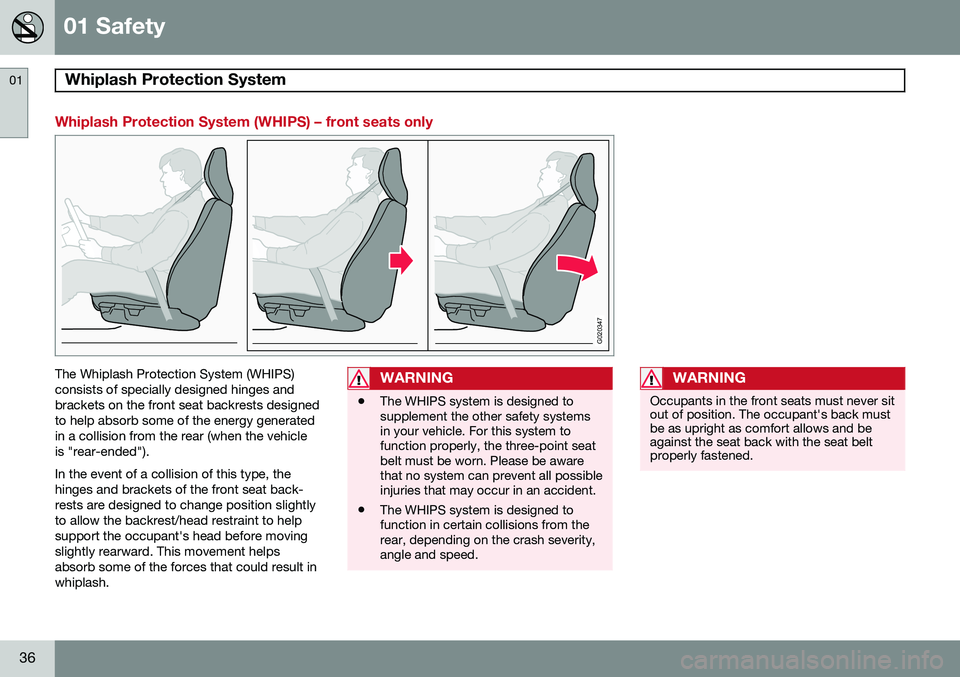
G020347
The Whiplash Protection System (WHIPS) consists of specially designed hinges andbrackets on the front seat backrests designedto help absorb some of the energy generatedin a collision from the rear (when the vehicleis "rear-ended"). In the event of a collision of this type, the hinges and brackets of the front seat back-rests are designed to change position slightlyto allow the backrest/head restraint to helpsupport the occupant's head before movingslightly rearward. This movement helpsabsorb some of the forces that could result inwhiplash.WARNING
•The WHIPS system is designed to supplement the other safety systemsin your vehicle. For this system tofunction properly, the three-point seatbelt must be worn. Please be awarethat no system can prevent all possibleinjuries that may occur in an accident.
• The WHIPS system is designed tofunction in certain collisions from therear, depending on the crash severity,angle and speed.
WARNING
Occupants in the front seats must never sit out of position. The occupant's back mustbe as upright as comfort allows and beagainst the seat back with the seat beltproperly fastened.
Page 40 of 308
01 Safety
Child safety 01
38
Children should be seated safely
Volvo recommends the proper use of restraint systems for all occupants including children.Remember that, regardless of age and size, achild should always be properly restrained ina vehicle. Your vehicle is also equipped with ISOFIX/ LATCH attachments, which make it moreconvenient to install child seats. Some restraint systems for children are designed to be secured in the vehicle by lapbelts or the lap portion of a lap-shoulder belt.Such child restraint systems can help protectchildren in vehicles in the event of an acci-dent only if they are used properly. However,children could be endangered in a crash if thechild restraints are not properly secured in thevehicle. Failure to follow the installationinstructions for your child restraint can resultin your child striking the vehicle's interior in asudden stop. Holding a child in your arms is NOT a suitable substitute for a child restraint system. In anaccident, a child held in a person's arms canbe crushed between the vehicle's interior andan unrestrained person. The child could alsobe injured by striking the interior, or by beingejected from the vehicle during a suddenmaneuver or impact. The same can also hap-pen if the infant or child rides unrestrained onthe seat. Other occupants should also beproperly restrained to help reduce the chanceof injuring or increasing the injury of a child. All states and provinces have legislation gov- erning how and where children should be car-ried in a vehicle. Find out the regulationsexisting in your state or province. Recentaccident statistics have shown that childrenare safer in rear seating positions than frontseating positions when properly restrained. Achild restraint system can help protect a childin a vehicle. Here's what to look for whenselecting a child restraint system: •
It should have a label certifying that it meets applicable Federal Motor VehicleSafety Standards (FMVSS 213) – or inCanada, CMVSS 213.
• Make sure the child restraint system isapproved for the child's height, weightand development – the label required bythe standard or regulation, or instructionsfor infant restraints, typically provide thisinformation.
• In using any child restraint system, weurge you to carefully look over theinstructions that are provided with therestraint. Be sure you understand themand can use the device properly andsafely in this vehicle. A misused childrestraint system can result in increased injuries for both the infant or child andother occupants in the vehicle.
When a child has outgrown the child safety seat, you should use the rear seat with thestandard seat belt fastened. The best way tohelp protect the child here is to place thechild on a cushion so that the seat belt isproperly located on the hips, see page 48.Legislation in your state or province maymandate the use of a child seat or cushion incombination with the seat belt, depending onthe child's age and/or size. Please checklocal regulations. A specially designed and tested booster cushion and backrest can be obtained fromyour Volvo retailer. USA : for children weighing 33 – 80 lbs. (15 –
36 kg) and 38 – 54 inches (97 – 137 cm) in height Canada : for children weighing 40 – 80 lbs.
(18 – 36 kg) and 40 – 54 inches (102 – 137 cm) in height
Page 41 of 308
01 Safety
Child safety01
39
WARNING
•Do not use child safety seats or child booster cushions/backrests in thefront passenger's seat. We also rec-ommend that children under 4 feet7 inches (140 cm) in height who haveoutgrown these devices sit in the rearseat with the seat belt fastened.
• On hot days, the temperature in thevehicle interior can rise very quickly.Exposure to these high temperaturesfor even a short period of time cancause heat-related injury or death.Small children are particularly at risk.
Child seat should always be registered. See page 40 for more information.
Automatic Locking Retractor/ Emergency Locking Retractor (ALR/ELR)
To make child seat installation easier, each seat belt (except for the driver's belt) is equip-ped with a locking mechanism to help keepthe seat belt taut.
When attaching the seat belt to a child seat:
1. Attach the seat belt to the child seat
according to the child seat manufactur- er's instructions.
2. Pull the seat belt out as far as possible.
3. Insert the seat belt latch plate into the buckle (lock) in the usual way.
4. Release the seat belt and pull it taut around the child seat.
A sound from the seat belt retractor will be audible at this time and is normal. The beltwill now be locked in place. This function isautomatically disabled when the seat belt isunlocked and the belt is fully retracted.
WARNING
Do not use child safety seats or child booster cushions/backrests in the frontpassenger's seat. We also recommendthat children who have outgrown thesedevices sit in the rear seat with the seatbelt properly fastened.
Volvo's recommendations
Why does Volvo believe that no child should sit in the front seat of a car? It's quite simplereally. A front airbag is a very powerful devicedesigned, by law, to help protect an adult. Because of the size of the airbag and its speed of inflation, a child should never beplaced in the front seat, even if he or she isproperly belted or strapped into a child safetyseat. Volvo has been an innovator in safetyfor over seventy-five years, and we'll continueto do our part. But we need your help. Pleaseremember to put your children in the backseat, and buckle them up.
Volvo has some very specific recommendations:
• Always wear your seat belt.
• Airbags are a SUPPLEMENTAL safety device which, when used with a three-point seat belt can help reduce seriousinjuries during certain types of accidents.Volvo recommends that you do not dis-connect the airbag system in your vehi-cle.
• Volvo strongly recommends that every-one in the vehicle be properly restrained.
• Volvo recommends that ALL occupants(adults and children) shorter than 4 feet7 inches (140 cm) be seated in the back