towing VOLVO XC90 2015 Owner's Manual
[x] Cancel search | Manufacturer: VOLVO, Model Year: 2015, Model line: XC90, Model: VOLVO XC90 2015Pages: 570, PDF Size: 12.44 MB
Page 473 of 570

WHEELS AND TIRES
471
Tread wear indicatorThe tires have wear indicator strips running across or parallel to the tread.
The letters TWI are printed on the side of the tire. When approximately 1/16" (1.6 mm) is left onthe tread, these strips become visible and indi-cate that the tire should be replaced. Tires withless than 1/16" (1.6 mm) tread offer very poortraction. When replacing worn tires, it is recommended that the tire be identical in type (radial) and sizeas the one being replaced. Using a tire of thesame make (manufacturer) will help preventalteration of the driving characteristics of thevehicle.
Related information
• Tire direction of rotation (p. 470)
• Checking tire inflation pressure (p. 473)
Loading specifications Properly loading your vehicle will provide maxi- mum return of vehicle design performance.
Weight designations
Before loading your vehicle, familiarize yourself with the following terms for determining yourvehicle's weight ratings, with or without a trailer,from the vehicle's Federal/Canadian Motor Vehi-cle Safety Standards (FMVSS/CMVSS) label, andthe vehicle's tire information placard:
Curb weightThe weight of the vehicle including a full tank of fuel and all standard equipment. It does notinclude passengers, cargo, or optional equipment.
Capacity weightAll weight added to the curb weight, including cargo and optional equipment. When towing,trailer hitch tongue load is also part of cargoweight.
Permissible axle weightThe maximum allowable weight that can be car- ried by a single axle (front or rear). These num-bers are shown on the Federal/Canadian MotorVehicle Safety Standards (FMVSS/CMVSS) label.The total load on each axle must never exceed itsmaximum permissible weight.
Gross vehicle weight (GVW)The vehicle's curb weight + cargo + passengers.
Steps for Determining Correct Load Limit1. Locate the statement "the combined weight
of occupants and cargo should never exceed XXX pounds" on your vehicle's placard.
2. Determine the combined weight of the driver and passengers that will be riding in yourvehicle.
3. Subtract the combined weight of the driver and passengers from XXX kilograms or XXXpounds.
4. The resulting figure equals the available amount of cargo and luggage load capacity.For example, if the "XXX" amount equals1400 lbs. and there will be five 150 lb. pas-sengers in your vehicle, the amount of availa-ble cargo and luggage load capacity is650 lbs. (1400 – 750 (5 × 150) = 650 lbs.)
5. Determine the combined weight of luggage and cargo being loaded on the vehicle. Thatweight may not safely exceed the availablecargo and luggage load capacity calculatedin Step 4.
6. If your vehicle will be towing a trailer, load from your trailer will be transferred to yourvehicle.
Page 477 of 570
WHEELS AND TIRES
* Option/accessory, for more information, see Introduction.475
NOTE
•If you overfill the tire, release air by push- ing on the metal stem in the center of thevalve. Then recheck the pressure withyour tire gauge.
• Some spare tires require higher inflationpressure than the other tires. Consult thetire inflation pressure table or the inflationpressure placard.
Changing tires
When changing wheels to another dimension, always follow Volvo's instructions.
When changing to tires of another
dimension
If you mount tires with a dimension other thanthe factory-installed tires, contact an authorizedVolvo retailer to update the vehicle's software.This may also be necessary when changing fromsummer to winter tires, or vice versa.
Related information
• Snow tires and chains (p. 473)
• Spare tire (p. 476)
• Installing a wheel (p. 479)
• Removing a wheel (p. 478)
Tools in the cargo compartment
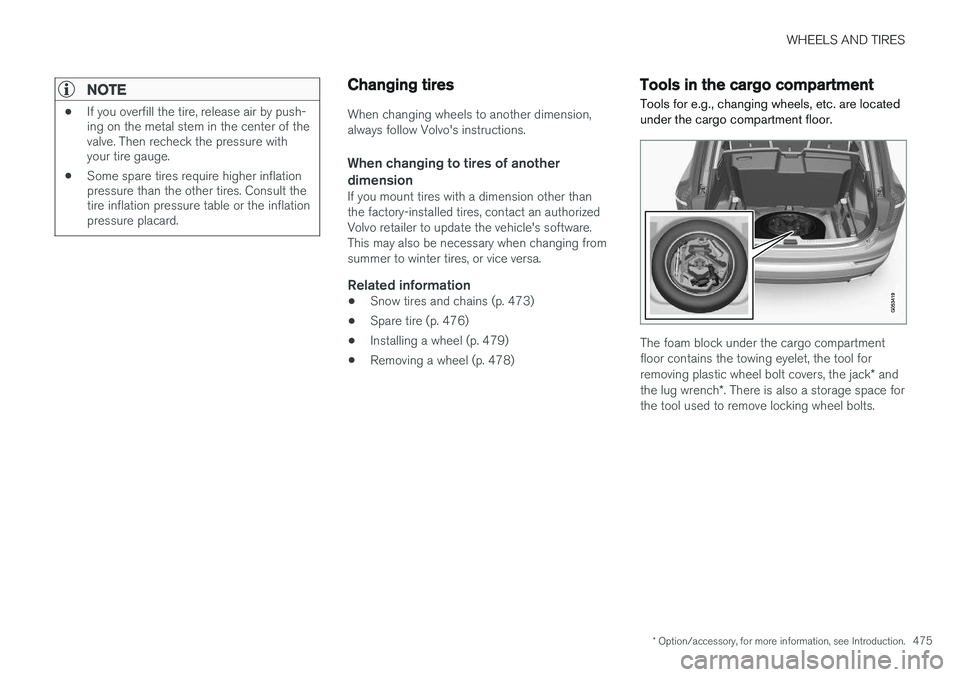
Tools for e.g., changing wheels, etc. are located under the cargo compartment floor.
The foam block under the cargo compartment floor contains the towing eyelet, the tool for removing plastic wheel bolt covers, the jack * and
the lug wrench *. There is also a storage space for
the tool used to remove locking wheel bolts.
Page 481 of 570

WHEELS AND TIRES
479
5.
Lug wrench and towing eyelet
Screw the towing eyelet into the lug wrench as shown in the illustration.
CAUTION
The towing eyelet must be screwed into the lug wrench as far as possible.
6. With the vehicle still on the ground, use the
lug wrench/towing eyelet to loosen the wheel bolts ½ – 1 turn by exerting downward(counterclockwise) pressure. 7. When hoisting the vehicle, it is essential that
the jack (or garage lift arms) are positionedcorrectly on the underside of the vehicle.There are two jack attachment points oneach side of the vehicle and there is a groovein the plastic cover at each attachment point.Position the jack under the attachment pointto be used on a level, firm, non-slippery sur-face and crank it up until it is correctlyaligned and seated in the attachment point.The pin on the jack's head must be posi-tioned in the hole in the attachment point.
8. Raise the vehicle until the wheel to bechanged is lifted off the ground. Remove the wheel bolts.
Related information
• Wheel bolts (p. 477)
• Installing a wheel (p. 479)
• Jack (p. 476)
Installing a wheel
It is important to install wheels properly.
1. Clean the contact surfaces on the wheel and hub.
2. Lift the wheel and place it on the hub.
3. Install the wheel bolts and tighten hand-tight. Using the lug wrench, tighten crosswise until all bolts are snug.
4. Lower the vehicle to the ground and alter- nately tighten the bolts crosswise to103 ft. lbs. (140 Nm).
5. Press the plastic covers onto the wheel bolts.
Page 560 of 570
558Emergency towing 344
Emission inspection readiness 488Engine
overheating 341
Start/Stop 364, 365
starting 356
turning off 359
Engine compartment fuses 501
Engine compartment overview 519
Engine oil 544 checking 520, 521
Engine specifications 543Entering a destination POI 440
Entering destination free-text search 436
recent options 438
tapping the map 435
using an address 441
Enterining destination 435
Environment 15Eyelet towing 343
Eyelets for anchoring loads 212
F
Federal Clean Air Act 488 Floor mats placing correctly 356
Fluid specifications 541, 542, 546Fog lights front 143
rear 144
Front airbags 83, 84 disconnecting passenger
Page 565 of 570
563
deactivating/reactivating 288
starting/activating 284
Spin control 308
Stability system 308 sport mode 309
Start/Stop (engine function) 364, 365Start and lock system type designations 220
Starting and driving 330
Starting the engine 356Starting the vehicle after a crash (crash mode) 81, 82
Start inhibitor (immobilizer) 221
Steel grid in cargo area 211
Steering wheel 157 adjusting 159
heated 189
horn 157
keypad 157
Steering wheel paddles 157
Stone chips, touching up 530, 531
Storage compartments 200
Studded tires 473Sunroof laminated panoramic roof 101, 102
Sun shade 104, 106
Sun visor 203
Suspension 372
System updates 490
T
Tailgate locking/unlocking 233 operating with the foot movement sen-
sor 228
power operated 235
wiper/washer 157
Tailgate wipers 523
Technician certification 54Temperature perceived 176
Temperature sensor ambient 116
Temporary spare tire 476Tethering wi-fi sharing 406
Three-way catalytic converter 349
Tire inflation pressure 545
Tire Pressure Monitoring System 480, 483 calibrating 484
type approval 484
Tire Pressure Monitoring System (TPMS) 484
Tires 466changing 475
changing from summer to winter 470
glossary of terms 469
improving economy 466
inflation pressure 473
inflation pressure table 545installing (mounting) a wheel on the
vehicle 479
rotation 467
snow 473
spare 476
specifications 467
storing 467
studded 473
tire pressure monitoring system 480, 483
tools in the cargo compartment 475
tread wear indicator 471
uniform tire quality grading 472
wheel bolts 477
Top tether anchors (child restraint systems) 74
Touching up paint 530, 531
Towing a trailer 351, 354 trailer hitch 353
Towing eyelet 343
Towing the vehicle 344
Traction control 308
Page 566 of 570
564Trailer towing 351, 354
trailer hitch 353
Transmission gear shift indicator 370
general description 367
Hill Start Assist 335
oil 546
shifting with steering wheel paddles 370
shiftlock override 369
Tread wear indicator 471
Trip computer 92, 94 reset 92
Trip odometers 92
Trips, long distance 339
Trip statistics 94Troubleshooting Sensus Navigation 462
Turn signals 148 changing bulbs 514
U
Uniform Tire Quality Grading 472
Unlocking the tailgate 233
Unlocking the vehicle 231, 232
USB/AUX connection 393, 397
User profile 112
V
Vehicle Event Data 26
Vehicle information 14
Vehicle loading 207, 471
Vehicle maintenance 488
performed by the owner 488
Vehicle status 491
Vehicle weights 539Voice control cell phones 121
giving commands 121
introduction 120
multimedia devices 122
radio 122
settings 125
Volvo and the environment 15
Volvo ID 27
Volvo maintenance 488Volvo On Call areas of availability 422
convenience services 416
personal information 420
PIN code 418
remote door unlock 426
safety services 424, 425
security services 425
using 414
Volvo On Call Roadside Assistance 14
Volvo On Call with Sensus Connect 414, 415
Volvo programs 14
W
Warning flashers, hazard 144
Warning lights 134
Warning system, collision 274
Warranties 488
Washer fluid 524Washers headlight 156
windshield 154
Water, driving through 340
Waxing 531Weights trailer 351
Wheels changing 475, 478
storing 467
Whiplash Protection System 89
Wi-Fi 406, 407