ECO mode VOLVO XC90 T8 2018 Owner´s Manual
[x] Cancel search | Manufacturer: VOLVO, Model Year: 2018, Model line: XC90 T8, Model: VOLVO XC90 T8 2018Pages: 686, PDF Size: 11.51 MB
Page 312 of 686
||
DRIVER SUPPORT
* Option/accessory.
310
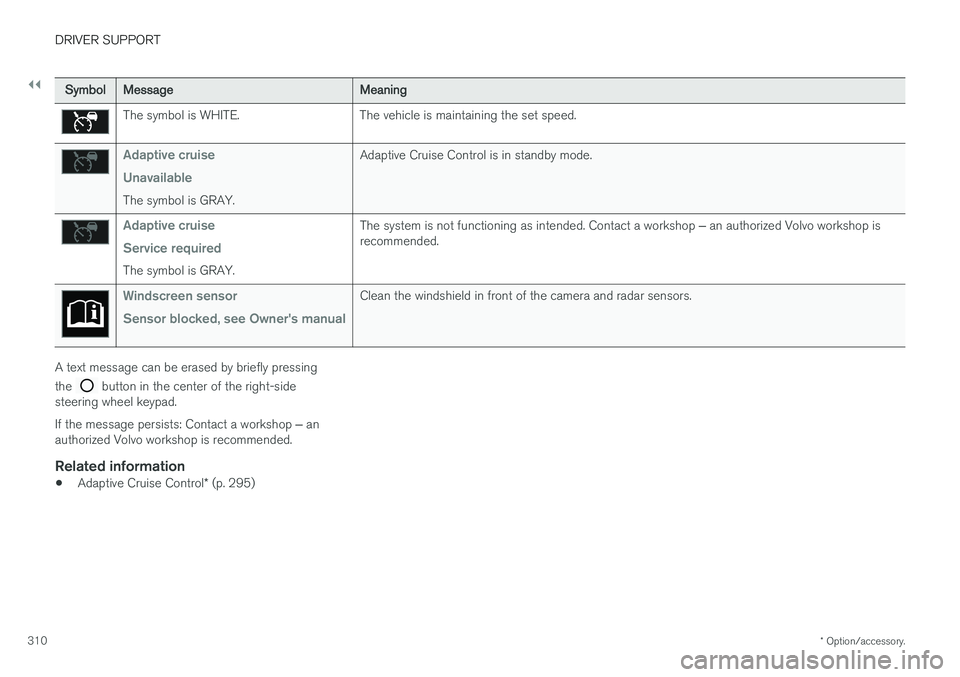
SymbolMessageMeaning
The symbol is WHITE. The vehicle is maintaining the set speed.
Adaptive cruise Unavailable
The symbol is GRAY. Adaptive Cruise Control is in standby mode.
Adaptive cruise Service required
The symbol is GRAY.
The system is not functioning as intended. Contact a workshop
‒ an authorized Volvo workshop is
recommended.
Windscreen sensor Sensor blocked, see Owner's manualClean the windshield in front of the camera and radar sensors.
A text message can be erased by briefly pressing the
button in the center of the right-side
steering wheel keypad. If the message persists: Contact a workshop ‒ an
authorized Volvo workshop is recommended.
Related information
• Adaptive Cruise Control
* (p. 295)
Page 313 of 686
DRIVER SUPPORT
}}
311
Pilot Assist
Pilot Assist helps the driver keep the vehicle in the current traffic lane by providing steeringassistance and maintaining an even speed and aset time interval to the vehicle ahead.
How Pilot Assist worksThe Pilot Assist function is primarily intended for use on highways and other major roads where itcan help provide a more comfortable and relaxingdriving experience.
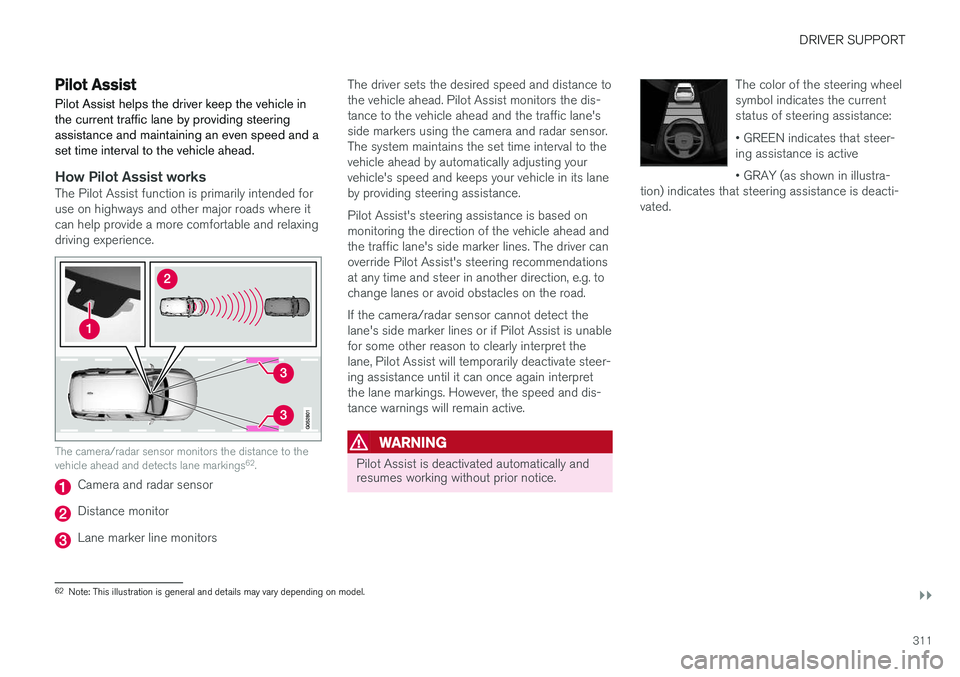
The camera/radar sensor monitors the distance to the vehicle ahead and detects lane markings 62
.
Camera and radar sensor
Distance monitor
Lane marker line monitors The driver sets the desired speed and distance to the vehicle ahead. Pilot Assist monitors the dis-tance to the vehicle ahead and the traffic lane'sside markers using the camera and radar sensor.The system maintains the set time interval to thevehicle ahead by automatically adjusting yourvehicle's speed and keeps your vehicle in its laneby providing steering assistance. Pilot Assist's steering assistance is based on monitoring the direction of the vehicle ahead andthe traffic lane's side marker lines. The driver canoverride Pilot Assist's steering recommendationsat any time and steer in another direction, e.g. tochange lanes or avoid obstacles on the road. If the camera/radar sensor cannot detect the lane's side marker lines or if Pilot Assist is unablefor some other reason to clearly interpret thelane, Pilot Assist will temporarily deactivate steer-ing assistance until it can once again interpretthe lane markings. However, the speed and dis-tance warnings will remain active.
WARNING
Pilot Assist is deactivated automatically and resumes working without prior notice.
The color of the steering wheel symbol indicates the currentstatus of steering assistance: • GREEN indicates that steer- ing assistance is active • GRAY (as shown in illustra-
tion) indicates that steering assistance is deacti- vated.
62 Note: This illustration is general and details may vary depending on model.
Page 320 of 686
||
DRIVER SUPPORT
* Option/accessory.
318
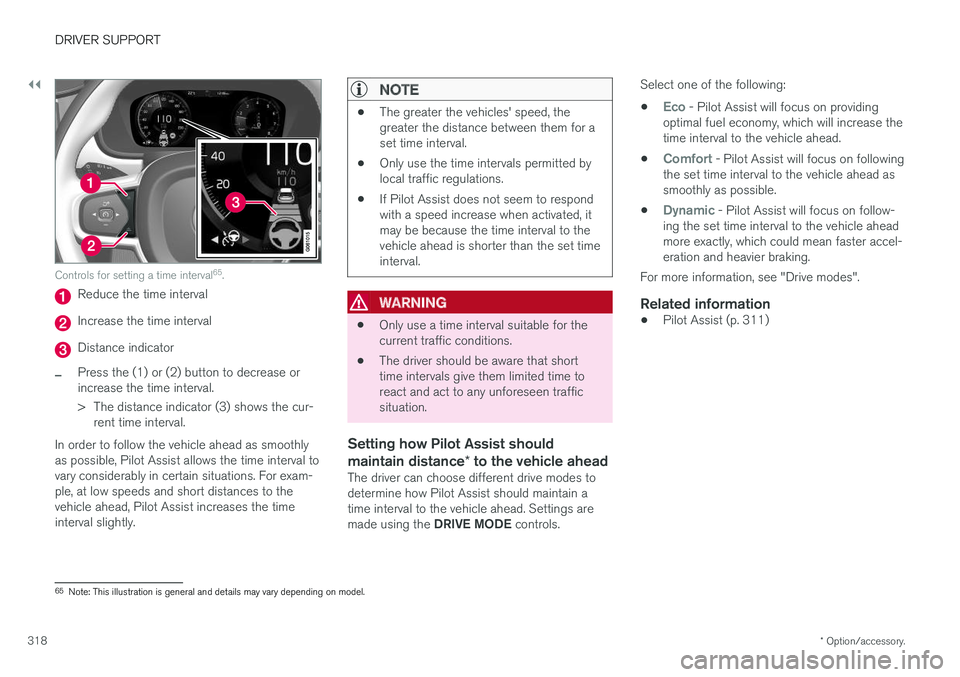
Controls for setting a time interval 65
.
Reduce the time interval
Increase the time interval
Distance indicator
–Press the (1) or (2) button to decrease or increase the time interval.
> The distance indicator (3) shows the cur-
rent time interval.
In order to follow the vehicle ahead as smoothly as possible, Pilot Assist allows the time interval tovary considerably in certain situations. For exam-ple, at low speeds and short distances to thevehicle ahead, Pilot Assist increases the timeinterval slightly.
NOTE
• The greater the vehicles' speed, the greater the distance between them for aset time interval.
• Only use the time intervals permitted bylocal traffic regulations.
• If Pilot Assist does not seem to respondwith a speed increase when activated, itmay be because the time interval to thevehicle ahead is shorter than the set timeinterval.
WARNING
•Only use a time interval suitable for the current traffic conditions.
• The driver should be aware that shorttime intervals give them limited time toreact and act to any unforeseen trafficsituation.
Setting how Pilot Assist should maintain distance
* to the vehicle ahead
The driver can choose different drive modes to determine how Pilot Assist should maintain atime interval to the vehicle ahead. Settings are made using the DRIVE MODE controls. Select one of the following:
•
Eco - Pilot Assist will focus on providing
optimal fuel economy, which will increase the time interval to the vehicle ahead.
•
Comfort - Pilot Assist will focus on following
the set time interval to the vehicle ahead as smoothly as possible.
•
Dynamic - Pilot Assist will focus on follow-
ing the set time interval to the vehicle ahead more exactly, which could mean faster accel-eration and heavier braking.
For more information, see "Drive modes".
Related information
• Pilot Assist (p. 311)
65
Note: This illustration is general and details may vary depending on model.
Page 324 of 686
DRIVER SUPPORT
322
Switching target vehicles with PilotAssist
At certain speeds, models with automatic trans-
missions and Pilot Assist can switch target vehi-cles.
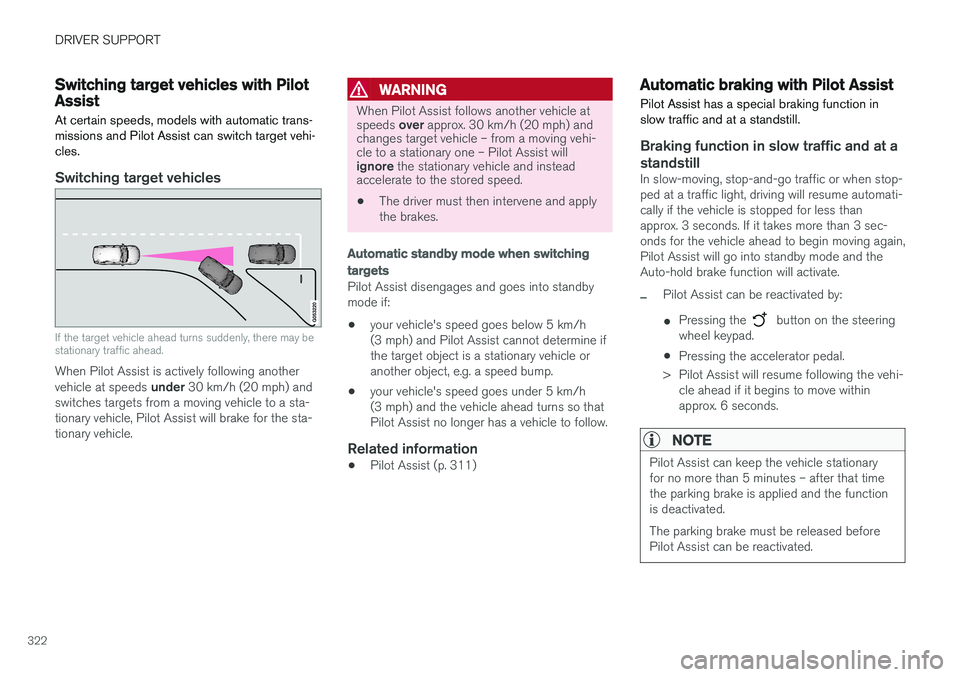
Switching target vehicles
If the target vehicle ahead turns suddenly, there may be stationary traffic ahead.
When Pilot Assist is actively following another vehicle at speeds under 30 km/h (20 mph) and
switches targets from a moving vehicle to a sta-
tionary vehicle, Pilot Assist will brake for the sta-tionary vehicle.
WARNING
When Pilot Assist follows another vehicle at speeds over approx. 30 km/h (20 mph) and
changes target vehicle – from a moving vehi- cle to a stationary one – Pilot Assist will ignore the stationary vehicle and instead
accelerate to the stored speed.
• The driver must then intervene and apply the brakes.
Automatic standby mode when switching
targets
Pilot Assist disengages and goes into standby mode if:
• your vehicle's speed goes below 5 km/h(3 mph) and Pilot Assist cannot determine ifthe target object is a stationary vehicle oranother object, e.g. a speed bump.
• your vehicle's speed goes under 5 km/h(3 mph) and the vehicle ahead turns so thatPilot Assist no longer has a vehicle to follow.
Related information
•Pilot Assist (p. 311)
Automatic braking with Pilot Assist
Pilot Assist has a special braking function in slow traffic and at a standstill.
Braking function in slow traffic and at a standstill
In slow-moving, stop-and-go traffic or when stop- ped at a traffic light, driving will resume automati-cally if the vehicle is stopped for less thanapprox. 3 seconds. If it takes more than 3 sec-onds for the vehicle ahead to begin moving again,Pilot Assist will go into standby mode and theAuto-hold brake function will activate.
–Pilot Assist can be reactivated by:
• Pressing the
button on the steering
wheel keypad.
• Pressing the accelerator pedal.
> Pilot Assist will resume following the vehi- cle ahead if it begins to move within approx. 6 seconds.
NOTE
Pilot Assist can keep the vehicle stationary for no more than 5 minutes – after that timethe parking brake is applied and the functionis deactivated. The parking brake must be released before Pilot Assist can be reactivated.
Page 326 of 686
||
DRIVER SUPPORT
* Option/accessory.
324
The driver is responsible for ensuring that the vehicle maintains a suitable distancefrom such obstacles.
• The camera and radar sensors do nothave the capacity to detect all oncomingobjects and obstacles in traffic environ-ments, e.g. potholes, stationary obstaclesor objects that completely or partiallyblock the route.
• Pilot Assist does not "see" pedestrians,animals, etc.
• The recommended steering input is lim-ited in force, which means that it cannotalways help the driver to steer and keepthe vehicle within the lane.
• Pilot Assist is switched off if the powersteering is working with reduced power -e.g. during cooling due to overheating(see section "Speed-dependent steeringforce").
The driver can always correct or adjust steeringassistance provided by Pilot Assist by turning thesteering wheel to the desired position.
Steep roads and/or heavy loadsPilot Assist is primarily intended to be driven onflat roads. The function may not be able to main-tain the correct time interval to the vehicle aheadwhen driving down steep hills. The driver should be extra attentive and prepared to apply thebrakes.
• Do not use Pilot Assist if the vehicle is carry-ing a heavy load or towing a trailer.
NOTE
Pilot Assist cannot be activated if a trailer, bike carrier or similar is connected to thevehicle electrical system.
Other limitations
•
The Off Road drive mode cannot be
selected when Pilot Assist is activated.
NOTE
The function uses the vehicle's camera unit, which has some general limitations – see thesection "Camera unit limitations".
NOTE
The function uses the vehicle's radar unit, which has some general limitations – see thesection "Radar unit limitations".
Related information
• Pilot Assist (p. 311)
• Speed-dependent steering wheel resistance (p. 272)
Pilot Assist
* symbols and messages
A number of symbols and messages relating to Pilot Assist may be displayed in the instrument panel and/or the head-up display *.
Page 328 of 686
||
DRIVER SUPPORT
* Option/accessory.
326
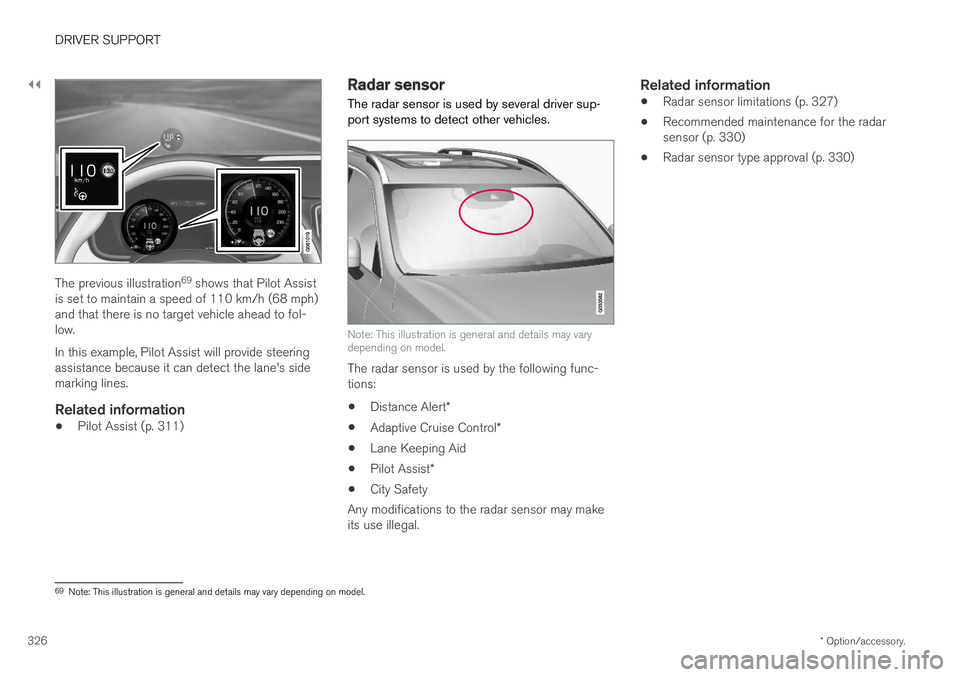
The previous illustration 69
shows that Pilot Assist
is set to maintain a speed of 110 km/h (68 mph) and that there is no target vehicle ahead to fol-low. In this example, Pilot Assist will provide steering assistance because it can detect the lane's sidemarking lines.
Related information
• Pilot Assist (p. 311)
Radar sensor
The radar sensor is used by several driver sup- port systems to detect other vehicles.
Note: This illustration is general and details may vary depending on model.
The radar sensor is used by the following func- tions:
• Distance Alert
*
• Adaptive Cruise Control
*
• Lane Keeping Aid
• Pilot Assist
*
• City Safety
Any modifications to the radar sensor may makeits use illegal.
Related information
• Radar sensor limitations (p. 327)
• Recommended maintenance for the radarsensor (p. 330)
• Radar sensor type approval (p. 330)
69
Note: This illustration is general and details may vary depending on model.
Page 333 of 686
DRIVER SUPPORT
* Option/accessory.331
Camera
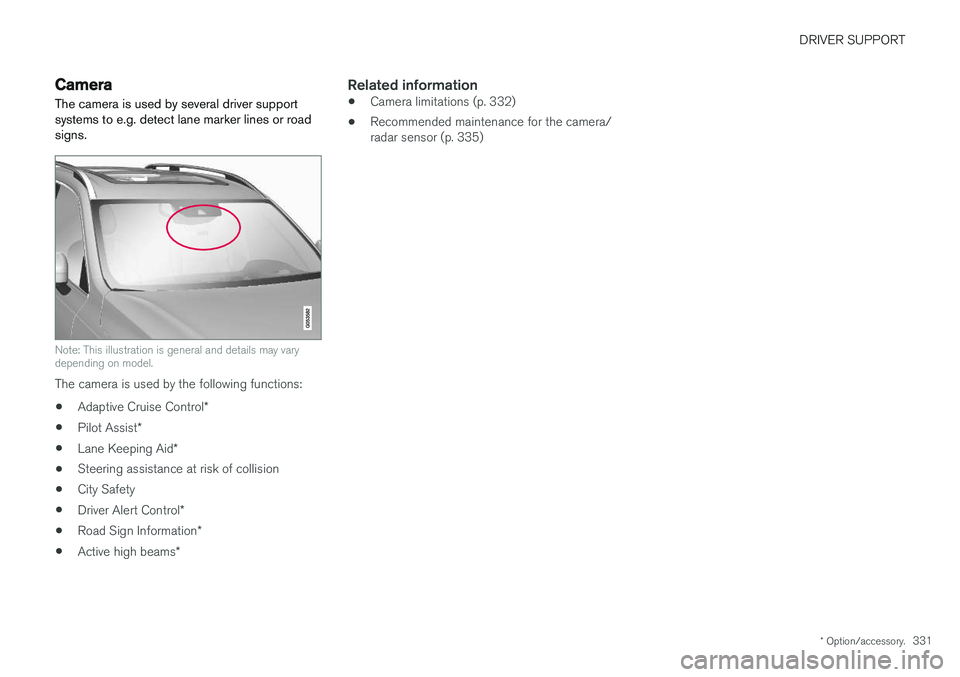
The camera is used by several driver support systems to e.g. detect lane marker lines or roadsigns.
Note: This illustration is general and details may vary depending on model.
The camera is used by the following functions:
• Adaptive Cruise Control
*
• Pilot Assist
*
• Lane Keeping Aid
*
• Steering assistance at risk of collision
• City Safety
• Driver Alert Control
*
• Road Sign Information
*
• Active high beams
*
Related information
•Camera limitations (p. 332)
• Recommended maintenance for the camera/ radar sensor (p. 335)
Page 337 of 686
DRIVER SUPPORT
}}
335
Recommended maintenance for thecamera/radar sensor
In order for the camera/radar sensor to function properly, the area of the windshield in front of theunit must be kept free of dirt, ice, snow, etc. andshould be washed regularly with water and carwashing detergent.
NOTE
Dirt, ice and snow covering the camera and radar unit reduce their function and can makemeasurement impossible. It could cause functions to be reduced, deac- tivated completely or produce an incorrectfunction response.
Related information
•Camera (p. 331)
City Safety
™
City Safety can alert the driver with light, sound and pulsations in the brake pedal to help thedriver detect pedestrians, cyclists, large animalsand vehicles that appear suddenly – the vehiclewill then attempt to automatically brake if thedriver does not act within a reasonable amountof time.
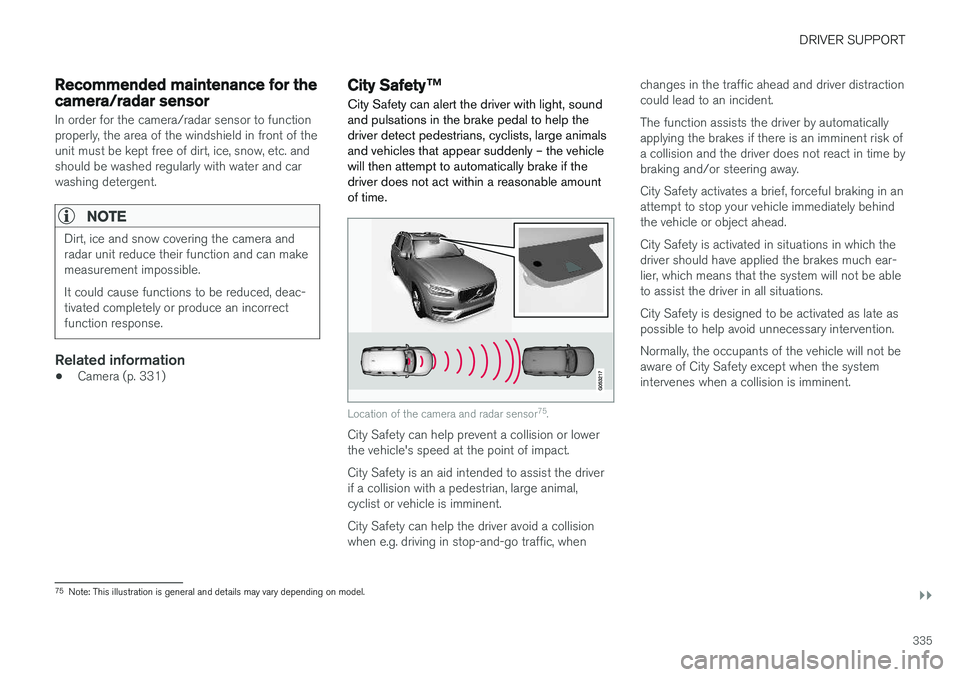
Location of the camera and radar sensor 75
.
City Safety can help prevent a collision or lower the vehicle's speed at the point of impact. City Safety is an aid intended to assist the driver if a collision with a pedestrian, large animal,cyclist or vehicle is imminent. City Safety can help the driver avoid a collision when e.g. driving in stop-and-go traffic, when changes in the traffic ahead and driver distractioncould lead to an incident. The function assists the driver by automatically applying the brakes if there is an imminent risk ofa collision and the driver does not react in time bybraking and/or steering away. City Safety activates a brief, forceful braking in an attempt to stop your vehicle immediately behindthe vehicle or object ahead. City Safety is activated in situations in which the driver should have applied the brakes much ear-lier, which means that the system will not be ableto assist the driver in all situations. City Safety is designed to be activated as late as possible to help avoid unnecessary intervention. Normally, the occupants of the vehicle will not be aware of City Safety except when the systemintervenes when a collision is imminent.
75
Note: This illustration is general and details may vary depending on model.
Page 353 of 686
DRIVER SUPPORT
* Option/accessory.351
Recommended maintenance forBLIS
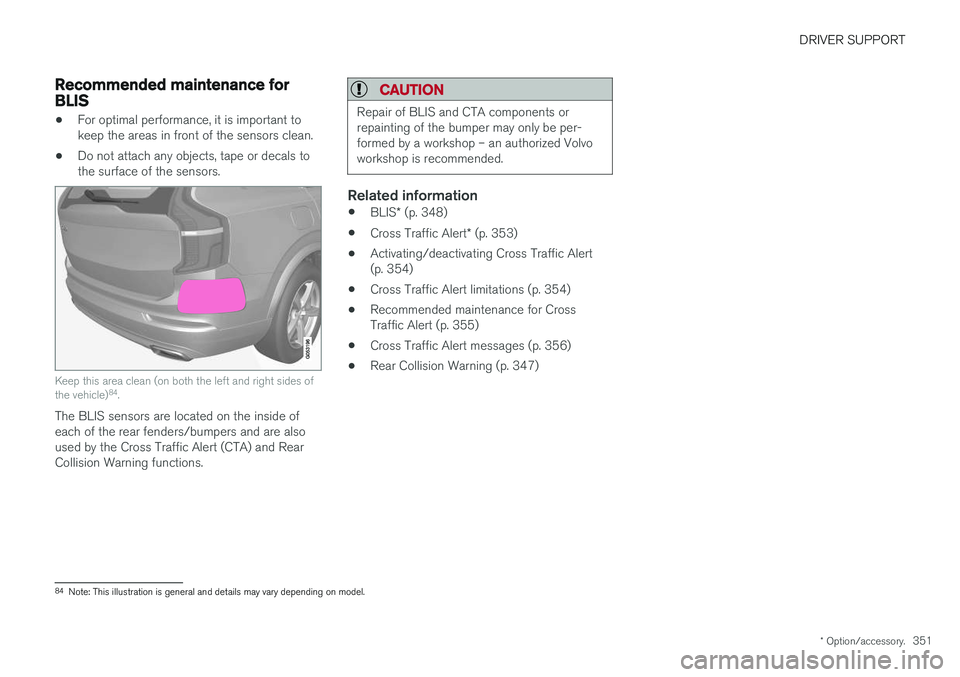
•For optimal performance, it is important to keep the areas in front of the sensors clean.
• Do not attach any objects, tape or decals tothe surface of the sensors.
Keep this area clean (on both the left and right sides of the vehicle) 84
.
The BLIS sensors are located on the inside of each of the rear fenders/bumpers and are alsoused by the Cross Traffic Alert (CTA) and RearCollision Warning functions.
CAUTION
Repair of BLIS and CTA components or repainting of the bumper may only be per-formed by a workshop – an authorized Volvoworkshop is recommended.
Related information
• BLIS
* (p. 348)
• Cross Traffic Alert
* (p. 353)
• Activating/deactivating Cross Traffic Alert (p. 354)
• Cross Traffic Alert limitations (p. 354)
• Recommended maintenance for CrossTraffic Alert (p. 355)
• Cross Traffic Alert messages (p. 356)
• Rear Collision Warning (p. 347)
84
Note: This illustration is general and details may vary depending on model.
Page 355 of 686
DRIVER SUPPORT
* Option/accessory.353
Cross Traffic Alert *
CTA 86
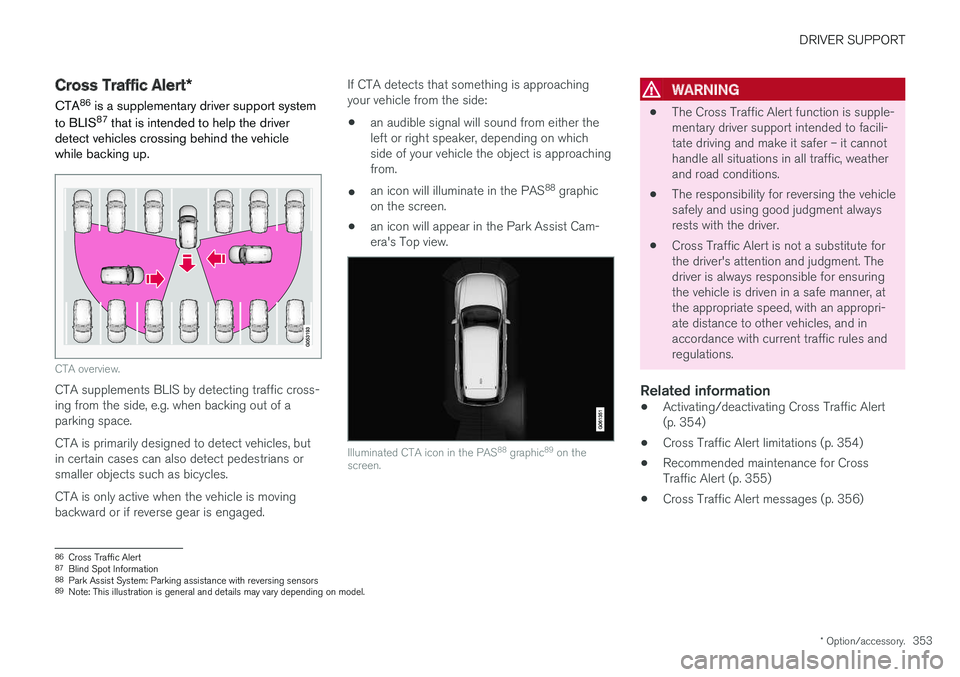
is a supplementary driver support system
to BLIS 87
that is intended to help the driver
detect vehicles crossing behind the vehicle while backing up.
CTA overview.
CTA supplements BLIS by detecting traffic cross- ing from the side, e.g. when backing out of aparking space. CTA is primarily designed to detect vehicles, but in certain cases can also detect pedestrians orsmaller objects such as bicycles. CTA is only active when the vehicle is moving backward or if reverse gear is engaged. If CTA detects that something is approachingyour vehicle from the side:
• an audible signal will sound from either theleft or right speaker, depending on whichside of your vehicle the object is approachingfrom.
• an icon will illuminate in the PAS 88
graphic
on the screen.
• an icon will appear in the Park Assist Cam-era's Top view.
Illuminated CTA icon in the PAS 88
graphic 89
on the
screen.
WARNING
• The Cross Traffic Alert function is supple- mentary driver support intended to facili-tate driving and make it safer – it cannothandle all situations in all traffic, weatherand road conditions.
• The responsibility for reversing the vehiclesafely and using good judgment alwaysrests with the driver.
• Cross Traffic Alert is not a substitute forthe driver's attention and judgment. Thedriver is always responsible for ensuringthe vehicle is driven in a safe manner, atthe appropriate speed, with an appropri-ate distance to other vehicles, and inaccordance with current traffic rules andregulations.
Related information
•
Activating/deactivating Cross Traffic Alert(p. 354)
• Cross Traffic Alert limitations (p. 354)
• Recommended maintenance for CrossTraffic Alert (p. 355)
• Cross Traffic Alert messages (p. 356)
86
Cross Traffic Alert
87 Blind Spot Information
88 Park Assist System: Parking assistance with reversing sensors
89 Note: This illustration is general and details may vary depending on model.