power steering VOLVO XC90 TWIN ENGINE 2018 User Guide
[x] Cancel search | Manufacturer: VOLVO, Model Year: 2018, Model line: XC90 TWIN ENGINE, Model: VOLVO XC90 TWIN ENGINE 2018Pages: 686, PDF Size: 17 MB
Page 191 of 686

SEATS AND STEERING WHEEL
* Option/accessory.189
•
Storing memory settings in power front
seats* (p. 186)
• Using stored memory in a powered front seat
(p. 187)
• Adjusting front seat cushion length (p. 189)
• Front seat massage settings* (p. 188)
• Adjusting front seat side bolster settings*
(p. 190)
• Adjusting front seat lumbar support* (p. 190)
• Adjusting the passenger seat from the driv-
er's seat* (p. 191) Adjusting front seat cushion length
The settings can be adjusted using either the
multifunction control* on the seat or the center
display. The adjustment settings are shown in
the center display. Multifunction control, located on the side of the seat
cushion.
Turn the control up or down to activate the multi-
function control.
Adjusting the seat cushionThe length of the seat cushion can be adjusted
using the multifunction control on the side of the
seat.
1. Activate the multifunction control by turning the control upward/downward. The seat set-
tings view will appear in the center display. 2.
Select Cushion extension in the seat set-
tings view.
• Push in the front part of the four-way but-
ton (the round one) to extend the seat
cushion.
• Press the rear part of the four-way button
to shorten the seat cushion.
Related information
• Manual front seats (p. 184)
• Power front seats* (p. 185)
• Adjusting the power front seats* (p. 185)
• Storing memory settings in power front
seats* (p. 186)
• Using stored memory in a powered front seat
(p. 187)
• Adjusting front seat massage settings*
(p. 188)
• Front seat massage settings* (p. 188)
• Adjusting front seat side bolster settings*
(p. 190)
• Adjusting front seat lumbar support* (p. 190)
• Adjusting the passenger seat from the driv-
er's seat* (p. 191)
Page 192 of 686

SEATS AND STEERING WHEEL
* Option/accessory.
190 Adjusting front seat side bolster
settings*
The settings can be adjusted using either the
multifunction control* on the seat or the center
display. The adjustment settings are shown in
the center display. Multifunction control, located on the side of the seat
cushion.
The side bolsters in the front seat backrests can
be inflated/deflated to adjust the amount of sup-
port provided.
To adjust the side bolsters:
1.
Activate the multifunction control by turning
the control upward/downward . The seat
settings view will appear in the center dis-
play. 2.
Select Side bolsters in the seat settings
view.
• Press the front part of the four-way button
to increase side bolster support .
• Press the rear part of the four-way button
to decrease side bolster support.
Related information
• Manual front seats (p. 184)
• Power front seats* (p. 185)
• Adjusting the power front seats* (p. 185)
• Storing memory settings in power front
seats* (p. 186)
• Using stored memory in a powered front seat
(p. 187)
• Adjusting front seat massage settings*
(p. 188)
• Adjusting front seat cushion length (p. 189)
• Front seat massage settings* (p. 188)
• Adjusting front seat lumbar support* (p. 190)
• Adjusting the passenger seat from the driv-
er's seat* (p. 191) Adjusting front seat lumbar
support*
Activate the multifunction control* by turning the
control upward/downward. The seat settings
view will appear in the center display. Multifunction control, located on the side of the seat
cushion.
Lumbar support can be adjusted in four direc-
tions by pressing the four-way lumbar support
button on the side of the seat cushion. The lum-
bar support can be adjusted forward/backward
and up/down.
Adjusting front seat lumbar support*To adjust the lumbar support:
1. Activate the multifunction control by turning the control upward/downward. The seat set-
tings view will appear in the center display.
Page 193 of 686
SEATS AND STEERING WHEEL
}}
* Option/accessory. 191
2.
Select Lumbar in the seat settings view.
• Press the four-way button (the round but-
ton) up/down to move the lumbar support
upward/downward.
• Press the front part of the four-way button
to increase lumbar support.
• Press the rear part of the four-way button
to decrease lumbar support.
Related information
• Manual front seats (p. 184)
• Power front seats* (p. 185)
• Adjusting the power front seats* (p. 185)
• Storing memory settings in power front
seats* (p. 186)
• Using stored memory in a powered front seat
(p. 187)
• Adjusting front seat massage settings*
(p. 188)
• Adjusting front seat cushion length (p. 189)
• Front seat massage settings* (p. 188)
• Adjusting front seat side bolster settings*
(p. 190)
• Adjusting the passenger seat from the driv-
er's seat* (p. 191) Adjusting the passenger seat from
the driver's seat*
The front passenger seat can be adjusted from
the driver's seat.
Activating the functionThe function is activated via the function view in
the center display:
Tap the Adjust PassengerSeat button to activate.
Adjust passenger seatThe driver must adjust the passenger seat within
10 seconds of activating the function. If no
adjustment is made within this time, the function
will be deactivated.
The driver adjusts the passenger seat using the
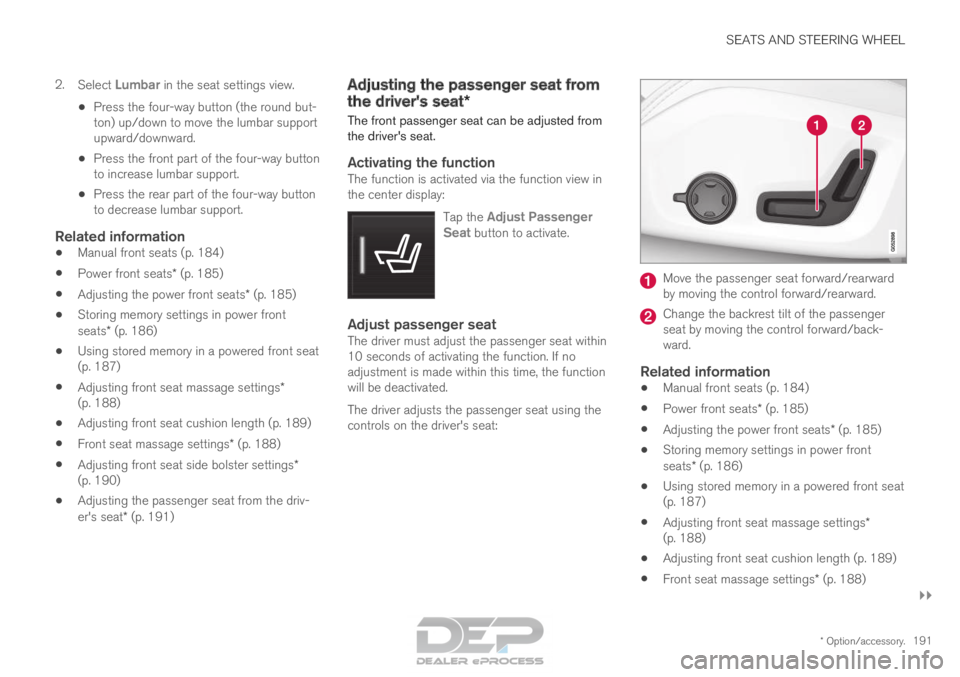
controls on the driver's seat: Move the passenger seat forward/rearward
by moving the control forward/rearward.
Change the backrest tilt of the passenger
seat by moving the control forward/back-
ward.
Related information
•
Manual front seats (p. 184)
• Power front seats* (p. 185)
• Adjusting the power front seats* (p. 185)
• Storing memory settings in power front
seats* (p. 186)
• Using stored memory in a powered front seat
(p. 187)
• Adjusting front seat massage settings*
(p. 188)
• Adjusting front seat cushion length (p. 189)
• Front seat massage settings* (p. 188)
Page 201 of 686
SEATS AND STEERING WHEEL
}}
* Option/accessory. 199
Steering wheel controls and horn
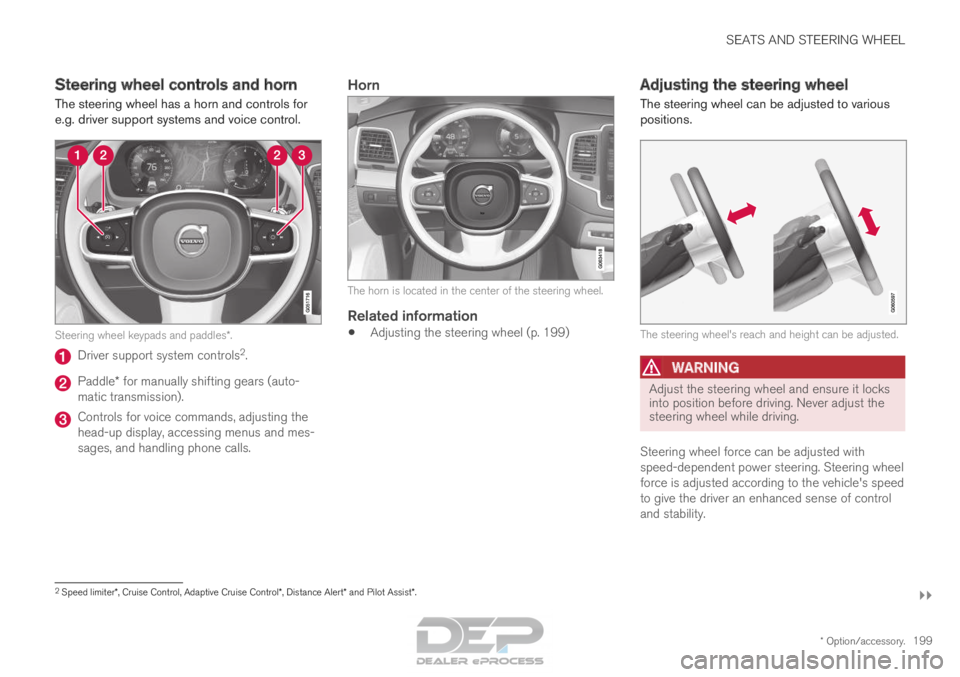
The steering wheel has a horn and controls for
e.g. driver support systems and voice control.
Steering wheel keypads and paddles*.
Driver support system controls
2
. Paddle* for manually shifting gears (auto-
matic transmission). Controls for voice commands, adjusting the
head-up display, accessing menus and mes-
sages, and handling phone calls.
Horn The horn is located in the center of the steering wheel.
Related information
•
Adjusting the steering wheel (p. 199) Adjusting the steering wheel
The steering wheel can be adjusted to various
positions. The steering wheel's reach and height can be adjusted.
WARNING
Adjust the steering wheel and ensure it locks
into position before driving. Never adjust the
steering wheel while driving.
Steering wheel force can be adjusted with
speed-dependent power steering. Steering wheel
force is adjusted according to the vehicle's speed
to give the driver an enhanced sense of control
and stability. 2
Speed limiter*, Cruise Control, Adaptive Cruise Control*, Distance Alert* and Pilot Assist*.
Page 217 of 686
CLIMATE CONTROL
}}
* Option/accessory. 215
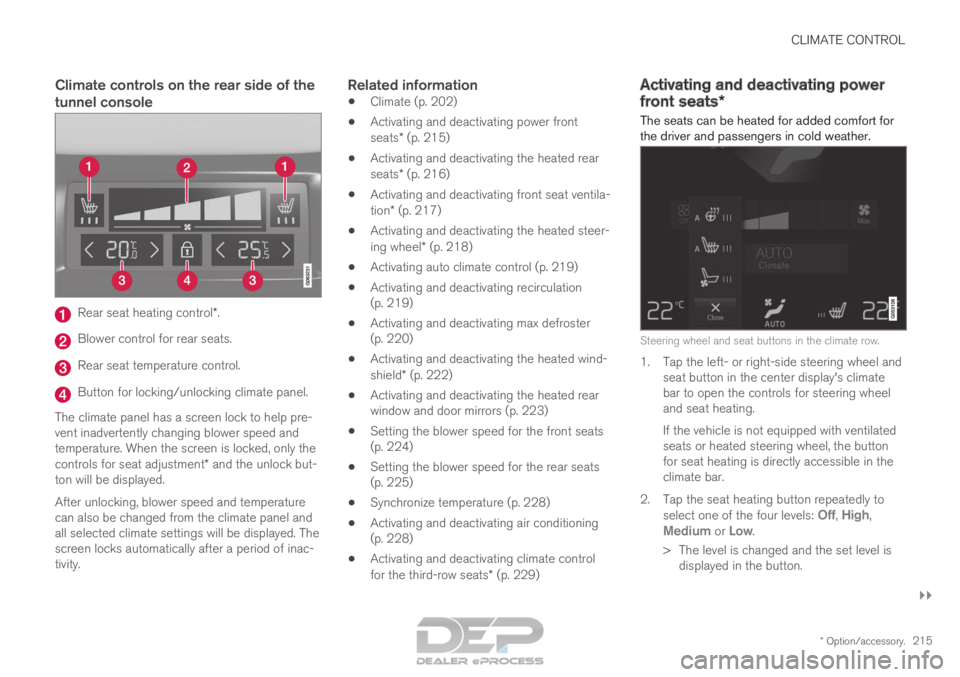
Climate controls on the rear side of the
tunnel consoleRear seat heating control*.
Blower control for rear seats.
Rear seat temperature control.
Button for locking/unlocking climate panel.
The climate panel has a screen lock to help pre-
vent inadvertently changing blower speed and
temperature. When the screen is locked, only the
controls for seat adjustment* and the unlock but-
ton will be displayed.
After unlocking, blower speed and temperature
can also be changed from the climate panel and
all selected climate settings will be displayed. The
screen locks automatically after a period of inac-
tivity.Related information
• Climate (p. 202)
• Activating and deactivating power front
seats* (p. 215)
• Activating and deactivating the heated rear
seats* (p. 216)
• Activating and deactivating front seat ventila-
tion* (p. 217)
• Activating and deactivating the heated steer-
ing wheel* (p. 218)
• Activating auto climate control (p. 219)
• Activating and deactivating recirculation
(p. 219)
• Activating and deactivating max defroster
(p. 220)
• Activating and deactivating the heated wind-
shield* (p. 222)
• Activating and deactivating the heated rear
window and door mirrors (p. 223)
• Setting the blower speed for the front seats
(p. 224)
• Setting the blower speed for the rear seats
(p. 225)
• Synchronize temperature (p. 228)
• Activating and deactivating air conditioning
(p. 228)
• Activating and deactivating climate control
for the third-row seats* (p. 229) Activating and deactivating power
front seats*
The seats can be heated for added comfort for
the driver and passengers in cold weather. Steering wheel and seat buttons in the climate row.
1. Tap the left- or right-side steering wheel and
seat button in the center display's climate
bar to open the controls for steering wheel
and seat heating.
If the vehicle is not equipped with ventilated
seats or heated steering wheel, the button
for seat heating is directly accessible in the
climate bar.
2.
Tap the seat heating button repeatedly to
select one of the four levels: Off,
High,
Medium or Low.
>
The level is changed and the set level is
displayed in the button.
Page 274 of 686
DRIVER SUPPORT
* Option/accessory.
272 Driver support systems
The vehicle is equipped with a number of driver
support systems that can provide the driver with
active or passive assistance in various situations.
The system can, for example, help the driver
maintain a set speed or a set time interval to the
vehicle ahead, help prevent a collision by warning
the driver and applying the brakes, or assist the
driver while parking.
Some of the systems are standard and others are
options. This also varies from market to market.
Related information
• Speed-dependent steering wheel resistance
(p. 272)
• Electronic Stability Control (p. 274)
• Stability system Roll Stability Control
(p. 273)
• Rear Collision Warning (p. 347)
• Speed limiter (p. 278)
• Cruise control (p. 286)
• Distance Alert* (p. 291)
• Adaptive Cruise Control* (p. 295)
• Pilot Assist (p. 311)
• Radar sensor (p. 326)
• Camera (p. 331)
• City Safety™ (p. 335)
• BLIS* (p. 348) •
Cross Traffic Alert* (p. 353)
• Road Sign Information* (p. 357)
• Driver Alert Control (p. 362)
• Lane Keeping Aid (p. 364)
• Steering assistance at risk of collision
(p. 372)
• Park Assist* (p. 381)
• Park Assist Camera* (p. 386)
• Park Assist Pilot* (p. 395) Speed-dependent steering wheel
resistance
Speed-dependent power steering increases the
steering wheel resistance in pace with the vehi-
cle's speed to give the driver an enhanced feel-
ing of control and stability.
Steering may feel stiffer on highways. When
parking and at low speeds, it will be easier to
move the steering wheel.
NOTE In some situations, the power steering may
become too hot and require temporary cool-
ing – during such time the power steering will
work at reduced output and the steering
wheel may feel more difficult to move.
In parallel with the temporarily reduced steer-
ing assistance, the driver display shows a
message as well as a STEERING WHEEL
symbol.
Page 275 of 686
DRIVER SUPPORT
* Option/accessory.273
WARNINGWhile the power steering is working at
reduced power, the driver support functions
with steering assistance are not available.
In such a situation, the driver display shows
the
Power steering failure or Power
Steering Assist Temporarily Reduced message, combined with a STEERING
WHEEL symbol.
Changing the level of steering wheel
resistance*
To change the level of steering wheel resistance,
see the description of the INDIVIDUAL option
under "Available drive modes" in the "Drive
modes" section.
On models not equipped with drive mode con-
trols and the INDIVIDUAL option, steering wheel
resistance can instead be set in the center dis-
play's Top view under:
Settings My Car Drive Modes
Steering force
Steering wheel resistance settings cannot be
accessed when turning at speeds above
10 km/h (6 mph).
Related information
•
Drive modes (p. 445)
• Pilot Assist (p. 311) •
Lane Keeping Aid (p. 364)
• Steering assistance at risk of collision
(p. 372)
• Park Assist Pilot* (p. 395) Stability system Roll Stability
Control
The Roll Stability Control (RSC 1
) system helps
minimize the risk of a rollover in the event of e.g.
a sudden evasive maneuver or if the vehicle
begins to skid.
The RSC system monitors the lateral angle at
which the vehicle is leaning and registers any
changes. Using this information, the system cal-
culates the likelihood of a rollover. If there is an
imminent risk of a rollover, Electronic Stability
Control is activated, engine torque is reduced and
brakes are applied to one or more of the wheels
until the vehicle has regained stability.
WARNING The vehicle
Page 326 of 686
||DRIVER SUPPORT
* Option/accessory.
324 The driver is responsible for ensuring that
the vehicle maintains a suitable distance
from such obstacles.
• The camera and radar sensors do not
have the capacity to detect all oncoming
objects and obstacles in traffic environ-
ments, e.g. potholes, stationary obstacles
or objects that completely or partially
block the route.
• Pilot Assist does not "see" pedestrians,
animals, etc.
• The recommended steering input is lim-
ited in force, which means that it cannot
always help the driver to steer and keep
the vehicle within the lane.
• Pilot Assist is switched off if the power
steering is working with reduced power -
e.g. during cooling due to overheating
(see section "Speed-dependent steering
force").
The driver can always correct or adjust steering
assistance provided by Pilot Assist by turning the
steering wheel to the desired position.
Steep roads and/or heavy loadsPilot Assist is primarily intended to be driven on
flat roads. The function may not be able to main-
tain the correct time interval to the vehicle ahead
when driving down steep hills. The driver should be extra attentive and prepared to apply the
brakes.
• Do not use Pilot Assist if the vehicle is carry-
ing a heavy load or towing a trailer.
NOTE Pilot Assist cannot be activated if a trailer,
bike carrier or similar is connected to the
vehicle electrical system.
Other limitations
•
The
Off Road drive mode cannot be
selected when Pilot Assist is activated.
NOTE The function uses the vehicle's camera unit,
which has some general limitations – see the
section "Camera unit limitations".
NOTE
The function uses the vehicle's radar unit,
which has some general limitations – see the
section "Radar unit limitations".
Related information
•
Pilot Assist (p. 311)
• Speed-dependent steering wheel resistance
(p. 272) Pilot Assist* symbols and messages
A number of symbols and messages relating to
Pilot Assist may be displayed in the instrument
panel and/or the head-up display*.
Page 346 of 686

DRIVER SUPPORT
344City Safety limitations
City Safety functionality may be reduced in cer-
tain situations.
Surroundings
Low objects
Hanging objects, such as flags for overhanging
loads or accessories such as auxiliary lights or
front protective grids that extend beyond the
height of the hood, may limit City Safety function-
ality.
Slippery road conditions
The extended braking distance on slippery roads
may reduce City Safety's capacity to help avoid a
collision. In these types of situations, the Anti-
lock Braking System and Electronic Stability Con-
trol (ESC 77
) will help provide optimal braking
power with maintained stability.
Backlighting
The visual warning signal in the windshield may
be difficult to detect in bright sunlight, if there are
reflections, or if the driver is wearing sunglasses
or not looking straight ahead.
Heat
If the temperature in the passenger compartment
is high due to e.g. bright sunlight, the visual warn-
ing signal in the windshield may be temporarily
disabled.
Camera and radar sensor's field of vision
The camera's field of vision is limited and in cer-
tain situations, it may be unable to detect pedes-
trians, large animals, cyclists or vehicles, or it may
detect them later than expected.
Vehicles that are dirty may be detected later than
clean vehicles, and in dark conditions, motorcy-
cles may be detected late or not at all.
If a text message displayed in the instrument
panel indicates that the camera/radar sensor is
obstructed, it may be difficult for City Safety to
detect pedestrians, large animals, cyclists, vehi-
cles or lane markings in front of the vehicle. City
Safety functionality may therefore be reduced.
Text messages may not be displayed for all situa-
tions in which the windshield sensors are
blocked. The driver must therefore always keep
the windshield in front of the camera/radar sen-
sor clean.
CAUTION Maintenance and replacement of City Safety
components may only be performed by a
workshop – an authorized Volvo workshop is
recommended.
Driver intervention
Backing up
City Safety is temporarily deactivated when the
vehicle is backing up.
Low speed
City Safety is not activated at very low speeds
under 4 km/h (3 mph). The system will therefore
not intervene in situations in which your vehicle is
approaching another vehicle very slowly, such as
when parking.
Active driver
Action by the driver always has priority. City
Safety will therefore not react or will react at a
later stage with a warning or intervention in situa-
tions in which the driver is clearly steering and
operating the accelerator pedal, even if a collision
is unavoidable.
An active and aware driving style may therefore
delay collision warnings and intervention in order
to minimize unnecessary warnings.
77
Electronic Stability Control
Page 369 of 686
DRIVER SUPPORT
}}
367
Activating/deactivating Lane
Keeping Aid
The Lane Keeping Aid (LKA
111
) function can be
switched On or Off.
On/OffPress the Lane Keeping Aid
button in the center display's
Function view. •
GREEN button indicator light - LKA is acti-
vated.
• GRAY button indicator light - LKA is deacti-
vated.
Related information
•Lane Keeping Aid (p. 364) Selecting type of assistance for
Lane Keeping Aid
The driver can determine what types of assis-
tance LKA 112
should provide if the vehicle veers
from its lane.
1. Select
Settings My Car IntelliSafe in
the center display's Top view.
2. Under Lane Keeping Aid Mode, select
what assistance LKA should provide:
• Assist the driver will receive steering
assistance but no warning.
• Both - the driver will receive both steering
assistance and a warning.
• Warning - the driver will only receive a
warning.
Related information
• Lane Keeping Aid (p. 364) Lane Keeping Aid limitations
In certain demanding driving conditions, Lane
Keeping Aid may not be able to properly assist
the driver. In these situations, it is recommended
that the function be deactivated. Examples of such situations include:
• road work
• winter driving conditions
• poor road surfaces
• a very sporty driving style
• bad weather with reduced visibility
• roads with indistinct or no lane markings
• sharp edges or lines other than the lane's
side markings
• when the power steering works at reduced
power - e.g. during cooling due to overheat-
ing (see section "Speed-dependent steering
force").
NOTE The function uses the vehicle's camera unit,
which has some general limitations – see the
section "Camera unit limitations".
111
Lane Keeping Aid
112 Lane Keeping Aid