power steering VOLVO XC90 TWIN ENGINE 2018 Owner's Manual
[x] Cancel search | Manufacturer: VOLVO, Model Year: 2018, Model line: XC90 TWIN ENGINE, Model: VOLVO XC90 TWIN ENGINE 2018Pages: 686, PDF Size: 17 MB
Page 376 of 686
||DRIVER SUPPORT
* Option/accessory.
374
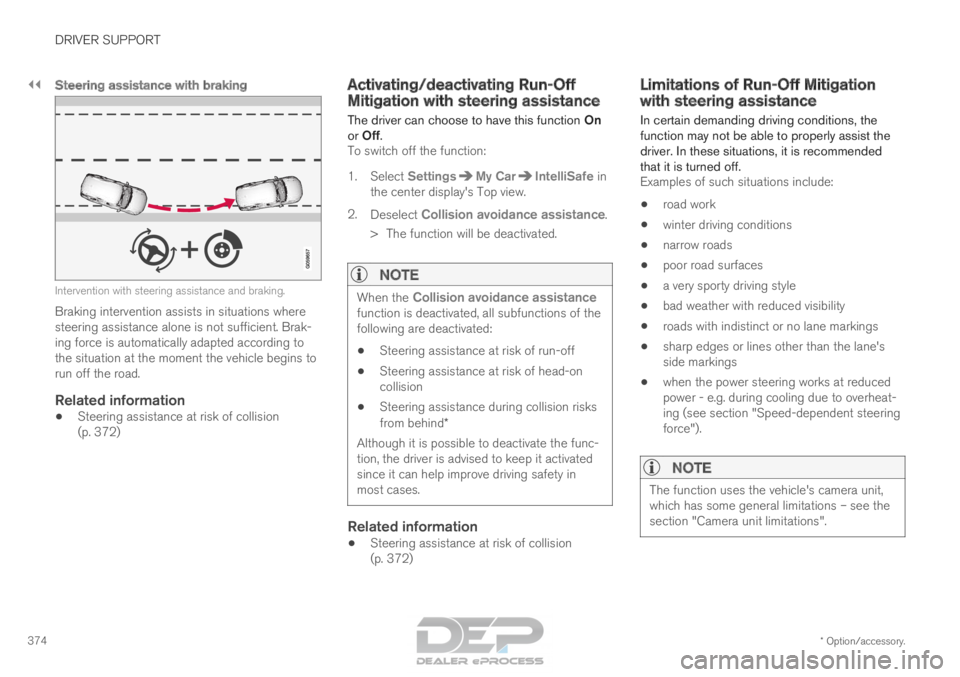
Steering assistance with braking Intervention with steering assistance and braking.
Braking intervention assists in situations where
steering assistance alone is not sufficient. Brak-
ing force is automatically adapted according to
the situation at the moment the vehicle begins to
run off the road.
Related information
• Steering assistance at risk of collision
(p. 372) Activating/deactivating Run-Off
Mitigation with steering assistance
The driver can choose to have this function On
or Off.
To switch off the function:
1.
Select Settings My Car IntelliSafe
in
the center display's Top view.
2. Deselect Collision avoidance assistance.
>
The function will be deactivated.
NOTE When the
Collision avoidance assistance
function is deactivated, all subfunctions of the
following are deactivated:
• Steering assistance at risk of run-off
• Steering assistance at risk of head-on
collision
• Steering assistance during collision risks
from behind*
Although it is possible to deactivate the func-
tion, the driver is advised to keep it activated
since it can help improve driving safety in
most cases.
Related information
• Steering assistance at risk of collision
(p. 372) Limitations of Run-Off Mitigation
with steering assistance
In certain demanding driving conditions, the
function may not be able to properly assist the
driver. In these situations, it is recommended
that it is turned off.
Examples of such situations include:
• road work
• winter driving conditions
• narrow roads
• poor road surfaces
• a very sporty driving style
• bad weather with reduced visibility
• roads with indistinct or no lane markings
• sharp edges or lines other than the lane's
side markings
• when the power steering works at reduced
power - e.g. during cooling due to overheat-
ing (see section "Speed-dependent steering
force").
NOTE The function uses the vehicle's camera unit,
which has some general limitations – see the
section "Camera unit limitations".
Page 378 of 686
||DRIVER SUPPORT
* Option/accessory.
376
Related information
• Steering assistance at risk of collision
(p. 372) Activating/deactivating Steering
assistance during collision risks
with oncoming vehicles
The driver can choose to have this function On
or Off.
To switch off the function:
1.
Select Settings My Car IntelliSafe
in
the center display's Top view.
2. Deselect Collision avoidance assistance.
>
The function will be deactivated.
NOTE When the
Collision avoidance assistance
function is deactivated, all subfunctions of the
following are deactivated:
• Steering assistance at risk of run-off
• Steering assistance at risk of head-on
collision
• Steering assistance during collision risks
from behind*
Although it is possible to deactivate the func-
tion, the driver is advised to keep it activated
since it can help improve driving safety in
most cases.
Related information
• Steering assistance at risk of collision
(p. 372) Limitations of steering assistance
during collision risks from
oncoming traffic
The function may have limited functionality in
certain situations and not intervene, e.g.:
•
for smaller vehicles such as motorcycles
• on roads that do not have clear lane mark-
ings
• if more than half of your vehicle has moved
into the adjacent lane
• outside the speed range 60-140 km/h
(37-87 mph)
• when the power steering works at reduced
power - e.g. during cooling due to overheat-
ing (see section "Speed-dependent steering
force").
Functionality may also be reduced in other situa-
tions, such as: • road work
• winter driving conditions
• narrow roads
• poor road surfaces
• a very sporty driving style
• bad weather with reduced visibility.
In these demanding driving conditions, the func-
tion may not be able to properly assist the driver.
In these situations, it is recommended that it is
turned off.
Page 380 of 686
||DRIVER SUPPORT
* Option/accessory.
378
Related information
• Steering assistance at risk of collision
(p. 372) Activating/deactivating Steering
assistance during collision risks
from behind*
The driver can choose to have this function On
or Off.
To switch it off:
1.
Select Settings My Car IntelliSafe
in
the center display's Top view.
2. Deselect Collision avoidance assistance.
>
The function will be deactivated.
NOTE When the
Collision avoidance assistance
function is deactivated, all subfunctions of the
following are deactivated:
• Steering assistance at risk of run-off
• Steering assistance at risk of head-on
collision
• Steering assistance during collision risks
from behind*
Although it is possible to deactivate the func-
tion, the driver is advised to keep it activated
since it can help improve driving safety in
most cases.
Related information
• Steering assistance at risk of collision
(p. 372) Limitations of steering assistance
during collision risks from behind
The function may have limited functionality in
certain situations and not intervene, e.g.:
•
for smaller vehicles such as motorcycles
• if more than half of your vehicle has moved
into the adjacent lane
• on roads/lanes with indistinct or no side lane
markings
• outside the speed range 60-140 km/h
(37-87 mph)
• when the power steering works at reduced
power - e.g. during cooling due to overheat-
ing (see section "Speed-dependent steering
force").
Functionality may also be reduced in other situa-
tions, such as: • road work
• winter driving conditions
• narrow roads
• poor road surfaces
• a very sporty driving style
• bad weather with reduced visibility.
In these demanding driving conditions, the func-
tion may not be able to properly assist the driver.
In these situations, it is recommended that it is
turned off.
Page 402 of 686

DRIVER SUPPORT
* Option/accessory.
400 Park Assist Pilot* limitations
Park Assist Pilot PAP 127
may not be able to
detect all conditions in all situations and func-
tionality may therefore be limited.
WARNING •
The PAP function is supplementary driver
support intended to facilitate driving and
help make it safer – it cannot handle all
situations in all traffic, weather and road
conditions.
• Pay particular attention to people and
animals near the vehicle.
• Bear in mind that the front end of the
vehicle may swing out towards oncoming
traffic during the parking maneuver.
• Objects situated higher than the detec-
tion area of the sensors are not included
when the parking maneuver is calculated,
which could cause PAP to swing into the
parking space too early. Such parking
spaces should be avoided for this reason.
• PAP is not a substitute for the driver's
attention and judgment. The driver is
always responsible for ensuring the vehi-
cle is driven in a safe manner, at the
appropriate speed, with an appropriate
distance to other vehicles, and in accord-
ance with current traffic rules and regula-
tions.
The driver should be aware of the following limi-
tations for Park Assist Pilot:The parking sequence is cancelledA parking sequence will be cancelled if:
• the driver moves the steering wheel
• the vehicle's speed exceeds 7 km/h (4 mph)
• the driver taps
Cancel in the center display
• when the anti-lock brakes or the Electronic
stability control are engaged - e.g. when a
wheel loses grip on a slippery road
• when the power steering works at reduced
power - e.g. during cooling due to overheat-
ing (see section "Speed-dependent steering
force").
A message in the center display will explain why
the parking sequence was cancelled.
CAUTION Under certain circumstances, PAP may not be
able to find parking spaces – one reason may
be that the sensors are disrupted by external
sound sources that emit the same ultrasonic
frequencies that the system works with.
Examples of such sources include horns, wet
tires on asphalt, pneumatic brakes, exhaust
noise from motorcycles, etc.
127
Park Assist Pilot
Page 408 of 686
HYBRID INFORMATION
406General information about Twin
Engine
Twin Engine vehicles are driven just like any
other vehicle, but certain functions differ from a
vehicle powered exclusively by gasoline. The
electric motor powers the vehicle primarily at low
speeds; the gasoline engine is used at higher
speeds or during more active driving. The instrument panel displays Twin Engine-spe-
cific information - charging information, selected
drive mode, distance to discharged battery and
hybrid battery charge level.
Different drive modes can be selected while driv-
ing, e.g. electric power only or, if more power is
needed, a combination of electric and gasoline
power. The vehicle calculates the optimal combi-
nation of driveability, driving experience, environ-
mental impact and fuel economy for the selected
drive mode.
In order to function optimally, the hybrid battery
(and its electrical drive systems) and the gasoline
engine (and its drive systems) must be at the
correct operating temperature. Battery capacity
can be considerably reduced if the battery is too
cold or too hot. Preconditioning prepares the
vehicle's drive systems and passenger compart-
ment before driving to help reduce both wear and
energy consumption. It also helps increase the
hybrid battery's range.
The hybrid battery, which powers the electric
motor, is recharged using the charging cable. It
can also be recharged during light braking and through engine braking in gear position B. The
combustion engine can also help recharge the
hybrid battery.
Important
No electrical current
Keep in mind that if there is no electrical current
to the vehicle, i.e. the ignition is switched off or
the start battery is discharged, certain functions
such as brakes, power steering, etc. will not work.
WARNING If the vehicle does not have electrical current
and both the electric motor and the gasoline
engine are switched off, the brakes cannot be
used to stop the vehicle.
Towing not permitted
Never tow a Twin Engine vehicle behind another
vehicle, as this could damage the electric motor.
Exterior engine noise
WARNING
Keep in mind that the vehicle does not emit
any engine noise when using the electric
motor and may therefore be difficult to detect
for children, pedestrians, cyclists or animals.
This is especially true at low speeds, e.g. in
parking lots.
High-voltage electrical current
WARNING Several components in the vehicle work with
high voltage that can be hazardous in case of
an incorrect procedure. These components
and any orange wiring in the vehicle may only
be handled by trained and qualified Volvo
service technicians.
Do not touch anything that is not clearly descri-
bed in this Owner's Manual.
Related information
• Charging the hybrid battery (p. 407)
• Hybrid gauge (p. 87)
• Drive modes (p. 445)
• Starting and stopping preconditioning
(p. 231)
• Hybrid battery (p. 619)
• Factors affecting electric motor range
(p. 458)
• Gear selector positions for automatic trans-
missions (p. 439)
• Towing using a towline (p. 476)
Page 440 of 686
||STARTING AND DRIVING
* Option/accessory.
438
Related information
• Rear Collision Warning (p. 347)
• BLIS* (p. 348)
• Brake functions (p. 429) Transmission
The transmission is part of the vehicle's driveline
(power transmission) between the engine and
the drive wheels. The function of the transmis-
sion is to change gears depending on speed
and power needs.
The vehicle has an 8-speed automatic transmis-
sion and an electric motor for rear-wheel drive.
The number of gears allows the engine's torque
and power band to be effectively utilized. Two of
the gears are overdrive gears that save fuel when
driving at a constant engine speed. The steering
wheel paddles* can be used to shift up or down
manually. The instrument panel shows the gear
currently in use.
CAUTION Check the operating temperature of the
transmission to help avoid damage to any of
the drive system components. If there is a risk
of overheating, a warning symbol will appear
in the instrument panel and a text message
will be displayed. Follow the recommenda-
tions given.
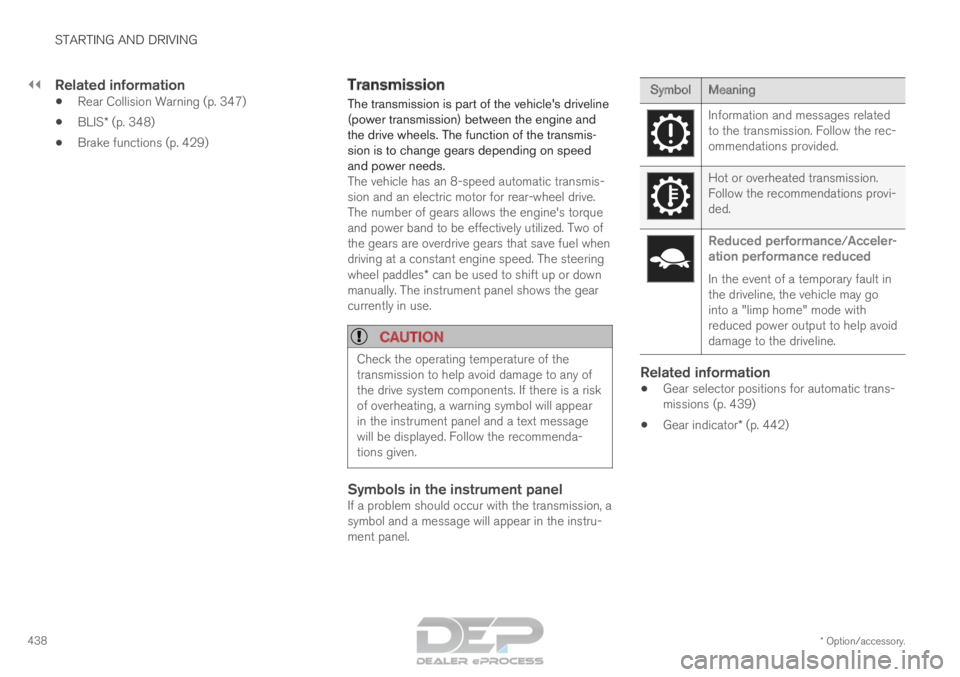
Symbols in the instrument panelIf a problem should occur with the transmission, a
symbol and a message will appear in the instru-
ment panel. Symbol
Meaning Information and messages related
to the transmission. Follow the rec-
ommendations provided.
Hot or overheated transmission.
Follow the recommendations provi-
ded.
Reduced performance/Acceler-
ation performance reduced
In the event of a temporary fault in
the driveline, the vehicle may go
into a "limp home" mode with
reduced power output to help avoid
damage to the driveline.
Related information
• Gear selector positions for automatic trans-
missions (p. 439)
• Gear indicator* (p. 442)
Page 447 of 686

STARTING AND DRIVING
}}
* Option/accessory. 445
Drive modes
Drive modes affect the vehicle's driving charac-
teristics in different ways to enhance and sim-
plify the driving experience in certain types of sit-
uations. Drive modes enable easy access to the vehicle's
many functions and settings in different driving
situations. The following systems are adapted to
help optimize driving characteristics in each drive
mode:
• Steering
• Engine/transmission/all-wheel drive
• Brakes
• Pneumatic suspension* and shock absorbers
• Instrument panel
• Climate control settings
Select the drive mode that is best suited to the
current driving conditions. Keep in mind that not
all drive modes are available in all situations.
Available drive modes
WARNING Keep in mind that the vehicle does not emit
any engine noise when using the electric
motor and may therefore be difficult to detect
for children, pedestrians, cyclists or animals.
This is particularly true at low speeds, e.g. in
parking lots.
WARNING
Do not leave the vehicle in an unventilated
area with a drive mode activated and the com-
bustion engine switched off. The engine will
start automatically if the charge level in the
hybrid battery is low and the resulting exhaust
gases can be very harmful to people and ani-
mals.
HYBRID
•
This is the default mode in which the electric
motor and combustion engine work together.
The vehicle starts in Hybrid mode. The control
system uses both the electric motor and the gas-
oline engine - separately or in tandem - and cal-
culates optimal utilization with regard to perform-
ance, fuel consumption and comfort. At high
speeds, ground clearance is automatically low-
ered 4
to reduce air resistance. Driving capacity on
the electric motor alone is determined by factors such as the hybrid battery's charge level, the
need for heat/cooling in the passenger compart-
ment, etc.
If there is sufficient charge in the battery, it is
possible to drive solely on electric power. When
the accelerator pedal is pressed, only the electric
motor will be activated until the battery reaches a
certain charge level. Above this level, the current
in the battery cannot supply the power requested
by the accelerator pedal and the combustion
engine will start.
When the hybrid battery's charge level is low, the
combustion engine will start more frequently to
save the remaining current in the battery. Charge
the hybrid battery from a 120-240 volt outlet
using a charging cable, or activate
Charge in
Function view to reset the option of only using
the electric motor.
This drive mode is designed for low energy con-
sumption with an optimized mix between the
electric motor and gasoline engine, without com-
promising on climate comfort or driving experi-
ence. When faster acceleration is requested by
the driver, the electric driveline will be utilized to
help provide maximum additional power. The
vehicle also monitors the driving conditions and
automatically engages all-wheel drive if neces-
sary. All-wheel drive and extra electric power are
always available regardless of the battery's
charging status. 4
For vehicles with pneumatic suspension.
Page 449 of 686
STARTING AND DRIVING
}}
447
OFF ROAD
• Maximizes the vehicle's ability to traverse dif-
ficult terrain or poor roads.
In this mode, ground clearance 4
is high, steering
is light, and all-wheel drive and Hill Descent
Control are activated.
This drive mode is only available at low speeds,
up to 40 km/h (25 mph). If this speed is excee-
ded, Off road mode will be cancelled and AWD
mode will be activated instead.
All-wheel drive requires both the combustion and
electric motor to be in continuous operation,
which results in higher fuel consumption.
In Off road mode, a compass will be displayed
between the speedometer and the tachometer in
the instrument panel. The permissible speed
range will be shown in the speedometer.
This drive mode is optimized for maximum control
when driving at low speeds on very poor roads or
difficult terrain. It raises the chassis 4
, reduces
driveline throttle response, and locks the vehicle
in all-wheel drive. The Hill Descent Control func-
tion facilitates controlled driving on steep down-
grades.NOTE This drive mode is not designed to be used
for normal street driving.
NOTE
Due to the increased ground clearance, if the
OFF ROAD mode was selected when the
engine was switched off, the suspension will
lower when the engine is restarted.
CAUTION
Do not use the OFF ROAD drive mode when
towing a trailer without an electrical connec-
tion. This could result in damage to the pneu-
matic suspension system's bellows.
AWD
•
Improves the vehicle's traction and handling
by increasing all-wheel drive.
This drive mode locks the vehicle in all-wheel
drive. An optimal distribution between front and
rear axle torque helps provide the best possible
control, stability and traction, e.g. on slippery
roads or when towing a heavy trailer or another
vehicle. The AWD drive mode is always available
regardless of the hybrid battery's charge status. Both the combustion engine and the electric
motor are engaged to enable all-wheel drive,
which results in higher fuel consumption.
In the other drive modes, the vehicle automati-
cally adapts the need for all-wheel drive accord-
ing to the road surface, and can activate the elec-
tric motor or start the combustion engine as nee-
ded.
POWER
•
Power mode is designed to provide sportier
driving characteristics and a faster accelera-
tion response.
This drive mode maximizes the combined power
from the combustion engine and the electric
motor by providing power to both the front and
rear wheels. Gear shifting will be faster and more
distinct and the transmission will prioritize gears
with a higher traction force. Steering response is
faster, suspension is stiffer and ground clearance
is lower 4
to help reduce body roll when cornering.
Both the combustion engine and the electric
motor are engaged to enable all-wheel drive,
which results in higher fuel consumption.
This drive mode is optimized for maximum per-
formance and throttle response. It changes the
throttle response, gear shifting program and
turbo boost system. Chassis settings and steer-
ing and brake response are also optimized. The
Power drive mode is always available regardless
of the hybrid battery's charge status. 4
For vehicles with pneumatic suspension.
Page 450 of 686

||STARTING AND DRIVING
448
INDIVIDUAL
•
Customizes drive mode to personal preferen-
ces.
Select one of the drive modes as a basis and
adjust the settings to achieve your preferred driv-
ing characteristics. These settings will be stored
in your driver profile.
Individual drive mode is only available if it has
been activated in the center display. Settings view
5
for Individual drive mode.
1. Tap Settings in the Top view.
2.
Tap My Car Individual Drive Mode
and
select Individual Drive Mode. 3.
Under Presets, select one of the following
drive modes as a basis: Pure, Hybrid or Power.
The following settings can be modified:
• Driver Display
• Steering force
• Powertrain Characteristics
• Brake Characteristics
• Suspension Control
• ECO Climate.
Using the combustion engineAn advanced control system determines the dis-
tance that the vehicle can be driven on the com-
bustion engine, electric motor, or both at the
same time.
Its primary function is to use the motor/engine
and the current available in the hybrid battery as
efficiently as possible based on the characteris-
tics of the various drive modes and the power
output requested by the driver by pressing the
accelerator pedal.
In certain cases, temporary limitations in the sys-
tem or mandatory functions to help maintain a
low overall emissions level may result in greater
use of the combustion engine. 5
The image is schematic and the details may vary depending on vehicle mod\
el or software update.
Page 459 of 686
STARTING AND DRIVING
}}
457
Driving
• Choose the Pure drive mode to help mini-
mize electric power consumption.
• Maintain a steady speed and a generous fol-
lowing distance to traffic ahead to minimize
braking. This drive mode has the lowest
power consumption.
• Balance energy requirements using the
accelerator pedal. Use the indicator on the
instrument panel to see available electric
power and avoid starting the combustion
engine unnecessarily. The electric motor is
more effective than the combustion engine,
especially at low speeds.
• When braking is necessary, brake gently
using the brake pedal. This will recharge the
hybrid battery. A regenerative function is
integrated in the brake pedal and can be
augmented by the electric motor's braking
capacity when the gear selector is in mode
B.
• Higher speeds increase energy consumption
- air resistance increases with speed.
• Activate the
Hold function in the Function
view at high speeds when traveling farther
than is possible using the hybrid battery's
capacity.
• Whenever possible, avoid using the Charge
function to charge the hybrid battery. Charg-
ing the battery using the combustion engine increases fuel consumption and carbon diox-
ide emissions.
• In a cold climate, reduce heating of the wind-
shield/rear window, mirrors, seats and the
steering wheel.
• Maintain the correct pressure in the tires and
check pressure regularly.
• The type of tires used could affect energy
consumption - consult a retailer for advice on
suitable tires.
• Remove unnecessary items from the vehicle
- the heavier the load, the higher the fuel
consumption.
• Roof loads increase air resistance and
increase fuel consumption. Remove roof
boxes, ski racks, etc. that are not in use.
• Avoid driving with the windows open.
• Do not keep the vehicle still on an upward
gradient by using the accelerator pedal. Use
the brakes instead.
Related information
•
Drive-E
‒
purer driving pleasure (p. 27)
• Factors affecting electric motor range
(p. 458)
• Using the electric motor only (p. 457)
• Hybrid gauge (p. 87)
• Checking tire pressure (p. 557) Using the electric motor only
When using the electric motor, Volvo Twin
Engine provides a combination of good fuel
economy, low emissions and high performance.
For energy-efficient driving:
• Select the Pure drive mode to help maximize
driving range using only the electric motor.
• Balance energy requirements using the
accelerator pedal. Use the indicator on the
instrument panel's hybrid gauge to see avail-
able electric power and avoid starting the
combustion engine unnecessarily.
• When braking is necessary, brake gently
using the brake pedal. This will recharge the
hybrid battery.
• Activate the
Hold function in the Function
view at high speeds when traveling farther
than is possible using the hybrid battery's
capacity.
• Reduce current consumption in the passen-
ger compartment by reducing e.g. fan speed,
electric heating, or air conditioning use.
Also follow the general economical driving advice
regarding speed, tires and load to maximize
range.
Related information
• General information about Twin Engine
(p. 406)
• Economical driving (p. 456)