weight VOLVO XC90 TWIN ENGINE 2018 User Guide
[x] Cancel search | Manufacturer: VOLVO, Model Year: 2018, Model line: XC90 TWIN ENGINE, Model: VOLVO XC90 TWIN ENGINE 2018Pages: 686, PDF Size: 17 MB
Page 65 of 686
SAFETY
}}63
Related information
• Safety mode (p. 61)
• Starting the vehicle (p. 424)
• Recovery (p. 477) Child safety
Children should always be seated safely when
traveling in the vehicle.
General informationVolvo recommends the proper use of restraint
systems for all occupants including children.
Remember that, regardless of age and size, a
child should always be properly restrained in a
vehicle.
Your vehicle is also equipped with ISOFIX/
LATCH attachments, which make it more conven-
ient to install child seats.
Some restraint systems for children are designed
to be secured in the vehicle by lap belts or the
lap portion of a lap-shoulder belt. Such child
restraint systems can help protect children in
vehicles in the event of an accident only if they
are used properly. However, children could be
endangered in a crash if the child restraints are
not properly secured in the vehicle. Failure to fol-
low the installation instructions for your child
restraint can result in your child striking the vehi-
cle's interior in a sudden stop.
Holding a child in your arms is NOT a suitable
substitute for a child restraint system. In an acci-
dent, a child held in a person's arms can be
crushed between the vehicle's interior and an
unrestrained person. The child could also be
injured by striking the interior, or by being ejected
from the vehicle during a sudden maneuver or impact. The same can also happen if the infant or
child rides unrestrained on the seat. Other occu-
pants should also be properly restrained to help
reduce the chance of injuring or increasing the
injury of a child.
All states and provinces have legislation govern-
ing how and where children should be carried in
a vehicle. Find out the regulations existing in your
state or province. Recent accident statistics have
shown that children are safer in rear seating
positions than front seating positions when prop-
erly restrained. A child restraint system can help
protect a child in a vehicle. Here's what to look
for when selecting a child restraint system:
It should have a label certifying that it meets
applicable Federal Motor Vehicle Safety Stand-
ards (FMVSS 213) - or in Canada, CMVSS 213.
Make sure the child restraint system is approved
for the child's height, weight and development -
the label required by the standard or regulation,
or instructions for infant restraints, typically pro-
vide this information.
In using any child restraint system, we urge you
to carefully look over the instructions that are
provided with the restraint. Be sure you under-
stand them and can use the device properly and
safely in this vehicle. A misused child restraint
system can result in increased injuries for both
the infant or child and other occupants in the
vehicle.
Page 68 of 686
||SAFETY
66
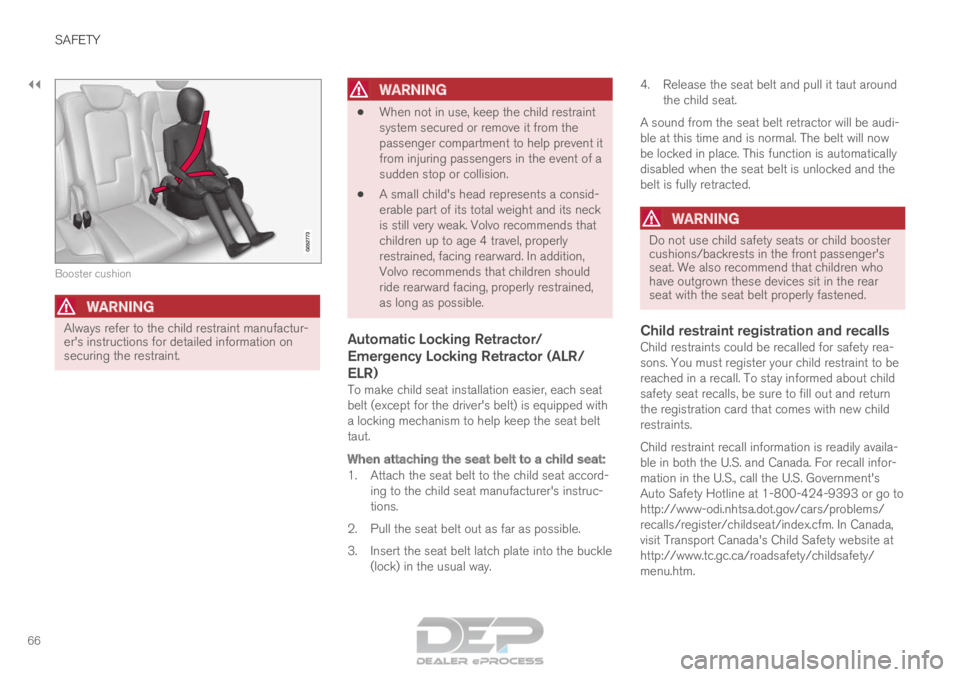
Booster cushion
WARNING
Always refer to the child restraint manufactur-
er's instructions for detailed information on
securing the restraint.
WARNING •
When not in use, keep the child restraint
system secured or remove it from the
passenger compartment to help prevent it
from injuring passengers in the event of a
sudden stop or collision.
• A small child's head represents a consid-
erable part of its total weight and its neck
is still very weak. Volvo recommends that
children up to age 4 travel, properly
restrained, facing rearward. In addition,
Volvo recommends that children should
ride rearward facing, properly restrained,
as long as possible.
Automatic Locking Retractor/
Emergency Locking Retractor (ALR/
ELR)
To make child seat installation easier, each seat
belt (except for the driver's belt) is equipped with
a locking mechanism to help keep the seat belt
taut.
When attaching the seat belt to a child seat:
1. Attach the seat belt to the child seat accord-
ing to the child seat manufacturer's instruc-
tions.
2. Pull the seat belt out as far as possible.
3. Insert the seat belt latch plate into the buckle (lock) in the usual way. 4. Release the seat belt and pull it taut around
the child seat.
A sound from the seat belt retractor will be audi-
ble at this time and is normal. The belt will now
be locked in place. This function is automatically
disabled when the seat belt is unlocked and the
belt is fully retracted.
WARNING Do not use child safety seats or child booster
cushions/backrests in the front passenger's
seat. We also recommend that children who
have outgrown these devices sit in the rear
seat with the seat belt properly fastened.
Child restraint registration and recallsChild restraints could be recalled for safety rea-
sons. You must register your child restraint to be
reached in a recall. To stay informed about child
safety seat recalls, be sure to fill out and return
the registration card that comes with new child
restraints.
Child restraint recall information is readily availa-
ble in both the U.S. and Canada. For recall infor-
mation in the U.S., call the U.S. Government's
Auto Safety Hotline at 1-800-424-9393 or go to
http://www-odi.nhtsa.dot.gov/cars/problems/
recalls/register/childseat/index.cfm. In Canada,
visit Transport Canada's Child Safety website at
http://www.tc.gc.ca/roadsafety/childsafety/
menu.htm.
Page 72 of 686
||SAFETY
70
WARNING
•
A small child's head represents a consider-
able part of its total weight and its neck is
still very weak. Volvo recommends that
children up to age 4 travel, properly
restrained, facing rearward. In addition,
Volvo recommends that children should
ride rearward facing, properly restrained, as
long as possible.
• Convertible child seats should be installed
in the rear seat only.
• A rear-facing convertible seat should not
be positioned behind the driver's seat
unless there is adequate space for safe
installation.
2.
Attach the seat belt to the convertible seat
according to the child restraint manufactur-
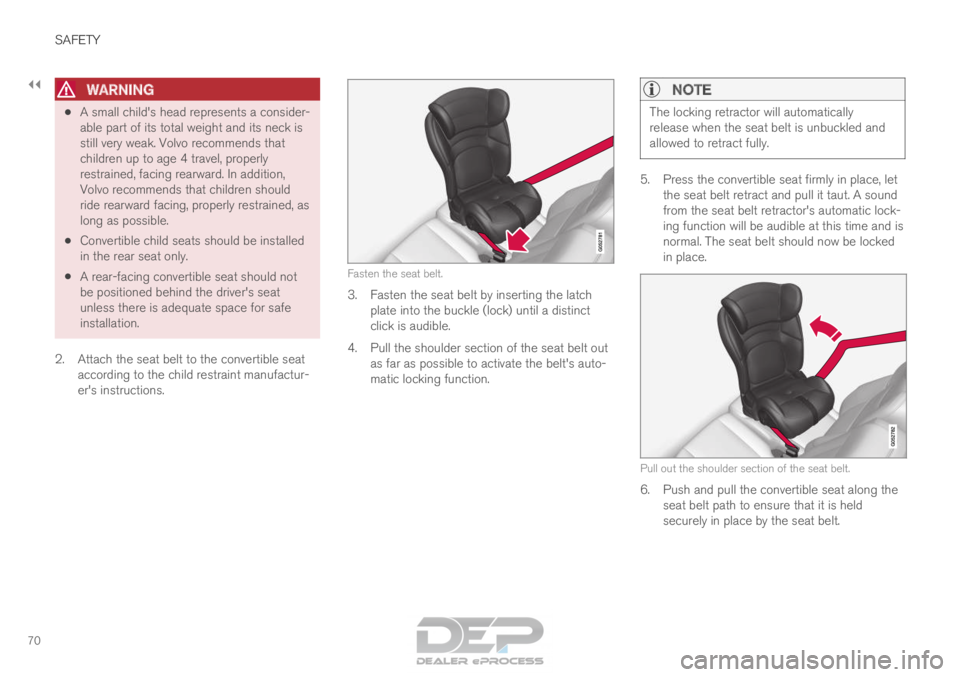
er's instructions. Fasten the seat belt.
3. Fasten the seat belt by inserting the latch
plate into the buckle (lock) until a distinct
click is audible.
4.
Pull the shoulder section of the seat belt out
as far as possible to activate the belt's auto-
matic locking function.
NOTE The locking retractor will automatically
release when the seat belt is unbuckled and
allowed to retract fully.
5. Press the convertible seat firmly in place, let
the seat belt retract and pull it taut. A sound
from the seat belt retractor's automatic lock-
ing function will be audible at this time and is
normal. The seat belt should now be locked
in place. Pull out the shoulder section of the seat belt.
6. Push and pull the convertible seat along the
seat belt path to ensure that it is held
securely in place by the seat belt.
Page 77 of 686

SAFETY
75
To access the anchors
1. Put the child restraint in position.
2. Kneel on the child restraint to press downthe seat cushion and locate the anchors by
feel.
3. Fasten the attachment on the child restraint's lower straps to the ISOFIX/LATCH
lower anchors.
4. Firmly tension the lower child seat straps according to the manufacturer's instructions.
WARNING Volvo's ISOFIX/LATCH anchors conform to
FMVSS/CMVSS standards. Always refer to
the child restraint system's manual for weight
and size ratings.
NOTE •
The rear center seat is not equipped with
ISOFIX/LATCH lower tether anchors. If a
child restraint is used in this seat, attach
the restraint's upper anchor strap (if
equipped with these) to the top tether
anchor point for this strap and secure the
child restraint with the vehicle's center
seat belt.
• Always follow your child seat manufactur-
er's installation instructions, and use both
ISOFIX/LATCH lower anchors and top
tethers whenever possible. Fasten the attachment correctly to the ISOFIX/LATCH
lower anchorsWARNING •
Be sure to fasten the attachment cor-
rectly to the anchor (see the illustration).
If the attachment is not correctly fas-
tened, the child restraint may not be
properly secured in the event of a colli-
sion.
• The ISOFIX/LATCH lower child restraint
anchors are only intended for use with
child seats positioned in the outboard
seating positions. These anchors are not
certified for use with any child restraint
that is positioned in the center seating
position. When securing a child restraint
in the center seating position, use only
the vehicle's center seat belt.
Related information
• Child restraints (p. 65)
• Top tether anchors (p. 72)
• ISOFIX/LATCH lower anchors (p. 74)
Page 78 of 686
SAFETY
* Option/accessory.
76 Integrated booster cushion*
1
The integrated booster cushion in the second
row center seating position helps ensure that a
child can sit comfortably and safely.
The integrated booster cushion has been spe-
cially designed to help safeguard children in the
rear seat when used with the vehicle's seat belts.
If using a booster cushion does not result in
proper positioning of the shoulder strap, then the
child should be placed in a properly secured child
restraint. The shoulder belt must never be placed
behind the child's back or under the arm.
Only used for children in the weight range
15-36 kg (33-80 lbs) and height range
97-137 cm (38-54 inches).
In Canada: 18 kg (40 lbs) is the minimum
weight requirement for a child using booster
cushions according to the Canadian regulation
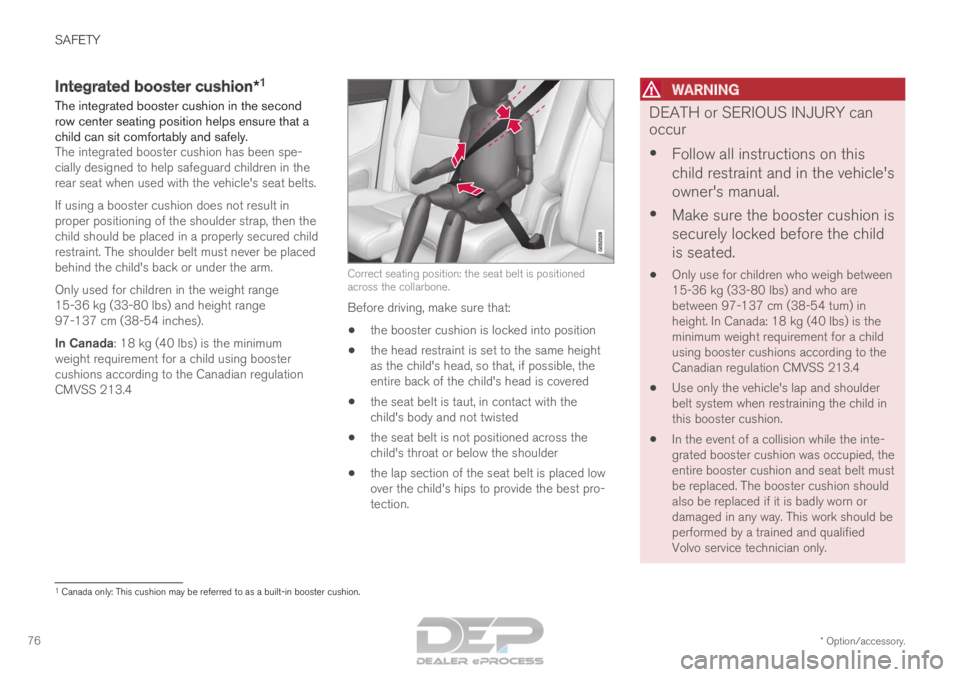
CMVSS 213.4 Correct seating position: the seat belt is positioned
across the collarbone.
Before driving, make sure that:
• the booster cushion is locked into position
• the head restraint is set to the same height
as the child's head, so that, if possible, the
entire back of the child's head is covered
• the seat belt is taut, in contact with the
child's body and not twisted
• the seat belt is not positioned across the
child's throat or below the shoulder
• the lap section of the seat belt is placed low
over the child's hips to provide the best pro-
tection.
WARNING DEATH or SERIOUS INJURY can
occur
•
Follow all instructions on this
child restraint and in the vehicle's
owner's manual.
• Make sure the booster cushion is
securely locked before the child
is seated.
• Only use for children who weigh between
15-36 kg (33-80 lbs) and who are
between 97-137 cm (38-54 tum) in
height. In Canada: 18 kg (40 lbs) is the
minimum weight requirement for a child
using booster cushions according to the
Canadian regulation CMVSS 213.4
• Use only the vehicle's lap and shoulder
belt system when restraining the child in
this booster cushion.
• In the event of a collision while the inte-
grated booster cushion was occupied, the
entire booster cushion and seat belt must
be replaced. The booster cushion should
also be replaced if it is badly worn or
damaged in any way. This work should be
performed by a trained and qualified
Volvo service technician only. 1
Canada only: This cushion may be referred to as a built-in booster cushi\
on.
Page 80 of 686

||SAFETY
* Option/accessory.
78
WARNING DEATH or SERIOUS INJURY can
occur
•
Follow all instructions on this
child restraint and in the vehicle's
owner's manual.
• Make sure the booster cushion is
securely locked before the child
is seated.
• Only use for children who weigh between
15-36 kg (33-80 lbs) and who are
between 97-137 cm (38-54 tum) in
height. In Canada: 18 kg (40 lbs) is the
minimum weight requirement for a child
using booster cushions according to the
Canadian regulation CMVSS 213.4
• Use only the vehicle's lap and shoulder
belt system when restraining the child in
this booster cushion.
• In the event of a collision while the inte-
grated booster cushion was occupied, the
entire booster cushion and seat belt must
be replaced. The booster cushion should
also be replaced if it is badly worn or
damaged in any way. This work should be
performed by a trained and qualified
Volvo service technician only.Related information
•
Integrated booster cushion* (p. 76)
• Folding down the integrated booster cush-
ion* (p. 78) Folding down the integrated
booster cushion*
When the integrated booster cushion in the rear
seat is not in use, it should be stowed (folded
down). Pull the handle forward to release the
booster cushion.
Page 81 of 686

SAFETY
* Option/accessory.79Press down on the center of the booster
cushion to lock it into position.
CAUTION
Make sure that there are no objects (e.g. toys)
on the seat under the integrated booster
cushion before folding it down.
NOTE
The integrated booster cushion must be
stowed (folded down) before folding down
the seat backrest.
WARNING DEATH or SERIOUS INJURY can
occur
•
Follow all instructions on this
child restraint and in the vehicle's
owner's manual.
• Make sure the booster cushion is
securely locked before the child
is seated.
• Only use for children who weigh between
15-36 kg (33-80 lbs) and who are
between 97-137 cm (38-54 tum) in
height. In Canada: 18 kg (40 lbs) is the
minimum weight requirement for a child
using booster cushions according to the
Canadian regulation CMVSS 213.4
• Use only the vehicle's lap and shoulder
belt system when restraining the child in
this booster cushion.
• In the event of a collision while the inte-
grated booster cushion was occupied, the
entire booster cushion and seat belt must
be replaced. The booster cushion should
also be replaced if it is badly worn or
damaged in any way. This work should be
performed by a trained and qualified
Volvo service technician only.Related information
•
Integrated booster cushion* (p. 76)
• Folding up the integrated booster cushion*
(p. 77)
Page 474 of 686
||STARTING AND DRIVING
472
Stowing the ball holder
WARNING
When not in use, the detachable ball holder
should always be properly stowed in the des-
ignated location under the floor of the cargo
compartment.
Related information
•
Driving with a trailer (p. 472)
• Towing capacity and tongue weight (p. 660) Driving with a trailer
There are a number of things to consider when
towing a trailer, such as the towbar, the trailer
and how the load is distributed in the trailer.
Load-carrying capacity is determined by the vehi-
cle's curb weight. The total weight of all passen-
gers and any installed accessories, e.g. towbar,
reduces the vehicle's load-carrying capacity by
the corresponding amount.
• Towbars used on the vehicle must be
approved for the applicable use.
• Distribute the load on the trailer so that the
weight on the towbar complies with the
specified maximum towball weight. The
tongue weight is calculated as part of the
vehicle's payload.
• Increase the tire pressure to the recom-
mended pressure for a full load.
• The engine is subjected to more load than
usual when towing a trailer.
• Towing a trailer affects the vehicle's han-
dling, durability and driving economy.
• Do not drive with a heavy trailer when the
vehicle is very new. Wait until the mileage
has reached at least 1000 km (620 miles).
• On long and steep downgrades, the vehicle's
brakes are subjected to much more load
than usual. When manually shifting, down-
shift and adapt speed accordingly. •
Follow applicable regulations regarding per-
mitted speed and weight.
• Drive slowly when towing a trailer up a long
and steep incline.
• The maximum trailer weights given only apply
to altitudes up to 1000 meters (3280 feet)
above sea level. At higher altitudes, engine
power (and thus the vehicle's climbing ability)
is decreased due to the reduced air density,
and the maximum trailer weight must there-
fore be reduced. The weight of the vehicle
and trailer must be decreased by 10% for
each additional 1000 m (3280 feet) or part
thereof.
• Avoid driving with a trailer on inclines of more
than 12%.
• Avoid overloading and other incorrect use.
• The trailer's brakes must be balanced with
the vehicle's brakes to help ensure safe
stops (follow applicable local regulations).
Page 475 of 686

STARTING AND DRIVING
* Option/accessory.473
CAUTION•
Bumper-attached trailer hitches must not
be used on Volvos, nor should safety
chains be attached to the bumper.
• Trailer hitches attaching to the vehicle
rear axle must not be used.
• Never connect a trailer's hydraulic brake
system directly to the vehicle brake sys-
tem, nor a trailer's lighting system directly
to the vehicle lighting system. Consult
your nearest authorized Volvo retailer for
correct installation.
• When towing a trailer, the trailer's safety
chains or wire must be correctly fastened
to the attachment points provided in the
trailer hitch on the vehicle. The safety
chain or wire must never be fastened to
or wound around the towing ball.
NOTE The optional detachable trailer hitch may not
be available in all markets or on all models.
Consult your Volvo retailer.
NOTE
Extreme weather conditions, towing a trailer,
driving at high altitudes and fuel quality are
factors that significantly increase a vehicle's
fuel consumption.
Trailer weights
WARNING Please adhere to the recommendations provi-
ded for trailer weight. If the recommendations
are not followed, the vehicle and trailer may
be difficult to control during evasive maneu-
vers and braking.
NOTE
The specified maximum trailer weights are
those permitted by Volvo. National vehicle
regulations may set additional restrictions on
trailer weight and speed. The trailer hitches
may be certified for higher towing weights
than the vehicle is permitted to tow.
Self-leveling suspension*The vehicle's self-leveling system attempts to
keep the vehicle at a constant level, regardless of
load (up to the maximum permitted weight).
When the vehicle is stationary, the rear end of the
vehicle will be slightly lowered, which is normal.
Driving in hilly terrain or hot weatherIn certain conditions, there is a risk of overheat-
ing when driving with a trailer. If overheating of
the engine and drive system is detected, a warn-
ing symbol will illuminate in the instrument panel
along with a message.The automatic transmission selects the optimal
gear for the current load and engine speed.
Steep inclines
Do not lock the automatic transmission into a
higher gear than what the engine can handle ‒ it
is not always preferable to drive in high gears at
low rpm.
Parking on a hill
1. Depress the brake pedal.
2. Apply the parking brake.
3. Put the gear selector in P.
4. Release the brake pedal.
Put chocks behind the wheels when the vehicle
is parked on a hill with a trailer attached.
Starting on a hill
1. Depress the brake pedal.
2. Put the gear selector in D.
3. Release the parking brake.
4. Release the brake pedal and start driving.
Related information
• Trailer Stability Assist* (p. 474)
• Checking trailer lights (p. 475)
• Towing capacity and tongue weight (p. 660)
• Overheating of engine and transmission
(p. 468)
Page 555 of 686
WHEELS AND TIRES
}}
553
Tread wear indicator
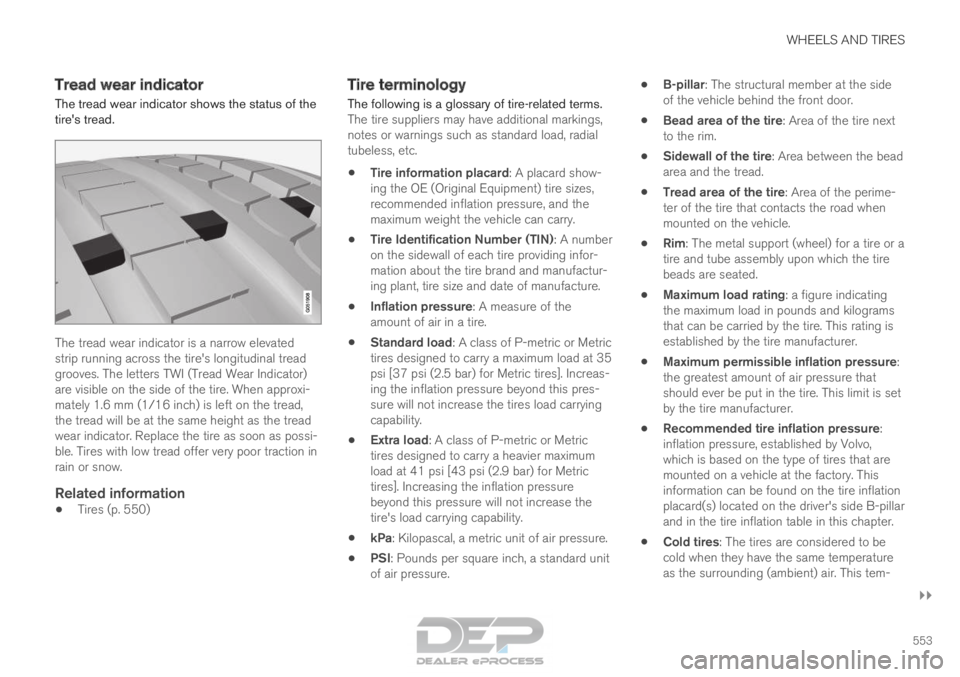
The tread wear indicator shows the status of the
tire's tread. The tread wear indicator is a narrow elevated
strip running across the tire's longitudinal tread
grooves. The letters TWI (Tread Wear Indicator)
are visible on the side of the tire. When approxi-
mately 1.6 mm (1/16 inch) is left on the tread,
the tread will be at the same height as the tread
wear indicator. Replace the tire as soon as possi-
ble. Tires with low tread offer very poor traction in
rain or snow.
Related information
•
Tires (p. 550) Tire terminology
The following is a glossary of tire-related terms.
The tire suppliers may have additional markings,
notes or warnings such as standard load, radial
tubeless, etc.
• Tire information placard: A placard show-
ing the OE (Original Equipment) tire sizes,
recommended inflation pressure, and the
maximum weight the vehicle can carry.
• Tire Identification Number (TIN): A number
on the sidewall of each tire providing infor-
mation about the tire brand and manufactur-
ing plant, tire size and date of manufacture.
• Inflation pressure: A measure of the
amount of air in a tire.
• Standard load: A class of P-metric or Metric
tires designed to carry a maximum load at 35
psi [37 psi (2.5 bar) for Metric tires]. Increas-
ing the inflation pressure beyond this pres-
sure will not increase the tires load carrying
capability.
• Extra load: A class of P-metric or Metric
tires designed to carry a heavier maximum
load at 41 psi [43 psi (2.9 bar) for Metric
tires]. Increasing the inflation pressure
beyond this pressure will not increase the
tire's load carrying capability.
• kPa: Kilopascal, a metric unit of air pressure.
• PSI: Pounds per square inch, a standard unit
of air pressure. •
B-pillar: The structural member at the side
of the vehicle behind the front door.
• Bead area of the tire: Area of the tire next
to the rim.
• Sidewall of the tire: Area between the bead
area and the tread.
• Tread area of the tire: Area of the perime-
ter of the tire that contacts the road when
mounted on the vehicle.
• Rim: The metal support (wheel) for a tire or a
tire and tube assembly upon which the tire
beads are seated.
• Maximum load rating: a figure indicating
the maximum load in pounds and kilograms
that can be carried by the tire. This rating is
established by the tire manufacturer.
• Maximum permissible inflation pressure:
the greatest amount of air pressure that
should ever be put in the tire. This limit is set
by the tire manufacturer.
• Recommended tire inflation pressure:
inflation pressure, established by Volvo,
which is based on the type of tires that are
mounted on a vehicle at the factory. This
information can be found on the tire inflation
placard(s) located on the driver's side B-pillar
and in the tire inflation table in this chapter.
• Cold tires: The tires are considered to be
cold when they have the same temperature
as the surrounding (ambient) air. This tem-