brake VOLVO XC90 TWIN ENGINE 2018 Owner's Manual
[x] Cancel search | Manufacturer: VOLVO, Model Year: 2018, Model line: XC90 TWIN ENGINE, Model: VOLVO XC90 TWIN ENGINE 2018Pages: 686, PDF Size: 17 MB
Page 194 of 686

SEATS AND STEERING WHEEL
* Option/accessory.
192 •
Adjusting front seat side bolster settings*
(p. 190)
• Adjusting front seat lumbar support* (p. 190) Folding the second row backrests
The second row of seats has three individual
seating positions. The backrests can be folded
down separately.
WARNING •
Adjust the seat and ensure it locks into
position before driving. Use caution when
adjusting the seat. Uncontrolled or care-
less adjustments could lead to injury.
• Long objects must always be securely
tied down to help prevent injury or dam-
age in the event of sudden braking.
• Always turn off the engine and apply the
parking brake when loading or unloading
the vehicle.
• Put the gear selector in P to help prevent
the gear selector from being inadvertently
moved.
CAUTION When the backrest is folded down, make sure
there are no objects in the rear seat, and the
seat belts are not buckled. Otherwise there is
a risk of damage to the upholstery.
CAUTION The seat cushion of the integrated child
restraint* must be in the stowed position
before the center seat backrest can be folded
down.
The armrest* in the center seat must be
raised before the seat backrest is folded
down.
If the vehicle has private locking*, the ski
hatch must be closed before the seat back-
rest is folded down.
NOTE The front seats may need to be pushed for-
ward and/or the backrest adjusted so that the
rear seat backrests can be fully lowered.
The rear seats may also need to be moved
rearward.
The seats in the second row must be in the
upright position before they can be folded
down completely. They should not be folded
down when they are tilted forward to access
the third row of seats.
Page 198 of 686

||SEATS AND STEERING WHEEL
* Option/accessory.
196
WARNING •
Adjust the seat and ensure it locks into
position before driving. Use caution when
adjusting the seat. Uncontrolled or care-
less adjustments could lead to injury.
• Long objects must always be securely
tied down to help prevent injury or dam-
age in the event of sudden braking.
• Always turn off the engine and apply the
parking brake when loading or unloading
the vehicle.
• Put the gear selector in P to help prevent
the gear selector from being inadvertently
moved.
Related information
• Folding the second row backrests (p. 192)
• Adjusting the second row head restraints
(p. 194)
• Adjusting the second row backrest tilt
(p. 196)
• Getting into and out of the third row of
seats* (p. 197)
• Folding the third row backrests* (p. 198) Adjusting the second row backrest
tilt
Backrest tilt can be adjusted separately for each
seat in the second row.
Center seat 1. Pull the strap on the right side of the center
seat.
2.
Adjust backrest tilt forward/backward by
decreasing/increasing pressure on the back-
rest.
3. Release the strap to lock the backrest in its new position and press on the backrest until
the lock engages.
Check to make sure the seat is securely locked
into place after its position has been changed.
Outboard seats 1. Pull the handle on the side of the seat
upward.
2.
Adjust backrest tilt forward/backward by
decreasing/increasing pressure on the back-
rest.
3. Release the handle to lock the backrest in its new position and press on the backrest until
the lock engages.
Check to make sure the seat is securely locked
into place after its position has been changed.
Page 199 of 686

SEATS AND STEERING WHEEL
* Option/accessory.197
WARNING•
Adjust the seat and ensure it locks into
position before driving. Use caution when
adjusting the seat. Uncontrolled or care-
less adjustments could lead to injury.
• Long objects must always be securely
tied down to help prevent injury or dam-
age in the event of sudden braking.
• Always turn off the engine and apply the
parking brake when loading or unloading
the vehicle.
• Put the gear selector in P to help prevent
the gear selector from being inadvertently
moved.
Related information
• Folding the second row backrests (p. 192)
• Adjusting the second row head restraints
(p. 194)
• Moving the second row seats forward/rear-
ward* (p. 195)
• Getting into and out of the third row of
seats* (p. 197)
• Folding the third row backrests* (p. 198) Getting into and out of the third row
of seats*
The second row of seats can be adjusted for
easier access to the third row of seats*. To fold down the backrest:
1.
Pull the handle on the upper side of the right
or left outboard second row seat upward/
forward.
2. Fold the backrest down and move the entire seat forward.
To return the seat to the upright position:
– Push the seat rearward to its end position.
The backrest should then easily return to the
correct position.
NOTE If a backrest in the second row of seats does
not lock back into the upright position after
being folded down (e.g. for getting in or out of
the third row of seats), it may need to be
pushed forward again and then pushed back
with more force.
WARNING
Make sure that the rear seat backrest and
head restraint are locked securely in place
after the seat is folded up.
The head restraints at the outer seats must
always be raised when there is a passenger in
one of these spots of the rear seat.
Related information
•
Folding the second row backrests (p. 192)
• Adjusting the second row head restraints
(p. 194)
• Moving the second row seats forward/rear-
ward* (p. 195)
• Adjusting the second row backrest tilt
(p. 196)
• Folding the third row backrests* (p. 198)
Page 274 of 686
DRIVER SUPPORT
* Option/accessory.
272 Driver support systems
The vehicle is equipped with a number of driver
support systems that can provide the driver with
active or passive assistance in various situations.
The system can, for example, help the driver
maintain a set speed or a set time interval to the
vehicle ahead, help prevent a collision by warning
the driver and applying the brakes, or assist the
driver while parking.
Some of the systems are standard and others are
options. This also varies from market to market.
Related information
• Speed-dependent steering wheel resistance
(p. 272)
• Electronic Stability Control (p. 274)
• Stability system Roll Stability Control
(p. 273)
• Rear Collision Warning (p. 347)
• Speed limiter (p. 278)
• Cruise control (p. 286)
• Distance Alert* (p. 291)
• Adaptive Cruise Control* (p. 295)
• Pilot Assist (p. 311)
• Radar sensor (p. 326)
• Camera (p. 331)
• City Safety™ (p. 335)
• BLIS* (p. 348) •
Cross Traffic Alert* (p. 353)
• Road Sign Information* (p. 357)
• Driver Alert Control (p. 362)
• Lane Keeping Aid (p. 364)
• Steering assistance at risk of collision
(p. 372)
• Park Assist* (p. 381)
• Park Assist Camera* (p. 386)
• Park Assist Pilot* (p. 395) Speed-dependent steering wheel
resistance
Speed-dependent power steering increases the
steering wheel resistance in pace with the vehi-
cle's speed to give the driver an enhanced feel-
ing of control and stability.
Steering may feel stiffer on highways. When
parking and at low speeds, it will be easier to
move the steering wheel.
NOTE In some situations, the power steering may
become too hot and require temporary cool-
ing – during such time the power steering will
work at reduced output and the steering
wheel may feel more difficult to move.
In parallel with the temporarily reduced steer-
ing assistance, the driver display shows a
message as well as a STEERING WHEEL
symbol.
Page 275 of 686
DRIVER SUPPORT
* Option/accessory.273
WARNINGWhile the power steering is working at
reduced power, the driver support functions
with steering assistance are not available.
In such a situation, the driver display shows
the
Power steering failure or Power
Steering Assist Temporarily Reduced message, combined with a STEERING
WHEEL symbol.
Changing the level of steering wheel
resistance*
To change the level of steering wheel resistance,
see the description of the INDIVIDUAL option
under "Available drive modes" in the "Drive
modes" section.
On models not equipped with drive mode con-
trols and the INDIVIDUAL option, steering wheel
resistance can instead be set in the center dis-
play's Top view under:
Settings My Car Drive Modes
Steering force
Steering wheel resistance settings cannot be
accessed when turning at speeds above
10 km/h (6 mph).
Related information
•
Drive modes (p. 445)
• Pilot Assist (p. 311) •
Lane Keeping Aid (p. 364)
• Steering assistance at risk of collision
(p. 372)
• Park Assist Pilot* (p. 395) Stability system Roll Stability
Control
The Roll Stability Control (RSC 1
) system helps
minimize the risk of a rollover in the event of e.g.
a sudden evasive maneuver or if the vehicle
begins to skid.
The RSC system monitors the lateral angle at
which the vehicle is leaning and registers any
changes. Using this information, the system cal-
culates the likelihood of a rollover. If there is an
imminent risk of a rollover, Electronic Stability
Control is activated, engine torque is reduced and
brakes are applied to one or more of the wheels
until the vehicle has regained stability.
WARNING The vehicle
Page 276 of 686
DRIVER SUPPORT
* Option/accessory.
274 Electronic Stability Control
The Electronic Stability Control (ESC 2
) function
helps the driver avoid skidding and improves the
vehicle's directional stability.
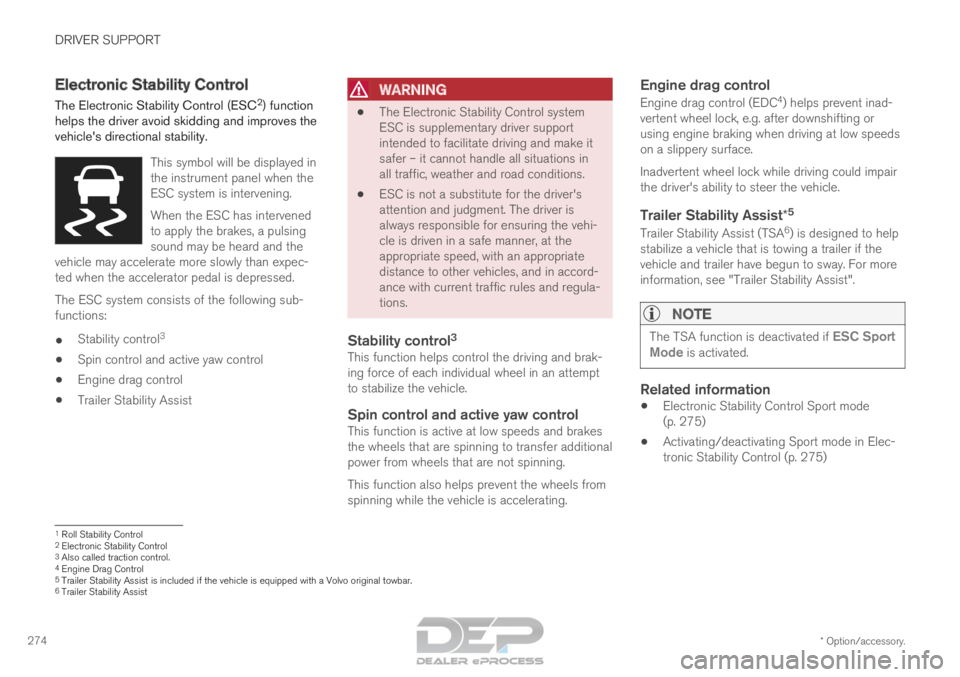
This symbol will be displayed in
the instrument panel when the
ESC system is intervening.
When the ESC has intervened
to apply the brakes, a pulsing
sound may be heard and the
vehicle may accelerate more slowly than expec-
ted when the accelerator pedal is depressed. The ESC system consists of the following sub-
functions:
•
Stability control 3
• Spin control and active yaw control
• Engine drag control
• Trailer Stability Assist
WARNING •
The Electronic Stability Control system
ESC is supplementary driver support
intended to facilitate driving and make it
safer – it cannot handle all situations in
all traffic, weather and road conditions.
• ESC is not a substitute for the driver's
attention and judgment. The driver is
always responsible for ensuring the vehi-
cle is driven in a safe manner, at the
appropriate speed, with an appropriate
distance to other vehicles, and in accord-
ance with current traffic rules and regula-
tions.
Stability control 3This function helps control the driving and brak-
ing force of each individual wheel in an attempt
to stabilize the vehicle.
Spin control and active yaw controlThis function is active at low speeds and brakes
the wheels that are spinning to transfer additional
power from wheels that are not spinning.
This function also helps prevent the wheels from
spinning while the vehicle is accelerating.
Engine drag control
Engine drag control (EDC
4
) helps prevent inad-
vertent wheel lock, e.g. after downshifting or
using engine braking when driving at low speeds
on a slippery surface.
Inadvertent wheel lock while driving could impair
the driver's ability to steer the vehicle.
Trailer Stability Assist* 5
Trailer Stability Assist (TSA
6
) is designed to help
stabilize a vehicle that is towing a trailer if the
vehicle and trailer have begun to sway. For more
information, see "Trailer Stability Assist".
NOTE The TSA function is deactivated if
ESC Sport
Mode is activated.
Related information
• Electronic Stability Control Sport mode
(p. 275)
• Activating/deactivating Sport mode in Elec-
tronic Stability Control (p. 275) 1
Roll Stability Control
2 Electronic Stability Control
3 Also called traction control.
4 Engine Drag Control
5Trailer Stability Assist is included if the vehicle is equipped with a V\
olvo original towbar.6 Trailer Stability Assist
Page 279 of 686

DRIVER SUPPORT
277
Electronic Stability Control symbols
and messages
A number of symbols and messages related to
Electronic Stability Control (ESC) may be dis-
played in the instrument panel. Some examples of symbols and messages are
shown in the table below.Symbol
Message MeaningSteady glow for
approx. 2 seconds.
System check when the engine is started.Flashing light.
The ESC is actively operating.Steady glow.
Sport mode is activated.
Note: The ESC system is not deactivated in this mode, but has partially reduc\
ed functionality. ESC
Temporarily off
The ESC system's functionality has been temporarily reduced due to hi\
gh brake system temperatures. The
function will be automatically reactivated when the brakes have cooled.
See the message in the instrument panel.ESC
Service required
The ESC system is not functioning properly.
• Stop the vehicle in a safe place, turn off the engine and then restart i\
t.
• Consult a workshop if the message persists ‒ an authorized Volvo workshop is recommended. A text message can be erased by briefly pressing
the
button in the center of the right-side
steering wheel keypad. If the message persists: Contact a workshop ‒ an
authorized Volvo workshop is recommended.
Related information
• Electronic Stability Control (p. 274)
Page 285 of 686
DRIVER SUPPORT
283
WARNING•
The ASL function is supplementary driver
support intended to facilitate driving and
help make it safer – it cannot handle all
situations in all traffic, weather and road
conditions.
• Even if the driver can clearly see the
speed limit sign, the speed information
from the Road Sign Information (RSI)
function to ASL may be incorrect. In such
cases, the driver must intervene and
accelerate or brake to an appropriate
speed.
• ASL is not a substitute for the driver's
attention and judgment. The driver is
always responsible for ensuring the vehi-
cle is driven in a safe manner, at the
appropriate speed, with an appropriate
distance to other vehicles, and in accord-
ance with current traffic rules and regula-
tions.
• See also the heading "Road Sign Infor-
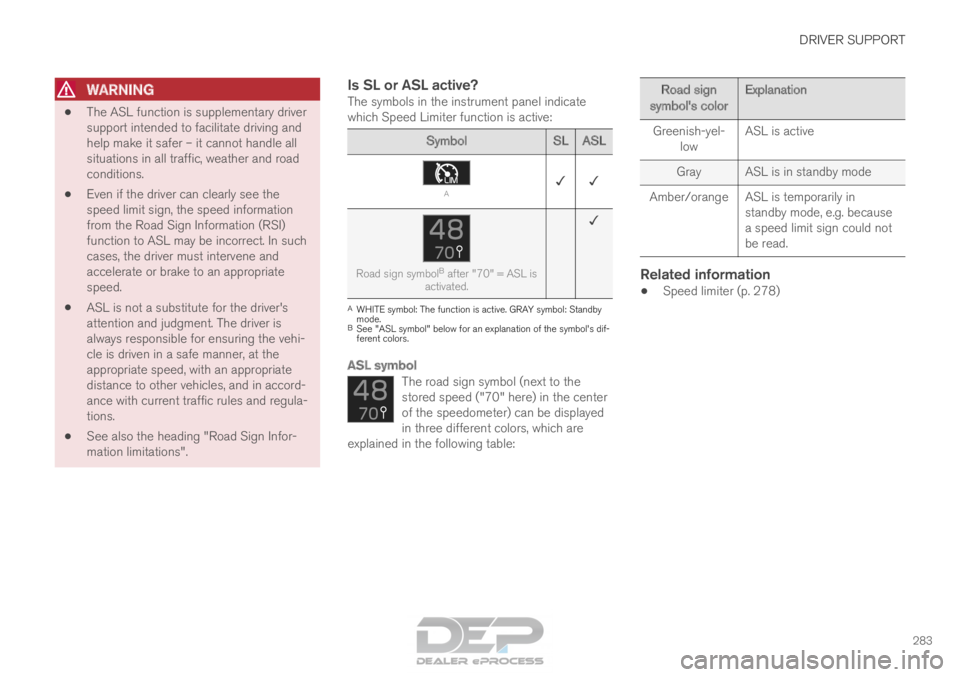
mation limitations".Is SL or ASL active?The symbols in the instrument panel indicate
which Speed Limiter function is active: Symbol
SLASL A
✓ ✓ Road sign symbol
B
after "70" = ASL is
activated. ✓ A
WHITE symbol: The function is active. GRAY symbol: Standby
mode.
B See "ASL symbol" below for an explanation of the symbol's dif-
ferent colors.
ASL symbol
The road sign symbol (next to the
stored speed ("70" here) in the center
of the speedometer) can be displayed
in three different colors, which are
explained in the following table: Road sign
symbol's color Explanation
Greenish-yel- low ASL is active
Gray
ASL is in standby mode
Amber/orange ASL is temporarily in standby mode, e.g. because
a speed limit sign could not
be read.
Related information
•Speed limiter (p. 278)
Page 287 of 686

DRIVER SUPPORT
* Option/accessory.285
Changing Automatic Speed Limiter
tolerance
The Automatic Speed Limiter (ASL
23
) can be set
to different tolerance levels.
It is also possible to allow the vehicle to drive
above or below the posted speed limit. For exam-
ple, if the vehicle is following a current posted
speed limit of 70 km/h (43 mph), the driver can
instead allow the vehicle to maintain a speed of
75 km/h (47 mph). Function buttons and symbols
24
. –
Tap the (1) button on the steering
wheel keypad until 70 km/h (43 mph) has
been changed to 75 km/h (47 mph) in the
center of the speedometer (4).
>
The vehicle will then use the selected tol-
erance of 5 km/h (4 mph) as long as the
posted speed limit the vehicle passes is
70 km/h (43 mph).
This tolerance level will be followed until
the vehicle passes a sign with a lower or
higher speed. The vehicle will then adjust
to the new speed limit and the set toler-
ance will be deleted from the system's
memory.
If Road Sign Information* is activated, the
posted speed limit will then be indicated
by a RED marking on the speedometer's
speed scale.
The set tolerance can be adjusted in the same
way as for the Speed Limiter's speed.
NOTE The highest possible selectable tolerance is
+/- 10 km/h (5 mph).
Related information
•
Speed limiter (p. 278) Automatic Speed Limiter limitations
ASL utilizes the speed limit information provided
by the RSI 25
system, not from the speed limit
signs that the vehicle passes.
If RSI 25
is unable to interpret and provide ASL
with speed information, ASL will go into standby
mode and switch over to SL. The driver will then
have to actively brake to bring the vehicle down
to the appropriate speed.
ASL will be reactivated when RSI 25
is once again
able to interpret and provide speed information to
ASL.
See "Road Sign Information limitations" for more
information.
Related information
• Speed limiter (p. 278) 23
Automatic Speed Limiter
24 Note: This illustration is general and details may vary depending on mod\
el.
25 Road Sign Information (RSI)
Page 290 of 686
DRIVER SUPPORT
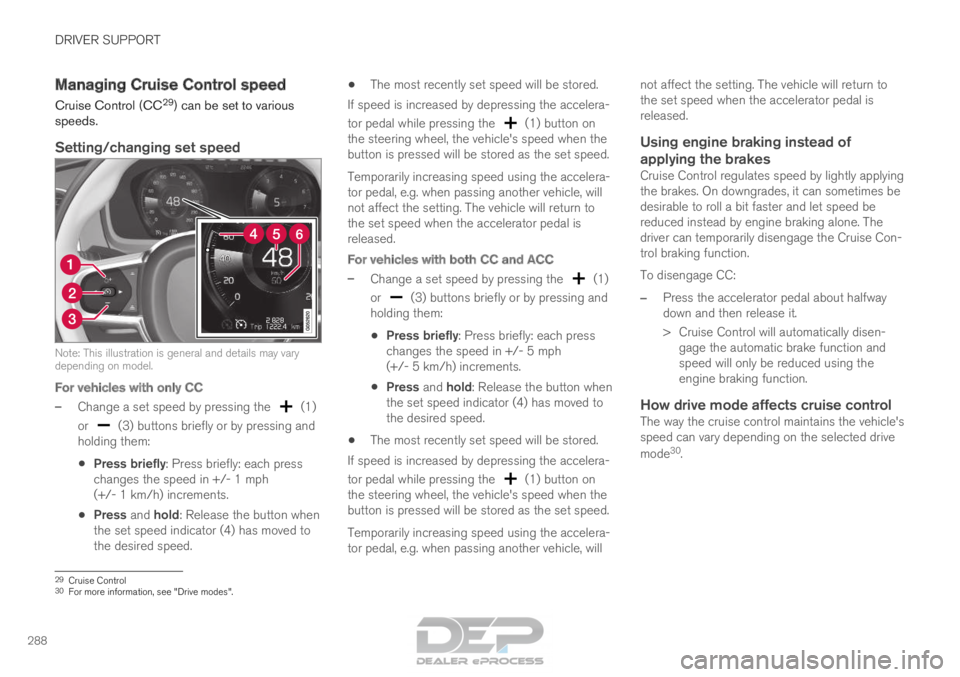
288Managing Cruise Control speed
Cruise Control (CC 29
) can be set to various
speeds.
Setting/changing set speed Note: This illustration is general and details may vary
depending on model.
For vehicles with only CC
–
Change a set speed by pressing the (1)
or (3) buttons briefly or by pressing and
holding them:
• Press briefly: Press briefly: each press
changes the speed in +/- 1 mph
(+/- 1 km/h) increments.
• Press and hold: Release the button when
the set speed indicator (4) has moved to
the desired speed. •
The most recently set speed will be stored.
If speed is increased by depressing the accelera-
tor pedal while pressing the (1) button on
the steering wheel, the vehicle's speed when the
button is pressed will be stored as the set speed.
Temporarily increasing speed using the accelera-
tor pedal, e.g. when passing another vehicle, will
not affect the setting. The vehicle will return to
the set speed when the accelerator pedal is
released.
For vehicles with both CC and ACC
– Change a set speed by pressing the (1)
or (3) buttons briefly or by pressing and
holding them:
• Press briefly: Press briefly: each press
changes the speed in +/- 5 mph
(+/- 5 km/h) increments.
• Press and hold: Release the button when
the set speed indicator (4) has moved to
the desired speed.
• The most recently set speed will be stored.
If speed is increased by depressing the accelera-
tor pedal while pressing the (1) button on
the steering wheel, the vehicle's speed when the
button is pressed will be stored as the set speed.
Temporarily increasing speed using the accelera-
tor pedal, e.g. when passing another vehicle, will not affect the setting. The vehicle will return to
the set speed when the accelerator pedal is
released.
Using engine braking instead of
applying the brakes
Cruise Control regulates speed by lightly applying
the brakes. On downgrades, it can sometimes be
desirable to roll a bit faster and let speed be
reduced instead by engine braking alone. The
driver can temporarily disengage the Cruise Con-
trol braking function.
To disengage CC:
– Press the accelerator pedal about halfway
down and then release it.
>
Cruise Control will automatically disen-
gage the automatic brake function and
speed will only be reduced using the
engine braking function.
How drive mode affects cruise controlThe way the cruise control maintains the vehicle's
speed can vary depending on the selected drive
mode 30
. 29
Cruise Control
30 For more information, see "Drive modes".