brake VOLVO XC90 TWIN ENGINE 2018 Repair Manual
[x] Cancel search | Manufacturer: VOLVO, Model Year: 2018, Model line: XC90 TWIN ENGINE, Model: VOLVO XC90 TWIN ENGINE 2018Pages: 686, PDF Size: 17 MB
Page 397 of 686

DRIVER SUPPORT
}}
* Option/accessory. 395
Park Assist Pilot*
Park Assist Pilot (
PAP 124
) helps the driver pull
into and out of parking spaces.
PAP first checks whether there is sufficient
space and then steers the car into the space.
The center display uses symbols, graphics and
messages to inform the driver of what steps need
to be taken and when.
WARNING •
The PAP function is supplementary driver
support intended to facilitate driving and
help make it safer – it cannot handle all
situations in all traffic, weather and road
conditions.
• Pay particular attention to people and
animals near the vehicle.
• PAP is not a substitute for the driver's
attention and judgment. The driver is
always responsible for ensuring the vehi-
cle is driven in a safe manner, at the
appropriate speed, with an appropriate
distance to other vehicles, and in accord-
ance with current traffic rules and regula-
tions.
NOTE The PAP function measures the space and
steers the vehicle – the driver's role is to:
• keep close watch of the area around the
vehicle
• follow the instructions on the center dis-
play
• change gears (reverse/forward) – a
"ping" sound indicates when the driver
should change gears
• regulate and maintain a safe speed
• apply the brakes and stop.
Related information
•Types of parking with Park Assist Pilot
(p. 395)
• Parking with Park Assist Pilot (p. 396)
• Leaving a parking space with Park Assist
Pilot (p. 399)
• Park Assist Pilot* limitations (p. 400)
• Recommended maintenance for Park Assist
Pilot (p. 402)
• Park Assist Pilot* messages (p. 403) Types of parking with Park Assist
Pilot
Park Assist Pilot (PAP 125
) can be used for the
following types of parking. 124
Park Assist Pilot
125 Park Assist Pilot
Page 398 of 686

||DRIVER SUPPORT
* Option/accessory.
396
Parallel parking Overview of parallel parking.
The PAP function parks the vehicle using the fol-
lowing steps:
1.
The system searches for and measures
potential parking spaces.
2. The vehicle is steered while it is backing into the parking space.
3. The vehicle's position in the space is adjusted by driving forward/backward.
The Park Out function can be used to receive
assistance from PAP while pulling out of a park-
ing space. See the heading "Pulling out of a
parking space" under "Parking with Park Assist
Pilot".
Perpendicular parking Perpendicular parking overview.
The PAP function parks the vehicle using the fol-
lowing steps:
1.
The system searches for and measures
potential parking spaces.
2. The vehicle is steered while it is backing into the space and its position is adjusted by driv-
ing forward/backward.
NOTE The PAP function
Park Out cannot help the
vehicle leave a perpendicular parking space –
the function should only be used for parallel
parking.
Related information
• Park Assist Pilot* (p. 395) Parking with Park Assist Pilot
Park Assist Pilot (PAP
126
) helps the driver park
using three different steps. The function can also
help the driver pull out of a parking space.
NOTE The PAP function measures the space and
steers the vehicle – the driver's role is to:
• keep close watch of the area around the
vehicle
• follow the instructions on the center dis-
play
• change gears (reverse/forward) – a
"ping" sound indicates when the driver
should change gears
• regulate and maintain a safe speed
• apply the brakes and stop. Information about the actions required by the
driver are provided in the center display using
symbols, graphics and/or text.
PAP can be activated if the following criteria have
been met after the engine is started:
•
No trailer is hitched to the vehicle
• Your vehicle's speed is lower than 30 km/h
(20 mph).
Page 402 of 686

DRIVER SUPPORT
* Option/accessory.
400 Park Assist Pilot* limitations
Park Assist Pilot PAP 127
may not be able to
detect all conditions in all situations and func-
tionality may therefore be limited.
WARNING •
The PAP function is supplementary driver
support intended to facilitate driving and
help make it safer – it cannot handle all
situations in all traffic, weather and road
conditions.
• Pay particular attention to people and
animals near the vehicle.
• Bear in mind that the front end of the
vehicle may swing out towards oncoming
traffic during the parking maneuver.
• Objects situated higher than the detec-
tion area of the sensors are not included
when the parking maneuver is calculated,
which could cause PAP to swing into the
parking space too early. Such parking
spaces should be avoided for this reason.
• PAP is not a substitute for the driver's
attention and judgment. The driver is
always responsible for ensuring the vehi-
cle is driven in a safe manner, at the
appropriate speed, with an appropriate
distance to other vehicles, and in accord-
ance with current traffic rules and regula-
tions.
The driver should be aware of the following limi-
tations for Park Assist Pilot:The parking sequence is cancelledA parking sequence will be cancelled if:
• the driver moves the steering wheel
• the vehicle's speed exceeds 7 km/h (4 mph)
• the driver taps
Cancel in the center display
• when the anti-lock brakes or the Electronic
stability control are engaged - e.g. when a
wheel loses grip on a slippery road
• when the power steering works at reduced
power - e.g. during cooling due to overheat-
ing (see section "Speed-dependent steering
force").
A message in the center display will explain why
the parking sequence was cancelled.
CAUTION Under certain circumstances, PAP may not be
able to find parking spaces – one reason may
be that the sensors are disrupted by external
sound sources that emit the same ultrasonic
frequencies that the system works with.
Examples of such sources include horns, wet
tires on asphalt, pneumatic brakes, exhaust
noise from motorcycles, etc.
127
Park Assist Pilot
Page 408 of 686
HYBRID INFORMATION
406General information about Twin
Engine
Twin Engine vehicles are driven just like any
other vehicle, but certain functions differ from a
vehicle powered exclusively by gasoline. The
electric motor powers the vehicle primarily at low
speeds; the gasoline engine is used at higher
speeds or during more active driving. The instrument panel displays Twin Engine-spe-
cific information - charging information, selected
drive mode, distance to discharged battery and
hybrid battery charge level.
Different drive modes can be selected while driv-
ing, e.g. electric power only or, if more power is
needed, a combination of electric and gasoline
power. The vehicle calculates the optimal combi-
nation of driveability, driving experience, environ-
mental impact and fuel economy for the selected
drive mode.
In order to function optimally, the hybrid battery
(and its electrical drive systems) and the gasoline
engine (and its drive systems) must be at the
correct operating temperature. Battery capacity
can be considerably reduced if the battery is too
cold or too hot. Preconditioning prepares the
vehicle's drive systems and passenger compart-
ment before driving to help reduce both wear and
energy consumption. It also helps increase the
hybrid battery's range.
The hybrid battery, which powers the electric
motor, is recharged using the charging cable. It
can also be recharged during light braking and through engine braking in gear position B. The
combustion engine can also help recharge the
hybrid battery.
Important
No electrical current
Keep in mind that if there is no electrical current
to the vehicle, i.e. the ignition is switched off or
the start battery is discharged, certain functions
such as brakes, power steering, etc. will not work.
WARNING If the vehicle does not have electrical current
and both the electric motor and the gasoline
engine are switched off, the brakes cannot be
used to stop the vehicle.
Towing not permitted
Never tow a Twin Engine vehicle behind another
vehicle, as this could damage the electric motor.
Exterior engine noise
WARNING
Keep in mind that the vehicle does not emit
any engine noise when using the electric
motor and may therefore be difficult to detect
for children, pedestrians, cyclists or animals.
This is especially true at low speeds, e.g. in
parking lots.
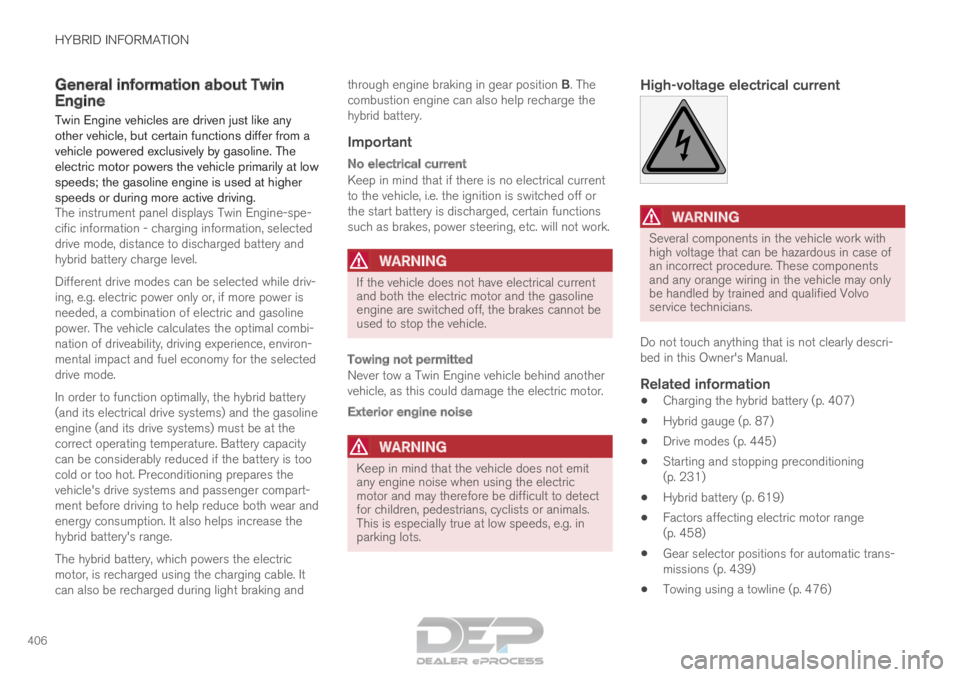
High-voltage electrical current
WARNING Several components in the vehicle work with
high voltage that can be hazardous in case of
an incorrect procedure. These components
and any orange wiring in the vehicle may only
be handled by trained and qualified Volvo
service technicians.
Do not touch anything that is not clearly descri-
bed in this Owner's Manual.
Related information
• Charging the hybrid battery (p. 407)
• Hybrid gauge (p. 87)
• Drive modes (p. 445)
• Starting and stopping preconditioning
(p. 231)
• Hybrid battery (p. 619)
• Factors affecting electric motor range
(p. 458)
• Gear selector positions for automatic trans-
missions (p. 439)
• Towing using a towline (p. 476)
Page 409 of 686
HYBRID INFORMATION
}}
407
Charging the hybrid battery
In addition to the conventional fuel tank, your
vehicle is also equipped with a rechargeable
lithium-ion hybrid battery.
The hybrid battery can be recharged using the
charging cable stored in a storage space in the
cargo compartment.
WARNING
The hybrid electrical system in your vehicle
uses high voltage electrical current. Any dam-
age to this system or to the hybrid battery
may result in the danger of overheating, fire,
or serious injury. If the vehicle is involved in a
collision or subjected to flooding, fire, etc.,
have it inspected by a trained and qualified
Volvo service technician. Prior to this inspec-
tion, the vehicle should be parked outdoors at
a safe distance from any building or poten-
tially flammable materials.
The hybrid battery's charging time depends on
the charging current used.
NOTE The capacity of the hybrid battery diminishes
somewhat with age and use, which could
result in increased use of the gasoline engine
and consequently, slightly higher fuel con-
sumption.
WARNING If the hybrid battery needs to be replaced, this
may only be done by Volvo retailer or author-
ized Volvo workshop.
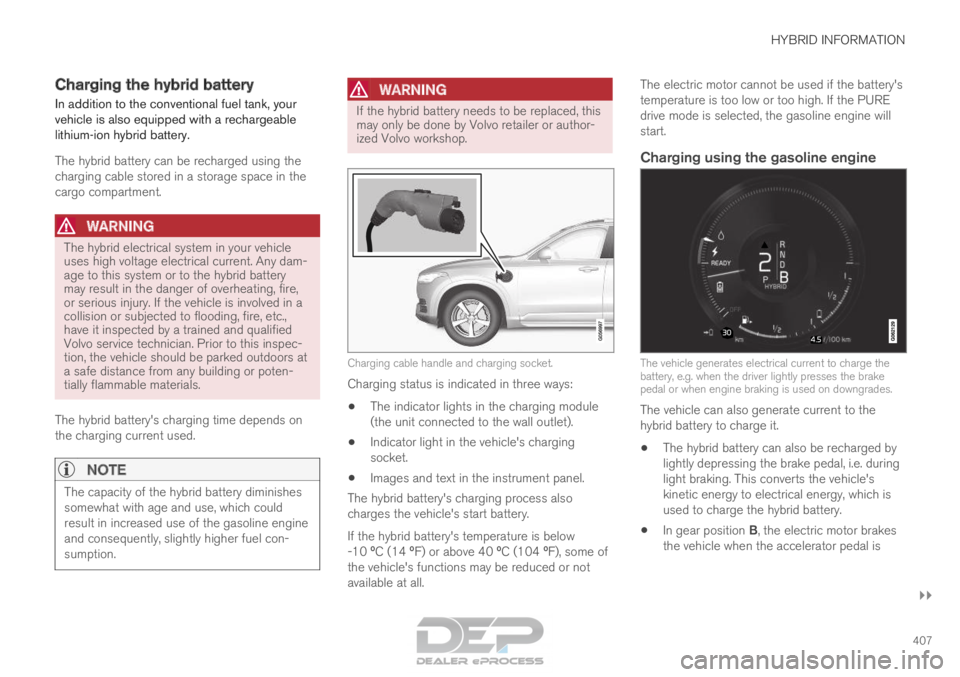
Charging cable handle and charging socket.
Charging status is indicated in three ways:
• The indicator lights in the charging module
(the unit connected to the wall outlet).
• Indicator light in the vehicle's charging
socket.
• Images and text in the instrument panel.
The hybrid battery's charging process also
charges the vehicle's start battery.
If the hybrid battery's temperature is below
-10 ºC (14 ºF) or above 40 ºC (104 ºF), some of
the vehicle's functions may be reduced or not
available at all. The electric motor cannot be used if the battery's
temperature is too low or too high. If the PURE
drive mode is selected, the gasoline engine will
start.
Charging using the gasoline engine
The vehicle generates electrical current to charge the
battery, e.g. when the driver lightly presses the brake
pedal or when engine braking is used on downgrades.
The vehicle can also generate current to the
hybrid battery to charge it.
• The hybrid battery can also be recharged by
lightly depressing the brake pedal, i.e. during
light braking. This converts the vehicle's
kinetic energy to electrical energy, which is
used to charge the hybrid battery.
• In gear position B, the electric motor brakes
the vehicle when the accelerator pedal is
Page 419 of 686

HYBRID INFORMATION
417
NOTEIf the instrument panel is not used, it will go
dark after a period of time. To reactivate the
display:
•
depress the brake pedal,
• open one of the doors, or
• put the ignition in mode I by turning the
START knob clockwise and then releas-
ing.
Related information
• Charging the hybrid battery (p. 407)
• Twin Engine symbols and messages in the
instrument panel (p. 419)
• Charging status in the vehicle's charging
socket (p. 414)
• Charging status in the charging cable's
charging module (p. 415)
• Stopping hybrid battery charging (p. 418)
Page 426 of 686

STARTING AND DRIVING
* Option/accessory.
424 Starting the vehicle
The vehicle can be started using the start knob
in the tunnel console when the remote key is in
the passenger compartment. Start knob in the tunnel console.
WARNING
Before starting:
• Buckle your seat belt.
• Adjust the seat, steering wheel and mir-
rors.
• Make sure you can fully depress the
brake pedal. The remote key is not physically used to start the
ignition because the vehicle is equipped with the
keyless Passive Start system.
To start the vehicle:
1.
The remote key must be inside the vehicle.
For vehicles with Passive Start, the key must
be in the front section of the passenger
compartment. With the optional keyless lock-
ing/unlocking function*, the key can be any-
where in the vehicle.
2. Press and hold down the brake pedal 1
as far
as possible.
3. Turn the start knob clockwise and release. The control will automatically return to the
original position.
WARNING •
Never use more than one inlay mat at a
time on the driver's floor. If any other type
of floor mat is used, remove the original
mat from the driver's seat floor before
driving. All types of mats must be securely
anchored in the attachment points in the
floor. Make sure the floor mat does not
impede the movement of the brake pedal
or accelerator pedal in any way, as this
could be a serious safety hazard.
• Volvo's floor mats are specially manufac-
tured for your vehicle. They must be prop-
erly secured in the attachment points in
the floor to help ensure they cannot slide
and become trapped under the pedals.
The starter motor will crank until the engine
starts or until its overheating protection is trig-
gered.
During normal start conditions, the vehicle's elec-
tric motor will be prioritized and the gasoline
engine will remain off. This means that once the
start knob is turned clockwise, the electric motor
has been "started" and the vehicle is ready to be
driven. The warning and information symbols in
the instrument panel will go out and the selected
theme will be displayed to indicate that the elec-
tric motor is activated. 1
If the vehicle is moving, it is only necessary to turn the start knob cl\
ockwise to start the engine.
Page 427 of 686
STARTING AND DRIVING
}}
425
In some situations, such as in cold weather or if
the hybrid battery's charge level is too low, the
gasoline engine will start instead.
The vehicle should not be started with the charg-
ing cable connected. However, if the cable can-
not be pulled out or if the vehicle incorrectly
detects a cable that is not connected, the vehicle
can be started using an override procedure:
1.
Press the brake pedal and turn the start
knob clockwise.
2. Charge cable Remove before start will
appear in the instrument panel.
3.
Turn the start knob clockwise again.
4. Removed? Turn and hold start knob 7s
will appear. Turn the knob clockwise and hold
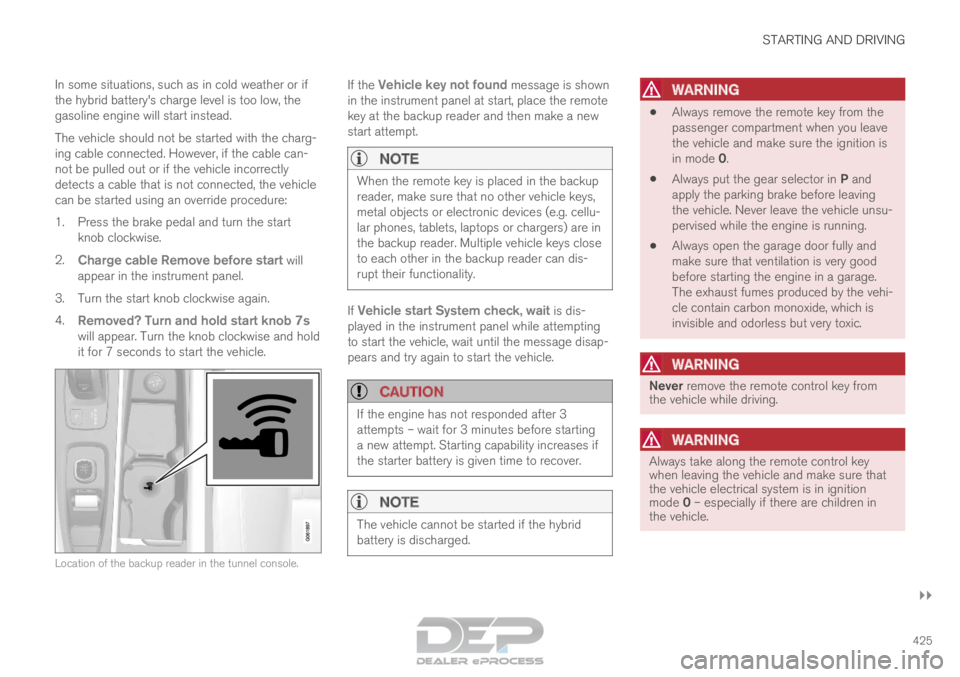
it for 7 seconds to start the vehicle. Location of the backup reader in the tunnel console. If the
Vehicle key not found message is shown
in the instrument panel at start, place the remote
key at the backup reader and then make a new
start attempt.
NOTE When the remote key is placed in the backup
reader, make sure that no other vehicle keys,
metal objects or electronic devices (e.g. cellu-
lar phones, tablets, laptops or chargers) are in
the backup reader. Multiple vehicle keys close
to each other in the backup reader can dis-
rupt their functionality.
If Vehicle start System check, wait is dis-
played in the instrument panel while attempting
to start the vehicle, wait until the message disap-
pears and try again to start the vehicle.
CAUTION If the engine has not responded after 3
attempts – wait for 3 minutes before starting
a new attempt. Starting capability increases if
the starter battery is given time to recover.
NOTE
The vehicle cannot be started if the hybrid
battery is discharged.
WARNING •
Always remove the remote key from the
passenger compartment when you leave
the vehicle and make sure the ignition is
in mode 0.
• Always put the gear selector in P and
apply the parking brake before leaving
the vehicle. Never leave the vehicle unsu-
pervised while the engine is running.
• Always open the garage door fully and
make sure that ventilation is very good
before starting the engine in a garage.
The exhaust fumes produced by the vehi-
cle contain carbon monoxide, which is
invisible and odorless but very toxic.
WARNING Never remove the remote control key from
the vehicle while driving.
WARNING
Always take along the remote control key
when leaving the vehicle and make sure that
the vehicle electrical system is in ignition
mode 0 – especially if there are children in
the vehicle.
Page 430 of 686
||STARTING AND DRIVING
428
Mode
Functions
II •The headlights illuminate.
• Warning/indicator lights illumi-
nate for 5 seconds.
• A number of other systems are
activated. However, seat and rear
window heating can only be acti-
vated when the engine is running.
This ignition mode uses a lot of
current from the battery and
should be avoided whenever pos-
sible! A
Also activated when the door is opened.
Related information
• Starting the vehicle (p. 424)
• Adjusting the steering wheel (p. 199)
• Jump starting using another battery (p. 469)
• Selecting ignition mode (p. 428) Selecting ignition mode
The vehicle's ignition can be put in various
modes (levels) to make different functions availa-
ble.
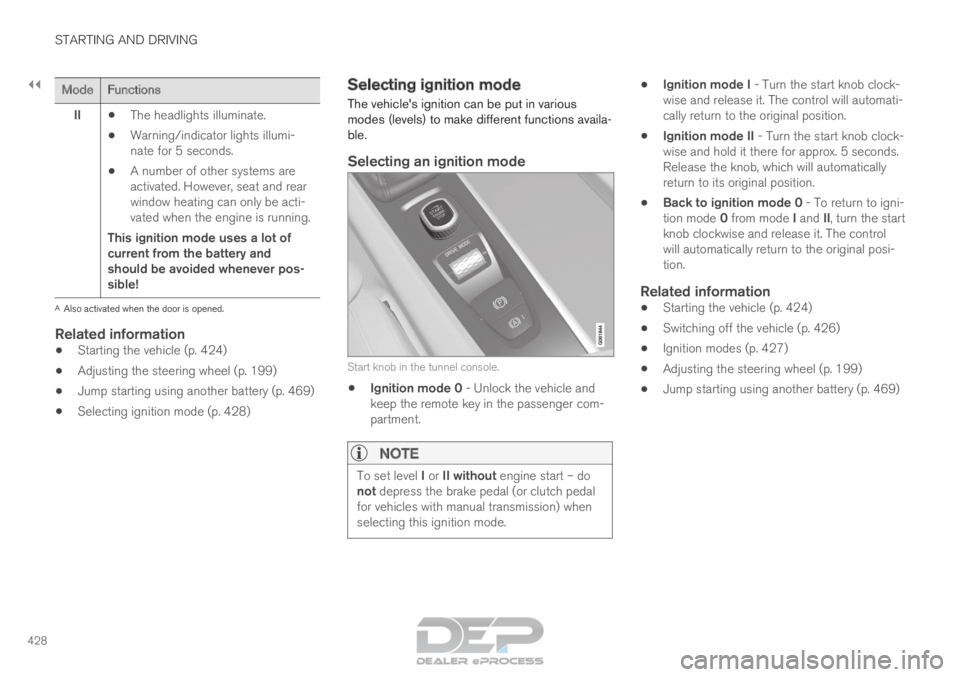
Selecting an ignition mode Start knob in the tunnel console.
•
Ignition mode 0 - Unlock the vehicle and
keep the remote key in the passenger com-
partment.
NOTE To set level I or II without engine start – do
not depress the brake pedal (or clutch pedal
for vehicles with manual transmission) when
selecting this ignition mode. •
Ignition mode I - Turn the start knob clock-
wise and release it. The control will automati-
cally return to the original position.
• Ignition mode II - Turn the start knob clock-
wise and hold it there for approx. 5 seconds.
Release the knob, which will automatically
return to its original position.
• Back to ignition mode 0 - To return to igni-
tion mode 0 from mode I and II, turn the start
knob clockwise and release it. The control
will automatically return to the original posi-
tion.
Related information
• Starting the vehicle (p. 424)
• Switching off the vehicle (p. 426)
• Ignition modes (p. 427)
• Adjusting the steering wheel (p. 199)
• Jump starting using another battery (p. 469)
Page 431 of 686

STARTING AND DRIVING
}}
429
Brake functions
The vehicle's brakes are used to reduce speed
or prevent the vehicle from rolling.
In addition to the wheel brakes and parking
brakes, the vehicle is also equipped with a num-
ber of automatic brake assist functions. These
systems help the driver by e.g. keeping the vehi-
cle stationary when the brake pedal is not
depressed (e.g. at a traffic light or intersection),
when starting up a hill or when driving down a hill.
Depending on how the vehicle is equipped, the
following brake assist functions may be included:
• Auto-hold brakes (Auto Hold)
• Hill Start Assist (Hill Start Assist)
• Braking assist after a collision
• City Safety
• Hill Descent Control (Hill Descent Control)
Related information
•Brakes (p. 429)
• Parking brake (p. 432)
• Auto-hold brakes (p. 436)
• Braking assist after a collision (p. 437)
• Hill Start Assist (p. 437)
• City Safety™ (p. 335)
• Hill Descent Control (p. 454) Brakes
The brake pedal is used to apply the vehicle's
regular brakes, which are part of the brake sys-
tem.
The vehicle is equipped with two brake circuits. If
one brake circuit is damaged, the brake pedal will
go down further when depressed. More pressure
will then be required from the driver for normal
braking effect.
WARNING
If the vehicle does not have electrical current
and both the electric motor and the gasoline
engine are switched off, the brakes cannot be
used to stop the vehicle.
In very hilly areas or when driving with a heavy
load, gear position B can be used to augment the
brakes with engine braking.
Use the Off Road drive mode to increase the
engine braking effect when driving on steep
downgrades at low speeds.
Anti-lock brakesThe vehicle is equipped with an Anti-lock Braking
System (ABS), which can help prevent the
wheels from locking and help maintain steering
control when braking. Vibrations may be felt from
the brake pedal when ABS is operating, which is
normal.
After the vehicle is started, a brief test of the
ABS system is automatically performed when the driver releases the brake pedal. An additional
automatic test of the system may be performed
when the vehicle is traveling at a low speed. Dur-
ing the test, the brake pedal may feel as though it
is pulsating.
Light braking charges the hybrid batteryWhen the brakes are applied lightly, the electric
motor braking function is used. This converts the
vehicle's kinetic energy into electrical energy,
which is used to charge the hybrid battery. When
the battery is being charged with the electric
motor braking function, this will be indicated in
the instrument panel.
When the battery is being charged with the electric
motor braking function, this will be indicated in the
instrument panel.
This function is active at speeds in the range of
150-5 km/h (93-3 mph). When braking at
speeds outside of this range, or during harder
braking, the hydraulic braking system is used to